Abstract
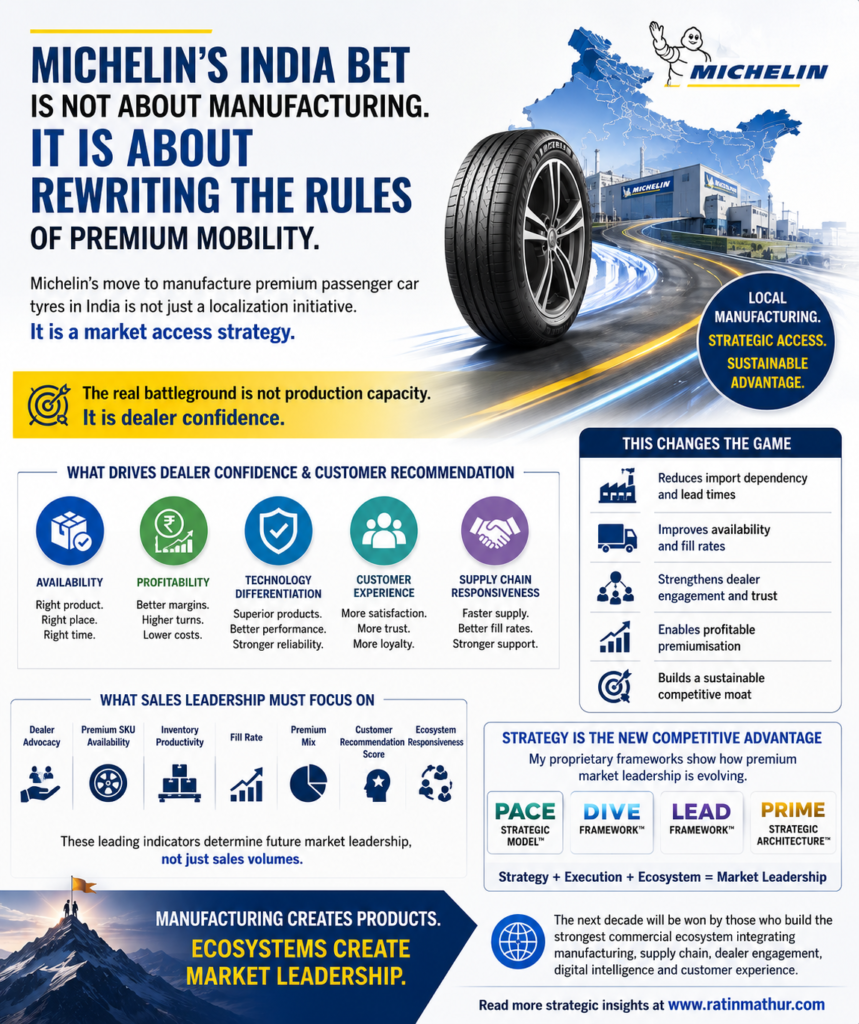
Michelin’s decision to commence passenger car tyre manufacturing in India marks one of the most strategically significant developments in the Indian tyre industry over the past decade. Unlike previous manufacturing announcements that were primarily driven by cost arbitrage, Michelin’s investment represents a deliberate shift toward market localization, supply chain resilience, premium market penetration, and long-term ecosystem development. The company’s public statements consistently emphasize that India is being positioned as a strategic manufacturing, research and development, sourcing, and export hub rather than merely a low-cost production base. This distinction has profound implications for the competitive landscape.
The launch of the India-manufactured Michelin Primacy 5 for the replacement market is expected to reshape competitive dynamics within the premium passenger tyre segment. While the immediate impact on overall industry volumes may remain moderate, the structural implications for dealer behaviour, premium brand competition, inventory management, distribution efficiency, and future OEM engagement are likely to unfold over the next five to seven years. The primary competitive pressure is expected to fall on multinational premium manufacturers such as Bridgestone, Goodyear, Yokohama, and Continental, while Indian manufacturers including MRF, Apollo Tyres, CEAT, and JK Tyre are expected to experience relatively limited direct impact during the initial phase because of Michelin’s current focus on larger wheel-size premium tyres.
This paper presents a strategic assessment of Michelin’s localization initiative from a Sales Leadership perspective. It examines the evolution of India’s passenger tyre market, analyzes changing customer behaviour, evaluates channel economics, introduces proprietary strategic frameworks for commercial decision-making, and develops analytical models that explain how localized manufacturing may influence market share, dealer profitability, and competitive positioning over the coming decade.
Introduction
The Indian automotive industry has entered a period of structural transformation. Rising disposable incomes, increasing highway connectivity, rapid urbanization, premium vehicle ownership, electrification, and a decisive shift toward sport utility vehicles have fundamentally altered the demand profile for passenger vehicle tyres. Tyres are no longer viewed solely as consumables that require replacement after a predefined mileage interval. Instead, they have become critical components influencing vehicle safety, driving comfort, energy efficiency, braking performance, and overall ownership experience.
Historically, multinational premium tyre manufacturers have encountered structural barriers while competing in India. Import duties, extended lead times, fragmented distribution networks, limited inventory availability, and unpredictable supply cycles constrained their ability to compete effectively with domestic manufacturers that benefited from localized production and extensive dealer networks. As a result, despite possessing globally recognized technologies, premium multinational brands often struggled to convert brand equity into sustained market penetration.
Michelin’s localization strategy fundamentally changes this equation. Rather than competing primarily through imported products, the company is transitioning toward localized manufacturing supported by domestic sourcing, engineering capabilities, and integrated supply chain management. Such a transformation should not be interpreted as a conventional capacity expansion. It represents a strategic repositioning that aligns Michelin with India’s evolving premium mobility ecosystem.
India’s Passenger Car Tyre Market Is Entering a New Strategic Phase
The Indian passenger tyre market has traditionally been characterized by volume-driven competition. Manufacturers focused on expanding manufacturing capacity, increasing geographical distribution, securing original equipment manufacturer contracts, and achieving economies of scale. Competitive differentiation largely revolved around pricing, durability, dealer penetration, and manufacturing efficiency.
Several macroeconomic and industry-specific developments have gradually shifted the competitive landscape. Premium passenger vehicle sales have increased consistently over the past decade. SUV penetration has expanded rapidly across multiple price segments. Consumers increasingly prioritize ride comfort, wet braking performance, cabin noise reduction, rolling resistance, and overall driving experience. The emergence of electric vehicles has introduced new engineering requirements related to vehicle weight, torque delivery, rolling resistance, and acoustic comfort.
These structural changes have created a premium replacement tyre market that differs significantly from the traditional mass-market replacement business. The purchasing decision is increasingly influenced by technology, product performance, digital information, and dealer recommendations rather than purely by price.
Table 1 summarizes the evolution of India’s passenger tyre market.
| Market Characteristic | Traditional Market | Emerging Premium Market |
| Primary Purchase Driver | Price | Safety and Performance |
| Vehicle Mix | Hatchbacks | SUVs and Premium Vehicles |
| Customer Decision | Cost-focused | Value-focused |
| Dealer Role | Transactional | Consultative |
| Product Selection | Limited | Technology-driven |
| Distribution | Inventory-centric | Demand-responsive |
| Competitive Advantage | Manufacturing Scale | Customer Experience |
This transformation establishes favourable conditions for manufacturers capable of combining advanced technology with localized execution.
Understanding Michelin’s Strategic Intent
Michelin’s public communications consistently emphasize that its investment in India is intended to improve market access rather than exploit labour-cost arbitrage. This distinction deserves careful consideration because it reveals the underlying strategic philosophy.
In mature industries, localization often follows one of three strategic pathways. The first is cost optimization, where manufacturing shifts primarily to reduce production costs. The second is market responsiveness, where manufacturing is localized to improve availability, shorten lead times, and enhance customer service. The third is ecosystem integration, where manufacturing becomes part of a broader strategy involving engineering, research and development, sourcing, exports, and long-term innovation.
Michelin’s announced strategy aligns far more closely with the second and third pathways than the first.
This positioning significantly reduces operational disadvantages that previously constrained Michelin’s competitiveness within India’s premium replacement market.
Table 2 compares the competitive environment before and after localization.
| Parameter | Import-Based Model | Local Manufacturing Model |
| Product Availability | Moderate | High |
| Lead Time | Long | Short |
| Supply Flexibility | Limited | High |
| Inventory Visibility | Moderate | High |
| Dealer Confidence | Moderate | High |
| Export Potential | Limited | High |
| Manufacturing Integration | Low | High |
The strategic importance of these changes extends beyond manufacturing. Improved operational responsiveness directly influences dealer satisfaction, inventory efficiency, premium customer experience, and long-term brand preference.
The Premium Replacement Market Represents the Real Competitive Battlefield
Contrary to conventional assumptions, the replacement market often generates greater profitability than OEM business because manufacturers enjoy stronger pricing flexibility, direct interaction with dealers, and greater influence over customer purchasing decisions. Dealer recommendations frequently determine final product selection, particularly within premium vehicle categories where consumers seek expert guidance regarding safety, comfort, and performance.
The premium replacement market differs fundamentally from mass replacement because inventory complexity increases exponentially as wheel diameters expand. Larger wheel sizes require significantly broader stock-keeping unit coverage, making supply chain efficiency substantially more important than manufacturing capacity alone.
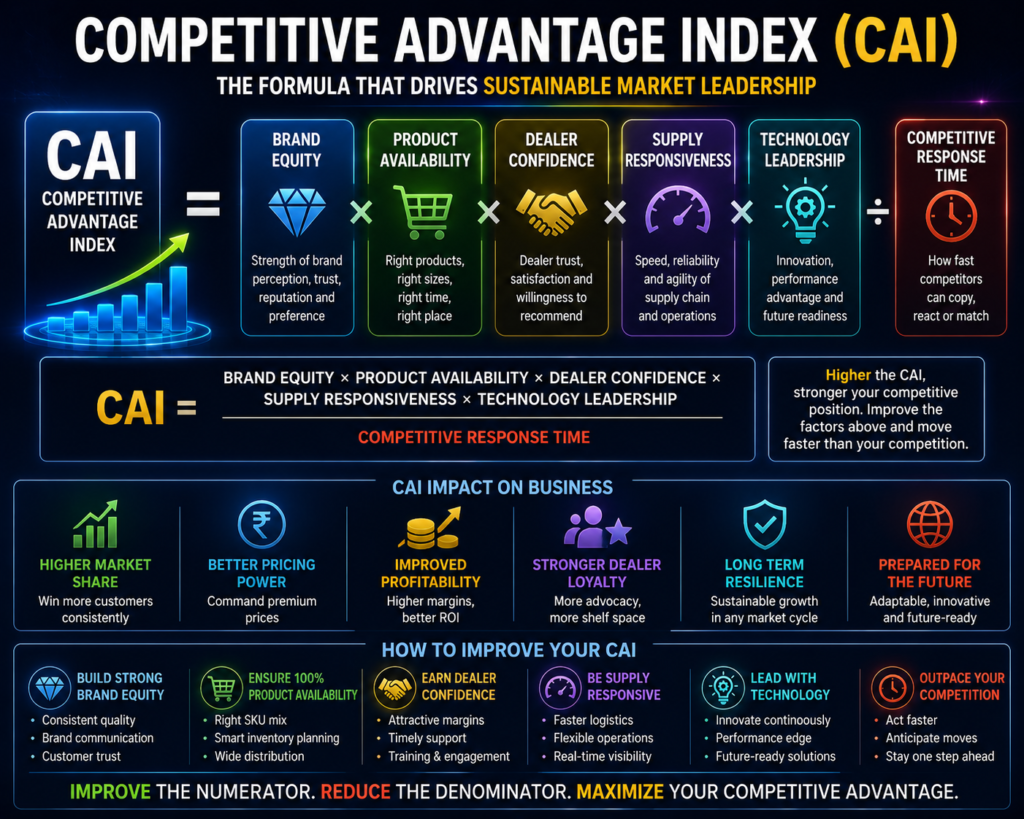
The resulting competitive advantage may therefore be represented conceptually through the following relationship:
Competitive Advantage Index (CAI)
CAI = (Brand Equity × Product Availability × Dealer Confidence × Supply Responsiveness × Technology Leadership) ÷ Competitive Response Time
The equation illustrates that manufacturing localization strengthens several variables simultaneously. Even without reducing retail prices, improvements in product availability, dealer confidence, and supply responsiveness increase the overall competitive advantage available to premium manufacturers.
This model explains why localization may generate market share gains without initiating industry-wide pricing disruption.
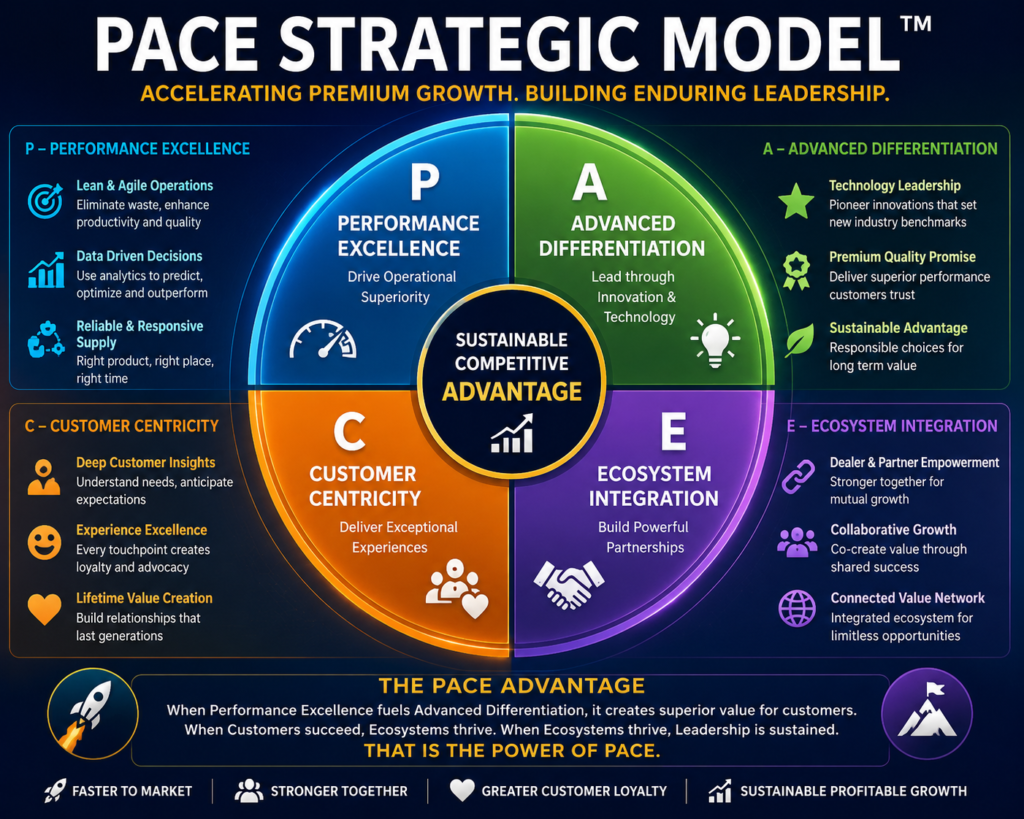
A Proprietary Framework for Sales Leadership: The PACE Strategic Model™
Traditional sales management frameworks often concentrate primarily on revenue targets, geographical coverage, and dealer expansion. Premium markets require a fundamentally different approach.
The proposed PACE Strategic Model™ provides a comprehensive commercial framework specifically designed for premium replacement tyre markets.
| Dimension | Strategic Objective | Leadership KPI |
| P – Premium Positioning | Strengthen perceived technological superiority | Premium SKU contribution |
| A – Availability Excellence | Maximize product accessibility | Fill rate and lead time |
| C – Channel Confidence | Build dealer advocacy | Dealer recommendation index |
| E – Experience Leadership | Enhance end-customer satisfaction | Repeat purchase and warranty satisfaction |
The interaction among these four dimensions creates a reinforcing commercial cycle. Premium positioning stimulates customer demand. Reliable availability strengthens dealer confidence. Increased dealer advocacy improves recommendation rates. Superior customer experience reinforces premium brand equity, completing a self-sustaining competitive loop.
Unlike conventional sales frameworks that emphasize volume alone, the PACE Strategic Model™ integrates operational excellence with commercial execution, making it particularly suitable for premium product categories where customer expectations extend beyond price considerations.
The Evolution of Dealer Economics: Why Local Manufacturing Changes Competitive Dynamics
The Indian tyre industry has historically been analysed through the lenses of manufacturing capacity, production costs, and market share. However, such approaches fail to explain why technologically superior multinational brands have often underperformed relative to their capabilities. The missing variable has always been dealer economics. Dealers constitute the most influential decision-makers within India’s passenger replacement tyre ecosystem because they act simultaneously as inventory managers, technical advisors, product educators, and trusted consultants for consumers. Any strategic initiative that fundamentally changes dealer economics inevitably alters competitive dynamics across the industry.
Michelin’s localization initiative therefore deserves attention not merely because tyres are now manufactured domestically, but because local manufacturing fundamentally transforms the economic relationship between the manufacturer, distributor, dealer, and end customer. Throughout the past decade, Michelin’s technological leadership remained largely undisputed among premium consumers. Nevertheless, many dealers preferred recommending competing brands primarily because operational uncertainty imposed significant commercial risks. Long replenishment cycles, inconsistent availability of premium stock keeping units, higher inventory carrying costs, and uncertain delivery schedules collectively reduced dealer confidence.
From a commercial perspective, dealer confidence is often more valuable than marginal improvements in manufacturing efficiency. Dealers rarely recommend products that expose them to delivery uncertainty or dissatisfied customers. Consequently, localized manufacturing becomes a strategic enabler that strengthens recommendation behaviour without necessarily changing product characteristics.
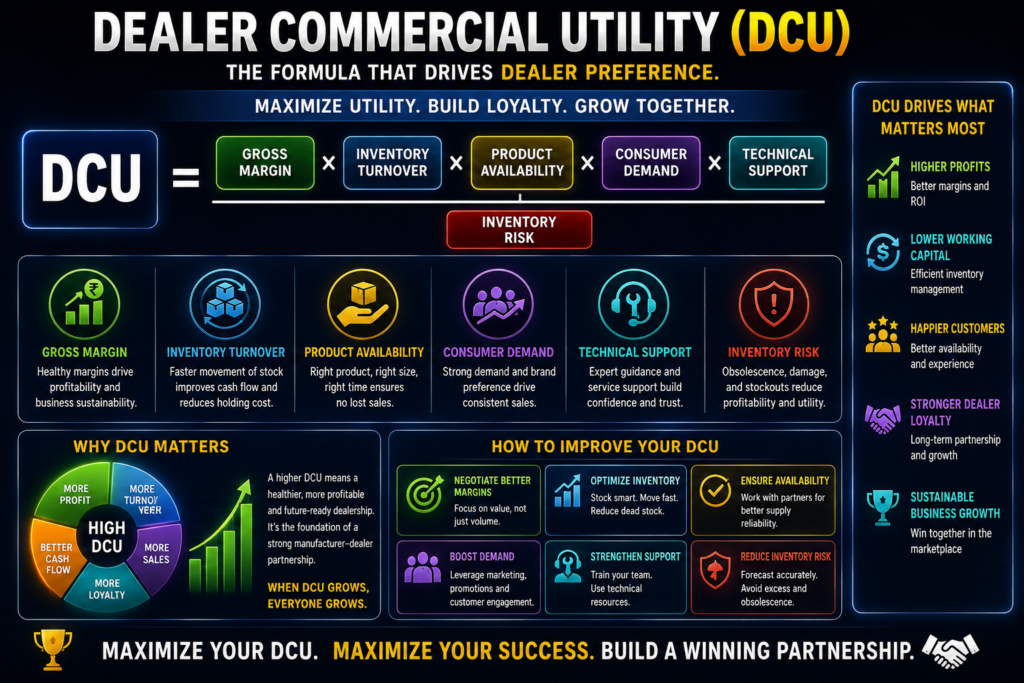
The economics of dealer decision-making can be represented through a simplified commercial utility function.
Dealer Commercial Utility (DCU)
DCU = (Gross Margin × Inventory Turnover × Product Availability × Consumer Demand × Technical Support) ÷ Inventory Risk
This formulation illustrates that dealer preference depends on a portfolio of operational variables rather than on gross margins alone. Manufacturers frequently attempt to increase dealer loyalty through incentive programmes, promotional campaigns, or extended credit periods. While these initiatives may temporarily improve sales, they seldom resolve structural operational constraints. Improvements in availability, replenishment speed, and inventory efficiency influence every transaction and therefore generate sustainable commercial advantages.
Table 3 illustrates the changing economics of premium tyre retailing.
| Commercial Variable | Import-Based Business Model | Local Manufacturing Model | Strategic Impact |
| Lead Time | High | Low | Significant |
| Inventory Requirement | High | Moderate | Significant |
| Working Capital | High | Lower | High |
| Fill Rate | Moderate | High | Very High |
| Dealer Confidence | Moderate | High | Very High |
| Customer Satisfaction | Moderate | High | High |
| Lost Sales Probability | High | Lower | Significant |
The cumulative improvement across these variables demonstrates why localization influences market competitiveness without necessarily altering retail pricing.
Premiumisation Is Reshaping the Entire Competitive Landscape
The Indian passenger vehicle market is experiencing one of the most significant structural transitions since liberalization. Earlier competitive advantages were derived primarily from manufacturing scale, pricing efficiency, and nationwide distribution networks. Today, premiumisation is replacing commoditization as the dominant market force.
Premiumisation extends beyond luxury vehicles. Consumers purchasing mid-sized sport utility vehicles increasingly demand technologies previously associated with executive sedans and luxury automobiles. Product evaluation now includes wet braking performance, ride comfort, tyre noise, durability, rolling resistance, fuel economy, and compatibility with electric vehicles.
Consequently, tyre manufacturers are competing within an entirely different value proposition.
Table 4 summarizes this transformation.
| Traditional Replacement Market | Emerging Premium Replacement Market |
| Price-sensitive customer | Value-sensitive customer |
| Functional replacement | Performance upgrade |
| Dealer recommendation based on availability | Dealer recommendation based on technology and experience |
| Limited product differentiation | Technology-intensive differentiation |
| Volume orientation | Margin orientation |
These behavioural changes disproportionately favour manufacturers possessing globally recognized research and development capabilities.
Michelin’s global investment in material science, tread compound engineering, rolling resistance optimization, wet braking technology, and sustainable mobility directly aligns with these evolving customer expectations. The company therefore enters the localized manufacturing phase during a period when consumer demand is increasingly aligned with its technological strengths.
The Strategic Shift from Supply Chains to Demand Networks
One of the most overlooked developments in the tyre industry is the transition from supply chain management toward demand network orchestration.
Traditional tyre distribution systems were designed primarily around production planning. Manufacturers produced tyres according to forecasted demand, shipped inventory through multiple distribution layers, and replenished dealer stock periodically. Such systems prioritized manufacturing efficiency over market responsiveness.
Digital technologies, advanced forecasting, integrated enterprise planning, and localized manufacturing now enable demand-driven replenishment models.
The future premium tyre ecosystem will increasingly resemble a synchronized demand network.
Table 5 presents the conceptual evolution.
| Traditional Supply Chain | Intelligent Demand Network |
| Production Driven | Customer Driven |
| Forecast Push | Demand Pull |
| Inventory Optimization | Customer Fulfilment |
| Periodic Replenishment | Continuous Replenishment |
| Regional Warehousing | Integrated Visibility |
| Manual Dealer Planning | Predictive Planning |
Within such networks, localized manufacturing becomes considerably more valuable than simple production capacity because responsiveness itself becomes a competitive asset.
Why Dealer Influence Will Increase Rather Than Decline
Several industries have experienced digital disruption that reduced the influence of intermediaries. The tyre industry presents a different scenario. Despite increasing online research, consumers continue to depend heavily on dealer expertise because tyre selection involves multiple technical variables, including vehicle specifications, rim dimensions, load ratings, speed ratings, alignment considerations, suspension conditions, and driving patterns.
Consequently, digital platforms complement dealer expertise rather than replace it.
This evolving relationship creates a hybrid decision-making process where customers enter dealerships with greater information but still rely upon professional recommendations before completing purchases.
Manufacturers capable of supporting dealers with technical education, digital product information, fitment guidance, and after-sales assistance are therefore likely to achieve stronger recommendation rates than competitors focusing solely on pricing or advertising.
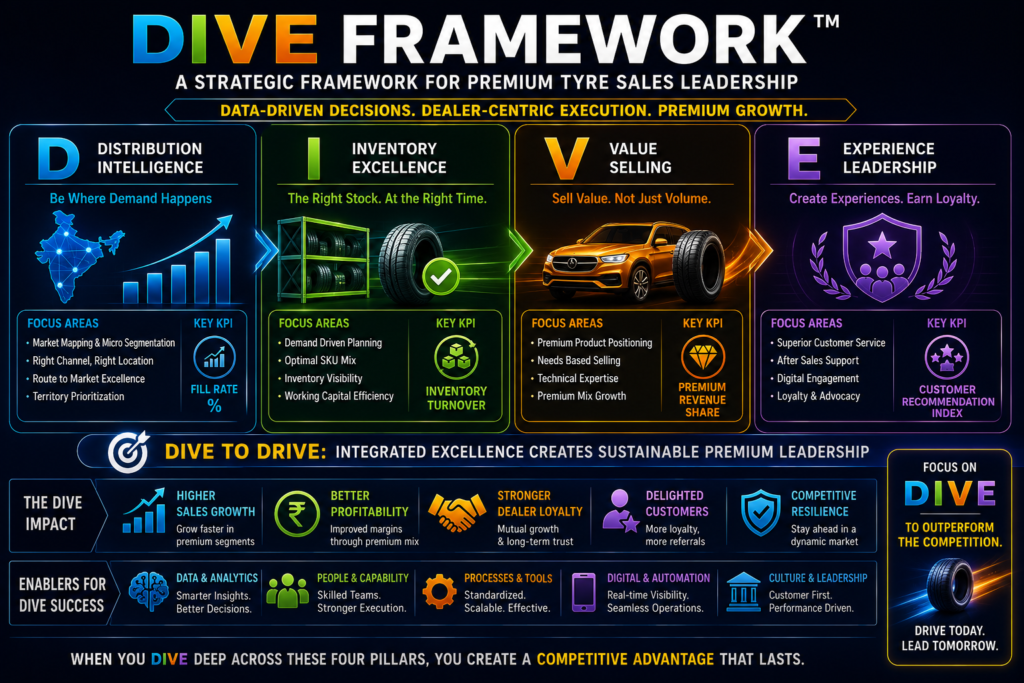
The Proprietary DIVE Framework™ for Sales Leadership
Traditional sales organizations frequently monitor revenue, market share, and dealer expansion independently. Such approaches often fail to identify early competitive threats.
To address this limitation, this paper introduces the DIVE Framework™, designed specifically for premium automotive aftermarket businesses.
DIVE represents four interdependent commercial pillars.
| Framework Dimension | Strategic Objective | Executive KPI |
| D – Distribution Intelligence | Improve market responsiveness | Fill Rate (%) |
| I – Inventory Excellence | Optimize working capital | Inventory Turnover |
| V – Value Selling | Increase premium mix | Premium Revenue Share |
| E – Experience Differentiation | Build long-term loyalty | Customer Recommendation Index |
The framework recognizes that future competitive advantage will emerge from the interaction among operational excellence, commercial execution, and customer experience rather than from manufacturing scale alone.
Unlike conventional performance scorecards that prioritize sales volume, the DIVE Framework™ encourages Sales Leadership to monitor operational indicators capable of predicting future market share changes several quarters before they become visible in financial statements.
Mathematical Model for Premium Market Share Migration
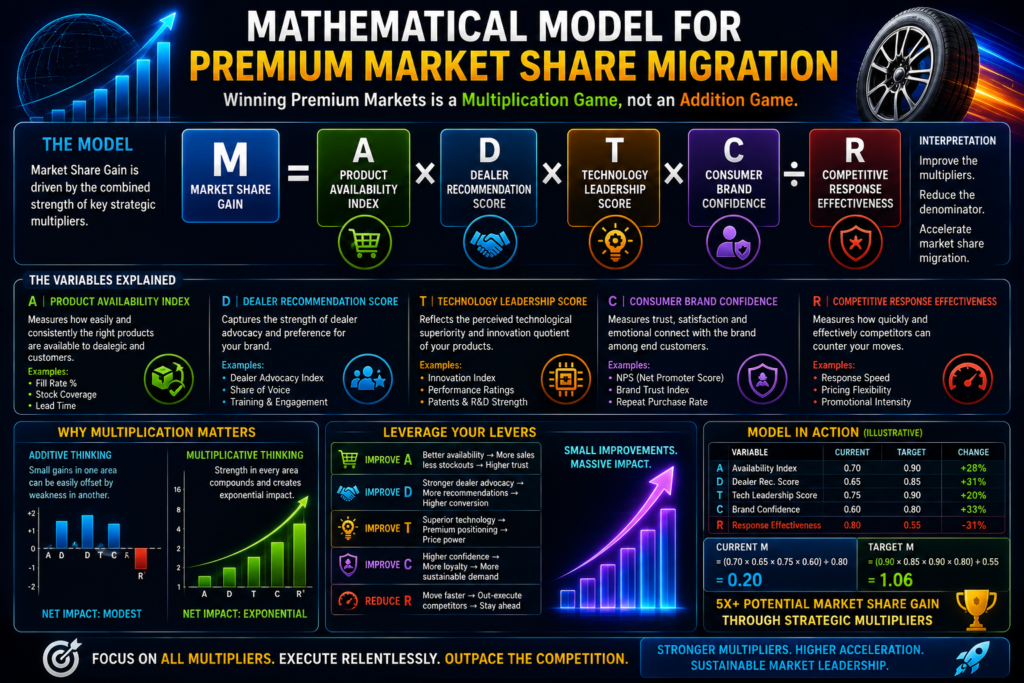
The competitive movement of premium market share may be approximated through a strategic influence equation.
Let:
M = Market Share Gain
A = Product Availability Index
D = Dealer Recommendation Score
T = Technology Leadership Score
C = Consumer Brand Confidence
R = Competitive Response Effectiveness
Then,
M ∝ (A × D × T × C) / R
The model illustrates an important strategic principle. Market share gains accelerate when improvements occur simultaneously across availability, dealer advocacy, technological differentiation, and consumer confidence. Conversely, rapid competitive responses from incumbent manufacturers reduce the magnitude of market share migration.
This relationship explains why Michelin’s localization alone will not guarantee leadership. Success ultimately depends upon execution across the broader commercial ecosystem.
Strategic Implications for Sales Leadership
Sales organizations operating within premium tyre markets should reconsider traditional performance metrics. Quarterly sales volume alone provides insufficient visibility into emerging competitive threats. Instead, executive dashboards should incorporate dealer recommendation indices, inventory availability, premium stock keeping unit penetration, customer satisfaction, fill rates, digital engagement, warranty performance, and premium replacement conversion ratios.
Manufacturers that successfully integrate manufacturing, supply chain management, commercial execution, and customer experience will progressively strengthen their competitive position. Those continuing to optimize these functions independently may experience declining dealer influence despite maintaining manufacturing scale.
Michelin’s localization therefore represents more than an operational investment. It introduces a new competitive benchmark for the Indian premium replacement tyre industry. Competitors are unlikely to respond through pricing alone because the primary competitive advantage increasingly resides within operational responsiveness, dealer confidence, and integrated customer experience.
The implications extend beyond Michelin itself. The initiative signals that India’s premium passenger tyre market has entered a new phase in which manufacturing localization, technological leadership, and commercial execution are converging into a unified strategic capability. Sales Leadership teams across the industry must therefore prepare not for incremental competitive adjustments but for a structural redefinition of how premium market leadership will be established and sustained over the coming decade.
Competitive Strategy in the Age of Premium Mobility
The globalization of the tyre industry has entered a new phase in which competitive advantage is no longer determined primarily by manufacturing capacity or cost leadership. Instead, firms increasingly compete through integrated ecosystems that combine product innovation, localized manufacturing, supply chain responsiveness, channel excellence, digital capabilities, and customer experience. Michelin’s decision to manufacture passenger car tyres in India represents one of the clearest manifestations of this strategic evolution. Rather than positioning India as a low-cost production destination, Michelin has articulated a vision that integrates manufacturing, research and development, sourcing, engineering, exports, and premium market development. Such a strategy reflects a long-term commitment to ecosystem leadership rather than incremental market participation.
The implications of this transition extend beyond Michelin itself. Every multinational and domestic tyre manufacturer operating in India must reassess its competitive assumptions. Historically, companies measured success through production capacity, dealer expansion, and OEM nominations. These variables remain important, but they are no longer sufficient. The next decade will reward organizations capable of integrating technology, operations, commercial execution, and customer engagement into a unified competitive model.
Why the Greatest Competitive Pressure Will Be Felt by Global Premium Manufacturers
Contrary to popular opinion, Michelin’s localization is unlikely to trigger immediate disruption across the broader Indian tyre industry. Instead, its primary impact will be concentrated within the premium passenger replacement market, where customer expectations, product positioning, and dealer behaviour differ fundamentally from the mass market.
The reason is straightforward. Michelin has chosen to localize production of premium passenger tyres in the 16-inch to 22-inch segment. This product portfolio overlaps directly with the strategic positioning of Bridgestone, Goodyear, Yokohama, Continental, and Pirelli far more than with the core portfolios of MRF, CEAT, JK Tyre, or Apollo’s high-volume passenger business.
Competition therefore becomes one of substitution within the premium segment rather than displacement across the broader market.
Table 6 illustrates the expected competitive exposure.
| Company | Premium Portfolio Overlap | Replacement Exposure | Short-Term Competitive Risk | Long-Term Strategic Risk |
| Bridgestone | Very High | Very High | Very High | Very High |
| Yokohama | Very High | High | Very High | High |
| Goodyear | High | Medium | High | High |
| Continental | High | Medium | High | Medium |
| Pirelli | Moderate | Low | Moderate | Moderate |
| Apollo Tyres | Moderate | High | Moderate | Medium |
| MRF | Limited | High | Low | Moderate |
| CEAT | Limited | High | Low | Low |
| JK Tyre | Limited | High | Low | Low |
The table demonstrates that Michelin’s initial competitive battlefield remains relatively narrow. However, should the company expand production into smaller rim sizes over the coming years, competitive pressure would extend progressively toward domestic manufacturers.
Bridgestone Faces the Most Complex Strategic Challenge
Among all competitors, Bridgestone occupies the position most directly comparable to Michelin. Both companies possess globally recognized technology, extensive premium portfolios, strong OEM credentials, and established premium customer perception.
Historically, Bridgestone enjoyed an operational advantage because of local manufacturing, broader inventory availability, and stronger dealer confidence. Michelin’s localization substantially reduces these competitive differences.
This development does not imply that Bridgestone will lose market leadership. Rather, it suggests that future competition will increasingly revolve around execution quality instead of structural operational advantages.
Sales Leadership within Bridgestone is therefore likely to emphasize strengthening dealer loyalty programmes, expanding premium retail initiatives, increasing technical education, accelerating product innovation, and enhancing customer engagement. The company possesses considerable resources and extensive manufacturing capability, making rapid strategic adaptation entirely feasible.
Goodyear’s Strategic Position Requires Repositioning Rather Than Defensive Action
Goodyear occupies a distinctive position within the Indian passenger tyre industry. The company benefits from strong global technology, longstanding OEM relationships, and significant brand recognition. However, its premium replacement market positioning has historically been less differentiated than that of Michelin or Bridgestone.
Michelin’s localization therefore creates competitive pressure not because Goodyear lacks technological capability but because the competitive narrative within premium replacement tyres is shifting toward customer experience, dealer recommendation, and localized responsiveness.
For Goodyear, future competitiveness may increasingly depend upon strengthening premium touring products, expanding dealer technical engagement, improving premium product visibility, and leveraging global innovation more aggressively within India’s evolving premium mobility ecosystem.
Indian Manufacturers Continue to Possess Structural Advantages
Public discussion surrounding Michelin’s investment has occasionally suggested that Indian tyre manufacturers may experience substantial market share erosion. Such conclusions appear premature.
Companies such as MRF, Apollo Tyres, CEAT, and JK Tyre possess structural strengths that remain difficult to replicate.
These include extensive manufacturing capacity, nationwide distribution networks, deep dealer relationships, comprehensive product portfolios, high brand familiarity, localized procurement systems, and decades of accumulated market knowledge.
Moreover, a substantial proportion of India’s passenger vehicle population continues to operate within value-oriented segments where purchasing decisions remain heavily influenced by affordability and availability.
Consequently, Michelin’s current strategy does not directly challenge the commercial foundation of domestic manufacturers.
Instead, competitive pressure will initially emerge within premium urban markets where customers increasingly prioritize technology, comfort, and performance.
Distribution Networks Are Becoming Strategic Assets Rather Than Operational Functions
One of the most important lessons emerging from Michelin’s localization initiative is that distribution networks should no longer be viewed merely as logistical systems.
Modern premium distribution networks perform multiple strategic functions simultaneously.
They generate customer intelligence, facilitate technical education, improve inventory visibility, strengthen dealer relationships, enhance brand experience, and create commercial agility.
Organizations capable of integrating digital forecasting, predictive replenishment, technical support, and customer engagement into unified distribution ecosystems will possess significant competitive advantages over those relying primarily upon traditional logistics management.
This evolution transforms distribution from an operational necessity into a strategic differentiator.
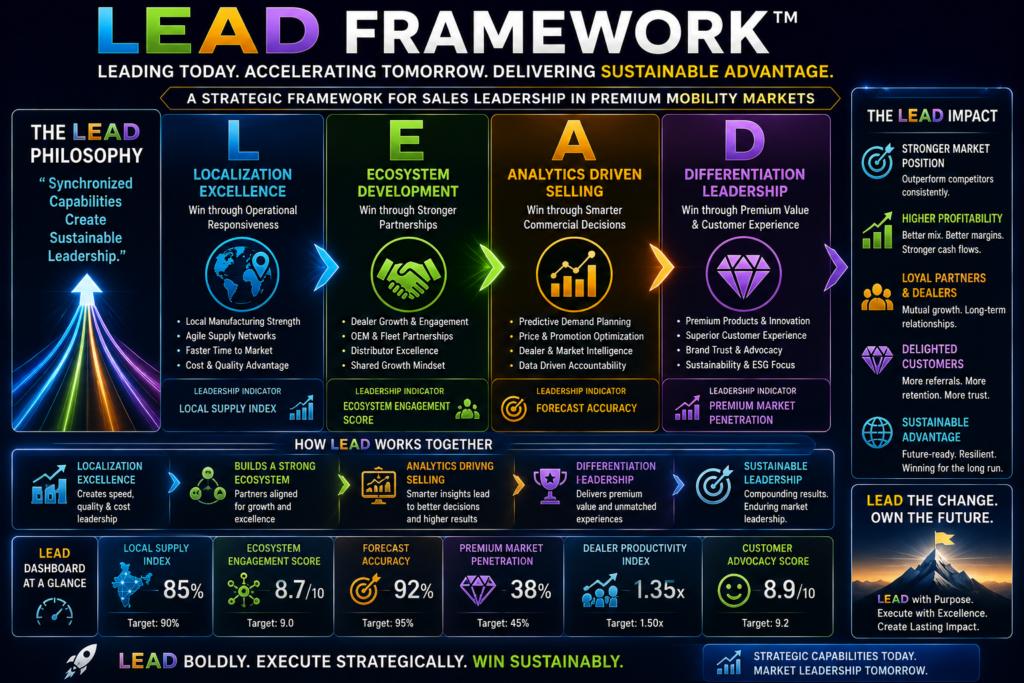
The Proprietary LEAD Framework™ for Sales Leadership
To support executive decision-making in this changing environment, this paper proposes the LEAD Framework™, a proprietary strategic architecture designed specifically for Sales Leadership operating within premium mobility industries.
LEAD represents four mutually reinforcing strategic dimensions.
| Strategic Dimension | Leadership Objective | Executive Measurement |
| L – Localization Excellence | Increase operational responsiveness | Local Supply Index |
| E – Ecosystem Development | Strengthen dealer, distributor and OEM integration | Ecosystem Engagement Score |
| A – Analytics Driven Selling | Improve predictive commercial decisions | Forecast Accuracy |
| D – Differentiation Leadership | Sustain premium competitive advantage | Premium Market Penetration |
Unlike conventional commercial frameworks, LEAD emphasizes organizational capability rather than isolated sales performance. Each dimension contributes to sustainable competitive advantage by integrating manufacturing, commercial operations, analytics, and customer experience into a coherent business system.
The Premium Competitive Momentum Model™
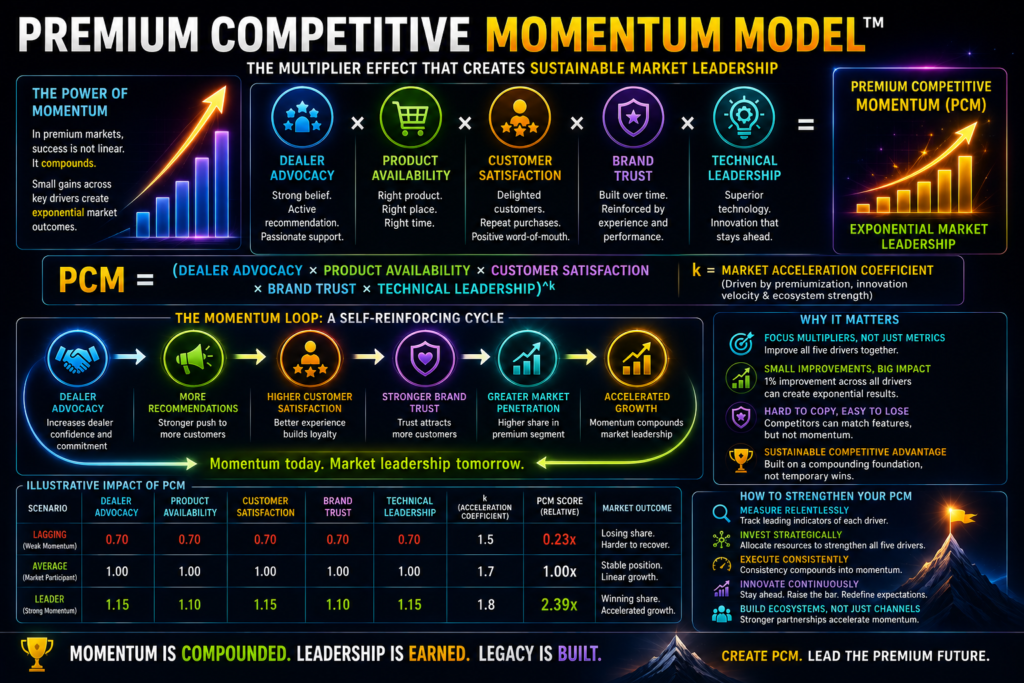
Traditional market share analysis often treats competitive change as linear. In reality, premium markets exhibit cumulative momentum. Once dealer confidence increases, recommendation rates improve. Higher recommendation rates strengthen customer satisfaction. Improved customer satisfaction reinforces brand reputation, leading to further dealer confidence.
This reinforcing mechanism may be represented conceptually as follows.
Premium Competitive Momentum (PCM)
PCM = (Dealer Advocacy × Product Availability × Customer Satisfaction × Brand Trust × Technical Leadership)ᵏ
where k represents the market acceleration coefficient generated by premiumisation.
The exponential representation illustrates that competitive momentum is rarely proportional. Small improvements across multiple strategic variables frequently produce disproportionately larger commercial outcomes.
Conversely, isolated improvements within a single variable often fail to produce sustainable market share gains.
Strategic Scenarios for the Indian Premium Tyre Market
The future evolution of India’s premium tyre industry will depend upon several interrelated variables including SUV penetration, electric vehicle adoption, premium consumer spending, highway infrastructure development, dealer modernization, localization policies, and competitive investment.
Three broad strategic scenarios emerge.
Table 7 summarizes these possibilities.
| Scenario | Market Characteristics | Competitive Outcome |
| Conservative Evolution | Moderate SUV growth, stable premium demand | Incremental gains for Michelin with limited disruption |
| Accelerated Premiumisation | Strong SUV and premium vehicle growth, expanding premium replacement market | Intensified competition among multinational premium manufacturers |
| Ecosystem Transformation | Rapid electrification, organized retail expansion, digital integration, localization acceleration | Structural redistribution of premium market leadership |
Among these alternatives, the second scenario currently appears most consistent with publicly available automotive industry trends. However, the probability of ecosystem transformation will increase as electric vehicles achieve broader market penetration and organized premium retail expands across metropolitan regions.
Strategic Lessons for Sales Leadership
Perhaps the most important conclusion emerging from Michelin’s localization strategy is that the traditional distinction between manufacturing strategy, commercial strategy, and customer strategy is gradually disappearing.
Future market leaders will not necessarily be those possessing the largest factories or the broadest dealer networks. Instead, competitive advantage will increasingly depend upon an organization’s ability to synchronize manufacturing responsiveness, inventory optimization, dealer confidence, technological differentiation, digital intelligence, and customer experience into an integrated commercial ecosystem.
Sales Leadership therefore requires a broader strategic mandate than ever before. Commercial excellence must evolve from territory management and revenue generation toward ecosystem orchestration.
Organizations that continue measuring success solely through quarterly sales performance may overlook structural competitive shifts already underway within dealer behaviour, premium customer expectations, and channel economics.
Michelin’s investment should therefore be interpreted as more than a manufacturing announcement. It represents an early indicator of the strategic architecture that is likely to define India’s premium passenger tyre industry throughout the next decade.
The companies that recognize this transition early and reorganize their commercial capabilities accordingly will be better positioned to capture the disproportionate value created by premiumisation, localization, electrification, and customer-centric mobility.
From Product Competition to Ecosystem Competition: The Future of India’s Premium Tyre Industry
The history of industrial competition demonstrates that industries rarely transform because of a single product launch. Instead, transformation occurs when one strategic decision fundamentally changes the competitive rules governing an entire ecosystem. Michelin’s decision to manufacture passenger car tyres in India represents such an inflection point. Although the immediate commercial impact will primarily affect premium passenger replacement tyres, the broader implications extend to manufacturing strategy, dealer economics, supply chain resilience, OEM relationships, digital commerce, and long-term competitive positioning.
The strategic significance of this development lies not in the production of tyres within India, but in the emergence of a new competitive paradigm where manufacturing localization, technology leadership, commercial responsiveness, and customer experience become inseparable components of corporate strategy.
The Indian tyre industry is therefore entering an era in which competitive advantage will increasingly be measured through ecosystem effectiveness rather than production capacity.
The Convergence of OEM and Replacement Markets
For several decades, tyre manufacturers managed Original Equipment Manufacturer (OEM) business and replacement business as two distinct commercial verticals. OEM operations emphasized production planning, engineering collaboration, quality validation, and procurement negotiations. Replacement operations focused on dealer expansion, distribution management, retail marketing, and customer service.
This organizational separation was appropriate when both markets evolved independently.
The premium mobility ecosystem has fundamentally altered this relationship.
Consumers purchasing replacement tyres increasingly evaluate products based upon their original vehicle fitment, while vehicle manufacturers monitor customer satisfaction, warranty performance, and aftermarket brand perception. Dealer recommendations influence replacement behaviour, which in turn strengthens brand visibility and reinforces future OEM competitiveness.
These interdependencies create a self-reinforcing strategic cycle.
Table 8 illustrates this convergence.
| OEM Value Driver | Replacement Value Driver | Integrated Strategic Outcome |
| Product Validation | Consumer Trust | Brand Credibility |
| Engineering Collaboration | Technical Selling | Technology Leadership |
| Manufacturing Scale | Dealer Availability | Market Responsiveness |
| Quality Assurance | Customer Experience | Premium Positioning |
| Vehicle Fitment | Replacement Preference | Sustainable Market Share |
Organizations capable of integrating these activities into unified commercial strategies are likely to outperform competitors managing them independently.
Electric Vehicles Will Redefine Premium Tyre Competition
Electrification represents perhaps the most underestimated driver of future tyre market transformation.
Electric vehicles impose engineering requirements substantially different from those associated with internal combustion engine vehicles. Increased battery weight, instantaneous torque delivery, regenerative braking, reduced cabin noise, and energy efficiency requirements collectively create demand for entirely new tyre technologies.
Premium tyre manufacturers possessing extensive global research capabilities are therefore expected to enjoy competitive advantages as electric vehicle adoption accelerates.
Future premium tyre performance will increasingly be evaluated through parameters such as rolling resistance, acoustic optimization, thermal stability, tread durability under high torque conditions, and intelligent material engineering.
Consequently, tyre manufacturers must expand their strategic focus beyond conventional performance characteristics.
Table 9 presents the changing engineering priorities.
| Internal Combustion Vehicle Priorities | Electric Vehicle Priorities |
| Mileage | Energy Efficiency |
| Dry Grip | Rolling Resistance |
| Durability | Battery Range Optimization |
| Ride Comfort | Acoustic Performance |
| Handling | High Torque Stability |
| Fuel Economy | Thermal Efficiency |
This transition reinforces Michelin’s long-standing investments in sustainable mobility technologies while simultaneously encouraging competitors to accelerate product innovation.
Digital Intelligence Is Becoming the New Competitive Currency
Digital transformation within the tyre industry extends beyond e-commerce.
Artificial intelligence, predictive analytics, connected supply chains, demand sensing, inventory optimization, customer relationship management, and dealer intelligence are collectively reshaping commercial decision-making.
Future Sales Leadership organizations will increasingly compete through superior information rather than superior intuition.
Dealer expansion decisions, inventory allocation, promotional investments, pricing optimization, and premium stock keeping unit distribution can now be guided through predictive analytical models rather than historical sales patterns.
This evolution transforms commercial organizations into intelligence-driven enterprises.
Manufacturers that integrate manufacturing systems, enterprise resource planning, dealer management systems, customer analytics, and predictive forecasting into unified decision platforms are expected to improve both operational efficiency and commercial responsiveness.
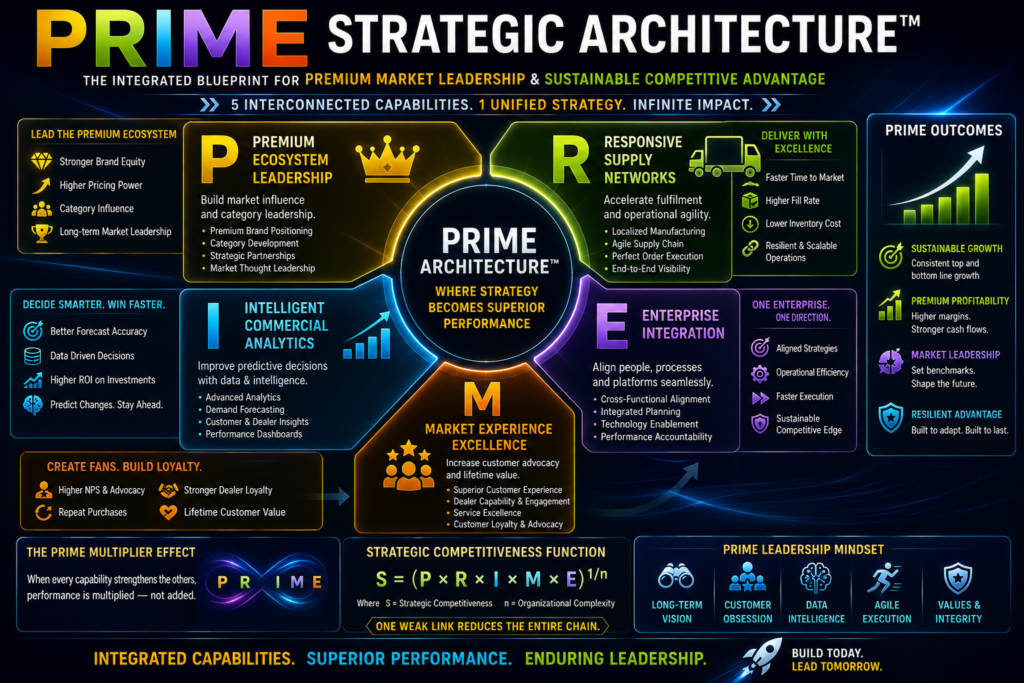
The Proprietary PRIME Strategic Architecture™
To assist executive leadership in navigating this increasingly complex environment, this paper introduces the PRIME Strategic Architecture™, a proprietary management framework specifically designed for premium automotive aftermarket industries.
PRIME represents five integrated strategic capabilities.
| Strategic Capability | Executive Objective | Leadership Indicator |
| P – Premium Ecosystem Leadership | Build market influence | Premium Revenue Index |
| R – Responsive Supply Networks | Accelerate fulfilment | Perfect Order Rate |
| I – Intelligent Commercial Analytics | Improve predictive decisions | Forecast Precision |
| M – Market Experience Excellence | Increase customer advocacy | Net Promoter Performance |
| E – Enterprise Integration | Align manufacturing, sales and service | Cross-Functional Effectiveness Score |
Unlike traditional strategic planning models that evaluate manufacturing, marketing, and sales independently, PRIME emphasizes enterprise-wide synchronization.
Its central premise is that sustainable premium leadership emerges when organizational capabilities reinforce one another continuously.
A Mathematical Representation of Strategic Competitiveness
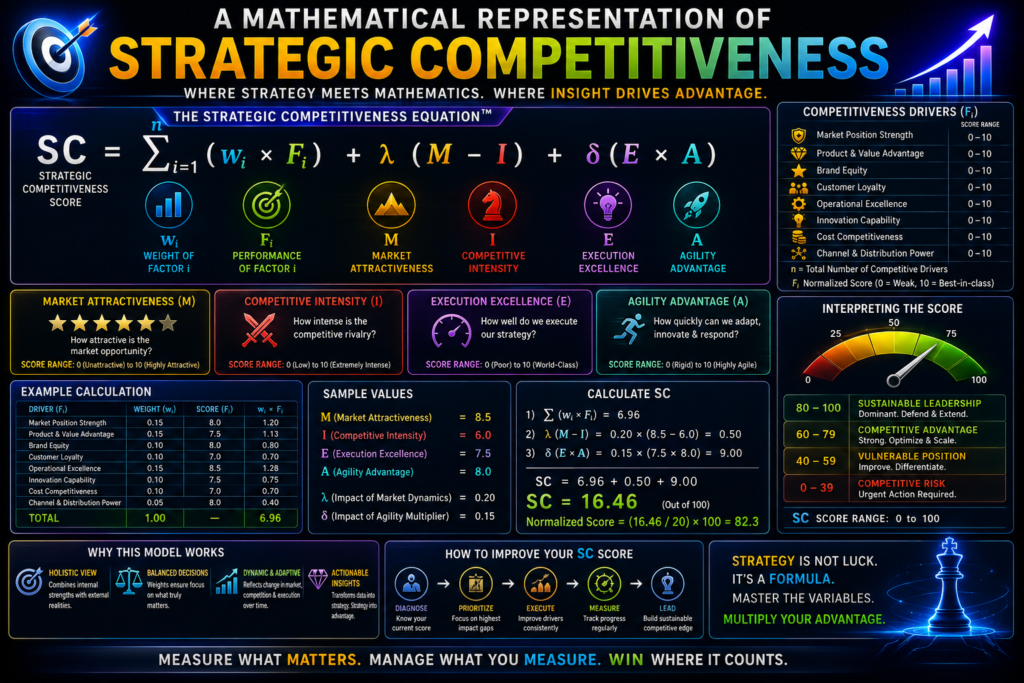
Competitive advantage within premium mobility markets increasingly depends upon the interaction of multiple organizational capabilities rather than isolated operational excellence.
This relationship may be expressed through the Strategic Competitiveness Function.
Let
S = Strategic Competitiveness
L = Localization Capability
D = Dealer Advocacy
T = Technology Leadership
I = Innovation Velocity
C = Customer Experience
A = Analytics Maturity
E = Ecosystem Integration
Then
S = (L × D × T × I × C × A × E)^(1/n)
where n represents organizational complexity.
Unlike additive performance models, this multiplicative formulation demonstrates that weakness within any major strategic capability disproportionately reduces overall competitiveness.
Consequently, future market leadership requires balanced organizational development rather than isolated excellence.
Building the Sales Leadership Dashboard of the Future
Traditional commercial dashboards frequently emphasize lagging indicators including sales volume, market share, monthly billing, and dealer additions.
While useful, these metrics reveal competitive outcomes after they have already occurred.
Modern Sales Leadership requires leading indicators capable of predicting competitive shifts before they become visible within financial statements.
Table 10 proposes a future-ready executive dashboard.
| Strategic Dimension | Traditional KPI | Predictive KPI |
| Sales Performance | Revenue | Premium Revenue Mix |
| Distribution | Dealer Count | Active Dealer Productivity |
| Inventory | Closing Stock | Fill Rate |
| Market | Market Share | Premium Category Penetration |
| Customer | Complaints | Customer Recommendation Index |
| Dealer | Incentive Spend | Dealer Advocacy Score |
| Supply Chain | Production | Service Level Agreement Compliance |
| Innovation | Product Launches | Premium SKU Adoption Rate |
Organizations measuring these predictive indicators are likely to recognize structural competitive changes significantly earlier than competitors relying exclusively upon historical financial metrics.
Strategic Recommendations for Industry Stakeholders
The strategic implications of Michelin’s localization extend beyond individual competitors and encompass the broader Indian mobility ecosystem.
Premium multinational manufacturers should prioritize strengthening dealer engagement, accelerating innovation, enhancing localized manufacturing capabilities, and expanding premium customer experience programmes rather than relying primarily upon pricing initiatives.
Domestic manufacturers should continue leveraging their extensive distribution networks while simultaneously investing in advanced passenger tyre technologies, electric vehicle compatibility, digital commerce, and premium brand development. Their existing manufacturing scale and deep market penetration provide substantial competitive resilience, but future growth will increasingly depend upon capturing higher-value customer segments.
Dealers should gradually reposition themselves from product distributors toward mobility advisors. Technical competence, digital integration, premium customer consultation, and professional service quality will become increasingly important sources of differentiation.
Original equipment manufacturers should deepen collaboration with tyre companies during vehicle development, particularly for premium sport utility vehicles and electric vehicles where tyre engineering significantly influences vehicle performance.
Policy makers may also view Michelin’s investment as evidence that India is evolving beyond a manufacturing destination toward a strategic innovation and export hub within the global automotive value chain.
Conclusion
Michelin’s localization of passenger car tyre manufacturing represents considerably more than the commissioning of an additional production line. It signals the beginning of a broader strategic transformation within India’s premium passenger tyre industry.
The future competitive landscape will be characterized less by manufacturing scale and more by ecosystem capability. Technology leadership, dealer confidence, digital intelligence, customer experience, manufacturing responsiveness, and enterprise integration will increasingly determine sustainable competitive advantage.
This transition does not imply that established market leaders will inevitably lose market share. Rather, it suggests that historical sources of competitive advantage are gradually becoming less sufficient. Organizations capable of adapting to ecosystem-based competition will strengthen their strategic position, while those relying exclusively upon traditional manufacturing and distribution advantages may experience progressively slower growth within premium market segments.
India’s passenger tyre industry therefore stands at the threshold of a new competitive era. Premiumisation, electrification, localization, digital transformation, and intelligent commercial execution are converging to redefine how market leadership will be established over the coming decade.
Michelin’s investment should therefore be understood not as the conclusion of a strategic initiative, but as the beginning of a much broader competitive transformation whose full implications will continue to unfold across manufacturers, dealers, consumers, and the automotive ecosystem throughout the next decade.
References
- Michelin India. (2026). Michelin launches Made-in-India Primacy 5 passenger car tyre. https://www.michelin.in/news
- Autocar Professional. (2026). Michelin plans to make India global hub for manufacturing, R&D and sourcing. https://www.autocarpro.in/news/michelin-plans-to-make-india-global-hub-for-manufacturing-rd-and-sourcing-133917
- Autocar Professional. (2026). Michelin says India tyre manufacturing is about market access, not lower costs. https://www.autocarpro.in/news/michelin-says-india-tyre-manufacturing-is-about-market-access-not-lower-costs-133920
- NDTV Auto. (2026). Michelin Primacy 5 debuts as brand’s first India-made passenger car tyre. https://www.ndtv.com/auto/michelin-primacy-5-debuts-as-brands-first-india-made-passenger-car-tyre-11858733
- The Times of India. (2026). Michelin positions India as a global manufacturing and technology hub. https://timesofindia.indiatimes.com/city/chennai/michelin-positions-india-as-a-global-manufacturing-and-technology-hub/articleshow/132836835.cms
- Automotive Tyre Manufacturers’ Association (ATMA). (Various years). Industry statistics and market insights. https://www.atmaindia.org
- ICRA Limited. (Various years). Indian tyre industry reports and rating rationales. https://www.icra.in
- CRISIL Ratings. (Various years). Automotive and tyre sector research. https://www.crisilratings.com
- Society of Indian Automobile Manufacturers (SIAM). (Various years). Automobile industry statistics. https://www.siam.in
- Ministry of Heavy Industries, Government of India. (Various years). Automotive sector policy documents. https://heavyindustries.gov.in
- Michelin Group. (Various years). Annual Reports and Universal Registration Documents. https://www.michelin.com
- Bridgestone Corporation, Goodyear Tire & Rubber Company, Yokohama Rubber Co., Apollo Tyres Ltd., MRF Ltd., CEAT Ltd., and JK Tyre & Industries Ltd. (Various years). Annual Reports, Investor Presentations and Public Filings. Official company websites.
Disclaimer
This paper has been prepared solely for strategic research, executive education, and management consulting purposes. It is based on publicly available information, company announcements, annual reports, investor presentations, industry publications, and publicly accessible summaries from organizations including Michelin, Autocar Professional, NDTV Auto, The Times of India, ATMA, SIAM, ICRA, and CRISIL. Proprietary subscription-based datasets from organizations such as NielsenIQ (formerly Nielsen/GfK), LMC Automotive, or other commercial research providers have not been reproduced. Where quantitative market-share projections, strategic frameworks, mathematical models, and competitive scenarios are presented, they represent the independent analytical interpretation and proprietary consulting methodologies of the author and should not be construed as factual forecasts or investment advice. Readers should supplement this analysis with organization-specific due diligence before making strategic, commercial, or investment decisions.