Executive Summary
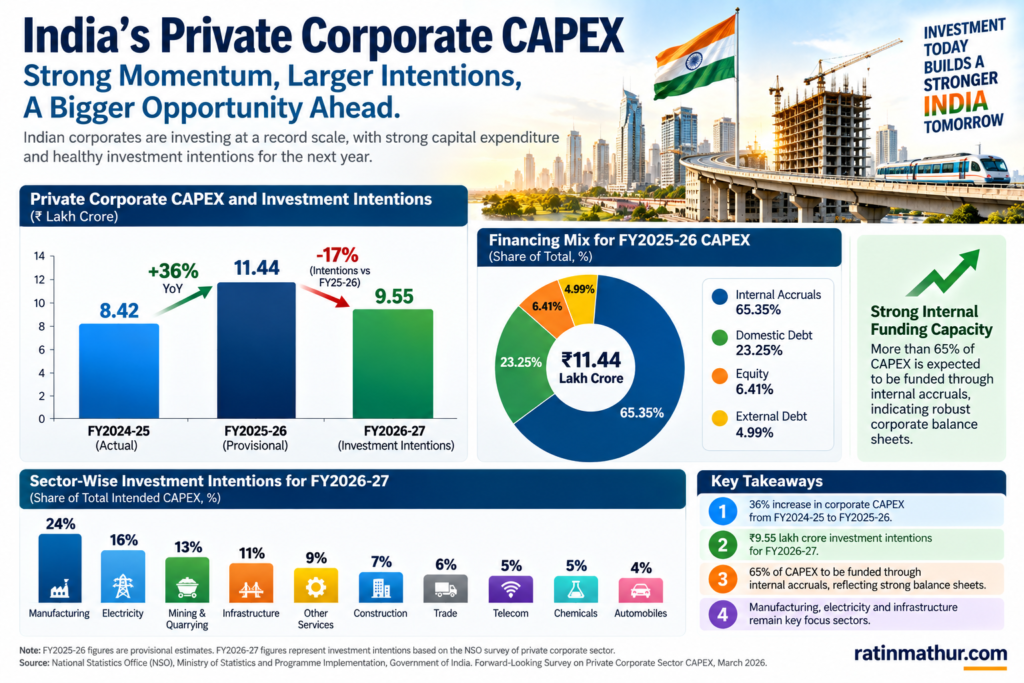
India today stands at an important economic crossroads. The country has many of the ingredients required for a powerful private investment cycle: strong domestic demand, infrastructure expansion, improving corporate balance sheets, digital public infrastructure, a large labor force, increasing manufacturing capability and growing integration with global supply chains. Gross foreign direct investment reached a record approximately US$94.5 billion in FY2025-26, while the National Statistics Office estimated private corporate capital expenditure at about ₹11.44 lakh crore for FY2025-26 and reported investment intentions of approximately ₹9.55 lakh crore for FY2026-27.
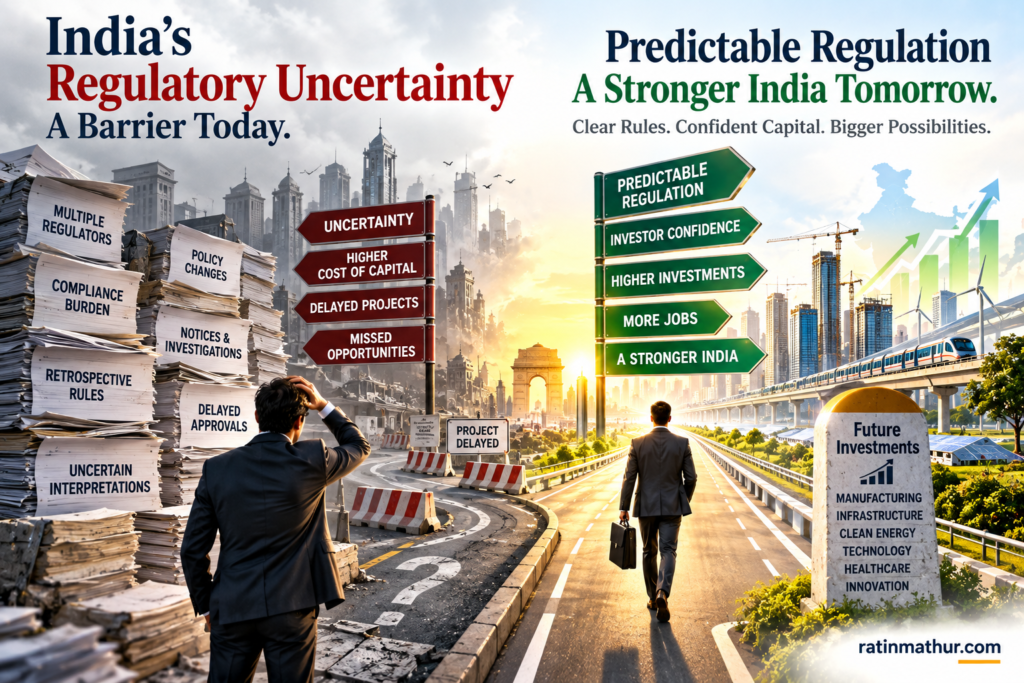
Yet an important contradiction remains. India can be an attractive market and still be perceived as a difficult environment for long-duration private capital. That is the essence of Ruchir Sharma’s recent warning that the problem is increasingly the “overzealousness of the regulatory agencies” and that businesses and investors can become uncomfortable because they do not know when a regulatory notice may arrive or on what grounds.
The issue is therefore not simply the amount of State intervention. It is the quality of regulatory intervention. Clear and predictable regulation can increase investment by reducing information asymmetry, protecting property and investor rights, creating credible markets and rewarding good corporate behavior. Unpredictable or disproportionate intervention can have the opposite effect by raising the risk premium attached to capital, delaying projects, changing business models, compressing valuations and strengthening incumbent companies that can afford higher compliance costs.
The corporate evidence is compelling. PB Fintech’s share price fell sharply after IRDAI proposed changes to insurance commissions even before the proposal became final. Kotak Mahindra Bank experienced a direct growth constraint after RBI restricted digital customer onboarding. IIFL Finance lost significant market value after restrictions on gold lending. Amazon had to redesign aspects of its marketplace model after changes to foreign-investment rules. IndiGo faced major operational disruption after revised pilot-duty requirements. On the positive side, PLI programmes, semiconductor incentives, renewable-energy policies, REIT and InvIT frameworks, and drone-sector reforms have helped unlock investment and create new business opportunities.
The strategic conclusion is not that India needs less regulation everywhere. India needs a more predictable regulatory state. The objective should be to combine strong enforcement where public interest genuinely requires it with clear rules, proportionate action, time-bound resolution, safe harbors for good-faith compliance and meaningful accountability for regulatory decision-making.
The next phase of India’s Ease of Doing Business agenda should therefore move beyond reducing the number of compliances. It should reduce the uncertainty surrounding regulatory interpretation and enforcement. The real competitive advantage for India will emerge when investors can confidently answer a simple question before committing capital: “If I follow the rules in good faith, do I know where I stand?”
Introduction
Economic growth requires more than capital. It requires confidence that capital committed today will operate under a sufficiently predictable institutional framework tomorrow.
This is particularly important for India because the next stage of growth is expected to require long-duration investment in manufacturing, infrastructure, energy transition, electronics, semiconductors, logistics, healthcare, digital infrastructure and urban development. These investments are relatively irreversible. A factory cannot be moved overnight. A power project cannot easily abandon its location. A semiconductor facility cannot pause construction indefinitely without substantial value destruction.
Ruchir Sharma’s recent comments therefore deserve attention beyond the immediate political or regulatory debate. His concern is not that India has an exceptionally interventionist government compared with every other emerging economy. Rather, he identifies regulatory-agency intervention and uncertainty as a growing concern for private investment.
This distinction is fundamental. A predictable regulation can be priced, budgeted and incorporated into a business plan. An unpredictable regulatory environment cannot be modelled with the same confidence.
An investor can calculate the cost of a tax, environmental standard, licensing requirement or labor obligation. What is much harder to calculate is the probability that the interpretation of a rule will change, a legacy transaction will be revisited, multiple agencies will take different positions, or an unresolved regulatory dispute will consume management attention and capital for several years.
That uncertainty becomes an invisible cost of capital.
Problem Statement & Objectives
The central problem examined in this paper is the possibility that India’s regulatory architecture can create a risk premium that is disproportionate to the underlying economic opportunity.
This does not imply that regulatory intervention is inherently undesirable. In financial services, healthcare, food safety, aviation, environmental protection, telecommunications and capital markets, regulation is indispensable. The problem arises when intervention becomes difficult to predict, disproportionate to the underlying risk, slow to resolve or insufficiently differentiated between material misconduct and technical non-compliance.
The paper has four objectives.
| Objective | Analytical Question |
|---|---|
| Identify the economic problem | How does regulatory uncertainty affect investment, valuation, entrepreneurship and corporate strategy? |
| Examine corporate evidence | How have regulatory actions or policy changes affected companies across different industries? |
| Separate good regulation from bad execution | When does regulation create economic value, and when can it create friction or uncertainty? |
| Develop strategic responses | What should government, regulators, boards and investors do to build a more predictable investment environment? |
The core proposition is that India should seek regulatory effectiveness rather than regulatory intensity. The strongest regulatory system is not necessarily the one that intervenes most often. It is the one that produces the highest degree of compliance, trust and market discipline with the lowest unnecessary economic friction.
Methodology
This paper uses a qualitative comparative methodology combining public regulatory actions, company-level market reactions, official policy documents, government data and publicly reported corporate outcomes. The corporate cases are selected to represent different industries rather than concentrated examples from financial services alone.
The analysis deliberately separates three categories: regulatory interventions that negatively affected corporate economics, regulatory or policy interventions that positively supported corporate development, and regulatory actions where the intervention may have been justified but nevertheless generated substantial short-term economic consequences.
The latter distinction is important. A decline in a company’s share price after regulatory action does not prove that the regulator acted incorrectly. It demonstrates that regulation can materially affect corporate economics and that businesses therefore need greater regulatory resilience.
India’s own Economic Survey provides support for this analytical direction. The Survey identifies compliance burden, legal safeguards for enforcement, liberalisation of controls and risk-based regulation as priorities for the next phase of ease-of-doing-business reforms. The 2025-26 Economic Survey also describes deregulation as a means of strengthening state capacity by reducing friction between businesses and government.
Landscape Analysis
India’s investment landscape provides both reassurance and warning.
The reassurance is visible in private investment. The NSO reported estimated private corporate CAPEX of ₹11.44 lakh crore during FY2025-26 and investment intentions of approximately ₹9.55 lakh crore for FY2026-27. Internal accruals accounted for about 65.35% of FY2025-26 CAPEX financing, indicating that corporate balance sheets have significant capacity to fund investment.
FDI data also demonstrate continuing international interest. Gross FDI inflows reached approximately US$94.5 billion in FY2025-26, up from US$80.6 billion, while net FDI was much smaller after accounting for repatriation and outward investment.
These numbers show that capital has not abandoned India.
But they also raise a more sophisticated question: Is India receiving as much patient, productive and long-duration capital as it could?
That is where regulatory quality becomes strategically important.
India has made measurable progress. The government has pursued compliance reduction, digitisation, process simplification and decriminalisation of several minor violations. The Economic Survey 2025-26 states that these reforms have contributed to lower compliance burdens, faster approvals and greater predictability, while Phase II of deregulation extends the effort to land, construction, utilities, environment, labor, health and education.
Yet the reform agenda is incomplete. Removing paperwork is only one dimension of regulatory reform. Reducing discretion, improving consistency and creating certainty of enforcement are arguably the more difficult next steps.
The challenge is therefore shifting from “How many rules exist?” to “How predictable are the rules that remain?”
Key Findings
Finding 1: Regulatory Uncertainty Creates A Hidden Cost Of Capital
The economic mechanism is straightforward. Investors evaluate expected cash flows against risk. When regulatory uncertainty rises, the required return rises. A higher required return lowers the present value of future cash flows even when the operating fundamentals remain unchanged.
Consider an illustrative ₹1,000-crore project generating ₹200 crore annually for ten years. At a 12% discount rate, the project produces a considerably higher present value than at a 14% discount rate. A regulatory risk premium of just 2% points can therefore eliminate a substantial portion of economic value without changing demand, technology or productivity.
This is why regulatory uncertainty is different from ordinary compliance cost. Compliance cost is measurable. Uncertainty is probabilistic and can affect capital allocation before a regulation becomes enforceable.
Finding 2: Regulation Can Reprice Companies Before It Changes Their Earnings
PB Fintech is an especially powerful example. IRDAI’s September 2026 consultation paper proposed significant changes to insurance distribution commissions. PB Fintech’s shares fell a record 36%, eliminating more than US$3 billion of market value, even though the proposal was still subject to consultation.
This demonstrates that markets price anticipated future regulation, not merely implemented regulation.
For long-duration investors, this distinction is critical.
Finding 3: Regulatory Risk Is Sector-Wide
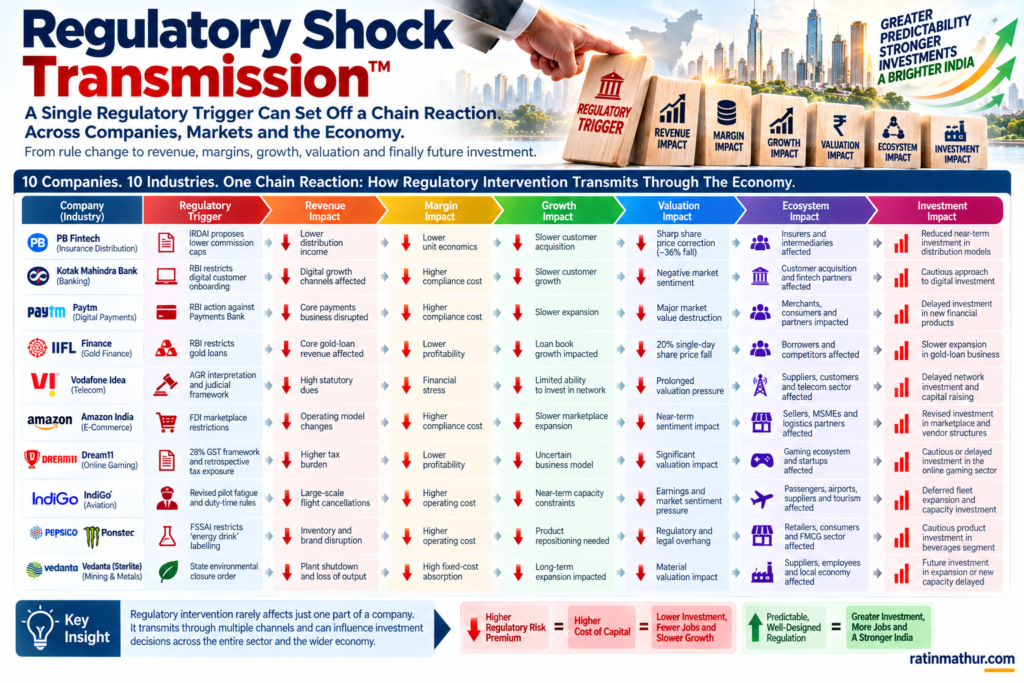
The issue extends well beyond finance. The examples range from e-commerce and telecommunications to aviation, food and beverages, mining, gaming and digital platforms.
| Industry | Company | Regulatory Trigger | Observed Corporate Effect |
|---|---|---|---|
| Insurance Distribution | PB Fintech | Proposed IRDAI commission restructuring | Sharp valuation correction before final implementation |
| Banking | Kotak Mahindra Bank | RBI restrictions related to IT and digital onboarding | Direct constraint on digital customer acquisition and growth |
| Digital Payments | Paytm | RBI action concerning Payments Bank compliance | Major business-model disruption and market-value destruction |
| Gold Finance | IIFL Finance | RBI restriction on gold lending | 20% one-day share-price fall; core product affected |
| Telecommunications | Vodafone Idea | AGR regulatory and judicial framework | Large accumulated statutory liabilities and long-term financial stress |
| E-Commerce | Amazon India | Changes to FDI marketplace rules | Vendor relationships and platform operating model had to be restructured |
| Online Gaming | Dream11 | 28% GST regime and retrospective tax consequences | Industry-wide tax liabilities potentially threatening business economics |
| Aviation | IndiGo | Revised pilot duty and rest requirements | Operational disruption and large-scale flight cancellations |
| Food & Beverage | PepsiCo | FSSAI restrictions on “energy drink” labelling | Significant inventory and branding disruption |
| Mining & Metals | Vedanta Sterlite Copper | Environmental and state-level closure action | Plant shutdown, supply disruption and major economic consequences |
The IIFL case illustrates how a regulatory restriction on one product can become a corporate crisis when that product represents a large proportion of the balance sheet. The company’s gold-loan exposure was approximately 32% of its loan portfolio when RBI imposed restrictions. Kotak’s case demonstrates a different transmission mechanism, where regulatory concerns around technology governance directly affected a digital growth channel.
Other cases demonstrate that uncertainty can affect operating models as well as financial performance. Amazon had to remove products and redesign vendor structures after changes in FDI rules for e-commerce. The IndiGo episode showed the operational consequences of implementing safety-related requirements in an industry with tightly interconnected aircraft, crew and scheduling economics.
The Vedanta Sterlite case is particularly instructive because environmental protection and local community concerns are legitimate public-policy objectives. Yet the closure of a facility that had accounted for a significant portion of India’s copper production also demonstrated the potential supply-chain and macroeconomic consequences of regulatory decisions involving large fixed investments.
Finding 4: Regulation Can Also Be A Powerful Investment Catalyst
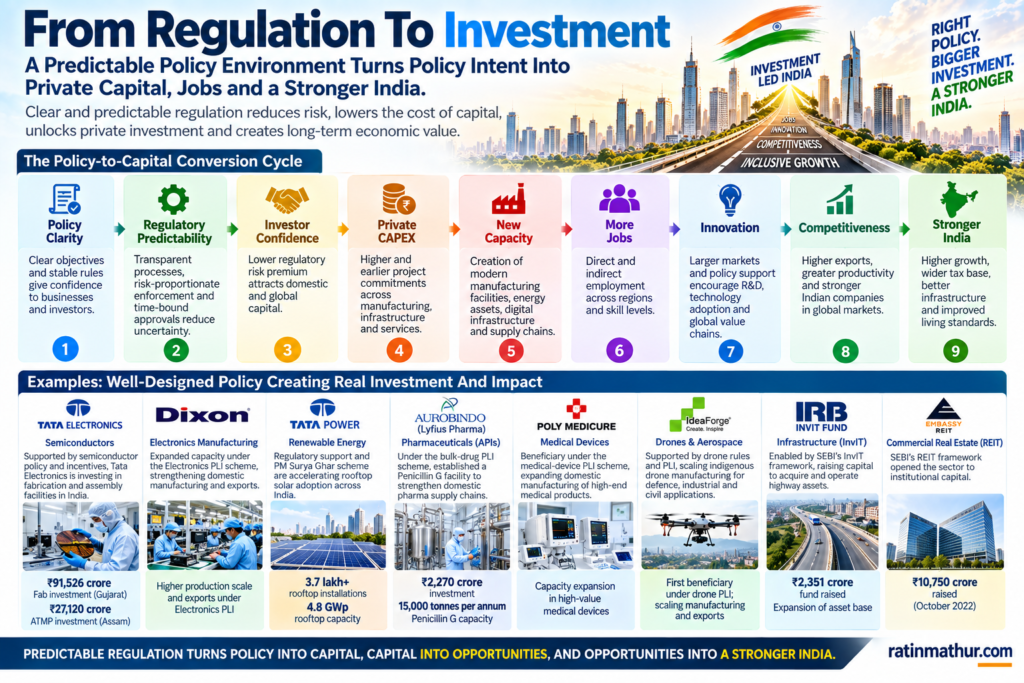
It would be intellectually incomplete to portray regulation only as a negative force.
India’s PLI programmes provide evidence of the opposite effect. As of March 31, 2026, the 14 PLI schemes had generated more than ₹2.40 lakh crore of actual investment and more than 14.15 lakh direct and indirect jobs, according to the government.
| Industry | Company | Policy / Regulatory Mechanism | Positive Strategic Effect |
|---|---|---|---|
| Electronics Manufacturing | Dixon Technologies | Electronics and IT hardware PLI ecosystem | Expanded domestic manufacturing footprint and scale |
| Semiconductors | Tata Electronics | Semiconductor policy and fiscal support | Supports very large-scale domestic semiconductor capacity |
| Advanced Batteries | Reliance New Energy Battery | PLI-ACC battery manufacturing programme | Enables domestic battery manufacturing and supply-chain development |
| Pharmaceuticals / APIs | Aurobindo Pharma via Lyfius Pharma | Bulk-drug PLI | ₹2,270 crore Penicillin G facility at Kakinada |
| Medical Devices | Poly Medicure | Medical-device PLI | Supports domestic production of high-end medical products |
| Textiles | Gokaldas Exports | MMF and technical-textile PLI | Encourages higher-value manufacturing and exports |
| Renewable Energy | Tata Power | PM Surya Ghar and related policy ecosystem | Accelerates rooftop solar adoption and creates scalable consumer-energy business |
| Infrastructure Capital Markets | IRB InvIT | SEBI InvIT framework | Creates a structured mechanism for infrastructure asset monetisation and capital recycling |
| Commercial Real Estate | Embassy Office Parks REIT | SEBI REIT framework | Brings institutional and public-market capital into commercial real estate |
| Drones | ideaForge Technology | Drone Rules liberalisation and drone PLI | Strengthened domestic manufacturing and created a clearer growth ecosystem |
Tata Electronics is an especially significant illustration of policy-led capital formation. The government reports approved semiconductor projects involving Tata Electronics with proposed investments of ₹91,526 crore in Gujarat and ₹27,120 crore in Assam.
Aurobindo’s Lyfius Pharma provides another example of policy converting strategic intent into physical capacity. Its Penicillin G facility at Kakinada represents an investment of ₹2,270.05 crore with installed capacity of 15,000 tonnes per annum.
The drone sector demonstrates that regulation can create a market rather than merely control one. Drone Rules 2021, airspace liberalisation, certification reforms and the PLI programme were implemented together to position India as a global drone hub. ideaForge was among the companies selected under the drone PLI framework.
Tata Power’s experience demonstrates a different model in which government policy stimulates consumer demand. The company identifies the PM Surya Ghar scheme as an important driver of rooftop solar growth and reports more than 3.7 lakh residential rooftop installations and more than 4.8 GWp of installed capacity.
The broader conclusion is decisive: the State can either reduce investment risk or increase it. The difference lies in regulatory design.
Challenges & Opportunities
The first challenge is regulatory fragmentation. An investor may interact with multiple Union, state and local authorities, each with different processes, interpretations and timelines. The company experiences these institutions as one regulatory environment even when the State treats them as separate administrative systems.
The second challenge is regulatory asymmetry. Large corporations can absorb lawyers, compliance officers, consultants and extended litigation. Smaller enterprises cannot. Consequently, excessive procedural complexity may unintentionally favor incumbents and create a regulatory moat around established businesses.
The third challenge is the difference between technical compliance and material harm. A regulatory system that treats every deviation with the same intensity can divert enforcement resources away from truly systemic risks. India’s Economic Survey has itself highlighted risk-based regulation and legal safeguards for enforcement as important components of the next reform phase.
The fourth challenge is transition risk. Even good regulations can create disruption when implementation timelines are too short, guidance is insufficient or industry preparedness is underestimated.
The opportunity is therefore to create a regulatory ecosystem that is simultaneously stronger and lighter: stronger in areas of genuine public risk, lighter where procedural activity produces little public value.
Strategic Frameworks & Recommendations
Regulatory Predictability Premium™ Framework
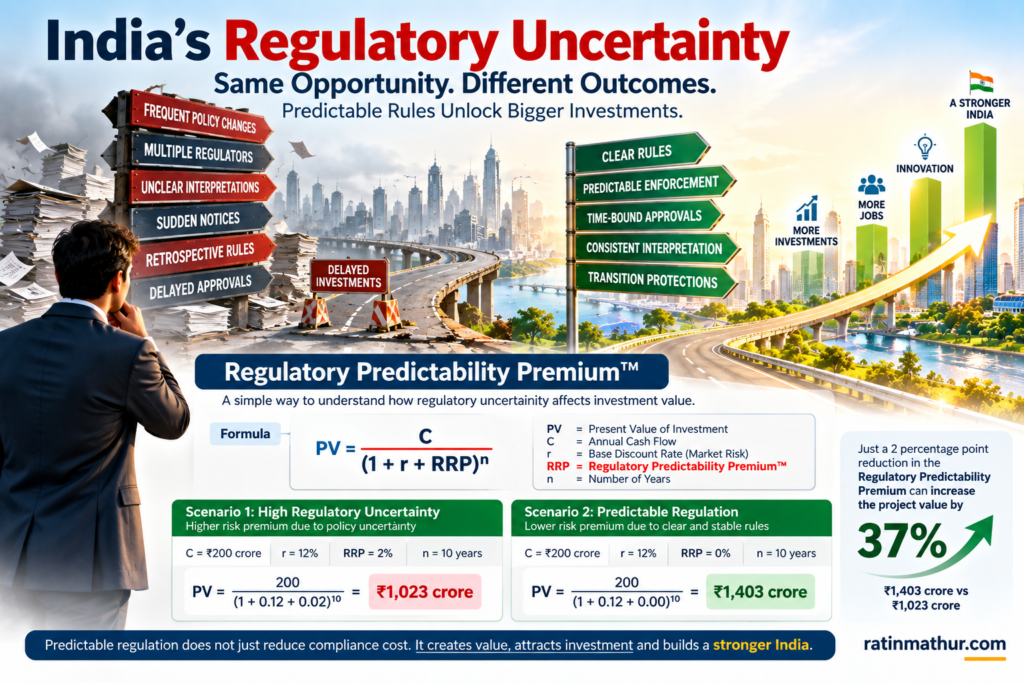
The Regulatory Predictability Premium™ Framework proposes that companies and policymakers treat regulatory predictability as an explicit economic variable rather than an abstract governance concept.
The framework starts from the premise that investors effectively price five components: regulatory clarity, enforcement discretion, probability of adverse intervention, speed of dispute resolution and degree of retroactive exposure. When these variables deteriorate, the investor’s required return rises. When they improve, the cost of capital can fall.
The framework can be applied both by policymakers evaluating the investment environment and by corporate boards assessing strategic exposure.
| Regulatory Variable | Low-Risk Condition | High-Risk Condition | Indicative Corporate Example |
|---|---|---|---|
| Rule Clarity | Specific and easily interpreted rules | Multiple possible interpretations | Amazon India |
| Enforcement Discretion | Evidence-based and bounded | Wide discretionary scope | PB Fintech |
| Notice Predictability | Defined triggers and thresholds | Uncertain timing or rationale | Financial-sector cases |
| Resolution Speed | Time-bound investigation and appeal | Multi-year uncertainty | Vodafone Idea |
| Retroactive Exposure | Prospective application with transition periods | Material historical exposure | Online gaming GST |
PB Fintech demonstrates how the market can attach a very high premium to uncertainty. The proposed insurance-commission change was sufficient to cause a dramatic market reaction before final implementation.
The policy recommendation is to introduce an explicit Regulatory Predictability Assessment for major new regulations. Every major economic regulation should communicate its objective, scope, materiality threshold, transition mechanism, enforcement architecture and review period. The objective is not to prevent regulators from acting. It is to make the consequences of regulatory action more foreseeable.
For corporate boards, the framework suggests incorporating a “Regulatory Premium” into project evaluation. A project that appears attractive at a 12% hurdle rate may become unattractive at 14% if the regulatory environment is uncertain. Therefore, regulatory risk should be integrated into investment committees, capital-allocation models and scenario planning.
Regulatory Shock Transmission™ Framework
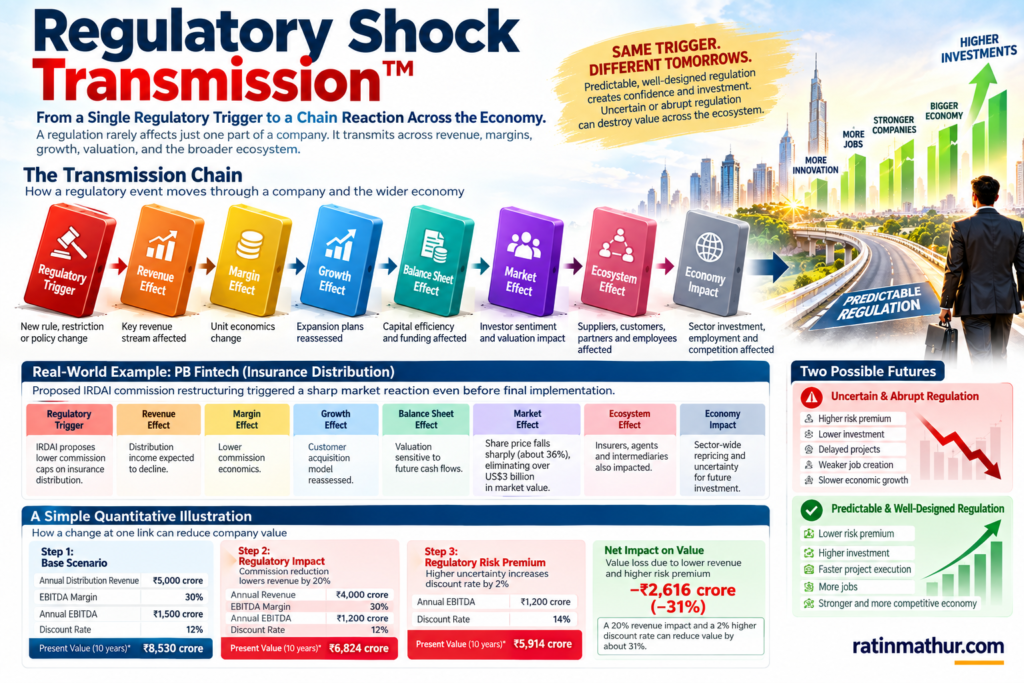
The Regulatory Shock Transmission™ Framework examines how a regulatory event moves through a company and ultimately affects investors, employees, suppliers and the wider economy.
The key insight is that regulation rarely affects only the variable directly targeted by the regulator. A commission cap can affect distributors, insurers, customer acquisition and valuations. A restriction on digital onboarding can affect loan growth, credit-card issuance and customer lifetime value. A telecom liability can affect network investment and competitive structure.
| Transmission Layer | Key Question | PB Fintech Example | IIFL Finance Example |
|---|---|---|---|
| Regulatory Trigger | What changed? | Commission proposal | Gold-loan restriction |
| Revenue Effect | What revenue stream is affected? | Distribution income | Gold-loan origination |
| Margin Effect | What happens to unit economics? | Distributor economics | Lending economics |
| Growth Effect | What happens to future expansion? | Customer-acquisition model | Loan-book growth |
| Balance-Sheet Effect | Is capital affected? | Valuation-sensitive | Core loan assets affected |
| Market Effect | How do investors respond? | Sharp share-price correction | 20% one-day decline |
| Ecosystem Effect | Who else is affected? | Insurers and intermediaries | Gold-loan competitors and borrowers |
The framework should be used by boards before major regulatory changes become effective. Companies should stress-test not only first-order effects but also second-order effects. If a commission changes, management should model customer acquisition, product mix, distributor behavior, insurer pricing and capital-market reaction. If a licensing rule changes, the analysis should examine plant utilization, stranded assets, employment, suppliers and financing commitments.
The government can also use the same framework before issuing major rules. A Regulatory Shock Impact Assessment should estimate the likely effects on investment, prices, employment, competition, smaller firms and supply chains.
The framework is particularly relevant for India because many strategic sectors rely on long-duration capital. Investors need to know not simply whether a regulation improves one metric, but whether the wider economic shock is proportionate to the problem being solved.
TRUST Regulation™ Framework
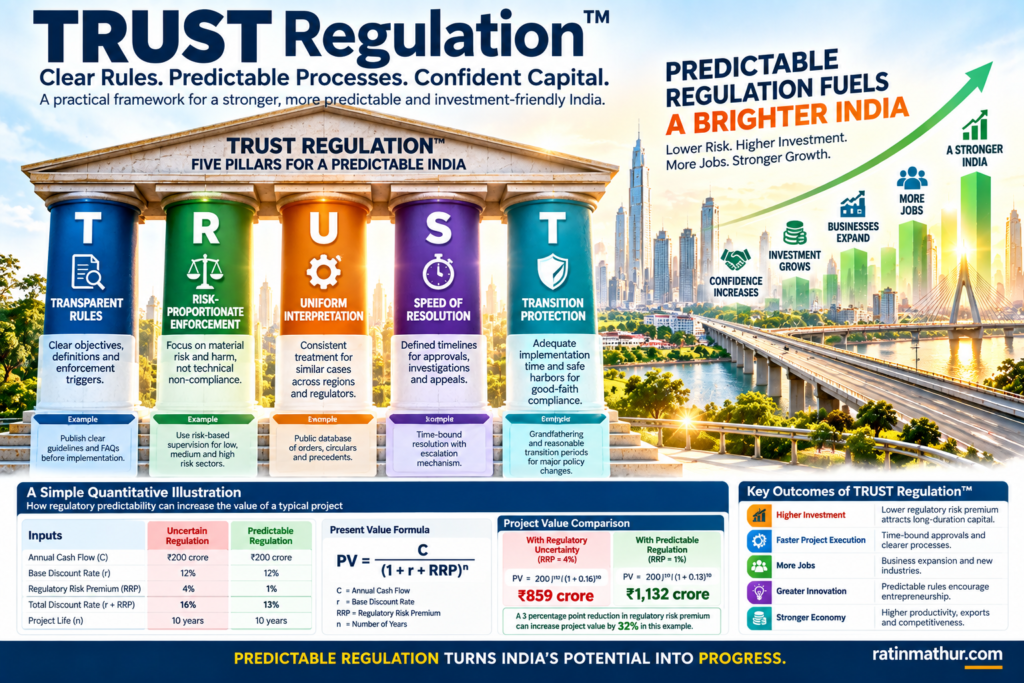
The TRUST Regulation™ Framework provides the institutional blueprint for the next phase of Indian regulatory reform. TRUST stands for Transparent Rules, Risk-Proportionate Enforcement, Uniform Interpretation, Speed of Resolution, and Transition Protection.
| TRUST Element | Recommended Regulatory Principle | Strategic Outcome |
|---|---|---|
| Transparent Rules | Clear objectives, definitions and enforcement triggers | Lower ambiguity |
| Risk-Proportionate Enforcement | Enforcement intensity linked to materiality and harm | Better regulatory efficiency |
| Uniform Interpretation | Consistent treatment across comparable cases | Lower discretionary risk |
| Speed Of Resolution | Defined timelines for notices, responses, investigations and appeals | Lower uncertainty |
| Transition Protection | Cure periods, safe harbors and forward-looking implementation | Greater investment confidence |
Transparent Rules means that businesses should understand what conduct creates material regulatory exposure. Risk-Proportionate Enforcement means a technical documentation error should not automatically attract the same response as deliberate fraud, financial misconduct or serious consumer harm. Uniform Interpretation requires comparable companies and circumstances to receive broadly comparable treatment. Speed of Resolution recognizes that an unresolved regulatory dispute can itself become an economic penalty. Transition Protection ensures that companies making long-term investments are given reasonable adjustment periods when the regulatory architecture changes.
The TRUST framework does not weaken regulators. It strengthens them by creating clearer boundaries around intervention.
The practical principle is simple: the State should retain strong teeth, but businesses should know when those teeth can be used and how the process works.
India can implement this through a regulatory “safe harbor” for good-faith compliance. A company that has followed published guidance, disclosed relevant information and corrected technical deficiencies within a reasonable cure period should ordinarily receive a different treatment from an entity engaged in deliberate misconduct.
The framework could also introduce annual regulator-level performance dashboards covering approval timelines, case-resolution periods, appeals, overturned decisions, regulatory duplication and stakeholder responsiveness. Such metrics would create accountability on both sides of the regulatory relationship.
Future Outlook & Conclusion
India’s economic opportunity remains enormous. The private sector has capital, technology ambitions and access to a rapidly expanding domestic market. Government policy has demonstrated that regulation can successfully create markets, mobilise investment and build strategic industries. PLI programmes have generated more than ₹2.40 lakh crore of investment, while the semiconductor, battery, drone and renewable-energy ecosystems illustrate the potential of targeted state intervention.
The future challenge is therefore not whether India should have a strong State. It should.
The question is whether India’s State can become more predictable without becoming weaker, and more disciplined without becoming less capable.
This distinction will matter enormously over the next decade.
India wants multinational companies to build factories, semiconductor fabs, battery plants and data centers. It wants domestic entrepreneurs to scale into global companies. It wants financial markets to channel household savings into productive investment. It wants infrastructure developers to commit capital for decades. None of these objectives can be achieved purely through incentives.
They require institutional trust.
The most important economic reform may therefore be a shift from regulatory control to regulatory confidence.
The measure of success should not be the number of notices issued, approvals digitised or regulations created. It should be whether productive businesses can make long-duration investments with reasonable confidence that the rules will remain clear, enforcement will be proportionate, comparable cases will be treated consistently and disputes will be resolved within credible timelines.
Ruchir Sharma’s concern should consequently be interpreted as a warning about the next generation of India’s growth model rather than simply as criticism of individual regulators. India’s first reform phase reduced many obvious barriers. The next phase must address a subtler barrier: the fear of unpredictable intervention after capital has been committed.
That fear is effectively a hidden tax.
It raises hurdle rates. It reduces investment optionality. It favors large incumbents. It discourages first-generation entrepreneurs. It can shift capital toward shorter-duration or less-regulated opportunities. And because the effect often occurs before a project is rejected, its economic cost can remain invisible in conventional investment statistics.
The strategic objective for India should therefore be clear.
Strong regulation where society needs protection. Light regulation where intervention adds little value. Predictable regulation everywhere.
That is not an anti-regulation philosophy.
It is a pro-investment, pro-entrepreneurship and pro-state-capacity philosophy.
The ultimate competitive advantage of India may not simply be that the country has the world’s largest pool of consumers, a large workforce or strong growth prospects.
It may be that investors eventually conclude something even more valuable:
India is a place where the opportunity is large, the State is strong, and the rules can be trusted.
That is when private investment stops merely being willing to come to India and becomes willing to commit for the long term.
References
- Sharma, R. (2026). Interview on India’s investment environment and regulatory intervention. The Economic Times. The Economic Times interview
- Government of India, Ministry of Finance. (2026). Economic Survey 2025-26. Economic Survey 2025-26
- Government of India, Ministry of Statistics and Programme Implementation. (2026, March 23). Forward-Looking Survey on Private Corporate Sector CAPEX Investment Intentions. NSO CAPEX release
- Reserve Bank of India. (2026). State of the Economy. Data on gross and net FDI inflows for FY2025-26. RBI-related source
- Reuters. (2026, September 24). PB Fintech’s $3 billion rout leads Indian insurance sector’s slump on commission-cap plan. Reuters report
- Reuters. (2026, September 29). India’s big insurance overhaul will test demand. Reuters analysis
- Reuters. (2024, April 24). India central bank bars Kotak Mahindra Bank from taking on new clients digitally. Reuters report
- Reuters. (2024, March 5). India’s IIFL Finance plunges after cenbank ban on offering gold loans. Reuters report
- Reuters. (2024). Japan’s SoftBank cuts stake in India’s Paytm to under 3%. Reuters report
- Reuters. (2019, February 1). Amazon takes numerous products off its India website to comply with new rules. Business Standard / Reuters report
- Indian Express. (2026, May 29). Why SC’s verdict on retrospective 28% GST levy on online gaming could be a death blow to the sector. Indian Express analysis
- Reuters. (2025, December 5). India suspends two rules governing night working hours for IndiGo pilots. Reuters report
- Reuters. (2026, October 1). PepsiCo, Monster challenge India ‘energy drink’ label ban citing business impact. Reuters report
- Reuters. (2018, May 28). Indian state orders permanent closure of Vedanta copper smelter after deadly protests. Reuters report via Investing.com
- Government of India, Ministry of Commerce & Industry. (2026, July 21). PLI Schemes Attract Over ₹2.40 Lakh Crore Investment, Generate More Than 14.15 Lakh Jobs. PIB release
- Government of India, Ministry of Heavy Industries. (2026, February 10). PLI-ACC Scheme. PIB release
- Government of India, Department of Pharmaceuticals. (2026, September 25). PLI Scheme for Bulk Drugs for Resilient Pharmaceutical Supply Chain. PIB release
- Government of India, Ministry of Electronics & Information Technology. (2026). ECMS Accelerates Electronics Manufacturing. PIB release
- Government of India, Ministry of Civil Aviation. (2022, April 20). PLI Scheme for Drones and Drone Components. PIB release
- Tata Power. (2026). Integrated Annual Report 2025-26. Tata Power Annual Report
- Securities and Exchange Board of India. (2017). IRB InvIT Fund: Final Offer Documents. SEBI InvIT filing
- Securities and Exchange Board of India. (2019). Embassy Office Parks REIT. SEBI REIT filing
- Ministry of Textiles, Government of India. (2026). PLI Textiles Applicants. PLI Textiles applicant list
Disclaimer
This article is intended for informational, analytical and educational purposes only. It expresses strategic interpretations based on publicly available information, regulatory announcements, company disclosures, government publications and media reports available as of October 4, 2026. The classification of examples as having “negative” or “positive” corporate impact describes the observed or potential economic effect on the company and does not constitute a judgment that any regulator acted improperly or that any regulation was legally or economically unjustified. Regulatory consultations, proposals, enforcement actions and court proceedings may change over time. The three frameworks, Regulatory Predictability Premium™, Regulatory Shock Transmission™, and TRUST Regulation™, are conceptual strategic frameworks developed for this article and are not established regulatory standards or investment methodologies. Nothing in this article constitutes investment, legal, tax, accounting or regulatory advice, and readers should independently verify relevant facts and seek qualified professional advice before making decisions.