Executive Summary
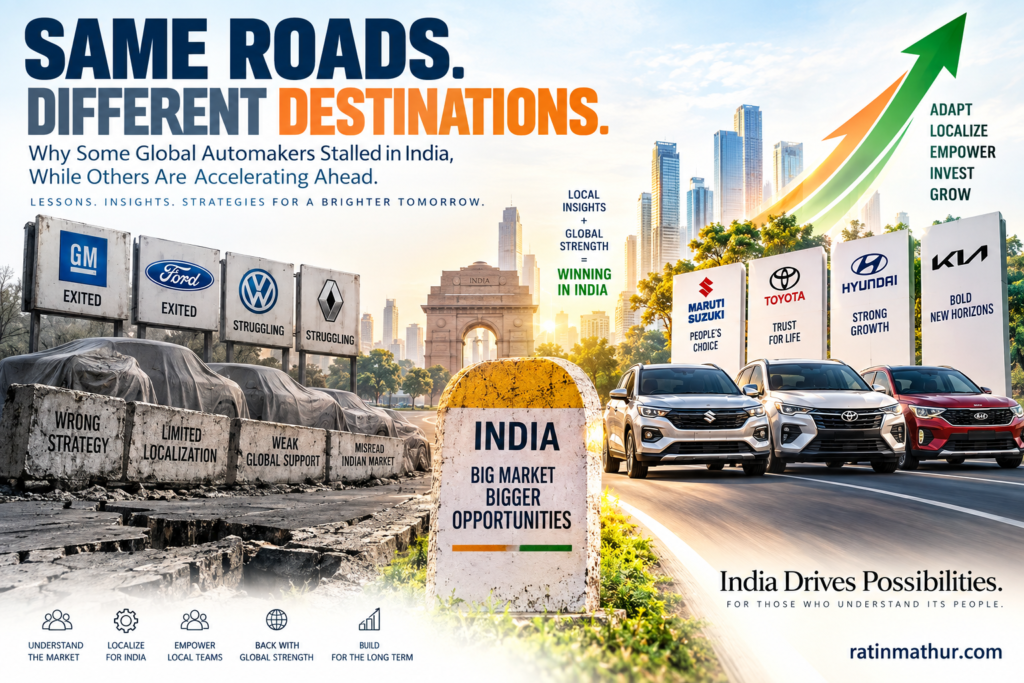
India has become one of the most consequential automotive markets in the world, yet its history with multinational automobile manufacturers is strikingly uneven. Maruti Suzuki built an extraordinary mass-market franchise; Hyundai became a major Indian manufacturer and global export base; Toyota has steadily expanded its presence; and Kia established meaningful scale in a remarkably short period. In contrast, General Motors exited passenger-vehicle manufacturing, Ford abandoned local vehicle manufacturing after years of losses, and Renault-Nissan and Volkswagen–Škoda have spent years rebuilding strategies that initially failed to deliver the scale and economics expected from India.
The obvious explanations are nationality, product localization, pricing, cost structure, distribution, consumer understanding and strategic commitment. All matter, but none independently explains the divergence. The deeper explanation is organizational: successful companies have tended to create an integrated India operating system in which local market knowledge is connected to global technology, capital, engineering and decision-making. The critical distinction is therefore not between Indian and foreign companies, or between Japanese, Korean, American and European management cultures. It is between connected and disconnected operating models.
India’s passenger-vehicle market reached a record 4.3 million units in FY2024-25, with utility vehicles accounting for 65% of passenger-vehicle sales. This is a market increasingly shaped by SUVs, technology, safety, financing, aspirational consumption, rural penetration and rapid product cycles. (Siam) The strategic implication is profound: an India subsidiary can no longer succeed merely by selling globally designed vehicles into India. It must increasingly participate in product definition, engineering, sourcing, manufacturing, pricing, distribution, digital experience and global export strategy.
The evidence also challenges a tempting hypothesis that Japanese and Korean manufacturers succeeded simply because they deployed more expatriates. Toyota, for example, increased senior expatriate presence while simultaneously building Indian manpower and explicitly planning to reduce expatriate numbers. (The Economic Times) Hyundai likewise developed substantial Indian leadership over time. The relevant organizational capability is not expatriate intensity. It is the quality of the bridge between India and headquarters.
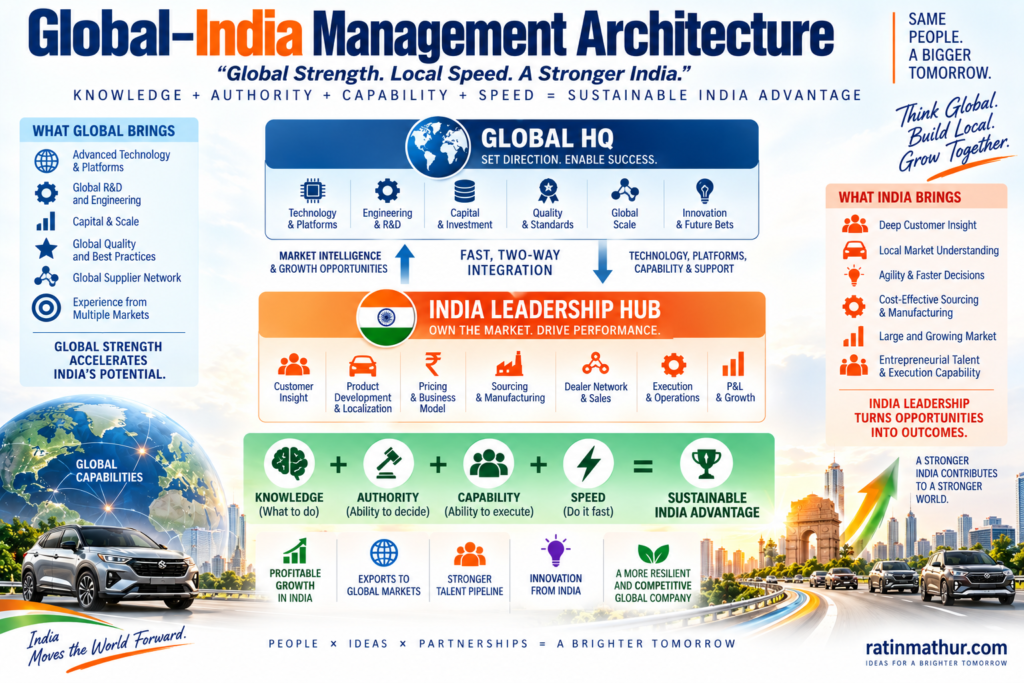
The strongest model can therefore be expressed as follows: Indian leadership should own the commercial reality of India, while the global organization supplies technology, platforms, capital, engineering, quality systems, supplier capabilities and international scale. Expatriates, where required, should operate as bridge managers and capability-transfer mechanisms rather than as permanent substitutes for local decision-makers.
This article develops that argument through the 7-Step Consulting Problem Solving methodology: problem definition, MECE structuring, prioritization, hypothesis development, evidence-based analysis, synthesis and actionable recommendations. The methodology emphasizes the separation of facts, assumptions, hypotheses, analysis, insights and recommendations.
The central conclusion is simple but consequential: India does not punish foreign automakers; it punishes disconnected operating models. The multinational that wins India is neither completely global-led nor completely India-led. It is India-led commercially, globally enabled technologically and jointly accountable strategically.
Introduction
India’s automobile market has become a strategic paradox for multinational manufacturers. It is simultaneously large enough to justify substantial investment and difficult enough to expose weaknesses in global operating models. A company can possess world-class engineering, strong brands, advanced manufacturing technology and significant financial resources and still fail to build a sustainable position in India.
The contrast between companies is particularly revealing. Maruti Suzuki created an ecosystem that became deeply embedded in India’s mobility economy. Hyundai built manufacturing, engineering, sourcing and export capabilities while developing strong local leadership. Toyota has gradually expanded its India footprint and strengthened local capabilities. Kia entered much later than most competitors but rapidly created a recognizable portfolio and meaningful market position. Kia reported approximately 280,000 India sales in 2025 and is targeting 410,000 units by 2030. (Kia Global)
Meanwhile, Ford accumulated significant industrial and engineering capabilities but could not make its Indian manufacturing economics sustainable. Ford stated in 2021 that it had accumulated more than $2 billion in operating losses over the previous decade and concluded that it could not identify a sustainable path to long-term profitability with local vehicle manufacturing. (Maruti Suzuki) General Motors ultimately phased out Chevrolet sales and shifted manufacturing toward exports rather than building a sustainable domestic passenger-vehicle business. Volkswagen and Škoda launched a major India 2.0 restructuring, investing €1 billion and developing a heavily localized platform, yet the group continued to struggle to reach sufficient scale. (Škoda Storyboard)
The interesting question is therefore not simply why some companies failed. It is why companies with broadly comparable access to technology, capital and managerial talent produced such different outcomes.
Problem Statement & Objectives
The core problem can be formulated as follows: Why have some global automobile manufacturers developed sustainable competitive positions in India while others with substantial resources, global brands and local investments have struggled to achieve profitable scale, and what organizational and strategic model best explains and potentially reverses this divergence?
The objective is not to assign success or failure to nationality. Rather, it is to identify the causal mechanisms through which market understanding, product localization, cost competitiveness, scale, management architecture, headquarters support, decision rights and strategic commitment interact.
The analysis therefore tests five interconnected hypotheses. The first is that market and product fit determine whether an OEM can generate sufficient volume. The second is that localization must extend beyond components into product development, cost architecture, sourcing, distribution and customer experience. The third is that scale is essential because localization without sufficient volume can create a high fixed-cost structure. The fourth is that organizational connectivity between India and headquarters affects decision speed, resource allocation and product responsiveness. The fifth is that India must become a strategic platform rather than merely a national sales subsidiary.
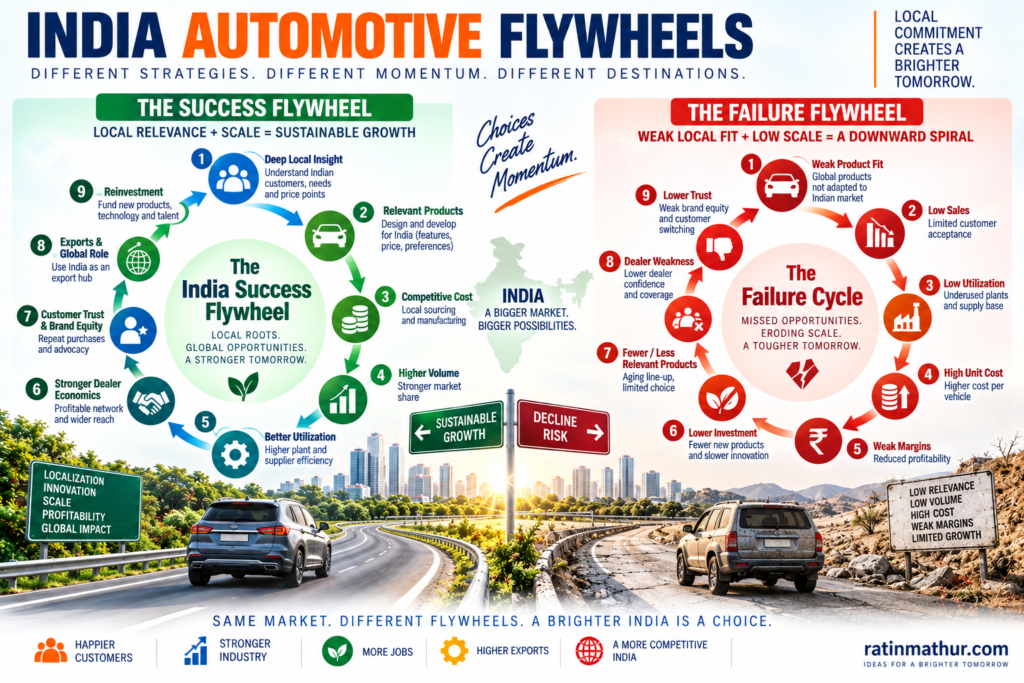
These hypotheses are interconnected rather than mutually exclusive. A poor product reduces volume; low volume reduces plant utilization; weak utilization raises unit economics; poor economics reduce management willingness to invest; reduced investment weakens product competitiveness; and the cycle repeats. Conversely, strong product-market fit creates scale, scale improves economics, better economics fund localization, localization improves products and costs, and India becomes more valuable to the global organization.
Methodology
The analysis follows the seven-step consulting methodology: defining the problem, structuring it through a MECE issue tree, prioritizing issues, developing hypotheses and an analysis plan, testing hypotheses through evidence, synthesizing the findings using the “So What?” principle, and translating the findings into actionable recommendations. The framework specifically requires management questions to be separated from symptoms and emphasizes evidence-based recommendations rather than jumping directly from problem to solution.
The analytical structure is therefore built around four major causal dimensions: market fit, economics, organizational effectiveness and strategic commitment. Market fit asks whether the company has products, pricing, segments and customer propositions appropriate for India. Economics examines localization, plant utilization, sourcing, margins, dealer economics and scale. Organizational effectiveness examines decision rights, local leadership, headquarters connectivity, technical support and decision speed. Strategic commitment examines capital allocation, product allocation, management attention and the role assigned to India within the global portfolio.
The evidence base combines company disclosures, industry data, historical corporate announcements and current strategic developments. Where organizational characteristics such as expatriate intensity, decision latency or informal headquarters influence cannot be measured consistently from public information, they are treated as hypotheses or analytical inferences rather than established facts.
Landscape Analysis
India’s automotive market has changed fundamentally from the market that existed when many global OEMs entered. Passenger-vehicle sales reached 4.3 million units in FY2024-25, the highest level recorded at the time, while utility vehicles represented 65% of passenger-vehicle sales. (Siam) The market has therefore moved toward SUVs and feature-rich vehicles while remaining intensely price-sensitive.
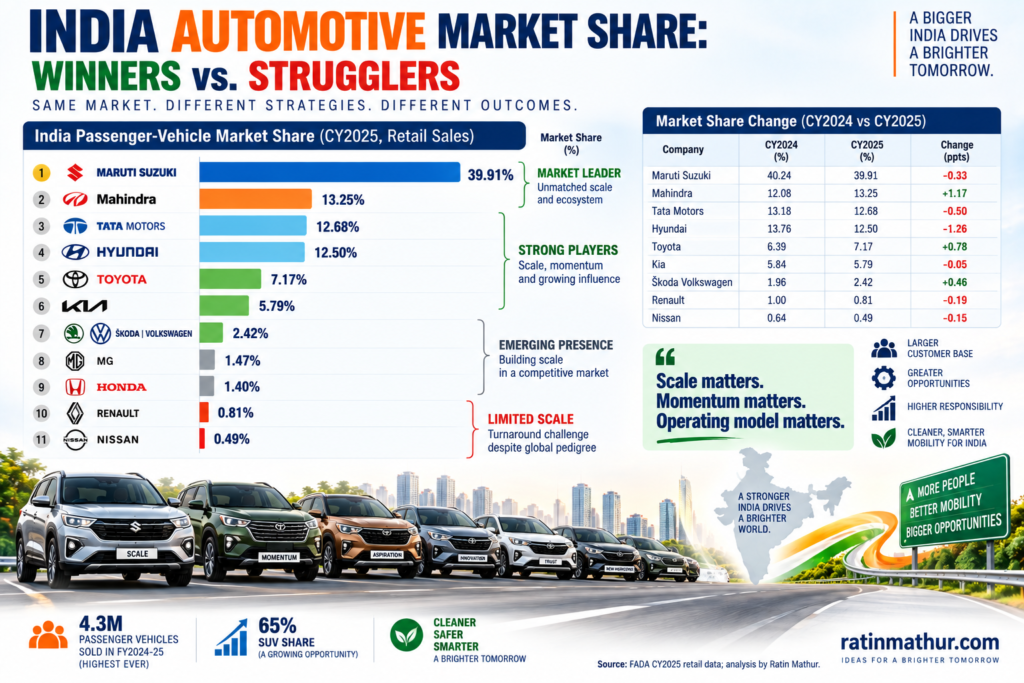
This creates a structural challenge for global OEMs. The Indian customer increasingly expects global standards in safety, technology, design and connected features but remains highly sensitive to acquisition cost, financing, maintenance cost, fuel efficiency and resale value. The winning product must therefore combine global engineering competence with local cost and usage optimization.
Maruti Suzuki demonstrates the power of accumulated ecosystem economics. In FY2025-26 it reported record total sales of 2.42 million vehicles, including approximately 448,000 exports, and accounted for 49% of India’s passenger-vehicle exports. (Maruti Suzuki) This scale is not merely a consequence of market share; it reinforces market share through supplier scale, dealer economics, manufacturing utilization, brand familiarity, service reach and export leverage.
Hyundai provides another important model. After three decades in India, Hyundai reported FY2025-26 sales of 775,031 units, including 190,125 exports, alongside revenue of approximately ₹70,763 crore. (HYUNDAI MOTORS) The company’s India operation increasingly combines manufacturing, engineering, product development and exports rather than functioning simply as a sales subsidiary.
Kia represents a different form of success. Entering the market in 2019, it reached approximately 280,000 annual India sales by 2025 and has established a strategic target of 410,000 units and 7.6% market share by 2030. (Kia Global) Its experience demonstrates that a late entrant can build scale quickly when product positioning, manufacturing, distribution and corporate commitment are aligned.
Volkswagen–Škoda illustrates a different lesson. India 2.0 explicitly attempted to solve organizational as well as product problems. Škoda assumed responsibility for the group, the companies were consolidated to improve coordination and faster decision-making, and the group invested €1 billion while creating a Pune technology center. (Škoda Storyboard) The MQB-A0-IN platform achieved localization of up to 95%, demonstrating that deep technical localization is achievable. (Škoda Storyboard) Yet the group continued to hold only around 2% market share after more than two decades, according to Reuters, illustrating that localization alone does not guarantee scale. (Reuters)
Renault’s current transformation provides another instructive case. Renault now describes India as one of its strategic international hubs, with engineering, design and manufacturing capabilities concentrated around Chennai. Its new Duster has been reimagined in India for contemporary Indian usage, while the Chennai ecosystem is increasingly positioned to support international markets. (Renault Group) In 2026 Renault further described Chennai as a major engineering and technology hub with around 6,000 engineers and IT specialists, alongside an expanded export role. (Renault Group Media)
These developments suggest that struggling OEMs are not necessarily abandoning India. The more interesting phenomenon is that several are attempting to transform India from a peripheral market into a development, manufacturing and export hub.
Key Findings
The first finding is that nationality is not a sufficient explanation for performance. Japanese and Korean manufacturers have performed strongly, but their success is better explained by operating-system characteristics than by nationality alone. Honda’s weaker recent position demonstrates that Japanese heritage does not automatically produce India success. Similarly, a European manufacturer can improve materially when it redesigns its India operating model.
The second finding is that localization is necessary but not sufficient. Škoda’s MQB-A0-IN platform demonstrates extremely high localization, yet the group’s overall market position remains modest. (Škoda Storyboard) Localization must therefore be understood as a business-system concept encompassing product definition, engineering, procurement, manufacturing, supplier development, pricing, distribution and decision-making.
The third finding is that scale and localization reinforce one another. A highly localized plant with low utilization can still have poor economics. Ford’s experience demonstrates this problem particularly clearly: significant industrial capacity and engineering presence did not translate into sustainable manufacturing profitability. (Maruti Suzuki)
The fourth finding is that India knowledge without decision authority is strategically weak. A local management team may understand customers, competitors and dealers extremely well, but if critical decisions require lengthy global approval, the organization cannot respond at market speed. Conversely, giving local management authority without providing technology, capital, platforms and global capabilities creates a different problem.
This creates what can be called the “knowledge-authority gap.” The most dangerous configuration occurs when India possesses knowledge but headquarters retains the critical decision rights, while headquarters possesses capital and technology but lacks sufficient real-time understanding of Indian market dynamics. The resulting organization is neither genuinely global nor genuinely local.
The fifth finding is that expatriates are valuable when they connect systems, not when they replace local leadership. Toyota’s historical experience is instructive: the company increased senior expatriate numbers while simultaneously planning to reduce them as Indian manpower capabilities strengthened. (The Economic Times) The strategic purpose of expatriates should therefore be knowledge transfer, technical integration, problem solving and organizational connectivity.
The sixth finding is that India strategic priority must be measured by resource and decision allocation rather than corporate rhetoric. An OEM may publicly describe India as a strategic market while allocating few dedicated platforms, limited capital, insufficient engineering resources or slow product approvals. Conversely, India becomes strategically important when it receives dedicated engineering, product ownership, capital, supplier-development resources and global export mandates.
The seventh finding is that the winning model is high local autonomy plus high global support. This is fundamentally different from both headquarters control and headquarters abandonment.
Challenges & Opportunities
The principal challenge for global OEMs is the economics of India’s middle-market automobile business. Customers demand sophisticated vehicles at prices that constrain margins. This means global engineering solutions must often be redesigned around Indian cost structures rather than simply localized through component substitution.
A second challenge is the speed of market change. SUVs have moved from a niche to the dominant passenger-vehicle body style, while safety, connected technology, electrification and design expectations are evolving rapidly. (Siam) A five-year global product cycle can therefore become dangerously slow if India cannot influence specifications early in the development process.
A third challenge is organizational fragmentation. Global groups often have multiple brands, platforms, functions and regional structures. If India must negotiate separately with product development, procurement, finance, engineering and headquarters committees, local responsiveness becomes structurally difficult.
Yet these challenges create major opportunities. India’s growing market can support economies of scale, while its engineering talent can contribute to global product development. Its supplier ecosystem can provide competitive sourcing, and its manufacturing base can become an export platform. Renault’s current India strategy explicitly demonstrates this transition toward an engineering, industrial and export hub. (Renault Group Media) Maruti’s export performance provides an even more mature example of India becoming a global production base. (Maruti Suzuki)
The opportunity is therefore not simply to “win India.” The larger opportunity is to use India to redesign how a multinational competes in emerging markets.
Strategic Frameworks & Recommendations
India Connected Operating System™ Framework
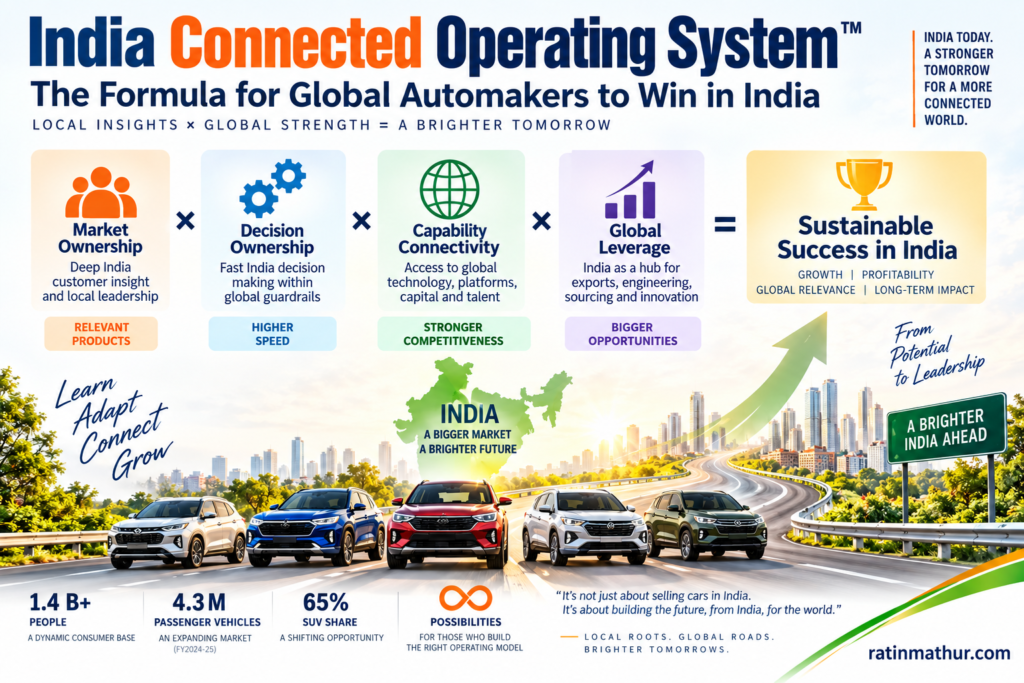
The India Connected Operating System™ framework proposes that an automotive subsidiary should be evaluated across four interconnected layers: market ownership, decision ownership, capability connectivity and global leverage. The framework is designed to solve the central organizational problem identified in this analysis: the separation of knowledge from authority.
| Layer | Strategic question | Winning configuration | Failure configuration |
| Market ownership | Who owns customer and commercial truth? | India leadership | HQ-led assumptions |
| Decision ownership | Who can make critical India decisions? | High local authority within guardrails | Multiple global approvals |
| Capability connectivity | How does India access global technology and expertise? | Fast two-way integration | Slow or episodic support |
| Global leverage | How does the world benefit from India? | Exports, engineering, sourcing and platforms | India treated as standalone market |
The framework does not recommend complete decentralization. Product safety standards, core technology, global quality systems, financial controls and brand architecture may appropriately remain globally governed. However, India should have meaningful authority over customer proposition, pricing, product adaptation, feature prioritization, channel strategy, supplier localization and market execution.
The critical organizational principle is “local ownership within global guardrails.” For example, India should not independently redefine global safety architecture, but it should have authority to determine which features customers value sufficiently to justify their cost, how those features are packaged, and how the resulting vehicle is priced.
Škoda’s India 2.0 transformation moved toward this architecture by giving Škoda responsibility for the Indian group campaign and establishing local technical development through the Pune technology center. (Škoda Storyboard) Renault’s current Chennai strategy goes further by integrating design, engineering, manufacturing and export capabilities. (Renault Group Media)
The framework also provides a practical management diagnostic. Every major India decision should be mapped according to who possesses information, who possesses authority, who supplies technical capability and who bears the economic consequence.
| Decision domain | India should lead | Global organization should lead | Joint accountability |
| Customer insight | High | Low | High |
| Pricing and variants | High | Guardrails | High |
| Product adaptation | High | Core architecture | High |
| Global technology | Low | High | High |
| Supplier localization | High | Technical standards | High |
| Manufacturing | High | Global standards | High |
| Brand architecture | Medium | High | High |
| Capital allocation | Business case | Portfolio governance | High |
| Export strategy | Market input | Global network | High |
| Talent development | High | Global capability | High |
For OEMs such as Volkswagen–Škoda and Renault–Nissan, the recommendation is to institutionalize this model rather than rely on individual executives to create connectivity. Decision rights should be explicitly documented, escalation thresholds should be defined, and India leadership should be measured on business outcomes rather than merely execution of global directives.
India Localization Flywheel™ Framework
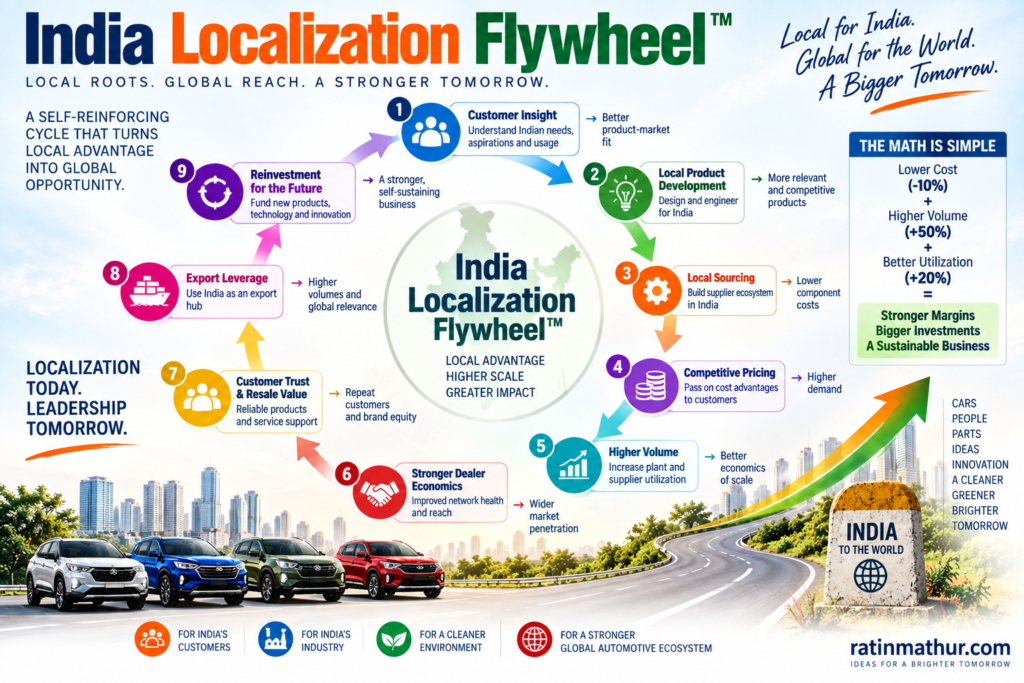
The India Localization Flywheel™ framework reframes localization as a cumulative economic system rather than a component-sourcing exercise. Its central proposition is that India success occurs when product localization, cost localization, volume, supplier scale, manufacturing utilization, customer trust and exports reinforce one another.
| Flywheel stage | Strategic mechanism | Expected effect |
| India customer insight | Identify local usage and aspiration | Better product-market fit |
| Local product architecture | Adapt global technology to India | Competitive proposition |
| Local sourcing | Increase supplier depth | Lower structural cost |
| Competitive pricing | Transfer cost advantage to market | Higher demand |
| Higher volume | Improve plant and supplier utilization | Lower unit economics |
| Better dealer economics | Improve network health | Wider reach |
| Stronger resale and trust | Reduce ownership risk | Repeat demand |
| Export leverage | Spread fixed development cost | Higher return on India investment |
| Reinvestment | Fund new products and technology | Sustained competitiveness |
This framework explains why localization by itself does not guarantee success. Volkswagen’s MQB-A0-IN platform reached up to 95% localization, but the company still faced a scale challenge. (Škoda Storyboard) The flywheel requires the interaction of localization and volume.
Ford illustrates the opposite problem. Its Indian operation possessed engineering, manufacturing and export capabilities, but insufficient domestic economics prevented the manufacturing system from reaching sustainable profitability. (Maruti Suzuki) In other words, localization without adequate demand can become a cost burden rather than a competitive advantage.
Maruti demonstrates a mature version of the flywheel. Its enormous domestic volume supports manufacturing and supplier scale, while exports spread the economics of India-based production across international markets. In FY2025-26, Maruti exported approximately 448,000 vehicles and accounted for 49% of India’s passenger-vehicle exports. (Maruti Suzuki)
Renault’s current strategy is increasingly aligned with this model. Its Chennai operation is being repositioned as an engineering, manufacturing and export hub, while the new Duster is designed around Indian customer requirements and subsequently positioned for international markets. (Renault Group)
The managerial implication is that OEMs should stop asking, “What percentage of the vehicle is localized?” and instead ask, “How much of the economic system is localized?” The latter is a much more powerful measure.
| Localization dimension | Basic localization | Strategic localization |
| Components | Local parts | Competitive local supplier ecosystem |
| Manufacturing | Assembly in India | Scaled manufacturing economics |
| Engineering | Adaptation | India-led product development |
| Product | Global model localized | India-specific architecture and proposition |
| Management | Local execution | Local decision ownership |
| Procurement | Local buying | Global-class India sourcing hub |
| Exports | Opportunistic | India integrated into global allocation |
| Innovation | Local tweaks | India-originated global solutions |
India Decision Velocity™ Framework
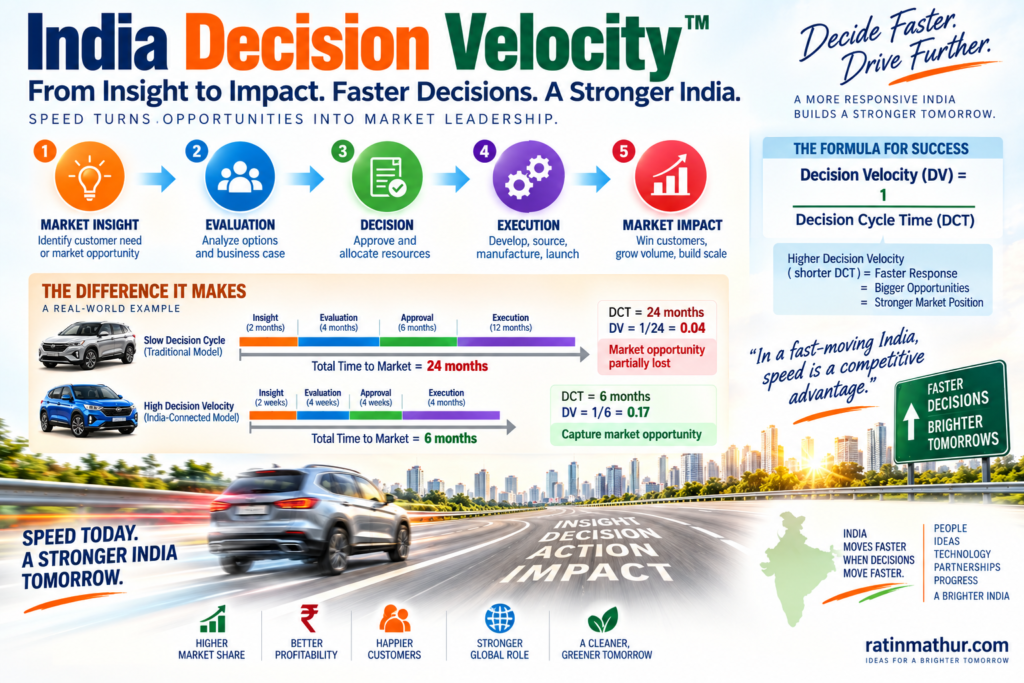
The India Decision Velocity™ framework addresses one of the least visible but potentially most important competitive variables: the speed with which an organization converts market information into decisions and decisions into products.
Traditional performance metrics measure market share, revenue, margins, utilization and product launches. Decision velocity measures the organizational time between an India business identifying a market requirement and the global organization authorizing action.
| Decision category | Diagnostic question | Strategic KPI |
| Product | How quickly can India modify specifications? | Product decision cycle time |
| Pricing | How quickly can competitive pricing be approved? | Pricing approval time |
| Features | How quickly can high-value features be added? | Feature decision latency |
| Supplier | How quickly can local suppliers be approved? | Supplier qualification cycle |
| Investment | How quickly can capacity investments be authorized? | Capex approval time |
| Engineering | How quickly can technical issues be escalated? | Engineering resolution time |
| Marketing | How quickly can campaigns respond to competitors? | Campaign response time |
The framework is particularly relevant to Volkswagen–Škoda because the company’s India restructuring explicitly emphasized coordinated and faster decision-making, while more recent reporting indicates another restructuring and potential partnership aimed partly at faster governance and improved competitiveness. (Škoda Storyboard)
The strategic recommendation is to establish an India Decision Authority Matrix. Decisions should be categorized as India-owned, globally governed or jointly governed. Approval layers should be eliminated where they do not add risk control. The CEO of the India operation should not merely be accountable for results; the role must carry sufficient authority to influence the variables that determine those results.
This creates a fundamental management principle: accountability must follow authority. If an India CEO is accountable for market share but cannot approve pricing, variants, product features or marketing investments, the organization has created accountability without control.
The three frameworks together create an integrated strategic architecture.
| Strategic question | India Connected Operating System™ | India Localization Flywheel™ | India Decision Velocity™ |
| What should the organization look like? | Defines operating model | Defines economic system | Defines decision architecture |
| What creates competitive advantage? | Global-local integration | Scale plus localization | Speed of response |
| What is the core risk? | Knowledge-authority gap | Localization without scale | Slow governance |
| Primary KPI | Decision authority index | Localization and scale economics | Decision cycle time |
| Main leadership action | Clarify roles | Build the flywheel | Remove approval friction |
Taken together, the frameworks suggest that Volkswagen–Škoda should deepen India ownership rather than merely add more products; Renault–Nissan should convert its emerging Chennai capabilities into a coherent product-and-export flywheel; and any future Western OEM entering or re-entering India should avoid treating the country as a distribution extension of a global product portfolio.
Future Outlook & Conclusion
India’s next automotive phase will be defined by electrification, software, connected vehicles, safety, SUVs, hybridization, financing innovation and increasingly sophisticated customers. The competitive question will therefore become even less about whether an OEM can manufacture a car in India and more about whether it can create a continuously adapting automotive business system in India.
The country’s importance is also expanding beyond domestic consumption. Maruti is using India as a major export base, Hyundai combines domestic operations with significant exports, and Renault is explicitly positioning Chennai as an international engineering and industrial hub. (Maruti Suzuki) This changes the strategic economics of India. The country can now justify investment not only through Indian sales but through global value creation.
The Volkswagen–Škoda case is particularly important because it shows that transformation takes time. The company has already demonstrated deep technical localization through MQB-A0-IN and organizational consolidation through India 2.0. (Škoda Storyboard) The next question is whether these capabilities can generate sufficient scale, product breadth and decision speed. Reuters’ recent reporting on a possible JSW partnership suggests that Volkswagen recognizes the need to strengthen localization, manufacturing competitiveness and governance. (Reuters)
Renault offers another important signal. The company is moving from an earlier market-specific presence toward a much broader India ecosystem combining design, engineering, manufacturing, sourcing and exports. (Renault Group Media) The new Duster is therefore strategically more significant than a single product launch: it is a test of whether India can become a product-development center rather than merely a market.
The broader lesson extends beyond automobiles. Multinationals entering India frequently confront the same organizational dilemma: local teams possess market knowledge while headquarters possesses technology, capital and global systems. When these capabilities are disconnected, the company becomes slow, expensive and strategically confused. When they are integrated, the local subsidiary can become an innovation engine for the wider corporation.
The answer to the original strategic question is therefore not that Japanese or Korean management is inherently better than American or European management. Nor is it that expatriates are the secret ingredient. Nor is it simply that Indian consumers require more localization.
The deeper answer is organizational design.
The successful multinational creates a system in which India sees, India speaks, India decides within agreed guardrails, headquarters enables, global functions accelerate, and both sides share accountability for outcomes.
That is why the most important distinction is not foreign versus Indian, Japanese versus Korean, or European versus American. It is connected versus disconnected.
The winning multinational in India is India-led commercially, globally enabled technologically and jointly accountable strategically.
References
- Ford Motor Company. (2021). Ford India restructuring announcement. Ford Motor Company corporate media
- General Motors. (2017). General Motors India manufacturing and Chevrolet strategy announcement. General Motors corporate media
- Hyundai Motor India Limited. (2026). 30th Annual Report 2025–26. Hyundai Motor India Annual Report
- Hyundai Motor India Limited. (2026). Q4 & FY2025–26 financial results. Hyundai Motor India FY2025–26 Results
- Kia Corporation. (2026). Emerging markets strategy: India line-up expansion. Kia Investor Relations
- Maruti Suzuki India Limited. (2026). Maruti Suzuki announces financial results for FY2025–26. Maruti Suzuki financial results FY2025–26
- Maruti Suzuki India Limited. (2026). Maruti Suzuki exports surge over 34% to reach an all-time high of 4.47 lakh vehicles in FY2025–26. Maruti Suzuki corporate website
- Renault Group. (2026). From Chennai to the world: How India is reshaping Renault Group’s strategy. Renault Group India strategy
- Renault Group. (2026). In India, Renault Duster opens a new chapter. Renault Group Duster strategy
- Renault Group. (2026). Renault Group unveils futuREady India to power its next phase of international growth. Renault Group futuREady India
- Society of Indian Automobile Manufacturers. (2025). Auto industry sales performance of March 2025, Q4 and FY2024–25. SIAM Industry Sales Performance
- Society of Indian Automobile Manufacturers. (2025). SIAM Annual Report 2024–25. SIAM Annual Report 2024–25
- Škoda Auto. (2018). The INDIA 2.0 project: ŠKODA AUTO assumes responsibility for the Indian market on Volkswagen Group’s behalf. Škoda INDIA 2.0 project
- Škoda Auto. (2019). INDIA 2.0 Project: ŠKODA and Volkswagen Group India open new Technology Center in Pune. Škoda Technology Center Pune
- Škoda Auto. (2021). ŠKODA KUSHAQ: Local development and production. Škoda Kushaq and MQB-A0-IN
- Toyota Kirloskar Motor. (2011). Toyota to rev up market share, hire 2,000 people. The Economic Times. Economic Times report
- Volkswagen Group. (2018). The Volkswagen Group intends to merge all passenger car entities in India. Volkswagen Group corporate information
- Reuters. (2025). Volkswagen to overhaul India business amid market pressures. Reuters
- Reuters. (2026). Volkswagen explores partnership with JSW Group in key India market. Reuters
Disclaimer
This article is an analytical and strategic interpretation of publicly available information and the 7-Step Consulting Problem Solving methodology. The three frameworks, namely India Connected Operating System™, India Localization Flywheel™, and India Decision Velocity™, are original conceptual frameworks developed for this article and are presented for strategic discussion and management application. The “™” designation identifies the framework names as proprietary conceptual labels for the author’s use and does not, by itself, establish trademark registration or legal trademark rights.
The article distinguishes publicly reported facts from analytical inference and strategic hypotheses. Public sources do not provide sufficiently consistent company-by-company data on expatriate numbers, headquarters intervention, decision-making latency, internal approval structures or informal management relationships. Accordingly, conclusions concerning organizational connectivity should not be interpreted as empirically proven claims about individual executives or national management cultures.
Company performance, market conditions, strategies and organizational structures continue to evolve. References to current or future strategies, including Volkswagen–JSW and Renault’s India transformation, should therefore be treated as developments at the time of publication rather than guarantees of future performance. The article is intended for educational, strategic and thought-leadership purposes and should not be construed as investment, legal, financial or management advice for any specific company.
This version is structured as a journal/newspaper-style thought-leadership paper, while keeping the three proprietary frameworks confined to the requested Strategic Frameworks & Recommendations section.