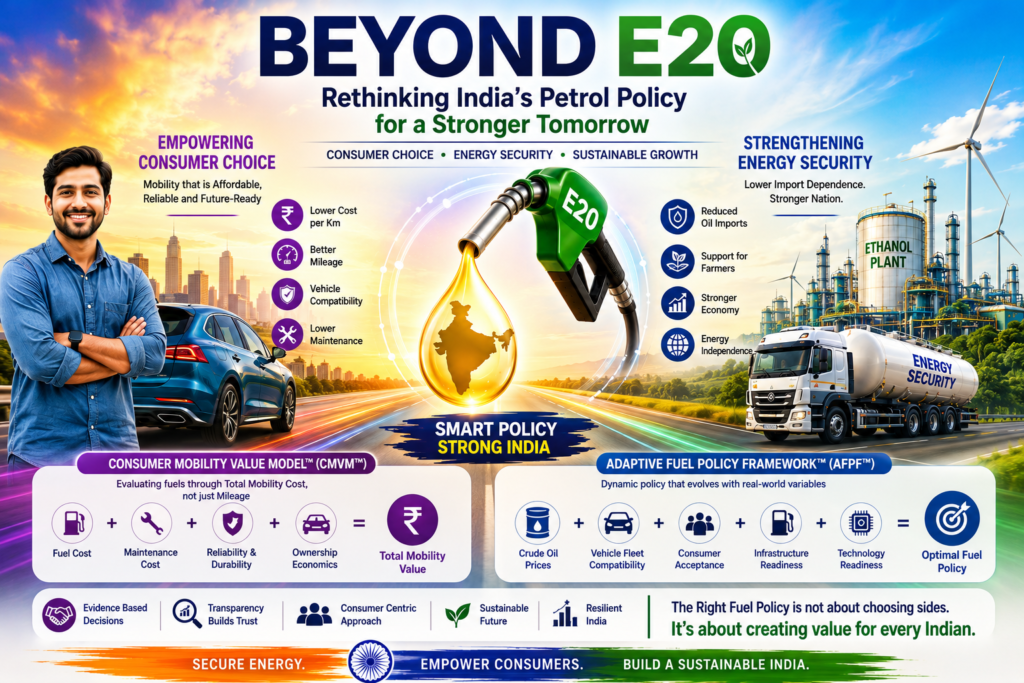
Part 1: The Strategic Dilemma—When National Interest Meets Consumer Choice
Abstract
India’s transition to 20% ethanol-blended petrol (E20) represents one of the most significant structural reforms in the country’s transport energy sector. Designed to reduce dependence on imported crude oil, strengthen energy security and support domestic biofuel production, the programme has fundamentally altered India’s fuel landscape. While policymakers consider ethanol blending a strategic necessity, many consumers continue to express concerns regarding fuel economy, vehicle compatibility and long-term ownership costs. The result is a widening gap between macroeconomic policy objectives and consumer perception.
This paper argues that the current debate has been framed too narrowly as a choice between supporting or opposing E20. The more important strategic question is how India can simultaneously strengthen energy security, protect consumer interests and create a fuel ecosystem capable of adapting to changing economic and technological conditions. By examining the issue through the perspectives of public policy, behavioural economics and strategic management, this article proposes that the long-term success of ethanol blending will depend not only on engineering and economics but also on transparency, consumer confidence and evidence-based governance.
Introduction
India’s E20 programme has emerged as one of the country’s most debated public policy initiatives. Few energy reforms have generated such contrasting reactions. On one side stands the Government, presenting ethanol blending as a strategic response to rising crude oil imports, geopolitical uncertainty and long-term energy resilience. On the other stands the consumer, evaluating the same policy through a far more immediate lens of mileage, monthly fuel expenditure and vehicle reliability.
These two perspectives are often portrayed as being in conflict. In reality, they represent different methods of evaluating value.
Governments make decisions that optimise national welfare over decades. Consumers make decisions that optimise household expenditure every month. Consequently, they measure policy success using different indicators.
India imports approximately eighty-five percent of its crude oil requirement. This dependence exposes the economy to volatile international oil prices, exchange-rate movements and geopolitical disruptions. From a national planning perspective, reducing petroleum imports through domestically produced ethanol is therefore a rational strategic objective.
Consumers, however, rarely evaluate fuel in terms of foreign exchange savings or macroeconomic resilience. Their questions are considerably more practical. Will my vehicle deliver the same mileage? Will maintenance costs increase? Is my vehicle fully compatible with higher ethanol blends? Will my total cost of ownership change?
The divergence between these two perspectives forms the foundation of the present debate.
The central argument of this article is that India’s ethanol policy should no longer be viewed simply as an energy policy. It should be understood as a strategic governance issue requiring the alignment of national priorities with consumer confidence. Policies succeed over the long term not merely because they are technically sound, but because they are trusted by the people expected to adopt them.
Understanding the Government’s Strategic Mindset
To understand the rationale behind E20, one must first recognise India’s structural energy challenge.
Unlike major oil-producing nations, India relies heavily on imported crude oil to satisfy domestic demand. This creates strategic vulnerabilities extending beyond economics. Geopolitical conflicts, supply disruptions, exchange-rate volatility and shipping constraints can all influence domestic fuel prices and national economic stability.
Viewed through this lens, ethanol is considerably more than a transport fuel.
It represents an instrument of national risk diversification.
Every litre of domestically produced ethanol blended into petrol marginally reduces dependence on imported petroleum products while simultaneously strengthening domestic agricultural and industrial value chains.
The Government has also argued that ethanol blending cushioned consumers from significantly higher retail petrol prices during periods of exceptionally high international crude oil prices. Public statements have suggested that retail petrol prices in Delhi could have approached approximately ₹125 per litre without ethanol blending during periods when global crude prices surged. Whether the precise figure withstands independent economic modelling remains a subject for rigorous analysis. Nevertheless, the strategic principle remains valid. Policymakers view ethanol blending as an economic shock absorber capable of reducing India’s exposure to external energy risks.
From a governance perspective, this rationale is internally consistent.
Governments are expected to strengthen long-term resilience rather than merely respond to short-term consumer preferences.
Understanding Consumer Perception
Consumers evaluate the same policy using a fundamentally different decision framework.
A household purchasing petrol does not directly experience improvements in foreign exchange reserves or national energy security. Instead, it evaluates fuel through the lens of personal economics.
Behavioural economics suggests that individuals attach greater importance to immediate and visible costs than to long-term collective benefits. Consequently, even a modest perceived reduction in mileage may receive greater attention than broader national gains arising from lower crude oil imports.
Consumer perception is further shaped by information asymmetry.
Technical experts evaluate ethanol using laboratory testing, engineering validation and lifecycle analysis.
Consumers often rely on personal experience, conversations with mechanics, online discussions and anecdotal evidence.
In such an environment, isolated negative experiences frequently attract greater public attention than large numbers of uneventful refuelling experiences.
This creates a trust gap rather than simply an information gap.
Consumers are not necessarily questioning the strategic objectives of the Government. They are asking whether those objectives translate into tangible benefits for their own households.
Consumer Mobility Value Model™ (CMVM™)
One of the most significant limitations in the current public debate is the widespread assumption that mileage alone determines the value of a fuel.
This assumption is economically incomplete.
Consumers do not purchase litres of petrol.
They purchase mobility.
The true economic value of any transport fuel should therefore be assessed not by kilometres per litre in isolation, but by the total cost of enabling reliable mobility throughout the ownership period of a vehicle. Fuel price is only one component of this equation. Maintenance expenditure, long-term reliability, depreciation attributable to fuel-related factors and vehicle availability also influence the overall economic value experienced by consumers.
The Consumer Mobility Value Model™ reframes the debate by replacing a fuel-centric perspective with a mobility-centric perspective. Rather than asking whether E20 delivers fewer kilometres per litre than conventional petrol, the framework asks whether the total cost of travelling a given distance increases or decreases over the life of the vehicle.
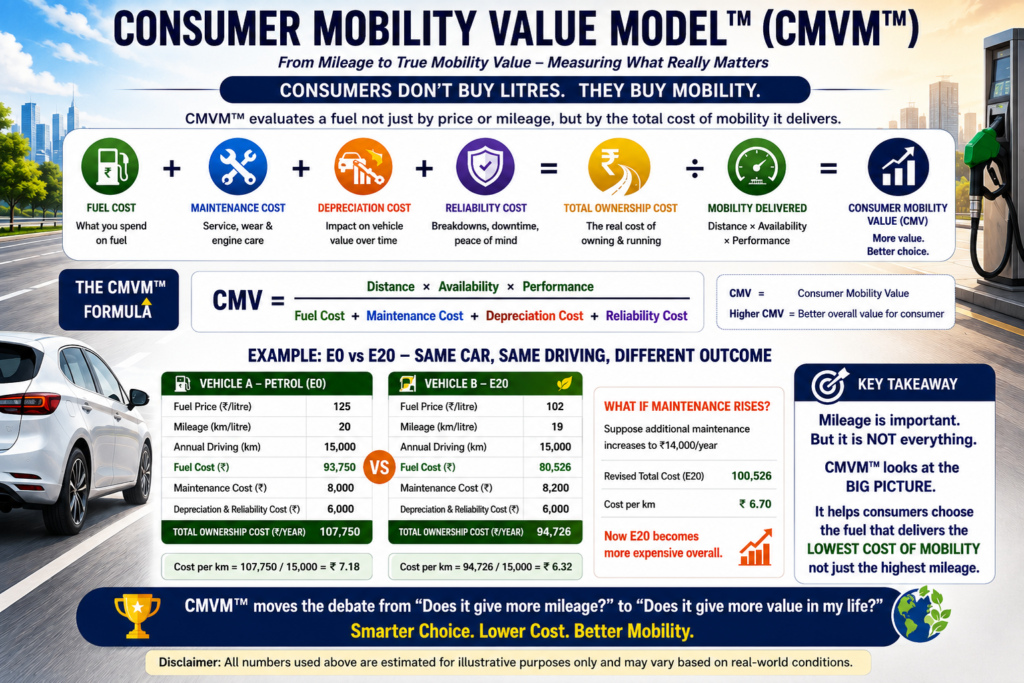
Consider two hypothetical vehicles travelling 15,000 kilometres annually. Vehicle A uses E0 petrol priced at ₹110 per litre and achieves 20 kilometres per litre, while Vehicle B uses E20 petrol priced at ₹102 per litre and achieves 19 kilometres per litre. Although Vehicle B records lower mileage, its annual fuel expenditure may still be lower because of the lower retail fuel price. If routine maintenance remains broadly comparable, the consumer’s overall cost per kilometre could remain unchanged or even decline. Conversely, if maintenance expenditure were to increase materially over time, the economic outcome could reverse despite the lower pump price.
This illustrates why mileage alone cannot determine consumer value.
The appropriate metric is total mobility cost.
Accordingly, the Consumer Mobility Value Model™ proposes that fuel selection should be evaluated through an integrated assessment of fuel expenditure, maintenance costs, long-term vehicle reliability and ownership economics rather than a single performance indicator.
Figure 1 presents the mathematical formulation of the Consumer Mobility Value Model™ together with an illustrative comparison of lifetime mobility cost under different fuel scenarios. The figure demonstrates that consumer value depends upon total ownership economics rather than fuel economy alone.
The Missing Dimension in India’s Fuel Debate
The national conversation surrounding E20 has largely been presented as a technical discussion regarding ethanol chemistry and engine compatibility.
This framing overlooks the broader strategic issue.
The fundamental question is not whether ethanol can be blended with petrol.
The real question is how governments should balance national strategic objectives with consumer autonomy and public confidence.
Every successful economic reform involves trade-offs.
Standardisation improves operational efficiency, reduces logistics costs and simplifies implementation. Consumer choice, however, increases confidence by recognising that markets consist of heterogeneous users with different requirements and expectations.
India’s passenger vehicle fleet clearly reflects this diversity. Vehicles currently operating on Indian roads have been designed over several decades under different engineering standards, emission regulations and fuel assumptions. While newer vehicles are increasingly engineered and validated for E20 compatibility, older vehicles represent a significant portion of the national fleet and continue to influence public perception.
Recognising this diversity does not weaken the strategic rationale for ethanol blending.
Instead, it strengthens the case for evidence-based governance capable of adapting to changing technological, economic and consumer conditions.
Table 1. Government and Consumer Decision Frameworks
| Dimension | Government Perspective | Consumer Perspective |
| Primary Objective | Energy security and macroeconomic resilience | Household affordability and vehicle reliability |
| Success Metric | Reduced crude oil imports and foreign exchange savings | Cost per kilometre and total ownership cost |
| Decision Horizon | Long-term national interest | Immediate and medium-term household economics |
| Principal Concern | Strategic resilience | Mobility value and operating costs |
| Policy Preference | Operational efficiency and standardisation | Transparency, confidence and informed decision-making |
Interim Conclusion
India’s ethanol blending programme represents considerably more than a change in fuel composition. It reflects a broader transformation in national energy strategy.
The Government’s rationale is strategically sound within the context of energy security, while consumer concerns arise from equally valid economic considerations. These perspectives should not be viewed as competing narratives but as complementary dimensions of the same policy challenge.
The Consumer Mobility Value Model™ demonstrates that evaluating fuels solely on mileage can produce misleading conclusions. A more comprehensive assessment requires consideration of total mobility cost and long-term ownership economics.
Part 2: From Fuel Standardisation to Adaptive Fuel Governance
From Standardisation to Optimisation
India’s ethanol blending programme has successfully moved beyond the question of whether large-scale ethanol adoption is operationally feasible. The more important question now is whether the current policy architecture will remain optimal over the next decade as vehicle technology, consumer expectations and global energy markets continue to evolve.
Public policy generally progresses through three stages. The first stage establishes strategic direction. The second focuses on implementation. The third emphasises optimisation through continuous learning. India’s ethanol programme has largely completed the first stage and is well advanced in the second. The next phase should therefore concentrate on refining the policy rather than merely expanding blending targets.
This distinction is significant because standardisation and optimisation are not identical concepts. Standardisation seeks operational simplicity by reducing complexity across the supply chain. Optimisation, on the other hand, attempts to maximise overall value by balancing operational efficiency with consumer welfare, technological readiness and long-term resilience. Policies that remain fixed despite changing economic conditions often become less effective over time, regardless of how successful they were during their initial implementation.
India’s passenger vehicle fleet clearly illustrates this challenge. Vehicles currently operating on Indian roads have been manufactured over several decades under different emission standards, engineering specifications and fuel assumptions. While newly developed passenger vehicles are increasingly engineered and validated for E20 compatibility, millions of older vehicles continue to remain in active service. A policy designed around the newest generation of vehicles may therefore not maximise perceived value across the entire fleet.
The strategic objective should not be to optimise for one generation of vehicles or one stakeholder. The objective should be to maximise long-term national welfare across the entire transport ecosystem.
Lessons from International Fuel Markets
International experience demonstrates that successful ethanol programmes are characterised by gradual evolution rather than rigid implementation.
Brazil’s biofuel programme is frequently regarded as the global benchmark for ethanol adoption. Its success did not arise solely because of higher ethanol blends. Instead, it resulted from decades of coordinated policy involving agricultural planning, fuel infrastructure, automotive engineering and widespread adoption of flex-fuel vehicles. Consumers gradually accepted higher ethanol utilisation because vehicle technology and market infrastructure evolved simultaneously.
The United States adopted a different pathway. Rather than relying exclusively on one fuel specification, multiple ethanol blends coexist according to vehicle compatibility, consumer demand and regional market conditions. This approach demonstrates that market segmentation can operate alongside national energy objectives when supported by clear regulations and appropriate infrastructure.
Several European countries similarly adopted transitional fuel strategies during the introduction of higher ethanol blends. Lower and higher ethanol fuels were available simultaneously for extended periods, allowing owners of legacy vehicles sufficient time to adapt while encouraging gradual technological progression.
These international experiences do not suggest that India should simply replicate another country’s model. India’s economic structure, agricultural capacity, vehicle fleet and fuel demand are unique. The more valuable lesson is that successful energy policies remain adaptive. They evolve continuously in response to technological progress, market behaviour and changing strategic priorities.
Adaptive Fuel Policy Framework™ (AFPF™)
One of the central conclusions emerging from this research is that fuel policy should not be regarded as a fixed regulatory decision. It should instead be viewed as a dynamic governance system capable of responding to measurable changes in the external environment.
The Adaptive Fuel Policy Framework™ has been developed to support this perspective.
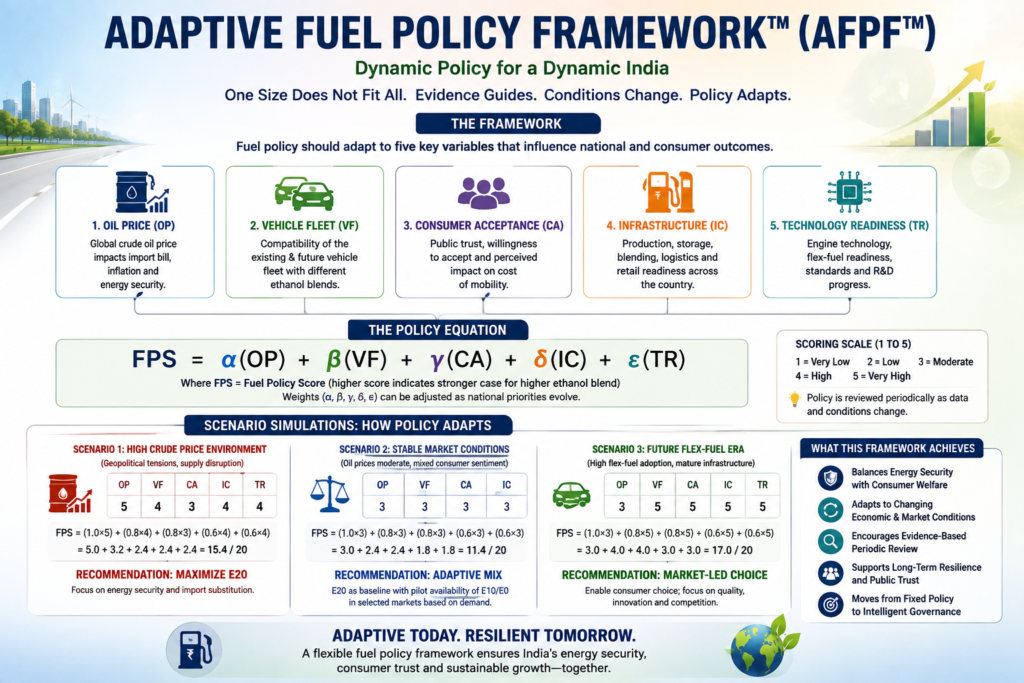
Unlike conventional policy models that assume one permanent solution, the framework proposes that the optimal fuel strategy should continuously respond to five strategic variables: international crude oil prices, passenger vehicle fleet compatibility, consumer acceptance, infrastructure capability and technological readiness.
During periods of elevated crude oil prices, reducing petroleum imports through higher ethanol utilisation generates greater macroeconomic value. Under such circumstances, policies encouraging wider adoption of higher ethanol blends contribute directly to energy security, foreign exchange conservation and national economic resilience.
Conversely, periods characterised by relatively stable crude oil prices, a large legacy vehicle fleet or heightened consumer concerns may justify evaluation of more adaptive implementation models supported by empirical evidence. Such adaptations do not weaken ethanol policy. Instead, they strengthen its long-term sustainability by aligning national objectives with changing market realities.
Looking further ahead, continued advances in engine technology, improved material compatibility and broader deployment of flex-fuel vehicles are likely to reduce many of today’s technical concerns. As these developments occur, future policy decisions may increasingly be influenced by consumer preference and market economics rather than compatibility constraints.
The Adaptive Fuel Policy Framework™ therefore rejects the assumption that effective policy must remain unchanged for decades. Instead, it recognises that resilient governance requires periodic reassessment of underlying assumptions as economic conditions, technological capabilities and consumer behaviour evolve.
Figure 2 illustrates the mathematical structure of the Adaptive Fuel Policy Framework™ together with scenario-based simulations demonstrating how changes in crude oil prices, vehicle fleet composition, consumer acceptance, infrastructure capability and technology readiness influence strategic fuel policy decisions.
Strategic Implications for India
The findings of this research indicate that India’s ethanol programme should now transition from an implementation-oriented strategy to a learning-oriented strategy.
Future policy discussions should move beyond debating whether ethanol blending is inherently good or bad. The more relevant question is whether the existing policy architecture continues to maximise national welfare under changing conditions.
This shift requires broader measures of success.
Blending percentages remain important indicators of programme implementation. However, they should no longer represent the sole measure of policy performance.
Future evaluation should also incorporate consumer mobility cost, vehicle compatibility, infrastructure resilience, public confidence, lifecycle environmental performance and long-term energy security. Together these indicators provide a more comprehensive understanding of whether the programme continues creating value across all stakeholder groups.
Such an approach encourages continuous policy improvement rather than periodic policy correction.
Strategic Recommendations
The findings of this study suggest that India’s long-term ethanol strategy should continue to prioritise energy security while progressively strengthening consumer confidence through evidence-based governance.
First, future programme evaluation should gradually shift from target-based measurement towards outcome-based measurement. Ethanol blending percentages represent implementation achievements, whereas consumer mobility cost, foreign exchange savings, infrastructure resilience and public confidence provide a broader assessment of long-term policy effectiveness.
Second, periodic independent evaluation should become an integral component of future policy reviews. Real-world studies examining vehicle durability, maintenance expenditure, fuel economy and lifecycle environmental performance would strengthen public confidence while providing policymakers with higher-quality evidence for future decision-making.
Third, greater emphasis should be placed upon consumer information and transparency. Consumers require accessible technical guidance regarding vehicle compatibility, expected operating costs and fuel selection. Well-informed consumers are considerably more likely to support long-term reforms than consumers who rely primarily upon anecdotal information.
Finally, India’s fuel strategy should remain adaptive rather than static. Economic conditions, global crude oil prices, automotive technologies and consumer behaviour will continue to evolve throughout the coming decade. Public policy should evolve alongside these developments while preserving its central objective of strengthening India’s long-term energy resilience.
Conclusion
India’s ethanol blending programme represents one of the country’s most significant structural reforms in the transport energy sector. The evidence examined throughout this paper supports the strategic rationale underlying the programme. Reducing dependence on imported crude oil strengthens national energy security, improves macroeconomic resilience and supports the development of a domestic biofuel economy.
At the same time, sustainable public policy cannot rely exclusively upon macroeconomic success. Long-term acceptance also depends upon consumer confidence, institutional credibility and continuous policy adaptation.
The Consumer Mobility Value Model™ demonstrates that fuels should be evaluated through total mobility economics rather than mileage alone. The Adaptive Fuel Policy Framework™ further illustrates that effective energy policy should remain responsive to changing economic conditions, technological progress and consumer expectations.
The future of India’s fuel ecosystem should therefore be judged not by whether it achieves a predetermined blending percentage, but by whether it successfully balances national strategic interests with consumer welfare, technological innovation and adaptive governance.
Policies that continuously learn from evidence are generally more resilient than policies that remain permanently fixed. The long-term success of India’s ethanol programme will ultimately depend not only upon the quantity of ethanol blended into petrol but also upon the quality of governance supporting its evolution.
References
- Government of India, Ministry of Petroleum & Natural Gas. (2018). National Policy on Biofuels, 2018. Ministry of Petroleum & Natural Gas. (Prime Minister of India)
- Government of India, Ministry of Petroleum & Natural Gas, & NITI Aayog. (2021). Roadmap for Ethanol Blending in India 2020–2025. (NITI Aayog)
- Government of India. Petroleum Planning & Analysis Cell (PPAC). India Petroleum Statistics and Ethanol Blending Programme Dashboard. (Petroleum Planning & Analysis Cell)
- International Energy Agency (IEA). (2024). Roadmap for Ethanol Blending in India 2020–25. (IEA)
- International Energy Agency (IEA). (2023). National Policy on Biofuels (2022 Amendment). (IEA)
- Government of India. Press Information Bureau (PIB). (2026). Ethanol Blended Petrol Programme: Frequently Asked Questions. (Press Information Bureau)
- Society of Indian Automobile Manufacturers (SIAM). Industry reports, technical publications and vehicle compatibility guidance.
- International Renewable Energy Agency (IRENA). Renewable energy and bioenergy publications.
- U.S. Department of Energy Alternative Fuels Data Center. Alternative fuels, ethanol blends and flex-fuel vehicle resources.
- The Times of India. (2026, July). Petrol would’ve hit ₹125/litre in Delhi without ethanol blend, says government. (Referenced for the Government’s public position regarding ethanol blending and retail fuel prices.)
- Millinger, M., Reichenberg, L., Hedenus, F., Berndes, G., Zeyen, E., & Brown, T. (2022). Are biofuel mandates cost-effective? An analysis of transport fuels and biomass usage to achieve emissions targets in the European energy system. arXiv. (arXiv)
- Saraf, N., & Shastri, Y. (2024). Impact of consumer preferences on decarbonization of transport sector in India. arXiv. (arXiv)
Disclaimer
This article presents an independent strategic assessment prepared for research, policy dialogue and educational purposes. The views, interpretations, analytical frameworks and strategic models presented herein are the independent work of the author and do not necessarily reflect the views of any government, regulatory authority, automobile manufacturer, oil marketing company or other organisation.
The proprietary frameworks introduced in this paper, including the Consumer Mobility Value Model™ (CMVM™) and the Adaptive Fuel Policy Framework™ (AFPF™), are conceptual decision-support tools developed to facilitate strategic thinking and policy evaluation. They are intended to complement, not replace, detailed engineering studies, economic modelling or regulatory analysis.
Wherever possible, the analysis is based on publicly available government publications, policy documents, industry reports and internationally recognised research. References to Government statements, including the reported estimate that petrol prices could have reached approximately ₹125 per litre without ethanol blending, are presented as policy positions or publicly reported claims and should not be interpreted as independently validated conclusions unless explicitly stated.
Illustrative examples, scenario analyses and numerical demonstrations used in this paper are intended to explain strategic concepts and should not be construed as forecasts, investment advice, engineering recommendations or legal opinions. Readers are encouraged to consult official Government notifications, vehicle manufacturers’ recommendations, peer-reviewed technical literature and qualified professionals before making policy, engineering, commercial or financial decisions.
Copyright © Ratin Mathur. All rights reserved. No part of this publication may be reproduced, distributed or transmitted in any form without appropriate attribution or prior written permission from the author. The proprietary frameworks and original analytical concepts contained in this paper remain the intellectual property of the author.