The R&D, Patent and Boardroom Imperative for Viksit Bharat 2047

Executive Summary
India’s economic transformation has entered a new phase. The country has moved from being primarily a market and manufacturing location to becoming a major global center for engineering, software, analytics, Global Capability Centers and increasingly sophisticated product development. Yet one fundamental question remains unresolved: Will India capture the highest-value economic layers of innovation, or will it continue to perform much of the work while strategic intellectual property, product ownership and technology economics remain concentrated elsewhere?
The traditional multinational corporation, or MNC, model helps explain the issue. Headquarters historically retained fundamental research, global product architecture, strategic technology decisions and intellectual-property ownership, while India focused on manufacturing, engineering execution, localization, software development, shared services and market delivery. That model was commercially rational. MNCs could combine centralized global IP governance with India’s engineering talent, cost competitiveness and expanding market.
However, the model is changing. India’s GCC ecosystem now includes 2,117 centers, approximately 2.36 million professionals and an estimated $98.4 billion in revenue in FY2026. Zinnov and Nasscom report that 39% of GCCs have reached “Portfolio Hub” status, characterized by end-to-end ownership from India across product, platform and IP responsibilities, while another 5% are classified as “Transformation Hubs”. This suggests that India’s role is already moving beyond the traditional back-office model.
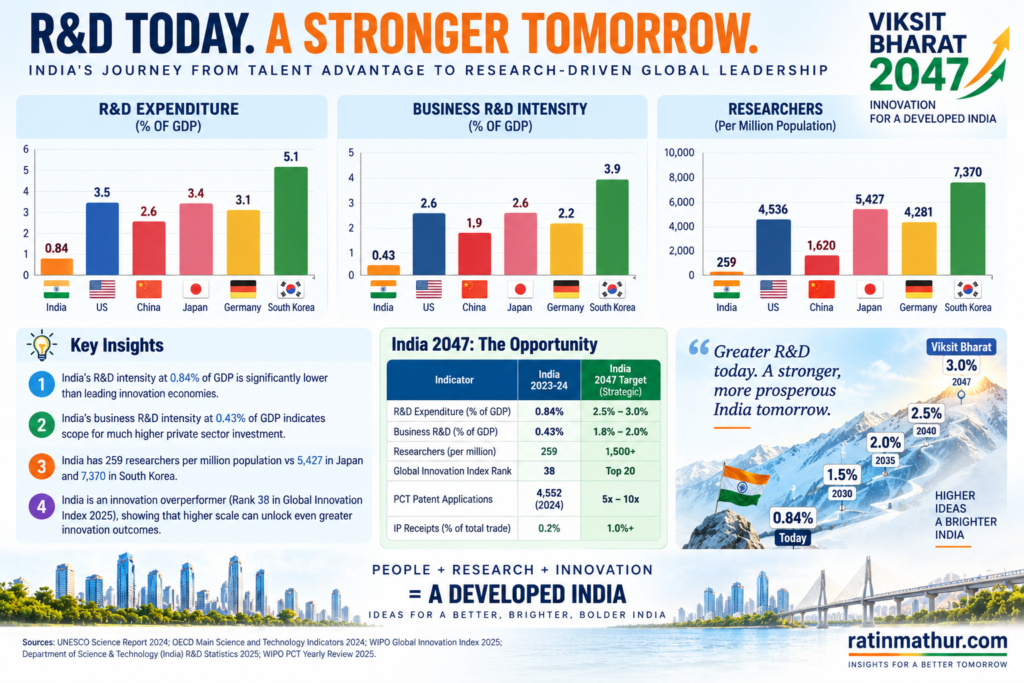
At the same time, the scale of India’s national R&D effort remains constrained. Official government data show that Gross Expenditure on Research and Development increased to approximately ₹2.45 lakh crore in FY2023-24, equivalent to 0.84% of GDP. Importantly, private industry accounted for 51.8% of national R&D expenditure, exceeding the government sector for the first time.
India’s patent activity is also accelerating. In FY2024-25, 110,375 patent applications were filed in India, including 68,201 by Indian applicants. Globally, India-origin PCT applications increased 22.2% in 2024 to 4,552. Yet this remains far below the international patenting scale of China, the United States, Japan and South Korea.
The evidence therefore points to a nuanced conclusion. India’s problem is not a fundamental absence of talent, policy support or innovation. India is already an innovation overperformer according to WIPO, ranking 38th in the Global Innovation Index 2025 and outperforming what would be expected from its income level. The larger structural challenge is the conversion of scientific and engineering capability into globally owned products, international patents, technology licensing, global product leadership and sustained economic value capture.
For corporate boards, this creates a strategic question rather than merely an operational one. The relevant metric should no longer be how many engineers an MNC employs in India. It should be how much global technology responsibility, product decision-making, invention, intellectual property and economic value is being created from India.
For policymakers, the objective should not be to force foreign-owned companies to transfer legitimate global IP into India. Such an approach could weaken India’s investment proposition. The objective should be to make India sufficiently attractive that MNCs voluntarily locate increasingly strategic R&D, product leadership and technology mandates in India.
For Viksit Bharat 2047, the transformation can be expressed in one sentence: India must move from participating in global value chains to designing, owning and leading global value chains.
Introduction
The development story of modern economies is increasingly a story of intangible capital. Factories, ports, highways and physical infrastructure remain essential, but the highest economic returns increasingly arise from technology, intellectual property, software, scientific knowledge, brands, product architecture, advanced manufacturing processes and organizational capabilities.
This creates a strategic paradox for India. The country possesses one of the world’s largest pools of engineers and technology professionals, a rapidly expanding domestic market, a sophisticated digital ecosystem, a large GCC base and a growing startup economy. Yet the economic ownership of many globally important technologies developed with Indian talent remains concentrated in multinational parent organizations outside India.
This does not necessarily represent exploitation, policy failure or corporate misconduct. Under global corporate structures, intellectual property is normally allocated through employment agreements, corporate funding arrangements and R&D governance. WIPO notes that, in many countries, inventions created by employees in the course of employment generally belong to the enterprise, subject to applicable law and contractual arrangements, while the employee remains recognized as the inventor.
The strategic concern is therefore different. If India contributes talent and engineering effort but consistently remains on the lower-value side of the intellectual property and product ownership equation, India may capture salaries and operating expenditure without capturing the full economic rents associated with innovation.
This distinction matters because developed economies tend to combine research, capital, intellectual property, technology commercialization and global market access. Viksit Bharat therefore requires more than higher production. It requires a greater share of the global innovation economy to originate from India.
Problem Statement and Objectives
The central problem can be stated as follows: India has achieved considerable scale in engineering and technology execution, but it has not yet achieved comparable scale in globally strategic research, IP creation, product ownership, technology commercialization and innovation-led economic value capture.
The issue has four dimensions: location of R&D, ownership of IP, allocation of strategic decision rights and commercialization of technology.
| Dimension | Traditional MNC pattern | Emerging Indian opportunity |
|---|---|---|
| Research | Concentrated near global headquarters | Distributed across global innovation centers |
| Engineering | Large-scale execution in India | India-led product and platform engineering |
| IP | Frequently managed and owned by parent entities | Increasing India-origin patent portfolios |
| Product decisions | Predominantly global headquarters | Increasing global product mandates from India |
| Commercialization | Global headquarters and major markets | India as technology development and export base |
| Board oversight | Cost, headcount and delivery | Technology, IP, talent and value creation |
The objectives of this paper are to determine why the traditional pattern emerged, assess whether India’s policies and skills are adequate, identify the structural constraints between research and commercialization, examine the implications for MNC boards and Indian corporate boards, and propose an actionable strategic architecture aligned with Viksit Bharat 2047.
Methodology
The analysis uses a strategic-policy approach combining official Indian government data, international intellectual-property and innovation indicators, multinational R&D evidence, GCC ecosystem data and contemporary policy developments.
Primary evidence includes NITI Aayog’s 2026 “Ease of Doing Research & Development in India” study, Department of Science and Technology R&D statistics, the Indian Patent Office Annual Report 2024-25, WIPO’s Global Innovation Index 2025 and PCT data, OECD R&D indicators and the 2026 Nasscom-Zinnov GCC Landscape. The analysis also considers documented examples of MNCs operating substantive global R&D organizations in India.
The assessment distinguishes between four concepts that are often conflated: where research is performed, where an inventor is located, where a patent is legally owned and where the associated economic value is ultimately captured. This distinction is essential for a meaningful board-level discussion.
Landscape Analysis
India’s innovation ecosystem is stronger than a simplistic narrative would suggest. WIPO ranked India 38th in the Global Innovation Index 2025, first within Central and Southern Asia and as a persistent innovation overperformer relative to its development level. India ranked 32nd on innovation outputs against 52nd on innovation inputs, indicating relatively efficient conversion of available resources into innovation outcomes.
The patent ecosystem has also expanded materially.
| Indicator | Latest evidence |
|---|---|
| Indian patent applications, FY2024-25 | 110,375 |
| Applications by Indian applicants | 68,201 |
| Indian applicants’ share | 61.79% |
| Growth in Indian applicant filings | 32.23% |
| India-origin PCT applications, 2024 | 4,552 |
| GII 2025 rank | 38 |
| GII innovation output rank | 32 |
| GII innovation input rank | 52 |
Sources: IP India and WIPO.
The R&D expenditure trajectory also shows structural improvement. GERD increased from ₹1.33 lakh crore in FY2019-20 to ₹2.45 lakh crore in FY2023-24, while the private-sector share increased from 33.8% to 51.8%.
However, the absolute intensity remains modest. NITI Aayog’s 2026 R&D study recommends increasing GERD to at least 2% of GDP over the next four to five years as part of strengthening the research base required for Viksit Bharat 2047.
The contrast with leading innovation economies is significant. OECD data show that the business sector accounted for approximately 73% of total R&D expenditure across the OECD in 2024.
India has therefore made two important transitions simultaneously: private industry is becoming the largest contributor to national R&D spending, while India’s GCC ecosystem is becoming increasingly involved in global product and IP responsibilities.
Key Findings
The first finding is that the traditional concentration of strategic R&D at MNC headquarters is economically rational from the perspective of corporate governance. Global headquarters typically controls corporate strategy, capital allocation, product portfolios, legal IP architecture and global commercialization. Centralizing these functions reduces coordination costs and simplifies ownership.
The second finding is that India does not have a fundamental skills deficit. India has abundant engineering and technology talent and is increasingly strong in software, AI, analytics and product engineering. The more difficult shortage is in frontier research density, senior scientific leadership, translational capability, advanced laboratories and commercialization expertise. WIPO’s 2025 profile shows India performing relatively well in knowledge and technology outputs but significantly less strongly in several aspects of human capital, research depth and institutional capability.
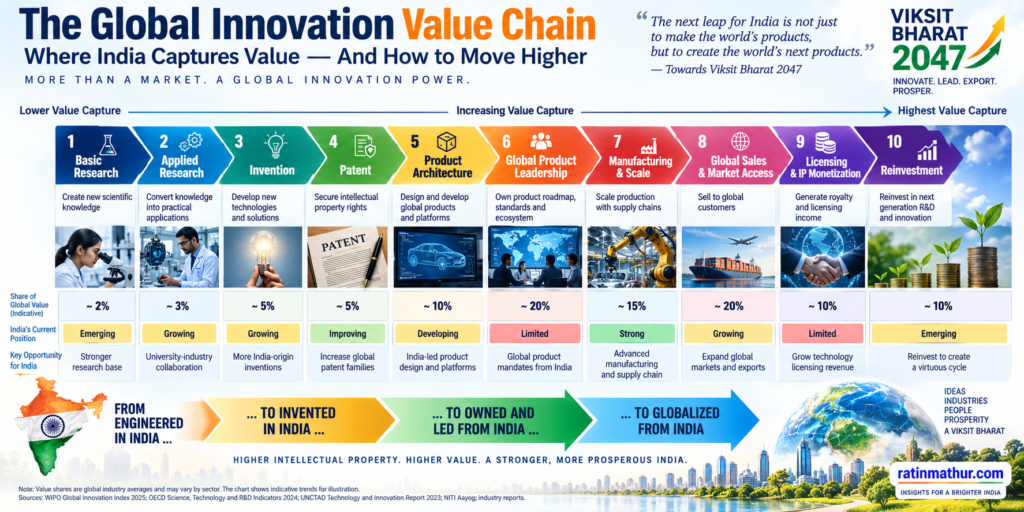
The third finding is that the weakest link is frequently the middle of the innovation chain.
NITI Aayog’s 2026 study identifies weak technology-transfer offices, inadequate IP cells, ownership ambiguity, limited TRL 3 to 6 prototyping and validation infrastructure, weak university-industry linkages, insufficient translational finance and limited regulatory sandbox capabilities.
This is strategically important because an invention does not become economic value merely because a patent exists.
| Innovation stage | India capability | Strategic gap |
|---|---|---|
| Scientific discovery | Growing | Scale and researcher density |
| Applied research | Moderate to strong in selected sectors | Fragmented ecosystems |
| Patent generation | Rapidly improving | International scale |
| Prototype development | Uneven | TRL 3 to 6 infrastructure |
| Validation and certification | Uneven | Cost and availability |
| Commercialization | Improving | Weak technology transfer |
| Global product ownership | Emerging | Concentrated outside India |
| Global licensing | Limited relative to potential | IP commercialization capability |
The fourth finding is that MNC behavior responds to ecosystem economics, not patriotism. OECD research on international business R&D shows that research locations are influenced by the quality and scale of knowledge bases, access to universities and research networks, specialized talent and innovation infrastructure.
The fifth finding is that India already has proof that MNCs can place sophisticated R&D in the country. Microsoft’s India Development Center describes itself as one of Microsoft’s largest R&D centers outside Redmond, while GE’s John F. Welch Technology Centre in Bengaluru has historically conducted global technology and engineering programs.
The sixth finding is that the government’s support architecture is now materially stronger. The ₹1 lakh crore RDI Fund is designed to catalyze private R&D through long-term loans, equity and deep-tech fund mechanisms. By July 2026, the Technology Development Board had approved 22 projects involving ₹2,192 crore of RDI support, while BIRAC had shortlisted eight projects involving ₹390.35 crore.
The policy question is therefore no longer whether India supports R&D. It is whether support mechanisms are sufficiently integrated, fast, predictable and commercially oriented to transform R&D into globally competitive technology businesses.
Challenges and Opportunities
The core challenge is institutional fragmentation. Research policy, higher education, industrial policy, taxation, intellectual property, startup financing, procurement and manufacturing incentives often operate through different policy structures.
The second challenge is the low density of advanced research. A large engineering workforce can deliver outstanding product development without automatically creating a world-class research ecosystem. India needs more principal investigators, postdoctoral researchers, senior scientists, specialist laboratories and technology leaders.
The third challenge is corporate risk tolerance. MNC boards must justify R&D capital through expected risk-adjusted returns. Research conducted in India will receive larger mandates when India offers not merely lower cost but superior innovation economics.
The fourth challenge is technology transfer. India may generate useful research but lose economic value if technology remains inside laboratories, fails to obtain commercial validation or is not connected to customers and manufacturing partners.
The fifth challenge is global IP commercialization. India’s IP receipts remain relatively modest. WIPO’s 2025 India profile places intellectual property receipts at only 0.2% of total trade, highlighting the distance between producing knowledge and monetizing it globally.
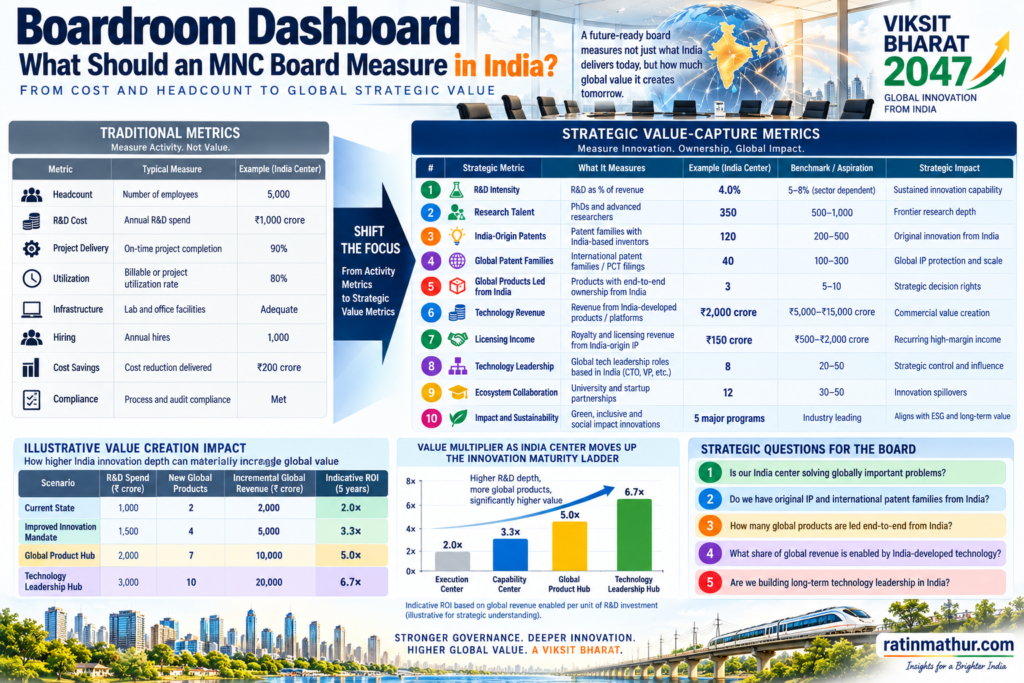
The sixth challenge is board-level measurement. Corporate boards often receive metrics on R&D expenditure, headcount, project schedules and patent counts. Those measures are insufficient for strategic value creation.
A board needs to understand whether its Indian R&D operation is actually gaining global decision rights.
| Traditional board metric | Strategic board metric |
|---|---|
| Number of engineers | Number of global technology leaders |
| R&D cost | R&D value generated |
| Patent count | Strategic patent families and commercial relevance |
| Headcount growth | High-value capability growth |
| Development projects | Global products led from India |
| Local revenue | Global revenue enabled from India |
| Cost savings | IP and productivity value |
| Center utilization | Global mandate ownership |
| Hiring | Researcher quality and retention |
The opportunity is substantial because India possesses three characteristics rarely available simultaneously: market scale, technical talent and a large existing base of multinational operations. The country can therefore become not only an R&D destination but an innovation orchestrator.
Strategic Frameworks & Recommendations
Strategic Framework 1: India Global IP Capture Cycle™
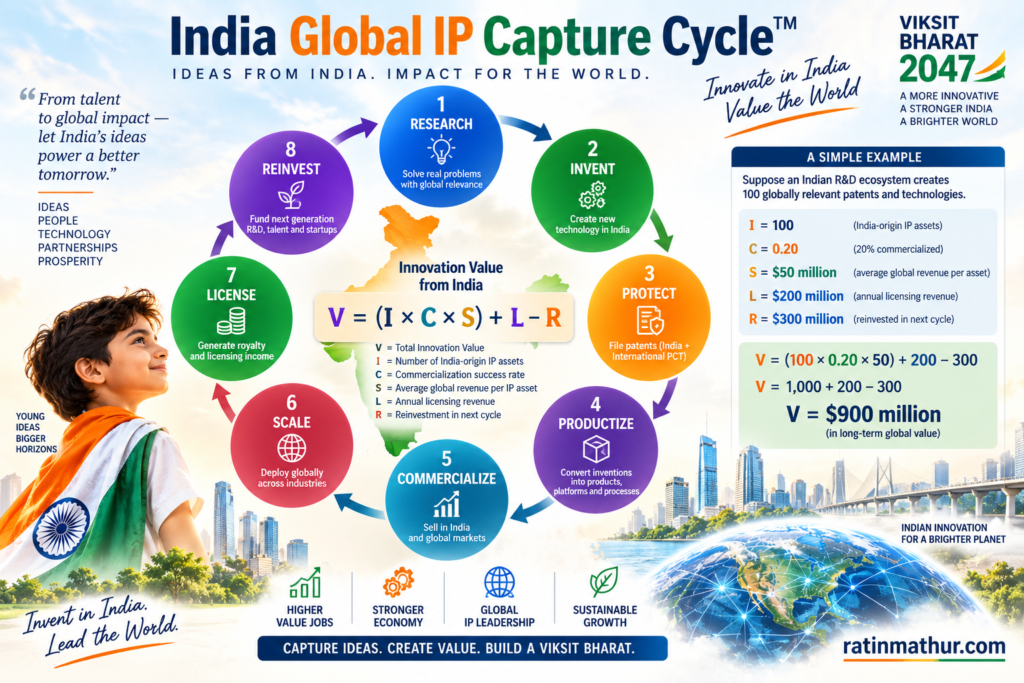
The India Global IP Capture Cycle™ is designed to address the central economic problem identified in this paper: the gap between conducting R&D in India and capturing the full economic value of that R&D.
The framework argues that the innovation chain should be managed as a continuous cycle rather than a series of disconnected activities. The strategic sequence is Research → Invent → Protect → Productize → Commercialize → Scale → License → Reinvest. The objective is not to demand that every MNC transfer global ownership of intellectual property to India. The objective is to maximize the amount of innovation activity, technology leadership, commercialization and reinvestment economically connected to India.
| Stage | Board question | Desired India outcome | Example |
|---|---|---|---|
| Research | What problems are India teams solving? | Global research mandates | Advanced automotive materials research |
| Invent | Where are core inventions originating? | India-based inventors | New manufacturing technology |
| Protect | Is India-origin IP internationally protected? | Global patent families | PCT filings from India-based teams |
| Productize | Who owns the product roadmap? | India-led product responsibility | Global industrial software platform |
| Commercialize | Where is the technology sold? | Global exports from India | Product developed and exported worldwide |
| License | Can technology generate recurring IP income? | Licensing economics | Industrial technology licensing |
| Reinvest | Where do innovation proceeds return? | Higher Indian R&D | Expanded laboratories and talent |
A hypothetical automotive example illustrates the framework. An MNC’s Indian engineering team identifies a new low-energy manufacturing process. Under a conventional model, India develops the process under specifications determined elsewhere, the parent controls the patent strategy and the technology is deployed globally. Under the India Global IP Capture Cycle™, the Indian center receives authority to lead research, creates the invention, participates in global patent strategy, develops the technology into a scalable product or manufacturing process, supports global deployment and becomes the principal innovation center for the next generation of the technology.
The critical board metric is therefore not “How many patents belong to India?” but “How much global economic value can be traced to India-origin innovation?” This creates a more commercially rational and globally compatible model of technology localization.
Strategic Framework 2: MNC R&D Sovereignty-to-Leadership Ladder™
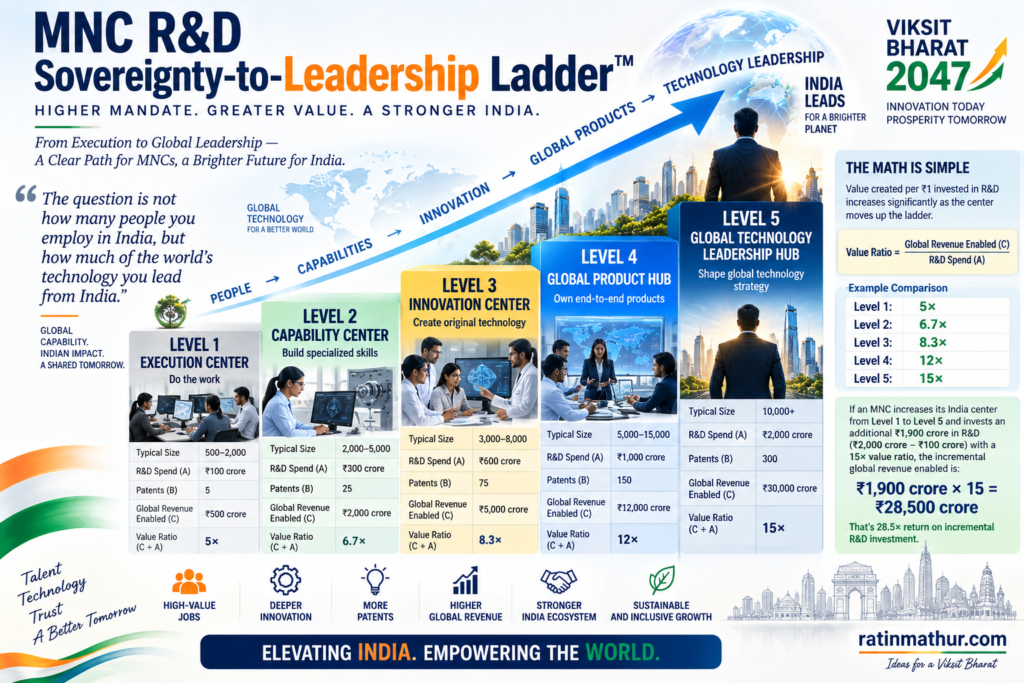
The MNC R&D Sovereignty-to-Leadership Ladder™ provides boards and policymakers with a maturity model for evaluating the strategic depth of an MNC’s India operation. It recognizes that an organization can have a very large engineering center while retaining limited strategic influence.
The framework has five maturity levels: Execution Center, Capability Center, Innovation Center, Global Product Hub and Global Technology Leadership Hub.
| Level | Core role | Decision rights | Typical economic value |
|---|---|---|---|
| 1. Execution Center | Specified engineering work | Low | Cost and delivery |
| 2. Capability Center | Specialized engineering | Moderate | Capability and productivity |
| 3. Innovation Center | Original technology development | Increasing | IP and innovation |
| 4. Global Product Hub | End-to-end product ownership | High | Global revenue and IP |
| 5. Global Technology Leadership Hub | Global technology strategy | Very high | Strategic technology value |
The board should determine not only where its engineers sit, but at what maturity level its India operation operates.
A company can, for example, employ 8,000 engineers in India and still remain at Level 2 if the global headquarters determines the technology roadmap, approves significant technical investment and owns all major product decisions. Conversely, an India operation employing 2,500 highly specialized professionals could be operating at Level 4 or Level 5 if it owns global products, patent portfolios and technological roadmaps.
This framework has direct relevance to the GCC transformation already documented by Nasscom and Zinnov. Their 2026 landscape indicates that 39% of Indian GCCs are Portfolio Hubs with end-to-end ownership from India, while 5% are Transformation Hubs.
The board-level implication is profound. MNC directors should establish explicit targets for the movement of Indian operations up the maturity ladder. Government can reinforce this movement through incentives linked to global R&D mandates, product ownership, advanced research, patent generation, Indian university partnerships and technology commercialization.
The policy objective should therefore be to make India a place where the fifth level is economically attractive, not administratively mandatory.
Strategic Framework 3: Viksit Bharat Innovation Value Capture Scorecard™
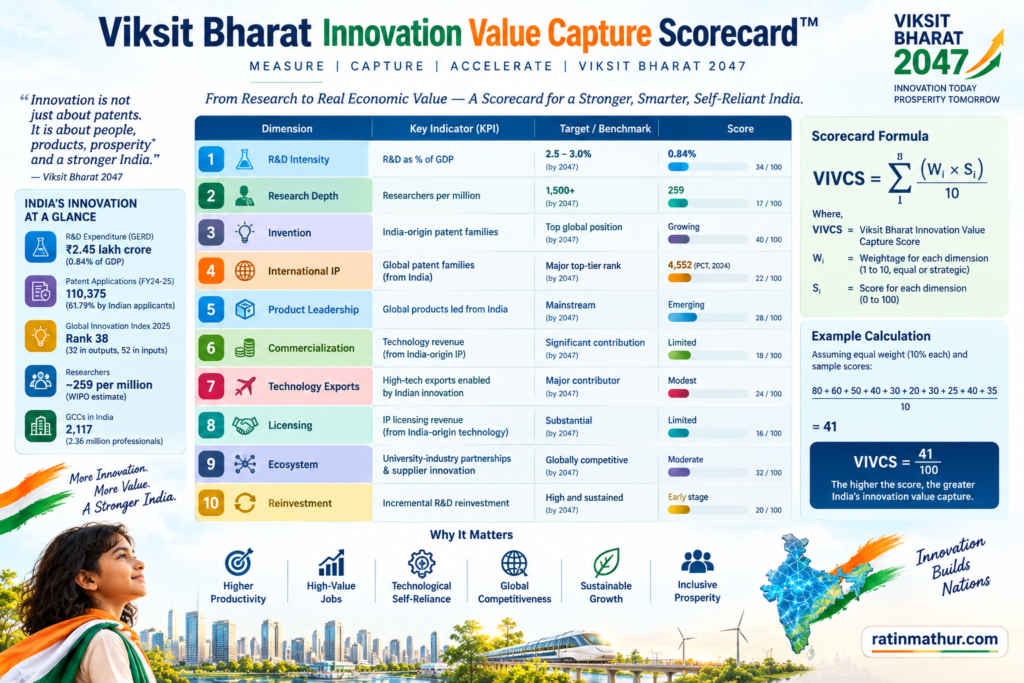
The Viksit Bharat Innovation Value Capture Scorecard™ converts the national innovation challenge into a measurable board and policy dashboard. Its underlying principle is that economic development depends not simply on the amount of R&D performed but on how effectively research is converted into productivity, products, patents, exports, licensing income and high-value employment.
The scorecard should be used by boards of major corporations, government agencies and industry bodies to assess whether innovation expenditure is generating strategic economic value.
| Scorecard dimension | Suggested KPI | Board-level question |
|---|---|---|
| R&D intensity | R&D as % of revenue | Are we investing enough for our sector? |
| Research depth | PhDs and advanced researchers | Are we building frontier capabilities? |
| Invention | India-origin inventions | Where is new knowledge being created? |
| International IP | Global patent families | Is innovation globally protected? |
| Product leadership | Global products led from India | Does India control product decisions? |
| Commercialization | Revenue from new technology | Is research becoming business value? |
| Technology exports | Global revenue enabled from India | Is India serving the world? |
| Licensing | IP receipts and royalty income | Are intangible assets monetized? |
| Ecosystem | University and supplier partnerships | Are innovation spillovers growing? |
| Reinvestment | Incremental R&D reinvestment | Does success strengthen the next cycle? |
A board applying this framework to an Indian MNC subsidiary might discover that R&D expenditure is rising rapidly while global product ownership remains unchanged. The issue then becomes visible as a strategic gap rather than as a successful R&D program based solely on expenditure.
At the national level, the framework can support a shift from patent-count policymaking to value-capture policymaking. India should continue tracking patents, researchers and R&D spending, but add global product ownership, technology exports, licensing revenue, commercialization and Indian-origin innovation mandates.
The three frameworks together create an integrated architecture.
| Strategic question | Applicable framework | Desired outcome |
|---|---|---|
| How do we capture more innovation value? | India Global IP Capture Cycle™ | Research converted into economic value |
| How deeply is India embedded in global MNC technology? | MNC R&D Sovereignty-to-Leadership Ladder™ | Global mandates migrate to India |
| How do we measure whether the system is succeeding? | Viksit Bharat Innovation Value Capture Scorecard™ | Technology translates into productivity and value |
Government should complement these frameworks by strengthening the mechanisms already identified by NITI Aayog: faster funding, flexible procurement, stronger technology-transfer offices, better translational infrastructure, higher researcher mobility, stronger industry linkages and a more outcome-focused R&D system.
The ₹1 lakh crore RDI Fund should increasingly operate as a bridge between research and commercialization, particularly for technologies that require long development cycles and substantial validation capital. Its current architecture already permits long-term unsecured loans, equity financing and contributions to deep-tech funds.
India should also introduce stronger incentives for incremental R&D. International evidence shows that expenditure-based and income-based R&D incentives are widely used globally. OECD data for 2025 show that 33 of 38 OECD jurisdictions offered expenditure-based R&D tax relief, demonstrating the competitive policy environment in which India is attempting to attract mobile R&D investment.
For MNCs, the policy proposition should be straightforward: India will not demand that legitimate global IP structures be dismantled, but India will make it progressively more attractive to locate global technology responsibility in the country.
For boards, the agenda should be elevated from “R&D operations” to “technology sovereignty and value creation.” The board should understand the location of core research, ownership of product roadmaps, international patent strategy, technology-transfer arrangements, researcher retention, university partnerships and the share of global product revenues enabled from India.
Future Outlook and Conclusion
The next twenty years will determine whether India remains primarily a large consumer, manufacturing and services economy or becomes a major global technology and innovation power.
There are encouraging signs. India’s private sector now accounts for more than half of national R&D spending. Patent filings are rising. India’s GCC ecosystem is moving toward global ownership. The country has a stronger policy architecture than at any previous point in its economic history. The government has created a major RDI financing mechanism, and NITI Aayog has explicitly identified the reforms required to improve India’s research environment.
But scale will determine outcomes.
India’s R&D intensity remains below what would be expected of an economy targeting sustained high growth and global technological leadership. International patenting remains modest relative to the leading innovation economies. University-industry collaboration and technology transfer remain important bottlenecks. Deep research capacity must expand. Most importantly, India needs more global technology decision-making to take place within the country.
The strategic objective should therefore not be framed as “Indian companies versus MNCs.” It should be framed as India versus the limits of its own position in the global innovation value chain.
MNCs can become powerful accelerators of India’s technological transformation. A global company with a major India R&D center can bring sophisticated technologies, demanding customers, global standards, research practices, supplier development, capital and international market access. The policy challenge is to ensure that these activities generate increasingly deep domestic spillovers.
The ultimate transition should be from an economy where India is told what to build toward an economy where technology decisions are increasingly made in India.
The progression can be understood through a simple strategic sequence.
| Development stage | India’s economic position |
|---|---|
| Made in India | Manufacturing destination |
| Engineered in India | Engineering destination |
| Invented in India | Innovation destination |
| Patented from India | IP creation destination |
| Product-led from India | Technology leadership destination |
| Commercialized globally from India | Global innovation power |
This is the R&D dimension of Viksit Bharat 2047.
NITI Aayog’s current policy work recognizes that achieving Viksit Bharat requires a stronger research and innovation base. The challenge now is to convert policy ambition into institutional execution and corporate behavior.
The ultimate test of success will not be whether India has the world’s largest GCC workforce, the highest patent growth rate or thousands of research centers.
The more meaningful question will be:
How many globally important products, platforms, technologies and intellectual-property portfolios will the world associate with innovation originating from India?
A genuinely developed India should not merely be a place where the products of global companies are manufactured or engineered.
It should increasingly be a place where those products are conceived, researched, patented, designed, led, commercialized and exported to the world.
That is the difference between being part of the global innovation system and becoming one of its principal architects.
And for corporate boards, policymakers and institutional investors, that difference may become one of the defining strategic questions of the Viksit Bharat journey toward 2047.
References
- NITI Aayog. (2026). Ease of Doing Research & Development in India: Removing Obstacles, Promoting Enablers. Government of India. NITI Aayog report
- Department of Science and Technology, Government of India. (2026). Research & Development Statistics 2025-26. Government of India. Government R&D expenditure data
- Office of the Controller General of Patents, Designs and Trade Marks. (2025). Annual Report 2024-25. Government of India. IP India Annual Report 2024-25
- World Intellectual Property Organization. (2025). Global Innovation Index 2025: India. Geneva: WIPO. WIPO India GII 2025 profile
- World Intellectual Property Organization. (2025). Global Innovation Index 2025. Geneva: WIPO. WIPO Global Innovation Index 2025 results
- World Intellectual Property Organization. (2025). PCT Yearly Review 2025. Geneva: WIPO. WIPO PCT Yearly Review 2025
- World Intellectual Property Organization. (2026). Frequently Asked Questions: Patents. Geneva: WIPO. WIPO patent ownership guidance
- World Intellectual Property Organization. (2026). FAQs: Technology Transfer. Geneva: WIPO. WIPO technology transfer guidance
- OECD. (2026). OECD overall R&D growth stable; government R&D budgets decline and reorient towards defence. Paris: OECD. OECD R&D indicators 2026
- OECD. (2026). Corporate Tax Statistics 2026: Tax incentives for research and development. Paris: OECD. OECD Corporate Tax Statistics 2026
- OECD. (2008). The Internationalisation of Business R&D: Evidence, Impacts and Implications. Paris: OECD Publishing. OECD Internationalisation of Business R&D
- UNCTAD. (2005). World Investment Report 2005: Transnational Corporations and the Internationalization of R&D. Geneva: United Nations Conference on Trade and Development. UNCTAD R&D internationalization report
- Nasscom & Zinnov. (2026). GCC Landscape in India 2026: The GCC Value Orbit. Nasscom-Zinnov GCC Landscape 2026
- Anusandhan National Research Foundation. (2026). Research, Development and Innovation Fund: Funding Mechanism. Government of India. RDI Fund mechanism
- Press Information Bureau. (2026). RDI Fund under ANRF. Government of India. RDI Fund implementation update
- Microsoft. (2026). Microsoft India Development Center. Microsoft India. Microsoft India Development Center
- GE. (2026). Going Places: These Indian Engineers Are Helping Solve the World’s Toughest Problems. GE News. GE John F. Welch Technology Centre
- NITI Aayog. (2026). DPI@2047 for Viksit Bharat: A Strategic Roadmap to Enable Non-linear Inclusive Socio-economic Growth. Government of India. DPI@2047 report
Disclaimer
This article is an independent strategic analysis prepared for informational and professional discussion. The three frameworks, namely India Global IP Capture Cycle™, MNC R&D Sovereignty-to-Leadership Ladder™, and Viksit Bharat Innovation Value Capture Scorecard™, are original analytical constructs developed for this article and are intended for conceptual and strategic use. The framework names and underlying models should not be interpreted as government policy, formal benchmarks, investment recommendations or legal advice. Government policies, R&D statistics, corporate strategies and international innovation indicators may change over time. Readers should verify current policies, corporate disclosures, legal provisions and statistical releases before making business, investment, governance or policy decisions.