Abstract
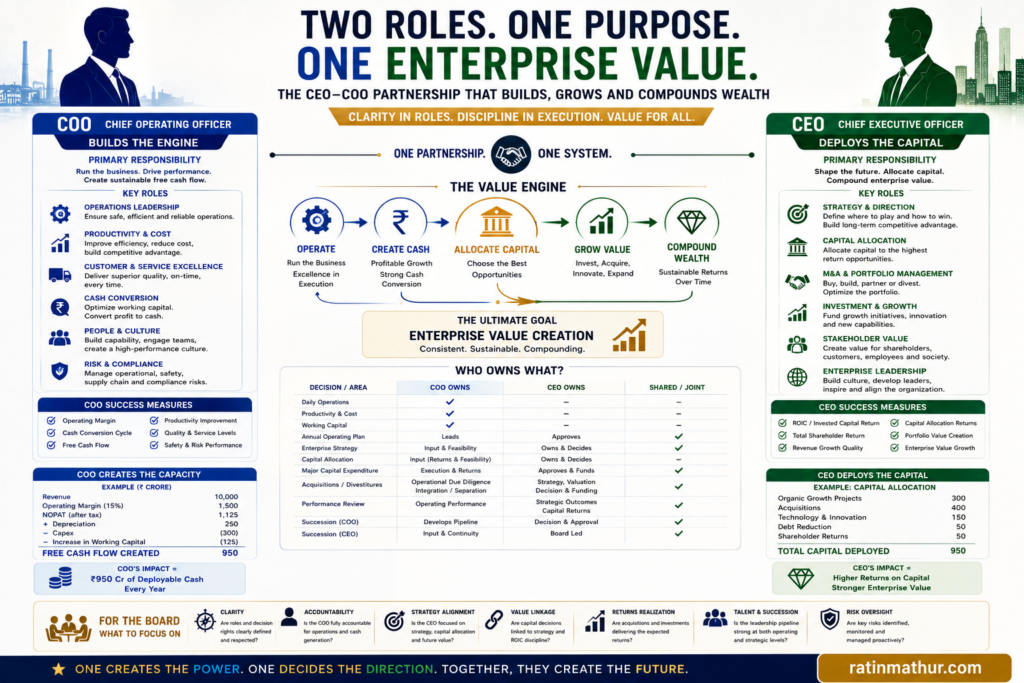
Great companies are rarely built by one executive working in isolation. Behind many successful enterprises is a powerful leadership equation: one leader ensures that the business performs today, while another ensures that the enterprise is prepared for tomorrow. This is where the relationship between the Chief Executive Officer and Chief Operating Officer becomes strategically important.
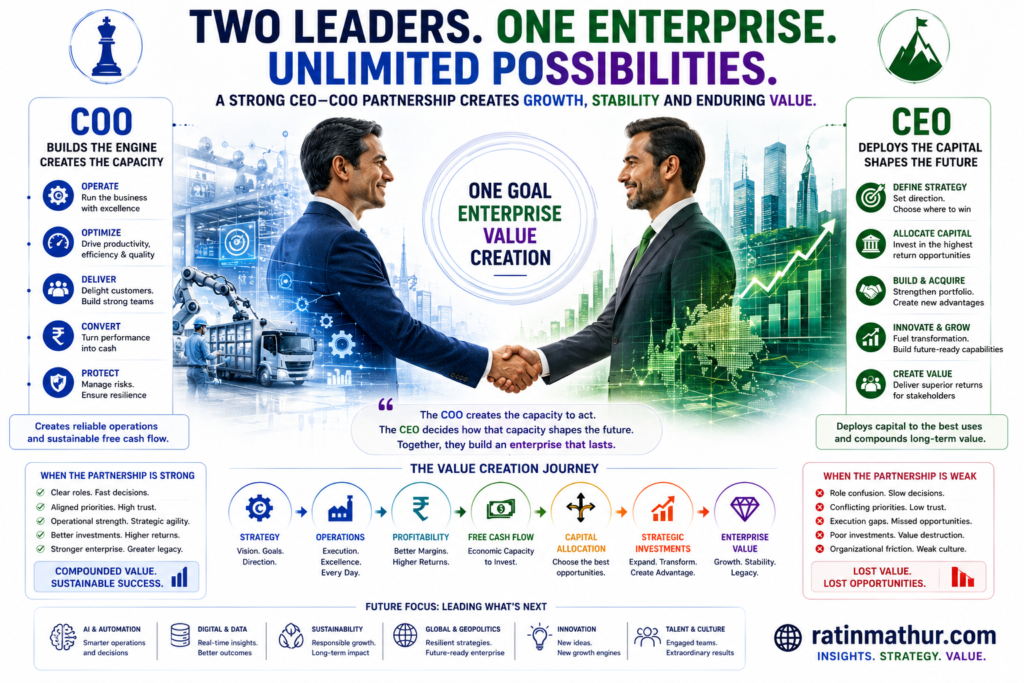
A strong CEO–COO relationship is not about creating two power centres. It is about creating one leadership system with a clear division of responsibility and a shared economic purpose. The COO keeps the operating engine running, strengthens execution, improves productivity, protects customers, develops people and converts business performance into cash. The CEO looks beyond the immediate horizon, shapes strategy, allocates capital, evaluates acquisitions, builds the portfolio and decides where the company’s financial strength should be deployed.
At its best, the relationship can be summarized simply: the COO creates the capacity and cash to act; the CEO decides where that capacity and cash can create the greatest long-term value.
This article examines why a strong CEO–COO bond matters, how clarity of roles can create strategic bandwidth, and what leaders and boards can learn from real-world corporate examples. The central argument is straightforward: companies become stronger when operational excellence and strategic capital allocation are connected through trust, clarity and shared accountability.
The Most Important Leadership Partnership Nobody Should Take for Granted
Every large organization faces two simultaneous challenges. It must perform today while preparing for a future that may look very different from its present.
The first challenge is execution. Customers must be served, products must be delivered, factories and supply chains must function, costs must be controlled, employees must perform and risks must be managed. The second challenge is strategic renewal. The company must decide where to invest, which technologies to adopt, which businesses to acquire or exit and how to position itself for the next decade.
These two challenges require different forms of executive attention.
A company cannot sacrifice today’s performance for tomorrow’s ambitions. At the same time, it cannot become so absorbed in today’s operations that it fails to prepare for tomorrow.
This is why the CEO–COO relationship can become one of the most consequential partnerships in corporate leadership.
The COO should create confidence that the enterprise is under operational control. The CEO should use that confidence to focus on decisions that shape the future. When this relationship works well, the CEO is not forced to become the permanent chief troubleshooter of the company, and the COO is not left operating without strategic direction.
The result is not simply better management. It is better use of leadership capacity.
The strongest relationship is therefore based on a simple but demanding principle: clear division of labour, constant alignment of purpose.
The COO must know what he or she owns. The CEO must know what must remain at the CEO level. Most importantly, the rest of the organization must know where decisions belong.
Without this clarity, the CEO becomes involved in routine operational issues while the COO repeatedly seeks approval for decisions that should fall within operating authority. Decision-making slows down, senior leaders learn to escalate rather than solve problems and accountability becomes blurred.
A strong CEO–COO bond prevents this organizational noise.
The COO Protects the Present So the CEO Can Build the Future
The COO’s greatest contribution is often misunderstood.
The role is not simply about reducing costs, improving processes or managing operations. Those responsibilities are important, but the larger contribution of an exceptional COO is that he or she creates a dependable operating system.
When operations are stable, predictable and disciplined, the CEO gains something extremely valuable: strategic bandwidth.
Strategic bandwidth is the amount of executive attention available for long-term decisions after the essential demands of running the current business have been properly managed.
A CEO whose day is consumed by plant disruptions, inventory problems, delivery failures, customer complaints and internal operating conflicts has limited capacity to think about acquisitions, technology shifts, capital allocation, new markets or long-term competitive threats.
This does not mean that the CEO should be disconnected from operations. A CEO must understand the business deeply. However, understanding operations and personally managing every operational issue are two very different things.
A strong COO allows the CEO to remain informed without becoming trapped.
The relationship can therefore be understood as a transfer of leadership capacity. The stronger and more reliable the operating system, the greater the CEO’s ability to focus on enterprise-level choices.
This creates a powerful chain of value.
Operational discipline creates reliability. Reliability creates executive capacity. Executive capacity improves strategic decision-making. Better strategic decisions can create stronger long-term value.
That is why the COO should never be viewed merely as an administrative extension of the CEO. At the highest level, the COO is a strategic enabler of CEO effectiveness.
The CEO Decides Where the Company’s Strength Should Go Next
If the COO helps create economic strength, the CEO must determine how that strength should be deployed.
This is where capital allocation becomes central to the CEO’s role.
Every successful company eventually faces choices. Should the next rupee, dollar or unit of capital be invested in expanding an existing business? Should the company build a new capability internally? Should it acquire another company? Should it invest in technology? Should it reduce debt? Should it return capital to shareholders? Or should it preserve cash because a better opportunity may emerge later?
These are not routine financial decisions. They are strategic decisions that can determine the future shape of the enterprise.
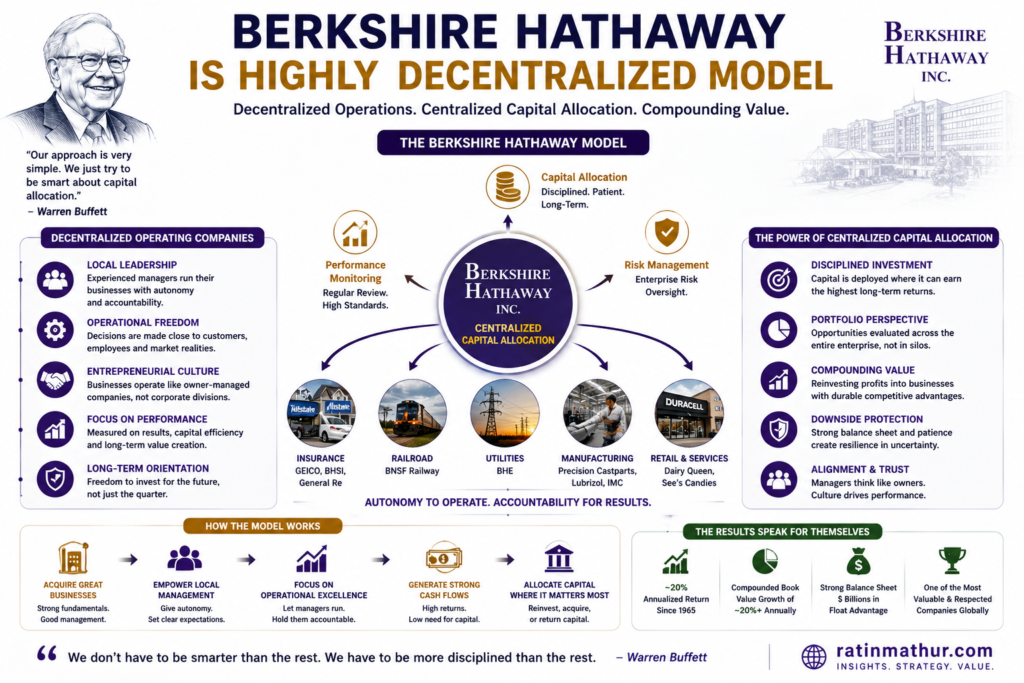
The importance of separating operating management from enterprise-wide capital allocation is illustrated clearly by Berkshire Hathaway. In its Owner’s Manual, the company describes a highly decentralized model in which operating managers run their businesses and send excess cash to headquarters, while central leadership focuses heavily on capital allocation and stewardship. The underlying philosophy is remarkably relevant to the CEO–COO relationship: those closest to operations should have authority to run the business, while enterprise leadership should evaluate a wider range of opportunities for deploying the cash that operations generate. (Berkshire Hathaway)
Berkshire is not a conventional CEO–COO example, and its decentralized structure should not be copied mechanically. However, its economic logic offers an important lesson.
Running a business and deciding where the enterprise should deploy its surplus capital are related but fundamentally different responsibilities.
This distinction is particularly important in diversified companies. A business unit leader may see an attractive investment inside his or her own business. The CEO, however, must compare that opportunity against every other potential use of capital across the enterprise.
The CEO’s responsibility is therefore broader than approving investments. It is deciding which opportunities deserve capital and, equally important, which opportunities do not.
Apple: When Operational Mastery Creates Strategic Freedom
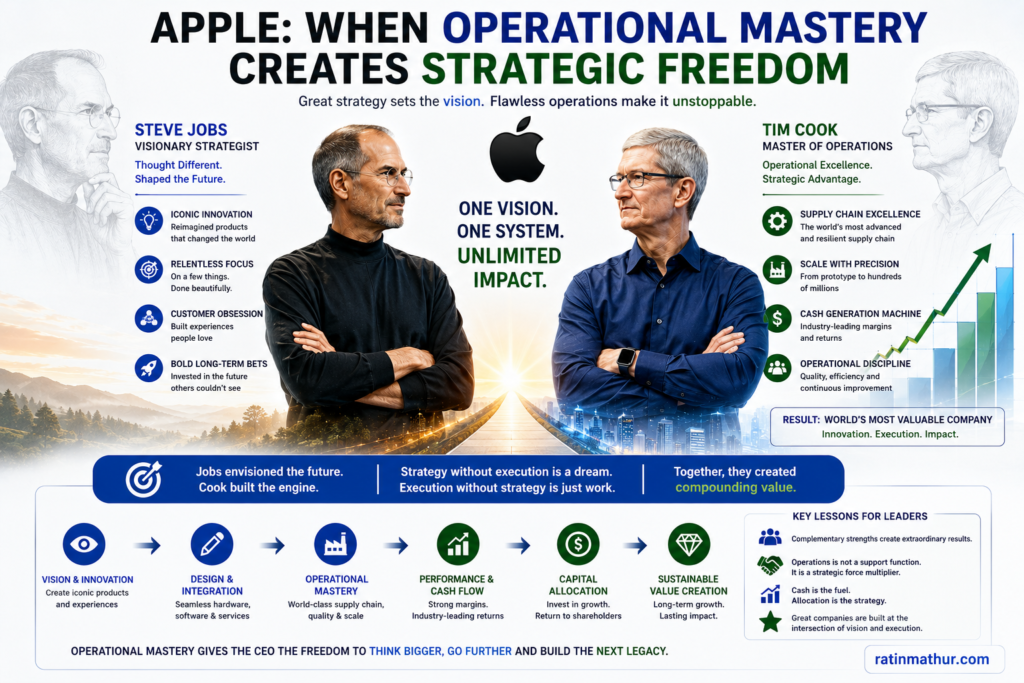
One of the most visible examples of complementary CEO and COO leadership came from the partnership between Steve Jobs and Tim Cook at Apple.
Apple formally named Cook its Chief Operating Officer in 2005 after he had already been performing many of the responsibilities associated with the role. Apple stated at the time that Cook would continue to be responsible for worldwide sales and operations and would report directly to Jobs, while also working closely with him and the executive team on the overall business. (Apple)
The importance of this relationship lies in the complementarity of their roles.
Jobs was deeply associated with product vision, innovation, design and strategic direction. Cook brought exceptional operational capability, with responsibility for worldwide operations, supply chain activities, sales and service support. Apple continues to describe Cook’s pre-CEO role as COO as involving end-to-end management of its supply chain and worldwide sales and operations. (Apple Investor Relations)
The lesson is not that every CEO should imitate Steve Jobs or every COO should imitate Tim Cook. The lesson is that extraordinary companies often benefit when visionary leadership and operational discipline reinforce rather than compete with each other.
A visionary strategy without operational excellence remains an aspiration.
Operational excellence without strategic direction can become highly efficient management of the wrong future.
Apple’s experience demonstrated the potential power of bringing both together. The CEO could remain intensely focused on the products, experiences and strategic choices that differentiated the company, while a highly capable operating leader helped build the systems required to deliver those ambitions at global scale. (Apple)
The relationship also demonstrates another critical principle: succession becomes more resilient when the organization develops leaders who understand the enterprise from complementary perspectives. Cook’s operational leadership before becoming CEO gave him deep exposure to the mechanisms through which Apple’s strategy became reality.
A strong COO can therefore be much more than operational insurance. The role can strengthen leadership continuity.
JPMorgan Chase: The Importance of a Leadership Bench
The experience of JPMorganChase demonstrates another dimension of the CEO–COO relationship: organizational resilience.
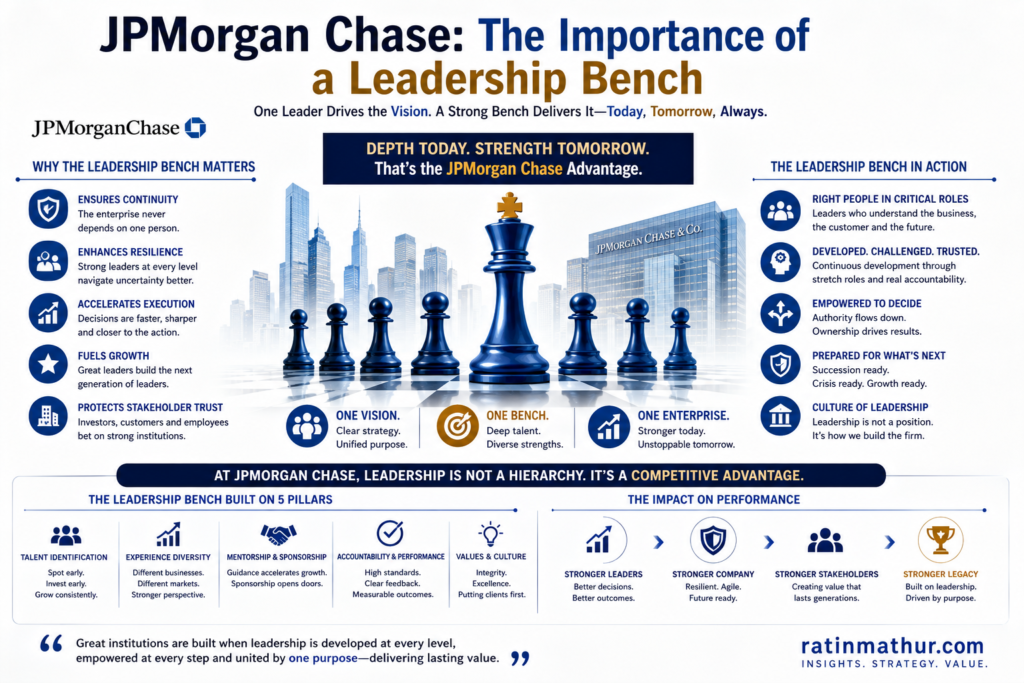
In 2018, JPMorgan Chase appointed Daniel Pinto and Gordon Smith as Co-Presidents and Co-Chief Operating Officers. Jamie Dimon described their expanded roles as formal recognition of the important contributions they had made across the company and highlighted the strength of the management team. (JPMorgan Chase)
The significance of this example is not simply the use of the COO title. It is the deliberate development of leadership capacity below the CEO.
Large and complex institutions cannot depend indefinitely on one individual. The CEO needs a senior leadership structure capable of running major businesses, integrating decisions across the organization and maintaining stability during periods of uncertainty.
JPMorgan Chase’s leadership model has continued to emphasize the importance of strong enterprise-wide operating leadership. Its current annual-report leadership structure identifies Jamie Dimon as Chairman and CEO and Jennifer Piepszak as Chief Operating Officer, alongside major business leaders responsible for different parts of the firm. (JPMorgan Chase)
This provides an important boardroom lesson.
A strong CEO does not become weaker by building powerful executives around him or her. In fact, the opposite is usually true. The stronger the leadership bench, the more capacity the CEO has to address enterprise-wide issues.
A capable COO can help create continuity during crises, support execution across business boundaries and reduce excessive dependency on one executive.
For boards, this matters enormously. CEO succession is often discussed as if it begins when a CEO is preparing to leave. In reality, succession resilience is built much earlier through the development of senior executives who understand how the enterprise works.
A high-quality CEO–COO partnership can therefore be a source of both current performance and future leadership continuity.
Why Trust Is More Important Than Perfect Chemistry
The CEO and COO do not need identical personalities.
In fact, they often should not have them.
One may be naturally oriented toward the future while the other is intensely focused on execution. One may be comfortable with calculated strategic risk while the other constantly asks whether the organization has the capability to deliver the plan.
These differences can be highly valuable.
The danger begins when differences become territorial.
The CEO may start interfering in routine operating decisions because of insufficient trust in the COO. The COO may become defensive or begin building an independent power base because authority is unclear. Senior executives then learn to exploit the gap by seeking different answers from different leaders.
This is how a leadership partnership becomes an organizational fault line.
The strongest CEO–COO relationships are built on trust, but trust alone is not enough. It must be supported by clarity.
The CEO must be confident that the COO will surface major risks rather than hide bad news. The COO must be confident that the CEO will not routinely override agreed operating authority. Both must know that difficult disagreement can occur without damaging the relationship.
The objective should not be permanent agreement.
A CEO and COO who never disagree may be avoiding important conversations.
The objective should be constructive disagreement followed by clear decisions.
A useful leadership principle is this: debate privately, decide clearly, communicate consistently.
Once a decision has been made, the CEO and COO must not allow the organization to see two competing operating directions.
The Economic Bond Must Be Stronger Than the Organizational Titles
The greatest danger in CEO–COO relationships is excessive focus on hierarchy.
Who reports to whom is important. Who has final authority is important. But titles alone do not create value.
The more important question is whether the CEO and COO are connected through a common economic model.
The COO should understand the strategic consequences of operational decisions. The CEO should understand the operational realities behind strategic assumptions.
Consider an acquisition.
The CEO may identify a target that appears strategically attractive. The company could enter a new market, acquire a technology or gain important customers. However, the projected value of the acquisition may depend on cost synergies, integration speed and revenue growth that the operating organization must actually deliver.
If the COO is not deeply involved in testing those assumptions before the transaction, the CEO may allocate capital based on economics that cannot be realized.
The same principle applies to large capital expenditure. A CEO may approve a new manufacturing facility because demand projections appear attractive. The COO must determine whether the organization can build, staff, supply and operate the facility at the assumed economics.
This is why the relationship must move beyond functional coordination.
The CEO and COO must share ownership of the economic truth.
The CEO asks whether an opportunity deserves capital.
The COO asks whether the enterprise can convert that capital into the promised outcome.
Neither question is sufficient by itself.
When the Partnership Fails, the Organization Pays the Price
Weak CEO–COO relationships often create four organizational problems.
The first is duplication. Both executives become involved in the same decisions. Meetings multiply, approvals slow down and managers wait for alignment at the top.
The second is escalation dependency. Managers stop making decisions because they know that every significant issue will eventually move upward. The CEO becomes a bottleneck rather than an enterprise leader.
The third is conflicting priorities. The CEO pushes for growth while the COO focuses on stability. The COO reduces costs while the CEO invests for expansion. Neither objective is necessarily wrong, but without a shared economic plan, the company can pull in opposite directions.
The fourth is leadership insecurity. When employees believe that the CEO and COO are competing, every disagreement becomes political. Senior executives begin choosing sides rather than solving problems.
This is why the bond between the CEO and COO is not a private executive matter.
It is an enterprise issue.
Employees observe it. Investors eventually experience its consequences. Boards must understand its effectiveness.
What Boards Should Look For
The board should not manage the CEO–COO relationship on a day-to-day basis. However, directors should understand whether the leadership architecture is creating clarity or confusion.
The board should ask whether the COO has genuine operating authority or merely a large title. It should examine whether the CEO is spending excessive time solving operational problems that should be managed through the operating system.
The board should also ask whether major strategic decisions have been tested against execution reality.
| Board Question | Why It Matters |
| Does the COO have clear authority over day-to-day operations? | Accountability cannot exist without authority |
| Does the CEO have sufficient strategic bandwidth? | The future can be neglected when the CEO is trapped in daily issues |
| Are major investments tested for operational feasibility? | Strong strategy can fail through weak execution |
| Are CEO and COO incentives aligned? | Different targets can create conflicting behaviour |
| Is disagreement resolved constructively? | Healthy challenge improves decision quality |
| Is the COO developing the next layer of operating leadership? | Reduces key-person dependency |
| Does the CEO review the economic outcomes of capital allocation? | Value creation requires learning from investment decisions |
The board’s most important responsibility is to ensure that the CEO and COO relationship is contributing to enterprise value rather than creating organizational ambiguity.
The Future Will Make This Partnership Even More Important
The demands on both roles are increasing.
Artificial intelligence is changing productivity and decision-making. Automation is changing operating models. Supply chains are being redesigned for resilience rather than simply cost. Technology cycles are accelerating. Geopolitical uncertainty is affecting investment decisions. Companies are increasingly required to allocate capital across both existing and emerging business models.
The COO of the future will not simply run factories, supply chains or shared services. The COO will increasingly redesign the operating architecture of the enterprise.
The CEO of the future will face more complex capital allocation decisions than ever before. Where should the company invest in artificial intelligence? Which capabilities should be built internally? Which technologies should be acquired? When should a legacy business be transformed, sold or closed?
This makes role clarity more important, not less.
The future CEO will need a strong COO to create operating confidence.
The future COO will need a strategically clear CEO to ensure that operational transformation is directed toward the right future.
The companies that perform best may not be those with the most complex leadership structures. They may be those with the clearest understanding of how leadership attention should be divided.
Recommendations for CEOs, COOs and Boards
The article deliberately avoids creating a large collection of strategic frameworks because the CEO–COO relationship is fundamentally about clarity, trust and disciplined execution. However, leaders can benefit from two practical frameworks that translate these principles into action.
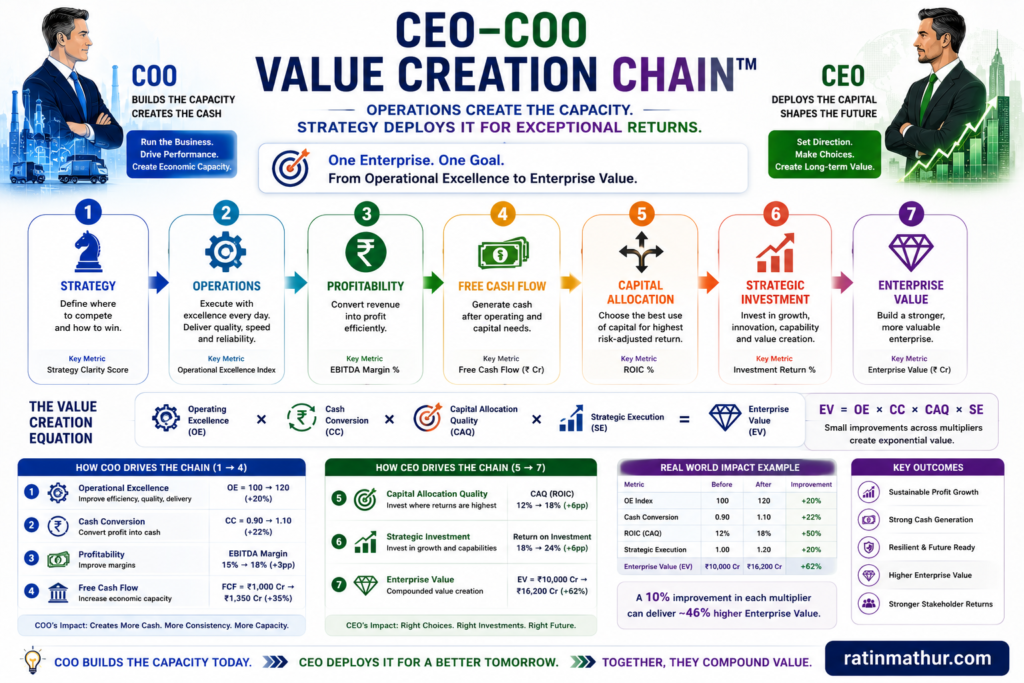
Recommendation 1: The CEO–COO Value Creation ChainTM
The first framework should help leaders understand how their roles connect economically rather than organizationally.
CEO–COO Value Creation ChainTM
Strategy → Operations → Profitability → Free Cash Flow → Capital Allocation → Strategic Investment → Enterprise Value
| Stage | Primary Leadership Focus | Core Question |
| Strategy | CEO | Where should the enterprise compete and win? |
| Operations | COO | How will the strategy be delivered reliably? |
| Profitability | COO | How efficiently can the business convert revenue into profit? |
| Free Cash Flow | COO with CFO | How much economic capacity is actually being created? |
| Capital Allocation | CEO | Where will the next unit of capital create the highest value? |
| Strategic Investment | CEO with COO validation | Can the opportunity create superior returns and be executed successfully? |
| Enterprise Value | CEO and COO | Are operations and capital deployment compounding long-term value? |
The strength of this framework is its simplicity.
The COO should not view free cash flow merely as a finance metric. It is the economic output of operating discipline. The CEO should not view capital allocation merely as a treasury or finance decision. It determines what the enterprise becomes next.
For example, if improved inventory management and productivity generate an additional ₹1 billion in free cash flow, the COO has helped create new strategic capacity. The CEO must then determine whether that ₹1 billion should be reinvested at an attractive return, used to acquire a capability, retained for resilience or returned to shareholders.
The value chain therefore creates one connected economic conversation between the CEO and COO.
The COO creates the capacity.
The CEO chooses the future use of that capacity.
Both remain accountable for whether the resulting investment ultimately creates value.
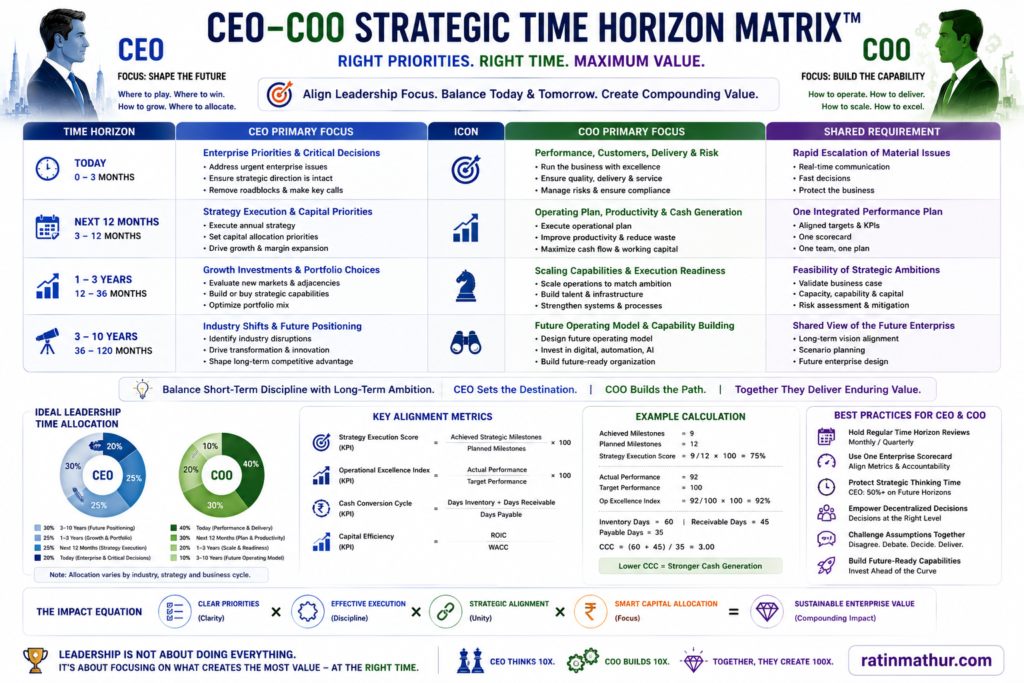
Recommendation 2: The CEO–COO Strategic Time Horizon MatrixTM
The second framework addresses executive attention.
A strong partnership requires the CEO and COO to work across different time horizons without becoming disconnected from each other.
| Time Horizon | CEO Primary Focus | COO Primary Focus | Shared Requirement |
| Today | Enterprise priorities and critical decisions | Performance, customers, delivery and risk | Rapid escalation of material issues |
| Next 12 Months | Strategy execution and capital priorities | Operating plan, productivity and cash generation | One integrated performance plan |
| 1–3 Years | Growth investments, portfolio choices and capability building | Scaling capabilities and execution readiness | Feasibility of strategic ambitions |
| 3–10 Years | Industry shifts, acquisitions, transformation and future positioning | Future operating model and organizational capability | Shared view of the future enterprise |
This framework prevents two common failures.
The first occurs when the CEO spends too much time in the present. The second occurs when the COO becomes so focused on today’s efficiency that future capability is neglected.
The matrix should be reviewed regularly by the CEO and COO together. The purpose is not to create another reporting document. The purpose is to ask whether executive attention is being invested in the right time horizon.
If the CEO spends 80 percent of the time on daily operational problems, the operating system may be weak.
If the COO spends almost no time building future capability, operational excellence may eventually become obsolete.
The strongest partnership creates a deliberate balance.
Conclusion
A powerful CEO–COO relationship is one of the clearest examples of how complementary leadership can create more value than individual brilliance.
The COO gives the CEO the confidence to look beyond today’s problems.
The CEO gives the COO the strategic direction that makes operational excellence economically meaningful.
The COO turns execution into economic capacity.
The CEO turns economic capacity into strategic choices.
The COO helps ensure that promises can be delivered.
The CEO determines which promises are worth making.
The strongest companies understand that these are not competing roles. They are two connected parts of one value-creation system.
Real-world corporate experience, from the complementary operating and strategic leadership visible during the Jobs–Cook era at Apple to the deliberate development of enterprise operating leadership at JPMorgan Chase, demonstrates the importance of strong leadership capacity below and alongside the CEO. Berkshire Hathaway’s decentralized operating and centralized capital-allocation philosophy provides a further lesson: companies can create enormous strategic leverage when operational leaders are trusted to run businesses while enterprise leadership remains focused on the highest-value deployment of capital. (Apple)
For boards, the question should not be whether the CEO and COO have identical strengths.
It should be whether their different strengths are connected by trust, role clarity and a common economic purpose.
Because ultimately, the most powerful leadership partnerships do not create two centres of power.
They create one enterprise that can execute today, invest intelligently tomorrow and compound value for the future.
References
- Apple Inc. (2005, October 14). Tim Cook named COO of Apple. Apple Newsroom
- Apple Inc. (n.d.). Tim Cook, Chief Executive Officer: Leadership and governance. Apple Investor Relations
- Berkshire Hathaway Inc. (n.d.). Owner’s Manual. Berkshire Hathaway Owner’s Manual
- Berkshire Hathaway Inc. (2025). Annual report 2025. Berkshire Hathaway 2025 Annual Report
- JPMorgan Chase & Co. (2018, September 11). JPMorgan Chase appoints Daniel Pinto and Gordon Smith as Co-Presidents and Co-Chief Operating Officers of the company. JPMorgan Chase announcement
- JPMorgan Chase & Co. (2026). 2025 annual report and proxy. JPMorgan Chase Annual Report
- Graham, J. R., Harvey, C. R., & Puri, M. (2015). Capital allocation and delegation of decision-making authority within firms. Journal of Financial Economics, 115(3), 449–470. ScienceDirect article
- Levinson, H. (1993). Between CEO and COO. Academy of Management Perspectives, 7(2), 71–83. Academy of Management article
- McKinsey & Company. (2023). Capital allocation starts with governance and should be led by the CEO.McKinsey article
- McKinsey & Company. (2026). The bridge builder COO: Delivering results by engaging stakeholders.McKinsey article
- Berkshire Hathaway Inc. (n.d.). Owner’s Manual.Berkshire Hathaway Owner’s Manual
- Berkshire Hathaway Inc. (2022). Annual Report 2022.Berkshire Hathaway Annual Report 2022
- Jensen, M. C. (1986). Agency costs of free cash flow, corporate finance, and takeovers. American Economic Review, 76(2), 323–329.
- Mankins, M. C., & Steele, R. (2005). Turning great strategy into great performance. Harvard Business Review, 83(7/8), 64–72.
- Porter, M. E. (1996). What is strategy? Harvard Business Review, 74(6), 61–78.
- Damodaran, A. (2012). Investment valuation: Tools and techniques for determining the value of any asset (3rd ed.). John Wiley & Sons.
Disclaimer
This article is intended for educational, strategic and informational purposes only. The analysis, observations and recommendations represent a conceptual perspective on executive leadership, corporate governance, operating management and capital allocation. The CEO–COO Value Creation ChainTM and CEO–COO Strategic Time Horizon MatrixTM are strategic management frameworks developed for leadership and boardroom discussion.
The examples discussed should not be interpreted as suggesting that one leadership structure is universally appropriate for every organization. The optimal relationship between a CEO and COO depends on the company’s size, ownership structure, industry, strategy, organizational complexity, leadership capabilities, regulatory environment and stage of development.
Organizations should adapt these concepts to their own circumstances and obtain appropriate professional, financial, legal, governance and board-level advice before making material management, succession, investment or organizational decisions. The author assumes no responsibility for actions or decisions taken solely on the basis of this article.