Abstract
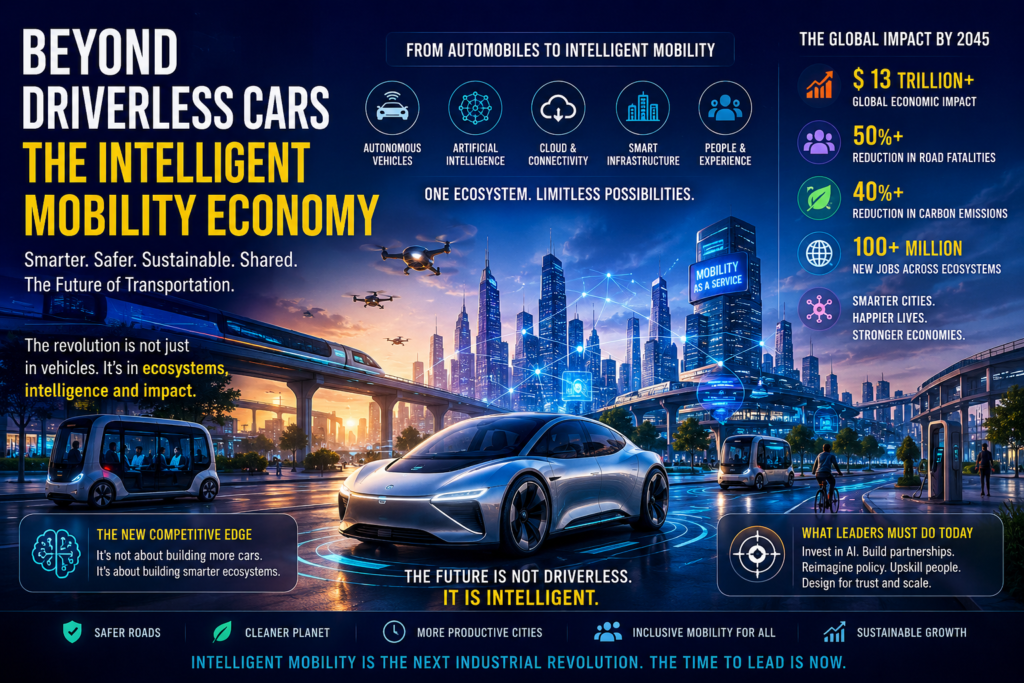
The global discussion surrounding driverless cars has largely focused on technological advancement, artificial intelligence, and autonomous driving capability. While these developments are undoubtedly significant, they represent only one dimension of a much broader economic transformation. This paper argues that the future of mobility will not be determined by autonomous vehicles alone but by the emergence of an Intelligent Mobility Economy in which artificial intelligence, digital infrastructure, transportation policy, cloud computing, cybersecurity, telecommunications, and consumer behavior converge into an integrated ecosystem.
Unlike many existing studies that evaluate autonomous vehicles primarily through engineering performance or technological readiness, this research adopts a multidisciplinary strategic perspective by integrating transportation economics, management consulting frameworks, behavioral science, market dynamics, and long-term scenario planning. The analysis extends to 2045 and examines the implications of autonomous mobility for governments, automotive manufacturers, technology companies, investors, urban planners, insurers, and consumers.
The findings challenge several widely held assumptions. Rather than replacing privately owned vehicles entirely, autonomous technologies are expected to transform commercial mobility much earlier than family vehicle ownership. The research also demonstrates that transportation ecosystem maturity—including infrastructure quality, digital connectivity, governance, regulatory capability, and consumer trust—plays a substantially greater role in autonomous adoption than population density alone.
The paper concludes that autonomous vehicles should be viewed not as a standalone technological innovation but as the foundation of an Intelligent Mobility Economy capable of reshaping industries, labor markets, urban development, and national competitiveness over the coming decades.
Keywords: Driverless Cars, Autonomous Vehicles, Artificial Intelligence, Intelligent Mobility Economy, Mobility as a Service, Robotaxis, Transportation Strategy, Smart Cities, Future Mobility, Business Strategy
Introduction
Throughout modern history, transformative innovations have fundamentally reshaped the structure of economies rather than merely improving individual products. Steam engines transformed manufacturing. Electricity redefined industrial productivity. The Internet revolutionized communication and commerce. Artificial intelligence is now catalyzing another structural transition whose implications extend well beyond computing.
Driverless mobility represents one of the most visible manifestations of this transition.
Public discussion frequently portrays autonomous vehicles as the inevitable replacement for conventional automobiles. Technology companies emphasize advances in perception systems, deep learning algorithms, sensor fusion, and high-definition mapping. Automotive manufacturers focus on higher levels of driving automation. Governments increasingly evaluate regulatory frameworks for testing and commercialization.
These discussions, although important, often overlook a more fundamental question.
What exactly is being transformed?
Is society witnessing the replacement of human drivers by artificial intelligence, or is a much larger economic system undergoing structural reinvention?
This paper argues that the latter interpretation provides a more accurate understanding of the future.
Autonomous mobility should not be viewed primarily as a new category of automobile. Instead, it represents the convergence of transportation, artificial intelligence, software engineering, telecommunications, digital infrastructure, cloud computing, cybersecurity, behavioral economics, and public policy into a single integrated mobility ecosystem.
The distinction is strategically significant.
For more than a century, automobiles have been treated as manufactured products purchased by individual consumers. Driverless mobility increasingly transforms transportation into an intelligent service supported by continuously evolving software platforms. Under this emerging paradigm, value shifts away from one-time vehicle transactions toward recurring digital services, real-time operational intelligence, predictive maintenance, fleet optimization, and mobility subscriptions.
Consequently, future industry leadership will depend less upon manufacturing scale and more upon ecosystem integration.
This transformation extends well beyond the automotive sector.
Insurance companies must redesign liability models.
Banks will increasingly finance fleets rather than individual consumers.
Urban planners will reconsider parking infrastructure and road utilization.
Telecommunications providers become essential transportation infrastructure partners.
Artificial intelligence developers evolve into mobility companies.
Governments transition from transportation regulators to ecosystem architects.
Such structural changes justify a broader analytical framework than conventional automotive forecasting.
Literature Review
Research into autonomous mobility has expanded rapidly over the past decade.
Engineering literature has primarily focused on perception systems, localization, sensor technologies, artificial intelligence algorithms, redundancy architectures, and functional safety. Significant contributions have emerged from automotive engineering research, standards organizations, and industrial technology developers.
Transportation economists have examined the implications of autonomous mobility for congestion, infrastructure utilization, logistics, travel demand, and environmental sustainability. Their findings generally suggest that higher vehicle utilization and optimized routing could improve transportation efficiency while simultaneously introducing new challenges relating to induced demand and urban planning.
Management consulting firms have explored commercial implications through reports addressing Mobility as a Service, software-defined vehicles, electrification, platform economics, and future transportation ecosystems. These studies consistently identify software capability, artificial intelligence, digital platforms, and recurring service revenue as increasingly important sources of competitive advantage.
Behavioral research has provided a different perspective by emphasizing consumer trust, perceived safety, emotional attachment to driving, privacy concerns, and social acceptance. These studies demonstrate that technological capability alone cannot guarantee market adoption. Consumer psychology remains an important determinant of future mobility choices.
Despite these valuable contributions, several important research gaps remain.
First, much of the existing literature evaluates autonomous vehicles independently rather than considering interactions among transportation systems, digital infrastructure, labor markets, public policy, and economic ecosystems.
Second, forecasts frequently assume a binary transition in which privately owned vehicles are replaced by shared autonomous transportation. Such assumptions often underestimate the social, behavioral, and emotional motivations associated with vehicle ownership.
Third, relatively few studies integrate management consulting methodologies such as PESTLE analysis, Porter’s Five Forces, SWOT, VRIO, value chain analysis, business model innovation, and scenario planning into a comprehensive autonomous mobility framework.
Fourth, many reports implicitly assume that highly populated countries will inevitably experience slower autonomous adoption without adequately distinguishing population density from transportation ecosystem maturity.
This paper addresses these limitations by integrating strategic management, economics, behavioral science, public policy, and systems thinking into a unified analytical framework extending through 2045.
Research Methodology
The research adopts a mixed-method strategic methodology rather than relying upon a single forecasting technique.
Historical evidence from transportation economics, artificial intelligence, automotive markets, infrastructure development, and demographic trends establishes the empirical foundation.
Management consulting frameworks including PESTLE analysis, Porter’s Five Forces, SWOT analysis, TOWS, VRIO, value chain analysis, Blue Ocean Strategy, Business Model Canvas, McKinsey Three Horizons, GE–McKinsey Matrix, BCG Matrix, and scenario planning are subsequently applied to evaluate structural industry dynamics.
Behavioral economics is incorporated to examine consumer decision-making relating to ownership, trust, privacy, convenience, and lifestyle preferences.
Comparative national analysis evaluates transportation ecosystem maturity using variables including infrastructure quality, regulatory readiness, digital connectivity, traffic predictability, artificial intelligence capability, institutional effectiveness, and consumer acceptance.
Scenario planning extends the analysis through 2045 under conservative, base-case, and accelerated adoption pathways.
Rather than forecasting only autonomous vehicle sales, the study evaluates the future distribution of passenger mobility demand across privately owned vehicles, hybrid ownership models, robotaxis, ride-hailing platforms, chauffeur-driven services, and corporate fleets.
This approach recognizes that multiple transportation models are likely to coexist throughout the forecast period.
Accordingly, the principal analytical unit becomes mobility demand rather than vehicle production.
Table 1 summarizes the methodological architecture employed throughout the research.
| Analytical Component | Primary Objective |
| Transportation Economics | Evaluate structural mobility demand |
| Strategic Management Frameworks | Assess industry transformation |
| Behavioral Economics | Analyze consumer adoption |
| Comparative Country Analysis | Evaluate national readiness |
| Scenario Planning | Forecast alternative futures through 2045 |
| Market Modeling | Estimate future mobility composition |
| Systems Thinking | Integrate cross-industry impacts |
The integrated methodology enables a broader understanding of autonomous mobility than conventional technology-focused forecasting and provides the foundation for evaluating the emergence of an Intelligent Mobility Economy.
Strategic Findings
The strategic evidence developed through this research suggests that the global conversation surrounding driverless vehicles has focused excessively on the automobile itself while paying comparatively less attention to the mobility system within which the automobile operates.
This distinction fundamentally changes how autonomous transportation should be analyzed.
The conventional automotive industry has historically been organized around manufacturing, distribution and ownership. Value creation occurred primarily when a vehicle was sold. Manufacturers competed through engineering quality, production efficiency, dealer networks and brand reputation.
Autonomous mobility gradually changes this economic logic.
Vehicles increasingly become software-defined platforms that continuously exchange information with cloud infrastructure, mapping systems, artificial intelligence engines, digital payment platforms, telecommunications networks and mobility operators. Revenue therefore shifts from one-time product transactions toward recurring digital services, fleet operations and intelligent transportation management.
The strategic question consequently changes from “Who builds the best automobile?” to “Who builds the most intelligent mobility ecosystem?”
This transition represents one of the largest structural changes experienced by the automotive industry since mass production.
The Intelligent Mobility Economy
The principal contribution of this paper is the proposition that autonomous mobility should be understood as the emergence of an Intelligent Mobility Economy rather than merely the commercialization of driverless vehicles.
The Intelligent Mobility Economy integrates physical transportation with digital intelligence.
Artificial intelligence optimizes routing.
Cloud computing continuously improves fleet performance.
Cybersecurity protects connected transportation systems.
Digital infrastructure enables real-time communication.
Governments establish regulatory architectures.
Consumers increasingly purchase mobility outcomes instead of transportation assets.
Economic value therefore migrates from manufacturing toward software, data, artificial intelligence and intelligent transportation services.
This evolution resembles the transformation previously observed in telecommunications, financial services and retail, where digital ecosystems gradually became more valuable than the physical products themselves.
Commercial Transportation Will Lead the Revolution
Perhaps the strongest conclusion emerging from this research concerns the sequence of autonomous adoption.
Public debate frequently assumes that autonomous vehicles will progressively replace privately owned family automobiles.
The economic evidence suggests a different outcome.
Commercial transportation possesses significantly stronger incentives for automation than household ownership.
Taxi operators seek lower operating costs.
Ride-hailing platforms seek higher vehicle utilization.
Corporate fleets seek standardized transportation.
Airport shuttle operators seek continuous operation.
Logistics providers seek productivity improvements.
Driver compensation represents one of the largest operating expenses within commercial transportation.
Autonomous systems directly address this cost.
By contrast, households purchase vehicles for reasons extending far beyond transportation efficiency.
Families value convenience, privacy, flexibility, emotional attachment, emergency preparedness, child transportation and personal freedom.
These motivations cannot be fully measured using conventional financial analysis.
Consequently, privately owned vehicles demonstrate greater structural resilience than many technology forecasts suggest.
Table 2 summarizes the differing incentives influencing autonomous adoption.
| Mobility Category | Primary Decision Driver | Relative Automation Incentive |
| Taxi services | Operating profitability | Very High |
| Ride-hailing | Fleet utilization | Very High |
| Corporate transportation | Cost optimization | High |
| Airport mobility | Operational efficiency | High |
| Chauffeur services | Mixed operational and hospitality value | Moderate |
| Family ownership | Lifestyle and emotional value | Moderate |
| Rural ownership | Accessibility and flexibility | Low to Moderate |
The evidence therefore indicates that autonomous mobility initially replaces paid driving labor rather than privately owned automobiles.
This distinction is strategically important because it changes long-term market expectations.
Why Family-Owned Vehicles Will Not Disappear
Predictions regarding the disappearance of private vehicle ownership frequently assume that transportation decisions are primarily economic.
Behavioral science demonstrates otherwise.
Automobiles occupy a unique position within consumer psychology.
Unlike most manufactured products, vehicles often become associated with personal achievement, family experiences, independence and identity.
Parents value immediate transportation availability during emergencies.
Families appreciate flexibility for school transportation, vacations and recreational activities.
Many consumers continue enjoying the experience of driving itself.
These behavioral considerations significantly slow the replacement of privately owned vehicles.
Autonomous technology is therefore more likely to evolve within private ownership than eliminate it.
Future households may increasingly own highly autonomous vehicles while continuing to value ownership itself.
Accordingly, the future should not be described as ownership versus autonomy.
The future is ownership with progressively greater autonomy.
The Population Density Myth
One of the most widespread assumptions regarding autonomous mobility is that densely populated countries cannot successfully deploy driverless transportation.
The research challenges this assumption.
Population density undoubtedly increases transportation complexity.
However, complexity alone does not determine commercial feasibility.
Transportation ecosystem maturity exerts substantially greater influence.
Countries possessing well-maintained roads, standardized lane markings, disciplined traffic behavior, reliable telecommunications, effective governance and digital infrastructure frequently demonstrate higher autonomous readiness than countries with lower population density but weaker transportation systems.
Table 3 illustrates the relationship.
| National Characteristic | Relative Influence on Autonomous Readiness |
| Transportation infrastructure | Very High |
| Regulatory maturity | Very High |
| Digital connectivity | High |
| Traffic predictability | High |
| Cybersecurity capability | High |
| Consumer trust | High |
| Population density | Moderate |
This finding has important implications for public policy.
Governments should prioritize transportation ecosystem modernization rather than viewing population density as an unavoidable obstacle.
Infrastructure Becomes Strategic National Capital
Historically, transportation infrastructure primarily consisted of roads, bridges and highways.
The autonomous mobility economy requires a broader definition.
Infrastructure increasingly includes intelligent traffic systems, digital communication networks, high-definition mapping, cybersecurity architecture, artificial intelligence capability, cloud computing and regulatory institutions.
Consequently, digital infrastructure becomes as strategically important as physical infrastructure.
Nations investing simultaneously in transportation modernization and digital capability are likely to strengthen long-term economic competitiveness.
The competitive advantage therefore shifts from manufacturing automobiles to orchestrating integrated transportation ecosystems.
Ecosystem Competition Replaces Product Competition
Another major finding concerns competitive dynamics.
The twentieth-century automotive industry was characterized by manufacturer-to-manufacturer competition.
Companies differentiated themselves through engineering, fuel efficiency, reliability and production scale.
Autonomous mobility fundamentally changes this competitive structure.
Future success depends upon collaboration among automotive manufacturers, artificial intelligence developers, cloud providers, semiconductor companies, telecommunications operators, mapping organizations, cybersecurity specialists and governments.
Competition therefore evolves from product ecosystems toward mobility ecosystems.
The organizations capable of integrating these capabilities most effectively are likely to establish sustainable competitive advantages.
Table 4 compares these two competitive models.
| Traditional Automotive Competition | Intelligent Mobility Competition |
| Vehicle quality | Ecosystem intelligence |
| Manufacturing efficiency | Artificial intelligence capability |
| Dealer network | Digital platform |
| Mechanical innovation | Continuous software evolution |
| Product differentiation | Data-driven mobility services |
| Brand reputation | Integrated ecosystem trust |
This transition explains why future industry leaders may not necessarily be those producing the highest number of vehicles.
The Economics of Utilization
Perhaps the most overlooked variable within autonomous mobility is vehicle utilization.
Private automobiles remain parked for most of the day.
Commercial fleets operate for substantially longer periods.
Higher utilization dramatically improves capital productivity.
Robotaxis, autonomous corporate fleets and shared mobility services therefore generate significantly greater economic output per vehicle than privately owned automobiles.
The autonomous mobility economy increasingly rewards utilization rather than ownership.
This principle reshapes vehicle financing, insurance, maintenance and fleet management.
Manufacturers that continue measuring success primarily through vehicle unit sales may therefore underestimate future value creation opportunities.
The Emergence of Hybrid Mobility
The research does not support either of the two extreme scenarios frequently presented within industry discussions.
The first assumes complete preservation of conventional ownership.
The second predicts the disappearance of privately owned vehicles.
Neither outcome appears consistent with the available evidence.
Instead, the most plausible future is a hybrid mobility ecosystem.
Households increasingly combine multiple transportation solutions according to journey purpose.
Daily commuting may involve autonomous ride-hailing.
Weekend family travel may continue using privately owned vehicles.
Business trips may utilize corporate autonomous fleets.
Urban transportation may rely increasingly upon robotaxis.
Long-distance recreational travel may continue favoring ownership.
Mobility therefore becomes increasingly personalized rather than standardized.
Consumers select transportation according to convenience, economics, flexibility and lifestyle rather than adhering to a single ownership model.
A New Framework for Understanding Transportation
The cumulative evidence suggests that autonomous mobility should no longer be analyzed through the traditional automotive lens.
A more appropriate framework considers three interacting systems.
The first system consists of transportation demand generated by households, businesses and governments.
The second system consists of intelligent digital infrastructure enabling connected mobility.
The third system consists of commercial ecosystems delivering transportation services.
Only through the interaction of these systems does autonomous mobility become economically sustainable.
This systems perspective provides a more comprehensive explanation of future transportation than technology-centered analyses alone.
Strategic Synthesis
Several consistent themes emerge across the findings presented in this research.
Artificial intelligence repeatedly appears as the primary source of competitive differentiation.
Commercial transportation consistently demonstrates stronger automation incentives than private ownership.
Infrastructure quality repeatedly outweighs population density as a determinant of national readiness.
Software ecosystems generate increasing economic value relative to manufacturing alone.
Consumer psychology remains a critical moderating influence on adoption.
Most importantly, the future transportation economy becomes increasingly organized around intelligent mobility rather than vehicle ownership alone.
These findings collectively support a broader strategic conclusion.
Driverless vehicles represent only the visible component of a much larger transformation.
The true revolution lies in the creation of an Intelligent Mobility Economy capable of integrating transportation, artificial intelligence, digital infrastructure and human behavior into a unified economic ecosystem.
Discussion
The findings presented in this paper suggest that much of the current discourse surrounding autonomous vehicles is framed too narrowly. Discussions frequently begin with technological capability and end with questions regarding market adoption. While important, this perspective overlooks the broader structural transformation occurring across transportation systems, industrial ecosystems and national economies.
The emergence of autonomous mobility should be interpreted as a systems transformation rather than a transportation innovation.
History demonstrates that every major technological revolution has generated economic value by reorganizing existing systems rather than simply improving products. Electrification reorganized manufacturing. The Internet reorganized information exchange. Smartphones reorganized communication, commerce and entertainment. Artificial intelligence is now reorganizing decision-making across virtually every industry.
Autonomous mobility represents one of the largest applications of artificial intelligence within the physical economy.
Its long-term significance therefore extends far beyond automobiles.
The analysis demonstrates that value creation gradually migrates away from mechanical engineering toward software development, cloud computing, data analytics, cybersecurity and intelligent transportation services. Vehicle manufacturers increasingly become software organizations. Transportation providers evolve into data-driven mobility operators. Governments become ecosystem coordinators responsible for integrating infrastructure, regulation, digital governance and public trust.
This transition fundamentally changes strategic planning.
Traditional automotive metrics such as annual vehicle production, dealership expansion and manufacturing capacity remain important, but they become insufficient for evaluating long-term competitiveness.
Instead, future success will increasingly depend upon artificial intelligence capability, ecosystem partnerships, digital infrastructure, software reliability, cybersecurity resilience and recurring service revenue.
The findings also carry important implications for labor markets.
Driverless mobility will undoubtedly reduce demand for occupations in which driving itself constitutes the principal economic activity. Taxi drivers, commercial chauffeurs and certain categories of transport operators may experience significant disruption over time.
However, historical evidence from previous industrial revolutions suggests that technological change rarely eliminates work entirely. Instead, it reallocates labor toward higher-value activities.
Demand is expected to expand for artificial intelligence engineers, robotics specialists, cybersecurity professionals, mobility data scientists, cloud architects, digital infrastructure planners, fleet optimization experts and intelligent transportation system managers.
Consequently, the principal challenge for governments is not preventing automation but preparing workforces for occupational transition through continuous education and large-scale reskilling initiatives.
Urban development also undergoes structural change.
Cities historically designed around privately owned automobiles may gradually transition toward integrated mobility ecosystems in which autonomous transportation complements public transit, cycling infrastructure and pedestrian-oriented planning.
Reduced parking requirements could increase the availability of urban land for residential development, commercial activities and public spaces. Intelligent traffic management systems may improve road utilization and reduce congestion in metropolitan areas.
These changes will not occur uniformly across countries.
The research repeatedly demonstrates that infrastructure quality, institutional effectiveness and regulatory maturity exert greater influence than population density.
Accordingly, countries should avoid assuming that autonomous mobility is reserved exclusively for advanced economies. Emerging economies capable of investing strategically in digital infrastructure, transportation modernization and governance reforms may become important participants in the future mobility economy despite current structural challenges.
Perhaps the most important implication concerns strategic thinking itself.
Autonomous mobility should no longer be evaluated as an automotive market.
It should be understood as a national competitiveness issue involving industrial policy, technological capability, digital infrastructure, education, workforce development and urban planning.
The countries that successfully coordinate these elements are likely to capture substantially greater long-term economic value than those focusing exclusively on vehicle manufacturing.
Conclusion
This paper set out to examine whether autonomous vehicles should be understood primarily as technological innovations or as catalysts for a broader economic transformation.
The evidence strongly supports the second interpretation.
Driverless vehicles represent only one component of a much larger structural transition that reorganizes transportation, manufacturing, digital infrastructure, artificial intelligence, public policy and consumer behavior into an integrated mobility ecosystem.
Contrary to many popular narratives, the research finds little evidence supporting the complete disappearance of privately owned vehicles within the forecast horizon extending to 2045.
Private ownership continues fulfilling important functional, emotional and social roles that commercial mobility services cannot fully replicate.
Instead, ownership itself evolves through progressively higher levels of automation.
Commercial transportation, however, demonstrates substantially stronger economic incentives for autonomous adoption. Taxi fleets, ride-hailing platforms, airport transportation, corporate mobility services and logistics operations are expected to lead commercialization because higher utilization, centralized fleet management and labor cost optimization generate compelling financial returns.
The research further demonstrates that transportation ecosystem maturity is a more reliable predictor of autonomous readiness than population density alone. Countries possessing advanced infrastructure, effective governance, digital connectivity and regulatory capability are likely to commercialize autonomous mobility earlier than countries lacking these structural foundations, irrespective of demographic density.
These findings collectively challenge conventional assumptions regarding the future of transportation.
The evidence indicates that autonomous mobility will not produce a binary transition from human-driven vehicles to driverless vehicles.
Instead, it will produce a diversified transportation ecosystem in which privately owned autonomous vehicles, robotaxis, shared mobility platforms, corporate fleets and public transportation coexist according to consumer preferences, economic incentives and regional conditions.
Perhaps the most significant conclusion emerging from this research is that the principal unit of strategic analysis should no longer be the automobile.
The correct unit of analysis is mobility itself.
As transportation increasingly becomes intelligent, connected and service-oriented, organizations must redefine competitive strategy around ecosystems rather than products, software rather than hardware, recurring digital value rather than one-time transactions and mobility outcomes rather than vehicle ownership alone.
The future therefore belongs not to driverless cars in isolation, but to the emergence of an Intelligent Mobility Economy capable of integrating technology, infrastructure, governance and human behavior into a seamless transportation ecosystem.
This perspective provides a more comprehensive framework for policymakers, business leaders, investors and researchers seeking to understand one of the most significant industrial transformations of the twenty-first century.
References
- Society of Automotive Engineers. (2021). Taxonomy and Definitions for Terms Related to Driving Automation Systems for On-Road Motor Vehicles (J3016). https://www.sae.org/standards
- International Transport Forum. (2024). Transport Outlook. https://www.itf-oecd.org
- Organisation for Economic Co-operation and Development. (2023). OECD AI Policy Observatory. https://oecd.ai
- World Bank. (2024). World Development Indicators. https://data.worldbank.org
- International Energy Agency. (2024). Global EV Outlook. https://www.iea.org
- United Nations. (2022). World Urbanization Prospects. https://population.un.org/wup
- United Nations Economic Commission for Europe. (2024). Connected, Cooperative and Automated Mobility. https://unece.org/transport
- World Economic Forum. (2023). Shaping the Future of Mobility. https://www.weforum.org
- National Highway Traffic Safety Administration. (2024). Automated Vehicles for Safety. https://www.nhtsa.gov/technology-innovation/automated-vehicles-safety
- KPMG. (Various years). Autonomous Vehicles Readiness Index. https://kpmg.com
- McKinsey & Company. (Various years). Future of Mobility and Automotive & Assembly publications. https://www.mckinsey.com/industries/automotive-and-assembly/our-insights
- Boston Consulting Group. (Various years). Future Mobility and Autonomous Vehicle Insights. https://www.bcg.com/industries/automotive
- Deloitte. (Various years). Future of Mobility reports. https://www2.deloitte.com/global/en/pages/manufacturing/topics/future-of-mobility.html
- World Health Organization. (2023). Global Status Report on Road Safety. https://www.who.int
Disclaimer
This article has been prepared exclusively for research, strategic planning and educational purposes. It combines publicly available information, established management consulting methodologies, transportation economics and original analytical interpretation.
All long-term market projections, adoption pathways and scenario analyses represent evidence-informed strategic assessments rather than guarantees or statements of future fact. Technological progress, regulatory developments, consumer behavior, geopolitical conditions and macroeconomic factors may evolve differently from the assumptions adopted in this paper.
The concept of the Intelligent Mobility Economy, together with the integrated strategic interpretations presented herein, represents an original analytical perspective developed by the author to stimulate discussion on the future of global mobility.
Readers are encouraged to use this article as one input within broader strategic planning processes and to supplement its findings with current empirical research, regulatory guidance and industry-specific analysis. Neither the author nor the publisher accepts responsibility for decisions made solely on the basis of this article.
The future of mobility will ultimately be determined not only by autonomous technology, but by the collective ability of governments, industries and societies to build intelligent, trusted and inclusive mobility ecosystems.
2 Responses
Great content! Keep up the good work!
Thank you, ExoWatts! I truly appreciate your support and kind words. I’m glad you found the article valuable. Stay connected for more insightful articles.