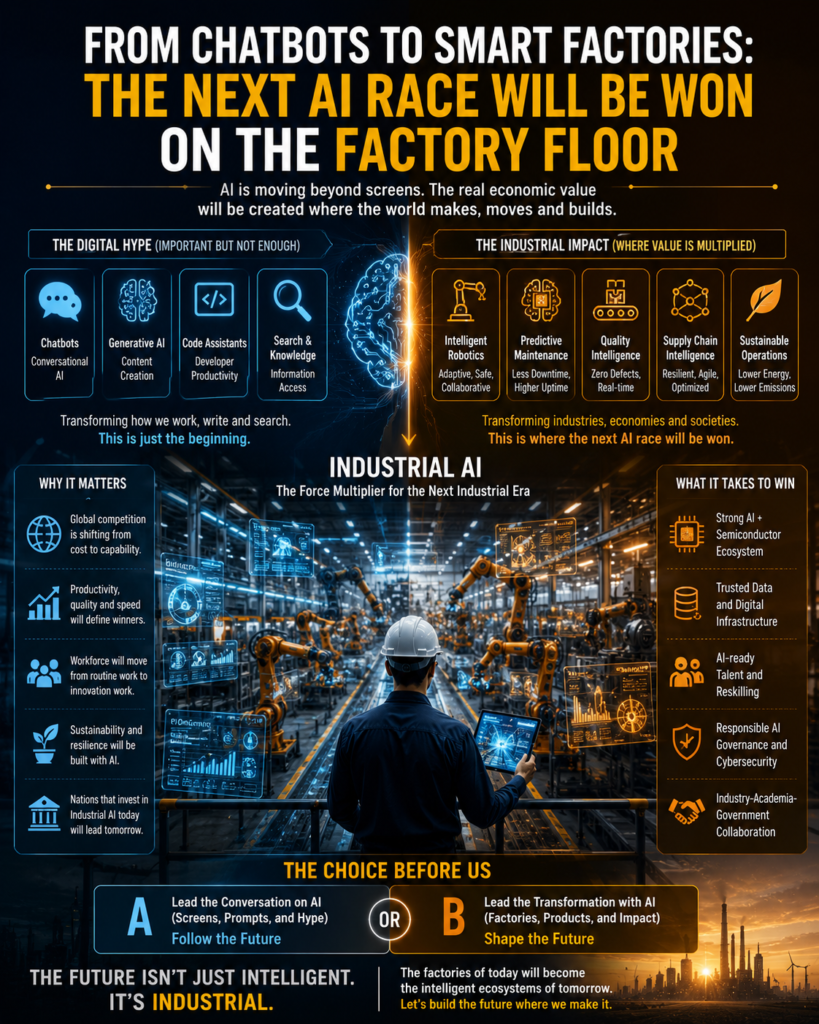
Abstract
Artificial Intelligence (AI) has entered a defining phase in its evolution. For more than six decades, AI remained largely confined to academic laboratories, research institutions, and technology companies where progress was measured by breakthroughs in algorithms, computational power, and model performance. Today, however, the global competitive landscape is undergoing a fundamental transformation. The true value of AI is no longer determined by the sophistication of language models or benchmark scores but by its ability to enhance industrial productivity, strengthen manufacturing competitiveness, improve supply-chain resilience, and accelerate sustainable economic growth.
This article argues that the next wave of global industrial leadership will belong to nations capable of successfully embedding Artificial Intelligence across the manufacturing value chain. Drawing upon global developments, comparative analyses, and strategic insights from China, India, the United States, Germany, Japan, South Korea, Singapore, and Taiwan, the paper examines how Industrial AI is transforming manufacturing from isolated automation into intelligent, self-learning industrial ecosystems.
The article proposes that Industrial AI should be viewed not merely as a digital technology initiative but as a comprehensive national capability requiring coordinated investment in manufacturing modernization, semiconductors, robotics, industrial software, digital infrastructure, workforce development, governance, and research commercialization. It introduces an ecosystem perspective that positions governments, enterprises, academia, startups, technology providers, and financial institutions as interconnected stakeholders responsible for translating AI innovation into measurable industrial outcomes.
Special emphasis is placed on China’s rapid transition from the world’s factory to an intelligent manufacturing powerhouse and India’s unique opportunity to combine software leadership, digital public infrastructure, entrepreneurial innovation, and expanding manufacturing capacity to create one of the world’s most inclusive Industrial AI ecosystems.
The article concludes that the future of manufacturing will be determined not by the nation that invents the most advanced algorithms but by the nation that most effectively integrates Artificial Intelligence into factories, supply chains, engineering processes, and industrial ecosystems.
Keywords: Artificial Intelligence, Industrial AI, Intelligent Manufacturing, Industry 5.0, Smart Factories, Digital Twins, Agentic AI, Physical AI, Manufacturing Strategy, China, India, Industrial Transformation, Industrial Policy, Manufacturing Competitiveness
Introduction
Artificial Intelligence has become one of the defining technologies of the twenty-first century. During the past decade, governments, technology companies, universities, investors, and policymakers have focused primarily on the rapid evolution of Generative AI, Large Language Models, multimodal systems, and advanced machine learning. While these developments have fundamentally transformed knowledge work, software development, education, healthcare, and digital services, they represent only one dimension of AI’s long-term economic potential.
The next frontier of Artificial Intelligence lies not within digital interfaces but inside factories, warehouses, engineering centers, production lines, industrial supply chains, and manufacturing ecosystems. As AI increasingly moves beyond generating content toward controlling physical systems, optimizing industrial operations, and supporting autonomous decision-making, manufacturing is emerging as the sector where AI can generate its largest and most enduring economic impact.
History demonstrates that technological breakthroughs alone rarely create lasting competitive advantage. Scientific discoveries become economically meaningful only when successfully commercialized at scale. The steam engine reshaped economies because industries redesigned factories around mechanical power. Electricity transformed manufacturing because production systems evolved to exploit its capabilities. Computing revolutionized business because organizations embedded digital technologies into operational processes. Artificial Intelligence now stands at a similar inflection point. Its long-term significance will be determined not by laboratory achievements but by its ability to increase industrial productivity, accelerate innovation, improve sustainability, strengthen supply-chain resilience, and redefine manufacturing competitiveness.
This shift represents a profound change in how governments and enterprises evaluate AI investments. Competitive advantage increasingly depends upon integrating intelligence across the entire manufacturing value chain rather than deploying isolated digital tools. Production planning, predictive maintenance, product design, engineering simulation, quality assurance, warehouse automation, logistics optimization, energy management, and customer service are becoming interconnected through AI-enabled decision-making. Manufacturing enterprises are gradually evolving into continuously learning systems where operational data generated by every machine, sensor, robot, supplier, and customer interaction contributes to enterprise-wide intelligence.
The implications extend far beyond individual companies. Manufacturing remains one of the most important contributors to national productivity, exports, employment, innovation, technological advancement, and geopolitical influence. Countries capable of embedding AI into industrial ecosystems will strengthen technological sovereignty, reduce dependence on external supply chains, attract global investment, and establish long-term economic resilience. Industrial AI has therefore become not merely a business opportunity but a strategic national capability.
China has recognized this reality through comprehensive industrial policies that integrate Artificial Intelligence with advanced manufacturing, robotics, industrial internet platforms, semiconductor development, and smart factories. Simultaneously, India stands at a historic crossroads where its globally recognized software capabilities, digital public infrastructure, entrepreneurial ecosystem, and expanding manufacturing base create a unique opportunity to build an alternative model of intelligent industrialization. Rather than replicating traditional manufacturing pathways, India possesses the potential to leapfrog directly toward AI-enabled manufacturing ecosystems capable of competing globally on productivity, innovation, sustainability, and resilience.
Against this backdrop, a critical question emerges. Which countries will lead the next industrial revolution? Increasingly, the answer will depend less on who develops the most sophisticated AI algorithms and more on who successfully integrates those algorithms into physical production systems, engineering processes, industrial operations, and manufacturing ecosystems.
The Global Shift from AI Innovation to Industrial Intelligence
The global conversation surrounding Artificial Intelligence is gradually shifting from technological capability toward industrial capability. During the initial wave of AI adoption, success was measured through research publications, model accuracy, computational performance, venture capital investment, and digital applications. Today, however, governments and enterprises are recognizing that AI’s greatest economic value lies in transforming physical industries that collectively account for a substantial proportion of global economic output.
Manufacturing occupies a particularly important position within this transformation because it influences productivity across numerous interconnected sectors, including mining, transportation, logistics, construction, energy, healthcare, defense, consumer goods, and infrastructure. Every improvement in manufacturing efficiency creates multiplier effects throughout national economies. Consequently, integrating Artificial Intelligence into industrial operations has become one of the most effective mechanisms for improving long-term economic competitiveness.
This transformation is being driven by the convergence of several technological developments. Cloud computing now provides scalable computational infrastructure. Edge computing enables real-time decision-making close to industrial equipment. Industrial Internet of Things (IIoT) devices generate continuous streams of operational data. Advanced sensors monitor equipment health with unprecedented precision. Robotics increasingly performs complex physical tasks. Digital Twins enable virtual simulation of manufacturing systems before operational implementation. Artificial Intelligence integrates these technologies into intelligent production environments capable of continuous learning and optimization.
Unlike previous automation initiatives that focused primarily on replacing repetitive manual activities, Industrial AI augments decision-making throughout manufacturing operations. Predictive maintenance systems forecast equipment failures before they occur. Computer Vision continuously inspects product quality. AI-driven production planning dynamically reallocates manufacturing capacity in response to changing customer demand. Supply-chain intelligence anticipates disruptions before they affect production schedules. Digital engineering platforms accelerate product development through AI-assisted simulation and optimization. These capabilities collectively transform factories from reactive production environments into adaptive systems capable of responding intelligently to rapidly changing operating conditions.
The implications extend beyond operational efficiency. Global manufacturing has entered a period characterized by geopolitical uncertainty, supply-chain disruptions, labor shortages, sustainability requirements, and increasing customer expectations for product customization. Traditional manufacturing models optimized primarily for cost minimization now struggle to balance resilience, flexibility, innovation, and environmental responsibility. Artificial Intelligence provides the analytical capability required to simultaneously optimize multiple operational objectives that previously involved complex trade-offs.
Countries across the world are responding differently to this emerging reality. The United States continues to dominate foundational AI research, semiconductor design, cloud computing, and venture capital. Germany strengthens manufacturing competitiveness through Industry 4.0, engineering excellence, and industrial software. Japan integrates AI with world-leading robotics while addressing demographic challenges through intelligent automation. South Korea combines semiconductor leadership with advanced electronics manufacturing. Singapore leverages digital infrastructure and governance to position itself as a global smart manufacturing hub. Taiwan remains indispensable through its semiconductor ecosystem that powers much of the world’s AI infrastructure.
China, however, has pursued perhaps the most comprehensive Industrial AI strategy. Rather than viewing AI as an independent technology sector, China has embedded Artificial Intelligence into manufacturing modernization, industrial internet platforms, advanced robotics, semiconductor development, logistics, renewable energy, and smart infrastructure. This coordinated ecosystem approach has significantly accelerated the commercialization of AI across multiple manufacturing industries.
India now has an unprecedented opportunity to establish its own distinctive Industrial AI model. Unlike many mature manufacturing economies constrained by legacy industrial infrastructure, India can combine software engineering expertise, Digital Public Infrastructure, cloud-native technologies, AI innovation, manufacturing expansion, and entrepreneurial dynamism to create intelligent manufacturing ecosystems designed around Artificial Intelligence from inception.
The emerging competition is therefore not simply about who possesses the largest AI models or the greatest computational resources. It is about which nations can most effectively transform scientific innovation into industrial productivity. The countries capable of integrating Artificial Intelligence seamlessly across engineering, manufacturing, logistics, supply chains, sustainability, workforce development, and governance will define the industrial leaders of the coming decades.
Industrial intelligence is becoming the new measure of national competitiveness. The movement of AI from laboratories to factory floors is no longer an isolated technology trend; it represents the beginning of a new industrial paradigm in which data become the raw material of manufacturing, algorithms become operational decision-makers, and intelligent factories become the foundation of economic leadership.
Table 1. Evolution from AI Research to Industrial Intelligence
| Era | Primary Focus | Key Outcome |
|---|---|---|
| AI Research Era | Algorithms, Machine Learning, Academic Research | Scientific advancement |
| Digital AI Era | Generative AI, Enterprise Software, Automation | Knowledge worker productivity |
| Industrial AI Era | Manufacturing, Robotics, Industrial Analytics | Intelligent production systems |
| Autonomous Manufacturing Era | Agentic AI, Physical AI, Industrial Foundation Models | Self-learning manufacturing ecosystems |
Table 2. Characteristics of the New Industrial AI Economy
| Traditional Manufacturing | AI-Driven Manufacturing |
|---|---|
| Reactive operations | Predictive operations |
| Fixed production schedules | Dynamic optimization |
| Periodic quality inspection | Continuous AI inspection |
| Preventive maintenance | Predictive and prescriptive maintenance |
| Human-only decision making | Human-AI collaborative intelligence |
| Isolated factories | Connected manufacturing ecosystems |
| Cost optimization | Productivity, resilience, innovation, and sustainability optimization |
China’s Industrial AI Revolution: From the Factory of the World to the World’s Intelligent Manufacturing Superpower
The transformation of China’s manufacturing sector represents one of the most ambitious industrial modernization programmes in modern economic history. Over four decades, China has progressed from being a low-cost manufacturing destination to becoming one of the world’s leading producers of electric vehicles, renewable energy technologies, advanced robotics, industrial equipment, telecommunications infrastructure, and increasingly, Artificial Intelligence-enabled manufacturing systems.
This transformation did not occur through isolated technological innovation. Instead, it emerged from a carefully coordinated national strategy that aligned industrial policy, infrastructure development, manufacturing investment, research institutions, universities, technology companies, venture capital, workforce development, and government support toward a common objective: transforming manufacturing into the primary engine of long-term economic competitiveness.
Unlike many countries where Artificial Intelligence evolved independently from industrial policy, China embedded AI directly into its manufacturing modernization agenda. Initiatives such as Made in China 2025 and the Next Generation Artificial Intelligence Development Plan positioned Artificial Intelligence not as a digital industry but as an enabling capability across advanced manufacturing, robotics, aerospace, transportation, healthcare, renewable energy, and industrial equipment. The objective was not merely to automate factories but to create intelligent manufacturing ecosystems capable of continuous learning, adaptive production, and autonomous optimization.
China’s approach demonstrates an important strategic principle. Manufacturing competitiveness increasingly depends upon ecosystem integration rather than technological superiority alone. Artificial Intelligence delivers limited value when deployed as isolated software applications. Its transformative impact emerges when engineering, design, production planning, predictive maintenance, quality assurance, warehouse management, logistics, customer demand forecasting, and supply-chain coordination become interconnected through a common intelligence platform.
Chinese manufacturers have increasingly adopted Industrial Internet platforms that connect machines, sensors, enterprise software, suppliers, logistics providers, and customers into unified operational ecosystems. Every production activity generates digital information that continuously improves manufacturing intelligence. Digital Twins simulate production changes before implementation. Computer Vision systems inspect every manufactured component in real time. Predictive maintenance algorithms forecast equipment failures before breakdowns occur. AI-enabled production scheduling dynamically reallocates manufacturing capacity based on changing customer demand and supply-chain conditions.
Companies such as Huawei, Haier, BYD, CATL, Xiaomi, Midea, SANY, Alibaba Cloud, Tencent Cloud, and Unitree Robotics illustrate different dimensions of this transformation. Huawei has integrated AI into manufacturing, cloud infrastructure, industrial connectivity, and intelligent production systems. Haier’s COSMOPlat platform demonstrates how customers can participate directly in manufacturing through AI-enabled mass customization. BYD and CATL utilize Artificial Intelligence throughout battery manufacturing, quality assurance, supply-chain optimization, and production scheduling, enabling rapid expansion within the global electric vehicle market. Xiaomi has developed highly automated manufacturing facilities where intelligent robotics, AI-driven quality inspection, and Digital Twins operate together within flexible production environments.
Robotics represents another defining element of China’s Industrial AI strategy. China has become the world’s largest installer of industrial robots while simultaneously investing heavily in domestic robotics manufacturers. Increasingly, these robots incorporate Artificial Intelligence, allowing them to perceive changing environments, collaborate with human workers, optimize manufacturing operations, and continuously improve through machine learning. This evolution toward Physical AI signals a transition from programmable automation to intelligent physical systems capable of adaptive industrial behavior.
China has also recognized that Artificial Intelligence depends fundamentally upon semiconductor capability. Investments in AI processors, chip manufacturing, advanced packaging, semiconductor research, and industrial computing infrastructure aim to strengthen technological sovereignty while reducing dependence on external supply chains. Although geopolitical restrictions have created significant challenges, they have simultaneously accelerated domestic innovation across multiple strategic technologies.
Perhaps the most important lesson from China’s experience lies in the speed with which research becomes commercialization. Universities, research laboratories, manufacturers, technology firms, venture capital organizations, and government agencies operate within tightly interconnected innovation ecosystems. This collaboration significantly shortens the period between laboratory discovery and industrial deployment, allowing manufacturing organizations to rapidly integrate emerging AI capabilities into commercial production.
China’s Industrial AI journey therefore demonstrates that manufacturing leadership is no longer determined primarily by labor costs or production volume. Instead, it increasingly depends upon the ability to integrate Artificial Intelligence, robotics, cloud computing, industrial software, Digital Twins, semiconductors, and intelligent supply chains into a continuously evolving industrial ecosystem capable of sustaining long-term competitive advantage.
India’s Historic Opportunity to Lead the Next Industrial Revolution
If China represents the world’s most comprehensive example of coordinated Industrial AI deployment, India represents one of the world’s most significant untapped opportunities. Unlike previous industrial revolutions, where manufacturing capability preceded technological leadership, India enters the Industrial AI era possessing globally recognized strengths in software engineering, digital infrastructure, data science, entrepreneurship, and engineering services.
This combination fundamentally changes India’s strategic position within global manufacturing. Rather than competing exclusively on labor costs or production scale, India has the opportunity to integrate Artificial Intelligence directly into its expanding manufacturing ecosystem, creating intelligent factories capable of competing through productivity, innovation, flexibility, sustainability, and resilience.
Several structural advantages distinguish India’s Industrial AI opportunity.
The first is its globally competitive software industry. Indian technology professionals have contributed significantly to global advances in cloud computing, enterprise software, cybersecurity, data analytics, and Artificial Intelligence. This software capability provides a strong foundation for developing indigenous Industrial AI platforms rather than relying exclusively on imported technologies.
The second advantage is India’s Digital Public Infrastructure. Platforms such as Aadhaar, Unified Payments Interface (UPI), DigiLocker, the Goods and Services Tax Network (GSTN), the Open Network for Digital Commerce (ONDC), and the Account Aggregator framework have demonstrated India’s ability to implement secure, interoperable digital platforms at national scale. Although these systems primarily support governance and financial inclusion, they establish institutional capabilities directly relevant to future industrial data platforms, trusted manufacturing ecosystems, and AI-enabled supply chains.
Third, India possesses one of the world’s youngest and largest engineering workforces. As manufacturing becomes increasingly knowledge-intensive, this demographic advantage can support rapid adoption of Artificial Intelligence, robotics, Digital Twins, industrial analytics, and advanced engineering technologies. However, realizing this opportunity requires educational institutions to integrate AI, manufacturing engineering, industrial automation, robotics, cybersecurity, and systems thinking into engineering curricula.
India’s manufacturing policy environment has also evolved significantly. The IndiaAI Mission, Digital India, Make in India, the Production Linked Incentive Schemes, the National Manufacturing Mission, the National Logistics Policy, and Semicon India collectively establish a comprehensive policy architecture supporting intelligent manufacturing. Rather than operating independently, these initiatives can function as complementary pillars of a long-term Industrial AI strategy.
The country’s industrial sectors are equally well positioned for AI adoption. Automotive manufacturers can integrate AI into electric vehicle production, battery manufacturing, predictive maintenance, and quality inspection. Steel producers can utilize AI for blast furnace optimization, energy management, and process control. Cement manufacturers can optimize kiln operations, quarry planning, logistics, and alternative fuel utilization. Pharmaceutical companies can strengthen quality assurance, compliance, and formulation development through AI-enabled analytics. Electronics manufacturers can leverage robotics, Computer Vision, and Digital Twins to improve productivity while supporting India’s semiconductor ambitions.
Perhaps the greatest opportunity lies within India’s Micro, Small, and Medium Enterprises. MSMEs contribute substantially to manufacturing output, exports, and employment but often face constraints related to capital, digital infrastructure, and technical expertise. Cloud-native Artificial Intelligence, AI-as-a-Service platforms, low-cost Computer Vision systems, industrial copilots, Edge AI devices, and shared Industrial AI Centers of Excellence can democratize advanced manufacturing technologies, enabling even smaller manufacturers to participate in intelligent industrial ecosystems.
India’s startup ecosystem further strengthens this opportunity. Thousands of AI-focused startups are developing industrial analytics, robotics, Digital Twins, Computer Vision, predictive maintenance platforms, supply-chain optimization tools, and manufacturing software. Collaboration between these startups and established manufacturers can accelerate commercialization while creating globally competitive Industrial AI products designed specifically for manufacturing environments.
Nevertheless, important challenges remain. Industrial automation remains uneven across sectors. Robotics adoption remains significantly below leading manufacturing economies. Semiconductor manufacturing capability is still developing. Many factories continue operating fragmented legacy systems that limit data integration. Workforce reskilling must accelerate substantially to prepare engineers, operators, and managers for AI-enabled manufacturing environments. Strong governance frameworks addressing cybersecurity, responsible AI, industrial data management, and operational resilience will also become increasingly important.
Despite these challenges, India’s opportunity is fundamentally different from that of most industrial nations. Rather than modernizing mature manufacturing systems, India can build intelligent manufacturing ecosystems from the ground up. By combining Artificial Intelligence with digital public infrastructure, manufacturing expansion, industrial corridors, renewable energy, semiconductor development, and engineering excellence, India can establish a distinctive Industrial AI model that emphasizes openness, inclusivity, interoperability, affordability, and sustainable industrial development.
The defining question for India is therefore no longer whether it should adopt Artificial Intelligence within manufacturing. The more important question is how rapidly it can transform its digital leadership into industrial leadership. The nations that successfully answer this question will shape the next era of global manufacturing, and India possesses many of the ingredients necessary to become one of them.
Table 3. Comparing China’s and India’s Industrial AI Models
| Dimension | China | India |
|---|---|---|
| Primary Strength | Manufacturing scale and industrial integration | Software engineering and digital innovation |
| National Strategy | State-coordinated intelligent manufacturing | Multi-programme digital and manufacturing transformation |
| AI Focus | Smart factories, robotics, industrial internet | AI-enabled manufacturing, MSMEs, engineering services |
| Semiconductor Strategy | Rapid domestic capability expansion | Emerging ecosystem through Semicon India |
| Workforce Advantage | Manufacturing experience | Young engineering talent |
| Long-Term Opportunity | Global intelligent manufacturing leadership | Inclusive AI-driven industrial transformation |
Table 4. Strategic Priorities for India’s Industrial AI Future
| Strategic Area | Expected National Impact |
|---|---|
| AI-enabled manufacturing modernization | Higher industrial productivity |
| Industrial AI adoption across MSMEs | Inclusive economic growth |
| Semiconductor ecosystem development | Technological sovereignty |
| AI-ready engineering workforce | Global talent leadership |
| Industrial innovation clusters | Faster commercialization |
| Indigenous Industrial AI platforms | Reduced technology dependence |
| AI governance and cybersecurity | Trusted manufacturing ecosystem |
| Sustainable intelligent manufacturing | Global competitiveness and ESG leadership |
The Emerging Technologies That Will Redefine Manufacturing
Industrial AI is entering a new phase in which intelligence extends beyond prediction and automation toward autonomous decision-making, adaptive manufacturing, and human-machine collaboration. While Industry 4.0 introduced connected factories through sensors, cloud computing, and Industrial Internet of Things (IIoT) technologies, the next decade will witness the emergence of manufacturing ecosystems capable of continuously learning, reasoning, optimizing, and acting with minimal human intervention.
One of the most transformative developments is Agentic AI. Unlike conventional AI systems that respond to predefined instructions, Agentic AI can independently plan tasks, coordinate multiple objectives, execute complex workflows, monitor outcomes, and continuously refine its decisions. Within manufacturing environments, AI agents will increasingly collaborate across production planning, procurement, quality assurance, logistics, inventory management, maintenance, sustainability, finance, and engineering.
Rather than functioning as isolated software applications, AI agents will form collaborative industrial networks. A production planning agent may communicate directly with procurement agents to anticipate raw material shortages. Maintenance agents may negotiate machine downtime with production scheduling systems. Sustainability agents may optimize energy consumption based on electricity pricing, renewable energy availability, and carbon emission targets. Human managers will increasingly supervise strategic priorities while AI coordinates routine operational decisions.
Equally transformative is the emergence of Physical AI. Generative AI changed digital knowledge work. Physical AI will redefine physical work itself.
Physical AI combines Artificial Intelligence, robotics, advanced sensing, computer vision, edge computing, autonomous mobility, and Digital Twins to create intelligent machines capable of interacting safely and adaptively with the physical world. Unlike conventional industrial robots that repeatedly execute pre-programmed instructions, Physical AI systems perceive changing environments, interpret operational conditions, collaborate with human workers, learn from experience, and continuously optimize their behavior.
This transformation extends across manufacturing, warehousing, mining, construction, agriculture, healthcare, logistics, and infrastructure development. Autonomous mobile robots transport materials inside factories. Intelligent drones inspect industrial assets. Collaborative robots work alongside human operators. Autonomous forklifts coordinate warehouse operations. Humanoid robots increasingly perform complex industrial activities that previously required manual intervention.
Industrial intelligence will also be transformed through Industrial Foundation Models. Just as Large Language Models learned from vast collections of internet data, Industrial Foundation Models will learn from manufacturing-specific information including engineering drawings, maintenance manuals, industrial standards, machine telemetry, quality records, production histories, process parameters, supplier documentation, operational procedures, and equipment specifications.
Future engineers may consult Industrial Foundation Models that understand decades of organizational knowledge. Maintenance personnel may diagnose equipment failures using AI systems trained upon millions of historical maintenance records. Designers may generate optimized manufacturing solutions based upon organizational best practices accumulated over many years. Manufacturing knowledge itself becomes an intelligent enterprise asset.
Digital Twins will evolve simultaneously. Today’s Digital Twins primarily simulate manufacturing systems during engineering design. Future Digital Twins will remain continuously synchronized with operational factories, creating living digital representations that evolve alongside physical production systems. Every operational change occurring inside a factory will immediately update its virtual counterpart. AI will continuously evaluate alternative production strategies before implementation, enabling organizations to optimize manufacturing while minimizing operational disruption.
These technologies collectively support the emergence of autonomous manufacturing. Autonomous manufacturing does not imply factories operating without people. Instead, it refers to manufacturing ecosystems where routine operational decisions become increasingly automated while humans concentrate on innovation, engineering, governance, strategic planning, safety, customer relationships, and continuous improvement.
The workforce itself will undergo profound transformation. Manufacturing professionals will increasingly supervise intelligent systems rather than perform repetitive operational activities. Engineers will collaborate with AI to design products. Maintenance technicians will interpret predictive diagnostics generated by machine learning. Production planners will orchestrate AI agents. Plant managers will oversee integrated digital ecosystems rather than individual production lines. Future manufacturing competitiveness will therefore depend as much upon workforce transformation as technological capability.
Sustainability further strengthens the strategic importance of Industrial AI. Artificial Intelligence continuously optimizes energy consumption, water utilization, carbon emissions, material efficiency, waste reduction, renewable energy integration, and circular manufacturing. Future factories will simultaneously pursue profitability and environmental responsibility, demonstrating that sustainability and productivity increasingly reinforce rather than constrain one another.
For both China and India, these emerging technologies create significant strategic opportunities. China continues investing aggressively in robotics, Industrial Internet platforms, AI semiconductors, and intelligent manufacturing clusters. India can leverage software engineering, Digital Public Infrastructure, AI startups, manufacturing expansion, engineering services, and renewable energy to create an alternative model of intelligent industrialization characterized by openness, affordability, scalability, and inclusiveness.
The defining competition of the next decade will therefore extend beyond Artificial Intelligence itself. It will center upon the ability of nations and enterprises to orchestrate multiple technologies into intelligent manufacturing ecosystems capable of learning continuously while adapting rapidly to changing market conditions.
Table 5. Emerging Technologies Shaping Industrial AI
| Technology | Manufacturing Transformation |
|---|---|
| Agentic AI | Autonomous operational decision-making |
| Physical AI | Intelligent robotics and adaptive automation |
| Industrial Foundation Models | Manufacturing knowledge intelligence |
| Digital Twins | Living virtual factories |
| Edge AI | Real-time production optimization |
| Computer Vision | Zero-defect quality assurance |
| Industrial Internet | Connected manufacturing ecosystems |
| Quantum Computing | Future optimization of complex industrial systems |
Governing Industrial AI: Trust as the New Competitive Advantage
Technological capability alone will not determine industrial leadership. As Artificial Intelligence increasingly influences physical production systems, governance becomes equally important. Industrial AI introduces risks extending beyond software failures to include worker safety, cybersecurity, operational continuity, intellectual property protection, environmental responsibility, regulatory compliance, and national security.
Future manufacturing enterprises must therefore govern Artificial Intelligence with the same rigor applied to financial reporting, operational safety, and enterprise risk management. Board oversight, executive accountability, trusted industrial data, explainable AI, cybersecurity resilience, continuous monitoring, and human supervision will become essential components of intelligent manufacturing.
Responsible AI is not an obstacle to innovation. Rather, it accelerates adoption by strengthening confidence among employees, customers, investors, regulators, suppliers, and society.
Countries capable of combining technological leadership with trusted governance frameworks will establish durable competitive advantages in global manufacturing.
Table 6. Pillars of Responsible Industrial AI
| Governance Dimension | Strategic Objective |
|---|---|
| Strategic Governance | Align AI with business objectives |
| Data Governance | Trusted industrial data |
| AI Model Governance | Reliable and explainable AI |
| Cybersecurity | Protection of manufacturing infrastructure |
| Operational Governance | Safe factory deployment |
| Human Oversight | Responsible decision-making |
| Continuous Monitoring | Adaptive governance |
Strategic Imperatives for Governments and Enterprises
Industrial AI should now be viewed as national industrial infrastructure comparable to transportation networks, telecommunications, energy systems, and financial markets. Governments must therefore create long-term Industrial AI strategies integrating manufacturing policy, semiconductor development, engineering education, research commercialization, industrial corridors, digital infrastructure, and workforce transformation.
For India, the opportunity is particularly significant. Rather than replicating manufacturing models developed elsewhere, India can establish a globally distinctive ecosystem combining Digital Public Infrastructure, cloud-native manufacturing, AI-enabled MSMEs, engineering services, renewable energy, startup innovation, semiconductor capability, and sustainable industrial development.
Enterprises must similarly recognize that Artificial Intelligence is not an information technology project but an enterprise transformation initiative. Organizations should prioritize high-value industrial use cases, establish trusted data foundations, invest continuously in workforce capability, strengthen governance, and scale successful pilots systematically across manufacturing operations.
Universities should redesign engineering education around Artificial Intelligence, robotics, Digital Twins, cybersecurity, industrial analytics, and systems engineering. Technology providers should democratize Industrial AI through affordable cloud platforms, interoperable industrial software, and AI-as-a-Service solutions. Financial institutions should increasingly support industrial digitalization through long-term investment mechanisms recognizing Industrial AI as a strategic productivity enabler.
Table 7. Strategic Roadmap for Industrial AI
| Stakeholder | Strategic Priority |
|---|---|
| Governments | National Industrial AI policy and semiconductor capability |
| Manufacturing Enterprises | Enterprise-wide AI transformation |
| MSMEs | Affordable cloud-native AI adoption |
| Universities | AI-integrated engineering education |
| Technology Companies | Industrial AI platforms and interoperability |
| Investors | Long-term industrial innovation funding |
| Corporate Boards | AI governance and strategic oversight |
Conclusion
Artificial Intelligence is rapidly becoming the defining industrial technology of the twenty-first century. Yet history reminds us that technological breakthroughs alone rarely determine economic leadership. Nations prosper when they successfully translate scientific innovation into industrial capability.
The first industrial revolution belonged to countries that mastered steam power. The second rewarded those that harnessed electricity and mass production. The third favored organizations that embedded computing into business operations. The fourth industrial revolution is now giving way to an era in which Artificial Intelligence becomes the operating system of manufacturing itself.
China has demonstrated how coordinated industrial policy, manufacturing modernization, robotics, semiconductors, cloud infrastructure, and Artificial Intelligence can collectively transform national competitiveness. India now possesses an equally historic opportunity to build an alternative model of Industrial AI by combining software leadership, Digital Public Infrastructure, engineering talent, manufacturing expansion, entrepreneurial innovation, and democratic institutions.
The most successful enterprises will no longer be those possessing the largest factories but those operating the smartest factories. The most competitive economies will no longer be those producing the greatest manufacturing volume but those generating the greatest manufacturing intelligence.
Ultimately, the future belongs to organizations capable of transforming every machine into a source of data, every factory into a learning system, every supply chain into an intelligent network, and every employee into a partner of Artificial Intelligence.
The race to develop powerful AI models has captured global attention. The race that will ultimately define economic leadership, however, is the race to move Artificial Intelligence from laboratories to factory floors.
Table 8. The Future of Industrial Leadership
| Past Industrial Era | Source of Competitive Advantage | Future Industrial Era |
|---|---|---|
| Steam Power | Mechanization | Intelligent Manufacturing |
| Electricity | Mass Production | Autonomous Production |
| Computing | Digital Automation | AI-Orchestrated Enterprises |
| Internet | Global Connectivity | Industrial Intelligence |
| Artificial Intelligence | Knowledge Generation | Intelligent Industrial Ecosystems |
References
- Acemoglu, D., & Restrepo, P. (2019). Automation and new tasks: How technology displaces and reinstates labor. Journal of Economic Perspectives, 33(2), 3–30. https://doi.org/10.1257/jep.33.2.3
- Brynjolfsson, E., & McAfee, A. (2014). The second machine age: Work, progress, and prosperity in a time of brilliant technologies. W. W. Norton & Company. https://wwnorton.com
- Davenport, T. H., & Ronanki, R. (2018). Artificial intelligence for the real world. Harvard Business Review, 96(1). https://hbr.org
- International Federation of Robotics. (2024). World Robotics Report 2024. https://ifr.org
- International Organization for Standardization. (2023). ISO/IEC 42001: Artificial Intelligence—Management System. https://www.iso.org
- Kagermann, H., Wahlster, W., & Helbig, J. (2013). Recommendations for implementing the strategic initiative Industrie 4.0. German National Academy of Science and Engineering (acatech). https://www.acatech.de
- Lee, J., Bagheri, B., & Kao, H. A. (2015). A cyber-physical systems architecture for Industry 4.0-based manufacturing systems. Manufacturing Letters, 3, 18–23. https://doi.org/10.1016/j.mfglet.2014.12.001
- McKinsey & Company. (2024). The State of AI. https://www.mckinsey.com
- Ministry of Electronics and Information Technology, Government of India. (2024). IndiaAI Mission. https://www.meity.gov.in
- National Institution for Transforming India (NITI Aayog). (2018). National Strategy for Artificial Intelligence. https://www.niti.gov.in
- National Institute of Standards and Technology. (2023). Artificial Intelligence Risk Management Framework (AI RMF 1.0). https://www.nist.gov
- Porter, M. E., & Heppelmann, J. E. (2014). How smart, connected products are transforming competition. Harvard Business Review. https://hbr.org
- Schwab, K. (2016). The Fourth Industrial Revolution. World Economic Forum. https://www.weforum.org
- World Economic Forum. (2024). Shaping the Future of Advanced Manufacturing and Value Chains. https://www.weforum.org
- China State Council. (2017). New Generation Artificial Intelligence Development Plan. http://english.www.gov.cn
Disclaimer
This article has been prepared solely for educational, research, strategic, and informational purposes. The analysis, interpretations, frameworks, opinions, and recommendations presented herein are based on publicly available information, academic literature, government publications, industry reports, corporate disclosures, and the author’s independent research and professional judgment. While every effort has been made to ensure the accuracy and relevance of the information at the time of publication, no representation or warranty, express or implied, is made regarding its completeness, accuracy, or suitability for any specific purpose. Readers are encouraged to independently verify facts and consult original sources before making strategic, operational, financial, legal, or investment decisions.
The references to countries, government initiatives, companies, products, technologies, standards, and case studies are included solely for analytical and educational purposes and should not be interpreted as endorsements, certifications, or recommendations. Artificial Intelligence, manufacturing technologies, regulations, industrial policies, and market conditions continue to evolve rapidly; therefore, future developments may differ from the perspectives presented in this article. The strategic frameworks and models included in this article represent the author’s original analytical interpretation unless otherwise attributed to an external source.
The implementation of Artificial Intelligence in manufacturing requires careful consideration of organizational readiness, data quality, cybersecurity, workforce capabilities, governance, regulatory compliance, operational safety, and ethical principles. The outcomes of AI adoption will vary depending on an organization’s industry, scale, technological maturity, and implementation approach. Accordingly, the author and publisher disclaim any liability for any direct or indirect loss, damage, or consequences arising from the use of, or reliance upon, the information contained in this article.
This article is intended to encourage informed discussion on the future of Industrial Artificial Intelligence and to support responsible innovation, sustainable manufacturing, and evidence-based decision-making. The views expressed are those of the author and do not necessarily reflect the official policies or positions of any government, organization, institution, or company referenced in this publication. Readers are encouraged to apply the concepts presented herein responsibly and in accordance with applicable laws, industry standards, and professional best practices.