Abstract
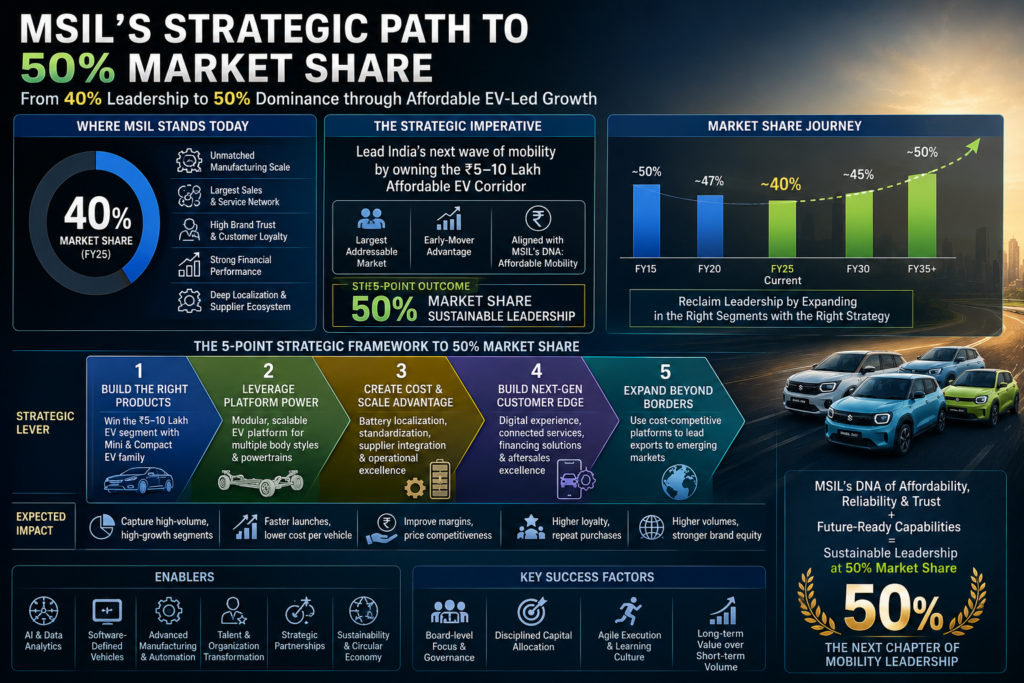
The Indian passenger vehicle industry is experiencing one of the most profound structural transformations in its history. While electrification, digitalization, artificial intelligence, connected mobility, and changing customer aspirations are redefining global automotive competition, India’s transition presents a unique paradox. The country’s largest automobile manufacturer, Maruti Suzuki India Limited, continues to lead the domestic passenger vehicle market with approximately 40 percent market share, yet this leadership has gradually declined from nearly 50 percent over the past decade. Conventional wisdom suggests that recovering lost market share requires launching additional sport utility vehicles (SUVs) and expanding participation in premium electric vehicle segments. This paper argues that such incremental strategies are unlikely to restore sustainable market leadership. Instead, India’s next automotive growth cycle will be shaped by affordable electrification rather than premium electrification. The paper proposes that Maruti Suzuki should strategically establish leadership in India’s ₹5–10 lakh electric vehicle corridor by developing a modular, scalable electric vehicle platform spanning Mini and Compact segments. Rather than competing model by model, the company should build an integrated affordable mobility ecosystem that combines manufacturing scale, localization, software-defined vehicles, battery partnerships, artificial intelligence, digital customer engagement, and export competitiveness. The paper concludes that affordable electric mobility represents not merely a product opportunity but a national industrial opportunity capable of redefining India’s automotive leadership over the next two decades.
Keywords: Maruti Suzuki, Electric Vehicles, India, Affordable Mobility, Business Strategy, Automotive Industry, Market Share, Platform Strategy, EV Ecosystem, Manufacturing Strategy
Introduction
Few companies have influenced the industrial and social development of modern India as profoundly as Maruti Suzuki India Limited. Since commencing operations in the early 1980s, the company fundamentally transformed personal mobility by making automobile ownership accessible to millions of middle-class households. Affordable pricing, dependable engineering, extensive localization, disciplined manufacturing, and an unmatched nationwide sales and service network enabled Maruti Suzuki to become one of the most successful automotive companies operating in any emerging economy.
For nearly three decades, the company consistently maintained a domestic passenger vehicle market share close to or above fifty percent. Such sustained market leadership is rare within the global automotive industry, particularly in markets characterized by increasing competition, regulatory complexity, and evolving consumer expectations. However, the structural foundations of India’s passenger vehicle market have changed significantly. Market leadership is no longer determined solely by manufacturing excellence or cost competitiveness. Instead, software integration, electrification, customer experience, artificial intelligence, digital ecosystems, sustainability, and platform economics are rapidly becoming defining sources of competitive advantage.
During the same period, Maruti Suzuki’s domestic market share has moderated to approximately forty percent. Although the company continues to remain India’s largest passenger vehicle manufacturer, the reduction in market share raises an important strategic question. Has Maruti Suzuki lost its competitive advantage, or has the market itself fundamentally changed?
This distinction is critically important. If market share has declined because operational excellence weakened, the solution would involve improving execution. If, however, the market has evolved toward new customer preferences, technologies, and business models, incremental operational improvements will be insufficient. The company must instead redefine its strategic positioning for the next era of mobility.
This paper argues that the second explanation is more compelling. Maruti Suzuki has not lost its historical strengths. Rather, the industry’s centre of gravity has shifted toward new segments, new technologies, and new customer expectations that reward different competitive capabilities.
The Structural Transformation of India’s Passenger Vehicle Industry
The Indian passenger vehicle industry has historically evolved through successive phases of industrial development. The initial decades following economic liberalization emphasized vehicle accessibility and manufacturing expansion. During this period, compact hatchbacks and entry-level cars became the primary engines of industry growth. Rising household incomes, increasing urbanization, and expanding financing availability enabled millions of first-time buyers to enter the automobile market.
The second phase introduced greater product diversity as manufacturers expanded into premium hatchbacks, compact sedans, and multi-purpose vehicles. Competition intensified as international manufacturers introduced differentiated products targeting increasingly sophisticated customers.
The current phase is fundamentally different. Instead of being driven primarily by affordability, market expansion is increasingly shaped by changing customer aspirations, digital technologies, safety expectations, environmental consciousness, and lifestyle-oriented purchasing behaviour. Utility vehicles, particularly SUVs, have emerged as the dominant growth category. Electrification has begun reshaping long-term product planning, while software-defined vehicles and connected mobility services are becoming increasingly important dimensions of customer value.
Table 1 illustrates the structural evolution of India’s passenger vehicle industry.
| Industry Phase | Dominant Growth Driver | Primary Customer Expectation | Strategic Outcome |
|---|---|---|---|
| Mass Motorization | Entry-level hatchbacks | Affordable ownership | Rapid market expansion |
| Product Diversification | Premium hatchbacks and sedans | Comfort and convenience | Segment specialization |
| SUV Expansion | Utility vehicles | Safety and lifestyle | Shift in product mix |
| Intelligent Mobility | Electrification and digital technologies | Connected, sustainable mobility | Capability-led competition |
The transformation illustrated above demonstrates that the industry has not entered a period of decline. Instead, the basis of competition has fundamentally evolved. Companies capable of anticipating the next stage of customer evolution are likely to shape the industry’s future leadership.
Understanding Maruti Suzuki’s Market Share Decline
Conventional industry analysis often attributes Maruti Suzuki’s declining market share to the success of competitors such as Kia India, MG Motor India, Tata Motors, and Mahindra & Mahindra in the SUV segment. While this explanation is partially valid, it remains incomplete.
The company did not lose leadership because its products suddenly became inferior. Instead, the fastest-growing segments of the market emerged in areas where Maruti Suzuki historically maintained relatively lower participation. Simultaneously, its strongest categories, particularly Mini and Compact hatchbacks, experienced slower structural growth due to changing customer aspirations, regulatory developments, and premiumization.
This distinction changes the nature of the strategic response. Rather than viewing the problem as one of competitive weakness, it should be interpreted as a challenge of strategic repositioning.
Table 2 summarizes the principal drivers contributing to market share erosion.
| Structural Driver | Relative Strategic Impact | Nature of Change |
|---|---|---|
| SUV-led market expansion | Very High | Structural |
| Premiumization | High | Structural |
| Changing customer aspirations | Very High | Behavioural |
| New market entrants | Moderate | Competitive |
| Electrification | Emerging | Technological |
| Declining entry-level ICE demand | High | Structural |
The evidence suggests that a significant proportion of market share erosion resulted from macro-level industry evolution rather than deterioration in Maruti Suzuki’s manufacturing capability, brand reputation, dealer network, or financial strength.
This conclusion is strategically important because structural challenges require structural solutions. Incremental product launches, while necessary, are unlikely to reverse a transformation that is fundamentally changing customer expectations and industry economics.
The Limits of an SUV-Centric Growth Strategy
Most strategic discussions surrounding Maruti Suzuki’s future emphasize accelerated investment in SUVs. There is little doubt that SUVs will continue to play an essential role within the company’s portfolio. However, an SUV-led strategy alone is unlikely to restore sustained market leadership.
SUV competition in India has become increasingly crowded. Domestic manufacturers, Korean manufacturers, Japanese manufacturers, Chinese-backed companies, and emerging electric vehicle specialists are simultaneously expanding their product portfolios. Product differentiation cycles have shortened considerably, technological features are replicated more rapidly than ever before, and pricing pressure continues to intensify.
Consequently, competing exclusively through additional SUV launches risks entering an increasingly saturated competitive arena where long-term differentiation becomes progressively more difficult.
Table 3 compares alternative strategic pathways available to Maruti Suzuki.
| Strategic Option | Long-Term Differentiation | Alignment with Brand Strength | Sustainable Competitive Advantage |
|---|---|---|---|
| Incremental SUV expansion | Moderate | Moderate | Limited |
| Premium EV strategy | Moderate | Low | Limited |
| Hybrid-led transition | Moderate | High | Transitional |
| Affordable EV platform strategy | Very High | Very High | Strong |
The comparison indicates that affordable electrification offers significantly stronger alignment with Maruti Suzuki’s historical identity than premium positioning strategies. Rather than competing directly within overcrowded premium segments, the company possesses an opportunity to redefine mass-market electric mobility.
Rethinking Affordability in the Electric Era
One of the most significant misconceptions surrounding India’s EV transition concerns the meaning of affordability.
Historically, affordability referred almost exclusively to purchase price. Consumers evaluated vehicle ownership primarily through initial acquisition cost and fuel efficiency. However, electrification fundamentally changes ownership economics.
Future affordability must be measured through total cost of ownership, incorporating purchase price, financing, electricity costs, maintenance expenditure, battery reliability, digital services, warranty coverage, resale value, and long-term ownership confidence.
Under this broader definition, affordable electric mobility becomes substantially more valuable than simply producing lower-priced vehicles.
The strategic opportunity therefore extends beyond designing inexpensive electric cars. It involves creating an ownership ecosystem that reduces customer anxiety while maximizing lifetime economic value.
This expanded definition of affordability forms the intellectual foundation for what this paper identifies as India’s next major automotive opportunity: the ₹5–10 lakh electric mobility corridor, where affordability, manufacturing scale, localization, and mass adoption converge into a potentially transformative strategic platform.
The Golden EV Price Corridor: India’s Largest Untapped Automotive Opportunity
Every transformational industrial revolution is defined by a strategic inflection point where technology, affordability, customer demand, and manufacturing economics converge. For India’s passenger vehicle industry, that convergence is likely to occur within the ₹5–10 lakh price corridor.
While much of the automotive industry’s attention has focused on premium electric vehicles priced above ₹15 lakh, India’s demographic and economic realities suggest that long-term market expansion will be driven by mass-market affordability rather than premium adoption. India’s automobile market continues to be characterized by first-time buyers, two-wheeler upgraders, value-conscious families, young professionals, and consumers from Tier-2 and Tier-3 cities. Collectively, these customer groups represent the largest volume opportunity in the country’s mobility ecosystem.
This paper therefore introduces the concept of the Golden EV Price Corridor, defined as the strategic market space broadly spanning ₹5–10 lakh (ex-showroom), where affordability, scale, localization, and electrification can coexist. Rather than viewing this corridor as a fixed pricing commitment, it should be interpreted as a strategic target range that may evolve with battery costs, localization levels, regulatory requirements, and technological advancements.
The significance of this corridor lies not merely in its size but in its strategic alignment with Maruti Suzuki’s historical competitive advantages. Since its inception, the company’s success has been founded upon democratizing mobility through affordable, reliable, and economical vehicles. Extending that philosophy into the electric era represents an evolution of the company’s identity rather than a departure from it.
Table 4 illustrates the strategic attractiveness of different EV price bands.
| EV Price Band (Approx.) | Market Characteristics | Competitive Intensity | Strategic Opportunity |
|---|---|---|---|
| Below ₹5 lakh | Ultra-entry mobility | Limited | Moderate |
| ₹5–10 lakh | Mass-market affordability | Emerging | Very High |
| ₹10–15 lakh | Mid-market EVs | High | High |
| ₹15–20 lakh | Premium EVs | Very High | Moderate |
| Above ₹20 lakh | Luxury EVs | High | Limited |
The analysis indicates that the greatest opportunity does not necessarily lie where competition is already strongest. Instead, it exists where the addressable customer base is largest and where Maruti Suzuki’s capabilities create the strongest strategic fit.
From Product Strategy to Platform Strategy
One of the most common strategic errors in the automotive industry is evaluating transformation through individual vehicle launches. Vehicle programmes generate revenue, but platforms create enduring competitive advantage.
The distinction is fundamental.
A vehicle is a product.
A platform is an enterprise capability.
Global automotive leaders increasingly compete through scalable architectures that support multiple products, shared components, common software, standardized electronics, and flexible manufacturing systems. Platform-based strategies reduce engineering complexity, improve procurement efficiency, accelerate product development, increase manufacturing utilization, and enable continuous technological improvement across an entire portfolio.
For Maruti Suzuki, this insight suggests that the objective should not be to develop isolated Mini EVs or Compact EVs. Instead, the company should create a modular affordable electric vehicle architecture capable of supporting an entire family of products.
This paper refers to this strategic initiative as Project Bharat EV.
Project Bharat EV should not be interpreted as a single vehicle programme. It should be viewed as an enterprise transformation platform capable of integrating engineering, manufacturing, software, battery systems, customer experience, and exports within one scalable operating model.
Table 5 outlines the conceptual architecture of Project Bharat EV.
| Common Platform Element | Strategic Purpose | Business Benefit |
|---|---|---|
| Modular chassis | Multiple vehicle derivatives | Engineering efficiency |
| Standardized battery architecture | Shared battery modules | Cost optimization |
| Common electronics | Software integration | Reduced complexity |
| Vehicle operating software | Connected mobility | Digital differentiation |
| Manufacturing platform | Flexible production | Higher capacity utilization |
| Shared safety systems | Regulatory compliance | Lower development cost |
Instead of approving four independent vehicle programmes, the Board would approve one industrial platform capable of supporting several future products.
The Economics of Scale in Affordable Electrification
Affordability is often perceived as a constraint on profitability. However, this assumption overlooks one of the most powerful principles in industrial economics: scale.
Large production volumes reduce unit costs through manufacturing efficiency, supplier specialization, procurement leverage, component standardization, logistics optimization, and higher asset utilization. These benefits become particularly important in electric vehicle manufacturing, where battery costs remain a substantial proportion of overall vehicle cost.
A modular affordable EV platform would therefore generate multiple economic advantages beyond vehicle sales alone.
Higher production volumes would encourage greater localization of batteries, power electronics, semiconductors, electric motors, and associated components. Increased localization would reduce dependence on imported systems while improving cost competitiveness and strengthening India’s automotive supply chain.
At the same time, common engineering architectures would reduce duplication across future product programmes, enabling software updates, safety improvements, and digital features to be deployed simultaneously across multiple vehicles.
Table 6 compares the economics of traditional vehicle development with platform-based development.
| Evaluation Parameter | Standalone Vehicle Development | Platform-Based Development |
|---|---|---|
| Engineering investment | High per model | Shared across portfolio |
| Procurement | Fragmented | Consolidated |
| Manufacturing | Product specific | Flexible |
| Software | Independent systems | Common architecture |
| Localization | Moderate | Higher |
| Product development cycle | Longer | Faster |
| Capacity utilization | Lower | Higher |
Platform thinking therefore transforms affordability from a pricing strategy into a manufacturing strategy.
Customer Behaviour Supports Affordable EV Leadership
The long-term attractiveness of the Golden EV Price Corridor is reinforced by evolving consumer behaviour.
Today’s automobile buyers no longer evaluate vehicles solely on purchase price. Increasingly, they compare total ownership economics, safety, digital features, maintenance requirements, software capabilities, financing options, and long-term resale confidence.
Consequently, affordability has become multidimensional.
Customers seek vehicles that minimize financial uncertainty over the entire ownership lifecycle rather than simply minimizing acquisition cost.
This behavioural shift strongly favours manufacturers capable of combining trusted brands with extensive service networks and predictable ownership experiences.
Maruti Suzuki possesses significant advantages in each of these areas.
Its nationwide dealer infrastructure, widespread service accessibility, high residual values, supplier ecosystem, and reputation for reliability provide competitive assets that become even more valuable during the transition toward electric mobility.
The company’s challenge is therefore not convincing customers to adopt electric vehicles.
The challenge is convincing customers that affordable electric mobility can be as trustworthy and economical as traditional internal combustion vehicles.
Why Competitors May Find This Strategy Difficult to Replicate
An effective corporate strategy must create barriers that competitors cannot easily overcome.
Vehicle design alone rarely satisfies this requirement.
Manufacturing plants can be constructed.
Individual products can be copied.
Technology features can be replicated.
Pricing strategies can be matched.
However, integrated ecosystems built upon decades of customer trust, localization, dealer relationships, supplier partnerships, and manufacturing excellence are substantially more difficult to imitate.
Project Bharat EV therefore derives its competitive strength not from technology alone but from combining traditional industrial capabilities with emerging digital capabilities.
Table 7 summarizes Maruti Suzuki’s existing strategic assets and the future capabilities required to sustain leadership.
| Existing Strategic Strength | Future Capability Requirement | Combined Competitive Advantage |
|---|---|---|
| Manufacturing scale | AI-enabled manufacturing | Productivity leadership |
| Dealer network | Digital customer platform | Lifetime customer engagement |
| Supplier localization | Battery localization | Cost competitiveness |
| Brand trust | Connected ownership ecosystem | Customer confidence |
| Cost leadership | Software-defined vehicles | Sustainable differentiation |
| Financial strength | Platform investment capability | Long-term enterprise value |
The integration of these capabilities creates a competitive position that extends beyond products into enterprise architecture.
Affordable Mobility as a National Industrial Strategy
The strategic importance of affordable electric mobility extends beyond corporate performance.
India’s long-term economic aspirations emphasize manufacturing competitiveness, advanced industrial capabilities, technological self-reliance, export expansion, clean mobility, and employment generation. A successful mass-market EV platform could contribute simultaneously to each of these objectives.
Large-scale affordable EV manufacturing has the potential to stimulate investment across batteries, electronics, software engineering, charging infrastructure, logistics, recycling, advanced materials, and digital services.
Moreover, because India’s automotive market remains fundamentally volume-driven, mass-market electrification is likely to generate broader industrial benefits than premium electric vehicle adoption alone.
The convergence of commercial opportunity and national industrial priorities represents one of Project Bharat EV’s most compelling characteristics.
Rather than viewing corporate growth and public policy as separate agendas, affordable electric mobility creates an opportunity for mutually reinforcing economic development.
The resulting industrial multiplier extends beyond automobile manufacturing into broader technological capability building, positioning India as a potential global production hub for affordable electric vehicles serving emerging markets across Asia, Africa, Latin America, and the Middle East.
The strategic significance of this opportunity becomes even greater when viewed through the lens of long-term global automotive competition, where manufacturing scale, localization, platform economics, and export competitiveness increasingly determine sustainable industry leadership rather than isolated product success.
A Roadmap Towards Sustainable Market Leadership
Corporate transformation is rarely achieved through a single breakthrough product. Sustainable leadership emerges when strategy, technology, manufacturing, organizational capability, capital allocation, and customer trust evolve simultaneously.
For Maruti Suzuki, the objective should therefore extend beyond increasing domestic market share from approximately forty percent to fifty percent. Market share should be viewed as the outcome of a superior competitive system rather than the primary strategic objective.
A phased transformation strategy offers the most balanced pathway.
During the initial phase, the company should continue strengthening its profitable ICE, CNG, and hybrid portfolio while simultaneously investing in battery localization, software-defined vehicle architecture, digital manufacturing, artificial intelligence, and modular EV platform development. Protecting cash generation from existing businesses will provide financial flexibility for long-term transformation without compromising shareholder returns.
The second phase should focus on introducing a family of affordable electric vehicles positioned within the Golden EV Price Corridor. Rather than launching isolated products, each vehicle should be derived from a common modular architecture capable of maximizing engineering reuse, manufacturing flexibility, procurement efficiency, and software integration.
The third phase should extend beyond vehicle manufacturing by building an integrated mobility ecosystem encompassing connected services, predictive maintenance, battery health management, certified pre-owned EV programmes, charging partnerships, digital financing, insurance integration, and battery recycling. At this stage, competitive advantage will increasingly originate from customer lifetime value rather than individual vehicle transactions.
Table 8 summarizes the proposed transformation roadmap.
| Transformation Phase | Strategic Focus | Expected Enterprise Outcome |
|---|---|---|
| Phase I (2026–2028) | Platform development, battery localization, software capability, manufacturing modernization | Capability creation |
| Phase II (2028–2032) | Affordable EV portfolio expansion, dealer transformation, export growth | Market expansion |
| Phase III (2032–2040) | Mobility ecosystem, AI-enabled enterprise, circular economy, global competitiveness | Sustainable leadership |
This phased approach reduces execution risk while preserving strategic flexibility in response to changing technology costs, consumer adoption rates, and regulatory developments.
Measuring Success Beyond Market Share
Traditional automotive performance measurement has focused primarily on annual sales volumes and domestic market share. While these indicators remain important, they no longer provide a comprehensive assessment of enterprise competitiveness.
Future leadership should instead be evaluated through a balanced portfolio of financial, operational, technological, and customer-centric metrics.
Table 9 proposes an expanded strategic scorecard.
| Strategic Dimension | Illustrative Performance Indicator |
|---|---|
| Market Leadership | Domestic passenger vehicle market share |
| Financial Performance | Return on Invested Capital (ROIC) |
| Manufacturing | Localization ratio and capacity utilization |
| Technology | Percentage of vehicles on common EV platform |
| Customer | Customer Lifetime Value and Net Promoter Score |
| Digital | Connected vehicle penetration |
| Sustainability | Battery recovery and recycling efficiency |
| Innovation | Share of software and digital services revenue |
Such a balanced scorecard encourages long-term value creation rather than short-term volume maximization.
Strategic Implications for Investors
For investors, Project Bharat EV should not be interpreted merely as an electric vehicle initiative. It represents a capital allocation strategy focused on building durable enterprise capabilities.
Platform-based investments generally create stronger long-term economics than isolated product programmes because engineering, software, procurement, and manufacturing investments are distributed across multiple products and market segments. As platform utilization increases, marginal development costs decline while enterprise productivity improves.
Investors should therefore evaluate Maruti Suzuki’s future transformation through capability creation rather than quarterly vehicle launch cycles. Measures such as localization progress, software capability, digital revenue generation, manufacturing productivity, export growth, and customer retention may become increasingly important leading indicators of future enterprise value.
Strategic Implications for Policymakers
The transition towards affordable electric mobility also carries significant implications for public policy.
India’s long-term industrial competitiveness will depend not only upon increasing electric vehicle penetration but also upon strengthening domestic manufacturing capabilities across batteries, electronics, semiconductors, software, charging infrastructure, and advanced materials.
Affordable electrification can generate broader economic benefits by expanding employment opportunities, encouraging technology development, strengthening exports, improving manufacturing productivity, and increasing domestic value addition.
Consequently, policy support directed towards localization, research and development, charging infrastructure, skill development, battery recycling, and supply chain resilience may generate stronger long-term industrial outcomes than policies focused solely on demand stimulation.
The intersection between industrial policy and corporate strategy therefore becomes increasingly important as India seeks to establish itself as a globally competitive automotive manufacturing hub.
Strategic Implications for the Indian Automotive Industry
The conclusions of this paper extend beyond a single manufacturer.
The Indian automotive industry is approaching a structural inflection point where future competitiveness will depend less upon expanding traditional product portfolios and more upon creating integrated mobility ecosystems.
Manufacturers capable of combining manufacturing excellence with software engineering, artificial intelligence, platform architecture, digital customer engagement, localization, and sustainability are likely to define the industry’s next era.
Companies that continue competing primarily through incremental product differentiation may encounter increasing pressure as technological convergence accelerates.
Affordable electric mobility therefore represents not merely another vehicle category but an entirely new competitive architecture.
Conclusion
Maruti Suzuki’s gradual reduction in domestic market share should not be interpreted as evidence of declining competitive capability. Instead, it reflects a broader transformation in customer behaviour, industry economics, technological evolution, and competitive dynamics.
The company’s historical strengths remain intact. Manufacturing scale, supplier localization, financial discipline, extensive dealer and service infrastructure, trusted brand equity, and operational excellence continue to represent significant competitive advantages.
However, sustaining leadership during the next decade will require extending these traditional strengths into new domains that include software-defined vehicles, battery ecosystems, artificial intelligence, connected services, digital customer engagement, and platform engineering.
This paper proposes that Maruti Suzuki pursue this transformation through Project Bharat EV, centred upon the Golden EV Price Corridor of approximately ₹5–10 lakh. Rather than emphasizing isolated vehicle launches, the strategy advocates creation of a modular affordable electric mobility platform capable of supporting multiple Mini and Compact vehicle architectures while simultaneously strengthening manufacturing competitiveness, localization, exports, customer lifetime value, and enterprise resilience.
The broader significance of this strategy extends beyond market share. If successfully executed, it has the potential to reposition Maruti Suzuki from India’s largest automobile manufacturer to India’s most influential affordable electric mobility company while contributing to national industrial development and global manufacturing competitiveness.
History demonstrates that Maruti Suzuki transformed Indian mobility once by making automobile ownership accessible to millions of households. The next chapter of that history may not be written by producing the most expensive electric vehicles or the largest number of vehicle variants. It may instead be written by making electric mobility genuinely affordable, scalable, trusted, and accessible to the largest segment of Indian society.
References
- Maruti Suzuki India Limited. (2025). Annual Report 2024–25. https://www.marutisuzuki.com/corporate/investors/annual-reports
- Society of Indian Automobile Manufacturers. (2025). Industry Statistics and Passenger Vehicle Sales. https://www.siam.in
- NITI Aayog & Rocky Mountain Institute. (2025). India Electric Vehicle Opportunity Report. https://www.niti.gov.in
- Ministry of Heavy Industries, Government of India. (2025). Electric Mobility Initiatives. https://heavyindustries.gov.in
- International Energy Agency. (2025). Global EV Outlook. https://www.iea.org/reports/global-ev-outlook-2025
- International Energy Agency. (2024). World Energy Outlook. https://www.iea.org/world-energy-outlook
- BloombergNEF. (2025). Electric Vehicle Outlook. https://about.bnef.com/electric-vehicle-outlook
- Porter, M. E. (1985). Competitive Advantage: Creating and Sustaining Superior Performance. Free Press.
- Kim, W. C., & Mauborgne, R. (2015). Blue Ocean Strategy (Expanded ed.). Harvard Business Review Press.
- Christensen, C. M. (1997). The Innovator’s Dilemma. Harvard Business School Press.
- World Economic Forum. (2025). Future of Mobility. https://www.weforum.org
- McKinsey & Company. (2025). The Future of Mobility and Automotive Industry. https://www.mckinsey.com/industries/automotive-and-assembly
- Deloitte. (2025). Global Automotive Consumer Study. https://www.deloitte.com
- PwC. (2025). eMobility Outlook. https://www.pwc.com
- EY. (2025). Automotive and Mobility Insights. https://www.ey.com
Disclaimer
This paper presents the independent analytical views of the author based on publicly available information, industry research, strategic management frameworks, and professional interpretation. The observations, strategic hypotheses, financial concepts, and recommendations are intended solely for academic discussion, executive insight, policy dialogue, and strategic thought leadership. They do not represent investment advice, legal advice, regulatory guidance, or any official position of Maruti Suzuki India Limited or any other organization referenced in this paper. Market conditions, technology costs, customer preferences, regulatory frameworks, and competitive dynamics are subject to change and may influence future outcomes. Readers are encouraged to undertake independent due diligence before making strategic, financial, or investment decisions based on the concepts discussed in this article.