Abstract
The Indian banking sector has emerged as one of the strongest pillars of the country’s economic transformation over the past decade. Robust capitalization, digital innovation, improving asset quality, and stronger regulatory oversight have positioned Indian banks among the world’s fastest-evolving financial institutions. Yet, beneath these encouraging indicators lies an increasingly important governance trend: the rising frequency of leadership transitions involving Chief Executive Officers (CEOs), Chief Financial Officers (CFOs), Managing Directors, and other senior executives.
Leadership exits in banking rarely represent isolated personnel decisions. They often serve as indicators of broader institutional dynamics involving governance quality, regulatory expectations, succession planning, strategic transformation, technological disruption, shareholder activism, and changing stakeholder expectations. While many resignations are entirely routine and arise from retirement, career advancement, contractual completion, or personal priorities, a noticeable increase in senior executive turnover warrants closer examination from boards, regulators, investors, policymakers, and governance professionals.
This paper analyzes the structural, regulatory, strategic, and governance dimensions behind executive resignations in Indian banks. It further examines their implications for institutional resilience, investor confidence, board accountability, and long-term value creation.
Introduction
Leadership continuity has traditionally been regarded as one of the strongest indicators of institutional stability within financial services. Unlike many industries where leadership changes primarily affect operational execution, banks occupy a unique position within the economy. They manage public deposits, facilitate credit creation, support monetary transmission, finance economic development, and influence financial stability.
Consequently, leadership transitions in banking are scrutinized by multiple stakeholders including regulators, institutional investors, rating agencies, employees, customers, and financial markets.
India’s banking ecosystem has undergone significant transformation following regulatory reforms, the Insolvency and Bankruptcy Code, tighter governance standards, digital banking expansion, fintech competition, environmental and social governance expectations, cybersecurity challenges, and increasing shareholder activism.
Within this evolving environment, CEOs and CFOs are expected to simultaneously deliver sustainable profitability, strengthen governance frameworks, maintain regulatory compliance, oversee digital transformation, manage capital allocation, enhance customer experience, and navigate macroeconomic uncertainty.
The complexity of these responsibilities has fundamentally altered the nature of banking leadership.
Evolution of Leadership Expectations in Banking
Historically, banking leadership primarily emphasized financial performance, branch expansion, deposit growth, and lending profitability.
Today’s expectations are significantly broader.
Modern banking executives must oversee artificial intelligence adoption, cybersecurity preparedness, climate risk assessment, ESG disclosures, anti-money laundering controls, operational resilience, digital infrastructure modernization, customer data protection, responsible lending practices, talent management, regulatory engagement, and shareholder communication.
Table 1 presents the evolution of leadership responsibilities.
| Traditional Leadership Priorities | Contemporary Leadership Priorities |
|---|---|
| Deposit growth | Digital transformation |
| Loan expansion | Cybersecurity governance |
| Cost management | ESG integration |
| Branch network | Customer experience |
| Financial reporting | Data governance |
| Operational efficiency | Regulatory engagement |
| Capital management | Enterprise risk oversight |
| Business expansion | Institutional resilience |
The expanding scope of accountability has increased both executive complexity and board expectations.
Why Are CEOs and CFOs Resigning?
Leadership exits cannot be attributed to a single cause. Rather, they reflect the convergence of multiple structural and organizational factors.
Career progression remains one of the most common reasons. Senior executives often transition to larger organizations, international assignments, private equity-backed financial institutions, fintech companies, or board positions.
Retirement also continues to account for a significant proportion of leadership changes, particularly in public sector banks and institutions governed by statutory retirement norms.
However, several emerging factors deserve greater attention.
Increasing regulatory scrutiny has substantially expanded executive accountability. Regulatory expectations now extend beyond financial performance to governance effectiveness, operational resilience, customer protection, technology governance, liquidity management, cyber preparedness, and risk culture.
This environment creates continuous performance pressure on senior executives.
Similarly, accelerated digital transformation has altered leadership requirements. Traditional banking expertise alone is no longer sufficient. Boards increasingly seek leaders capable of integrating artificial intelligence, digital lending, cloud infrastructure, data analytics, embedded finance, and fintech partnerships into long-term strategy.
The competitive landscape has also changed dramatically.
Banks now compete not only with traditional financial institutions but also with payment platforms, digital banks, fintech firms, wealth management companies, insurance providers, and technology companies entering financial services.
This intensifies strategic expectations placed upon executive leadership.
Governance Has Become the New Competitive Advantage
One of the most significant developments within banking is the elevation of governance from a compliance function to a strategic capability.
Strong governance now influences investor confidence, capital access, regulatory relationships, market valuation, customer trust, and organizational reputation.
Boards increasingly evaluate leadership through multiple governance dimensions.
Table 2 illustrates this shift.
| Earlier Evaluation Metrics | Current Evaluation Metrics |
|---|---|
| Profitability | Governance quality |
| Revenue growth | Risk culture |
| Cost reduction | Compliance effectiveness |
| Market share | Cyber resilience |
| Asset expansion | Stakeholder trust |
| Operational efficiency | ESG performance |
| Quarterly earnings | Long-term sustainability |
Leadership transitions often reflect boards adapting to these evolving expectations.
The Expanding Role of Boards
Boards have become significantly more proactive in shaping institutional strategy.
Independent Directors, Audit Committees, Risk Management Committees, Nomination and Remuneration Committees, and Board Chairs now exercise greater oversight across strategic decisions.
Their responsibilities extend beyond approving financial statements.
Modern boards oversee succession planning, executive evaluation, risk governance, capital allocation, technology investments, digital strategy, regulatory preparedness, and organizational culture.
Consequently, executive performance is increasingly evaluated within a broader governance framework rather than purely financial outcomes.
CFOs Are No Longer Traditional Finance Leaders
Perhaps the most significant transformation has occurred in the office of the Chief Financial Officer.
Historically responsible for accounting, treasury, budgeting, and reporting, CFOs now function as strategic partners to CEOs and boards.
Table 3 highlights this evolution.
| Traditional CFO | Strategic CFO |
|---|---|
| Financial reporting | Strategic advisor |
| Budget preparation | Capital strategist |
| Cost monitoring | Enterprise risk partner |
| Treasury management | Digital transformation sponsor |
| Compliance reporting | Investor communication leader |
| Accounting oversight | ESG disclosure oversight |
| Financial controls | Technology investment evaluation |
The increased complexity of the CFO role naturally contributes to higher leadership mobility.
Regulatory Expectations Continue to Rise
Banking remains among the most heavily regulated industries globally.
Indian regulators have consistently strengthened governance expectations through enhanced supervisory frameworks, board accountability requirements, disclosure standards, risk governance expectations, and technology oversight.
While stronger regulation enhances financial stability, it also increases executive accountability.
Leadership today operates under continuous regulatory observation.
Executives must ensure compliance while simultaneously driving innovation and profitability.
Balancing these competing priorities has become increasingly challenging.
The Importance of Succession Planning
One of the strongest indicators of institutional maturity is succession preparedness.
Effective succession planning minimizes uncertainty during leadership transitions and preserves strategic continuity.
Boards that institutionalize leadership development create resilient organizations capable of sustaining performance regardless of individual departures.
Table 4 presents characteristics of effective succession planning.
| Weak Succession Framework | Strong Succession Framework |
|---|---|
| Reactive appointments | Continuous leadership pipeline |
| Limited internal talent | Structured leadership development |
| Emergency replacement | Planned transition |
| Knowledge concentration | Institutional knowledge sharing |
| Leadership dependency | Leadership continuity |
Institutions that invest consistently in succession planning generally experience smoother leadership transitions and stronger market confidence.
Market Perception Matters
Financial markets respond not merely to leadership exits but to uncertainty surrounding those exits.
Transparent communication significantly influences investor reactions.
When boards articulate clear succession plans, strategic continuity, and governance processes, market volatility tends to remain limited.
Conversely, opaque disclosures often generate speculation regarding governance quality, strategic disagreements, regulatory concerns, or organizational instability.
Transparency therefore becomes a governance asset.
Digital Transformation Is Reshaping Leadership
Artificial intelligence, machine learning, predictive analytics, cloud computing, cybersecurity, and automation are redefining banking operations.
Leadership must now combine financial expertise with technological understanding.
Boards increasingly seek executives capable of integrating innovation while maintaining robust governance controls.
This requires multidisciplinary leadership competencies previously considered unnecessary.
Consequently, executive selection criteria continue evolving.
Investor Expectations Have Changed
Institutional investors increasingly evaluate governance quality alongside financial performance.
Environmental, Social, and Governance (ESG) considerations have become integral components of investment decisions.
Leadership credibility influences valuation.
Investors increasingly examine board composition, executive succession, disclosure quality, diversity, cyber preparedness, regulatory relationships, and governance effectiveness.
Leadership transitions therefore influence broader assessments of institutional quality.
Lessons for Independent Directors
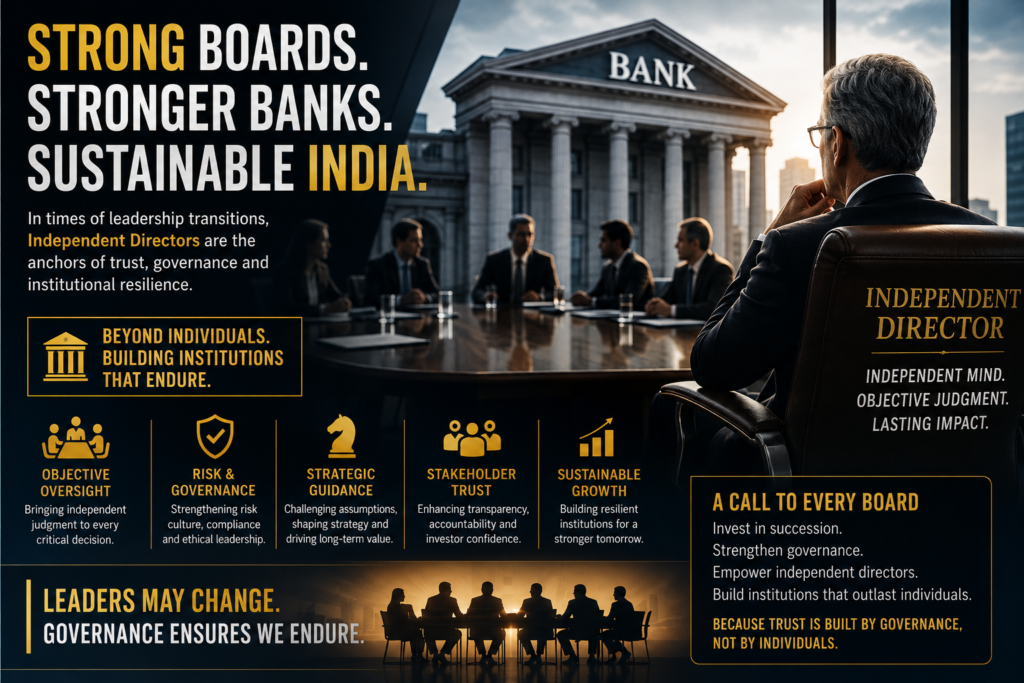
Independent Directors occupy a particularly important position during leadership transitions.
Their responsibility extends beyond approving appointments.
Boards must continuously evaluate leadership readiness, strategic alignment, organizational culture, governance maturity, regulatory preparedness, and stakeholder communication.
Independent Directors should ask several critical questions whenever significant leadership changes occur.
Table 5 outlines these governance considerations.
| Board Question | Governance Objective |
|---|---|
| Is succession planning current? | Leadership continuity |
| Is strategy institution-driven? | Strategic resilience |
| Is risk independently monitored? | Governance integrity |
| Are disclosures transparent? | Investor confidence |
| Is talent development effective? | Long-term sustainability |
| Are regulatory relationships strong? | Supervisory confidence |
The quality of these discussions often determines whether leadership transitions strengthen or weaken institutions.
Building Institutions Beyond Individuals
One of the defining characteristics of enduring organizations is institutional strength.
Organizations overly dependent upon individual leaders face elevated succession risk.
Conversely, institutions with mature governance systems, distributed leadership, knowledge management, and strong organizational culture remain resilient despite executive transitions.
The objective of governance should therefore be institutional permanence rather than executive permanence.
Strong organizations create systems that outlast individuals.
Future Outlook
The coming decade will likely witness continued leadership mobility across Indian banking.
Digital banking expansion, fintech integration, artificial intelligence adoption, climate-related financial disclosures, cybersecurity investments, ESG expectations, and evolving regulatory frameworks will continue reshaping executive responsibilities.
Boards should anticipate greater demand for leaders possessing multidisciplinary expertise encompassing finance, technology, governance, regulation, strategy, sustainability, and stakeholder management.
Leadership capability will increasingly become a strategic differentiator.
Simultaneously, investors will place greater emphasis on governance quality than ever before.
Institutions capable of demonstrating transparent succession planning, effective board oversight, disciplined risk management, and resilient organizational culture are likely to command stronger market confidence.
Conclusion
The recent wave of CEO and CFO resignations across Indian banks should not be interpreted solely as a series of isolated personnel events. Rather, it reflects the profound transformation underway within India’s financial system.
Leadership today carries unprecedented responsibility. Executives are expected to navigate regulatory complexity, technological disruption, geopolitical uncertainty, cyber risks, sustainability expectations, investor scrutiny, and rapidly evolving customer demands while maintaining financial performance.
These realities naturally contribute to higher leadership mobility.
The true measure of institutional strength is therefore not whether leaders resign, but whether organizations continue to inspire confidence after they do.
Boards that invest in governance excellence, succession planning, leadership development, strategic resilience, and transparent communication will emerge stronger regardless of executive transitions.
For Independent Directors, the central lesson is clear. Governance is no longer a compliance obligation. It is a strategic capability that protects institutions during uncertainty, strengthens stakeholder trust, and creates sustainable long-term value.
In an increasingly complex financial landscape, leadership may change, but well-governed institutions endure.
References
- Reserve Bank of India. (2024). Report on Trend and Progress of Banking in India. https://www.rbi.org.in
- Reserve Bank of India. (2024). Master Directions and Circulars on Corporate Governance. https://www.rbi.org.in
- Securities and Exchange Board of India. (2024). SEBI (Listing Obligations and Disclosure Requirements) Regulations. https://www.sebi.gov.in
- Basel Committee on Banking Supervision. (2021). Corporate Governance Principles for Banks. https://www.bis.org
- Organisation for Economic Co-operation and Development. (2023). G20/OECD Principles of Corporate Governance. https://www.oecd.org/corporate
- International Monetary Fund. (2024). Global Financial Stability Report. https://www.imf.org
- World Bank. (2024). Global Financial Development Report. https://www.worldbank.org
- Reuters. (2026). Coverage of Executive Leadership Changes in Indian Banking Sector. https://www.reuters.com
- McKinsey & Company. (2024). Global Banking Annual Review. https://www.mckinsey.com
- Deloitte. (2024). Banking and Capital Markets Outlook. https://www.deloitte.com
Disclaimer
This article is intended solely for educational, research, governance, and informational purposes. The analysis represents the author’s independent assessment based on publicly available information, regulatory publications, academic literature, and industry developments. It does not attribute any resignation to undisclosed facts or imply wrongdoing by any individual or institution. Leadership transitions may occur for a wide range of legitimate professional and personal reasons. Readers should rely on official disclosures, regulatory filings, and company announcements before making investment, governance, or business decisions.