Abstract
The FIFA World Cup 2026 represents one of the most significant structural transformations in the history of international football. Expanding from 32 to 48 participating nations, the tournament introduced a new competitive framework that altered qualification dynamics, increased global representation, and reshaped tactical priorities. While public attention naturally focuses on goals, star players, and knockout drama, the group stage offers a deeper analytical lens into how modern football is evolving. This study examines the group-stage performance of all 48 participating teams using tournament standings, qualification outcomes, goal difference, offensive and defensive effectiveness, and comparative group competitiveness. The analysis demonstrates that sustained consistency, defensive organization, and tactical efficiency remain more influential determinants of success than isolated moments of attacking brilliance. Furthermore, the expanded tournament format has significantly increased competitive parity while preserving overall quality, suggesting that football’s competitive landscape is becoming more geographically diversified.
Introduction
Football has increasingly become a game of information rather than intuition. Elite national teams now combine traditional coaching with data science, predictive analytics, tactical modelling, and performance intelligence to gain marginal advantages. Consequently, tournament standings should not be viewed merely as final results but as datasets that reveal strategic behaviour, organizational capability, and competitive maturity.
The FIFA World Cup 2026 provides an exceptional opportunity to examine these dynamics. The expansion to 48 teams introduced twelve groups and increased the number of knockout qualifiers from sixteen to thirty-two. This structural change not only enhanced global participation but also fundamentally changed how teams approached risk management, attacking intent, squad rotation, and qualification strategies.
This paper evaluates the tournament beyond individual matches by identifying statistical patterns that explain competitive success and offer insight into the future direction of international football.
Tournament Overview
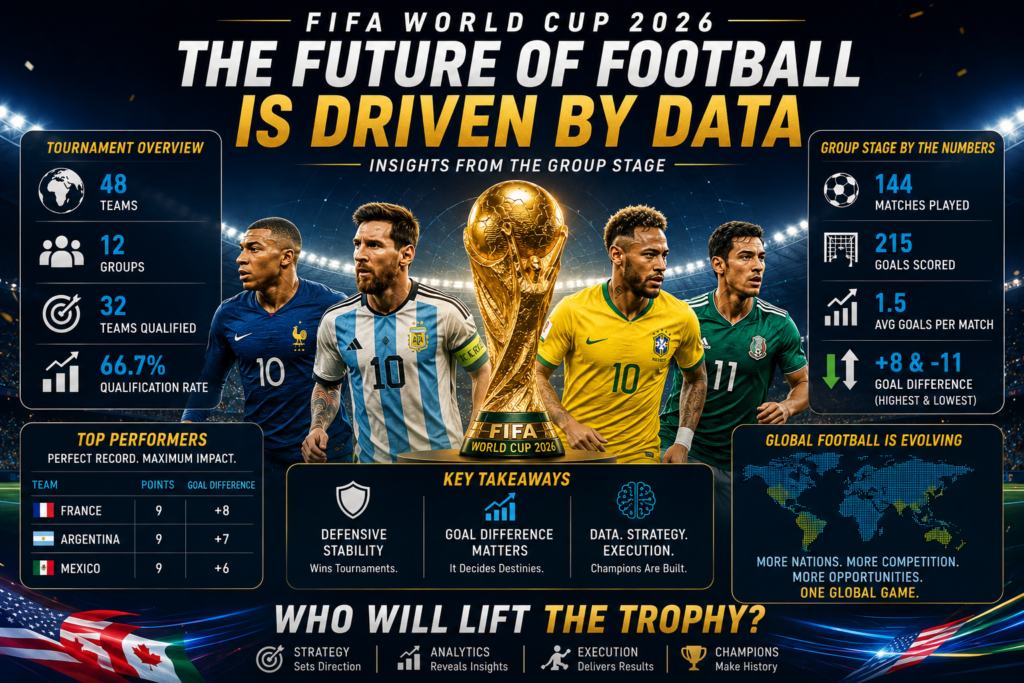
The tournament featured 48 national teams divided into twelve groups of four teams each. The top two teams from every group, together with the eight best third-placed teams, qualified for the Round of 32.
| Tournament Metric | Value |
|---|---|
| Participating Teams | 48 |
| Groups | 12 |
| Teams per Group | 4 |
| Teams Qualifying | 32 |
| Qualification Rate | 66.7% |
| Group Winners | 12 |
| Group Runners-up | 12 |
| Best Third-Placed Teams | 8 |
Compared with previous World Cups, the revised structure produced a substantially higher qualification rate while maintaining meaningful competition across all groups until the final round of fixtures.
Elite Performance and Tournament Leaders
Three nations distinguished themselves by completing the group stage with perfect records. France finished with the tournament’s strongest statistical profile, followed closely by Argentina and Mexico. Brazil, the Netherlands, Spain, England, Switzerland, Colombia, and Morocco formed the second tier of high-performing nations, each demonstrating balanced tactical execution.
| Overall Top Performers | Points | Goal Difference |
|---|---|---|
| France | 9 | +8 |
| Argentina | 9 | +7 |
| Mexico | 9 | +6 |
| Brazil | 7 | +6 |
| Netherlands | 7 | +6 |
| Spain | 7 | +5 |
| England | 7 | +4 |
| Switzerland | 7 | +4 |
| Colombia | 7 | +3 |
| Morocco | 7 | +3 |
France emerged as the tournament benchmark, combining attacking efficiency with exceptional defensive discipline. Argentina demonstrated comparable consistency, while Mexico’s perfect campaign highlighted the growing competitiveness of CONCACAF football.
The Strategic Importance of Defensive Stability
One of the strongest findings from the tournament is that defensive organization remains the single most reliable predictor of qualification. Teams capable of minimizing goals conceded consistently occupied the upper half of group standings regardless of differences in attacking output.
The relationship between defensive resilience and qualification illustrates a broader shift in international football. Tournament football rewards consistency over spectacle. Teams that successfully controlled transitions, maintained compact defensive structures, and minimized tactical errors accumulated points steadily even without producing exceptionally high-scoring performances.
Several teams advanced primarily because of disciplined defensive systems rather than overwhelming attacking dominance, reinforcing a principle that has characterized successful international tournaments for decades.
Goal Difference as a Strategic Asset
Goal difference played a decisive role in determining final group positions across multiple groups. In closely contested groups, superior goal difference separated first from second place and second from third place, directly influencing knockout pathways.
Rather than viewing goal difference as a secondary statistic, modern tournament strategy increasingly treats it as an extension of risk management. Teams pursuing additional goals against weaker opposition improve not only their offensive statistics but also their probability of securing more favourable knockout draws.
The data suggests that coaching staffs increasingly optimize for cumulative tournament position rather than isolated match outcomes.
The Impact of the Expanded 48-Team Format
Perhaps the most significant finding is that the expanded format did not dilute tournament quality. Instead, it broadened competitiveness.
Several third-placed teams progressed to the knockout stage after demonstrating consistent performances despite failing to finish in the top two of their groups. This kept qualification races alive until the final matchday in most groups and reduced the number of inconsequential fixtures.
The expanded format also increased opportunities for emerging football nations to compete meaningfully against established powers, accelerating competitive development across multiple confederations.
Confederation Performance
The tournament highlighted the continued strength of European football while simultaneously demonstrating increasing competitiveness across other regions.
| Confederation | Overall Assessment |
|---|---|
| UEFA | Outstanding |
| CONMEBOL | Outstanding |
| CONCACAF | Strong |
| CAF | Strong |
| AFC | Moderate |
| OFC | Developing |
UEFA remained the most represented confederation among knockout qualifiers, while CONMEBOL continued to produce elite-level performances. CONCACAF benefited from Mexico’s dominant campaign, and CAF further demonstrated its growing competitiveness through performances from Morocco, Côte d’Ivoire, Ghana, and other representatives.
This distribution suggests that global football is gradually becoming less concentrated among traditional powers.
Emerging Competitive Trends
The tournament reveals five structural trends likely to influence future international competitions.
First, defensive discipline continues to outperform purely attacking football over short tournaments.
Second, tournament management has become increasingly data-driven, with coaching staffs optimizing qualification probability rather than individual match entertainment.
Third, the expanded format rewards consistency across three matches rather than reliance on isolated victories.
Fourth, global competitive balance continues to improve, with emerging football nations narrowing historical performance gaps.
Finally, statistical indicators such as goal difference, points efficiency, and defensive stability increasingly provide better forecasts of knockout success than public perception or historical reputation.
Knockout Readiness Assessment
Based on group-stage performance, five nations entered the knockout rounds as primary championship contenders.
| Championship Tier | Teams |
|---|---|
| Tier 1 | France, Argentina, Brazil, Spain, Netherlands |
| Tier 2 | England, Germany, Mexico, Switzerland, Colombia |
| Dark Horses | Morocco, Japan, Belgium, Portugal, Croatia |
France possessed the strongest overall statistical profile through a combination of maximum points, tournament-leading goal difference, and balanced attacking and defensive execution. Argentina followed closely, while Brazil and the Netherlands demonstrated the consistency expected of established contenders.
Several dark-horse teams displayed tactical maturity capable of producing significant knockout-stage upsets.
Strategic Implications
The FIFA World Cup increasingly resembles a strategic competition rather than a sequence of isolated matches. National federations investing in analytics, sports science, tactical preparation, and performance optimization consistently outperform teams relying primarily on individual talent.
Future success will depend on integrating technical coaching with predictive analytics, opposition intelligence, player workload management, and real-time decision support. Tournament football is evolving toward evidence-based management where marginal gains accumulated across multiple dimensions determine championship outcomes.
The 2026 tournament reinforces that sustainable success is built upon organizational excellence rather than moments of individual brilliance alone.
Conclusion
The FIFA World Cup 2026 demonstrates that football’s future lies at the intersection of athletic excellence, tactical sophistication, and analytical intelligence. The expansion to forty-eight teams has successfully increased global participation while maintaining competitive integrity. Traditional football powers remain among the elite, yet the performance gap separating established and emerging nations continues to narrow.
France, Argentina, and Mexico established themselves as the leading performers of the group stage, but the broader narrative extends beyond rankings. The tournament illustrates how consistency, defensive resilience, intelligent tournament management, and strategic adaptability increasingly define success at the highest level.
For football federations, coaches, analysts, and decision-makers, the implications are clear. Competitive advantage will belong to organizations capable of transforming data into actionable strategy. The future of international football will not be won solely by the most talented players but by the teams that make the smartest decisions before, during, and after every match.
References
- FIFA. (2026). FIFA World Cup 2026 Tournament Information. https://www.fifa.com
- FIFA. (2026). FIFA World Cup Regulations. https://digitalhub.fifa.com
- FIFA. (2026). Official Match Centre and Statistics. https://www.fifa.com/en/tournaments/mens/worldcup
- Fédération Internationale de Football Association. (2025). Football Performance Insights. https://inside.fifa.com
- International Football Association Board. (2025). Laws of the Game 2025/26. https://www.theifab.com
- Stats Perform. (2025). Football Analytics Research. https://www.statsperform.com
- Opta Analyst. (2026). International Football Performance Analysis. https://theanalyst.com
- Union of European Football Associations. (2025). Technical Reports and Football Development. https://www.uefa.com
Disclaimer
This article is an independent analytical study prepared using the uploaded FIFA World Cup 2026 group-stage dataset together with publicly available tournament information and football analytics principles. Performance ratings, power rankings, strategic assessments, championship tiers, and interpretive insights are analytical constructs developed by the author and do not represent official FIFA evaluations, rankings, or forecasts. While every effort has been made to ensure accuracy, readers should refer to official FIFA publications for authoritative tournament records, regulations, and statistics.