Executive Summary
Donald Trump’s foreign policy is often described as unpredictable, confrontational or transactional. These descriptions capture elements of his behaviour but do not fully explain the underlying strategic pattern. A more useful interpretation is that Trump increasingly differentiates countries according to the amount of independent power they possess, the cost they can impose on the United States, and the concessions Washington can extract from them.
This creates an apparent paradox. Trump frequently displays personal respect toward nuclear-armed or strategically dangerous leaders such as Xi Jinping, Vladimir Putin and Kim Jong Un, while applying unusually strong pressure to traditional U.S. allies such as NATO members, Japan, South Korea and European partners. The contrast can look like weakness toward adversaries and hostility toward friends. Strategically, however, it is better understood as a deliberate form of asymmetric bargaining.
The 2026 U.S. National Defense Strategy provides institutional evidence that this approach is not merely personal presidential improvisation. It identifies defending the U.S. homeland, deterring China through strength rather than unnecessary confrontation, increasing allied burden-sharing and strengthening the U.S. defense industrial base as its four principal priorities. It explicitly states that alliances remain essential, but that allies should no longer operate as “dependencies” of the previous generation and should take greater responsibility for their own defense. (U.S. Department of War)
Trump’s approach therefore contains two apparently contradictory but strategically connected components. Against powerful adversaries, he prefers deterrence combined with negotiation, direct leader-to-leader engagement and escalation management. Against allies, he seeks greater payment, military spending, market access, political alignment and support for U.S. strategic priorities.
North Korea illustrates the first component dramatically. On August 16, 2026, Trump ordered a substantial reduction in U.S.-South Korean military exercises, emphasizing his relationship with Kim Jong Un and describing the exercises as costly and unnecessarily provocative. The exercises were subsequently shortened from eleven days to five. Reuters also reported on August 18 that Trump was pushing his aides to arrange another meeting with Kim as early as autumn 2026. (Reuters)
NATO illustrates the second. At the 2025 Hague summit, allies committed to spending 5% of GDP annually on defense and security by 2035, including at least 3.5% on core defense requirements. NATO reported in June 2026 that European allies and Canada had already increased their combined defense spending by nearly 20% in real terms in 2025 compared with 2024. (NATO)
The critical strategic question is therefore not whether Trump is “afraid” of nuclear states. There is insufficient evidence to make that psychological claim. The more defensible conclusion is that Trump assigns a higher diplomatic premium to countries capable of imposing catastrophic costs and a higher economic burden on countries that depend significantly on American protection and market access.
That produces real benefits for Washington. The United States can demand greater allied defense spending, shift some regional security responsibilities outward, expand American defense exports, reduce certain burdens and negotiate from a stronger financial and industrial position. The 2026 strategy explicitly frames stronger allies as a way to establish military strength from which Trump can negotiate favorable terms for the United States. (U.S. Department of War)
But the strategy carries substantial risks. Alliance relationships are not simply financial contracts. They generate intelligence, basing, interoperability, diplomatic influence, supply-chain access and strategic depth. Excessive pressure can weaken confidence in U.S. commitments and encourage allies to hedge, rearm independently or seek alternative security relationships. The decision to scale back U.S.-South Korean exercises while simultaneously emphasizing relations with Kim Jong Un is therefore strategically consequential because it potentially trades alliance reassurance for diplomatic maneuverability. (AP News)
This paper argues that Trump’s grand strategy is best understood through two proprietary analytical frameworks. The Transactional Power Premium™ explains why Trump behaves differently toward adversaries and allies. The Alliance–Adversary Leverage Matrix™ identifies the conditions under which the strategy strengthens U.S. power and the conditions under which it could inadvertently weaken it.
The ultimate strategic paradox is this:
Trump is attempting to make America stronger by making allies more self-reliant and adversaries more negotiable. The danger is that he may underestimate the possibility that America’s alliance network is itself one of America’s greatest forms of hard power.
Introduction
For most of the post-1945 period, the United States built an international system based on alliances, institutions, forward military presence, economic integration and collective deterrence. Washington accepted substantial costs in return for a broader strategic architecture in which American leadership generated political and economic influence.
Trump’s worldview is different.
It does not necessarily reject American leadership. It questions the price at which leadership is purchased.
The Trump approach asks a more transactional set of questions: What does the United States receive in return for its protection? Who pays for military security? Who benefits from access to the American market? Which partners support U.S. strategic priorities? Which countries can impose serious costs on America? Which adversaries can be negotiated with rather than confronted indefinitely?
This is why the apparent contradiction between Trump’s treatment of adversaries and allies matters.
The traditional alliance model implicitly assumes that the United States should reassure allies because credibility is itself a strategic asset. Trump’s model places greater emphasis on extracting contributions from allies before providing that reassurance.
With nuclear adversaries, the logic is reversed. The potential cost of escalation can be enormous, so direct engagement and personal diplomacy become valuable instruments of risk control.
The result is not necessarily a hierarchy in which adversaries are more important than allies. It is a different calculation of risk, leverage and return.
Problem Statement & Objectives
The central analytical problem is that Trump’s public behaviour can easily be misinterpreted as irrational. If he respects Xi, Putin or Kim while criticizing Europe, Japan or South Korea, the obvious interpretation is that he prefers authoritarian leaders to democratic allies.
That interpretation may contain a political element but does not adequately explain the strategic pattern.
The deeper question is whether Trump’s policy represents a coherent hierarchy of power.
| Question | Strategic interpretation |
| Why show respect to nuclear adversaries? | Because escalation costs are extreme and bargaining channels have strategic value |
| Why pressure traditional allies? | Because Washington believes allies possess greater dependence on U.S. security and therefore greater capacity to contribute |
| Why negotiate with China while confronting allies on trade? | China can impose systemic economic and military costs; allies can be pressured through market and security leverage |
| Why cultivate Kim Jong Un? | Personal diplomacy may create an alternative route to managing nuclear escalation |
| Why demand 5% NATO spending? | To shift more security costs toward wealthy allied economies |
| Why maintain U.S. alliances at all? | Because alliances remain force multipliers against major competitors |
| What is Trump’s ultimate objective? | Maximum U.S. leverage at lower American cost |
The objectives of this paper are to determine whether this pattern constitutes a coherent strategy, identify the benefits Trump and the United States may obtain, assess the risks generated by the strategy, and establish a framework for understanding the future of U.S. grand strategy.
Methodology
The analysis uses a strategic synthesis of nuclear deterrence, alliance theory, bargaining power, economic statecraft, military burden-sharing and contemporary U.S. policy.
The distinction between adversaries and allies is treated as a strategic classification rather than a moral classification. “Adversary” in this paper refers primarily to states capable of materially challenging U.S. security interests, especially nuclear powers such as China, Russia and North Korea. “Allies” refers primarily to treaty allies and close security partners whose defense relationships with Washington create significant mutual dependence.
The analysis uses the 2026 National Defense Strategy as the principal institutional source, complemented by NATO official documents and recent reporting on Trump’s China, North Korea, South Korea and European policies. The objective is not to determine Trump’s private psychological motivations, which cannot be established reliably, but to infer strategic logic from observable policy behaviour.
Landscape Analysis
The contemporary strategic environment is radically different from the immediate post-Cold War period. The United States faces several nuclear-armed powers while simultaneously attempting to maintain a global alliance system. China is expanding its military capabilities, Russia retains enormous nuclear forces, North Korea continues developing nuclear weapons and missile systems, and regional security dilemmas in Asia and Europe are becoming more interconnected.
The 2026 National Defense Strategy acknowledges this complexity. It calls for wider military-to-military communication with Beijing to support strategic stability and de-escalation while simultaneously building stronger defenses designed to prevent China from dominating the Indo-Pacific. The document explicitly rejects the idea that the United States should either dominate or humiliate China, instead emphasizing strength from which favorable negotiations can occur. (U.S. Department of War)
This is an important distinction.
Washington is increasingly trying to separate competition from uncontrolled confrontation.
The logic can be summarized as follows.
| Strategic category | Typical U.S. objective | Primary instrument |
| Nuclear superpower | Prevent escalation while preserving deterrence | Military strength plus negotiation |
| Nuclear rogue state | Limit proliferation and reduce immediate risk | Deterrence plus leader-level diplomacy |
| Strategic competitor | Prevent dominance without unnecessary war | Military denial, technology controls and negotiation |
| Treaty ally | Increase contribution and reduce U.S. burden | Bargaining, pressure and incentives |
| Wealthy partner | Expand economic and defense contribution | Trade and investment leverage |
| Regional partner | Share regional security responsibilities | Capability-building and selective U.S. support |
China is the clearest illustration of the first strategic category. Trump’s May 2026 Beijing visit did not produce a comprehensive resolution of the rivalry, but it produced a more stable framework after the trade confrontation of 2025. Reuters characterized the outcome as a partial return from open confrontation toward a more predictable but still competitive relationship. (Reuters)
North Korea represents an even sharper example. Trump is again pursuing a direct relationship with Kim Jong Un, with reporting indicating interest in another summit in 2026. (Reuters)
At the same time, Washington has increased pressure on allies. NATO’s 5% spending commitment is the most visible manifestation. Spain has even faced threats of trade restrictions over defense spending and disagreement with U.S. policy toward Iran, demonstrating how economic instruments can now be used against treaty partners. (Reuters)
The strategic environment has therefore become increasingly transactional across both alliance and adversary relationships.
Key Findings
The first major finding is that the “fear” hypothesis should be replaced by a risk-premium hypothesis. Trump does not have to fear a nuclear leader personally to recognize that a nuclear state deserves careful management. Nuclear weapons increase the cost of miscalculation and make direct coercion more dangerous.
The second finding is that Trump’s respect toward adversarial leaders can function as a negotiating instrument. Personal recognition may reduce barriers to leader-level communication and create opportunities unavailable through institutional diplomacy alone. His relationship with Kim Jong Un is especially revealing because Trump appears to believe personal engagement itself can create strategic openings.
The third finding is that Trump’s pressure on allies is partly rooted in a different assumption: allies already benefit from U.S. security architecture and therefore can be required to contribute more.
This logic has produced measurable outcomes. NATO allies have committed to 5% defense-related spending by 2035, and NATO reports that European allies and Canada increased their combined defense spending by nearly 20% in real terms in 2025. (NATO)
The fourth finding is that Trump is attempting to transform U.S. alliances from dependency relationships into contribution relationships.
This is explicitly stated in the 2026 National Defense Strategy. Allies remain essential, but the administration wants them to carry more of the burden in areas where their interests are more directly affected. (U.S. Department of War)
The fifth finding is that the strategy seeks to preserve a crucial distinction: America does not necessarily want permanent confrontation with its strongest adversaries. It wants sufficient strength to negotiate from leverage.
That is why the 2026 strategy combines stronger denial defense in the Indo-Pacific with expanded military communication with Beijing. (U.S. Department of War)
The sixth finding is that the biggest strategic risk is not criticism from allies itself. It is credibility erosion.
If allies conclude that U.S. protection is contingent on immediate political compliance, they may begin diversifying away from Washington. This is particularly important in Asia, where South Korea has now experienced a visible reduction in joint military exercises while Trump simultaneously emphasizes his relationship with Kim Jong Un. (Reuters)
The seventh finding is that Trump may be attempting to optimize American power efficiency rather than American global reach.
This is a profound distinction.
The traditional model maximized reach.
The Trump model seeks to maximize the return generated by American power.
Challenges & Opportunities
The strategy has several important strengths.
The first is fiscal leverage. Wealthy allies can spend more on their own defense rather than relying disproportionately on U.S. resources. This is especially important in Europe, where collective defense spending has historically relied heavily on American capabilities.
The second is defense-industrial leverage. Increased allied defense expenditure creates demand for American aircraft, missiles, air defense systems, intelligence platforms, communications technology and other military products. NATO itself is increasing emphasis on defense-industrial cooperation and production capacity. (NATO)
The third is strategic concentration. If European allies assume greater responsibility for European defense, Washington can allocate more resources toward homeland defense and the Indo-Pacific.
The fourth is negotiating leverage. Trump’s logic is that U.S. military power becomes more valuable when combined with allied spending rather than substituted for it.
The fifth is escalation control. Engagement with nuclear adversaries can provide direct communication channels that reduce the danger of accidental or uncontrolled conflict.
Yet the risks are equally significant.
The first is alliance credibility. A military alliance depends not only on capability but on expectations. If uncertainty about U.S. commitment rises, allies may respond by increasing indigenous capabilities, seeking regional alternatives or developing independent deterrence strategies.
The second risk is adversarial opportunism. China, Russia and North Korea can exploit divisions between Washington and its allies.
The third risk is diplomatic fragmentation. Countries that once coordinated with Washington may begin hedging more aggressively.
The fourth risk is nuclear proliferation. If allied states conclude that U.S. extended deterrence cannot be relied upon, domestic arguments for independent nuclear capabilities may become stronger.
The fifth risk is strategic over-personalization. A state cannot build durable grand strategy solely around personal relationships between presidents.
The sixth risk is bargaining exhaustion. If every relationship becomes transactional, the United States may gradually erode the intangible trust that makes alliances work efficiently.
The most revealing case is South Korea. The United States and South Korea have now shortened the annual Ulchi Freedom Shield exercise from eleven days to five after Trump’s order. The move was linked to cost concerns, Seoul’s position regarding Iran and Trump’s emphasis on his relationship with Kim Jong Un. (Reuters)
This is strategically significant because the decision simultaneously communicates two different messages.
To North Korea, the message may be:
Washington is willing to reduce visible military pressure in exchange for diplomatic space.
To South Korea, the message may be:
The U.S. security relationship is subject to the president’s broader political calculations.
Whether the first message produces negotiations and whether the second undermines deterrence will determine the strategic outcome.
Strategic Frameworks & Recommendations
The Transactional Power Premium™
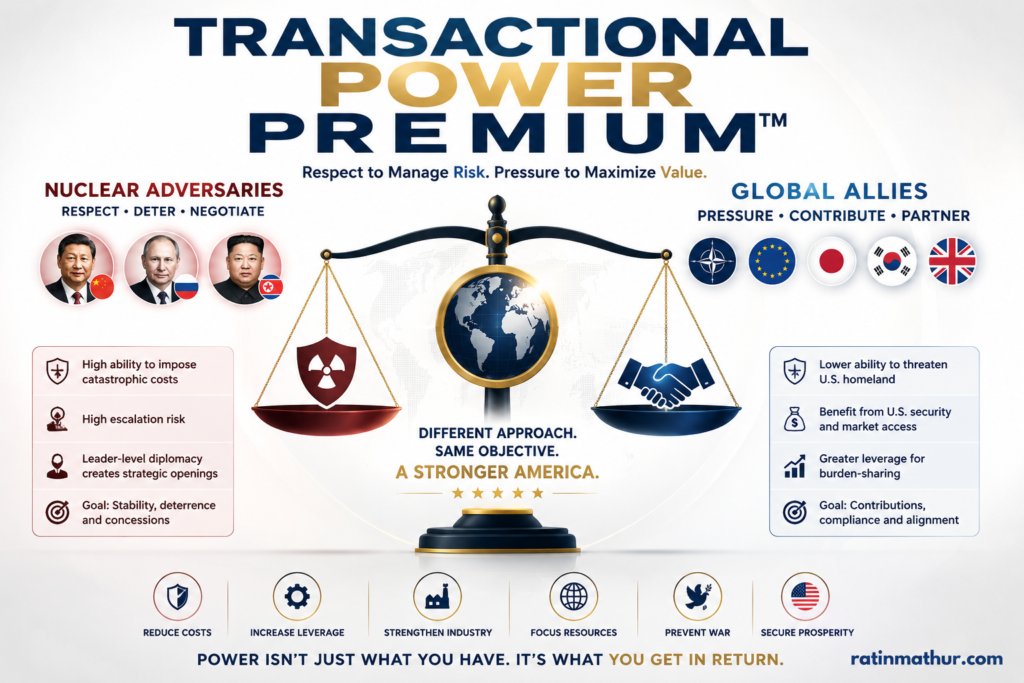
The Transactional Power Premium™ explains why Trump appears more respectful toward nuclear adversaries while simultaneously pressuring U.S. allies.
The framework argues that a state’s diplomatic treatment is increasingly influenced by four variables: its ability to impose catastrophic costs on the United States, its economic importance, its alternatives to American cooperation and America’s leverage over the state.
The greater the counterpart’s independent power and ability to impose costs, the more valuable negotiation becomes. The greater Washington’s leverage over the counterpart, the more attractive pressure becomes.
This does not mean that Trump likes adversaries more than allies. It means that he believes power asymmetry determines negotiating style.
| Dimension | Nuclear adversary | Treaty ally | Strategic consequence |
| Ability to impose catastrophic cost | Very high | Usually low against U.S. homeland | More caution toward adversary |
| Dependence on U.S. security | Low | Often high | More pressure on ally |
| Economic alternatives | Often substantial | Variable | Greater need for reciprocal bargaining |
| Escalation risk | Very high | Lower | Negotiation becomes more valuable |
| Political leverage available to Washington | Limited | Often high | Pressure becomes more attractive |
| Leader-level diplomacy | High strategic value | Less essential | Greater emphasis with adversaries |
| Desired U.S. outcome | Stability plus concessions | Contributions plus compliance | Different negotiation models |
The framework can be demonstrated through three cases.
With China, Washington seeks strength without unnecessary confrontation because China combines nuclear capability, economic scale, technological capacity and regional military power. The 2026 defense strategy therefore supports communication with Beijing while simultaneously strengthening deterrence. (U.S. Department of War)
With North Korea, Trump’s willingness to pursue another summit and reduce selected military exercises illustrates the value he places on personal diplomacy when the counterpart possesses nuclear weapons and direct escalation potential. (Reuters)
With NATO allies, Washington has much more leverage because European states benefit from U.S. military capabilities and access to the American economic system. The 5% defense commitment represents a clear attempt to transform that leverage into measurable allied contributions. (NATO)
The strategic recommendation from the framework is that Washington should not confuse pressure with power. Pressure works when the counterpart has limited alternatives. With an adversary capable of catastrophic retaliation, pressure without an off-ramp can create unnecessary escalation.
The most effective U.S. strategy is therefore maximum leverage with minimum unnecessary escalation.
| Power situation | Recommended Trump approach | Example |
| Nuclear adversary with high escalation potential | Deter, communicate and negotiate | China, North Korea, Russia |
| Wealthy treaty ally with low dependence alternatives | Pressure for greater contribution | NATO allies |
| Strategic ally with critical geography | Pressure but protect credibility | Japan, South Korea |
| Economic rival without direct nuclear confrontation | Tariff pressure plus negotiation | China and major trade partners |
| Weak adversary | Coercive leverage plus clear exit option | Case-specific |
The Alliance–Adversary Leverage Matrix™
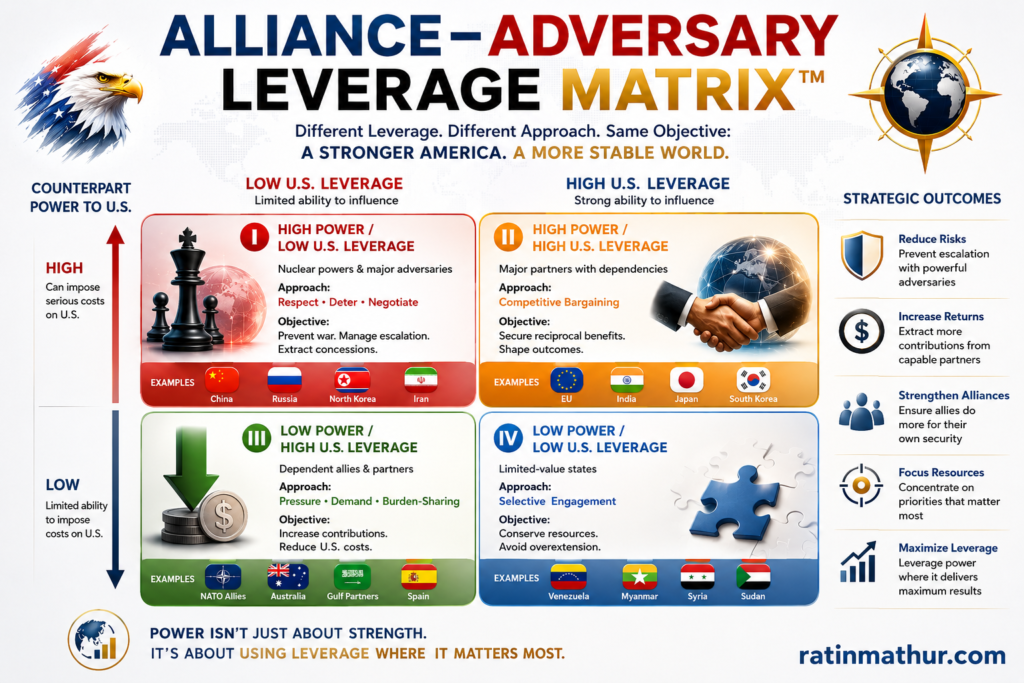
The Alliance–Adversary Leverage Matrix™ provides the second analytical framework. It evaluates U.S. foreign relationships on two axes: the strategic cost the counterpart can impose on Washington and the leverage Washington can exercise over the counterpart.
The resulting four-quadrant matrix explains much of Trump’s foreign-policy behaviour.
| Quadrant | Counterpart characteristics | Trump-style response | Strategic objective |
| I: High Counterparty Power / Low U.S. Leverage | Nuclear or major-power adversary | Respect, deterrence, negotiation | Avoid catastrophic escalation |
| II: High Counterparty Power / High U.S. Leverage | Major economic partner with dependencies | Competitive bargaining | Extract reciprocal benefits |
| III: Low Counterparty Power / High U.S. Leverage | Dependent ally or partner | Pressure and burden-sharing | Reduce U.S. cost |
| IV: Low Counterparty Power / Low U.S. Leverage | Limited-value state | Selective engagement | Conserve resources |
China largely fits Quadrant I or II depending on the issue. The United States possesses economic and technological leverage, but China retains enormous retaliatory and alternative capabilities. Consequently, Washington must combine coercion with negotiation.
North Korea is heavily concentrated in Quadrant I. Its economy is weak relative to the United States, but its nuclear arsenal and geographic position create extraordinary escalation risk. That explains why personal diplomacy can have more value than conventional economic pressure alone.
Most NATO allies fall into Quadrant III from Trump’s perspective. They are wealthy and strategically valuable, but Washington believes their dependence on U.S. military capabilities gives it substantial bargaining power.
Japan and South Korea occupy a particularly interesting hybrid position. They have substantial economic and technological strength, and their geopolitical importance is extremely high, but they still rely heavily on U.S. extended deterrence and military cooperation. This creates high leverage for Washington but also high strategic risk if that leverage is abused.
| Relationship | Counterparty power | U.S. leverage | Appropriate strategic balance |
| China | Very high | High but constrained | Competition plus strategic stability |
| Russia | Very high | Limited | Deterrence plus negotiation |
| North Korea | High in security impact | Limited | Deterrence plus diplomacy |
| NATO Europe | High | High | Burden-sharing plus alliance assurance |
| Japan | High | Medium-high | Reciprocity plus deterrence |
| South Korea | High | High | Cost-sharing plus alliance credibility |
| Australia | Medium-high | Medium | Partnership plus capability integration |
| EU | Very high economically | Medium-high | Trade negotiation plus strategic coordination |
The strategic recommendation from the Alliance–Adversary Leverage Matrix™ is that the more powerful the counterpart, the more carefully leverage must be converted into negotiation; the more dependent the counterpart, the more carefully pressure must be balanced with relationship preservation.
This produces a critical principle:
Never use maximum leverage simply because maximum leverage exists.
The strategic purpose of leverage is to obtain outcomes, not to demonstrate power.
That distinction is fundamental to sustainable statecraft.
Future Outlook & Conclusion
Trump’s second-term foreign policy is creating a new model of American power.
It is not traditional isolationism.
The United States remains deeply involved in Europe, the Indo-Pacific and global economic affairs. Nor is it conventional alliance leadership because Trump increasingly challenges the assumption that the United States should absorb disproportionate costs merely to preserve alliance relationships.
The emerging model can be described as transactional primacy.
America remains the most powerful actor in the system, but it increasingly wants every relationship to generate measurable strategic return.
The consequences will depend on execution.
If Trump succeeds in persuading allies to spend more, contribute more, purchase more American equipment and assume greater regional responsibility while maintaining confidence in U.S. commitments, the strategy could substantially strengthen American power.
NATO’s 5% commitment already demonstrates that this approach can create measurable change. (NATO)
If Trump simultaneously maintains direct communication with nuclear adversaries and uses military strength to create negotiating leverage, he could also reduce the risk of uncontrolled escalation while preserving American deterrence. The 2026 National Defense Strategy explicitly seeks this balance with China. (U.S. Department of War)
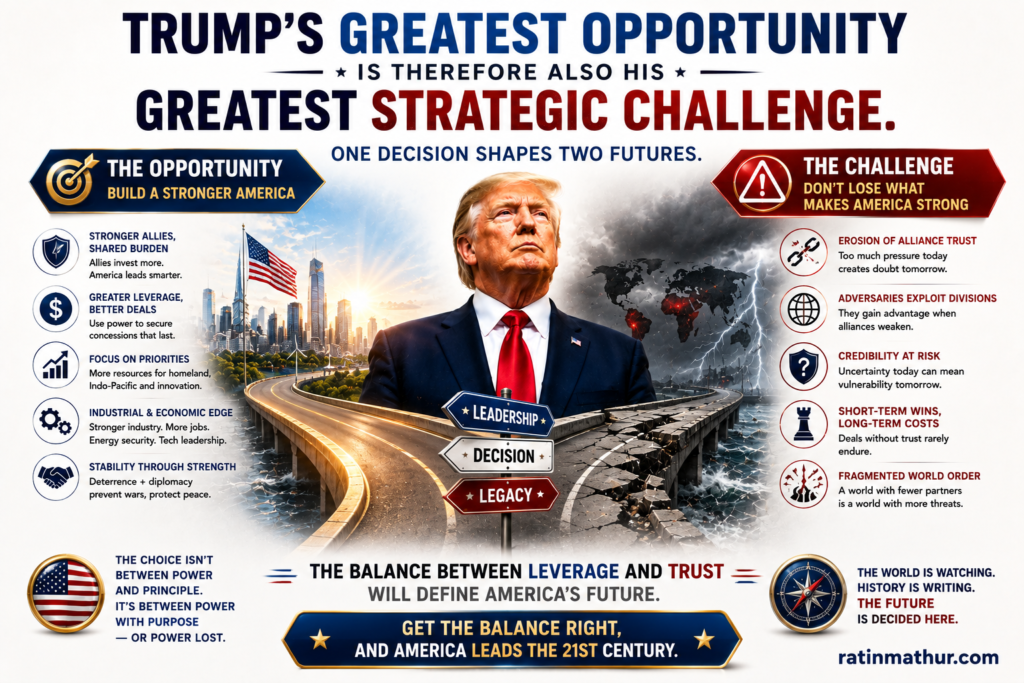
The danger emerges if the balance between pressure and reassurance is lost.
An ally can be pressured into spending more.
An ally cannot necessarily be pressured into trusting more.
Trust is accumulated slowly and destroyed quickly.
The South Korea episode is therefore a strategic test. Scaling back exercises may create diplomatic space with North Korea, but if Seoul concludes that American security commitments can be adjusted without consultation, the long-term consequences could include greater strategic autonomy, stronger domestic pressure for independent military capabilities and increased regional uncertainty. (AP News)
The same principle applies to Europe.
Greater European defense spending strengthens NATO and can reduce the U.S. burden. But excessive economic coercion or political hostility could accelerate Europe’s search for strategic alternatives.
Trump’s greatest opportunity is therefore also his greatest strategic challenge.
He can transform America’s alliance system from a subsidized security network into a stronger partnership in which allies contribute substantially more.
But he must preserve the perception that the United States remains a credible ultimate guarantor when existential security interests are at stake.
The central strategic lesson is that alliances and adversaries require different forms of power management.
Adversaries must be respected enough to prevent uncontrolled escalation, but deterred enough to prevent coercion.
Allies must be challenged enough to contribute, but reassured enough to remain strategically committed.
Trump appears to understand the first principle instinctively.
The unresolved question is whether he will consistently apply the second.
His foreign policy therefore should not be judged simply by whether he is “tough on allies” or “soft on adversaries”. Those descriptions are too superficial.
The deeper question is whether Trump can convert asymmetric bargaining power into a durable American strategic advantage without destroying the alliance network that gives U.S. power its global reach.
The answer will determine whether the Trump doctrine becomes a successful restructuring of American grand strategy or an inadvertent acceleration of geopolitical fragmentation.
The most powerful formulation of the strategy is therefore not:
America First.
It is:
America Stronger Through Leverage, Deterrence and Selective Partnership.
But the strategic warning should remain equally clear:
Leverage creates concessions. Trust creates coalitions. A great power needs both.
References
- U.S. Department of Defense. (2026). 2026 National Defense Strategy. U.S. Department of Defense. 2026 National Defense Strategy
- NATO. (2025). The Hague Summit Declaration. North Atlantic Treaty Organization. The Hague Summit Declaration
- NATO. (2026). Defence investment and NATO’s 5% commitment. North Atlantic Treaty Organization. NATO 5% defence commitment
- NATO. (2026). Deterrence and defence. North Atlantic Treaty Organization. NATO deterrence and defence
- Center for Strategic and International Studies. (2026). The 2026 National Defense Strategy by the Numbers: Radical Changes, Moderate Changes, and Some Continuities. CSIS. CSIS analysis
- Reuters. (2026, May 16). Trump returns from China with stability and a stalemate. Reuters. Reuters: Trump returns from China
- Reuters. (2026, August 16). Trump orders Pentagon to cut back military exercises with South Korea. Reuters. Reuters: Trump orders cuts to South Korea drills
- Reuters. (2026, August 18). Trump pushes for Kim Jong Un meeting this year, WSJ reports. Reuters. Reuters: Trump pushes for Kim meeting
- Associated Press. (2026, August 19). South Korean and US militaries shorten drills by about half after Trump ordered a reduction. Associated Press. Associated Press: South Korea–U.S. drills
- Reuters. (2026, July 8). Trump orders halt to US trade with Spain over NATO spending, Iran. Reuters. Reuters: Trump and Spain trade dispute
- Reuters. (2026, August 14). US raises pressure on EU to “deliver” on non-tariff trade commitments. Reuters. Reuters: U.S. pressure on EU
- The White House. (2026). Presidential statements and policy materials on America First national security and economic policy. Executive Office of the President. The White House
Disclaimer
This article is an independent strategic analysis prepared for informational, educational and thought-leadership purposes. It does not represent the official position of the Government of the United States, any foreign government, political party, institution, company or international organization. The analysis interprets publicly available information and policy developments and should not be regarded as a prediction of future government decisions.
References and cited developments reflect information available as of August 19, 2026. Foreign policy, military deployments, trade measures, diplomatic negotiations and political decisions can change rapidly. Readers should independently verify current developments before relying on this analysis for investment, policy, business or geopolitical decisions.
The terms Transactional Power Premium™ and Alliance–Adversary Leverage Matrix™ are proprietary analytical frameworks developed for this article and are presented as strategic thought-leadership concepts. Their use in this article does not constitute legal registration or a determination of trademark ownership status.