Executive Summary
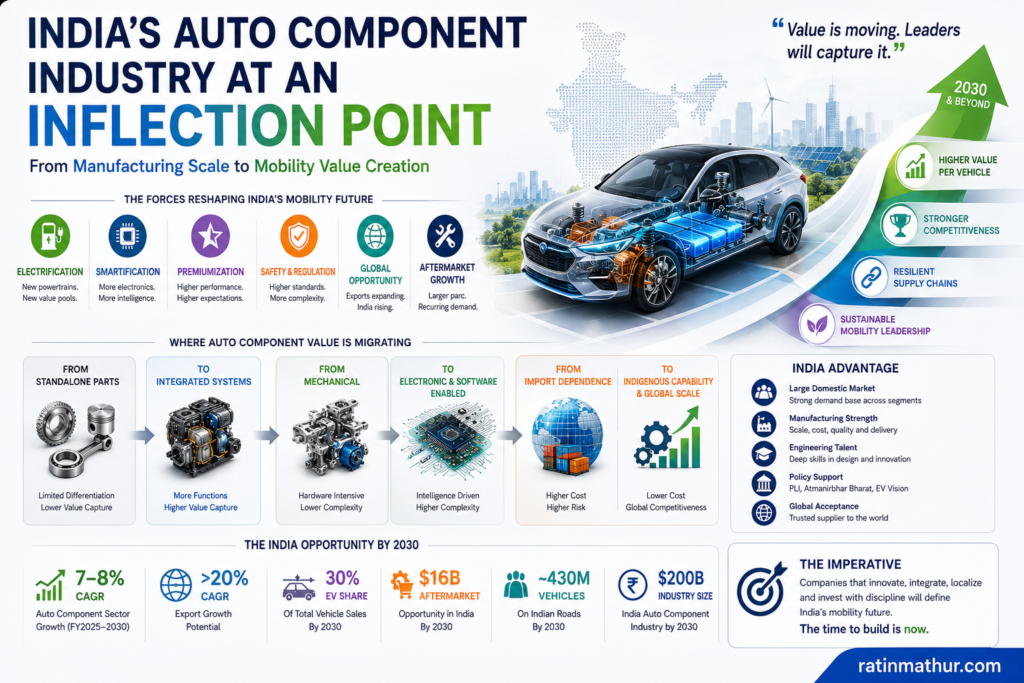
India’s auto component industry is entering a decisive phase in its evolution. For decades, the sector’s growth was closely linked to the expansion of domestic vehicle production. The future, however, will be shaped by a more powerful transformation: the increasing value, technological complexity and strategic importance of the components embedded in every vehicle. Electrification, electrical and electronic integration, premiumization, safety requirements, localization, export expansion and the growth of the vehicle parc are changing where value is created and who captures it.
McKinsey’s analysis indicates that India’s domestic auto component sector could grow at approximately 7–8% CAGR annually through FY2030, compared with approximately 5–6% CAGR growth for the broader automotive industry. This difference is strategically significant because it suggests that component demand can grow faster than vehicle volumes. The reason is rising content per vehicle. As vehicles become more electrified, connected, electronically controlled, safer and increasingly premium, the value of components required to manufacture each vehicle increases. At the same time, India’s export opportunity is expected to expand strongly, while the domestic aftermarket could reach approximately $16 Bn by 2030, supported by a vehicle parc approaching approximately 430 Mn vehicles.
The resulting opportunity is substantial, but it will not be distributed equally across the industry. The next generation of leaders will not necessarily be the companies with the largest manufacturing capacities. They will be companies that understand where value is migrating and can reposition their portfolios accordingly. Electrical and electronic systems, EV-related components, battery-management technologies, motors, power electronics, thermal management, advanced safety systems and premium vehicle technologies represent important emerging value pools. At the same time, selected mature component businesses can remain highly profitable if they possess global competitiveness, scale, cost leadership and the ability to consolidate fragmented markets.
This article develops an India-specific strategic interpretation of the sector through two proprietary frameworks. The India Mobility Value Migration™ Framework explains how automotive value is shifting from conventional standalone components toward integrated, technology-intensive and higher-value systems. The India 2030 Mobility Moat™ Framework identifies the competitive capabilities that Indian companies must build to convert market growth into sustainable strategic advantage.
The core conclusion is that India’s next automotive opportunity is not simply about manufacturing more components. It is about capturing a larger, more technologically sophisticated and more defensible share of automotive value. Companies that combine engineering, integration, localization, market diversification and disciplined capital allocation can potentially emerge as leaders in India’s mobility value chain through 2030 and beyond.
| Strategic Indicator | India Outlook | Strategic Significance |
| Broader automotive industry growth through FY2030 | ~ 5–6% CAGR | Establishes the underlying vehicle-demand base |
| Domestic auto component sector growth through FY2030 | ~ 7–8% CAGR | Indicates faster expansion in component value than the overall automotive market |
| Potential component-sector growth premium | ~ 1.4–1.6 times automotive growth | Reflects rising content and complexity per vehicle |
| Potential export growth | More than 20% annually | Expands India’s role in global automotive supply chains |
| India’s EV ambition by 2030 | 30% of vehicle sales | Supports structural investment in electrification |
| Potential domestic aftermarket by 2030 | ~ $16 Bn | Creates recurring and diversified demand |
| Potential vehicle parc by 2030 | ~ 430 Mn | Expands replacement and lifecycle opportunities |
Source: McKinsey & Company analysis and India-focused policy sources.
Introduction
India has become one of the world’s most important automotive markets, supported by a large domestic customer base, growing manufacturing capabilities, competitive engineering talent and an increasingly sophisticated supplier ecosystem. The auto component industry has been an essential part of this transformation. It has evolved from a predominantly manufacturing-oriented sector into an industrial ecosystem supplying increasingly complex products to domestic and international automotive manufacturers.
Historically, the sector operated according to a relatively direct economic relationship. As vehicle production increased, component demand increased. The strongest suppliers differentiated themselves through quality, cost efficiency, reliable delivery, customer relationships and manufacturing scale. These capabilities remain important, but they are no longer sufficient by themselves to guarantee future leadership.
The automotive product is changing. A vehicle is increasingly an integrated system of mechanical engineering, electrical architecture, electronics, sensors, software-enabled functions, advanced safety technologies and connected capabilities. This transformation changes the composition of the automotive bill of materials. Some traditional components will continue to grow, some will mature and others may face structural pressure. Simultaneously, new categories of components and systems will capture an increasing share of vehicle value.
Electrification is transforming the powertrain. Smartification is increasing electrical and electronic content. Premiumization is raising demand for more sophisticated braking, steering, suspension, lighting, climate-control and interior systems. Regulatory and safety requirements are increasing technological complexity. The growing installed vehicle base is expanding the opportunity for replacement and aftermarket products. McKinsey’s analysis identifies these structural forces as important drivers of India’s future auto component growth.
India therefore stands at an important strategic intersection. The country must continue to strengthen its traditional manufacturing advantages while simultaneously developing new technology, engineering and system-integration capabilities. The opportunity is to use the scale of the domestic automotive market as a foundation for global competitiveness rather than treating India only as a location for low-cost production.
The strategic question is consequently changing. The question is no longer simply, “How fast will India’s automotive market grow?” The more important question is, “Where will the value within that market move, and which companies will capture it?”
Problem Statement & Objectives
India’s auto component industry has a significant growth opportunity, but the sector faces an increasingly complex strategic challenge. Not all component categories will benefit equally from the transformation of mobility. A company can grow in absolute terms while losing relative importance if the value of its products represents a declining share of the vehicle. Conversely, a supplier can outperform the broader automotive market if it participates in categories where content per vehicle is rising.
This creates a problem of strategic positioning. Traditional financial analysis focused solely on revenue growth can fail to identify whether a company is gaining or losing long-term relevance. Similarly, investing in a high-growth technology does not automatically create value if the company lacks engineering capability, customer access, manufacturing competitiveness or capital discipline.
The first objective of this article is to examine the structural transformation of India’s auto component industry. The second objective is to explain why component markets can grow faster than the overall automotive industry. The third objective is to identify the major growth and investment opportunities emerging from electrification, electrical and electronic integration, premiumization, localization, exports and the aftermarket. The fourth objective is to assess the continuing strategic relevance of selected mature and ICE-related component categories. The fifth objective is to provide a practical strategic framework for Indian manufacturers and investors seeking to allocate capital effectively through 2030.
| Core Strategic Question | Objective |
| Where is automotive value moving? | Identify expanding and declining component value pools |
| Why can component demand outgrow vehicle demand? | Assess the impact of rising content per vehicle |
| Which technologies offer structural growth? | Evaluate electrification, E/E systems, safety and premiumization |
| Can mature businesses still create value? | Assess consolidation, scale and cash-generation opportunities |
| How should Indian companies reposition? | Develop a framework for strategic portfolio transformation |
| What creates durable competitive advantage? | Identify the capabilities and moats required through 2030 |
Methodology
This article uses an India-focused strategic desk-research methodology. Its primary analytical foundation is McKinsey & Company’s report, Shifting into high gear: India’s auto component sector, which examines projected market growth, changing component value pools, electrification, electrical and electronic content, premiumization, aftermarket development, ownership patterns and investment opportunities. The analysis particularly considers the projected difference between automotive industry growth and auto component sector growth, changes in vehicle bills of materials and the potential evolution of India’s automotive value chain.
The research is supplemented by official India-focused policy and institutional context, including the Ministry of Heavy Industries’ Production Linked Incentive framework for automobiles and auto components and NITI Aayog’s analysis of India’s electric vehicle opportunity. These sources provide context on India’s policy direction, industrial priorities and longer-term mobility transition.
The methodology is interpretive rather than predictive. It does not independently forecast company revenues, equity prices or sector valuations. Instead, it synthesizes existing findings into a strategic assessment of value migration, competitive positioning and investment opportunities.
The two strategic frameworks introduced in this article are original conceptual frameworks developed specifically for this analysis. They are intended to help business leaders, investors and strategic decision-makers organize complex industry developments into practical decision criteria.
Landscape Analysis
The Indian auto component industry is being reshaped by several structural forces operating simultaneously. The most important is the transition from an automotive architecture dominated by mechanical systems toward one characterized by greater electrical, electronic and intelligent-system content.
This does not imply that traditional mechanical engineering will disappear. India will continue to require large volumes of mechanical components for conventional vehicles, hybrid systems and a substantial existing vehicle base. However, the relative composition of value is changing. Increasingly, the highest-growth opportunities are likely to emerge where mechanical capability is combined with electrical, electronic or software-enabled functionality.
Electrification represents the most visible dimension of this transition. EVs require batteries, battery-management systems, electric motors, inverters, controllers, charging-related technologies and specialized thermal-management systems. McKinsey’s analysis indicates that these categories can materially alter the bill of materials, particularly in rapidly electrifying vehicle segments.
The second major transformation is smartification. Modern vehicles require increasingly complex electrical and electronic architecture. Sensors, electronic control units, wiring systems, displays, connectivity technologies and advanced safety systems are becoming more important. As vehicles move toward greater automation and intelligence, the value represented by electrical and electronic content can increase substantially.
Premiumization is a third major force. India’s consumers are increasingly demanding vehicles with better safety, comfort, performance and technology. McKinsey projects significant growth in higher-value vehicle categories, particularly midmarket and premium SUVs. Such vehicles require more sophisticated and higher-value components, creating opportunities across chassis systems, lighting, climate control, interiors, electronics and safety technologies.
The growth of the installed vehicle base creates a fourth major opportunity. New vehicle production generates initial component demand, but every vehicle also creates a future replacement cycle. A larger vehicle parc therefore supports a growing aftermarket for replacement parts and associated services. This demand is structurally different from OEM demand because it can provide repeated revenue opportunities throughout a vehicle’s operating life.
The fifth force is global supply-chain transformation. India’s manufacturing scale, cost competitiveness and engineering capabilities can support a larger role in international automotive supply chains. The opportunity extends beyond new technologies. In selected mature categories, India may also benefit as global suppliers rationalize capacity and OEMs seek reliable, cost-effective sources.
| Structural Force | Impact on India’s Industry | Major Strategic Opportunity |
| Electrification | Changes the powertrain and component architecture | Batteries, motors, BMS, inverters and power electronics |
| Smartification | Raises electrical and electronic content | Sensors, ECUs, wiring, displays and connectivity |
| Premiumization | Increases vehicle specification and component value | Advanced braking, lighting, HVAC, interiors and suspension |
| Regulation and safety | Raises engineering complexity | Advanced safety and compliant technology systems |
| Vehicle parc expansion | Increases replacement demand | Aftermarket products and distribution |
| Localization | Encourages domestic capability development | Import substitution and technology ownership |
| Global supply-chain shifts | Broadens the addressable market | Export-led scale and international customer diversification |
Key Findings
The first key finding is that India’s auto component sector is increasingly a value-growth market rather than merely a volume-growth market. The projected difference between broader automotive industry growth and component-sector growth indicates that rising content per vehicle is becoming a major driver of the sector.
This shift is economically important. Vehicle production may grow at a moderate rate, while the value of components per vehicle grows faster because each vehicle contains more technology. An EV requires new powertrain systems. A connected vehicle requires more electronic architecture. A premium vehicle incorporates more advanced features. A vehicle designed to meet stricter safety standards may require more sophisticated components. The combined effect is a compounding increase in component opportunity.
The second key finding is that automotive value migration will be uneven. Electrical and electronic systems, EV-related components, advanced safety technologies and premium systems are likely to benefit from strong structural demand. Yet mature categories should not automatically be considered unattractive. A company with a strong cost position, efficient capacity, global customers and the ability to gain market share from exiting competitors may generate substantial cash flows even in a slower-growth category.
The third finding is that India’s electrical and electronic opportunity is particularly broad because it benefits from several structural trends simultaneously. Electrification, smartification, connectivity and premiumization all require more sophisticated electrical and electronic systems. This creates a diversified demand foundation rather than dependence on one technology alone.
The fourth finding is that the aftermarket represents a strategically significant source of recurring growth. McKinsey projects that India’s vehicle parc could approach approximately 430 million vehicles and the domestic aftermarket could reach approximately $16 billion by 2030. This provides suppliers with an opportunity to participate not only at the point of vehicle manufacturing but also throughout the vehicle’s operating life.
The fifth finding concerns industry structure. McKinsey’s analysis indicates a highly promoter-led sector, with 92 percent of companies in its sample majority promoter-owned and approximately 38 percent of promoters older than 55. This creates potential opportunities for succession, institutionalization, strategic acquisitions and private-equity-backed consolidation.
The sixth finding is that manufacturing scale must increasingly be complemented by engineering capability. Future leaders will likely participate earlier in product development, codevelopment and system integration. The ability to design, test, validate and improve products can create higher switching costs and stronger customer relationships than basic build-to-print manufacturing.
Challenges & Opportunities
India’s automotive transition presents an unusual strategic paradox. The same forces creating opportunity can also create risk. A technology shift can expand a new value pool while simultaneously reducing the relevance of an existing product. Companies must therefore manage the future without abandoning the economic value of the present.
Technology timing is one of the most important challenges. Companies that invest too late may lose strategic relevance. Companies that invest too early or too aggressively may suffer from underutilized capacity and weak returns. This is especially relevant in emerging EV technologies where product architectures and adoption rates can evolve rapidly.
Customer concentration presents another challenge. A supplier heavily dependent on one or two OEMs can experience rapid growth but remain strategically vulnerable. Greater diversification across customers, vehicle categories, export markets and aftermarket channels can reduce this dependency.
Capital allocation is equally important. The industry will require investment in R&D, manufacturing technology, localization and digital capabilities. However, growth capital should not be deployed simply because a market is expanding. The strategic test should be whether an investment creates a defendable position, improves return on capital or strengthens long-term relevance.
The greatest opportunity is to build a balanced strategic portfolio. Emerging businesses can create future growth. Mature businesses can generate cash. Exports can expand market access. Aftermarket operations can create recurring demand. Localization can improve resilience. Acquisitions can accelerate capabilities. The challenge is to connect these opportunities into one coherent strategy.
Strategic Frameworks & Recommendations
The India Mobility Value Migration™ Framework
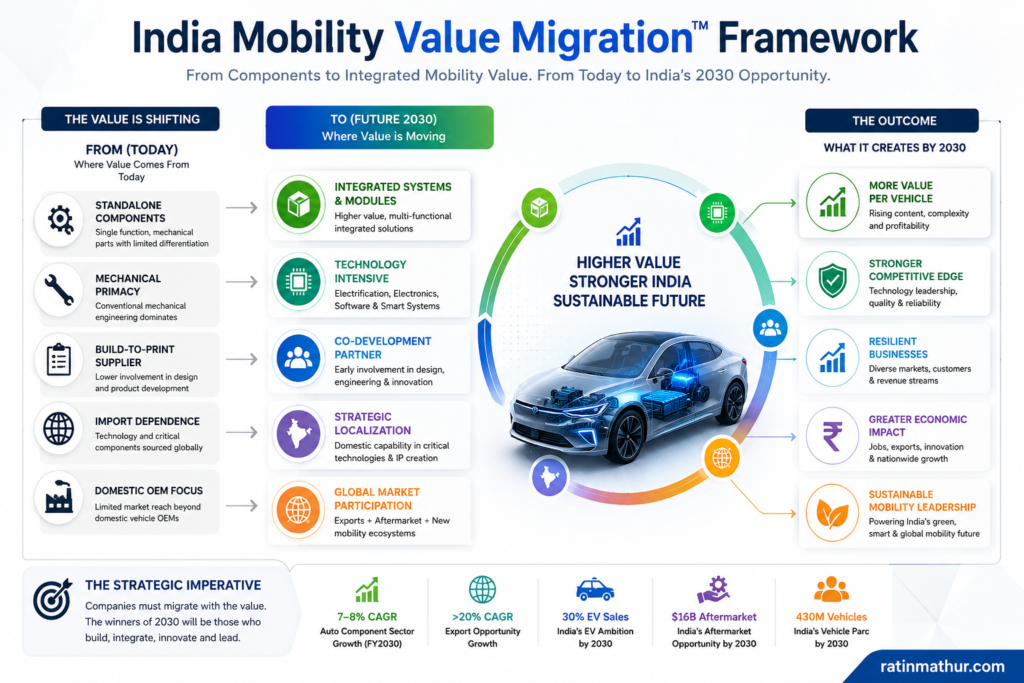
The India Mobility Value Migration™ Framework is based on the premise that the future of India’s auto component industry will be determined by the direction in which value moves within the automotive bill of materials. The framework shifts strategic analysis away from the traditional question of whether the automotive market is growing and toward a more important question: which parts of the vehicle are becoming more economically valuable?
The first migration is from standalone components toward integrated systems. Traditionally, a supplier might manufacture one mechanical part according to an OEM’s specification. The future opportunity increasingly lies in supplying modules that combine mechanical, electrical and electronic functionality. Integrated systems allow suppliers to participate in a larger share of vehicle value and become more deeply embedded in customer product architecture.
The second migration is from conventional mechanical functionality toward technology-intensive capability. This does not eliminate mechanical products; instead, it increases the value of mechanical companies that can integrate new technologies. A conventional wiring-harness manufacturer, for example, may expand into high-voltage EV harnesses, battery connections and integrated electrical architecture. A thermal-management supplier can move from conventional engine cooling toward EV battery and power-electronics cooling systems. A braking company can progress toward electronically controlled braking and advanced safety systems.
The third migration is from production participation toward development participation. A supplier that receives a finalized design and manufactures a component has a different competitive position from a supplier involved in product development. Early involvement can improve customer relationships, increase switching costs and provide greater visibility into future vehicle programs.
The fourth migration is from import dependence toward strategic localization. The objective is not merely to assemble imported technologies in India. The stronger opportunity lies in building domestic manufacturing, engineering, testing and supplier capabilities around strategically important technologies. Successful localization can improve supply-chain resilience and create a platform for exports.
The framework can be illustrated through a hypothetical Indian thermal-management company. Its historical business may consist primarily of supplying conventional radiators. The India Mobility Value Migration™ Framework would not necessarily recommend abandoning this profitable business. Instead, it would assess how the company’s core capabilities can migrate toward future value pools. The company could use its expertise in heat transfer, manufacturing and OEM relationships to develop cooling systems for batteries, motors and power electronics. It could thereby move from a traditional product category into a broader mobility thermal-management platform.
| Value Migration Dimension | Historical Position | Future Position | India-Specific Example |
| Product scope | Individual component | Integrated system or module | Wiring supplier expands into high-voltage electrical architecture |
| Technology | Predominantly mechanical | Electro-mechanical and electronic | Braking supplier develops electronic braking solutions |
| Customer role | Build-to-print manufacturing | Codevelopment and engineering participation | Supplier collaborates during EV platform development |
| Supply chain | Imported technology dependence | Strategic domestic capability | Local engineering and manufacturing of critical subsystems |
| Market exposure | Domestic OEM concentration | OEM, exports and aftermarket | Indian supplier builds global and replacement channels |
| Value capture | Limited component share | Higher share of vehicle-system value | Thermal supplier expands into battery cooling |
The strategic importance of the framework lies in capital allocation. Companies should not ask whether they should “enter EVs” or “invest in electronics” as broad strategic categories. They should identify where their existing capabilities provide a credible right to win. A precision-machining company may have a stronger opportunity in specialized motor components than in battery-cell manufacturing. A lighting company may logically move toward intelligent and adaptive lighting. A company with deep electrical expertise may expand into high-voltage systems rather than unrelated mechanical products.
For investors, the framework provides a way to distinguish between superficial exposure and meaningful strategic positioning. A company should not receive a premium simply because it has announced an EV product. The more relevant question is whether its capabilities allow it to capture a defensible share of a growing value pool. The combination of technology, customer integration, manufacturing scale and localization is more important than thematic association alone.
The India 2030 Mobility Moat™ Framework
The India 2030 Mobility Moat™ Framework addresses the next strategic question. Identifying an attractive market is not enough. Companies must also develop the capabilities necessary to defend their position once competitors enter.
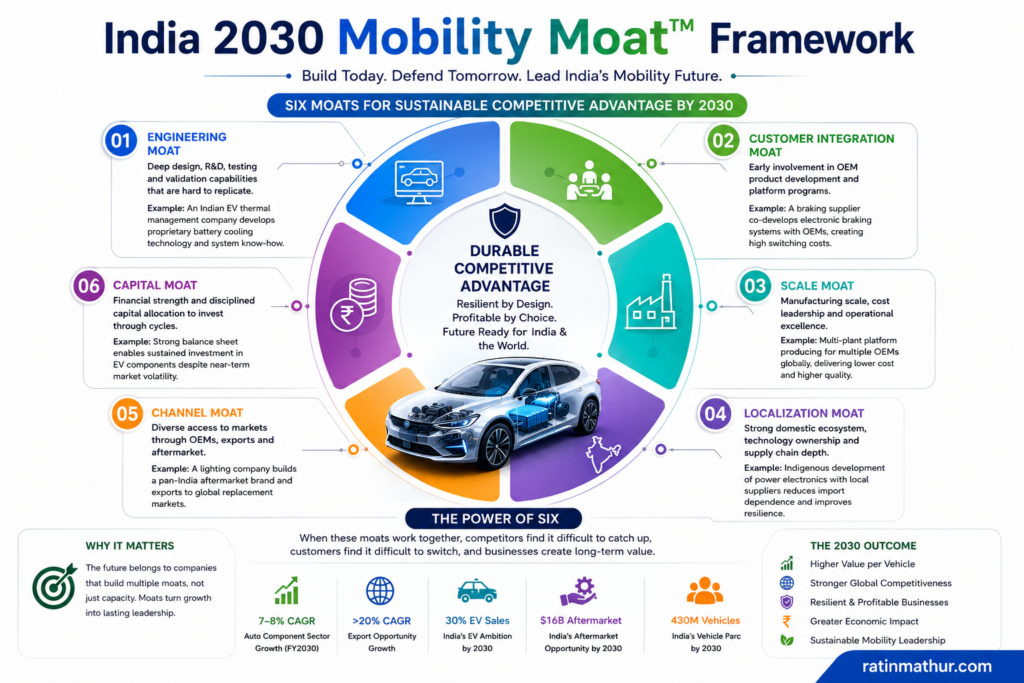
The framework identifies six interconnected sources of competitive advantage: engineering capability, customer integration, manufacturing scale, strategic localization, channel diversification and capital discipline.
The engineering moat is created when a company possesses design, testing, validation and product-development capabilities that are difficult to replicate. A supplier with proprietary knowledge of battery cooling or power electronics can potentially command a stronger position than a company merely manufacturing according to another organization’s design.
The customer-integration moat develops when the supplier becomes deeply involved in an OEM’s product-development process. Codevelopment relationships can increase switching costs because replacing a supplier becomes more difficult when that supplier’s engineering knowledge is embedded in the vehicle architecture.
The scale moat is created through manufacturing volume, procurement strength, efficient capacity utilization and cost competitiveness. Scale remains critically important in India because automotive manufacturing continues to require high quality at competitive costs.
The localization moat goes beyond domestic production. It exists when a company develops a local ecosystem of suppliers, engineering resources, testing capability and manufacturing expertise that reduces strategic dependence on imports. This can improve resilience and create a cost base suitable for exports.
The channel moat is created through diversification beyond a narrow set of OEM customers. An Indian component company with export customers and a strong aftermarket brand possesses additional demand channels. The aftermarket is particularly important because it allows the company to participate in the life cycle of vehicles already on the road.
The capital moat reflects a company’s ability to invest through technology cycles without undermining financial stability. Automotive transitions can take longer than expected, and new technologies often require sustained investment. A financially disciplined company is therefore better positioned to survive periods of technological uncertainty and capture opportunities when competitors lack investment capacity.
Consider a hypothetical Indian braking manufacturer. The company begins with a strong domestic manufacturing business. It develops an engineering moat by investing in electronic braking and safety technologies. It creates a customer-integration moat by participating in new vehicle-platform development. It strengthens its scale moat by supplying multiple OEMs. It develops a localization moat by producing key subsystems in India. It adds a channel moat by establishing a branded aftermarket business and export distribution. Finally, disciplined capital allocation enables the company to fund this transition without excessive leverage. The result is not simply a larger company. It is a company protected by several layers of competitive advantage.
| Strategic Moat | What the Company Must Build | Example | Long-Term Advantage |
| Engineering moat | Design, testing and validation capability | EV battery thermal-management expertise | Difficult-to-replicate knowledge |
| Customer-integration moat | Early OEM codevelopment relationships | Joint development of a new vehicle subsystem | Higher switching costs |
| Scale moat | Efficient capacity and procurement strength | Multi-OEM production platform | Lower unit costs |
| Localization moat | Domestic technology and supply-chain capability | India-based manufacturing of critical EV subsystems | Resilience and export competitiveness |
| Channel moat | Exports and aftermarket distribution | Branded replacement network across India | Diversified revenue |
| Capital moat | Strong balance sheet and disciplined investment | Phased technology investments | Ability to invest through industry cycles |
The framework demonstrates why future leadership cannot be measured by revenue alone. A company can have strong sales but limited competitive protection. Another company may currently be smaller but possess several reinforcing moats. Over time, the latter may create more durable value because competitors find it more difficult to replicate its engineering, customer relationships, scale, channels and capital strength.
The strategic objective for Indian companies should therefore be to accumulate multiple moats. The strongest competitive positions will likely emerge where these advantages reinforce one another.
Strategic Recommendations
| Strategic Priority | Recommendation | India-Specific Strategic Rationale | Expected Impact |
| Portfolio repositioning | Conduct a product-by-product assessment of whether component value per vehicle is rising, stable or declining | India is experiencing simultaneous growth in EVs, E/E systems, premium vehicles and traditional vehicles | More disciplined capital allocation |
| Value migration | Expand into technology-adjacent products rather than unrelated fashionable sectors | Existing Indian manufacturing and engineering capabilities can provide a credible right to win | Lower execution risk and stronger strategic fit |
| Engineering capability | Increase investment in design, testing, validation and codevelopment | Future automotive value will increasingly be captured during product development | Higher margins and switching costs |
| OEM relationships | Move from build-to-print supply toward earlier participation in vehicle development | Deep integration improves supplier relevance and customer retention | Stronger long-term contracts and system ownership |
| Electrification | Focus on selected EV value pools where existing capabilities are transferable | EV opportunity is large, but not every company should enter every category | More targeted growth investment |
| Electrical and electronics | Develop capabilities in high-voltage systems, sensors, controls and integrated E/E architecture | Multiple structural trends are increasing E/E content | Participation in broad, diversified growth pools |
| Localization | Build domestic engineering and supply capabilities in strategically important technologies | India’s industrial scale and policy direction support deeper domestic value creation | Greater resilience and import substitution |
| Exports | Invest in global quality, certification and customer-development capabilities | Export growth can diversify domestic market risk and provide scale | Larger addressable market |
| Aftermarket | Develop branded replacement products and stronger distribution networks | India’s growing vehicle parc creates recurring replacement demand | Diversified and recurring revenues |
| Mature businesses | Retain and strengthen profitable legacy categories where scale and cost advantages exist | ICE demand will remain significant during the transition, and weaker competitors may exit | Cash generation and consolidation opportunities |
| M&A and succession | Target acquisitions that add engineering, technology, channels or scale | Promoter-led ownership and succession dynamics can create transaction opportunities | Faster capability development |
| Capital allocation | Use phased investment and clear return thresholds for emerging technologies | Adoption rates and technology architectures may evolve unpredictably | Reduced risk of overinvestment |
| Talent | Build multidisciplinary teams across mechanical, electrical, electronics and digital engineering | Future automotive systems increasingly combine multiple technologies | Improved innovation and execution capability |
| Governance | Institutionalize succession planning and professional management | Industry ownership patterns may create transition risk | Greater scalability and investor confidence |
Future Outlook & Conclusion
India’s auto component industry is moving toward a more complex but potentially more valuable future. The next decade will not be defined solely by how many vehicles India manufactures. It will be defined by the changing composition of those vehicles and by the ability of Indian suppliers to capture the expanding value embedded within them.
The projected growth advantage of the auto component sector over the broader automotive market demonstrates the importance of this shift. Rising content per vehicle is becoming a structural growth engine. Electrification adds new powertrain systems. Smartification increases electrical and electronic content. Premiumization increases the value of vehicle systems. The growing vehicle parc expands aftermarket demand. Exports create an opportunity to extend India’s manufacturing and engineering capabilities into global supply chains.
The industry will, however, operate in two strategic realities at once. Emerging technologies will grow rapidly, but mature technologies will continue to generate substantial demand and cash flows. The strongest companies will not necessarily abandon their legacy businesses. Instead, they will manage them intelligently while building exposure to future value pools.
The India Mobility Value Migration™ Framework provides a way to identify where future value is moving. It encourages companies to examine their position within changing vehicle architecture and to move toward higher-value, more integrated and technologically relevant products where their capabilities create a genuine competitive advantage.
The India 2030 Mobility Moat™ Framework provides the complementary answer to the question of sustainability. Growth alone is not enough. Indian companies must build engineering, customer-integration, scale, localization, channel and capital moats. The companies with several reinforcing advantages will be better positioned to withstand competition, technological disruption and changing customer demands.
For investors, the sector presents a combination of structural growth and structural transformation. The most attractive opportunities may not always be found in the largest or most fashionable technology categories. They may emerge where growing markets intersect with strong competitive barriers, capable management, disciplined capital allocation and credible opportunities for consolidation.
For corporate leaders, the strategic imperative is clear. Manufacturing excellence must remain a foundation, but the next stage of leadership requires more. Companies must understand where value is migrating, invest in engineering, develop system-level relevance, deepen localization, diversify markets and preserve financial flexibility.
India has the market scale, manufacturing base, engineering talent and policy momentum to become a more important global automotive component and mobility technology hub. The critical question is whether Indian companies will capture the higher-value layers of that opportunity.
The defining transition is from manufacturing scale to mobility value creation. The winners of India’s next automotive decade will not merely manufacture more. They will understand which capabilities matter most, own a more valuable part of the vehicle architecture and build competitive moats strong enough to defend their position long after the initial growth opportunity emerges.
References
- McKinsey & Company. (2026). Shifting into high gear: India’s auto component sector. McKinsey & Company. Official McKinsey automotive insights
- McKinsey & Company. (2025). Shaping the future of India’s auto component industry amid global trade shifts. McKinsey & Company. Official McKinsey & Company website
- Ministry of Heavy Industries, Government of India. (n.d.). Production Linked Incentive Scheme for Automobile and Auto Component Industry. Government of India. Ministry of Heavy Industries
- NITI Aayog. (2025). Unlocking a $200 billion opportunity: Electric vehicles in India. Government of India. NITI Aayog official website
The principal quantitative findings, industry projections and sector observations used in this article are based on the McKinsey & Company report provided for analysis, including its discussion of India’s auto component market growth, value migration, EV and electrical and electronic components, premiumization, aftermarket opportunity, ownership structure and investment potential.
Disclaimer
This article is intended solely for informational, educational, editorial and strategic discussion purposes. It does not constitute investment, financial, legal, tax, accounting or other professional advice. Nothing in this article should be interpreted as a recommendation or solicitation to buy, sell, hold, acquire or dispose of any company, security, business, financial asset or investment.
The market projections, industry estimates and strategic observations discussed in this article are based on the cited sources and analytical interpretations available at the time of preparation. Actual outcomes may differ materially because of changes in economic conditions, automotive demand, technology adoption, regulation, competition, geopolitical developments, supply chains and other factors.
The analysis focuses exclusively on India unless otherwise required for contextual interpretation. Readers should independently verify all relevant information and seek appropriate professional advice before making investment, business, acquisition, capital-allocation or strategic decisions.
The India Mobility Value Migration™ and India 2030 Mobility Moat™ frameworks are original conceptual frameworks developed for this article. The ™ symbol reflects claimed conceptual and brand association within this publication and does not, by itself, indicate registration with any trademark authority. No part of these frameworks should be interpreted as a guarantee of business, investment or financial performance.