Introduction
The Strait of Hormuz has long been recognized as one of the most strategically important maritime chokepoints in the world. Discussions around this narrow waterway usually focus on oil prices, military tensions, shipping disruptions, and geopolitical rivalries. However, one of the most dangerous and least understood consequences of any prolonged disruption in the Strait of Hormuz is its direct impact on global food security.
The modern world is deeply interconnected. Energy systems, agricultural production, transportation networks, financial markets, fertilizer supply chains, and humanitarian operations are now part of one highly dependent global structure. A disruption in one strategic corridor can trigger cascading effects across multiple industries and countries within days.
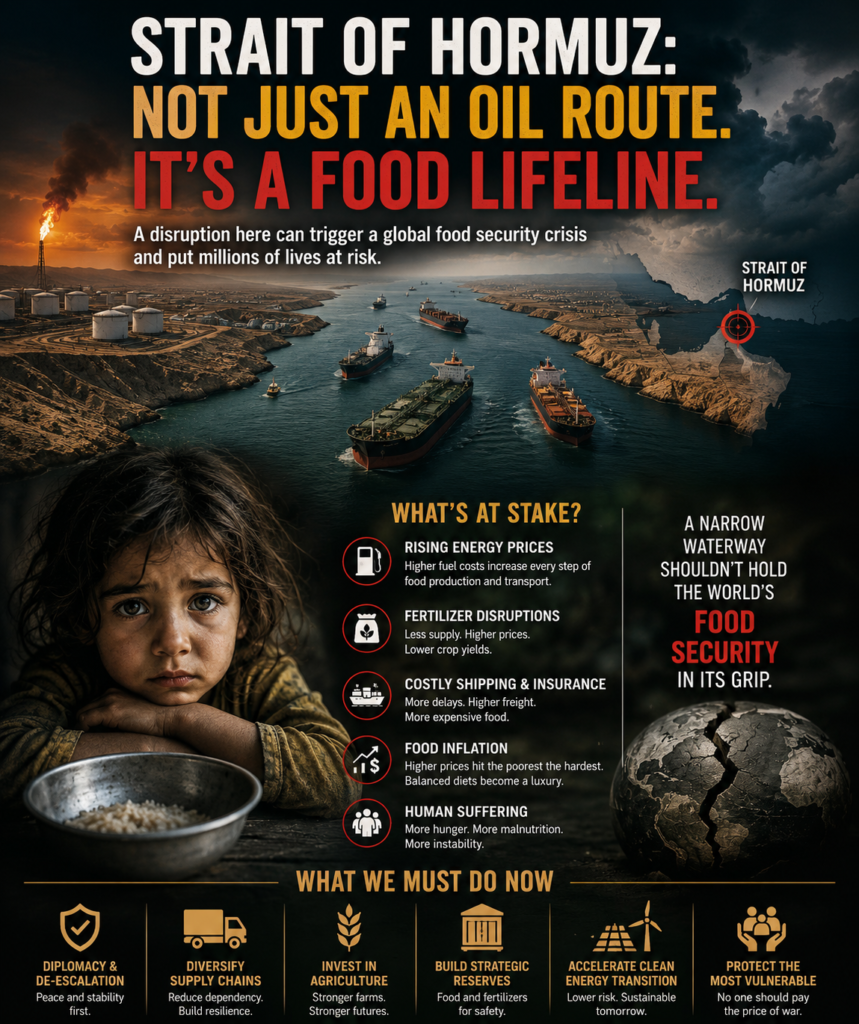
The Strait of Hormuz is not merely an oil transit route. It is a central artery supporting global economic stability and food availability. Any significant closure or disruption has the potential to create widespread inflation, fertilizer shortages, agricultural production challenges, transportation disruptions, and humanitarian distress across continents.
The danger becomes even more severe for developing economies where millions of households already face economic vulnerability, food inflation, weak purchasing power, and climate related pressures. Rising food prices can quickly escalate into hunger, malnutrition, social instability, migration pressure, and economic distress.
This article explores the deeper relationship between the Strait of Hormuz and global food security. It examines how energy disruptions impact agricultural systems, why fertilizer supply chains are highly vulnerable, how developing economies may suffer the most, and what governments and global institutions must do to strengthen resilience before the crisis evolves into a larger humanitarian emergency.
Understanding the Strategic Importance of the Strait of Hormuz
The Strait of Hormuz is located between Iran and Oman and serves as the primary maritime gateway connecting the Persian Gulf to the Arabian Sea and the Indian Ocean. Despite its relatively narrow geographical width, its global economic significance is enormous.
A substantial percentage of global crude oil exports and liquefied natural gas shipments move through this waterway every day. Major Gulf energy producers including Saudi Arabia, Iraq, Kuwait, Qatar, and the United Arab Emirates depend heavily on this route for exports.
The world’s dependence on the Strait of Hormuz is not limited to energy alone. The Gulf region is also a major supplier of petrochemicals, fertilizers, and industrial feedstocks that are essential for global agriculture and manufacturing systems.
Any disruption in this region can therefore trigger a simultaneous shock across multiple sectors:
• Energy markets experience supply shortages.
• Shipping and insurance costs rise sharply.
• Agricultural input prices increase.
• Industrial production costs escalate.
• Inflation spreads globally.
• Food affordability weakens.
• Economic instability intensifies.
This interconnected nature of modern supply chains means that the consequences of geopolitical instability in Hormuz extend far beyond regional politics.
Why Food Security Is Directly Linked to Energy Security
Many people underestimate the extent to which modern food systems depend on energy. Agriculture today is highly mechanized and energy intensive.
Fuel powers tractors, irrigation systems, harvesting equipment, transportation vehicles, refrigeration systems, processing plants, and logistics infrastructure. Natural gas is also a critical feedstock in fertilizer production.
As a result, disruptions in oil and gas supply quickly translate into higher agricultural costs.
When energy prices rise:
• Farm operating costs increase.
• Transportation expenses surge.
• Cold storage becomes more expensive.
• Fertilizer manufacturing costs escalate.
• Food distribution networks weaken.
• Consumer food prices rise.
The relationship between energy and food is deeply interconnected.
A disruption in Hormuz can therefore transform rapidly from an energy crisis into a food affordability crisis.
This is especially dangerous in lower income countries where food expenditure constitutes a large percentage of household income. Families living near subsistence levels are highly sensitive to inflation in fuel and food prices.
Even moderate increases in food prices can reduce nutrition quality, increase hunger, and worsen poverty.
Fertilizer Supply Chains and the Hidden Agricultural Risk
One of the most overlooked consequences of Hormuz disruption is its impact on global fertilizer markets.
The Gulf region is a major producer and exporter of ammonia, urea, and other nitrogen based fertilizers. These products are essential for maintaining agricultural productivity worldwide.
Fertilizers directly influence crop yields. Without sufficient fertilizer availability, agricultural productivity declines significantly.
This creates several risks:
• Lower crop output.
• Reduced farm profitability.
• Higher food prices.
• Increased import dependence.
• Long term agricultural instability.
Developing economies are particularly vulnerable because many rely heavily on imported fertilizers.
If fertilizer prices rise sharply or supplies become disrupted, small farmers may reduce fertilizer application to control costs. This directly impacts crop yields and food availability in subsequent harvest cycles.
The effects are often delayed but severe.
A fertilizer disruption today can lead to agricultural shortages months later.
This creates prolonged inflationary pressure and deepens food insecurity over time.
Asia’s Exposure to Hormuz Related Food and Energy Risks
Asian economies are among the most dependent on Gulf energy supplies moving through the Strait of Hormuz.
Countries such as India, China, Japan, South Korea, Pakistan, Bangladesh, and Sri Lanka import significant amounts of crude oil and liquefied natural gas from the Gulf region.
India presents a particularly important case.
India imports a large majority of its crude oil requirements. Rising oil prices affect transportation, agriculture, manufacturing, logistics, and household expenses across the economy.
Food inflation is highly sensitive in India because millions of households remain price conscious and economically vulnerable.
A prolonged Hormuz disruption could result in:
• Higher fuel prices.
• Rising fertilizer costs.
• Increased transportation expenses.
• Elevated food inflation.
• Reduced household purchasing power.
• Pressure on government subsidies.
• Greater fiscal strain.
The effects would be particularly severe for lower income and middle income households.
Countries such as Pakistan and Sri Lanka face even greater vulnerability due to external debt pressures, weaker currencies, and economic instability.
A sharp increase in energy and food import bills could significantly worsen inflationary conditions and economic stress.
China is also heavily exposed because of its large industrial base and dependence on imported energy and agricultural commodities.
Gulf Countries and the Paradox of Food Vulnerability
One of the most ironic aspects of the Hormuz crisis is that several Gulf countries themselves remain heavily dependent on imported food.
Nations such as Qatar, Kuwait, Bahrain, and the United Arab Emirates import a substantial share of their food requirements because of limited agricultural capacity and water scarcity.
Despite their economic wealth, these countries remain vulnerable to disruptions in shipping and maritime logistics.
A prolonged crisis in Hormuz can affect:
• Food import schedules.
• Shipping insurance availability.
• Port operations.
• Consumer prices.
• Supply chain continuity.
This demonstrates that economic prosperity alone does not guarantee food security.
In a globalized economy, resilience depends heavily on diversified supply chains, strategic reserves, and stable trade routes.
Africa Could Face Severe Humanitarian Consequences
Sub Saharan Africa is likely to face some of the most severe consequences of prolonged Hormuz instability.
Many African countries are already dealing with food insecurity caused by droughts, conflicts, climate change, and economic challenges.
Several nations rely heavily on imported food and fertilizers.
A major increase in energy prices and transportation costs could significantly increase food import expenses.
At the same time, fertilizer shortages could reduce local agricultural productivity.
This combination creates a dangerous cycle:
• Higher food costs.
• Lower crop yields.
• Reduced affordability.
• Increased hunger.
• Worsening malnutrition.
• Humanitarian pressure.
Food insecurity in Africa is not only a humanitarian issue. It also becomes a political and economic issue.
Historically, sharp food inflation has contributed to civil unrest, migration pressure, and political instability in several regions.
Shipping Disruptions and the Breakdown of Global Supply Chains
Global food systems depend heavily on uninterrupted maritime logistics.
The Strait of Hormuz is one of the most critical shipping routes in the world. Any security concerns immediately affect freight costs, shipping schedules, and insurance premiums.
Shipping companies may reroute vessels or temporarily suspend operations during periods of heightened geopolitical risk.
This creates several challenges:
• Longer delivery times.
• Higher fuel consumption.
• Container shortages.
• Port congestion.
• Increased transportation costs.
• Reduced supply chain efficiency.
Food systems are highly sensitive to logistics disruptions because agricultural products are often perishable and time sensitive.
Developing countries with weaker infrastructure and limited storage capacity are especially vulnerable to these disruptions.
Inflation, Currency Pressure, and Economic Instability
Food insecurity is closely connected to macroeconomic stability.
When oil prices rise sharply, inflation spreads across multiple sectors.
Central banks may respond by increasing interest rates to control inflation. However, higher interest rates can slow economic growth and weaken employment.
Oil importing countries also face additional pressure on foreign exchange reserves because they must spend more on energy imports.
This often weakens national currencies.
A weaker currency makes imported food and fertilizers even more expensive.
The result is a dangerous economic cycle:
• Higher import costs.
• Rising inflation.
• Reduced purchasing power.
• Economic slowdown.
• Greater poverty.
• Social instability.
Countries with high debt burdens and limited foreign reserves are especially vulnerable.
Climate Change Is Multiplying the Risk
The Hormuz crisis is unfolding at a time when global food systems are already under pressure from climate change.
Extreme weather events including droughts, floods, heatwaves, and irregular rainfall patterns are reducing agricultural productivity in many regions.
Climate related crop failures combined with fertilizer shortages and transportation disruptions create a highly dangerous situation.
Agricultural resilience becomes significantly weaker when multiple crises occur simultaneously.
For example:
• Drought reduces crop yields.
• Fertilizer shortages lower productivity further.
• Energy inflation increases transportation costs.
• Food imports become less affordable.
• Governments face growing social pressure.
This convergence of geopolitical instability and climate stress represents one of the greatest long term threats to global food security.
Humanitarian Systems Could Face Enormous Pressure
International humanitarian agencies are already under pressure from ongoing conflicts, displacement crises, and climate related disasters.
A global food inflation shock caused by Hormuz disruption would significantly increase humanitarian needs.
At the same time, rising transportation and procurement costs would reduce the purchasing power of aid organizations.
This means humanitarian agencies may be able to support fewer people even as global needs increase.
Refugees and displaced populations are especially vulnerable because they have limited financial resilience.
Reduced food aid can quickly worsen malnutrition and humanitarian distress.
Financial Markets and Commodity Volatility
Global commodity markets often amplify crises through speculation and uncertainty.
When markets anticipate shortages, prices rise rapidly even before physical supply disruptions fully materialize.
This affects food affordability globally.
Commodity volatility can trigger panic buying, export restrictions, and stockpiling behavior among governments and businesses.
These reactions often worsen global shortages.
Several countries imposed export restrictions during previous food crises, which intensified international price spikes and supply uncertainty.
A similar pattern could emerge during a prolonged Hormuz crisis.
The Strategic Lessons for Governments and Businesses
The Hormuz crisis highlights several structural weaknesses in global systems.
First, excessive dependence on a few critical trade routes creates major vulnerabilities.
Second, food security cannot be separated from energy security.
Third, supply chain resilience is now a strategic necessity rather than an operational preference.
Governments and businesses must rethink long term resilience strategies.
This includes:
• Diversifying energy sources.
• Building strategic food and fertilizer reserves.
• Strengthening domestic agricultural production.
• Investing in renewable energy.
• Expanding regional trade partnerships.
• Improving storage and logistics infrastructure.
• Increasing climate resilience in agriculture.
• Reducing overdependence on single supply routes.
• The crisis also reinforces the importance of diplomacy and geopolitical stability.
Preventing escalation is significantly less costly than managing the humanitarian consequences of prolonged disruption.
The Human Dimension of the Crisis
Beyond economics and geopolitics lies the human reality of food insecurity.
A rise in food prices may appear as an economic statistic in developed economies, but in vulnerable regions it can mean:
• Children receiving fewer meals.
• Families reducing nutrition quality.
• Farmers abandoning cultivation.
• Communities experiencing hunger.
• Households falling deeper into poverty.
• Food insecurity affects education, healthcare, productivity, and long term human development.
The poorest populations contribute the least to geopolitical conflicts, yet they often bear the greatest burden during global crises.
This highlights the ethical and humanitarian responsibility of global leaders to prioritize stability, cooperation, and resilience.
Conclusion
The Strait of Hormuz is no longer merely a strategic maritime corridor associated with oil markets and geopolitical tensions. It has become a symbol of how interconnected and fragile the modern global system truly is.
A prolonged disruption in Hormuz has the potential to trigger a global food security crisis through rising energy prices, fertilizer shortages, transportation disruptions, inflationary pressure, and weakened agricultural productivity.
The consequences would extend far beyond economics.
Millions of vulnerable households across Asia, Africa, and developing economies could face worsening food affordability, hunger, malnutrition, and social instability.
The crisis demonstrates that food security, energy security, geopolitical stability, and climate resilience are deeply interconnected.
The world must move beyond reactive crisis management and focus on building long term resilience.
This requires strategic planning, diversified supply chains, agricultural investment, renewable energy expansion, diplomatic cooperation, and stronger humanitarian preparedness.
If global leaders fail to act collectively, the costs will not only be measured in market volatility or economic losses. They will be measured in human suffering, inequality, and lost opportunities for millions across the world.
The Strait of Hormuz is therefore not just a regional geopolitical issue. It is a global warning about the vulnerability of interconnected systems in an increasingly uncertain world.
References
- International Energy Agency. (2025). Global energy security and maritime chokepoints. Retrieved from https://www.iea.org
- World Bank. (2025). Food Security Update: Rising Energy and Fertilizer Risks. Retrieved from https://www.worldbank.org/en/topic/agriculture/brief/food-security-update
- Food and Agriculture Organization. (2025). Global fertilizer market trends and food security implications. Retrieved from https://www.fao.org
- International Food Policy Research Institute. (2025). Geopolitical disruptions and global food systems. Retrieved from https://www.ifpri.org
- Reuters. (2026). Oil market disruptions and global economic risks linked to Hormuz tensions. Retrieved from https://www.reuters.com
- United Nations World Food Programme. (2025). Global hunger trends and humanitarian funding challenges. Retrieved from https://www.wfp.org
- Kiel Institute for the World Economy. (2025). Economic vulnerabilities from maritime trade disruptions. Retrieved from https://www.ifw-kiel.de
- United Nations Conference on Trade and Development. (2025). Global supply chains and maritime logistics risks. Retrieved from https://unctad.org
- International Monetary Fund. (2025). Commodity price shocks and emerging market vulnerabilities. Retrieved from https://www.imf.org
- Food and Agriculture Organization. (2025). Climate change, agriculture, and food security. Retrieved from https://www.fao.org/climate-change
Disclaimer
This article is intended solely for informational, educational, analytical, and awareness purposes. The content presented reflects general research, publicly available information, market observations, geopolitical developments, and macroeconomic analysis at the time of writing. The article does not constitute investment advice, financial advice, legal advice, geopolitical guidance, policy recommendations, security assessment, or official forecasting.
The views and interpretations expressed in this article are intended to encourage discussion and understanding of global food security, energy dependency, supply chain resilience, and geopolitical risk exposure. While reasonable efforts have been made to ensure accuracy and reliability, the author and publisher make no guarantees regarding the completeness, accuracy, timeliness, or future validity of the information presented.
Geopolitical events, commodity markets, trade policies, and economic conditions are highly dynamic and subject to rapid change. Readers are advised to consult official government sources, international institutions, industry experts, and professional advisors before making business, policy, investment, operational, or strategic decisions based on the information discussed in this article.
The article may include references to third party organizations, reports, publications, and publicly accessible sources for informational and academic purposes only. All trademarks, organization names, and referenced materials remain the property of their respective owners.
The author and publisher shall not be held responsible for any direct, indirect, incidental, consequential, financial, operational, geopolitical, or commercial losses arising from the use, interpretation, or reliance upon this content.
Readers are encouraged to independently verify information and conduct their own due diligence regarding geopolitical developments, market conditions, food security trends, energy markets, and international trade dynamics.