Introduction
The global artificial intelligence race has entered a defining phase. For the past two years, the world has been captivated by generative AI breakthroughs, billion-dollar investments, AI chatbots, semiconductor shortages, and rapidly evolving large language models. Companies competed aggressively to build the most advanced AI systems, while governments and enterprises rushed to understand the implications of this technological revolution.
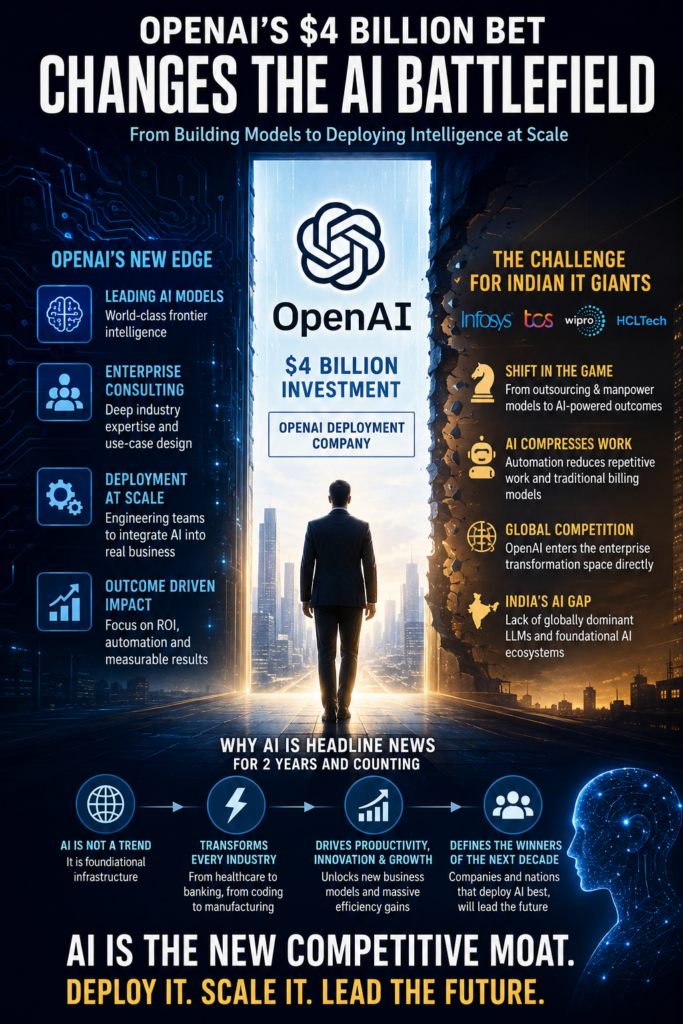
However, OpenAI’s reported move to establish the “OpenAI Deployment Company” with an estimated investment exceeding $4 billion represents something much bigger than another corporate expansion. It signals a strategic shift in the global AI economy. The competition is no longer only about creating the most powerful AI models. The new battle is about deploying artificial intelligence at enterprise scale and integrating AI deeply into real business operations.
This development has major implications for global consulting firms, enterprise technology providers, and especially Indian IT giants such as Infosys, Tata Consultancy Services (TCS), Wipro, HCLTech, and Tech Mahindra. It also raises larger questions about whether Indian IT firms and India’s broader technology ecosystem are moving fast enough in the age of AI.
Artificial intelligence is no longer simply a technology trend. It is becoming foundational infrastructure for the modern economy.
The Evolution of the AI Economy
Before the rise of generative AI, artificial intelligence largely operated behind the scenes. AI existed in recommendation engines, fraud detection systems, image recognition tools, predictive analytics, and search algorithms. Large enterprises used AI in specialized applications, but the technology remained relatively invisible to the general public.
Everything changed with the emergence of generative AI platforms such as ChatGPT. For the first time, businesses, students, professionals, developers, and consumers could directly interact with AI systems in natural language. AI became accessible, visible, and immediately useful.
This transition transformed AI from a back-end technology into a mainstream productivity platform.
The first phase of the AI race focused heavily on model development. Companies competed to create larger, faster, and more capable AI systems. Headlines revolved around model performance, reasoning capabilities, GPU infrastructure, and valuation growth.
Now, the market is entering a second phase.
The new focus is enterprise deployment.
Organizations no longer want only AI demonstrations or chatbot experiments. They want measurable business outcomes. They want AI integrated into customer service, software engineering, operations, supply chains, manufacturing, healthcare, finance, legal workflows, and strategic decision-making systems.
This is precisely where OpenAI’s deployment strategy becomes highly significant.
Why OpenAI’s Deployment Company Matters
Historically, technology companies built software while consulting firms and IT services companies implemented enterprise transformation projects. OpenAI’s deployment-focused expansion challenges this traditional separation.
OpenAI is no longer positioning itself only as a research laboratory or model provider. It is increasingly becoming an enterprise transformation company capable of combining advanced AI models with deployment expertise, consulting capabilities, engineering support, and industry-specific integration.
This changes the nature of competition in the technology industry.
The real AI question is no longer:
“Who has the best model?”
The more important question is:
“Who can deploy AI fastest and create measurable business impact?”
Enterprise AI deployment is far more complex than simply integrating a chatbot into a workflow. Large-scale AI implementation requires data integration, cybersecurity alignment, governance frameworks, regulatory compliance, employee training, infrastructure modernization, workflow redesign, and continuous monitoring.
This creates enormous opportunities for organizations capable of combining AI technology with operational transformation expertise.
OpenAI’s strategy suggests that the company understands where the next trillion-dollar opportunity lies.
The Impact on Indian IT Giants
The emergence of deployment-focused AI companies creates direct strategic pressure on traditional IT services firms.
For decades, Indian IT giants dominated the global outsourcing and digital transformation industry through large-scale manpower models, cost efficiency, operational excellence, and enterprise implementation capabilities.
Firms such as Infosys, TCS, Wipro, and HCLTech built successful business models around application development, enterprise software implementation, managed services, infrastructure management, and long-term outsourcing contracts.
Artificial intelligence changes the economics of this model.
AI can automate significant portions of repetitive knowledge work, including coding, testing, documentation, customer support, reporting, business analysis, and workflow management.
This creates both risks and opportunities for Indian IT firms.
| Traditional IT Services Model | AI-Native Enterprise Model |
|---|---|
| Revenue linked to manpower scale | Revenue linked to AI-driven outcomes |
| Large delivery teams | Smaller expert teams supported by AI |
| Linear productivity growth | Exponential productivity scaling |
| Manual-heavy workflows | AI-assisted automation |
| Outsourcing-focused | Transformation-focused |
| Time-based billing | Outcome-based value creation |
The major challenge for Indian IT firms is that many global AI leaders control foundational platforms, cloud ecosystems, chips, and proprietary models.
Indian IT companies remain primarily system integrators rather than owners of foundational AI ecosystems.
This distinction is strategically important because the companies controlling the core AI layer may capture disproportionate long-term economic value.
Are Indian IT Firms Too Late in AI?
Indian IT companies are not absent from the AI race. Most leading firms have already launched AI partnerships, internal AI tools, generative AI practices, training initiatives, and enterprise AI consulting services.
However, the concern is not about participation.
The concern is about leadership.
The global AI landscape is increasingly dominated by organizations controlling:
| Critical AI Layer | Global Leaders |
|---|---|
| Foundational Models | OpenAI, Anthropic, Google, Meta |
| AI Chips | NVIDIA, AMD |
| Cloud Infrastructure | Microsoft, AWS, Google Cloud |
| AI Consumer Platforms | OpenAI, Google, Meta |
| Semiconductor Manufacturing | TSMC, Samsung |
India still lacks globally dominant foundational large language models at comparable scale.
This raises serious long-term strategic questions.
India succeeded tremendously during the outsourcing and software services era. However, the next decade may reward countries and companies that own AI platforms, infrastructure, data ecosystems, and foundational intelligence systems.
The risk is that India could remain an implementation economy while others capture the highest-value AI layers.
At the same time, India possesses significant strengths.
The country has one of the world’s largest engineering talent pools, a rapidly growing startup ecosystem, strong digital public infrastructure through platforms such as Aadhaar and UPI, and an enormous domestic market capable of driving AI adoption across sectors.
The challenge is whether these strengths can be converted into globally competitive AI leadership.
Why AI Has Dominated Headlines for Two Years
Artificial intelligence continues dominating global headlines because its impact extends across nearly every industry simultaneously.
Unlike earlier technological shifts that transformed individual sectors gradually, AI affects knowledge work directly.
It influences how businesses operate, how employees work, how consumers search for information, how software is developed, how decisions are made, and how governments function.
| Why AI Remains Dominant | Strategic Impact |
|---|---|
| Productivity gains | Significant efficiency improvements |
| Workforce transformation | Redefines jobs and workflows |
| Investment surge | Massive capital inflows globally |
| Enterprise adoption | AI becoming business-critical |
| Geopolitical competition | Nations racing for AI leadership |
| Consumer accessibility | Everyday users interacting with AI |
| Continuous innovation | Rapid pace of breakthroughs |
AI is increasingly being compared to foundational technological revolutions such as electricity, the internet, and smartphones.
However, AI may prove even more transformative because it directly augments cognitive work.
Electricity automated physical power.
The internet transformed communication and information access.
Artificial intelligence has the potential to amplify human reasoning, productivity, creativity, and decision-making.
This explains why governments, enterprises, investors, startups, and global technology companies continue prioritizing AI so aggressively.
Enterprise AI Deployment Is the Real Opportunity
Many organizations initially approached AI as an experimental technology. During 2023 and early 2024, enterprises launched pilot projects, chatbot initiatives, and proof-of-concept deployments.
Now, executive leadership teams increasingly demand measurable business outcomes.
Organizations want AI systems capable of reducing costs, accelerating workflows, improving customer experiences, optimizing operations, and generating competitive advantages.
This transition from experimentation to scaled deployment creates enormous market opportunities.
Industries across the world are already integrating AI into core operations.
| Industry | AI Deployment Examples |
|---|---|
| Banking | Fraud detection, AI relationship managers, risk analytics |
| Healthcare | Diagnostics, clinical documentation, drug discovery |
| Manufacturing | Predictive maintenance, quality inspection, automation |
| Retail | Personalized recommendations, inventory optimization |
| Education | AI tutors, adaptive learning systems |
| Software | AI-assisted coding and testing |
| Logistics | Supply chain optimization and forecasting |
This is why deployment capability is becoming more valuable than model ownership alone.
An advanced AI model without integration creates limited value.
A properly deployed AI ecosystem can transform an enterprise.
Consulting and Outsourcing Are Being Reinvented
Artificial intelligence is also disrupting the consulting and outsourcing industry itself.
Traditional consulting firms historically relied on human-driven analysis, large consulting teams, extensive documentation, and long implementation cycles.
AI compresses many of these activities dramatically.
Tasks that once required weeks of research can increasingly be completed within hours using AI-assisted systems.
This does not eliminate consulting firms, but it fundamentally changes the consulting value proposition.
Future consulting leaders may require:
- Deep AI implementation expertise
- Proprietary AI platforms
- AI governance frameworks
- Industry-specific AI accelerators
- Real-time analytics systems
- AI-native transformation capabilities
OpenAI’s deployment strategy may accelerate this industry transition significantly.
The Geopolitical AI Race
Artificial intelligence is increasingly viewed as a strategic geopolitical asset.
Countries are competing aggressively for leadership in:
| Strategic AI Area | Importance |
|---|---|
| Semiconductor manufacturing | Core infrastructure for AI systems |
| AI chips and GPUs | Enables model training and inference |
| Cloud computing | Supports scalable AI deployment |
| Frontier AI research | Drives innovation leadership |
| Defense AI | National security applications |
| Quantum computing | Future computational advantage |
| AI talent | Long-term innovation capability |
The AI race increasingly resembles earlier global competitions around nuclear technology, space exploration, telecommunications, and internet infrastructure.
Countries leading AI development may gain substantial economic and geopolitical influence over the coming decades.
This is one reason governments worldwide are aggressively increasing AI investments.
Can India Become an AI Superpower?
India has the potential to become a major AI player, but significant challenges remain.
The country possesses strong engineering talent, a rapidly digitizing economy, large-scale digital public infrastructure, and growing entrepreneurial energy.
However, India must accelerate investments in foundational AI capabilities.
Key areas requiring attention include:
| Strategic Requirement | Why It Matters |
|---|---|
| GPU infrastructure | Essential for training advanced models |
| Semiconductor ecosystem | Reduces dependency on foreign supply chains |
| AI research funding | Encourages frontier innovation |
| AI product ownership | Captures long-term economic value |
| AI governance frameworks | Ensures responsible deployment |
| Workforce reskilling | Prepares workforce for AI economy |
India cannot rely entirely on external AI ecosystems for long-term digital sovereignty.
Artificial intelligence will influence finance, healthcare, education, governance, defense, manufacturing, and national infrastructure.
Countries lacking domestic AI capabilities may face long-term strategic vulnerabilities.
The next decade may determine whether India evolves into an AI superpower or remains primarily an implementation and services economy.
The Future of Work in the AI Era
One of the biggest concerns surrounding AI involves workforce disruption.
Artificial intelligence is likely to automate many repetitive and process-driven tasks. However, technological revolutions historically also create new categories of employment.
| Technological Shift | Jobs Reduced | Jobs Created |
|---|---|---|
| Industrial Revolution | Manual factory work | Industrial engineering |
| Internet Era | Traditional retail roles | E-commerce and digital marketing |
| Cloud Computing | On-premise IT maintenance | Cloud architecture and DevOps |
| AI Revolution | Repetitive knowledge work | AI engineering and AI governance |
The critical issue is adaptation speed.
Organizations and countries investing aggressively in AI literacy, reskilling, and digital transformation may benefit substantially.
Those delaying adaptation may struggle competitively.
Strategic Recommendations
The rise of deployment-focused AI companies offers important lessons for enterprises, policymakers, and technology firms.
Indian IT companies should invest more aggressively in proprietary AI platforms, AI-native consulting models, and industry-specific AI solutions. Dependence on traditional manpower-heavy delivery models may become increasingly risky over time.
Policymakers should accelerate investments in AI infrastructure, semiconductor ecosystems, GPU capacity, research institutions, and AI education. Public-private collaboration will be essential for building globally competitive AI ecosystems.
Enterprises should move beyond AI experimentation and focus on measurable business transformation. Organizations that integrate AI strategically into operations, customer engagement, analytics, and decision-making may achieve major competitive advantages.
At the workforce level, AI literacy and continuous upskilling will become increasingly important. Employees capable of working effectively alongside AI systems may remain highly valuable in the evolving digital economy.
Conclusion
OpenAI’s reported $4 billion deployment initiative represents a historic turning point in the AI economy.
The first phase of the AI race focused on building powerful models.
The next phase will focus on deploying intelligence into every layer of enterprise operations and economic activity.
This transition has profound implications for technology companies, consulting firms, governments, enterprises, workers, and investors.
For Indian IT giants such as Infosys, TCS, Wipro, and HCLTech, the AI revolution presents both disruption and opportunity.
The future may belong not to the companies with the largest workforce, but to the organizations capable of deploying AI fastest, creating measurable business outcomes, and building scalable AI-native ecosystems.
At a national level, India faces a strategic imperative.
The country must move beyond being only a consumer and implementer of global AI technologies.
India must actively participate in building foundational AI infrastructure, research ecosystems, semiconductor capabilities, and globally competitive AI platforms.
Artificial intelligence is no longer simply another technology trend.
It is becoming foundational infrastructure for the modern economy.
The companies and nations that deploy AI strategically, responsibly, and at scale may define the next era of global economic power.
References
- Accenture. (2024). Technology Vision 2024: Human by Design. Accenture Research. Retrieved from Accenture Technology Vision 2024
- Anthropic. (2024). Responsible Scaling Policy. Anthropic. Retrieved from Anthropic Responsible Scaling Policy
- Brynjolfsson, E., & McAfee, A. (2014). The Second Machine Age: Work, Progress, and Prosperity in a Time of Brilliant Technologies. W. W. Norton & Company. Retrieved from The Second Machine Age Book
- Gartner. (2024). Top Strategic Technology Trends for 2024. Gartner Research. Retrieved from Gartner Strategic Technology Trends 2024
- Google Cloud. (2024). Enterprise Generative AI Adoption Report. Google Cloud. Retrieved from Google Cloud AI Insights
- International Monetary Fund. (2024). Artificial Intelligence and the Future of Work. IMF Publications. Retrieved from IMF AI and Future of Work
- McKinsey & Company. (2024). The State of AI in 2024. McKinsey Global Institute. Retrieved from McKinsey State of AI 2024
- Microsoft. (2024). AI Transformation and Enterprise Productivity Report. Microsoft Research. Retrieved from Microsoft AI Transformation Insights
- NVIDIA. (2024). The Future of Accelerated Computing and AI Infrastructure. NVIDIA Publications. Retrieved from NVIDIA AI Infrastructure
- OpenAI. (2024). Enterprise AI Deployment and Scaling Insights. OpenAI Research. Retrieved from OpenAI Enterprise
- PwC. (2024). AI Predictions and Business Transformation Outlook. PwC Global. Retrieved from PwC AI Business Predictions
- Stanford University Human-Centered AI Institute. (2024). AI Index Report 2024. Stanford HAI. Retrieved from Stanford AI Index Report 2024
- World Economic Forum. (2024). The Future of Jobs Report 2024. World Economic Forum. Retrieved from WEF Future of Jobs Report
Disclaimer
This article is intended solely for educational, informational, strategic, and analytical purposes. The views and interpretations presented are based on publicly available information, industry developments, market observations, and independent analysis at the time of writing.
The article does not constitute investment advice, legal advice, financial advice, technology implementation advice, or professional consulting recommendations. Readers are advised to conduct their own independent research and consult qualified professionals before making strategic, financial, technological, or operational decisions.
References to companies, technologies, platforms, or organizations are made strictly for analytical and informational discussion. Mention of any company or product does not imply endorsement, criticism, partnership, or affiliation.
Artificial intelligence technologies evolve rapidly, and market conditions, regulations, competitive landscapes, and technological capabilities may change significantly over time. Forecasts, projections, and future scenarios discussed in this article are speculative in nature and subject to uncertainty.
The author and publisher disclaim any liability arising directly or indirectly from the use, interpretation, or reliance upon the information contained in this article.
Readers are encouraged to evaluate AI adoption responsibly, ethically, and in compliance with applicable laws, regulations, cybersecurity standards, and data privacy requirements.