Abstract
Board Evaluation has become a recognized pillar of corporate governance in India, but the effectiveness of the exercise depends on whether it is capable of surfacing difficult truths and converting them into corrective action. The Institute of Company Secretaries of India (ICSI) framework establishes a comprehensive foundation covering evaluation of the Board, committees, individual directors and Chairperson, while emphasizing leadership, teamwork, accountability, communication, decision-making, succession and Board effectiveness. SEBI’s Guidance Note similarly covers the subject, process, criteria, feedback, action planning, disclosure, frequency, responsibility and periodic review of Board Evaluation. (Securities and Exchange Board of India)
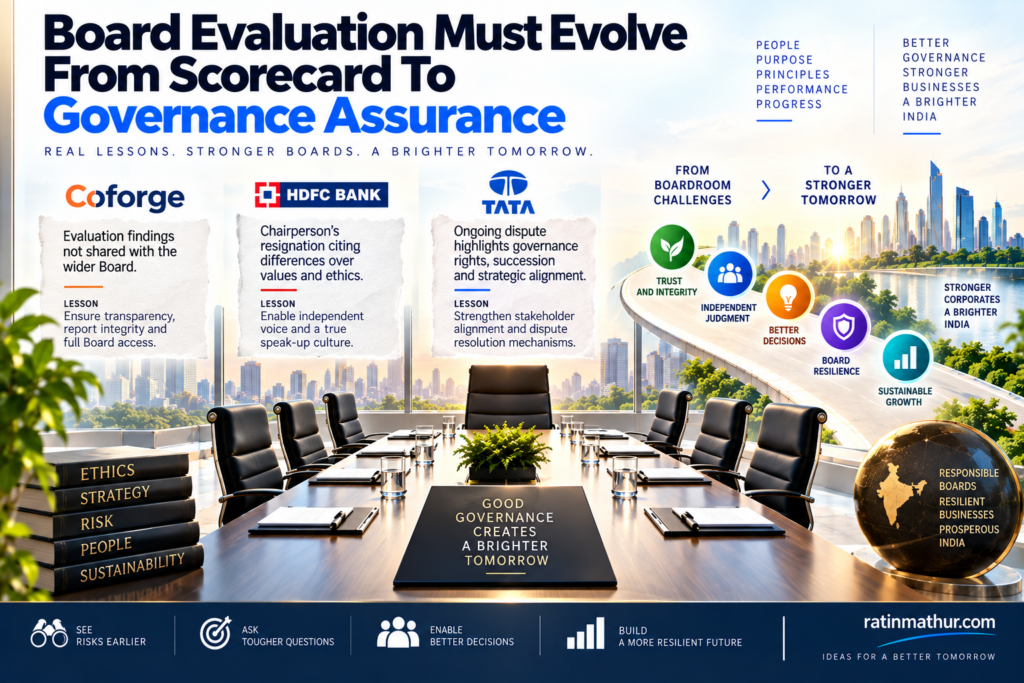
Recent developments involving Coforge, HDFC Bank and Tata Sons/Tata Trusts demonstrate why the next generation of Board Evaluation must go beyond questionnaires and annual ratings. The critical question is no longer only whether a Board is effective. It is whether the governance system is capable of detecting suppressed information, unresolved dissent, power imbalances, conflicts, weak succession and other emerging risks before they escalate into Boardroom disruption. This paper proposes a more evidence-based, independently assured and resilience-oriented model and introduces three strategic frameworks for its implementation.
Executive Summary
Board Evaluation was designed to make Boards more effective, accountable and capable of continuous improvement. The ICSI guide explicitly recognizes its role in improving leadership, communication, teamwork, decision-making, Board-management relationships and the identification of skill gaps. It also recommends a diagnostic approach covering Board effectiveness, committee effectiveness, composition, strategic requirements, governance processes, management interface, succession and Board leadership, followed by detailed findings, action plans, skills matrices, coaching and mechanisms for addressing underperformance.
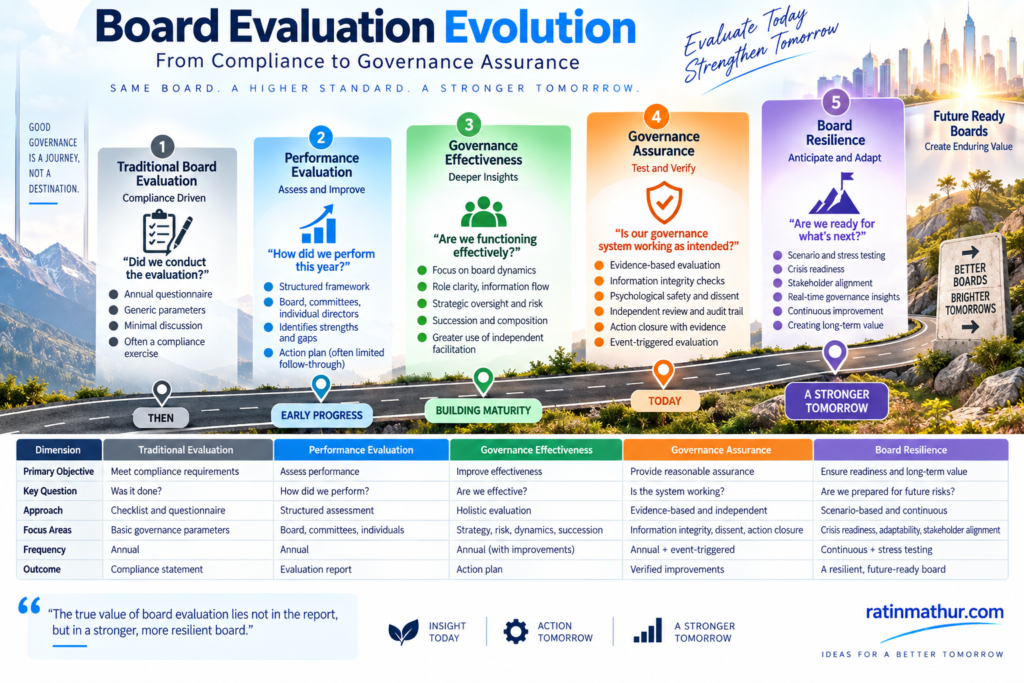
The central weakness is therefore not the absence of a framework. It is the risk that the framework becomes a periodic assessment rather than an early-warning system. A Board can complete an evaluation, report that the process was satisfactory and still fail to surface an important governance concern. The distinction is between evaluation of performance and assurance of governance integrity.
Recent events provide three different illustrations. At Coforge, public reporting based on company disclosures indicated that an internal KPMG review found shortcomings in the manner in which Board Evaluation findings were shared and presented, including the non-disclosure of the Chairman’s lowest rating to the NRC and wider Board. (The Indian Express) At HDFC Bank, the FY2024-25 evaluation already covered Boardroom culture, ethics and information flow, yet Chairman Atanu Chakraborty subsequently resigned citing differences over values and ethics; the Bank appointed external law firms to review the resignation letter. (HDFC Bank) At Tata Sons, the current public dispute between Tata Sons and Tata Trusts over leadership and a potential listing illustrates the importance of Board-shareholder alignment, governance rights and structured conflict-resolution mechanisms. (Reuters)
The answer is not to abandon traditional Board Evaluation but to strengthen it with evidence, independent oversight, continuous monitoring, governance stress testing and verified action closure.
Introduction
The Board is the principal institution through which a company exercises strategic direction, oversight and accountability. The ICSI guide describes three core Board roles: providing strategic direction, controlling through management oversight, and providing advice and support. The Companies Act, 2013 reinforces this fiduciary responsibility by requiring directors to act in good faith, exercise due care, skill and diligence, exercise independent judgment and avoid conflicts of interest.
These responsibilities have become considerably more complex. Boards now operate amid rapid technological change, cyber risk, artificial intelligence, geopolitical uncertainty, complex ownership structures, heightened regulatory expectations, stakeholder activism, succession pressures and increasing scrutiny of corporate culture. The OECD’s 2023 principles explicitly place independent judgment, conflict management, risk oversight, digital security, data privacy, stakeholder interests and regular Board evaluation within the Board’s responsibilities. (OECD)
Against this backdrop, a traditional annual questionnaire is necessary but insufficient. The Board needs to know not only how directors perceive its performance but whether the conditions for good governance are actually present.
Problem Statement & Objectives
The problem can be stated simply: Board Evaluation may measure perceptions of effectiveness without adequately testing the integrity of the governance environment in which those perceptions are generated.
The existing framework is strong in defining who should be evaluated and the broad subjects of evaluation. The ICSI guide specifically emphasizes Board composition, dynamics, role clarity, strategy and risk oversight, accountability, decision-making, communication and individual director characteristics. It also emphasizes confidentiality, transparency, independent facilitation and action planning.
The strategic objective should therefore evolve from “conduct an evaluation” to “provide reasonable confidence that the Board’s governance system is working as intended.”
| Existing objective | Enhanced objective |
|---|---|
| Evaluate Board performance | Evaluate Board performance and governance resilience |
| Assess individual directors | Assess contribution, independence, challenge and conduct |
| Assess meeting effectiveness | Assess decision quality and quality of challenge |
| Review information flow | Test whether material information reaches directors completely and on time |
| Identify improvement areas | Identify and risk-classify governance weaknesses |
| Prepare action plan | Establish accountable, evidence-backed remediation |
| Conduct annual review | Combine annual, continuous and event-triggered review |
| Disclose process | Disclose process, material observations and action taken where appropriate |
Methodology
This paper uses a governance-focused analytical methodology. First, the ICSI Guide to Board Evaluation was examined as the primary source framework, including its treatment of Board, committee, individual director and Chairperson evaluation, external evaluation, action planning, succession and evaluation barriers. The guide itself notes that Board Evaluation should improve leadership, teamwork, accountability, decision-making, communication and Board operations.
Second, the analysis was compared with SEBI’s Guidance Note on Board Evaluation and current statutory governance requirements. SEBI’s framework covers the subject of evaluation, objectives and criteria, feedback, action plans, disclosure, frequency, responsibility and review of the evaluation process. (Securities and Exchange Board of India)
Third, the analysis incorporates the OECD’s current governance principles relating to independent judgment, conflicts, risk management, whistleblowing, information, stakeholder interests and regular Board evaluation. (OECD)
Fourth, recent developments involving Coforge, HDFC Bank and Tata Sons/Tata Trusts were examined as case illustrations. These examples are not treated as proof that a company or individual violated law unless a competent authority has established such a finding. They are used to identify governance questions that a robust Board Evaluation process should be capable of detecting.
Landscape Analysis
India has progressed from treating Board Evaluation as a voluntary governance practice to embedding it within the statutory and listed-company governance framework. SEBI’s guidance recognizes evaluation of the Board as a whole, individual directors and committees, together with responsibilities and disclosures around the process. (Securities and Exchange Board of India)
International practice reinforces the movement toward rigorous and independent evaluation. The OECD recommends regular Board evaluations and periodic external facilitation to improve objectivity, while also emphasizing the importance of appropriate Board competence and diversity to reduce groupthink. (OECD)
The important development for Indian Boards is that the operating environment has changed faster than the architecture of evaluation.
| Governance dimension | Traditional approach | Emerging requirement |
|---|---|---|
| Independence | Formal declaration of independence | Demonstrated ability to exercise independent judgment |
| Information | Adequacy and timeliness of Board papers | Testing whether adverse information is filtered or delayed |
| Culture | Boardroom behavior and cohesion | Psychological safety and freedom to dissent |
| Decisions | Participation and quality of discussion | Evidence-based decision-quality review |
| Chairperson | Leadership and meeting effectiveness | Power balance, dissent, information integrity and independent evaluation |
| Succession | Existence of a succession plan | Readiness tested through scenarios |
| Conflicts | Disclosure and avoidance | Continuous conflict mapping and escalation |
| Evaluation | Annual assessment | Annual, continuous and event-triggered assurance |
| Actions | Action plan | Verified closure with evidence |
| Disclosure | Process disclosure | Meaningful disclosure of themes, actions and governance changes |
Key Findings
The first major finding is that the integrity of the evaluation process itself should be evaluated. The ICSI framework correctly recognizes confidentiality, transparency and independent facilitation as important to credibility. The Coforge episode demonstrates why this principle should be converted into a formal governance control. According to public reporting of the company’s disclosures, KPMG identified shortcomings in how the Board Evaluation Report was presented and shared, including the fact that the Chairman’s lowest rating was not disclosed or discussed with the NRC or full Board. (The Indian Express) The governance lesson is broader than the specific personalities involved: an evaluation finding cannot create value if the governance process permits selective access to the finding.
The second finding is that psychological safety and ethical dissent require stronger testing. HDFC Bank’s FY2024-25 Board Evaluation framework covered composition, roles, Board processes, Boardroom culture, Code of Conduct and Ethics, quality and flow of information, and follow-up on earlier evaluation themes. (HDFC Bank) Yet Chairman Atanu Chakraborty resigned in March 2026 citing differences over values and ethics. HDFC Bank stated publicly that no specific happenings or practices had been brought to its attention and subsequently appointed external law firms to review the resignation letter. (HDFC Bank) The subsequent review process does not establish that the Board’s evaluation system failed or that misconduct occurred. It does, however, demonstrate why Board Evaluation needs a confidential mechanism that asks directors what they have not felt comfortable raising in ordinary Board processes.
The third finding concerns Board-shareholder alignment. Tata Sons is majority owned by Tata Trusts, which hold 66% of the company according to Tata’s corporate information. (Tata Group) In September 2026, Reuters reported a public dispute over the reappointment of N. Chandrasekaran and the possibility of a Tata Sons listing, with different positions being expressed by Tata Sons and Tata Trusts. (Reuters) This situation illustrates why evaluation should not stop at director competencies. Governance architecture must also test the clarity of shareholder rights, nominee responsibilities, reserved matters and mechanisms for resolving disagreements between major stakeholders and the Board.
The fourth finding is that Board Evaluation must include actual decision quality. Asking whether directors received adequate information is useful but incomplete. A stronger system examines selected major Board decisions, the assumptions presented, alternatives considered, challenges raised, conflicts managed, dissent recorded, external advice obtained and whether the post-decision outcome was reviewed.
The fifth finding is that underperformance and governance weaknesses need consequences. The ICSI guide recognizes the need for action planning and mechanisms to address weaknesses and underperformance. A mature system should establish explicit thresholds for remediation, retraining, committee reassignment, succession planning, re-nomination review or other appropriate Board action.
Challenges & Opportunities
The largest challenge is human behavior. Directors may hesitate to provide candid feedback about peers, Chairpersons, promoters or senior management where they perceive reputational, relational or professional consequences. The ICSI guide itself recognizes that internal evaluations may discourage directors from sharing issues and that external evaluation can improve objectivity and stakeholder confidence.
A second challenge is the potential conflict created when the person being evaluated controls access to the findings. A Board Evaluation system should distinguish between legitimate confidentiality and inappropriate restriction of information. Confidentiality should protect the identity of respondents; it should not permit the substance of a material governance finding to be withheld from the appropriate decision-making body.
A third challenge is compliance fatigue. When annual evaluation becomes a familiar questionnaire, directors can unconsciously optimize for completion rather than introspection. The opportunity is to move toward a mixed methodology combining quantitative surveys, confidential interviews, facilitated discussion, document review and evidence-based decision assessment. The ICSI guide itself recognizes questionnaires, interviews and facilitated discussion as complementary methodologies.
A fourth challenge is the speed of change. A Board skills matrix designed several years ago may no longer reflect the company’s risk profile. Artificial intelligence, cyber security, digital regulation, geopolitical risk and data governance now require Board-level understanding. The opportunity is to connect Board Evaluation directly with Board composition and succession planning.
Strategic Frameworks & Recommendations
Strategic Framework 1: Governance Assurance Loop™
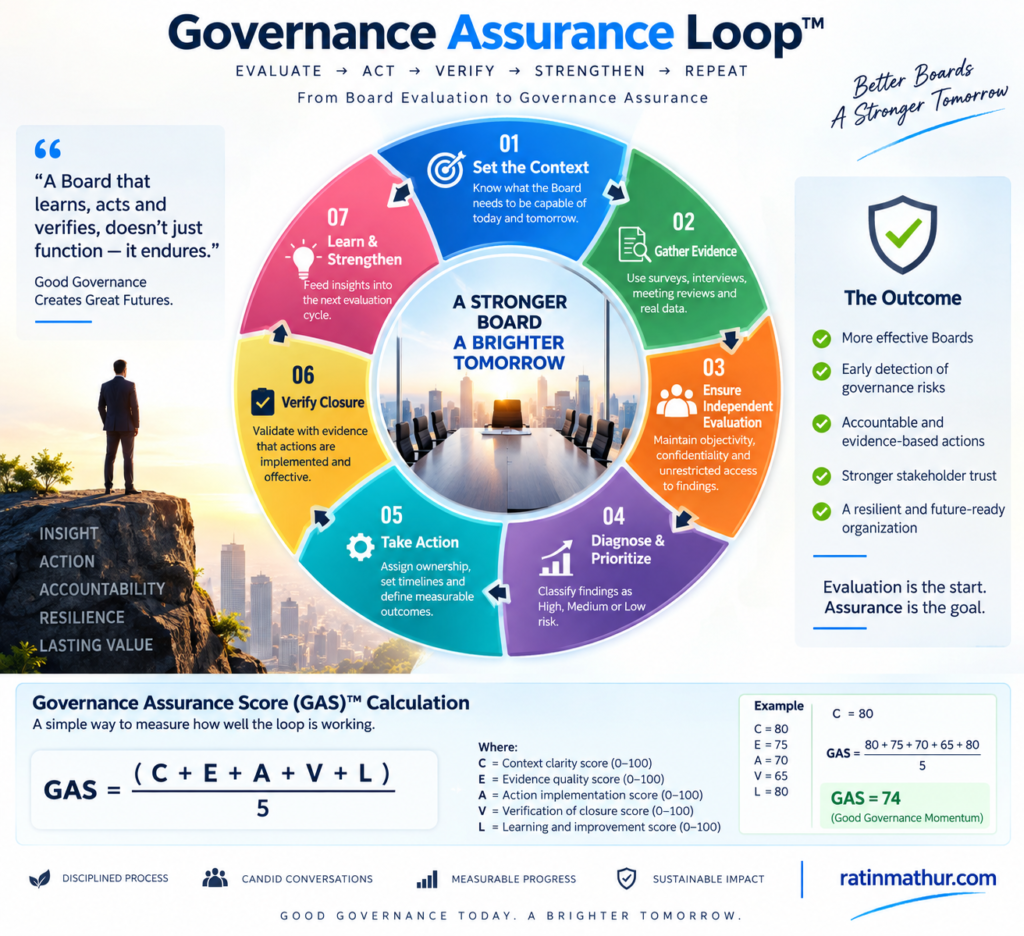
The Governance Assurance Loop™ converts Board Evaluation from an annual scorecard into a closed-loop governance system. Its premise is that the Board should not merely receive an evaluation report; it should be able to demonstrate that the process was complete, independent, candid, acted upon and subsequently verified. This is consistent with the ICSI emphasis on confidentiality, independent facilitation, action plans and post-evaluation improvement, while adding a governance-assurance layer.
The Loop begins with governance context, moves through evidence collection and independent evaluation, then proceeds to risk classification, corrective action, evidence-based closure and continuous reassessment. It should be owned by the Board through the NRC or an appropriately constituted independent mechanism, with the Chairperson’s evaluation separately led by independent directors.
| Stage | Governance question | Recommended control | Illustrative example |
|---|---|---|---|
| Context | What does the Board need to be capable of today and tomorrow? | Annual strategic and skills-gap assessment | A manufacturing Board identifies cyber and supply-chain expertise as gaps |
| Evidence | What is actually happening in the Boardroom? | Survey, confidential interviews, minutes and decision review | Directors privately identify delays in receiving risk information |
| Assurance | Was the evaluation complete and independent? | Evaluator independence declaration and access controls | No single Chairperson or committee member can suppress findings |
| Diagnosis | Which findings represent governance risk? | Red, amber and improvement classification | Information suppression classified as a high-priority issue |
| Action | What must change and by when? | Named owner, deadline and measurable outcome | Revised Board-information protocol within 60 days |
| Verification | Has the issue genuinely been corrected? | Evidence-based closure and independent verification | Internal Audit tests whether the new reporting process is operating |
| Learning | What changed after the intervention? | Next evaluation linked to prior findings | The following evaluation tests whether information quality improved |
Consider a hypothetical case in which directors consistently report that Board papers arrive too late for meaningful review. A conventional evaluation may record “information flow requires improvement.” Under the Governance Assurance Loop™, the issue becomes a governance finding, receives an owner and deadline, and is later tested for closure through actual Board-paper timestamps and director feedback. The value lies not in the score but in closing the loop between observation and evidence.
Strategic Framework 2: Boardroom Integrity Matrix™
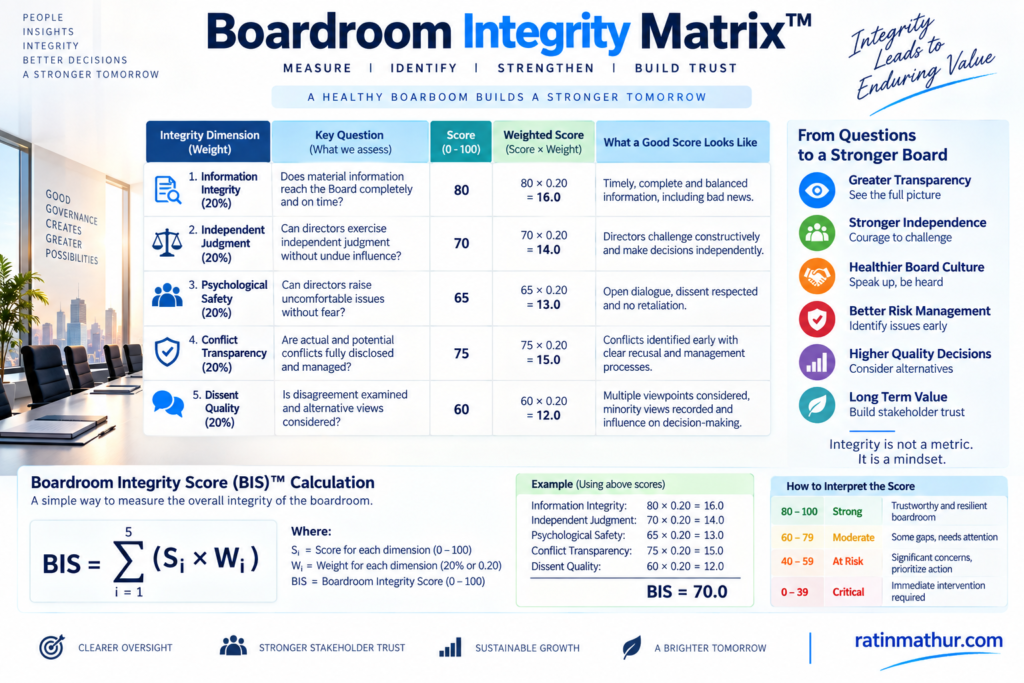
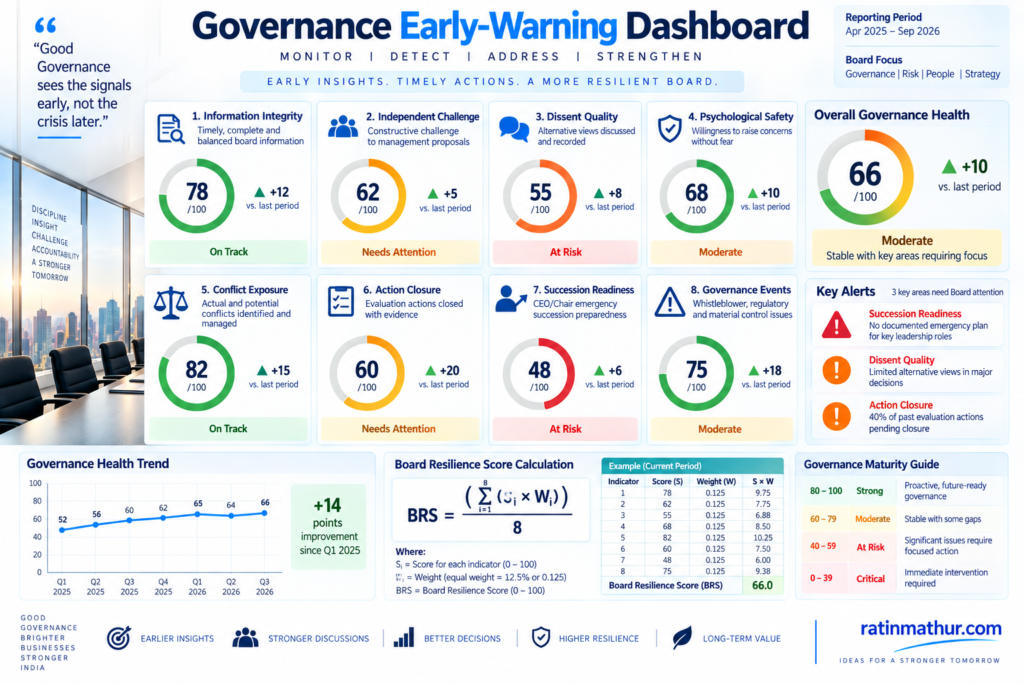
The Boardroom Integrity Matrix™ addresses the most difficult part of Board Evaluation: whether the environment allows independent and candid judgment. The framework adds five dimensions to traditional performance assessment: information integrity, independence of judgment, psychological safety, conflict transparency and dissent quality.
The framework should not be used as a single numerical score. It is designed as a diagnostic matrix in which one critical governance weakness can trigger enhanced review irrespective of otherwise favorable results.
| Integrity dimension | Core test | Red flag indicator | Recommended Board response |
|---|---|---|---|
| Information integrity | Does material information reach the Board completely and on time? | Important findings not circulated | Independent review of reporting and access protocols |
| Independent judgment | Can directors disagree with management or major shareholders? | Consistent deference to one power center | Independent-director session and governance review |
| Psychological safety | Can directors raise uncomfortable issues without fear? | Reluctance to dissent or request information | Confidential interviews and direct Lead ID access |
| Conflict transparency | Are actual and potential conflicts fully surfaced? | Repeated ambiguity around related interests | Conflict mapping and recusal protocols |
| Dissent quality | Is disagreement examined rather than suppressed? | Decisions routinely appear unanimous despite complexity | Require alternatives, dissent summaries and decision rationale |
The Coforge example illustrates the information-integrity dimension. Public reporting indicates that the problem identified by KPMG was associated with the handling and presentation of evaluation findings, including limited access to detailed findings and the omission of the Chairman’s lowest rating from discussion. (The Indian Express) The Board-level lesson is that the integrity of information about the Board itself requires the same governance discipline expected for financial, risk and compliance information.
The HDFC Bank example illustrates the psychological-safety dimension. The Bank’s published evaluation framework already addresses culture, ethics and information flow. (HDFC Bank) An enhanced model would add a direct question: “What concern have you considered raising but have not raised, and why?” The objective is not to validate any particular allegation, but to identify barriers that prevent legitimate concerns from entering the governance process.
Strategic Framework 3: Board Resilience Stress-Test™
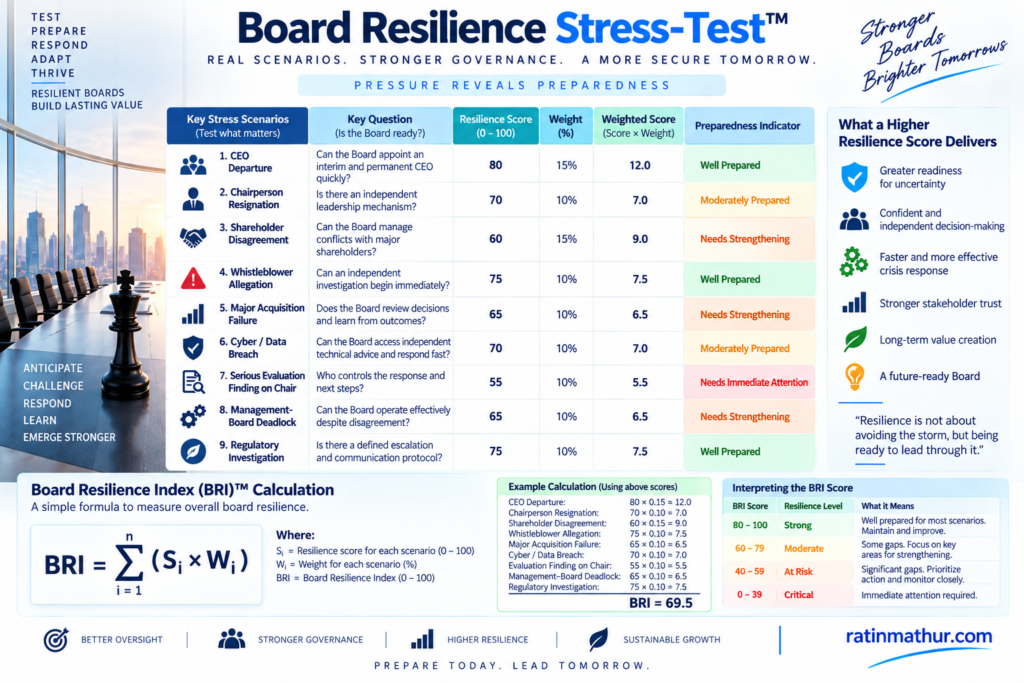
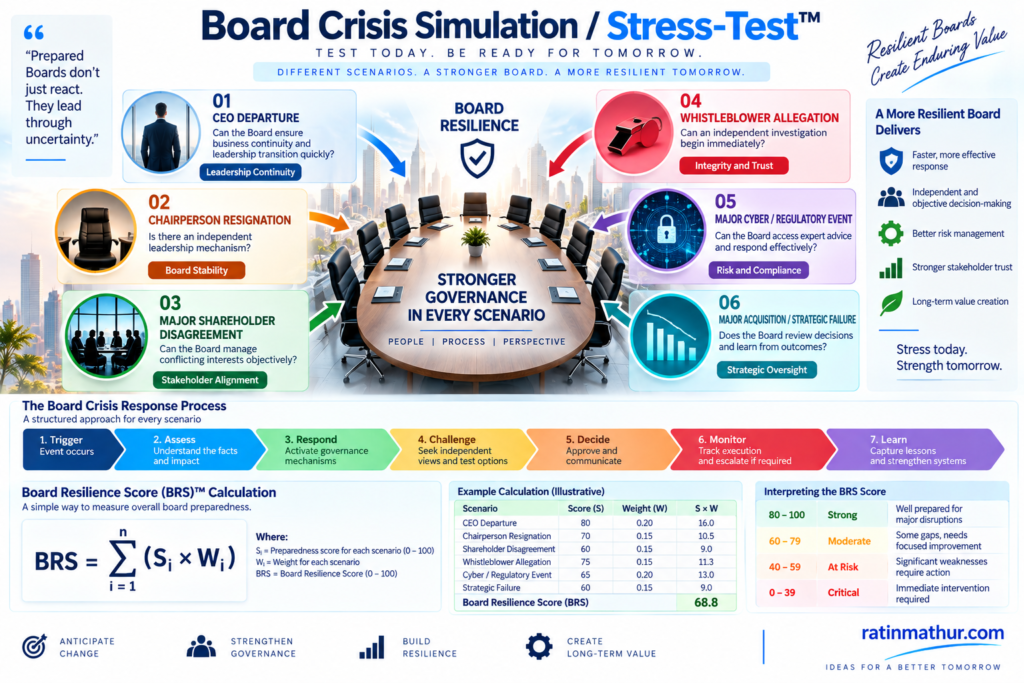
The Board Resilience Stress-Test™ moves Board Evaluation from retrospective assessment to forward-looking preparedness. A Board may function effectively in normal conditions yet struggle when confronted with sudden leadership loss, shareholder disagreement, regulatory intervention, major control failure or a serious whistleblower allegation. The stress test therefore evaluates whether governance mechanisms remain functional under pressure.
This framework reflects the OECD emphasis on independent judgment, conflicts, risk oversight, whistleblowing and Board responsibility, while extending the logic into scenario-based evaluation. (OECD)
| Stress scenario | Governance test | Evidence of resilience |
|---|---|---|
| Sudden CEO departure | Can succession be activated rapidly? | Named interim and permanent succession pathways |
| Chairperson resignation | Who leads the Board evaluation and transition? | Independent leadership mechanism |
| Major shareholder disagreement | Can the Board resolve rights and fiduciary-duty tensions? | Clearly defined escalation and decision rights |
| Serious whistleblower concern | Can an independent investigation begin immediately? | Direct Audit Committee or equivalent access |
| Major acquisition failure | Does the Board review decision assumptions and lessons? | Documented post-investment review |
| Material cyber incident | Can the Board access independent technical advice? | Defined escalation and external expertise |
| Board evaluation identifies a serious Chair concern | Who controls the response? | Independent director-led process |
| Management and Board disagree materially | Can the Board operate without relationship breakdown? | Executive sessions and documented dissent process |
The Tata Sons/Tata Trusts developments demonstrate why this type of stress test is valuable. The current public dispute involves questions of leadership, ownership rights and a proposed listing, with differing positions expressed by Tata Sons and Tata Trusts. (Reuters) A stress-test question for any company with a concentrated ownership structure would therefore be: What happens when the largest shareholder and the Board fundamentally disagree on a strategic matter? A high-quality answer must come from governance documents, decision rights and escalation mechanisms, not from personal relationships.
The three frameworks can operate together. The Governance Assurance Loop™ establishes process integrity and follow-through. The Boardroom Integrity Matrix™ examines the quality of information, independence and Boardroom behavior. The Board Resilience Stress-Test™ tests whether the governance system can function under adverse conditions.
| Governance objective | Primary framework | Expected outcome |
|---|---|---|
| Integrity of evaluation process | Governance Assurance Loop™ | Findings are complete, independent and acted upon |
| Quality of Boardroom culture | Boardroom Integrity Matrix™ | Directors can challenge, dissent and escalate concerns |
| Crisis preparedness | Board Resilience Stress-Test™ | Governance remains functional under pressure |
| Continuous improvement | All three | Evaluation becomes a repeatable governance capability |
Future Outlook & Conclusion
The future of Board Evaluation in India should not be defined by longer questionnaires, more sophisticated scoring or more elaborate annual disclosures. It should be defined by whether the process improves the Board’s ability to see reality clearly, challenge assumptions, resolve disagreements constructively and correct weaknesses before they become major events.
The ICSI guide established an important foundation by connecting Board Evaluation with leadership, teamwork, accountability, decision-making, communication, succession and Board effectiveness. SEBI subsequently reinforced the importance of clear evaluation subjects, criteria, feedback, action plans, disclosure and periodic review. (Securities and Exchange Board of India) The next step is to add an explicit governance-assurance dimension.
The lessons from recent developments are therefore highly relevant. Coforge shows the importance of evaluation integrity and ensuring that material findings cannot be selectively withheld. HDFC Bank demonstrates why formal assessment of culture and ethics should be supplemented by confidential mechanisms that encourage directors to surface unresolved concerns. Tata Sons and Tata Trusts illustrate the need to evaluate stakeholder alignment, governance rights, succession and mechanisms for managing strategic disagreement.
A mature Board Evaluation system should ultimately answer six questions. Did the right issues reach the Board? Did directors have enough information to challenge management? Could they disagree without fear? Were conflicts properly managed? Were governance weaknesses converted into measurable actions? And were those actions independently verified?
The most important shift is therefore conceptual.
Board Evaluation should no longer be viewed simply as an appraisal of the Board. It should be viewed as an assurance mechanism for the quality, integrity and resilience of corporate governance.
The Board of the future should not ask only, “How did we perform this year?” It should ask the more consequential question: “What could prevent this Board from functioning effectively when it matters most, and have we tested that risk before it becomes a crisis?”
That is the point at which Board Evaluation moves from compliance to governance leadership.
References
1. Institute of Company Secretaries of India. (2017). A guide to board evaluation. New Delhi, India: ICSI. https://www.independentdirectorsdatabank.in/img/partners/617fb17c6add3.pdf
2. Securities and Exchange Board of India. (2017, January 5). Guidance note on board evaluation. Securities and Exchange Board of India. SEBI Guidance Note on Board Evaluation
3. Securities and Exchange Board of India. (2023). Master circular for compliance with the provisions of the Securities and Exchange Board of India (Listing Obligations and Disclosure Requirements) Regulations, 2015 by listed entities. SEBI Master Circular
4. Ministry of Corporate Affairs. (2013). The Companies Act, 2013 (as amended). Government of India. Companies Act, 2013
5. OECD. (2023). G20/OECD principles of corporate governance 2023. OECD Publishing. https://doi.org/10.1787/ed750b30-en. OECD Principles of Corporate Governance 2023
6. HDFC Bank Limited. (2025). Annual report 2024-25. HDFC Bank Limited. HDFC Bank Annual Report 2024-25
7. HDFC Bank Limited. (2026, March 18). Resignation of Mr. Atanu Chakraborty as a Part-time Chairman and Independent Director of HDFC Bank Limited. HDFC Bank Exchange Disclosure
8. HDFC Bank Limited. (2026, March 24). Appointment of external law firms. HDFC Bank Disclosure on External Law Firms
9. Reuters. (2026, March 18). India’s HDFC Bank part-time chairman resigns citing differences over values and ethics. Reuters report
10. Indian Express. (2026, September 12). Coforge Chairman OP Bhatt got lowest rating, report not disclosed to Board. Indian Express report
11. Economic Times. (2026, September 11). KPMG audit revealed OP Bhatt suppressed key information as Coforge board chair. Economic Times report
12. Coforge Limited. (2024). Annual report 2023-24. National Stock Exchange of India. Coforge Annual Report disclosure on Board Evaluation
13. Reuters. (2026, September 17). India’s Tata reappoints chairman, backs listing in rift with controlling charity. Reuters report
14. Reuters. (2026, September 18). Tata Group’s boardroom clash rocks India’s most storied conglomerate. Reuters report
Disclaimer
This article is an independent governance analysis prepared for informational and educational purposes. It is based on the ICSI guide supplied for review, applicable Indian governance materials, OECD principles, company disclosures and publicly available reporting available as of September 19, 2026. References to Coforge, HDFC Bank and Tata Sons/Tata Trusts are illustrative case studies and should not be interpreted as a finding of legal, regulatory or fiduciary wrongdoing unless expressly established by a competent authority. Publicly reported matters may continue to develop, and readers should consult the relevant company disclosures, regulators and qualified legal or governance professionals for decisions requiring professional advice. The three frameworks identified as Governance Assurance Loop™, Boardroom Integrity Matrix™ and Board Resilience Stress-Test™ are proposed conceptual frameworks for this article; the TM designation is used as framework branding and does not represent a claim of trademark registration.