Abstract
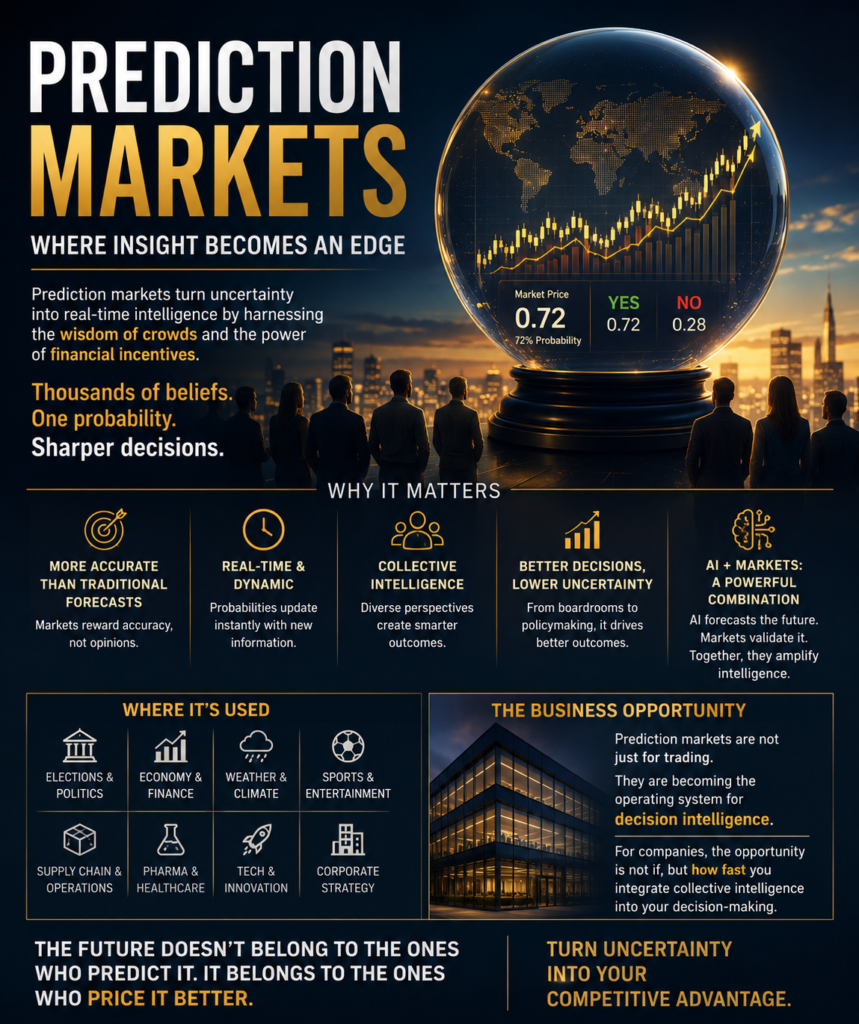
Prediction markets are rapidly evolving from niche forecasting platforms into sophisticated decision intelligence systems capable of transforming how governments, corporations, investors, and individuals make strategic decisions. By combining behavioral economics, financial market principles, game theory, artificial intelligence, and collective intelligence, prediction markets convert dispersed information into continuously updated probabilities of future events. Unlike traditional forecasting methods that rely on surveys, expert panels, or historical models, prediction markets create financial incentives for participants to reveal their genuine beliefs, producing dynamic forecasts that often outperform conventional approaches.
The increasing adoption of artificial intelligence, real-time analytics, blockchain infrastructure, and decentralized finance has accelerated the development of prediction markets across the world. Organizations are beginning to recognize that these platforms are not merely speculative marketplaces but strategic tools capable of improving demand forecasting, risk management, innovation planning, public policy evaluation, and corporate governance. While countries such as the United States have made significant progress through regulated exchanges and decentralized platforms, India remains at an early stage of adoption due to regulatory uncertainty despite possessing one of the world’s largest digital economies.
This paper examines the evolution, operating principles, business models, revenue streams, strategic importance, global competitive landscape, opportunities for India, and the future trajectory of prediction markets. It argues that prediction markets represent a fundamental shift in how information is generated, validated, and monetized in the age of artificial intelligence.
Keywords: Prediction Markets, Decision Intelligence, Artificial Intelligence, Behavioral Economics, Collective Intelligence, Business Strategy, Forecasting, Blockchain, Financial Markets, India.
Introduction
Every strategic decision begins with a prediction.
Executives predict customer demand before increasing production. Investors predict corporate earnings before purchasing shares. Governments predict inflation before announcing monetary policy. Pharmaceutical companies predict the probability of clinical trial success before investing billions of dollars in research. Every major economic decision is ultimately based on expectations about uncertain future events.
Historically, organizations have relied upon statistical models, expert opinions, consumer surveys, and historical trends to estimate future outcomes. While these methods remain valuable, they often suffer from confirmation bias, limited information, delayed updates, and institutional inertia. In an increasingly complex and interconnected world, decision-makers require forecasting systems capable of continuously incorporating new information and reflecting changing probabilities in real time.
Prediction markets address this challenge by creating marketplaces where participants trade contracts based on future events. Instead of merely expressing opinions, participants commit financial resources to their predictions. Market prices therefore become continuously updated probability estimates generated through the collective intelligence of thousands of informed participants.
The convergence of artificial intelligence, digital finance, blockchain technology, and cloud computing has transformed prediction markets from academic experiments into commercially viable platforms with applications extending far beyond elections and sporting events. They are increasingly becoming an important component of enterprise decision intelligence.
The Evolution of Prediction Markets
The conceptual foundations of prediction markets emerged from research in economics during the late twentieth century. Early academic experiments demonstrated that markets designed around future events frequently generated forecasts superior to expert panels and opinion surveys.
The launch of the Iowa Electronic Markets during the late 1980s marked one of the earliest practical demonstrations that financial incentives could improve forecasting accuracy. Since then, technological advances have significantly expanded the accessibility, scale, and sophistication of prediction markets.
| Period | Major Development | Strategic Significance |
|---|---|---|
| 1988–1995 | Academic prediction markets | Validation of market-based forecasting |
| 1995–2010 | Internet-based forecasting platforms | Broader public participation |
| 2010–2020 | Blockchain-enabled prediction markets | Global decentralized participation |
| 2020–Present | AI-driven prediction intelligence | Enterprise and institutional adoption |
The industry has now evolved beyond political forecasting into an emerging discipline of decision intelligence applicable across virtually every sector of the global economy.
Understanding the Science Behind Prediction Markets
Prediction markets are built upon several well-established academic disciplines.
Behavioral economics explains how individuals process information, incentives, and uncertainty. Unlike traditional surveys where respondents face no consequences for inaccurate opinions, prediction markets reward participants who correctly anticipate future events while penalizing incorrect forecasts. This financial accountability encourages participants to incorporate available information more carefully.
Game theory further strengthens prediction markets by creating competitive environments in which participants continuously update their positions as new information becomes available. The resulting market prices represent the equilibrium between diverse perspectives rather than the opinion of a single expert.
Collective intelligence, often described as the “wisdom of crowds,” forms another critical foundation. When information is distributed among thousands of independent participants possessing different experiences, expertise, and data sources, aggregated market prices frequently become remarkably accurate indicators of future outcomes.
Artificial intelligence increasingly complements these human forecasting mechanisms by analyzing large volumes of structured and unstructured data, identifying emerging trends, and assisting participants in evaluating probabilities more efficiently.
How Prediction Markets Operate
Prediction markets function similarly to financial exchanges.
Participants purchase contracts representing specific future outcomes. Each contract generally settles at a predetermined value depending upon whether the specified event occurs.
For example, a contract asking whether global oil prices will exceed a specified threshold by year-end may currently trade at a value implying a seventy percent probability. As geopolitical events, production data, economic indicators, or policy announcements emerge, traders continuously adjust their positions, causing probabilities to update almost instantly.
Unlike conventional forecasting reports published monthly or quarterly, prediction markets provide continuously evolving estimates reflecting the latest available information.
| Traditional Forecasting | Prediction Markets |
|---|---|
| Periodic updates | Continuous updates |
| Expert-driven | Crowd-driven |
| Opinion based | Financially incentivized |
| Static reports | Dynamic probabilities |
| Limited information | Aggregated information |
| Historical analysis | Forward-looking intelligence |
Business Model Analysis
The business model of prediction market companies resembles modern financial exchanges more than conventional gaming platforms.
These companies rarely assume directional risk regarding event outcomes. Instead, they provide secure technological infrastructure enabling buyers and sellers to transact efficiently while ensuring transparency, liquidity, settlement accuracy, and regulatory compliance.
As participation increases, network effects strengthen the platform because greater liquidity attracts additional participants, creating a self-reinforcing cycle similar to equity exchanges.
| Business Component | Description |
|---|---|
| Digital Marketplace | Connects buyers and sellers |
| Trading Infrastructure | Executes transactions securely |
| Market Creation | Designs event contracts |
| Settlement Engine | Determines winning outcomes |
| Risk Management | Ensures market integrity |
| Compliance | Meets regulatory requirements |
| Analytics Platform | Provides forecasting insights |
Unlike traditional businesses requiring physical inventory, prediction markets scale primarily through technology, making them highly capital efficient.
Revenue Model Analysis
Prediction market operators diversify revenue through multiple complementary streams.
| Revenue Source | Strategic Importance |
|---|---|
| Transaction Fees | Primary recurring income |
| Trading Commissions | Revenue linked to trading volume |
| Enterprise Forecasting Solutions | High-margin SaaS offerings |
| Data Licensing | Sale of market intelligence |
| API Services | Integration with institutional platforms |
| Premium Analytics | Subscription-based revenue |
| Institutional Services | Professional forecasting solutions |
| White-label Technology | Platform licensing |
| Advertising and Partnerships | Brand monetization |
Enterprise adoption is expected to become the industry’s fastest-growing revenue segment as organizations increasingly integrate prediction intelligence into strategic planning systems.
The Global Competitive Landscape
The international prediction market ecosystem has become increasingly competitive, attracting venture capital investment, institutional participation, and significant technological innovation.
| Company | Primary Focus | Business Model |
|---|---|---|
| Polymarket | Global decentralized event markets | Blockchain marketplace |
| Kalshi | Regulated event contracts | Exchange model |
| PredictIt | Academic forecasting | Research marketplace |
| Manifold Markets | Educational forecasting | Virtual currency platform |
| Metaculus | Scientific forecasting | Community intelligence |
Each platform addresses different regulatory environments, customer segments, and technological approaches, demonstrating the versatility of prediction market applications.
The Convergence of Artificial Intelligence and Prediction Markets
Artificial intelligence represents one of the most transformative forces shaping the future of prediction markets.
Modern AI systems excel at analyzing enormous quantities of information but frequently struggle with estimating uncertainty. Prediction markets complement AI by providing continuously updated probability estimates reflecting real-world expectations.
Future AI agents may participate directly in prediction markets, processing financial reports, geopolitical developments, economic indicators, weather data, satellite imagery, and social media information before executing trades based on algorithmic forecasts.
This convergence creates a feedback loop where artificial intelligence improves forecasting quality while prediction markets provide valuable probability signals that enhance AI decision-making.
The combination represents an emerging discipline increasingly described as decision intelligence.
Enterprise Applications Across Industries
Prediction markets are no longer limited to elections or sports.
Corporations increasingly recognize their potential to improve strategic planning across numerous functions.
| Industry | Strategic Applications |
|---|---|
| Manufacturing | Demand forecasting, production planning |
| Automotive | EV adoption, supply chain risks |
| Banking | Interest rate expectations |
| Insurance | Catastrophe risk forecasting |
| Healthcare | Clinical trial probability |
| Retail | Consumer demand prediction |
| Energy | Commodity price forecasting |
| Aviation | Weather disruption forecasting |
| Telecommunications | Technology adoption |
| Consulting | Strategic scenario planning |
These applications enable organizations to improve forecasting accuracy while reducing organizational bias.
Why Prediction Markets Matter in the Age of Artificial Intelligence
Modern economies generate unprecedented volumes of information.
Executives face growing uncertainty arising from geopolitical conflicts, technological disruption, climate change, supply chain volatility, changing consumer behavior, and rapid innovation.
Traditional forecasting systems struggle to incorporate continuously evolving information.
Prediction markets solve this challenge by transforming distributed information into continuously updated probabilities.
Instead of asking what happened yesterday, they estimate what is most likely to happen tomorrow.
This shift from descriptive analytics toward predictive intelligence represents one of the most important developments in modern decision-making.
India’s Emerging Opportunity
India possesses many structural advantages that could eventually support a thriving prediction market ecosystem.
The country has one of the world’s largest internet populations, an advanced digital payments infrastructure, growing artificial intelligence capabilities, increasing financial literacy, and one of the fastest-growing startup ecosystems.
However, regulatory uncertainty currently limits real-money prediction market development.
Despite these challenges, enterprise prediction markets present a significant opportunity because organizations can deploy internal forecasting systems without entering consumer betting markets.
| Opportunity Area | Potential Impact |
|---|---|
| Corporate Forecasting | Improved strategic planning |
| Government Policy Analysis | Better policy evaluation |
| Startup Ecosystem | New AI platforms |
| Consulting Industry | Enhanced decision support |
| Financial Institutions | Advanced risk management |
| Manufacturing | Demand prediction |
| Healthcare | Resource planning |
India therefore has the opportunity to become a global leader in enterprise prediction intelligence even before broader consumer adoption becomes feasible.
Strategic Implications for Business Leaders
Prediction markets should not be viewed merely as another financial innovation.
They represent a new mechanism for organizational learning.
Instead of relying exclusively on executive intuition, organizations can continuously measure internal expectations regarding product launches, project completion, customer adoption, competitive threats, hiring outcomes, and investment priorities.
Companies capable of integrating prediction markets into strategic planning may develop superior forecasting capabilities, faster decision cycles, stronger risk management, and more resilient organizations.
In increasingly competitive industries, better forecasting itself becomes a sustainable competitive advantage.
Challenges and Ethical Considerations
Despite their considerable promise, prediction markets face several important challenges.
Regulatory uncertainty remains the largest barrier to widespread adoption in many jurisdictions. Ethical concerns surrounding markets involving sensitive topics require careful governance. Liquidity constraints may reduce forecasting accuracy in smaller markets, while market manipulation and insider information require robust surveillance mechanisms.
Artificial intelligence introduces additional governance considerations because autonomous trading systems may influence market dynamics in unforeseen ways.
These challenges highlight the importance of developing transparent regulatory frameworks that encourage innovation while protecting market integrity.
The Future of Prediction Markets
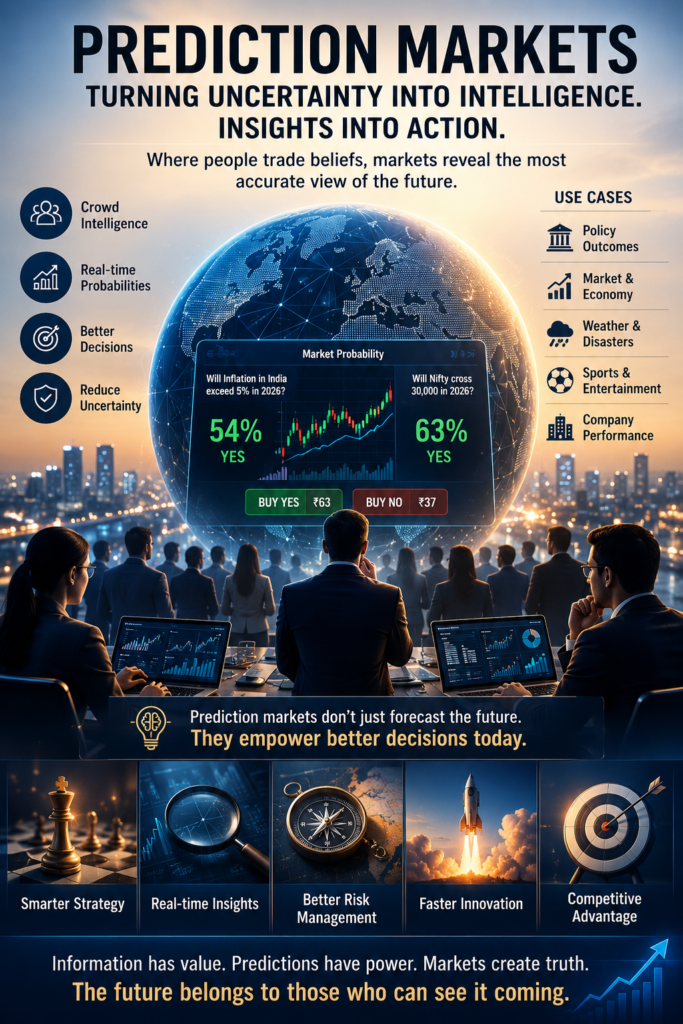
The next decade is likely to witness the transformation of prediction markets from specialized forecasting platforms into core components of enterprise decision intelligence.
Artificial intelligence, blockchain technology, cloud computing, digital identity systems, and advanced analytics will continue expanding the capabilities of these platforms.
Prediction markets may eventually integrate directly into enterprise resource planning systems, business intelligence dashboards, digital twins, supply chain platforms, and AI copilots.
Organizations will increasingly purchase probabilities alongside traditional market research reports.
Information itself will become a tradable strategic asset.
Rather than asking whether prediction markets will become mainstream, business leaders should ask how quickly they can incorporate probabilistic intelligence into their decision-making processes.
Conclusion
Prediction markets represent one of the most significant innovations at the intersection of economics, finance, artificial intelligence, and strategic management. They challenge conventional forecasting by replacing static opinions with continuously evolving probabilities generated through financially incentivized collective intelligence.
For governments, they offer better policy evaluation. For corporations, they enhance strategic planning and operational forecasting. For investors, they provide dynamic assessments of future events. For artificial intelligence, they supply valuable probability signals that improve decision-making.
India currently stands at an important crossroads. Although regulatory uncertainties remain, the country’s digital maturity, entrepreneurial ecosystem, and expanding AI capabilities position it to become an influential participant in the global evolution of prediction intelligence. Enterprise applications, consulting services, and AI-powered forecasting platforms present particularly promising opportunities.
The future competitive landscape will increasingly favor organizations capable of making faster, more accurate, and better-informed decisions. In that environment, prediction markets will evolve beyond trading platforms to become foundational infrastructure for decision intelligence in the twenty-first century.
References
- Arrow, K. J., Forsythe, R., Gorham, M., Hahn, R., Hanson, R., Ledyard, J., … & Zitzewitz, E. (2008). The Promise of Prediction Markets. Science, 320(5878), 877-878. https://www.science.org/doi/10.1126/science.1157679
- Berg, J., Nelson, F., & Rietz, T. (2008). Prediction Market Accuracy in the Long Run. International Journal of Forecasting. https://www.sciencedirect.com/journal/international-journal-of-forecasting
- Wolfers, J., & Zitzewitz, E. (2004). Prediction Markets. Journal of Economic Perspectives, 18(2), 107-126. https://www.aeaweb.org/articles?id=10.1257/0895330041371321
- Hanson, R. (2003). Combinatorial Information Market Design. Information Systems Frontiers. https://link.springer.com/article/10.1023/A:1022058209073
- Tetlock, P., & Gardner, D. (2015). Superforecasting: The Art and Science of Prediction. Crown Publishing. https://www.penguinrandomhouse.com/books/239790/superforecasting-by-philip-tetlock-and-dan-gardner/
- Polymarket. (2026). Official Platform. https://polymarket.com
- Kalshi. (2026). Official Platform. https://kalshi.com
- Metaculus. (2026). Official Platform. https://www.metaculus.com
- World Economic Forum. (2025). Artificial Intelligence and Decision Intelligence Reports. https://www.weforum.org
- McKinsey & Company. (2025). Decision Intelligence and AI Insights. https://www.mckinsey.com
Disclaimer
This article is intended solely for educational, research, and strategic discussion purposes. The analysis reflects publicly available information, academic literature, and industry developments available at the time of writing. References to prediction market platforms are illustrative and should not be interpreted as endorsements, investment advice, legal guidance, or recommendations to participate in any specific platform. Readers should independently evaluate applicable regulations, legal requirements, and financial risks before engaging with any prediction market or related financial product. The views expressed are those of the author based on available evidence and are intended to encourage informed discussion on the evolving role of prediction markets in business strategy, artificial intelligence, and decision intelligence.