Executive Summary
The lubricant industry is one of the most essential yet under-transformed sectors in the industrial and automotive ecosystem. Lubricants are critical for automobiles, manufacturing plants, heavy machinery, marine operations, aviation systems and industrial equipment. Despite the technological advancements in lubricant formulation and manufacturing, the sales ecosystem of the lubricant industry continues to operate through highly traditional and fragmented models.
Most lubricant companies still depend heavily on distributor-driven selling, price-based competition and relationship-oriented dealer channels rather than data-driven customer engagement and value-oriented solution selling. As a result, the industry faces declining margins, weak customer loyalty, low product differentiation and poor digital integration.
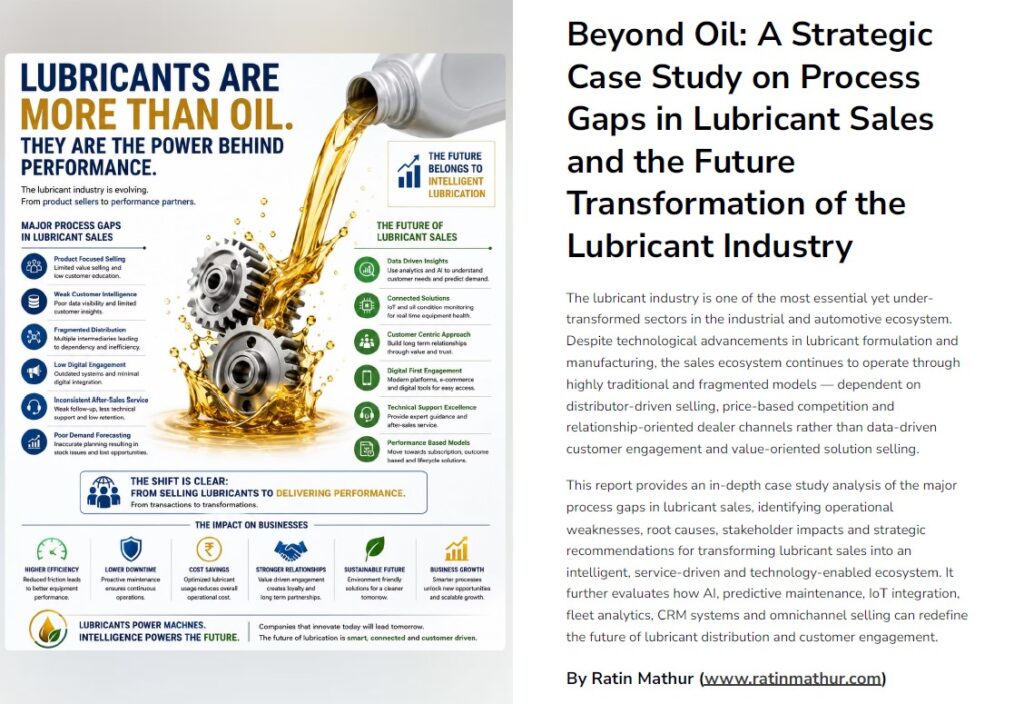
This report provides an in-depth case study style analysis of the major process gaps in lubricant sales. It identifies the operational weaknesses, explains the root causes, highlights the impact on stakeholders and presents strategic recommendations for transforming lubricant sales into an intelligent, service-driven and technology-enabled ecosystem.
The report further evaluates how artificial intelligence, predictive maintenance, IoT integration, fleet analytics, CRM systems and omnichannel selling can redefine the future of lubricant distribution and customer engagement.
1. Introduction to the Lubricant Industry
Lubricants are specialized substances used to reduce friction, wear and heat between moving surfaces. The lubricant industry serves multiple sectors including automotive, industrial manufacturing, mining, construction, marine, aviation, agriculture and energy.
The lubricant market consists of engine oils, hydraulic oils, gear oils, compressor oils, transmission fluids, greases and specialty lubricants. Globally, companies such as Shell, ExxonMobil, BP Castrol, Chevron and TotalEnergies dominate the market while Indian companies such as Indian Oil, Bharat Petroleum, Hindustan Petroleum, Gulf Oil, Castrol India and Veedol continue to maintain strong domestic presence.
The lubricant sales ecosystem includes manufacturers, distributors, retailers, mechanics, workshops, fleet operators, industrial buyers, OEMs and end consumers. Despite the complexity of the ecosystem, most sales models remain highly fragmented and reactive.
The industry is now approaching a transformation phase where customers increasingly expect predictive maintenance solutions, digital support, technical consulting and lifecycle performance management rather than merely lubricant products.
2. Structure of Lubricant Sales Ecosystem
| Stakeholder | Role in Sales Ecosystem |
| Lubricant Manufacturers | Product development and branding |
| Distributors | Regional inventory movement |
| Dealers and Retailers | Product selling and customer interaction |
| Mechanics and Workshops | Product recommendation influencers |
| Fleet Operators | High-volume lubricant consumers |
| Industrial Plants | Long-term industrial lubricant usage |
| OEMs | Technical approvals and endorsements |
| Digital Platforms | Online lubricant sales and customer engagement |
| Service Providers | Maintenance and application support |
| AI and Analytics Companies | Predictive maintenance and sales intelligence |
Most lubricant sales are strongly influenced by mechanics, workshop owners and distributor relationships. This creates a market where brand loyalty is often secondary to commercial incentives.
3. Major Process Gaps in Lubricant Sales
3.1 Commodity-Based Selling Instead of Technical Solution Selling
One of the biggest gaps in lubricant sales is the excessive dependence on price-driven selling. Lubricants are often treated as interchangeable commodities rather than performance-enhancing engineering solutions.
Sales teams frequently focus on discounts, retailer margins and incentive schemes instead of educating customers on technical benefits such as engine protection, fuel efficiency, thermal stability, oxidation resistance and extended drain intervals.
As a result, customers often fail to understand the long-term operational savings that premium lubricants can provide.
| Existing Situation | Future Transformation |
| Price-focused selling | Value-based technical consulting |
| Discount competition | Performance differentiation |
| Product pushing | Lifecycle solution selling |
| Short-term transactions | Long-term customer engagement |
A fleet operator purchasing low-cost lubricant may initially save money but may eventually face higher engine wear, increased maintenance costs and lower equipment life.
The solution requires lubricant companies to transition toward consultative and performance-oriented selling.
3.2 Weak Customer Data and CRM Integration
Many lubricant companies continue to rely on disconnected dealer records, spreadsheets and manual invoices. There is very limited centralized customer intelligence available across the sales ecosystem.
Manufacturers often do not possess accurate visibility regarding lubricant usage cycles, customer replacement behavior, consumption trends, equipment conditions or maintenance patterns.
This creates major inefficiencies in forecasting, targeting and customer retention.
| Gap Area | Impact |
| No centralized customer database | Weak retention |
| No predictive consumption tracking | Lost repeat business |
| Manual dealer records | Poor forecasting |
| Limited customer analytics | Weak personalization |
A modern lubricant sales ecosystem should integrate CRM platforms with workshops, fleets, industrial buyers and service centers. Predictive analytics can identify when customers are likely to require lubricant replacement and automatically trigger targeted engagement.
This transformation can significantly improve repeat sales and customer loyalty.
3.3 Overdependence on Mechanics and Workshop Influence
Mechanics and workshops strongly influence lubricant purchase decisions in both automotive and commercial vehicle markets. In many cases, end consumers simply trust mechanic recommendations without understanding technical product differences.
This creates a highly relationship-driven ecosystem where product selection is influenced more by incentives and personal relationships than by technical suitability.
| Current Industry Challenge | Business Impact |
| Mechanic incentive dependency | Brand switching |
| Low end-customer awareness | Weak loyalty |
| Relationship-based recommendations | Unstable sales volumes |
| Limited technical transparency | Customer confusion |
Lubricant companies need to digitally engage both mechanics and consumers while improving transparency and technical education.
Companies should establish certified lubrication advisor programs, digital mechanic training platforms and AI-powered product recommendation tools.
3.4 Poor Digital Transformation and Omnichannel Presence
The lubricant industry remains significantly behind industries such as electronics, automotive accessories and consumer appliances in terms of digital transformation.
Many lubricant brands still operate with outdated dealer-centric systems and weak online engagement.
Customers increasingly expect:
▪ Online product selection
▪ Vehicle compatibility checks
▪ Maintenance reminders
▪ Digital invoices
▪ Subscription-based replenishment
▪ Doorstep delivery
However, many lubricant companies still lack integrated digital platforms.
| Digital Gap | Consequence |
| Weak e-commerce presence | Loss of younger customers |
| No vehicle compatibility tools | Incorrect product usage |
| No digital service integration | Poor customer experience |
| Weak mobile applications | Low engagement |
Future lubricant ecosystems must integrate AI-driven product recommendation engines, online booking systems and digital maintenance records.
3.5 Weak Fleet and Industrial Account Management
Large fleet operators and industrial plants consume significant volumes of lubricants. However, lubricant sales teams often focus only on volume transactions rather than operational optimization.
Most lubricant suppliers fail to provide advanced services such as:
▪ Oil condition monitoring
▪ Predictive maintenance analytics
▪ Equipment performance tracking
▪ Consumption optimization
▪ Downtime reduction planning
This creates missed opportunities for long-term strategic partnerships.
| Existing Model | Advanced Model |
| Product supply | Performance partnership |
| Volume-based contracts | Outcome-based contracts |
| Reactive maintenance | Predictive maintenance |
| Sales relationship | Integrated operational support |
Companies that provide intelligent lubrication management solutions can create stronger long-term customer retention.
3.6 Lack of AI and Predictive Analytics in Sales Planning
Many lubricant companies still rely heavily on traditional forecasting methods and distributor feedback for demand planning.
This creates problems such as:
▪ Inventory imbalance
▪ Stockouts
▪ Excess inventory
▪ Regional forecasting errors
▪ Inefficient pricing decisions
Artificial intelligence can significantly improve forecasting accuracy by analyzing:
▪ Seasonal demand
▪ Industrial activity
▪ Vehicle movement
▪ Agricultural cycles
▪ Weather conditions
▪ Economic indicators
| Traditional Forecasting | AI-Driven Forecasting |
| Historical estimates | Real-time predictive analytics |
| Distributor intuition | Data-driven intelligence |
| Reactive planning | Proactive optimization |
| Limited accuracy | Dynamic forecasting |
Companies investing in AI-enabled sales intelligence can improve profitability and operational efficiency.
3.7 Weak Brand Differentiation
Many lubricant brands communicate similar messages regarding engine protection and performance. This creates limited differentiation in the minds of customers.
As a result, pricing and distributor incentives dominate buying decisions.
Premiumization remains weak because customers are unable to clearly understand the measurable performance differences between standard and premium lubricants.
| Weak Differentiation Factors | Strategic Solution |
| Generic marketing | Industry-specific branding |
| Similar packaging | Technology-focused storytelling |
| Price competition | Lifecycle value communication |
| Low emotional connection | Performance-based positioning |
Lubricant companies must communicate tangible business outcomes such as fuel savings, equipment life improvement and reduced maintenance costs.
3.8 Poor After-Sales Engagement and Customer Retention
Most lubricant companies stop customer engagement after product purchase. There is minimal follow-up regarding maintenance schedules, product performance or replacement intervals.
This creates low repeat engagement and weak loyalty.
An advanced lubricant sales ecosystem should maintain continuous customer interaction through:
▪ Maintenance alerts
▪ Digital service records
▪ Loyalty programs
▪ Subscription models
▪ Technical support systems
| Current Situation | Future Customer Experience |
| One-time selling | Lifecycle engagement |
| No follow-up | Automated maintenance support |
| Manual communication | AI-driven personalization |
| Weak retention | Long-term loyalty |
Companies that build customer engagement ecosystems will gain sustainable competitive advantage.
3.9 Sustainability and ESG Communication Gap
Environmental sustainability is becoming increasingly important across industries. However, many lubricant companies fail to effectively communicate their sustainability initiatives.
Customers increasingly expect:
▪ Recyclable packaging
▪Bio-based lubricants
▪ Lower emissions
▪ Waste oil recovery
▪ Circular economy initiatives
Yet sustainability communication remains limited.
| Sustainability Gap | Business Risk |
| Weak ESG communication | Loss of premium positioning |
| Limited recycling awareness | Regulatory pressure |
| Low sustainability branding | Weak investor perception |
| Poor circular economy integration | Missed future opportunities |
Companies that integrate sustainability into their sales strategy can improve brand value and long-term positioning.
4. Future Transformation of Lubricant Sales
The lubricant industry is gradually shifting from a product-selling model toward a predictive maintenance and performance management ecosystem.
Future lubricant companies will increasingly operate as technology-enabled service providers.
The transformation will include:
▪ AI-driven lubricant recommendations
▪ Connected machinery monitoring
▪ Predictive maintenance systems
▪ Subscription-based lubricant delivery
▪ Smart industrial analytics
▪ Integrated fleet management platforms
| Future Trend | Industry Impact |
| AI-driven sales | Higher efficiency |
| Smart lubrication systems | Reduced downtime |
| Predictive maintenance | Improved customer retention |
| Digital ecosystems | Stronger brand loyalty |
| Subscription models | Recurring revenue |
The lubricant companies that successfully integrate technology with customer engagement will become future market leaders.
5. Who Can Close These Sales Process Gaps?
Closing lubricant sales process gaps requires coordinated participation from multiple stakeholders.
| Stakeholder | Role in Transformation |
| Lubricant Manufacturers | Digital transformation and product innovation |
| AI Companies | Predictive analytics and forecasting |
| CRM Providers | Customer intelligence systems |
| Fleet Operators | Data integration and predictive maintenance |
| Mechanics and Workshops | Customer education |
| OEMs | Technical approvals and compatibility support |
| Digital Platforms | Omnichannel customer engagement |
| Sustainability Consultants | ESG and circular economy integration |
The future lubricant ecosystem will depend on collaborative integration rather than isolated product selling.
6. Strategic Recommendations
Lubricant companies should immediately begin transitioning toward data-driven and service-oriented business models.
The first strategic priority should be CRM integration across distributors, workshops and industrial customers. This will improve customer visibility and forecasting capabilities.
The second priority should focus on technical solution selling. Sales teams should shift from product-oriented conversations toward operational performance discussions.
The third priority involves AI integration for predictive demand forecasting and maintenance analytics.
The fourth priority requires digital transformation including e-commerce integration, mobile applications and customer engagement platforms.
The fifth priority should focus on sustainability positioning and circular economy integration.
Companies that delay digital transformation risk losing competitiveness in an increasingly intelligent and connected industrial ecosystem.
7. Conclusion
The lubricant industry stands at a critical turning point. Traditional sales models based on distributor relationships, mechanic influence and price-driven competition are becoming increasingly unsustainable.
The future of lubricant sales will be shaped by intelligent technologies, predictive maintenance systems, customer analytics, sustainability integration and omnichannel engagement.
Lubricants will increasingly be sold not merely as chemical products but as integrated performance management solutions.
The companies that successfully transform their sales ecosystems through AI, digitalization, technical consulting and lifecycle engagement will dominate the next generation of lubricant markets.
Organizations that continue operating with fragmented and traditional selling approaches may face declining margins, weaker customer loyalty and long-term competitive disruption.
The lubricant industry is no longer simply about oil.
It is becoming an intelligent ecosystem focused on efficiency, reliability, sustainability and operational performance.
8. References
- Shell Global. (2025). Lubricants and industrial solutions. Retrieved from https://www.shell.com
- ExxonMobil. (2025). Industrial lubrication solutions and services. Retrieved from https://www.exxonmobil.com
- Castrol. (2025). Lubricant technology and automotive solutions. Retrieved from https://www.castrol.com
- McKinsey & Company. (2024). Digital transformation in industrial sectors. Retrieved from https://www.mckinsey.com
- Deloitte. (2024). Future of predictive maintenance and industrial analytics. Retrieved from https://www.deloitte.com
- PwC. (2024). Industrial AI and connected operations report. Retrieved from https://www.pwc.com
- Accenture. (2024). AI-driven sales transformation in manufacturing industries. Retrieved from https://www.accenture.com
- Society of Tribologists and Lubrication Engineers. (2024). Advances in lubrication management. Retrieved from https://www.stle.org
- International Energy Agency. (2024). Industrial efficiency and sustainability outlook. Retrieved from https://www.iea.org
- Harvard Business Review. (2024). Customer-centric industrial transformation. Retrieved from https://hbr.org
9. Detailed Disclaimer
This report has been prepared solely for educational, strategic, informational and analytical purposes. The information, observations, forecasts and recommendations presented in this report are based on publicly available industry trends, business frameworks, operational analysis and strategic interpretation as of the date of preparation.
The report does not constitute financial advice, investment advice, operational guarantees, legal consultation or binding business recommendations. Readers are advised to conduct independent research and professional due diligence before making any strategic, operational, technological or financial decisions.
All trademarks, company names and brand references mentioned in this report belong to their respective owners. The inclusion of any company or organization does not imply endorsement, partnership or affiliation.
Market dynamics, technology adoption rates, economic conditions, competitive environments and regulatory frameworks may change over time which can affect the relevance and applicability of the analysis.
The author and publisher disclaim any liability arising directly or indirectly from the use, interpretation or implementation of the information contained in this report. Readers are encouraged to consult industry experts, legal advisors, financial professionals and technology consultants before undertaking any major business transformation initiatives.