Why Intelligent Proposal Systems Are Becoming a Strategic Growth Engine for Industrial and Enterprise Businesses
Introduction
In modern B2B markets, proposals are no longer just sales documents. They have evolved into strategic business assets that directly influence customer perception, revenue generation, enterprise scalability, operational efficiency, and long-term competitive positioning. Industrial machinery manufacturers, EPC contractors, OEM suppliers, engineering companies, infrastructure firms, industrial automation providers, healthcare equipment suppliers, and enterprise technology companies increasingly operate in highly competitive tender-driven environments where proposal quality, compliance accuracy, personalization, pricing intelligence, and response speed determine who wins large contracts.
For many years, proposal preparation relied heavily on manual workflows, disconnected spreadsheets, repetitive documentation processes, fragmented approval chains, email-based collaboration, and outdated proposal templates. These traditional systems may have worked effectively in smaller and less complex business environments, but they are becoming increasingly inefficient in today’s enterprise ecosystems characterized by global operations, complex compliance requirements, increasing tender volumes, and rising customer expectations.
Enterprise customers now expect suppliers to deliver highly customized, technically accurate, compliance-ready, and professionally structured proposals within increasingly shorter timelines. Organizations unable to meet these expectations often experience slower sales cycles, lower bid win rates, operational inefficiencies, higher compliance risks, and reduced competitiveness.
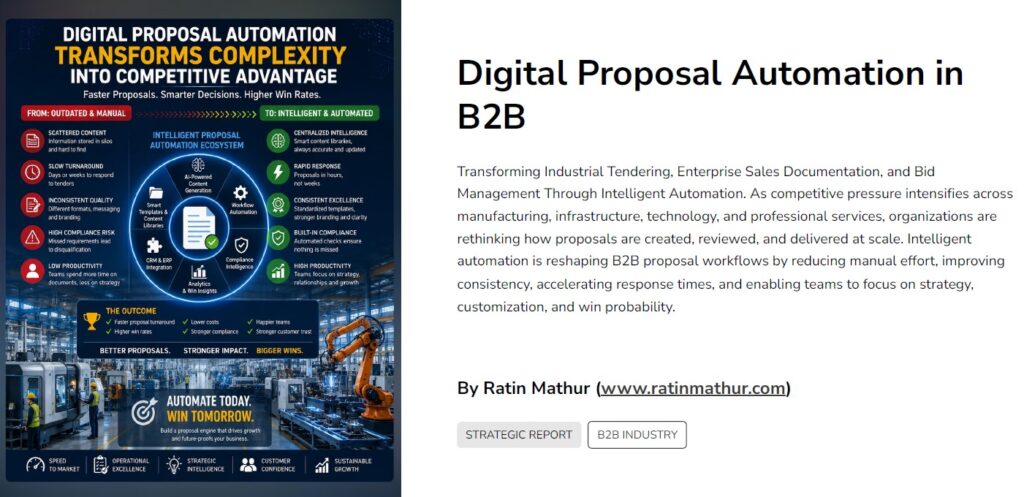
Digital Proposal Automation is rapidly emerging as one of the most important strategic transformation initiatives in B2B sales operations. By integrating workflow automation, AI-powered content generation, centralized content libraries, CRM integration, ERP connectivity, analytics, compliance intelligence, and collaborative approval systems, organizations can significantly improve proposal quality, speed, consistency, and scalability.
This article explores how Digital Proposal Automation is transforming modern B2B industries, particularly industrial machinery and equipment supplier companies. It examines strategic importance, operational frameworks, AI integration opportunities, implementation approaches, industry applications, future trends, business benefits, and strategic recommendations for organizations seeking long-term competitive advantage.
The Strategic Evolution of Proposal Management
Proposal management has transformed dramatically over the last decade.
Historically, proposals were often treated as administrative deliverables managed primarily by sales support teams. Today, however, proposals represent a direct reflection of an organization’s operational maturity, technical capability, responsiveness, governance standards, and strategic alignment.
Large enterprise tenders frequently require highly detailed documentation including engineering specifications, project execution plans, technical drawings, commercial pricing schedules, legal terms, ESG disclosures, warranty structures, safety certifications, service agreements, compliance declarations, cybersecurity documentation, and financial information.
In many industrial organizations, proposal development requires collaboration between multiple departments including sales, engineering, procurement, manufacturing operations, legal, finance, quality assurance, and executive leadership.
Traditional proposal workflows often create major operational bottlenecks. Teams spend substantial time searching for historical documents, validating technical specifications, coordinating approvals through emails, updating repetitive content, formatting proposals manually, and managing multiple document versions.
These inefficiencies increase proposal turnaround time, reduce productivity, create compliance risks, and weaken customer responsiveness.
Digital Proposal Automation fundamentally changes this operating model by transforming proposal development into a centralized, intelligent, scalable, and workflow-driven business capability.
Why Digital Proposal Automation Matters
The growing importance of Digital Proposal Automation is driven by several major business and market forces.
The first major factor is increasing competition.
Enterprise customers today evaluate suppliers not only based on products and pricing but also on responsiveness, professionalism, technical depth, compliance capability, and execution discipline. Faster and more accurate proposal delivery creates a significant competitive advantage.
For example, an industrial automation company supplying robotic systems to automotive manufacturers implemented AI-driven proposal automation integrated with engineering configuration software and CRM platforms. Before automation, proposal turnaround time averaged 12 to 14 days. Following implementation, the organization reduced turnaround time to less than 72 hours while simultaneously improving technical accuracy and compliance quality.
This faster response capability allowed the company to participate in more tenders and improve bid conversion rates.
The second major factor is increasing proposal complexity.
Modern enterprise tenders often involve:
- Technical compliance matrices
- ESG declarations
- Cybersecurity requirements
- Multi-country regulatory documentation
- Advanced engineering specifications
- Customized service commitments
- Sustainability reporting
- Digital infrastructure requirements
Manual proposal systems struggle to manage this level of complexity efficiently.
The third factor is operational scalability.
As organizations grow, proposal volumes increase substantially. Manual proposal preparation methods create operational bottlenecks that limit growth capacity.
Digital Proposal Automation enables businesses to scale proposal operations without proportional increases in staffing.
The fourth major factor is customer experience.
Enterprise buyers increasingly expect suppliers to provide highly personalized and industry-specific proposals. Generic proposals are becoming far less effective in modern B2B environments.
Automation systems integrated with customer analytics and CRM data enable organizations to personalize proposals dynamically based on customer industry, geographic location, operational requirements, historical engagement, and purchasing behavior.
Core Components of Digital Proposal Automation
Successful Digital Proposal Automation ecosystems combine multiple technologies, workflows, and governance systems into an integrated operational framework.
One of the most important components is standardized proposal templates.
Templates create consistency across proposal structure, branding, pricing formats, legal clauses, technical terminology, warranty terms, and service agreements.
An industrial compressor manufacturer developed industry-specific templates for oil and gas, cement, power generation, steel manufacturing, and chemical processing sectors. Each template dynamically adjusted engineering language, compliance requirements, and service descriptions based on customer industry.
Centralized content libraries also play a critical role.
These repositories contain reusable technical descriptions, engineering specifications, case studies, customer references, certifications, installation procedures, ESG declarations, legal clauses, safety documentation, and product information.
An industrial robotics company created a centralized content repository containing more than 20,000 reusable assets accessible globally by proposal teams. This significantly accelerated proposal creation while improving consistency and technical accuracy.
Workflow automation is another foundational capability.
Proposal development frequently involves multiple stakeholders and approval stages. Automated workflows streamline approval routing, escalation management, task assignments, deadline tracking, and collaboration visibility.
For example, a manufacturing equipment supplier implemented automated pricing approvals integrated with financial governance systems. Proposals exceeding predefined discount thresholds were automatically routed to regional finance directors for approval.
CRM integration further improves operational efficiency.
Integrated systems automatically populate customer information, opportunity details, contract values, pricing history, and relationship data into proposal workflows.
This eliminates duplicate data entry and improves personalization quality.
The Role of Artificial Intelligence in Proposal Automation
Artificial Intelligence is rapidly reshaping enterprise proposal management.
Generative AI systems can now create proposal introductions, executive summaries, technical narratives, customer-specific messaging, value propositions, and industry-focused positioning statements automatically.
For example, an enterprise software company implemented AI-assisted proposal generation integrated with customer analytics platforms. Proposal teams were able to generate customized executive summaries based on customer industry, operational priorities, geographic region, and engagement history.
This dramatically reduced proposal preparation time while improving personalization quality.
AI also strengthens compliance management.
Compliance failures remain one of the leading causes of proposal rejection in enterprise tenders.
Intelligent compliance systems can compare tender requirements against internal knowledge bases and automatically identify missing certifications, technical gaps, contractual inconsistencies, cybersecurity deficiencies, and regulatory deviations.
A defense equipment supplier implemented AI-powered compliance mapping capable of scanning tender documentation and validating proposal completeness before submission.
The organization significantly reduced compliance-related proposal rejections while improving review efficiency.
Predictive analytics represents another important AI capability.
AI systems can analyze historical deal outcomes, customer behavior, pricing competitiveness, competitor intelligence, and relationship strength to estimate bid win probability.
An industrial infrastructure company implemented predictive bid scoring across proposal operations and improved proposal efficiency by focusing resources on high-probability opportunities.
AI-powered pricing optimization is also becoming increasingly important.
Intelligent pricing systems analyze commodity price fluctuations, customer purchasing behavior, competitor positioning, historical pricing patterns, and margin targets to recommend optimized commercial structures.
For example, a valve manufacturing company integrated AI pricing engines with procurement systems and commodity market analytics to dynamically adjust proposal pricing based on steel price volatility and regional demand conditions.
Industry Applications of Digital Proposal Automation
Digital Proposal Automation is creating measurable business value across multiple B2B industries.
Industrial machinery manufacturers frequently manage highly customized proposals involving engineering calculations, equipment configurations, service commitments, installation methodologies, and technical compliance documentation.
A CNC machine manufacturer implemented proposal automation integrated with ERP systems and engineering configuration platforms. Proposal turnaround time decreased from 14 days to less than 3 days while proposal capacity increased substantially.
Engineering, procurement, and construction companies also benefit significantly from automation.
EPC tenders involve highly complex documentation including compliance matrices, project execution plans, engineering drawings, bill of quantities, subcontractor documentation, safety certifications, and financial disclosures.
An infrastructure EPC company automated proposal assembly and compliance validation, reducing bid preparation costs while improving governance quality and submission accuracy.
Technology companies and SaaS providers increasingly rely on proposal automation to support enterprise sales scalability.
A cloud services company automated architecture documentation, subscription pricing, SLA generation, cybersecurity compliance declarations, and implementation roadmaps.
This improved enterprise sales productivity and accelerated deal closure cycles.
Healthcare equipment suppliers also operate within highly regulated tender environments.
A medical imaging company automated warranty documentation, technical specifications, regulatory certifications, and service agreements, reducing compliance errors and accelerating hospital tender submissions.
Business Benefits of Proposal Automation
Digital Proposal Automation delivers substantial operational and strategic advantages.
One of the most visible benefits is faster proposal turnaround.
Organizations implementing automation frequently reduce proposal preparation time by 40 to 80 percent depending on proposal complexity and operational maturity.
Improved proposal quality is another major benefit.
Automated systems improve technical consistency, formatting quality, legal governance, compliance accuracy, and commercial standardization while reducing manual errors.
Proposal automation also increases sales productivity significantly.
Sales teams spend less time formatting documents, searching for information, coordinating approvals, and managing repetitive administrative tasks.
This allows teams to focus more heavily on customer engagement, relationship development, strategic positioning, and revenue generation.
Operational scalability is another important advantage.
Organizations can manage substantially higher proposal volumes without proportional increases in staffing requirements.
Governance quality also improves considerably.
Automated workflows create audit trails, approval visibility, role-based access controls, version management systems, and structured compliance oversight.
Customer experience improvements are equally important.
Enterprise buyers increasingly value responsiveness, personalization, clarity, and professionalism. Faster and more accurate proposal delivery improves customer trust and strengthens competitive positioning.
Challenges in Proposal Automation Implementation
Despite its strategic advantages, proposal automation implementation involves several operational and organizational challenges.
Poor data quality remains one of the most common problems.
Many organizations maintain fragmented content repositories, outdated technical specifications, duplicate files, and inconsistent legal or commercial clauses across departments.
Without strong content governance, automation effectiveness declines significantly.
Resistance to organizational change is another major challenge.
Employees accustomed to manual proposal workflows may initially resist AI-driven systems and automated processes.
Successful implementation therefore requires executive sponsorship, structured training programs, phased transformation strategies, and clear communication regarding operational benefits.
Legacy system integration complexity can also create implementation risks.
Many organizations operate disconnected ERP systems, CRM platforms, engineering databases, pricing engines, and document repositories.
API-driven integration architecture is therefore essential for scalable proposal ecosystems.
Highly customized enterprise tenders may also limit full automation potential.
While automation can accelerate large portions of proposal development, strategic positioning, executive messaging, and customer-specific negotiation language often still require human oversight.
Hybrid AI-human collaboration models are therefore becoming increasingly important.
Future Trends in Digital Proposal Automation
The future of proposal management will be heavily influenced by advances in AI, analytics, workflow intelligence, and autonomous systems.
Generative AI will increasingly create near-complete proposal drafts automatically using customer data, pricing intelligence, historical proposals, compliance requirements, and industry benchmarks.
Proposal teams will gradually transition from manual content creation toward strategic review and customer engagement.
Autonomous compliance systems will proactively identify cybersecurity concerns, ESG deficiencies, contractual risks, and regulatory gaps before proposal submission.
Real-time competitive benchmarking will allow organizations to compare proposal pricing and positioning against evolving market conditions.
Hyper-personalized proposal ecosystems will dynamically adapt content, pricing, messaging, and technical positioning based on customer behavior, industry trends, and regional market conditions.
Industrial proposal systems may also integrate digital twins, simulation environments, and immersive engineering visualizations to improve customer understanding and technical validation.
Voice-driven proposal creation powered by conversational AI may eventually allow executives to generate proposal drafts and customer summaries through natural language interaction.
Strategic Recommendations
Organizations planning Digital Proposal Automation initiatives should approach implementation as a long-term strategic transformation program rather than merely a software deployment project.
The first recommendation is to establish centralized proposal governance structures.
Proposal ownership often becomes fragmented across regional offices, sales teams, engineering departments, finance units, and business divisions.
Centralized governance ensures consistency across templates, branding, pricing structures, legal clauses, technical terminology, and compliance documentation.
Organizations should begin implementation within high-volume and repetitive proposal categories where measurable operational improvements can be achieved rapidly.
Standardized products, recurring service contracts, and frequently issued RFQs often provide the strongest initial return on investment.
Content management should be treated as a strategic capability.
Organizations should invest heavily in centralized repositories containing engineering specifications, product descriptions, certifications, customer references, ESG disclosures, legal clauses, service agreements, and technical documentation.
AI implementation should follow a phased maturity roadmap.
Organizations should initially focus on workflow automation, compliance intelligence, intelligent content search, and analytics before progressing toward autonomous proposal generation.
Enterprise integration remains critical.
Proposal automation platforms should integrate seamlessly with CRM systems, ERP platforms, product lifecycle management systems, analytics environments, and pricing engines.
Organizations should also implement proposal performance dashboards tracking proposal turnaround time, compliance accuracy, proposal costs, bid win rates, revision frequency, customer engagement, and pricing effectiveness.
Cybersecurity and data governance should receive significant attention.
Proposal systems frequently contain sensitive commercial agreements, intellectual property, engineering documentation, pricing structures, and customer information.
Role-based access controls, encryption systems, audit trails, and cybersecurity governance frameworks are therefore essential.
Training and organizational adoption programs are equally important.
Sales teams, engineering departments, finance functions, legal teams, and leadership stakeholders must understand the strategic importance of proposal automation and its role in long-term enterprise scalability.
Finally, organizations should continuously evolve proposal automation capabilities based on customer expectations, AI advancements, market dynamics, regulatory changes, and competitive conditions.
Proposal automation should become a continuously improving strategic capability rather than a static operational tool.
Conclusion
Digital Proposal Automation is rapidly becoming a foundational capability in modern B2B industries.
Industrial machinery manufacturers, EPC contractors, OEM suppliers, infrastructure firms, healthcare equipment companies, engineering organizations, and enterprise technology providers increasingly compete in environments where proposal quality, response speed, compliance accuracy, personalization, and operational efficiency determine business success.
Traditional manual proposal methods are no longer sustainable within enterprise sales ecosystems characterized by increasing complexity, global operations, rising customer expectations, regulatory pressure, and growing competitive intensity.
Modern proposal automation ecosystems combine workflow automation, AI-powered intelligence, predictive analytics, centralized governance, CRM integration, compliance management, and collaborative workflows to create scalable, intelligent, and highly efficient proposal operations.
Organizations implementing Digital Proposal Automation are improving customer engagement, accelerating proposal turnaround, reducing operational costs, strengthening governance, improving proposal quality, and increasing enterprise scalability.
The future of proposal management will increasingly involve AI-driven systems capable of generating highly personalized, strategically optimized, compliant, and data-driven proposals in real time.
Digital Proposal Automation is no longer simply an operational efficiency initiative.
It is becoming a strategic growth engine and a major source of competitive advantage in modern B2B markets.
References
- Accenture. (2024). Technology vision 2024: Human by design. Accenture. Retrieved from https://www.accenture.com/us-en/insights/technology/technology-trends-2024
- Bain & Company. (2023). Commercial excellence in B2B sales transformation. Bain & Company. Retrieved from https://www.bain.com/insights/topics/commercial-excellence/
- Deloitte. (2024). Global technology industry outlook. Deloitte Insights. Retrieved from https://www2.deloitte.com/
- Forrester Research. (2023). The future of B2B sales and proposal automation. Forrester. Retrieved from https://www.forrester.com/
- Gartner, Inc. (2024). Magic quadrant for configure, price and quote application suites. Gartner Research. Retrieved from https://www.gartner.com/
- Harvard Business Review. (2023). How AI is transforming sales and customer engagement. Harvard Business Publishing. Retrieved from https://hbr.org/
- HubSpot. (2024). Sales enablement and proposal automation trends report. HubSpot Research. Retrieved from https://www.hubspot.com/
- International Data Corporation (IDC). (2024). Worldwide artificial intelligence and automation spending guide. IDC. Retrieved from https://www.idc.com/
- Loopio Inc. (2024). Proposal management benchmark report. Loopio. Retrieved from https://loopio.com/resources/
- McKinsey & Company. (2023). The state of AI in 2023 and generative AI’s breakout year. McKinsey Digital. Retrieved from https://www.mckinsey.com/
- Microsoft Corporation. (2024). AI transformation and intelligent business process automation. Microsoft. Retrieved from https://www.microsoft.com/
- Oracle Corporation. (2024). Modern bid management and proposal automation strategies. Oracle. Retrieved from https://www.oracle.com/
- PandaDoc, Inc. (2024). Digital document workflow and proposal automation guide. PandaDoc. Retrieved from https://www.pandadoc.com/resources/
- Proposal Management Professionals. (2023). Best practices in proposal development and bid management. APMP. Retrieved from https://www.apmp.org/
- Salesforce, Inc. (2024). State of sales report. Salesforce Research. Retrieved from https://www.salesforce.com/resources/research-reports/state-of-sales/
Disclaimer
This article has been prepared exclusively for educational, informational, strategic, and business advisory purposes. The analysis, examples, operational models, technology trends, AI use cases, business frameworks, and strategic recommendations presented in this document are based on publicly available industry research, consulting methodologies, market intelligence, technology developments, and professional interpretation available at the time of writing. Although reasonable efforts have been made to ensure accuracy, completeness, and relevance, no guarantees or warranties are provided regarding the future applicability, reliability, commercial suitability, or operational effectiveness of the information contained within this article.
The implementation approaches, automation strategies, AI integration methods, governance models, workflow recommendations, pricing optimization approaches, and digital transformation concepts discussed in this article are intended to provide strategic guidance only and should not be interpreted as legal, financial, investment, operational, cybersecurity, regulatory, or compliance advice. Actual business outcomes may vary significantly depending on organizational maturity, leadership capability, workforce readiness, infrastructure quality, integration complexity, market conditions, cybersecurity preparedness, industry regulations, geographic conditions, operational discipline, and execution effectiveness.
Neither the author nor any associated organization, advisor, consultant, contributor, or affiliated entity shall be held liable for any direct, indirect, operational, financial, legal, reputational, cybersecurity-related, or consequential damages resulting from the use, implementation, interpretation, or reliance