Executive Summary
Artificial intelligence is changing the economics of corporate strategy. Activities that traditionally required substantial analyst capacity, consulting teams and management time, including market scanning, competitor analysis, scenario construction, strategic benchmarking, customer research synthesis and strategic-option generation, can increasingly be accelerated through AI. This does not make strategy irrelevant. It changes where strategic scarcity resides. When sophisticated analysis becomes widely accessible, the differentiating capability shifts from generating strategic ideas to converting those ideas into coordinated decisions, redesigned operating models, resource commitments, behavioural change and measurable economic outcomes.
Recent evidence strongly supports this shift. McKinsey’s research indicates that AI adoption has become widespread but that enterprise-wide financial impact remains limited, with the principal constraints increasingly located in operating models, workflows, leadership and organisational capability rather than AI availability itself. McKinsey’s 2026 operating-model research argues that companies creating differentiated advantage are redesigning how work is performed and how decisions are made, rather than simply inserting AI into existing processes (McKinsey & Company, 2026a). (McKinsey & Company) BCG’s July 2026 research similarly found that nearly nine in ten CEOs reported cost or revenue benefits from AI in targeted areas, yet more than half cited a missing link between AI and the P&L, and only 14% clearly defined P&L impact for all AI initiatives. High-performing companies were approximately seven times more likely to redesign workflows and reshape the business end-to-end (Boston Consulting Group, 2026). (BCG Global)
This paper argues that competitive advantage in the AI era will increasingly be determined by a company’s capacity for what may be termed organizational execution velocity: the speed and quality with which an enterprise senses change, makes strategic choices, reallocates resources, redesigns work, mobilizes people, captures value and learns from results. The argument extends established management-consulting frameworks such as Porter’s competitive positioning, McKinsey’s 7-S, value-chain analysis, Balanced Scorecard, scenario planning and operating-model design into an AI-enabled strategy-to-execution context.
The paper introduces three strategic frameworks: the AI Strategy-to-Value Flywheel™, the Execution Velocity Architecture™, and the Strategic Rewiring Matrix™. Together, these frameworks seek to address the central management challenge of the next decade: not how to generate more strategy, but how to ensure that strategy becomes organisational behaviour and measurable economic performance.
Introduction
For decades, management literature has distinguished strategy from operational effectiveness. Michael Porter argued that strategy is fundamentally about choosing a unique and valuable competitive position and creating fit among activities, rather than simply performing common activities better (Porter, 1996). (Harvard Business Review) Robert Kaplan and David Norton subsequently demonstrated that measurement systems influence organisational behaviour and developed the Balanced Scorecard to translate strategy into broader performance dimensions beyond short-term financial results (Kaplan & Norton, 1992). (Harvard Business Review)
AI introduces an important new variable into this established strategic logic. It lowers the marginal cost of analysis and expands the speed at which organisations can explore alternatives. A CEO can now obtain rapid analyses of market trends, customer sentiment, competitors, technologies, regulations and strategic scenarios. A strategy team can construct multiple hypotheses, pressure-test assumptions and generate management narratives dramatically faster than was possible a decade ago.
Yet the speed of strategic analysis has not been matched by an equivalent increase in implementation capability. The consequence is a widening contradiction: organisations can produce more strategy, but struggle to execute more of it.
This is not primarily a technological paradox. It is an organisational one. AI is increasingly becoming an accessible general-purpose capability. Similar models, platforms and tools are available to competing firms. Consequently, the technology itself is unlikely to remain a durable source of differentiation. The more enduring source of advantage will be how organisations combine AI with proprietary data, operating routines, decision rights, talent, workflow design, customer relationships and organisational learning. McKinsey’s recent work explicitly frames this transition as a movement from AI as table stakes toward AI-enabled competitive moats created through hard-to-replicate operating models (McKinsey & Company, 2026b). (McKinsey & Company)
Problem Statement & Objectives
The strategic problem can therefore be expressed as follows: if AI makes high-quality strategic analysis increasingly abundant, what organisational capabilities will determine whether strategy creates enterprise value?
Four interrelated management challenges emerge. The first is the strategy-to-value gap, in which organisations can identify attractive AI opportunities but cannot demonstrate their impact on revenue, margin, cash flow or return on invested capital. The second is the strategy-to-workflow gap, where companies introduce AI into processes without redesigning the underlying work. The third is the strategy-to-capability gap, where ambitious objectives exceed the organisation’s talent, data, technology or change capacity. The fourth is the strategy-to-accountability gap, in which multiple functions participate but nobody is personally responsible for the economic outcome.
The objective of this paper is to develop a strategic management perspective that moves beyond AI adoption toward AI-enabled execution. It therefore examines how established consulting frameworks can be adapted, how leading corporate examples demonstrate the principles in practice, and how boards and CEOs can redesign governance and operating systems to capture value at scale.
| Strategic question | Traditional strategy emphasis | AI-era management emphasis |
|---|---|---|
| What should we do? | Analysis and strategic choice | AI-assisted analysis plus leadership judgment |
| Where should we invest? | Annual capital allocation | Dynamic value-pool allocation |
| How should work be performed? | Existing operating model | AI-enabled workflow redesign |
| How will success be measured? | Financial and operational KPIs | Value, adoption, productivity and strategic advantage |
| Who owns execution? | Functional leadership | Explicit enterprise value accountability |
| How often should strategy change? | Annual or periodic | Continuous sensing with disciplined strategic adaptation |
Methodology
The methodology combines strategic-management theory, management-consulting frameworks, contemporary AI transformation research and publicly documented corporate cases. The conceptual foundation draws on Porter’s strategic-positioning framework, the Balanced Scorecard, McKinsey’s operating-model and organisational-alignment thinking, and contemporary transformation principles concerning AI, data, workflow redesign and organisational adoption.
The empirical perspective relies primarily on recent 2025–2026 research from McKinsey & Company, Boston Consulting Group and Accenture, supplemented by documented corporate case studies involving Reckitt, Blackstone, Sonar, Siemens, Adani Green Energy, Bajaj Finserv and Danone. The intention is not to treat vendor case studies as independent academic evidence; rather, they are used as illustrative examples of implementation patterns and reported outcomes. Where reported metrics originate from corporate or consulting sources, they should be interpreted as case evidence rather than as universally generalisable estimates.
Landscape Analysis
The first structural change is the compression of the traditional strategy cycle. AI can scan information, synthesise research and generate strategic alternatives at a speed previously associated with large teams and long planning cycles. McKinsey’s research describes AI as increasingly capable of supporting research, interpretation, simulation and strategic communication, while human leadership remains responsible for judgment, choices and mobilisation.
The second change is the democratisation of strategic intelligence. When competing firms have access to similar foundation models, generic analytical capabilities become less distinctive. McKinsey’s 2026 research argues that the differentiator is increasingly the operating model through which firms use common technology, because workflows, governance, organisational knowledge and decision architecture accumulate over time and are difficult to replicate quickly (McKinsey & Company, 2026a). (McKinsey & Company)
The third change is the movement from isolated use cases to end-to-end reinvention. Accenture’s analysis of more than 2,000 GenAI projects found that only 36% of executives reported scaling GenAI solutions and only 13% reported significant enterprise-level value. It also reported higher ROI where executives were engaged and where organisations focused on end-to-end process reinvention rather than isolated adoption (Accenture, 2025). (Accenture)
The fourth change is the changing role of the CIO and transformation leader. McKinsey’s 2026 Global Tech Agenda research reports that leading CIOs are increasingly shaping enterprise strategy and embedding AI and data into operating models instead of acting primarily as technology service providers (McKinsey & Company, 2026c). (McKinsey & Company)
| Evolution of enterprise strategy | Industrial-era model | Digital-era model | AI-era model |
|---|---|---|---|
| Intelligence | Periodic research | Continuous analytics | AI-enabled sensing and simulation |
| Strategy cycle | Annual | Quarterly | Continuous sensing, periodic choice |
| Technology | Enabler | Strategic capability | Embedded decision and execution layer |
| Operating model | Stable hierarchy | Matrix and digital platforms | Human-agent workflows and dynamic coordination |
| Performance | Lagging financial metrics | Balanced KPIs | Real-time value and adoption metrics |
| Advantage | Scale and assets | Data and digital capabilities | Proprietary operating model plus organisational learning |
Key Findings
The first finding is that strategy is not becoming less important; strategic choice is becoming more important. AI can generate alternatives, but it cannot determine which strategic position is economically attractive, culturally feasible or aligned with a firm’s distinctive assets. Porter’s emphasis on trade-offs therefore becomes more, not less, relevant. When every firm can rapidly generate options, the ability to deliberately choose what not to pursue becomes a differentiator.
The second finding is that AI value depends disproportionately on workflow and operating-model redesign. McKinsey’s July 2026 analysis reports that leading AI performers were more likely to redesign workflows before selecting technology and that only about 21% of surveyed companies had fundamentally redesigned their operating models around AI (McKinsey & Company, 2026a). (McKinsey & Company)
The third finding is that focus beats proliferation. BCG’s 2025 AI Radar found that leading companies concentrated on an average of 3.5 AI use cases versus 6.1 among other organisations, while expecting substantially higher ROI. More than 80% of leading-company AI investment was directed toward reshaping functions and creating new offerings rather than purely incremental productivity initiatives (Boston Consulting Group, 2025). (BCG Global)
The fourth finding is that execution needs financial ownership. BCG’s 2026 research shows that many CEOs struggle to connect AI initiatives to the P&L. This suggests that the governance unit of AI transformation should not be the model, project or pilot; it should be the economic value pool and its accountable owner (Boston Consulting Group, 2026). (BCG Global)
The fifth finding is that people and adoption are strategic infrastructure. Accenture reports substantially greater likelihood of enterprise-level value where leadership deeply understands GenAI and where organisations redesign work and build new talent models (Accenture, 2025). (Accenture)
Corporate examples reinforce these findings. At Reckitt, AI was embedded into Revenue Growth Management rather than treated as a standalone technology project. Its RGM transformation addressed pricing and promotion processes that had previously been reactive, fragmented and dependent on individual judgment. The transformation combined AI with common data, commercial planning, governance, capability building and market-level adoption, illustrating that the competitive value resides in the integrated commercial system, not merely in the algorithm (McKinsey & Company, 2026d). (McKinsey & Company)
Blackstone’s Legal & Compliance transformation provides another powerful example. The organisation mapped its investor-communications workflow, identified unnecessary handoffs and clarified the distinction between routine and high-risk decisions before embedding AI. McKinsey reports expected reviewer productivity gains of more than 30% and approximately $5 million in annual run-rate savings by 2027. The case demonstrates the principle of redesigning work before automating it (McKinsey & Company, 2026e). (McKinsey & Company)
Sonar’s product-development transformation demonstrates how AI becomes materially more valuable when the entire workflow is redesigned. Teams embedded AI agents across product discovery, ideation, backlog creation, coding, testing and remediation. McKinsey reports up to 2.2 times pull-request throughput, 3.4 times shorter pull-request cycle time and 50%–80% self-reported productivity gains in build activities among teams (McKinsey & Company, 2026f). (McKinsey & Company)
Siemens’ Electronics Factory Erlangen illustrates the industrial dimension. The factory combines more than 100 AI algorithms with digital twins and modular IT/OT architecture and reports a 69% increase in labour productivity, a 40% reduction in time to market and a 42% reduction in energy use between 2019 and 2023 (Siemens, 2025). (Siemens Blog) The lesson is again systemic: AI produces impact when connected to processes, engineering systems, physical operations and managerial routines.
Indian examples are equally relevant. Adani Green Energy developed a Digital Canvas platform with AI-powered agents to centralise project oversight, automate reporting and support decision-making across a growing transformation portfolio. The case demonstrates that AI can become part of management infrastructure rather than a separate technology initiative (Microsoft, 2026a). (Microsoft) Bajaj Finserv’s data transformation addressed inconsistent definitions and fragmented systems by creating a governed data foundation using Microsoft Fabric. The company reports a 40% improvement in data preparation, a 30% reduction in storage costs and a 25% reduction in audit exceptions, underscoring the importance of data governance as execution infrastructure (Microsoft, 2026b). (Microsoft) Danone’s adoption of Copilot and autonomous agents was combined with global upskilling and process transformation in areas including HR and order-to-cash, illustrating that workforce capability is inseparable from technology implementation (Microsoft, 2025). (Microsoft)
Challenges & Opportunities
The greatest challenge is the possibility of strategic abundance without organisational focus. AI can generate dozens of use cases and strategic alternatives, creating a false perception of progress while scarce management capacity becomes fragmented.
The second challenge is pilot purgatory. Organisations often approve experimentation without designing the mechanisms needed for scaling, including ownership, architecture, process redesign, financial measurement and change management.
The third challenge is legacy organisational architecture. AI may accelerate activities while leaving unchanged the approvals, hierarchy, data silos and decision rights that constrain the enterprise. In this situation, AI increases the speed of the existing system rather than changing the system.
The fourth challenge is value attribution. A productivity gain is not automatically an economic gain. Time saved becomes value only when capacity is redeployed, costs are removed, output is increased or customer outcomes improve.
The fifth challenge is strategic convergence. As AI tools become widely available, competitors may deploy similar technologies. Sustainable advantage therefore requires proprietary assets and organisational systems that compound with use.
Yet the opportunity is enormous. Organisations can convert AI into a growth engine, a cost transformation engine, a resilience mechanism, a faster innovation system and a new basis for competitive differentiation. McKinsey’s 2026 research argues that leading AI transformations can substantially improve EBITDA when companies select high-value domains and redesign the operating model around them (McKinsey & Company, 2026a; McKinsey & Company, 2026g). (McKinsey & Company)
Strategic Frameworks & Recommendations
AI Strategy-to-Value Flywheel™
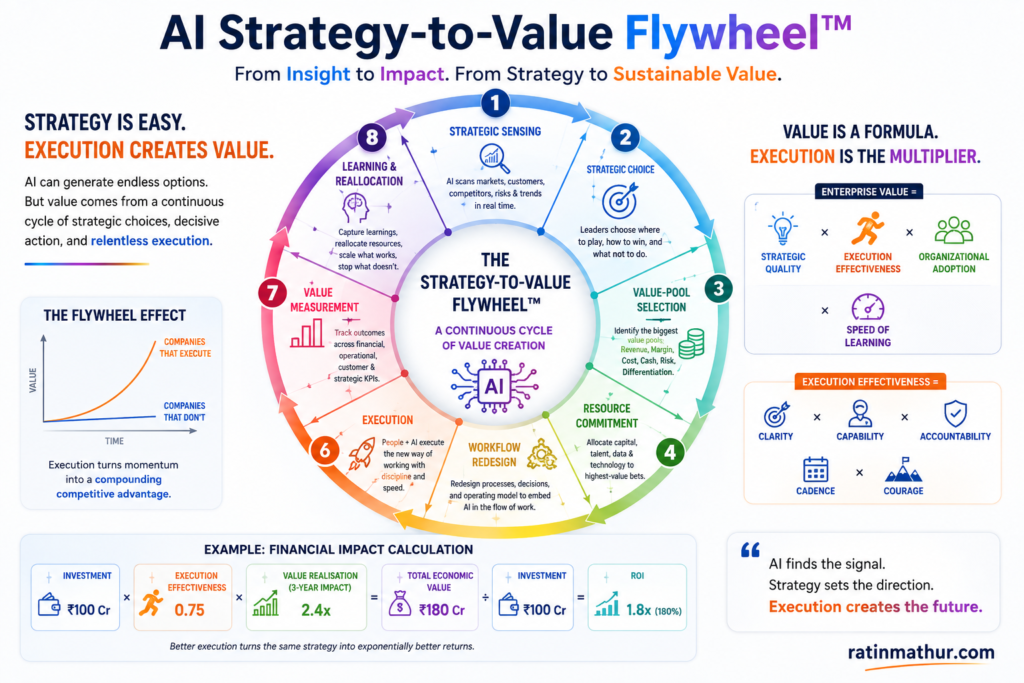
The AI Strategy-to-Value Flywheel™ is designed to close the gap between strategic ambition and measurable economic value. It treats strategy not as a static plan but as a repeating management cycle comprising strategic sensing, choice, value-pool selection, resource commitment, workflow redesign, execution, measurement and organisational learning. The framework builds on strategic choice, Balanced Scorecard thinking and contemporary AI transformation research, but places value realisation at the centre. Its key proposition is that every major AI initiative should begin with an enterprise problem, link directly to an economic value pool and contain a closed-loop mechanism through which execution results reshape future strategic decisions.
The flywheel begins with Strategic Sensing, in which AI continuously monitors customer, market, competitor, regulatory and technological signals. The next stage is Strategic Choice, where leadership determines which signals warrant action. Value-Pool Selection then identifies whether the opportunity lies primarily in revenue, margin, productivity, working capital, risk or strategic differentiation. Resource Commitment translates the choice into capital, talent and technology allocation. Workflow Redesign changes how work is actually performed. Execution embeds people and AI into the operating process. Value Measurement captures operational and financial outcomes. Learning and Reallocation closes the loop by determining whether the strategy should be scaled, modified or stopped.
| Flywheel stage | Management question | Principal output | Example |
|---|---|---|---|
| Strategic Sensing | What is changing? | External and internal signals | AI detects changing consumer pricing behaviour |
| Strategic Choice | What matters strategically? | Explicit strategic decision | Increase predictive pricing capability |
| Value-Pool Selection | Where is economic value? | Revenue/margin/cash opportunity | Improve gross margin by better promotion decisions |
| Resource Commitment | What will we fund? | Capital and talent commitment | Dedicated cross-functional RGM team |
| Workflow Redesign | How must work change? | New operating process | Integrate AI recommendations into commercial planning |
| Execution | Who does what? | Embedded execution | AI-supported pricing and promotion decisions |
| Value Measurement | Did it create value? | Financial and operating KPI | Margin uplift and revenue improvement |
| Learning & Reallocation | What should change next? | Scale, adapt or stop decision | Expand winning practices to additional markets |
Reckitt illustrates the framework particularly well. The company did not merely purchase an AI capability and expect value to emerge. It changed revenue-growth management from a reactive, fragmented and judgment-heavy process into a more predictive and scalable commercial operating model. That combination of technology, workflow, governance and capability is precisely what converts an analytical insight into economic value (McKinsey & Company, 2026d). (McKinsey & Company) The managerial recommendation is therefore to place an explicit value bridge behind every strategic AI initiative: investment should lead to workflow change, workflow change should lead to operational improvement, and operational improvement should lead to measurable P&L or strategic advantage.
Execution Velocity Architecture™
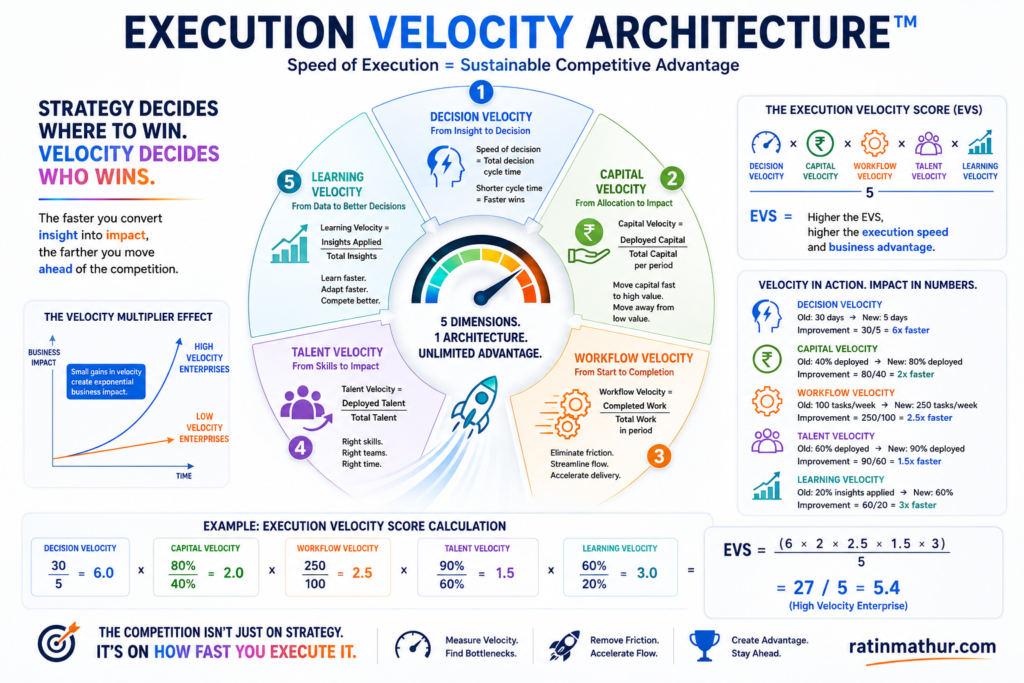
The Execution Velocity Architecture™ addresses a different problem: the organisational friction that prevents strategic decisions from becoming action. Its central premise is that competitive advantage will increasingly depend on the time between identifying an important signal and converting it into a measurable business outcome. It therefore evaluates the enterprise through five interconnected dimensions: decision velocity, capital velocity, workflow velocity, talent velocity and learning velocity. The framework extends the logic of strategy execution, transformation offices, RACI or RAPID-style accountability and operating-model design into an AI environment.
Decision velocity asks how quickly important decisions can move from insight to approval. Capital velocity asks how quickly resources can move toward higher-value opportunities and away from failing ones. Workflow velocity measures how rapidly redesigned processes move work through the organisation. Talent velocity assesses whether skills and people can be redeployed toward emerging priorities. Learning velocity measures how quickly the organisation converts execution data into better decisions.
| Velocity dimension | Diagnostic question | Typical constraint | Strategic intervention |
|---|---|---|---|
| Decision velocity | How quickly can we decide? | Excessive hierarchy | Clarify decision rights |
| Capital velocity | How quickly can resources move? | Annual budgeting rigidity | Dynamic portfolio allocation |
| Workflow velocity | How quickly does work move? | Handoffs and legacy approvals | AI-enabled process redesign |
| Talent velocity | How quickly can skills move? | Fixed organisational roles | Reskilling and redeployment |
| Learning velocity | How quickly do we learn? | Fragmented performance data | AI-enabled performance sensing |
Sonar’s AI-native product-development transformation illustrates workflow velocity. The organisation redesigned the product-development life cycle so that AI agents could support multiple stages from discovery through coding and remediation. The resulting improvements in pull-request throughput and cycle time show that value emerged not simply because developers had better software tools, but because the workflow itself was redesigned to exploit AI (McKinsey & Company, 2026f). (McKinsey & Company)
For boards, the framework provides a practical governance test. A transformation that has sophisticated technology but slow decision-making should be considered strategically immature. Similarly, a company that creates AI recommendations but cannot reallocate capital or talent should recognise that its organisational architecture is constraining strategy. The recommendation is to measure time-to-decision, time-to-resource, time-to-deployment and time-to-value as explicitly as traditional financial metrics. Organisational speed should become a board-level performance variable.
Strategic Rewiring Matrix™
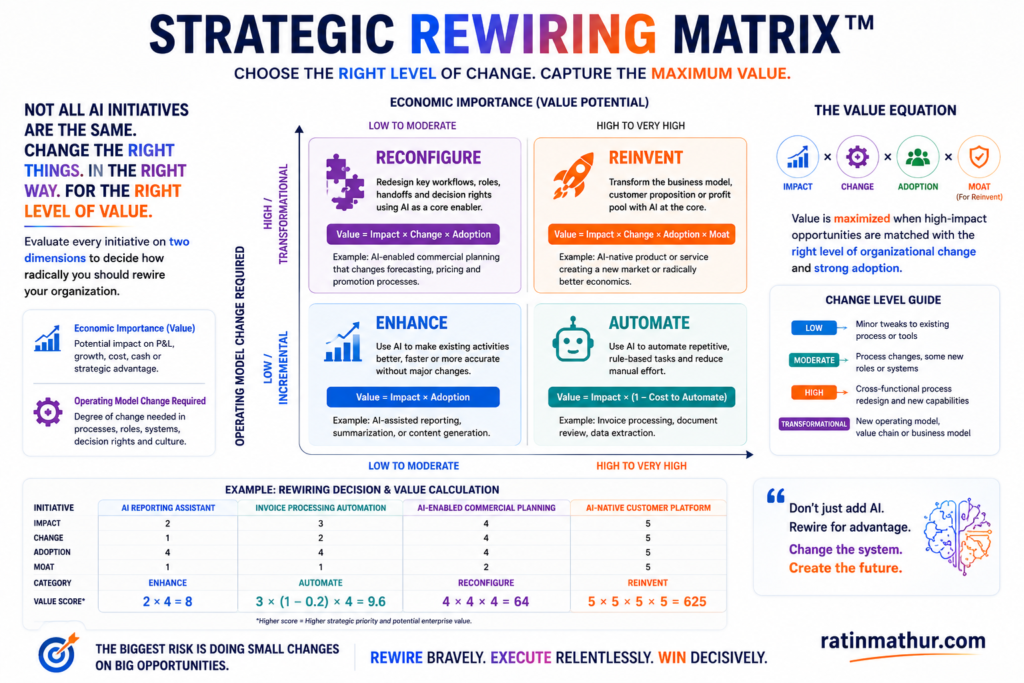
The Strategic Rewiring Matrix™ is designed to prevent one of the most common failures of digital and AI transformation: putting advanced technology into a legacy operating model. It evaluates each strategic initiative across two dimensions: economic importance and degree of operating-model change required. This produces four strategic categories: Enhance, Automate, Reconfigure and Reinvent. The framework integrates Porter’s activity-system logic, McKinsey’s 7-S perspective and contemporary operating-model thinking.
Enhance initiatives use AI to improve existing activities without fundamentally changing organisational design. Automate initiatives use AI to remove repetitive work while preserving the basic workflow. Reconfigure initiatives alter processes, roles, handoffs and decision rights because AI changes how the work should be performed. Reinvent initiatives fundamentally reshape the customer proposition, operating model or profit pool. Management should progressively increase strategic scrutiny as initiatives move from Enhance toward Reinvent because the potential value and organisational complexity increase simultaneously.
| Category | Economic importance | Operating-model change | Management posture | Illustrative example |
|---|---|---|---|---|
| Enhance | Low to moderate | Low | Deploy selectively | AI-assisted reporting |
| Automate | Moderate | Moderate | Automate and measure | Routine document review |
| Reconfigure | High | High | Redesign workflow first | AI-enabled commercial planning |
| Reinvent | Very high | Transformational | Rebuild business model | AI-native product or service |
Blackstone’s Legal & Compliance transformation illustrates the Reconfigure category. The organisation first examined workflow, ownership and escalation pathways and then used AI to automate first-pass review while directing human expertise toward novel and higher-risk decisions. The resulting productivity improvements were therefore generated through organisational redesign plus technology rather than automation alone (McKinsey & Company, 2026e). (McKinsey & Company)
Siemens Erlangen demonstrates the Reinvent category more broadly. The deployment of AI, digital twins and modular IT/OT architecture affected how the factory operates as an integrated production system rather than simply automating individual tasks. Reported improvements in labour productivity, time to market and energy efficiency illustrate what happens when digital and AI capabilities are integrated into the operating architecture of the enterprise (Siemens, 2025). (Siemens Blog)
The strategic recommendation is that boards should reject AI business cases that show only technological feasibility. Every high-value case should explicitly state which activities will disappear, which activities will change, which decisions will move, which skills will become more important and which economic outcomes will result. The greater the potential value, the more willing management should be to challenge the legacy operating model rather than preserve it.
Future Outlook & Conclusion
The next phase of enterprise strategy is unlikely to be defined by the superiority of individual AI models. Model capabilities are diffusing rapidly, and technology access is becoming increasingly broad. The strategic differentiator will instead be the organisational system through which those capabilities are converted into business results.
The future enterprise will therefore operate less like an annual strategy cycle and more like a strategic control system. It will continuously sense external change, use AI to interpret signals, employ leadership judgment to determine priorities, allocate resources toward the highest-value opportunities, redesign workflows, measure outcomes and adjust the system. The organisation’s advantage will reside in the speed and quality of this loop.
This has profound implications for boards, CEOs and management consultants. Boards should stop treating AI primarily as a technology agenda and start evaluating it as an enterprise transformation and capital-allocation agenda. CEOs should own strategic prioritisation, resource reallocation and operating-model redesign. CFOs should connect AI initiatives to value pools and P&L outcomes. CIOs and technology leaders should increasingly act as architects of enterprise capabilities rather than custodians of technology platforms. CHROs must make workforce reinvention and capability building integral to strategy execution.
For management consulting, the implication is equally significant. As AI reduces the value of generic research, benchmarking and presentation production, the premium will shift toward strategic judgment, operating-model architecture, transformation leadership, value realisation and organisational change. The consultant of the future will not merely answer, “What should the client do?” The higher-value question will be, “How will we redesign the enterprise so that the organisation consistently does it?”
The central conclusion of this paper is therefore deliberately provocative:
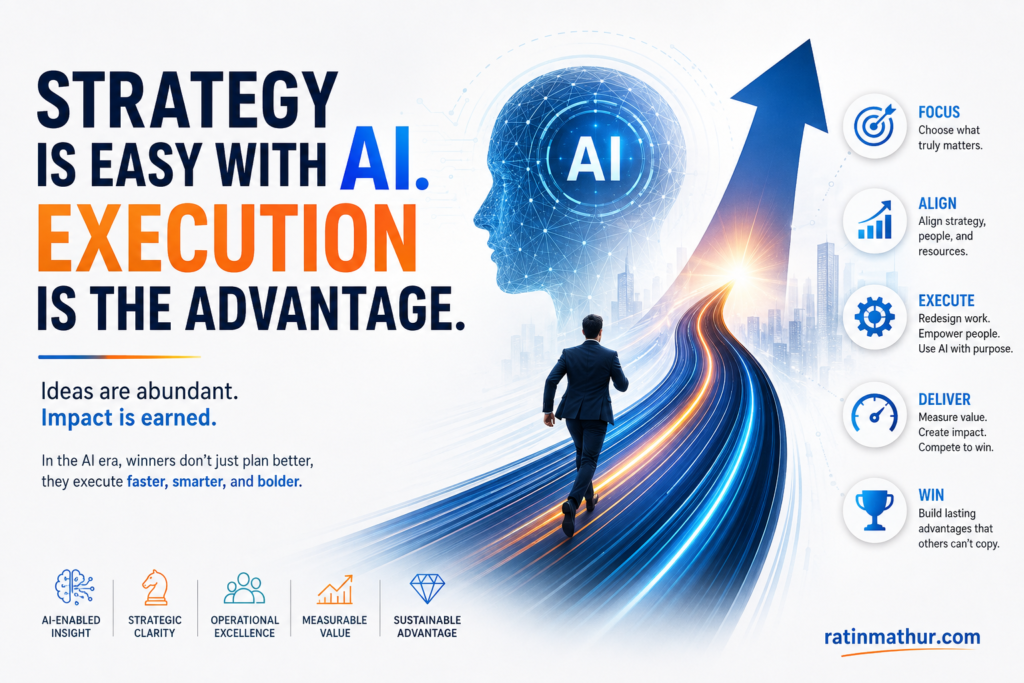
AI is making strategy easier to formulate, but it is making execution the decisive source of competitive advantage.
When every competitor can generate sophisticated analysis, few will possess the discipline to choose narrowly. When every competitor can access advanced AI, few will redesign the organisation around it. When everyone can identify opportunities, fewer will mobilise capital, talent and leadership attention to capture them. And when everyone can launch pilots, the winners will be those that scale the few initiatives that materially change economics.
The strategic battlefield is consequently shifting from intelligence advantage to execution advantage.
The organisations most likely to outperform will not necessarily be those with the most AI initiatives, the largest technology budgets or the most impressive strategy presentations. They will be those capable of translating insight into choice, choice into organisational commitment, commitment into redesigned work, redesigned work into adoption, and adoption into superior economics.
In the AI era, strategy may increasingly become a commodity.
Execution will not.
References
- Accenture. (2025, March 6). Making reinvention real with gen AI: What more than 2,000 client projects revealed. Accenture report
- Boston Consulting Group. (2025, January 15). Apotheker, J., Duranton, S., Lukic, V., de Bellefonds, N., Iyer, S., Bouffault, O., & de Laubier, R. From potential to profit: Closing the AI impact gap. BCG AI Radar. BCG AI Radar 2025
- Boston Consulting Group. (2026, July 22). Nearly nine in ten CEOs see some cost or revenue benefits from AI in targeted areas, but most are struggling to scale it. BCG 2026 CEO research
- Kaplan, R. S., & Norton, D. P. (1992). The balanced scorecard: Measures that drive performance. Harvard Business Review, 70(1), 71–79. Harvard Business Review
- McKinsey & Company. (2026a, July 7). The operating model advantage: Why AI winners are rewiring their organizations. McKinsey operating-model research
- McKinsey & Company. (2026b, May 15). From AI table stakes to AI advantage: Building competitive moats. McKinsey AI competitive-moats research
- McKinsey & Company. (2026c, February 9). McKinsey Global Tech Agenda 2026: How CIOs are shaping enterprise strategy and growth. McKinsey Global Tech Agenda 2026
- McKinsey & Company. (2026d, January 15). Reckitt’s bold ambition: Harnessing AI to redefine revenue growth management. McKinsey Reckitt case study
- McKinsey & Company. (2026e). Blackstone’s Legal and Compliance AI transformation started with technology. McKinsey Blackstone case study
- McKinsey & Company. (2026f). When AI becomes part of the workflow: Redesigning how software gets built. McKinsey Sonar case study
- McKinsey & Company. (2026g). Rewired 2.0: How leading companies are (still) winning with AI. McKinsey Rewired 2.0
- Microsoft. (2025, October 24). Danone: Transforming critical business operations at scale with Microsoft AI & autonomous agents. Microsoft Danone case study
- Microsoft. (2026a, July 8). Adani Green Energy scales project governance and AI-driven decision-making with Microsoft Power Platform. Microsoft Adani Green Energy case study
- Microsoft. (2026b, March 16). Bajaj Finserv unifies its data estate on Microsoft Fabric and gains 40% productivity. Microsoft Bajaj Finserv case study
- Porter, M. E. (1996, November–December). What is strategy? Harvard Business Review, 74(6), 61–78. Harvard Business Review
- Siemens. (2025, January). The Electronics Factory Erlangen: A beacon of digital transformation in industry. Siemens case study
Disclaimer
This article is intended for strategic, educational and management-discussion purposes only. The frameworks introduced as the AI Strategy-to-Value Flywheel™, Execution Velocity Architecture™ and Strategic Rewiring Matrix™ are conceptual frameworks developed for this article and should not be interpreted as established academic or proprietary third-party frameworks. Corporate performance figures and case outcomes are based on publicly available company, consulting-firm or technology-provider publications and may reflect the methodologies, assumptions and definitions used by those organisations. They should not be interpreted as independently audited evidence or as guarantees that equivalent results will be achieved elsewhere. Strategic decisions should be based on organisation-specific data, management judgment, independent validation and appropriate financial, legal, regulatory and operational assessment.