From Human-Driven Taxis To AI-Powered Mobility Networks: The Next Transportation Revolution
1. Executive Summary
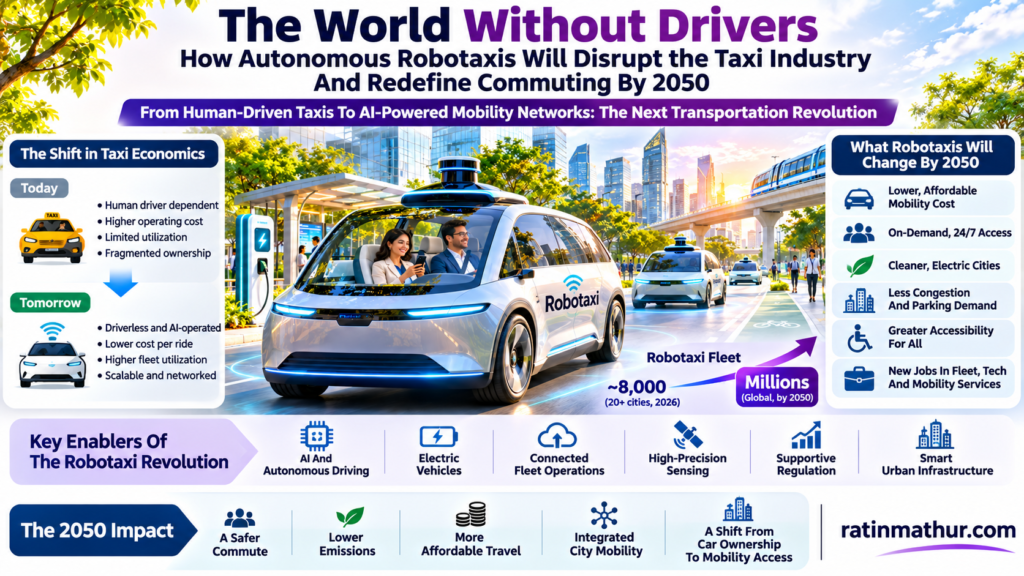
The global transportation industry is entering a new phase of disruption. Autonomous driverless taxis, commonly known as robotaxis, are transforming the traditional relationship between vehicles, drivers, passengers and mobility platforms. What began as an experimental application of artificial intelligence is increasingly developing into a commercial transportation business, challenging conventional taxi operators and redefining how people commute.
For more than a century, the taxi business has depended on three fundamental elements: a vehicle, a human driver and a passenger. Digital ride-hailing platforms such as Uber and Lyft transformed the customer interface by connecting passengers with drivers through mobile applications. Autonomous robotaxis introduce a more fundamental change by removing the requirement for a human driver during approved operations and replacing it with artificial intelligence, sensors, computing systems and fleet-management platforms.
The transformation is no longer restricted to one company or country. Waymo operates commercially in the United States, while Baidu Apollo Go, Pony.ai and WeRide are expanding driverless operations across China and the Middle East. Zoox and Tesla are introducing additional driverless services in selected US markets. Europe has entered the deployment phase through projects in Croatia, while the United Kingdom, Switzerland, Germany, Japan, South Korea and Singapore are conducting supervised pilots or preparing future deployments.
The International Energy Agency reported in May 2026 that commercial driverless taxi services were operating in more than 20 cities globally, with approximately 8,000 robotaxis across the market as of March 2026. Importantly, all commercial robotaxi services identified in its assessment were battery electric vehicles (IEA, 2026).
This convergence of electrification and autonomy is significant. Electric vehicles provide relatively simple propulsion architectures, precise electronic torque control and stable high-voltage power for onboard computing and sensors. They are also suitable for high-utilization urban taxi fleets because of their operating economics and zero tailpipe emissions.
However, the implications go far beyond replacing taxi drivers. Robotaxis could transform vehicle ownership, urban commuting, public transportation integration, passenger accessibility, employment, parking infrastructure and the economics of personal mobility.
The commercial opportunity is substantial, but the risks are equally important. High technology costs, passenger safety, employment displacement, empty vehicle movements, congestion, regulatory uncertainty and public trust will determine how quickly autonomous mobility becomes mainstream.
This paper examines the global robotaxi landscape, the transformation of taxi economics, the experience of passengers, the role of electric vehicles, the safety implications, and the future of commuting through 2050. It also introduces three original strategic frameworks: MOSAIC™, C-TRIP™ and RISE™, designed to guide the commercial development, integration and responsible deployment of autonomous mobility.
2. Introduction
The evolution of transportation has repeatedly changed the structure of industries and economies. The automobile transformed personal mobility and created a global manufacturing ecosystem. The expansion of public transportation enabled mass urban commuting, while app-based ride-hailing transformed how passengers accessed taxis.
Autonomous driving represents another fundamental shift. Unlike conventional Advanced Driver Assistance Systems, Level 4 autonomous vehicles can perform the complete driving task without requiring human intervention within a defined Operational Design Domain (ODD). Passengers do not need to monitor the road or take control when the system is operating within its approved conditions (National Highway Traffic Safety Administration [NHTSA], n.d.).
This distinction is critical. A car offering adaptive cruise control, lane keeping or supervised highway driving is not necessarily a driverless vehicle. Level 4 automation transfers responsibility for the driving task to the autonomous system within its approved operating environment.
The emergence of robotaxis is therefore changing the definition of transportation from vehicle ownership and driver availability to technology-enabled mobility access.
A commuter may eventually book an autonomous electric vehicle, travel to a metro station, connect to public transportation and use another autonomous shuttle for the final journey. A corporate employee may access a monthly mobility subscription instead of depending on a personal vehicle. An airport may operate dedicated driverless passenger fleets without employing onboard drivers.
This transformation raises a fundamental strategic question: will the future transportation industry be organized around individuals owning cars and employing drivers, or around intelligent, shared and independently operating mobility networks?
3. Problem Statement & Objectives
The traditional taxi industry faces structural limitations arising from driver availability, compensation, operating schedules, vehicle utilization and fragmented fleet ownership. Ride-hailing platforms have improved customer access but continue to depend predominantly on human drivers.
Autonomous taxis challenge this model by transferring the driving function from humans to integrated AI and vehicle-control systems. However, eliminating the driver does not automatically produce a profitable or socially sustainable transportation business.
Robotaxi operators must finance specialized electric vehicles, sensors, AI computing, software, vehicle maintenance, charging infrastructure, insurance, fleet operations and regulatory compliance. They must also achieve sufficient customer demand and vehicle utilization to recover these investments.
The social implications are equally significant. Professional taxi drivers, chauffeurs and other workers dependent on driving may face increasing competitive pressure as autonomous services expand.
This study examines how autonomous mobility changes the economics of taxi operations, evaluates the commercial and technological landscape, investigates how passengers experience driverless transportation, assesses the role of electric vehicles, and explores the implications for commuting and urban mobility in 2050.
4. Methodology
This paper adopts a qualitative, comparative and forward-looking industry research methodology.
The analysis uses publicly available company announcements, government transportation information, industry reports, academic research and operating information from autonomous vehicle companies. The global deployment assessment distinguishes fully driverless paid passenger services from limited public access, unpaid pilots, safety-driver operations and testing.
The assessment covers the United States, China, the United Arab Emirates, Europe and selected Asian markets, with an additional focus on India’s transportation market.
The research uses the International Energy Agency’s Global EV Outlook 2026, McKinsey’s November 2026 shared autonomous mobility research, National Household Travel Survey findings from India, and recent academic studies examining passenger trust, commuting preferences, employment impacts and vehicle travel demand.
The 2050 outlook is presented as scenario analysis rather than a definitive prediction. Quantitative estimates from companies and research organizations are attributed to their respective sources and are not treated as guaranteed market outcomes.
5. Landscape Analysis
5.1 The Global Driverless Taxi Market: From Experiments To Commercial Operations
The global robotaxi market has progressed beyond experimental demonstrations. Commercial driverless services are now available in selected urban areas, although their operating boundaries and passenger access differ significantly.
The International Energy Agency estimated that approximately 8,000 robotaxis were operating across around 20 cities in March 2026, with commercial activity concentrated in China and the United States, alongside deployments in Dubai and Abu Dhabi (IEA, 2026).
The following table presents representative services and developments verified through November 9, 2026. It distinguishes mature paid driverless operations from restricted pilots and supervised trials.
| Country | Company / Operator | Cities / Locations | Deployment Status |
|---|---|---|---|
| United States | Waymo | Phoenix, San Francisco Bay Area, Los Angeles, Austin, Atlanta, Dallas, Houston, Miami, Orlando, Nashville, San Antonio, San Diego and Tampa | Commercial driverless passenger rides |
| United States | Tesla Robotaxi | Austin, with limited expansion activities in Dallas, Houston, Miami, Orlando and Tampa | Unsupervised operations and early-stage deployment; fare availability varies |
| United States | Zoox | Las Vegas and San Francisco | Driverless public passenger programmes, initially free or limited |
| United States | Motional | Las Vegas | Commercial pilot with onboard safety operator |
| United States | May Mobility | Atlanta | Supervised autonomous ride-hailing pilot |
| China | Baidu Apollo Go | Wuhan, Beijing and Chongqing | Commercial fully driverless passenger rides |
| China | Pony.ai | Beijing, Shanghai, Guangzhou and Shenzhen | Fully driverless commercial operations |
| China | WeRide | Beijing and Guangzhou | Commercial fully driverless operations |
| China | DiDi Autonomous Driving | Beijing and Guangzhou | Driverless trials in designated demonstration areas |
| China | CaoCao Mobility | Hangzhou | Controlled driverless testing |
| UAE | WeRide | Abu Dhabi and selected Dubai districts | Driverless commercial rides in designated operating areas |
| UAE | Baidu Apollo Go | Dubai and Abu Dhabi | Driverless commercial ride-hailing |
| Croatia | Pony.ai and Verne | Zagreb | Invitation-only fully driverless passenger test rides; regular service has included supervised operations |
| United Kingdom | Wayve and Uber | London | Public-facing testing with safety driver |
| United Kingdom | Waymo | London | Testing and preparation with human safety operators |
| Switzerland | WeRide and local mobility partners | Zurich region | Supervised autonomous passenger service |
| Germany | MOIA / Volkswagen ecosystem | Hamburg | Limited passenger pilot with onboard safety operators |
| Spain | WeRide | Madrid region | Testing with an onboard specialist |
| Japan | Waymo and local partners | Tokyo | Mapping, testing and preparation for future deployment |
| Singapore | WeRide and Grab | Punggol | Fixed-route public pilot with safety operator |
| South Korea | SWM and Kakao Mobility | Seoul, Gangnam | Paid autonomous taxi pilots with onboard test drivers |
Source: IEA (2026), company announcements and an independent operator-city deployment tracker updated November 2, 2026. Status is specific to individual services, not necessarily the entire operator or country. A pilot with a test driver is not classified as a fully driverless commercial taxi service.
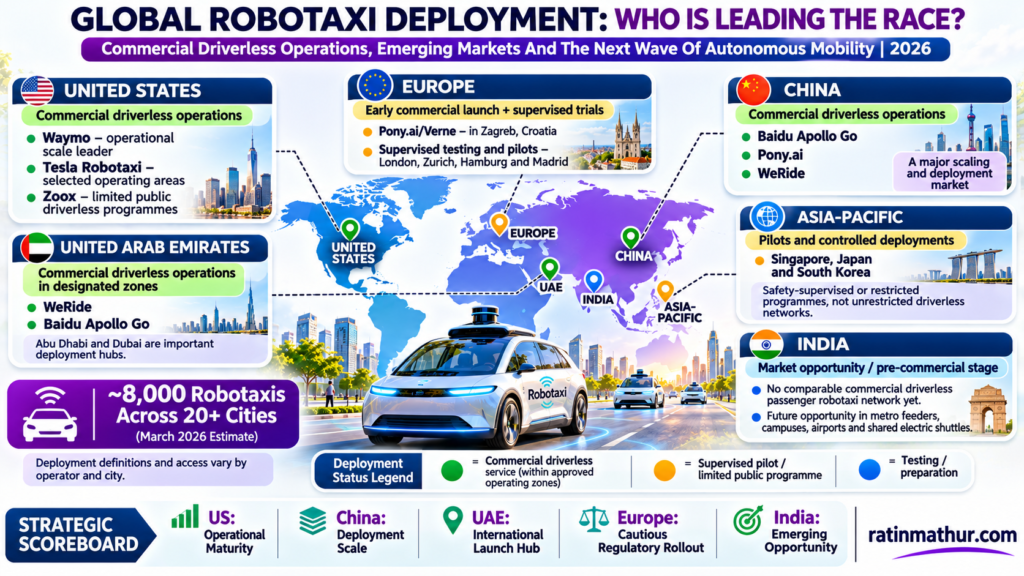
The United States is led by Waymo, while Chinese operators Baidu, Pony.ai and WeRide have developed multiple commercial deployments. The UAE has emerged as an important international market, particularly Dubai, where autonomous vehicles are integrated with local taxi operators and ride-hailing platforms (IEA, 2026; MetaRoles, 2026).
Europe is moving more cautiously. In Zagreb, Pony.ai and Verne introduced fully driverless passenger test rides on public roads in September 2026, initially for invited passengers on a designated airport route. London, Zurich and Hamburg remain largely supervised deployment environments rather than unrestricted commercial driverless networks (Pony.ai, 2026; TAD Tracker Europe, 2026).
Japan, South Korea and Singapore are also advancing through testing and controlled passenger programmes. India has yet to establish a comparable commercial driverless passenger service.
5.2 The Leading Robotaxi Operators And Their Business Strategies
| Company | Autonomous Platform | Vehicle / Technology Strategy | Commercial Approach |
|---|---|---|---|
| Waymo | Waymo Driver | Multi-sensor autonomous electric vehicles and proprietary AI | Direct robotaxi operations and ride-hailing partnerships |
| Baidu | Apollo Go | Purpose-built RT6 and autonomous driving technology | Self-operated services and partnerships with Uber and local taxi companies |
| Pony.ai | Pony.ai Driver | Gen-7 autonomous driving systems and OEM partnerships | Robotaxi technology and fleet operations |
| WeRide | WeRide autonomous platform | Robotaxis, robobuses and autonomous commercial vehicles | Mobility partnerships and fleet operations |
| Tesla | Robotaxi / FSD technology | Vertically integrated EV and AI ecosystem | Vehicle sales and emerging autonomous mobility services |
| Zoox | Zoox Driver | Purpose-built autonomous electric vehicle with carriage-style seating | Direct mobility service |
| Motional | Motional Driverless Technology | Hyundai IONIQ 5 autonomous vehicle | Ride-hailing partnerships and fleet deployment |
An important development is the increasing separation of the technology provider, vehicle manufacturer, fleet operator and booking platform.
For example, Uber’s August 2026 launch of Baidu’s fully driverless Apollo Go service in Dubai allows passengers to book autonomous rides through Uber. New Horizon Luxury Transport manages the fleet, Baidu supplies the driving technology, and the Dubai regulatory and taxi ecosystem supports operations (Uber, 2026).
This demonstrates that the future robotaxi industry may function through interconnected partnerships rather than a single vertically integrated transportation company.
5.3 How Driverless Cabs Are Changing The Taxi Industry
The traditional taxi business is labour-intensive. The human driver represents a significant operating expense, and the International Energy Agency estimates that driver costs account for more than 50% of conventional taxi operating costs.
Robotaxis remove routine onboard driver compensation but introduce higher upfront investment in sensors and computing hardware, software development, maintenance and vehicle control centres. The IEA also observes that robotaxi fares have generally remained higher than conventional ride-hailing services in the United States and China, although the price difference has narrowed (IEA, 2026).
| Business Parameter | Conventional Taxi | Autonomous Taxi |
|---|---|---|
| Driving workforce | Required for every journey | Not required onboard during approved operations |
| Vehicle utilization | Driver shift dependent | Potentially extended operating hours |
| Main cost pressures | Driver compensation and vehicle costs | Vehicle hardware, software, maintenance and infrastructure |
| Fleet allocation | Driver and dispatch dependent | AI-managed demand allocation |
| Operating model | Driver-centric | Technology and fleet-centric |
| Revenue channels | Passenger fares | Passenger fares, fleet partnerships and mobility subscriptions |
| Maintenance | Traditional vehicle servicing | Vehicle and specialized autonomous-system servicing |
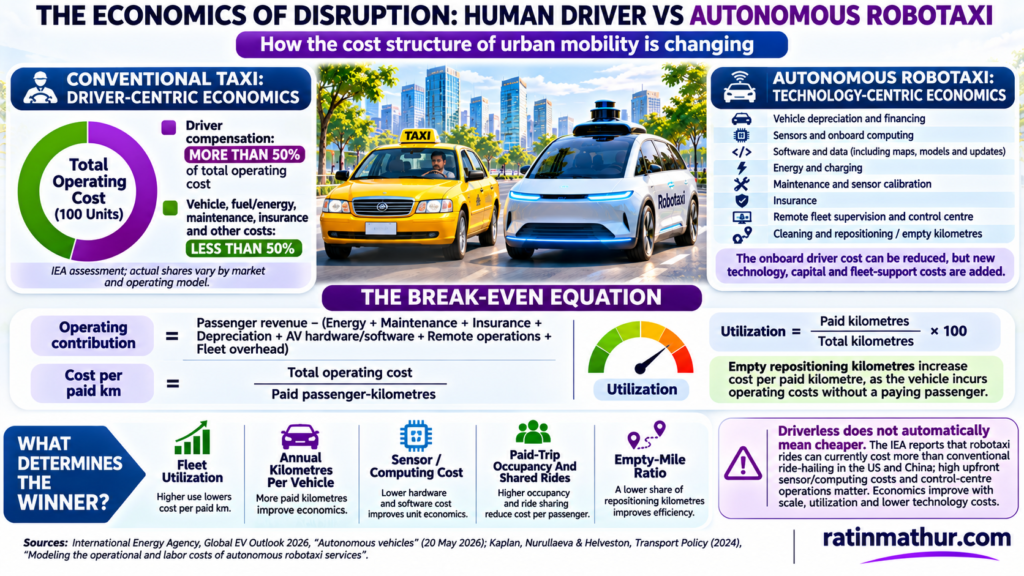
This transition does not eliminate employment altogether. It changes the skill requirements of the transportation industry, increasing demand for fleet technicians, charging operators, sensor specialists, safety engineers and autonomous software professionals.
5.4 Passenger Experience: What Is It Like To Travel In A Driverless Cab?
The acceptance of autonomous taxis ultimately depends on the experience of passengers and other road users.
A passenger booking a robotaxi through a mobile application experiences an on-demand transportation service similar to conventional ride-hailing. The difference becomes visible when the vehicle arrives without a human driver.
The passenger enters the vehicle, confirms the journey through its interface and travels while the autonomous system manages steering, braking, acceleration, traffic interactions and navigation.
The absence of a human driver changes the passenger experience in several ways.
| Passenger Dimension | Potential Experience |
|---|---|
| Convenience | App-based pickup and digital journey management |
| Privacy | No routine interaction with an onboard driver |
| Comfort | A quiet electric vehicle and consistent driving behaviour |
| Productivity | Opportunity to read, work or communicate during travel |
| Availability | Potentially longer service hours |
| Accessibility | Opportunities for people unable to drive, subject to vehicle design |
| Safety concerns | Anxiety about emergencies without an onboard human |
| Personal security | Greater importance of passenger support and emergency communication |
Recent research provides useful evidence of actual customer perceptions.
McKinsey’s November 2026 analysis found that 87% of people who had used shared autonomous vehicles rated their experience positively. Among people who had not used these services, 43% were considering using them in the future (McKinsey & Company, 2026).
A UC Berkeley SafeTREC study published in August 2026 surveyed 811 San Francisco residents with real-world exposure to autonomous vehicles, including 376 robotaxi passengers. Overall, 61% reported trusting autonomous vehicles to be safe. Trust was considerably higher among passengers, at 82%, compared with approximately 43–45% among non-passengers (Guirado et al., 2026).
Another study involving 411 robotaxi users in Phoenix and San Francisco found that passengers considered the time spent travelling in robotaxis less burdensome than time spent in public transit or conventional ride-hailing vehicles. The research also found that robotaxis were replacing some conventional ride-hailing and public transportation journeys, highlighting both competitive opportunities and potential risks for public transit (Dong et al., 2026).
The findings suggest that familiarity and actual riding experience can improve customer acceptance. However, passenger confidence does not eliminate concerns about technical failures, emergency response, personal safety or cybersecurity.
5.5 Electric Vehicles: The Foundation Of The Robotaxi Revolution
The relationship between electric vehicles and autonomous transportation is more important than simply replacing petrol engines with electric motors.
Battery electric vehicles provide a technological platform that is particularly suitable for autonomous operations.
Their advantages include electronic torque control, fewer mechanical moving parts, integrated vehicle computing architecture, regenerative braking and stable high-voltage electrical power for sensors and onboard computers.
The IEA reported that all commercial robotaxi services in operation in its March 2026 assessment were battery electric vehicles. It also noted that autonomous sensor and computing systems can draw several hundred watts to more than 1 kW of electrical power, making electrical architecture an important consideration (IEA, 2026).
| EV Advantage | Relevance To Autonomous Taxis |
|---|---|
| High-voltage battery | Supports propulsion and autonomous electronics |
| Electronic torque control | Precise acceleration and vehicle movement |
| Regenerative braking | Improves energy utilization |
| Lower mechanical complexity | Simplifies certain maintenance requirements |
| Centralized electronic architecture | Supports software-based vehicle integration |
| Lower urban tailpipe emissions | Improves local air quality |
| Fleet charging systems | Supports centralized energy management |
The industry is also moving from conventional electric vehicles retrofitted with autonomous technology toward purpose-built software-defined robotaxis.
Examples include Baidu’s Apollo RT6, Zoox’s purpose-designed autonomous vehicle and Waymo’s latest Ojai platform.
This combination of electrification and autonomy could eventually produce a new category of mobility asset designed primarily for transportation services rather than private ownership.
5.6 Safety: Can Passengers Trust A Vehicle Without A Driver?
Safety is the most critical requirement for commercial autonomous mobility.
Level 4 vehicles use multiple cameras, radar, LiDAR, onboard computing and AI software to understand the road environment and make driving decisions. Their architecture also incorporates redundancy in critical systems, including computing, braking, steering and electrical power.
Waymo’s safety dashboard reported 271.3 million rider-only miles through June 2026. Its company-reported comparison showed 95% fewer serious-injury-or-worse crashes and 82% fewer injury-causing crashes than its human-driver benchmarks in the operating areas studied (Waymo, 2026).
These results are encouraging, but should be interpreted carefully. They are based on Waymo’s published analysis and selected operating geographies. They do not establish that every robotaxi operator has achieved equivalent safety performance.
The National Transportation Safety Board also investigated a January 2026 incident in Santa Monica in which a Waymo vehicle struck a nine-year-old pedestrian crossing within a school zone. Another investigation examined a Waymo vehicle passing a stopped school bus in Austin. These incidents demonstrate that driverless vehicles can still make mistakes and that pedestrian prediction, unusual traffic conditions and emergency response require continuous improvement (NTSB, 2026).
Safety assessment must therefore extend beyond a company’s cumulative autonomous miles. It should include independent investigations, incident reporting, vulnerable road user protection, cybersecurity, operational restrictions and transparent performance measurement.
5.7 The Impact On Congestion And Public Transportation
Robotaxis could reduce the need for privately owned vehicles, but they could also increase road traffic through empty repositioning journeys and lower transportation costs that encourage additional trips.
Shared rides provide an opportunity to transport more passengers using fewer vehicles. Conversely, individual door-to-door robotaxi journeys could compete with buses, metros and walking.
Research published in Nature Sustainability in September 2026, using more than four million taxi and robotaxi order records in Wuhan, found that robotaxis overlap with conventional taxi demand but can also complement public transportation, particularly through journeys associated with metro and bus station areas (2026).
The strategic question is therefore not whether robotaxis will replace public transport. It is whether autonomous mobility can be integrated into a wider transportation network without creating unnecessary vehicle movements.
6. Key Findings
6.1 The Taxi Industry Is Transitioning From Human Labour To Intelligent Fleet Operations
Removing the onboard driver changes the taxi industry’s cost structure and operating model. Competitive advantage will increasingly depend on software, vehicle utilization, autonomous hardware costs, charging infrastructure and fleet management.
However, technology costs must fall sufficiently before driverless taxis can consistently compete with conventional ride-hailing across a wider range of customers and cities.
6.2 The Future Customer Will Purchase Mobility Rather Than Necessarily Own A Vehicle
Autonomous taxis could reduce the need for some households to own multiple vehicles. A family could use a combination of private vehicles, shared robotaxis, metro travel and mobility subscriptions.
The decision will depend on total transportation costs, service reliability and availability rather than the purchase price of a vehicle alone.
6.3 Passenger Experience Will Determine The Speed Of Adoption
The positive feedback from current robotaxi riders indicates that familiarity can improve acceptance. Yet passengers expect reliability, cleanliness, convenient pickup, personal security, emergency assistance and transparent communication.
The absence of a human driver also changes the meaning of customer service. The mobility company must become responsible for the entire passenger journey.
6.4 EVs And Autonomous Driving Will Develop Together
Electric propulsion and software-defined vehicle architecture provide a suitable foundation for autonomous mobility. This creates opportunities across batteries, power electronics, sensors, vehicle computing, thermal management, charging and automotive software.
6.5 Employment Displacement Requires Early Attention
Robotaxi expansion could challenge the livelihoods of taxi drivers and other professional drivers. New employment opportunities will develop in technology and fleet operations, but they may not compensate one-for-one for displaced driving positions.
6.6 India Will Need An Affordability-Led Strategy
India’s travel patterns differ substantially from those of the United States and China. The National Household Travel Survey 2025–2026 found that two-wheelers account for 42.6% of workers’ primary commuting modes nationally and 52.3% in urban areas. Average monthly expenditure on commuting among urban workers was ₹1,044 (MoSPI, 2026).
This suggests that expensive individual robotaxi services will initially serve a limited market. Shared electric shuttles, metro feeders, corporate mobility and controlled-campus services may offer more practical entry opportunities.
7. Challenges & Opportunities
Autonomous mobility faces challenges across technology, finance, public policy and social acceptance.
| Challenge | Potential Industry Impact | Strategic Response |
|---|---|---|
| High vehicle and sensor costs | Slow commercial expansion | Common platforms and hardware optimization |
| Safety incidents | Loss of passenger confidence | Independent validation and transparent reporting |
| Driver employment displacement | Social and economic disruption | Reskilling and transition programmes |
| Empty vehicle mileage | Congestion and higher energy use | Fleet optimization and shared rides |
| Fragmented regulations | Delayed cross-border deployment | Harmonized safety and operating standards |
| Cybersecurity threats | Operational and data risks | Automotive cybersecurity controls |
| Charging infrastructure | Lower fleet availability | Centralized high-capacity charging |
| Passenger acceptance | Slower adoption | Better user experience and accessibility |
| Public transit competition | Potential reduction in transit ridership | Integrated multimodal mobility |
India presents opportunities in autonomous electric shuttles, airport transportation, technology parks, corporate campuses, metro connectivity and industrial logistics.
However, India has not yet established a dedicated national legal framework for unrestricted commercial driverless taxi operations. Existing road transport legislation remains designed primarily around human-driven vehicles, making regulatory development an essential prerequisite for wider deployment.
8. Strategic Frameworks & Recommendations
The autonomous mobility industry requires integrated strategies connecting commercial viability, commuting networks and responsible technological deployment. The following three original frameworks are designed to provide a strategic foundation for industry participants and policymakers.
8.1 MOSAIC™: Mobility Orchestration And Shared Economics Framework
MOSAIC™ focuses on building commercially viable autonomous transportation networks by improving fleet utilization, matching supply with passenger demand and integrating vehicles, charging infrastructure, maintenance and digital platforms.
The framework consists of five dimensions: Market Segmentation, Orchestration, Shared Asset Utilization, Integrated Operations and Commercial Economics.
| Dimension | Strategic Objective | Management Application |
|---|---|---|
| Market Segmentation | Identify high-potential passenger segments | Corporate, airport, premium and shared commuting |
| Orchestration | Optimize fleet allocation | AI-based vehicle positioning |
| Shared Asset Utilization | Increase productive vehicle hours | Reduce empty mileage and idle time |
| Integrated Operations | Coordinate the mobility ecosystem | Charging, cleaning, servicing and diagnostics |
| Commercial Economics | Improve financial performance | Cost per passenger-kilometer and contribution margin |
For example, an autonomous taxi company entering Gurugram could initially focus on residential societies, corporate offices, airports and metro stations. Its fleet management platform would use demand patterns to position vehicles in locations where passenger requests are expected to be concentrated.
During morning hours, vehicles could serve home-to-office journeys, while daytime operations could accommodate airport and commercial travel. Corporate subscriptions would provide predictable demand, while digital bookings could capture additional passengers.

The company would measure paid kilometers, empty mileage, charging time, vehicle availability and contribution margin rather than merely counting vehicles deployed.
| MOSAIC™ Performance Indicator | Measurement |
|---|---|
| Fleet utilization | Share of available time spent on productive journeys |
| Revenue per vehicle | Daily and monthly fare revenue |
| Empty-mile ratio | Unoccupied distance as a share of total distance |
| Cost per passenger-kilometer | Total cost divided by passenger distance |
| Vehicle availability | Percentage of fleet ready for deployment |
| Contribution margin | Revenue less directly attributable operating expenses |
The strategic implication is that robotaxi operators must manage vehicles as revenue-generating intelligent assets rather than conventional taxis.
8.2 C-TRIP™: Connected Transit And Integrated Commuting Framework
C-TRIP™ addresses the future of commuting by integrating autonomous taxis with metro systems, buses, rail, corporate transportation and shared mobility.
Its central principle is that autonomous vehicles should connect existing transportation networks rather than replace every form of public transport.
| Dimension | Strategic Objective | Management Application |
|---|---|---|
| Commuting Pattern Analysis | Identify residential and employment clusters | Map commuting corridors |
| Transit Integration | Connect autonomous vehicles with mass transit | Metro and bus feeders |
| Ride Sharing | Improve passenger occupancy | Shared corporate journeys |
| Inclusive Mobility | Improve accessibility | Senior and disability-friendly transportation |
| Productivity-Oriented Travel | Improve passenger experience | Work, rest and digital connectivity |
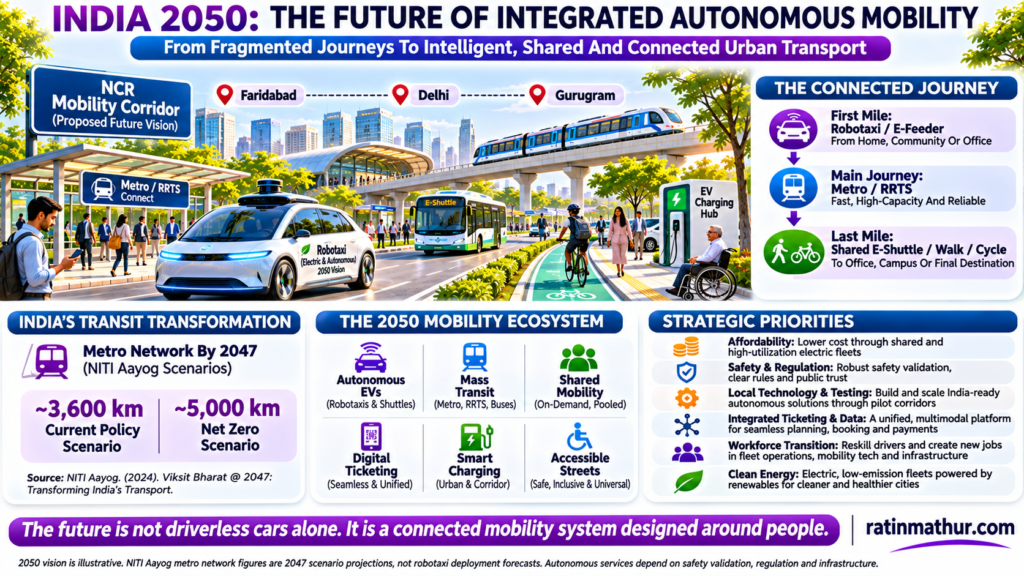
Consider a commuting network connecting Faridabad, Delhi and Gurugram. Employees living in residential societies could book shared autonomous shuttles connecting them to metro stations. The metro would handle longer-distance passenger movement, while autonomous vehicles would cover the first and last mile.
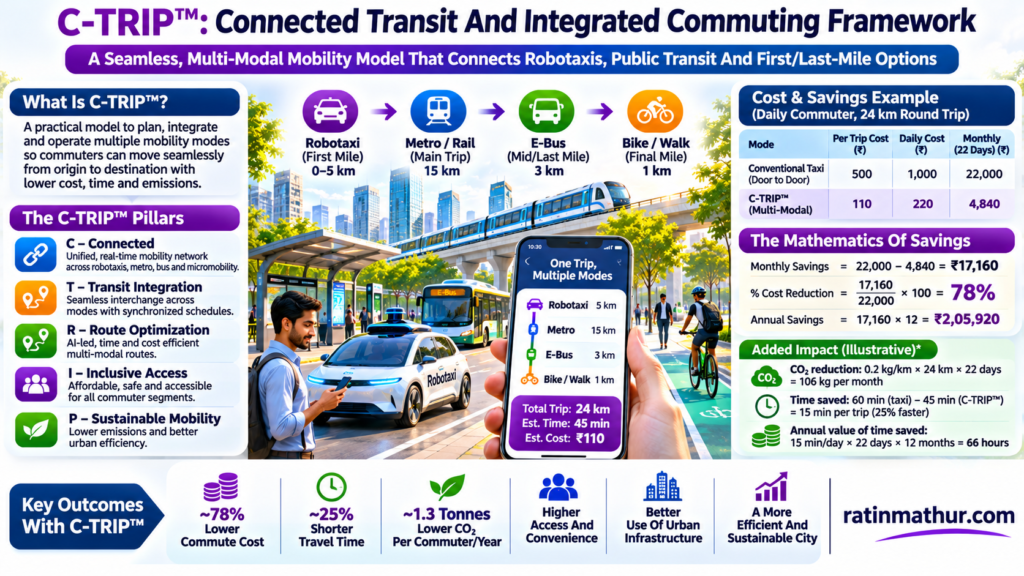
Companies could purchase monthly commuting packages for their employees, while the operator would optimize vehicle schedules according to office timings and passenger density.
| C-TRIP™ Performance Indicator | Measurement |
|---|---|
| Door-to-door journey time | Total origin-to-destination duration |
| First-mile and last-mile coverage | Share of commuters served |
| Average passenger occupancy | Passengers per vehicle |
| Monthly cost per commuter | Total commuting expenditure |
| Public transit integration | Share of journeys connected with mass transit |
| Accessibility coverage | Availability of suitable vehicles |
| Customer retention | Recurring mobility subscribers |
This framework is particularly relevant for India because affordable shared transportation and metro connectivity will be critical to successful autonomous mobility adoption.
8.3 RISE™: Responsible Innovation, Safety, Inclusion And Environment Framework
RISE™ provides a framework for ensuring that autonomous mobility delivers sustainable economic and social outcomes. It recognizes that technological capability alone does not establish public trust or long-term commercial viability.
The framework integrates Road Safety And Accountability, Inclusion And Employment Transition, Sustainability And Resource Efficiency, and Ecosystem Governance.
| Dimension | Strategic Objective | Management Application |
|---|---|---|
| Road Safety And Accountability | Establish measurable safety standards | Independent assessments and incident reporting |
| Inclusion And Employment Transition | Protect affected communities | Reskilling and accessibility programmes |
| Sustainability And Resource Efficiency | Improve environmental performance | Shared journeys and empty-mile control |
| Ecosystem Governance | Establish public confidence | Cybersecurity, data privacy and regulatory compliance |
For example, a smart city introducing autonomous electric taxis could begin with a designated airport-to-business-district corridor. Operations would be permitted only after system validation, regulatory approval and appropriate safety assessment.
The operator would publish safety statistics, establish passenger emergency assistance, introduce accessible vehicle configurations and offer technical training opportunities to workers affected by automation.
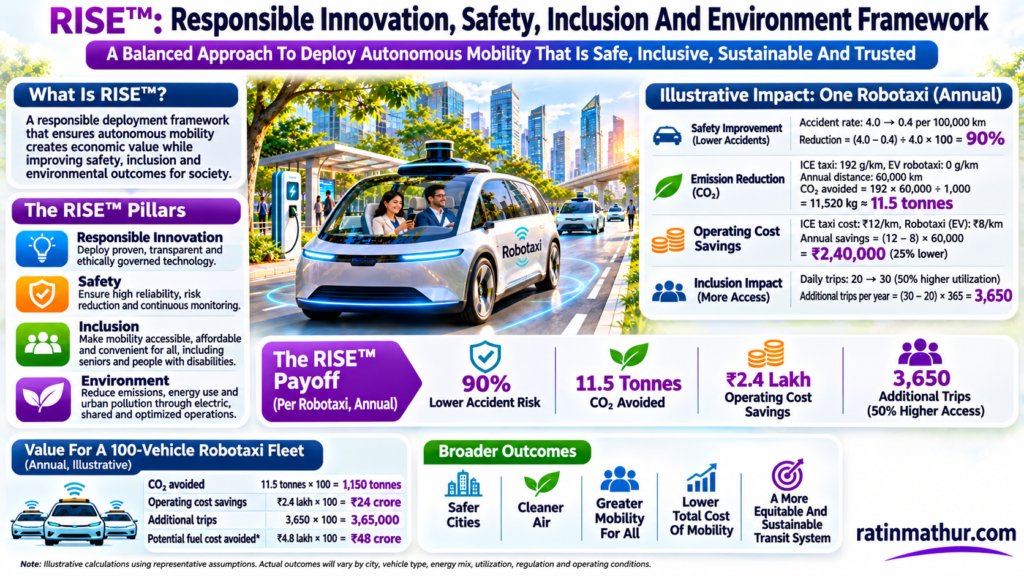
The city would measure not only passenger numbers but also accidents, energy consumption per passenger-kilometer, employment transition, empty mileage and public acceptance.
| RISE™ Performance Indicator | Measurement |
|---|---|
| Safety performance | Incidents per million autonomous miles |
| Employment transition | Workers trained and redeployed |
| Accessibility | Availability of accessible vehicles |
| Energy efficiency | Energy use per passenger-kilometer |
| Empty mileage | Unoccupied vehicle distance |
| Governance | Regulatory and cybersecurity compliance |
| Public trust | Passenger and community satisfaction |
RISE™ positions safety, social inclusion and environmental responsibility as core operating requirements rather than separate corporate social responsibility activities.
9. Future Outlook & Conclusion
9.1 The Road To 2030
Between 2026 and 2030, the autonomous taxi industry is likely to concentrate on scaling operations in selected cities, reducing sensor and computing costs, developing purpose-built electric vehicles and expanding regulatory approvals.
The number of partnerships between autonomous technology companies, ride-hailing platforms, fleet operators and automobile manufacturers is expected to increase.
Corporate transportation, airports, controlled urban corridors and shared shuttles could become important commercial applications.
9.2 The Transformation Between 2030 And 2040
During the following decade, autonomous mobility could extend beyond individual robotaxis to shared transportation networks, dedicated commuter subscriptions and automated shuttle systems.
Vehicle manufacturers may increasingly design electric vehicles around autonomous driving architecture rather than adapting conventional models.
Public transport integration, automated charging, fleet optimization and autonomous vehicle maintenance could become important urban infrastructure services.
9.3 The Future Of Driverless Mobility By 2050
By 2050, autonomous transportation could evolve into a significant part of urban mobility, although the extent of adoption will depend on technology, affordability, regulation, infrastructure and consumer preferences.
The future should be evaluated through three possible scenarios.
| Scenario | Description | Potential Urban Outcome |
|---|---|---|
| Shared Intelligent Mobility | High use of shared autonomous vehicles integrated with public transportation | Lower vehicle ownership and more efficient passenger utilization |
| Autonomous Convenience Economy | Widespread individual robotaxis, including empty repositioning | Greater convenience but potential congestion and higher vehicle travel |
| Hybrid Mobility Ecosystem | Combination of private vehicles, robotaxis, shuttles, public transport and human-driven services | Gradual and geographically differentiated transition |
The International Transport Forum’s Urban Mobility System Upgrade study explored the possibility that shared self-driving cars could make up to nine out of ten conventional cars redundant under certain highly shared urban mobility scenarios. However, the study also highlighted that total travel volumes could increase and that public transportation would remain important in determining overall benefits (ITF, 2015).
This is a scenario, not a forecast that nine out of ten cars will disappear.
A plausible 2050 transportation ecosystem could include purpose-built autonomous electric vehicles for individual journeys, shared robotaxis for urban travel, autonomous shuttles for residential and business districts, automated freight vehicles for logistics and conventional public transportation for mass passenger movement.
The traditional concept of a personal car may change. Instead of purchasing multiple vehicles, households could access different transportation services depending on the purpose, cost and distance of a journey.
However, Level 5 universal autonomy should not be assumed as a guaranteed outcome by 2050. Level 4 services could remain geographically and operationally restricted in many markets even as commercial deployment expands.
9.4 India’s Strategic Opportunity
India should approach autonomous transportation as an opportunity to develop both a mobility services industry and an automotive technology supply chain.
Its priorities should include controlled-environment autonomous mobility, shared electric shuttles, metro feeders, corporate transportation, automotive electronics, software development, safety validation and fleet infrastructure.
Affordability must remain central. A transportation service priced beyond the reach of conventional commuters cannot become a mass mobility solution simply because it is technologically advanced.
For India, the most relevant initial opportunity may not be a premium driverless taxi competing with every conventional cab. It may be a shared electric autonomous shuttle connecting residential communities, metro stations, offices, airports and industrial campuses.
Conclusion
The autonomous robotaxi revolution represents a structural change in the global transportation industry. It challenges the traditional economics of taxis, changes the relationship between vehicle ownership and mobility access, creates new employment requirements and introduces an entirely new technology and infrastructure ecosystem.
Electric vehicles provide the physical and electronic foundation for this transition, while artificial intelligence provides the intelligence that enables vehicles to navigate without human drivers.
The commercial winners will not necessarily be the companies manufacturing the largest number of autonomous cars. They will be the companies capable of transporting the greatest number of passengers safely and affordably while maintaining high vehicle utilization, low operating costs and strong public confidence.
By 2050, mobility could be purchased increasingly as a service rather than built around individual vehicle ownership. But achieving that outcome will require more than technological innovation. It will require intelligent business models, integrated transportation planning, responsible governance and a commitment to making mobility accessible to all.
The next transportation revolution will not be defined merely by the disappearance of the driver. It will be defined by the emergence of intelligent mobility networks that change how people move, work and experience cities.
10. References
- International Energy Agency. (2026, May 20). Autonomous vehicles. Global EV Outlook 2026. https://www.iea.org/reports/autonomous-vehicles
- McKinsey & Company. (2026, November 4). From science fiction to reality: The next phase of shared autonomous mobility. https://www.mckinsey.com/industries/automotive-and-assembly/our-insights/from-science-fiction-to-reality-the-next-phase-of-shared-autonomous-mobility
- Baidu, Inc. (2026, May 18). Baidu announces first quarter 2026 results. https://ir.baidu.com/news-releases/news-release-details/baidu-announces-first-quarter-2026-results/
- Pony.ai. (2025, November 6). Pony AI kicks off fully-driverless commercial services for Gen-7 Robotaxis across Guangzhou, Shenzhen and Beijing. https://ir.pony.ai/news-releases/news-release-details/pony-ai-inc-kicks-fully-driverless-commercial-services-gen-7
- Uber Technologies, Inc. (2026, August 20). Uber launches Baidu’s fully driverless Apollo Go in Dubai. https://investor.uber.com/news-events/news/press-release-details/2026/Uber-Launches-Baidus-Fully-Driverless-Apollo-Go-in-Dubai-Establishing-the-First-Multi-Partner-Autonomous-Network-Globally/default.aspx
- Roads and Transport Authority, Dubai. (2026, March 30). Launching commercial operations of the autonomous taxi service in Umm Suqeim and Jumeirah. https://rta.ae/wps/portal/rta/ae/home/news-and-media/all-news/NewsDetails/launching-commercial-operations-of-the-autonomous-taxi-service-in-umm-suqeim-and-jumeirah
- MetaRoles. (2026, November 2). Robotaxi services by city and status: Where rides run with no one at the wheel. https://metaroles.ai/posts/robotaxi-services-by-city
- Guirado, C., Oum, S., Griswold, J., & Walker, J. (2026). Trust in the wild: Multi-modal safety perceptions in naturalistic AV deployment. Transportation Research Part F: Traffic Psychology and Behaviour, 122, Article 103738. https://doi.org/10.1016/j.trf.2026.103738
- Dong, X., Lin, Z., Guerra, E., Tang, Z., & Luo, Y. (2026). User perceptions of robotaxis and mode choice among robotaxi, transit, and ridesharing. Transportation Research Record: Journal of the Transportation Research Board. https://doi.org/10.1177/03611981261487420
- Yu, Z., Wang, J., Zuo, T., Alm, J., Li, X., & Li, X. (2026). Robotaxis reduce taxi drivers’ income. Humanities and Social Sciences Communications, 13, Article 629. https://doi.org/10.1057/s41599-026-07366-x
- Waymo. (2026). Safety impact: Autonomous driving safety data and methodology. https://waymo.com/safety/impact/
- National Highway Traffic Safety Administration. (2026). Standing general order on crash reporting. U.S. Department of Transportation. https://www.nhtsa.gov/laws-regulations/standing-general-order-crash-reporting
- National Transportation Safety Board. (2026). Automated driving system-equipped vehicle collision with student pedestrian: Santa Monica, California. https://www.ntsb.gov/investigations/Pages/HWY26FH008.aspx
- Ministry of Statistics and Programme Implementation. (2026, October 5). National Household Travel Survey: July 2025–June 2026. Government of India. https://www.pib.gov.in/PressReleasePage.aspx?PRID=2319180
- International Transport Forum. (2015). Urban mobility system upgrade: How shared self-driving cars could change city traffic. OECD Publishing. https://itf-oecd.org/urban-mobility-system-upgrade-1
- International Transport Forum. (2023, June 26). Making automated vehicles work for better transport services: Regulating for impact. OECD Publishing. https://doi.org/10.1787/2ea70307-en
- NHTSA. (n.d.). Automated vehicle safety. U.S. Department of Transportation. https://www.nhtsa.gov/vehicle-safety/automated-vehicle-safety
11. Disclaimer
This article is intended for informational, educational and strategic research purposes. It draws upon publicly available industry information, company disclosures, academic studies and government publications available as of November 9, 2026. Deployment status, vehicle numbers, market estimates, safety statistics and company announcements may change. Commercial and technological scenarios are analytical assessments, not guaranteed outcomes or investment advice.
MOSAIC™, C-TRIP™ and RISE™ are original strategic frameworks proposed by the author in this article. The use of these marks does not imply registered trademark status or established legal exclusivity. Trademark availability and registration should be assessed separately before commercial use.