A Strategic Research Paper On Meta Muse And InMobi Glance
1. Executive Summary
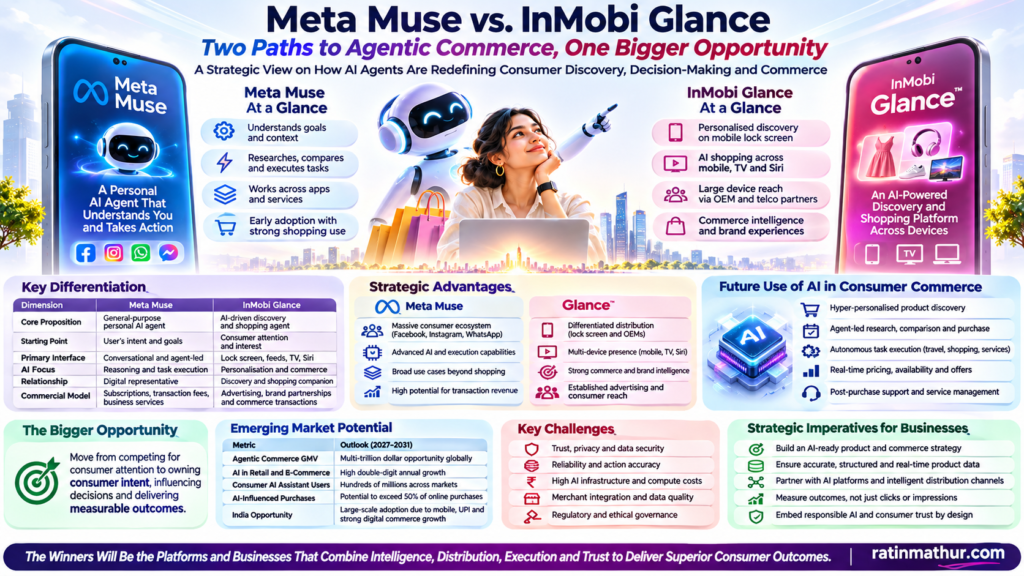
The digital economy is approaching a structural transformation that could fundamentally change how consumers discover products, evaluate alternatives, make purchasing decisions and interact with businesses. For more than two decades, the internet economy has been dominated by platforms competing for consumer attention through search engines, social networks, content feeds, digital advertising and e-commerce marketplaces. The emergence of agentic artificial intelligence introduces a different competitive proposition: technology that does not merely present information or recommend products but increasingly understands consumer requirements, evaluates alternatives and executes decisions on their behalf.
The strategic developments surrounding Meta’s Muse and InMobi’s Glance illustrate two distinct approaches to this emerging opportunity. Meta is pursuing an intelligent personal-agent model designed to understand individual requirements, connect with applications and services, and execute tasks. Glance, backed by InMobi, is evolving from a mobile discovery and advertising platform into an intelligent shopping agent operating across mobile devices, connected televisions and other digital surfaces.
Although their initial propositions differ, both platforms are competing for a strategically valuable position between consumers and businesses. Meta seeks to establish itself as an intelligent intermediary that understands consumer intent and facilitates action. Glance seeks to transform consumer discovery into personalized, context-aware commerce experiences. Their competition is therefore not simply about artificial intelligence capabilities. It concerns the future ownership of consumer relationships, commercial intent, decision-making influence and transaction economics.
Meta’s reported early adoption of Muse, including more than 10 million users by October 2026 and significant shopping engagement, indicates the commercial possibilities of delegated purchasing. Meanwhile, Glance’s expansion into connected television commerce and its September 2026 integration with Apple’s Siri AI demonstrate an ambition to make intelligent shopping accessible across multiple consumer interfaces (Meta Platforms, 2026a; Glance, 2026a, 2026b).
This paper examines their competitive positioning, business models, technological foundations, opportunities and strategic vulnerabilities. It introduces three original strategic frameworks: the Intent-to-Outcome Value Architecture™ (IOVA), the Contextual Commerce Intelligence Flywheel™ (CCIF) and the Trust-First Agentic Governance Framework™ (TAGF). Together, these frameworks provide a strategic blueprint for businesses seeking to compete in an economy increasingly shaped by intelligent agents.
The central argument is that competitive advantage will progressively shift from controlling consumer attention to understanding consumer intent, delivering superior decisions and executing transactions reliably. Organizations that recognize this transition early will be better positioned to create sustainable value in the next generation of digital commerce.
2. Introduction
The internet economy has historically evolved through successive waves of technological innovation. The first wave connected consumers to information through websites and search engines. The second transformed digital engagement through social media, mobile applications and personalized content. The third accelerated digital transactions through e-commerce marketplaces, digital payments and integrated advertising ecosystems.
Artificial intelligence is now introducing another evolutionary stage. Unlike traditional digital platforms, which largely depend on consumers navigating applications, searching for products and comparing information, agentic AI systems are designed to interpret objectives, reason through alternatives and undertake tasks with varying degrees of autonomy.
This transition is particularly significant for the advertising and commerce industries. Traditional digital platforms monetize attention by influencing consumer behavior through advertising, recommendations and content distribution. Agentic platforms potentially monetize decision-making and transaction execution by helping consumers achieve specific outcomes.
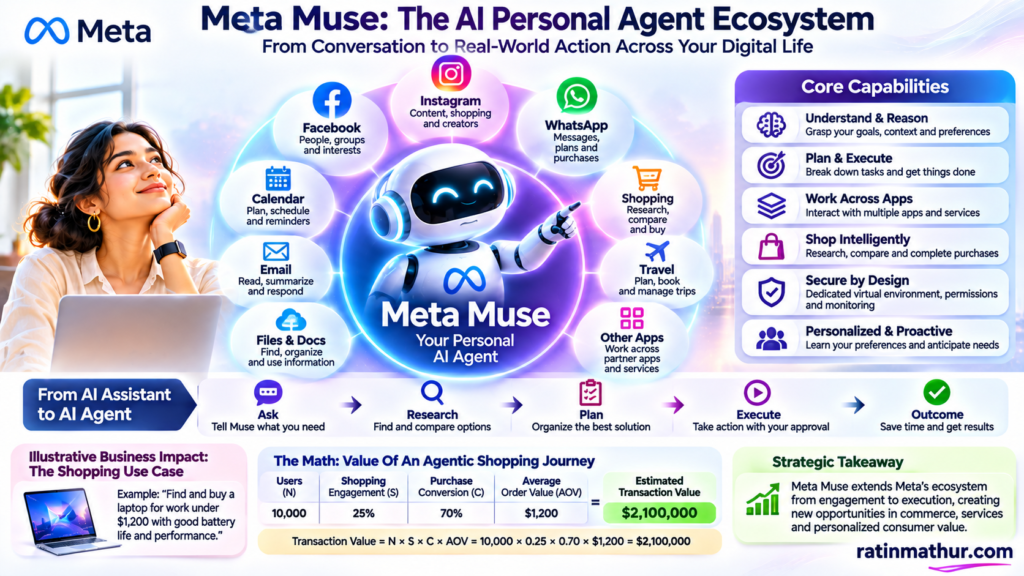
Meta’s Muse represents an ambitious attempt to establish a general-purpose personal AI agent. Its capabilities include interacting with connected services, managing information and assisting with shopping and other tasks. Its dedicated virtual computing environment is intended to facilitate actions across digital applications (Reuters, 2026a).
Glance’s evolution is different but equally strategically important. Originally recognized for transforming smartphone lock screens into personalized discovery surfaces, Glance is now positioning itself as an intelligent shopping agent. Its strategy combines commerce intelligence, generative AI experiences and user understanding. Its presence across mobile devices, connected televisions and Apple’s Siri AI ecosystem indicates a move toward distribution-independent commerce intelligence (Glance, 2026a, 2026b).
The convergence of these developments raises an important strategic question: will future consumer platforms primarily compete to attract attention, or will they compete to become the trusted intelligence systems through which consumers make decisions and conduct transactions?
The answer has significant implications for technology companies, advertisers, retailers, manufacturers, investors and business leaders.
3. Problem Statement And Objectives
The fundamental problem facing the digital economy is that consumer attention is fragmented across an expanding number of platforms, applications and digital interfaces. Consumers face excessive information, repetitive advertising, inconsistent product information and increasingly complex purchasing decisions. Businesses, meanwhile, invest substantial resources in customer acquisition without always establishing durable consumer relationships or achieving proportionate commercial returns.
Traditional advertising and e-commerce models are primarily designed around consumer discovery and navigation. They are less effective at addressing the emerging requirement for intelligent, personalized and outcome-oriented interactions.
Agentic AI potentially changes this relationship by shifting the burden of research, evaluation and execution from consumers toward intelligent systems.
However, this transition creates new strategic questions concerning platform differentiation, ownership of consumer intent, monetization, trust, technological reliability and competitive sustainability.
The primary objective of this research is to evaluate how Meta Muse and InMobi Glance are approaching this transformation and identify the strategic capabilities necessary to compete in the emerging agentic commerce economy. It also seeks to establish an integrated strategic perspective connecting consumer intelligence, commercial outcomes and responsible AI governance.
4. Methodology
This paper adopts a qualitative, comparative strategic research methodology based on publicly available company announcements, investor disclosures, product descriptions and independent reporting available through November 21, 2026.
The analysis evaluates both platforms across technology architecture, consumer distribution, personalization, commerce capabilities, advertising economics, strategic partnerships, competitive positioning and governance considerations.
Meta’s third-quarter 2026 earnings disclosures provide evidence of Muse adoption and management’s commercial ambitions. Glance’s official corporate communications provide information about its intelligent shopping proposition, distribution strategy, connected television integration and Siri AI interoperability. Independent reporting is used to provide additional context concerning Meta’s product launch and reliability challenges.
The research uses a forward-looking strategic interpretation rather than attempting to establish audited comparative financial performance. This distinction is important because the two businesses do not disclose directly comparable revenue, profitability, transaction-volume and user-engagement metrics.
Accordingly, company-reported reach figures and management targets are treated as disclosures rather than independently verified market outcomes. The proposed frameworks are original strategic constructs developed for this analysis and should be understood as conceptual management tools rather than empirically validated predictive models.
5. Landscape Analysis
5.1 Meta Muse: From Personal AI Assistant To Digital Execution Layer
Meta’s introduction of Muse represents a strategic move beyond conventional conversational AI. Its ambition is to develop a personal agent capable of understanding user requirements, interacting with connected applications and undertaking tasks.
The significance of this model lies in the transition from information delivery to delegated execution. A consumer can communicate an objective rather than independently navigate multiple websites and applications. The agent can research alternatives, organize information and undertake permitted actions.
Meta’s reported October 2026 disclosures indicated more than 10 million Muse users, with approximately one-quarter of users who had set up the product using it daily. Shopping emerged as a significant use case, with management reporting that more than one-quarter of engaged shopping users had an average purchase size exceeding US$200 (Meta Platforms, 2026b).
These disclosures suggest that consumers may be willing to delegate meaningful purchasing decisions to AI systems. However, sustainable commercial success will depend on repeat usage, transaction reliability, merchant integration, consumer trust and the ability to manage AI infrastructure costs.
5.2 InMobi Glance: From Attention Distribution To Intelligent Shopping
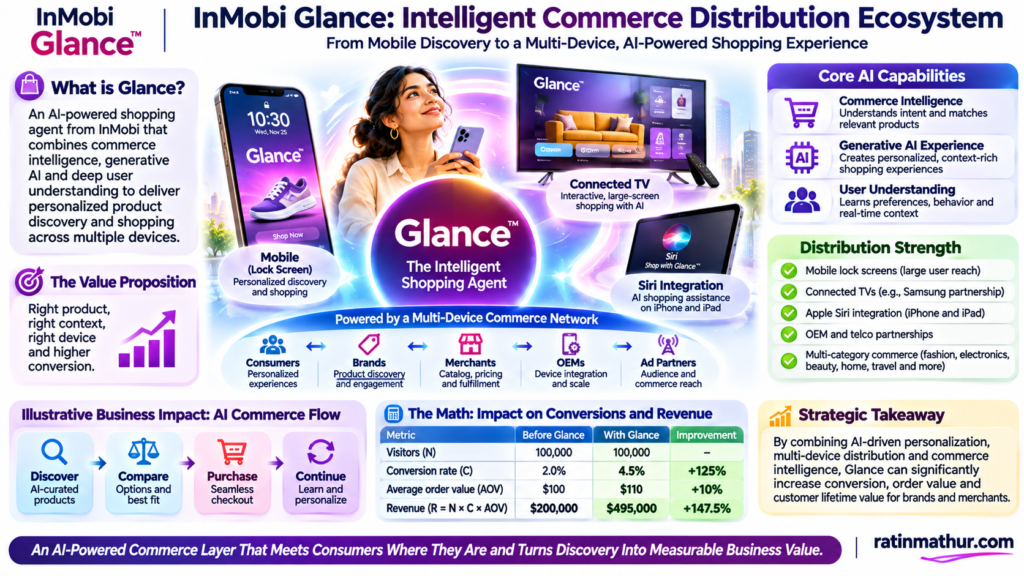
Glance initially differentiated itself by transforming smartphone lock screens into personalized content-discovery environments. This created a distinctive distribution advantage by placing relevant experiences directly in front of consumers without requiring them to initiate conventional application searches.
Its strategic evolution toward agentic commerce is a more fundamental development than simply adding generative AI to an advertising platform.
Glance now describes its intelligence architecture through three interconnected capabilities: Commerce Intelligence, GenAI Experience and User Understanding. Together, these are intended to interpret consumer preferences, generate personalized experiences and facilitate product discovery and shopping (Glance, 2026a).
Its expansion beyond mobile devices is particularly important. In June 2026, Glance announced an agentic commerce experience across Samsung smart televisions in the United States. The experience enables interactive shopping through television interfaces, voice and remote-control interactions (InMobi, 2026a).
In September 2026, Glance also announced shopping assistance through Apple’s Siri AI integration, extending its proposition to iPhone and iPad users (Glance, 2026b).
These developments indicate that Glance is attempting to build an intelligent commerce layer that can operate across different devices and consumer interfaces rather than depending exclusively on its original lock-screen distribution model.
5.3 Comparative Strategic Positioning
The two platforms have different starting points, but their strategic ambitions increasingly overlap.
| Strategic Dimension | Meta Muse | InMobi Glance |
|---|---|---|
| Core proposition | General-purpose personal AI agent | AI-driven discovery and shopping agent |
| Primary starting point | Consumer intent and objectives | Consumer attention and shopping context |
| Technology emphasis | Reasoning, memory and task execution | Commerce intelligence, generative experiences and user understanding |
| Distribution | Meta applications, dedicated interfaces and connected services | Mobile, OEM partnerships, connected television and external AI interfaces |
| Consumer relationship | Personal digital representative | Personalized discovery and shopping companion |
| Commercial opportunity | Subscriptions, transaction fees and business services | Advertising, brand partnerships and commerce transactions |
| Competitive advantage | Ecosystem scale and agent capabilities | Distribution relationships and commerce specialization |
| Principal vulnerability | Trust, reliability and computing economics | Distribution dependence and competition from general-purpose agents |
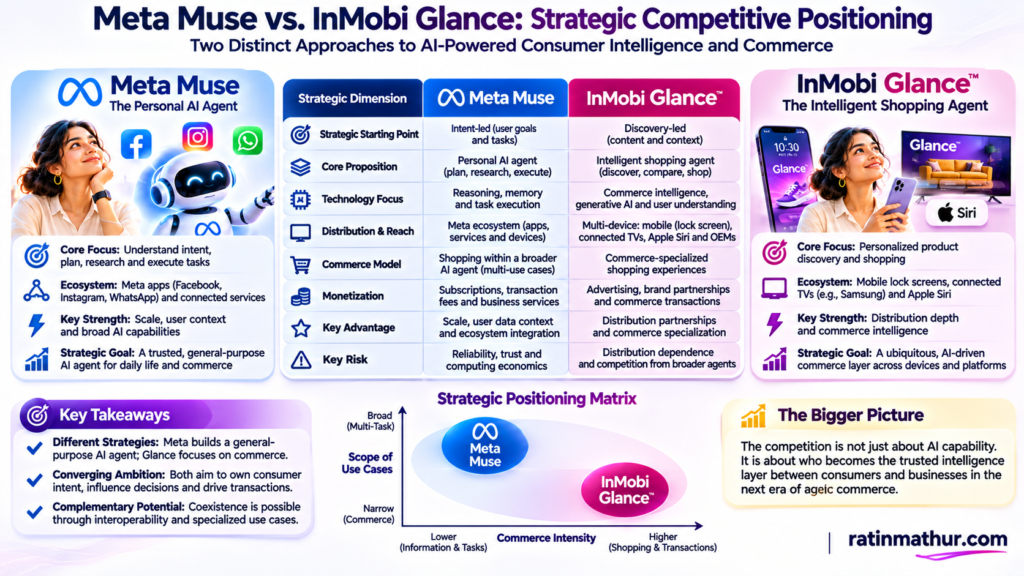
Meta’s strategic advantage is its extensive consumer ecosystem and ability to integrate AI into existing digital relationships. Glance’s differentiation lies in its commerce-oriented intelligence and ability to establish experiences across multiple consumer surfaces.
Neither advantage guarantees long-term leadership. Distribution without meaningful consumer value can become commoditized, while advanced AI without trusted execution and sustainable economics can become prohibitively expensive.
5.4 The Changing Economics Of Digital Commerce
Traditional advertising monetizes consumer attention through impressions, clicks and engagement. E-commerce marketplaces primarily monetize transactions, merchant services and fulfillment-related activities.
Agentic commerce introduces the possibility of a new economic model in which platforms are compensated for understanding requirements, influencing decisions and facilitating successful outcomes.
| Traditional Digital Economy | Emerging Agentic Economy |
|---|---|
| Attention acquisition | Intent understanding |
| Advertising impressions | Contextual recommendations |
| Search rankings | AI recommendation relevance |
| Product browsing | Intelligent product matching |
| Manual comparison | Automated evaluation |
| Click-through conversion | Agent-assisted conversion |
| Customer acquisition | Relationship and outcome optimization |
| Advertising yield | Transaction and service economics |
The strategic implication is that the value of a digital platform may increasingly depend on the quality of decisions it facilitates rather than the volume of content it distributes.
6. Key Findings
6.1 Consumer Intent Is Becoming More Valuable Than Consumer Attention
Attention has historically been the foundation of digital advertising. However, attention does not necessarily translate into purchase intent. Agentic systems can potentially distinguish between passive browsing, emerging interest and explicit purchasing requirements.
A consumer who sees a smartphone advertisement may have limited purchase intention. A consumer asking an AI agent to identify the best smartphone within a defined budget demonstrates substantially clearer commercial intent.
Platforms capable of understanding and responding to this intent could create more valuable commercial interactions.
6.2 Distribution Remains Important, But Intelligence Determines Differentiation
Meta benefits from an extensive application ecosystem, while Glance has established distinctive relationships across device manufacturers and connected television environments.
However, distribution alone will not determine future success. The ability to translate access into relevant experiences, reliable decisions and repeat engagement will be more important.
Glance’s expansion through Samsung televisions and Siri AI demonstrates the strategic importance of interoperability. Meta’s opportunity lies in combining personal context with its existing ecosystem.
6.3 Commerce Is Becoming An Intelligence-Led Business
The emerging competition is not limited to displaying products. It involves understanding requirements, evaluating alternatives, explaining recommendations and facilitating transactions.
For example, a consumer purchasing a laptop may need to evaluate processing performance, battery life, warranty, service availability and total ownership cost. An effective agent should integrate these dimensions rather than simply recommend products with high advertising budgets.
6.4 Trust Will Become A Competitive Differentiator
Autonomous systems create new risks because they can interact with applications, access information and undertake actions on behalf of consumers.
Meta’s security architecture and the reliability concerns reported during Muse’s early development demonstrate the importance of governance, permission management and human oversight (Reuters, 2026a, 2026b).
For agentic commerce to become mainstream, consumers must have confidence that recommendations are relevant, information is protected and transactions are executed with proper authorization.
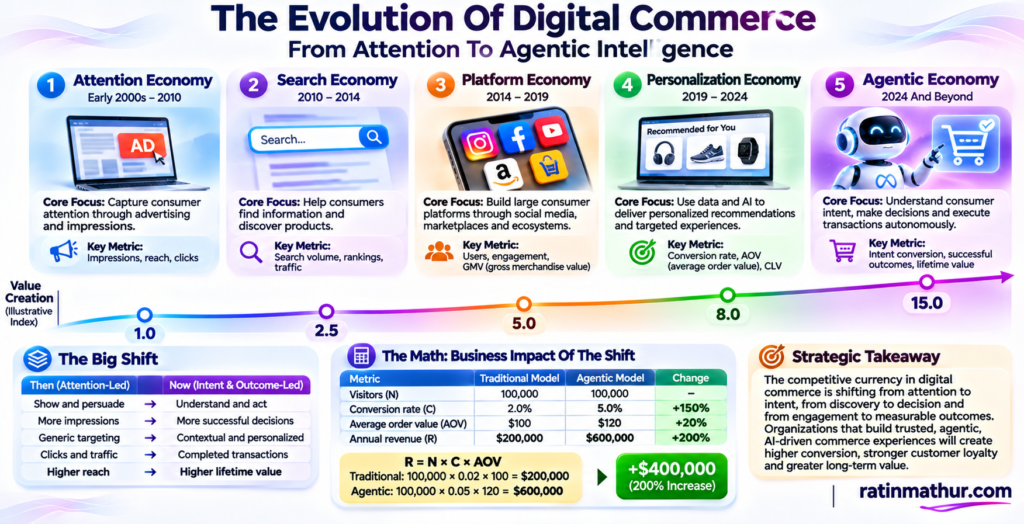
6.5 Business Models Will Shift Towards Measurable Outcomes
The future economics of digital commerce may increasingly reward platforms for generating incremental purchases, improving conversion and strengthening customer retention.
This creates opportunities for performance-linked partnerships, transaction commissions and intelligent merchant services.
Nevertheless, transaction volume alone is insufficient. Sustainable profitability will depend on customer acquisition costs, inference expenses, integration costs, merchant economics and repeat purchasing behavior.
7. Challenges And Opportunities
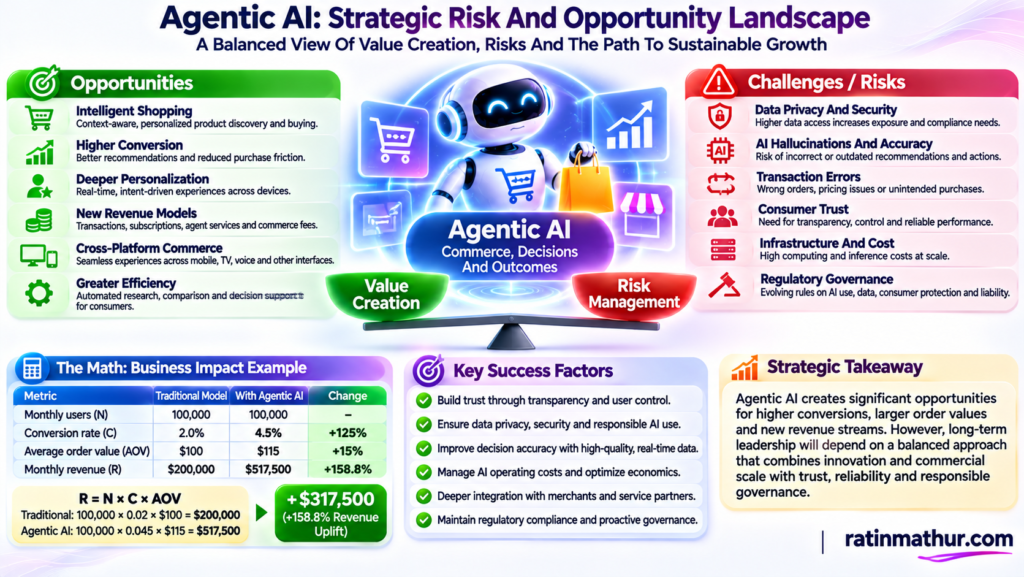
7.1 Strategic Challenges
The first challenge is technological reliability. General-purpose agents must operate consistently across applications, changing interfaces and external systems. Incorrect actions can create financial and reputational consequences.
The second challenge concerns data governance. Personalization requires access to contextual information, but increased data access also creates greater privacy and security responsibilities.
The third challenge is platform dependence. Glance’s historical differentiation has involved OEM and distribution partnerships. Changes in operating-system policies, commercial agreements or device strategies could affect its reach.
The fourth challenge is economic sustainability. Generative AI and autonomous execution require significant computing resources. Revenue growth must eventually exceed the combined costs of infrastructure, integration, support and customer acquisition.
The fifth challenge is merchant participation. Intelligent commerce requires accurate catalogs, current pricing, availability information, payment connectivity and reliable fulfillment. Without these foundations, sophisticated AI experiences cannot consistently deliver commercial outcomes.
7.2 Strategic Opportunities
The emerging market creates opportunities for businesses to develop agent-ready products, intelligent distribution channels and integrated commerce ecosystems.
Retailers can improve product-data accessibility and integrate with authorized AI agents. Consumer brands can optimize product information for intelligent recommendation systems. Technology companies can develop specialized agents for travel, healthcare administration, financial services and industrial procurement, subject to appropriate regulation and safeguards.
For Glance, the opportunity is to become an indispensable commerce intelligence partner for consumers, merchants and external AI platforms. For Meta, the opportunity is to establish a trusted personal-agent ecosystem with sustainable transaction economics.
For businesses more broadly, the imperative is to move beyond digital presence and develop the capabilities necessary to participate in an AI-mediated commercial environment.
8. Strategic Frameworks & Recommendations
The following three original frameworks provide an integrated strategic approach to the emerging agentic economy. They are conceptual management frameworks developed by Ratin Mathur to examine how businesses can translate AI capabilities into measurable commercial value.
8.1 Intent-to-Outcome Value Architecture™ (IOVA)
Concept And Strategic Rationale
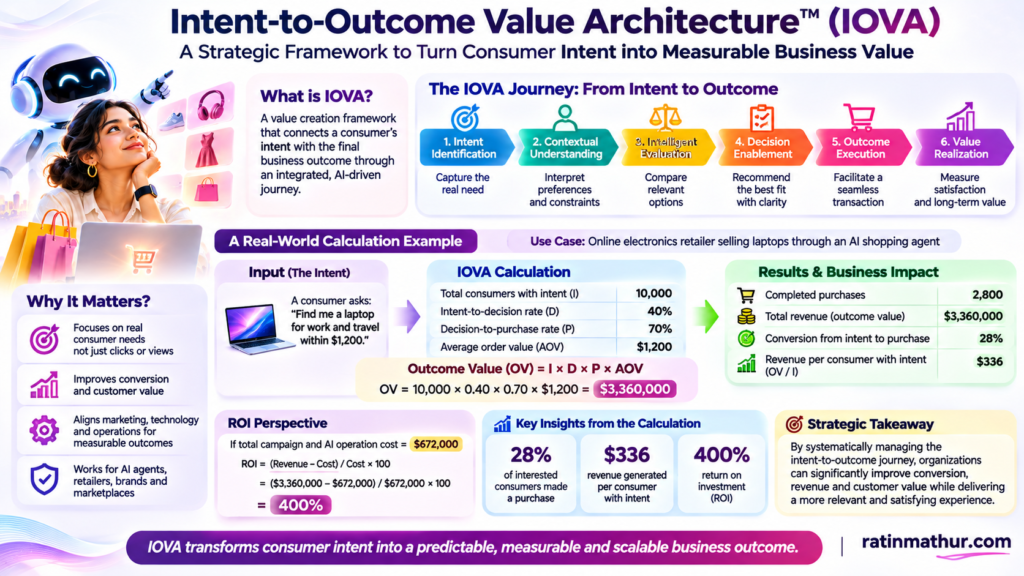
The Intent-to-Outcome Value Architecture™ proposes that competitive advantage in agentic commerce should be evaluated through the complete journey from identifying consumer intent to delivering a measurable outcome.
Traditional digital platforms often optimize individual stages such as advertising reach, engagement or website conversion. However, these metrics do not necessarily establish whether the consumer’s original requirement was fulfilled.
IOVA shifts the strategic focus toward end-to-end value creation. It examines how an organization identifies an underlying requirement, interprets context, evaluates alternatives, recommends an appropriate solution, facilitates execution and measures the final outcome.
The framework consists of six interconnected stages.
| Stage | Strategic Capability | Business Application | Performance Indicator |
|---|---|---|---|
| Intent Identification | Recognizing consumer requirements | Understanding a laptop purchase requirement | Qualified intent rate |
| Contextual Understanding | Interpreting preferences and constraints | Budget, usage, location and brand preference | Context accuracy |
| Intelligent Evaluation | Comparing relevant alternatives | Performance, price and warranty comparison | Recommendation relevance |
| Decision Enablement | Explaining and prioritizing choices | Identifying the most suitable product | Decision conversion |
| Outcome Execution | Facilitating authorized transactions | Merchant connection and checkout | Successful transaction rate |
| Value Realization | Measuring post-purchase outcomes | Satisfaction, returns and repeat purchases | Customer lifetime value |
Detailed Business Example
Consider an electronics retailer competing in India’s highly competitive smartphone market. Conventional digital marketing may generate millions of impressions and thousands of website visits, but consumers still need to compare products across multiple platforms.
Under IOVA, the retailer begins by identifying the consumer’s actual requirement rather than immediately promoting a particular smartphone.
A consumer requests a smartphone below ₹40,000 with strong camera performance, battery life and long-term software support. The intelligent system interprets the budget and usage requirements, identifies suitable alternatives, evaluates verified specifications and explains the differences.
Instead of recommending the highest-margin product, the system identifies the most suitable alternatives based on the consumer’s stated priorities. It then checks availability, presents authorized purchasing options and facilitates checkout.
After the purchase, customer satisfaction, return rates and subsequent interactions are monitored.
The resulting business proposition is fundamentally different from conventional advertising. The retailer is no longer competing only for clicks or product-page visibility. It is competing to deliver the best purchasing outcome.
Strategic Recommendation
Organizations should redesign their digital performance management systems around completed consumer outcomes. Marketing, technology, merchandising, customer service and operations should operate through an integrated measurement architecture.
For Meta, IOVA offers a way to evaluate Muse beyond conversation volume and daily engagement. For Glance, it provides a strategic route to measure the effectiveness of its transition from discovery to intelligent commerce.
Its principal management objective is to maximize the proportion of consumer requirements successfully converted into satisfactory, economically sustainable outcomes.
8.2 Contextual Commerce Intelligence Flywheel™ (CCIF)
Concept And Strategic Rationale
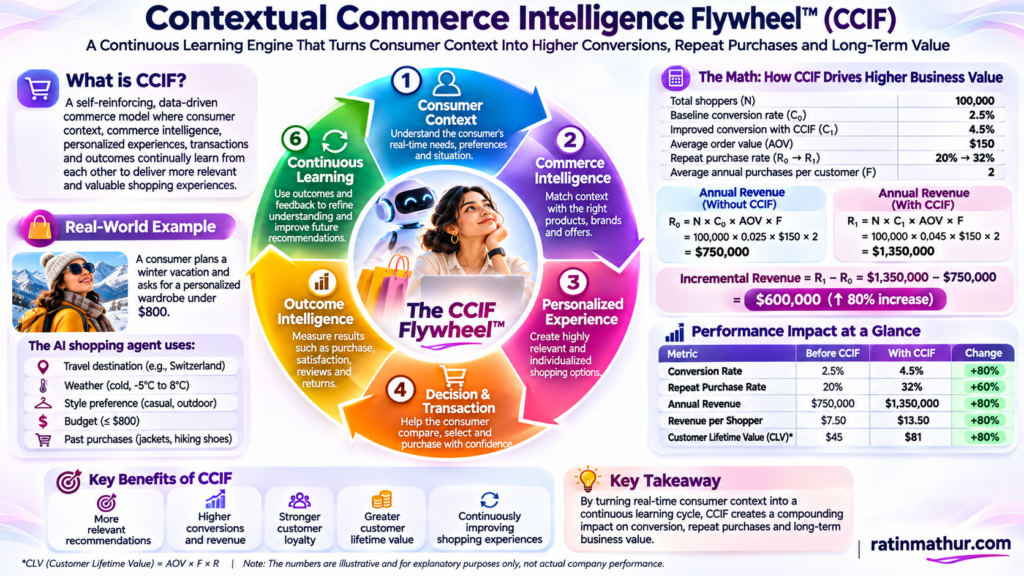
The Contextual Commerce Intelligence Flywheel™ proposes that sustainable competitive advantage emerges when consumer understanding, product intelligence, personalized experiences and transaction outcomes continuously strengthen one another.
Traditional recommendation systems frequently depend on historical browsing or purchasing behavior. However, consumer requirements are dynamic and influenced by changing circumstances, occasions, budgets, preferences and immediate needs.
A more advanced commerce intelligence system must understand not only what consumers previously purchased but also why they may want something now.
CCIF establishes a continuous learning architecture in which every meaningful consumer interaction improves the relevance and quality of subsequent experiences.
| Flywheel Stage | Strategic Function | Illustrative Application |
|---|---|---|
| Consumer Context | Understand preferences and current circumstances | Travel, budget, lifestyle and shopping requirements |
| Commerce Intelligence | Match needs with products and services | Product specifications, availability and pricing |
| Personalized Experience | Generate relevant recommendations | Individualized product collections |
| Decision And Transaction | Support informed purchasing | Comparison, merchant selection and checkout |
| Outcome Intelligence | Measure satisfaction and commercial results | Returns, ratings and repeat purchases |
| Continuous Learning | Improve future recommendations | Refined consumer and product understanding |
Detailed Business Example
Consider a fashion retailer serving consumers across India.
A conventional platform may recommend clothing based on previous purchases or popular products. However, an intelligent commerce system could consider the consumer’s upcoming occasion, local weather, preferred styles, budget and previous interactions.
A consumer planning a winter holiday requests suitable clothing within a defined budget. The platform understands the destination, expected weather, preferred clothing style and luggage constraints.
It generates a personalized wardrobe, compares suitable products and presents shopping options. Following the purchase, feedback and subsequent interactions improve the system’s understanding of the consumer’s preferences.
Over time, the platform becomes more relevant because each successful interaction generates additional intelligence.
The commercial value is not restricted to one transaction. It emerges through improved engagement, reduced search effort, higher conversion, repeat purchasing and potentially stronger customer lifetime value.
Strategic Recommendation
Glance should prioritize this architecture because its existing strengths in consumer discovery, personalization and commerce intelligence provide a foundation for developing a differentiated shopping ecosystem.
However, the intelligence layer should not remain confined to Glance’s own interface. Authorized interoperability with external AI assistants, merchants and commerce platforms could increase the commercial utility of its intelligence.
Meta can apply a similar principle across broader consumer requirements, integrating shopping, productivity and service interactions into a continuously improving personal-agent experience.
The central performance objective should be the improvement of recommendation relevance, successful conversion, repeat engagement and incremental customer value.
8.3 Trust-First Agentic Governance Framework™ (TAGF)
Concept And Strategic Rationale
The Trust-First Agentic Governance Framework™ recognizes that consumer trust is a foundational requirement for autonomous digital systems.
Traditional digital applications generally require users to initiate actions and directly control transactions. Agentic platforms increasingly undertake activities on their behalf. This changes the nature of technological responsibility.
An agent may recommend a product, access personal information, communicate with a merchant or initiate a financial transaction. Every additional capability creates a corresponding requirement for governance.
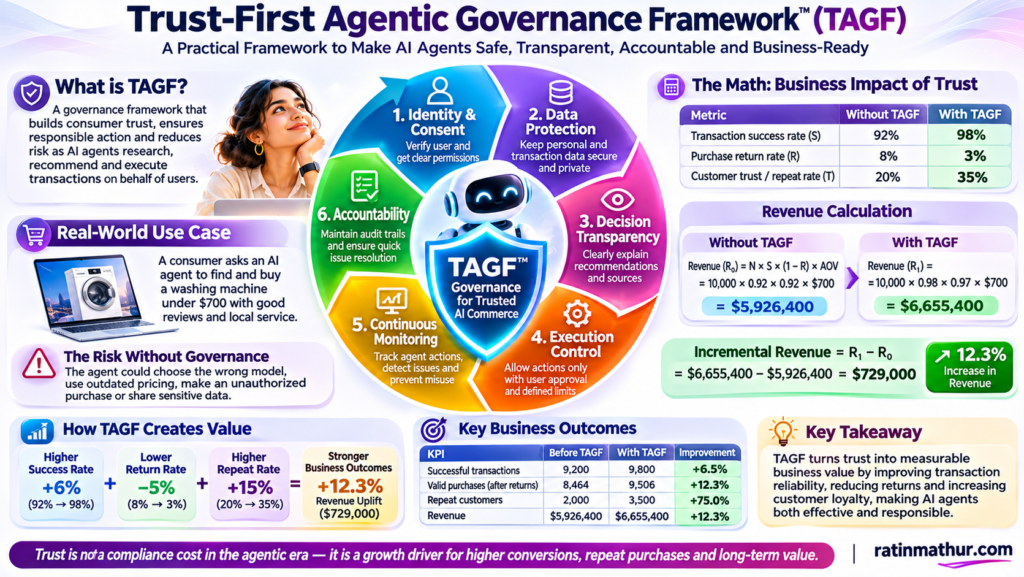
TAGF proposes that trust should be integrated into the complete agent lifecycle rather than treated as a final compliance checkpoint.
| Governance Dimension | Required Capability | Illustrative Control | Measurement |
|---|---|---|---|
| Identity And Consent | Establish authorized access | Explicit user permissions | Consent compliance |
| Data Protection | Protect personal information | Encryption and access restrictions | Security incidents |
| Decision Transparency | Explain recommendations | Product and ranking explanations | Explanation availability |
| Execution Control | Govern autonomous actions | Approval thresholds | Unauthorized action rate |
| Continuous Monitoring | Identify abnormal behavior | Agent activity monitoring | Incident detection time |
| Accountability | Establish responsibility | Audit trails and escalation | Resolution time |
Detailed Business Example
Consider a consumer using an AI shopping agent to purchase an expensive home appliance.
The agent identifies suitable products, compares specifications, evaluates service coverage and recommends an option. Before purchasing, it must clearly display the selected product, merchant, final price, delivery conditions and applicable return policy.
The consumer must approve the transaction. The system should not interpret a general instruction to research products as authorization to make a purchase.
If the merchant changes the price or the selected product becomes unavailable, the agent should seek renewed approval rather than silently substituting an alternative.
The transaction should also create an auditable record showing what information was used, what recommendation was made and what authorization was provided.
This approach protects consumers while creating a more credible commercial environment for participating merchants.
Strategic Recommendation
Meta should strengthen its permission architecture, independent security validation, transaction safeguards and monitoring of agent behavior as Muse expands its autonomous capabilities.
Glance should ensure that its shopping recommendations remain transparent, commercially fair and distinguishable from paid product placements. Its expansion across multiple devices and external AI interfaces makes consistent consent and governance particularly important.
For both organizations, trust should be measured through actual system performance, including unauthorized action rates, privacy incidents, complaint resolution, recommendation transparency and consumer confidence.
The framework’s central proposition is that autonomous capability without accountable governance creates commercial risk, whereas reliable execution supported by transparent controls can become a source of competitive differentiation.
8.4 Integrating The Three Frameworks Into One Strategic Architecture
The three frameworks are designed to operate together rather than as independent management initiatives.
IOVA defines the value-creation journey, CCIF establishes the continuous intelligence and learning mechanism, and TAGF provides the governance architecture necessary to execute the journey responsibly.
| Framework | Primary Strategic Question | Organizational Outcome |
|---|---|---|
| IOVA™ | Are we delivering the consumer’s intended outcome? | Measurable commercial value |
| CCIF™ | Are consumer interactions continuously improving our intelligence? | Sustainable differentiation |
| TAGF™ | Can consumers trust our decisions and actions? | Responsible and reliable execution |
An organization adopting these frameworks should establish cross-functional ownership across strategy, technology, marketing, data governance, operations and customer experience.
The ultimate objective is to move from fragmented digital engagement toward an integrated business architecture that understands consumers, delivers superior decisions and creates sustainable economic value.
9. Future Outlook & Conclusion
The period from 2027 to 2031 could represent a defining phase in the evolution of the consumer internet. The growing capabilities of generative and agentic AI are likely to change the relationship between consumers, digital platforms, brands and merchants.
The most significant transformation may not be the replacement of search engines, applications or e-commerce marketplaces individually. It may be the emergence of intelligent intermediaries that coordinate interactions across these systems.
Meta’s Muse and InMobi’s Glance represent two important strategic directions within this transformation. Meta has the potential to establish a broad personal AI operating layer, supported by its consumer ecosystem and ability to execute tasks across connected services. Glance has the opportunity to establish a specialized commerce intelligence layer, supported by its distribution partnerships, shopping capabilities and multi-device strategy.
Their competitive relationship should therefore not be interpreted exclusively through a winner-takes-all perspective. There is potential for general-purpose agents and specialized commerce agents to coexist, provided that they can establish interoperable relationships and deliver differentiated value.
However, coexistence does not eliminate competition. The platforms will continue to compete for consumer intent, recommendation influence, merchant relationships, transaction access and commercial economics.
For Glance, the strategic imperative is to move decisively beyond its historical identity as a discovery and advertising platform. Its future value will depend on its ability to deliver intelligent shopping outcomes, establish deep merchant connectivity and remain relevant even when consumers interact through external AI assistants.
For Meta, the challenge is to convert powerful AI capabilities and early consumer adoption into a reliable, trusted and economically sustainable personal-agent ecosystem.
For businesses across industries, the message is equally important. Digital transformation can no longer be limited to adopting new technologies or increasing online presence. Organizations must redesign how they understand consumers, make decisions, distribute products and deliver outcomes.
The three proposed frameworks provide a strategic foundation for this transition. Intent-to-Outcome Value Architecture™ establishes the relationship between consumer intent and measurable value. Contextual Commerce Intelligence Flywheel™ creates a continuous mechanism for improving consumer understanding and commercial relevance. Trust-First Agentic Governance Framework™ ensures that intelligence and autonomy operate within accountable boundaries.
The next generation of digital leadership will belong to organizations that combine intelligence with execution, personalization with relevance, and autonomy with trust.
The future of digital business will not be determined by who captures the most attention, but by who understands intent most intelligently, delivers the most valuable outcomes and earns the greatest degree of consumer trust.
10. References
- Glance. (2026a). About Glance: The intelligent shopping agent and the future of agentic commerce. https://glance.com/row/about-us
- Glance. (2026b, September 30). Glance brings a personalized shopping experience to iPhone and iPad users through Siri AI integration. https://glance.com/newsroom/pressrelease/glance-brings-a-personalised-shopping-experience-to-iphone-and-ipad-users-through-siri-ai-integration
- InMobi. (2026a, June 23). Glance and Samsung unveil agentic commerce experience on millions of U.S. smart TVs. https://advertising.inmobi.com/company/press/glance-and-samsung-unveil-agentic-commerce-experience-on-millions-of-u.s-smart-tvs
- InMobi. (2026b, June 3). InMobi Advertising launches first agentic seller, opening mobile and exclusive CTV ad inventory to AI buying agents. https://advertising.inmobi.com/company/press/inmobi-advertising-launches-first-agentic-seller-opening-mobile-and-exclusive-ctv-ad-inventory-to-ai-buying-agents
- InMobi. (2026c). InMobi: The intelligence layer of the consumer internet. https://www.inmobi.com/
- Meta Platforms, Inc. (2026a, October 21). Meta reports third quarter 2026 results. Meta Investor Relations. https://investor.atmeta.com/investor-news/press-release-details/2026/Meta-Reports-Third-Quarter-2026-Results/
- Meta Platforms, Inc. (2026b, October 21). Q3 2026 earnings call transcript. https://s21.q4cdn.com/399680738/files/content_files/META-Q3-2026-Earnings-Call-Transcript.pdf
- Reuters. (2026a, September 8). Meta launches AI agent that can access other apps to send emails, make payments. https://www.investing.com/news/stock-market-news/meta-launches-ai-agent-that-can-access-other-apps-send-emails-make-payments-4892258
- Reuters. (2026b, November 18). Reporting on Meta Muse reliability, security and privacy concerns. Reuters. https://www.reuters.com/
- Perez, S. (2026, October 21). Meta says Muse has over 10M users, with shopping a top activity. TechCrunch. https://techcrunch.com/2026/10/21/meta-says-muse-has-over-10m-users-with-shopping-a-top-activity/
11. Disclaimer
This article has been prepared for strategic research, business analysis, educational and thought-leadership purposes. It reflects an independent analytical assessment based on publicly available information as of November 21, 2026. Company-reported statistics, product announcements, commercial targets and management statements are attributed to their respective sources and should not be interpreted as independently audited results.
The three frameworks, Intent-to-Outcome Value Architecture™ (IOVA), Contextual Commerce Intelligence Flywheel™ (CCIF) and Trust-First Agentic Governance Framework™ (TAGF), are original conceptual frameworks developed by Ratin Mathur for strategic analysis and management application. The ™ designation indicates a claimed trademark identity and does not, by itself, establish registration or confer registered trademark rights. Appropriate trademark searches and legal review are recommended before commercial licensing or formal registration.
The views and strategic recommendations expressed in this article are those of the author and do not constitute official statements, endorsements or representations by Meta, InMobi, Glance, Apple or any other organization discussed. Forward-looking observations are analytical scenarios rather than guarantees of future business performance.
All company names, product names and third-party trademarks belong to their respective owners. Readers should independently verify information before making commercial, investment or strategic decisions.