Beyond Automation And Economic Growth: A Strategic Blueprint For Preserving Human Potential In An Increasingly Automated World
Executive Summary
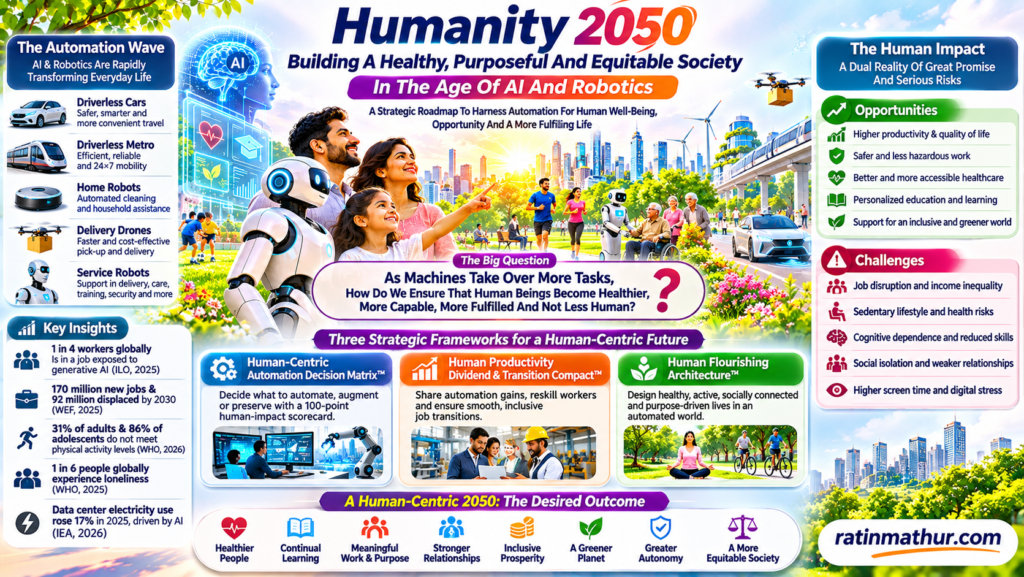
Humanity is approaching one of the most consequential transitions in its economic and social evolution. Artificial intelligence (AI), robotics, autonomous vehicles, humanoid machines, intelligent infrastructure, and automated services are progressively transforming how people work, travel, learn, communicate, consume, and live. Activities that have historically required human physical effort and intellectual capabilities are increasingly being performed by machines. This transformation promises higher productivity, improved safety, convenience, better access to healthcare, and potentially greater leisure. However, it raises a much more fundamental question: what happens to human beings when technology progressively removes the need to work, move, think, interact, and perform everyday activities?
The challenge extends far beyond technological unemployment. An excessively automated society could experience declining physical activity, unhealthy lifestyles, cognitive dependency, digital overload, social isolation, economic inequality, weakened practical skills, and loss of purpose. These outcomes are not inevitable consequences of technology, but they represent interconnected risks that economic and social planning must address before they become structural problems.
The International Labour Organization (ILO, 2025) estimates that approximately one in four workers globally is employed in an occupation with some degree of exposure to generative AI. Its research suggests that transformation of existing jobs is generally more likely than complete occupational elimination. Meanwhile, the World Economic Forum (WEF, 2025) projects that broader technological, demographic, economic, and environmental transitions could create 170 million jobs and displace 92 million by 2030, resulting in a projected net increase of 78 million jobs. These are employer-based projections across multiple structural changes, not estimates of jobs lost exclusively to AI.
This paper argues that technological progress must be evaluated through a broader human development perspective. Economic productivity cannot remain the sole measure of success. Physical and mental health, cognitive capability, meaningful employment, social relationships, individual autonomy, equitable wealth distribution, and environmental sustainability must become equally important considerations.
To translate this philosophy into practical action, the paper introduces three proposed strategic frameworks: the Human-Centric Automation Decision Matrix™, the Human Productivity Dividend & Transition Compact™, and the Human Flourishing Architecture™. Together, they address technology investment decisions, workforce and economic transformation, and the preservation of human well-being.
The paper also proposes a transition from an employment-centric economic model towards a human-centric society in which automation reduces unnecessary hardship while productivity gains create better opportunities, stronger social protection, improved health, and more meaningful human activity. With particular attention to India, it presents a strategic pathway towards 2050 in which technological advancement and human development reinforce each other.
The central proposition is that the ultimate success of AI and robotics should not be determined by how much human effort machines eliminate, but by how effectively technology enables humanity to flourish.
Introduction
Every major technological revolution has transformed the relationship between humans, work, and economic production. Agricultural mechanization reduced dependence on manual farming. Industrialization introduced machines capable of manufacturing at unprecedented scale. Computers automated information processing, while the internet transformed communication, commerce, and access to knowledge. Each transition disrupted certain occupations while generating new industries, economic opportunities, and working models.
The emerging AI and robotics revolution is different in one important respect: it is simultaneously advancing physical automation, cognitive automation, and social interaction automation. Autonomous vehicles can perform transportation activities, industrial robots can undertake repetitive manufacturing operations, generative AI can produce reports and software, and increasingly sophisticated machines can provide household assistance and customer interaction.
The scale of industrial automation is already measurable. According to the International Federation of Robotics (IFR, 2025), 542,000 industrial robots were installed worldwide in 2024, more than double the number installed a decade earlier. India recorded 9,120 industrial robot installations in 2024, a 7% increase over the previous year, making it the sixth-largest installer of industrial robots globally.
The next phase could extend automation from factories into homes, offices, hospitals, transport networks, educational institutions, retail establishments, and public infrastructure. A household may eventually use intelligent machines for cleaning, cooking assistance, security, shopping, and transportation, while AI manages scheduling, learning, personal administration, and information retrieval.
These developments could substantially improve living standards. Yet they could also fundamentally change human behavior. When physical effort disappears from everyday activities, people must deliberately preserve physical fitness. When AI performs research and analysis, people must consciously maintain independent reasoning. When virtual companions and automated services become widely available, societies must protect genuine human relationships.
The United Nations Development Programme’s Human Development Report 2025, A Matter of Choice: People and Possibilities in the Age of AI, presents a particularly relevant perspective. It emphasizes that human development in the age of AI depends on the choices societies make and their ability to use technology to expand people’s opportunities, capabilities, and freedoms (United Nations Development Programme, 2025).
This raises a fundamental issue for policymakers and business leaders. Is the purpose of technological progress to make machines increasingly capable, or to make human beings healthier, more capable, and more fulfilled?
Humanity 2050 should therefore be understood not merely as a technology forecast, but as a strategic blueprint for designing a society in which technological advancement remains aligned with human development.
Problem Statement & Objectives
The central problem is the growing possibility of a disconnect between machine productivity and human well-being. Businesses may achieve higher output with fewer employees, households may become increasingly dependent on automated services, and individuals may spend more time interacting with digital systems while undertaking less physical and social activity.
Traditional economic systems have linked employment, income, identity, social participation, and personal independence. As technology changes this relationship, societies must reconsider how people earn income, maintain their capabilities, contribute to communities, and find meaning beyond conventional employment.
The implications extend across multiple generations. Children growing up in digitally intensive environments may develop strong technology familiarity but receive insufficient opportunities for physical activity, independent problem-solving, and social learning. Working professionals may encounter occupational displacement or declining demand for certain skills. Older people may benefit from assistive technology but become increasingly dependent on automated services. Low-income households may experience disruption without necessarily having the resources to access new opportunities.
This paper examines five interconnected objectives. It evaluates the impact of AI and robotics on human health, employment, intelligence, relationships, economic security, and autonomy. It analyses the opportunities and risks of increasing automation, with particular attention to India. It identifies the responsibilities of governments, businesses, investors, technology developers, educational institutions, and individuals. It proposes three actionable strategic frameworks for responsible automation and human development. Finally, it establishes a long-term pathway towards a healthier, more purposeful, inclusive, and economically equitable society by 2050.
Methodology
This paper adopts a qualitative, evidence-informed strategic research methodology based on secondary research, institutional publications, technology adoption data, employment projections, public health evidence, and policy analysis.
The evidence base includes research and publications from the United Nations Development Programme, International Labour Organization, World Economic Forum, World Health Organization, International Monetary Fund, International Federation of Robotics, International Energy Agency, and NITI Aayog.
The analysis uses a systems-thinking approach to examine how automation influences multiple dimensions of human development simultaneously. For example, autonomous transportation can improve mobility and convenience while potentially reducing incidental walking. AI-assisted education can improve access to knowledge while creating a risk of excessive intellectual dependence if students stop practicing independent problem-solving. Industrial robotics can improve employee safety while creating employment transition challenges.
The analysis distinguishes observed evidence from projections, potential consequences, and strategic recommendations. The three proposed frameworks are original conceptual models developed through this research synthesis. They are not presented as validated international standards or established scientific indices.
The year 2050 represents the strategic planning horizon rather than a prediction that all technologies or societal changes discussed will materialize by that date.
Landscape Analysis
1. The Expansion Of Physical, Cognitive And Social Automation
Automation is moving beyond conventional industrial applications into increasingly diverse areas of human activity.
Physical automation includes autonomous transportation, robotic manufacturing, household cleaning systems, automated logistics, delivery drones, and assistive robots. Cognitive automation includes AI-enabled research, financial analysis, software development, content creation, planning, and decision support. Social automation includes virtual assistants, conversational agents, digital companions, and service robots.
The convergence of these technologies could fundamentally alter the organization of daily life. A future household may require fewer routine human interventions, while businesses may operate with smaller teams supported by intelligent systems. Healthcare may combine human professionals with continuous digital monitoring and robotic assistance. Education may integrate personalized AI tutors with human teachers and mentors.
However, technological capability should not be confused with universal affordability or immediate adoption. Deployment depends on capital costs, infrastructure, safety, reliability, regulation, public acceptance, and the economics of each application. The speed of adoption will vary substantially across countries, industries, and income groups.
2. The Employment And Economic Landscape
The WEF’s Future of Jobs Report 2025 estimates that 170 million new jobs could be created and 92 million displaced by 2030 through multiple structural transitions. The resulting net increase of 78 million jobs does not mean that every displaced worker will successfully transition into a new occupation. Nor does it imply that new jobs will emerge in the same locations, industries, or skill categories as those that disappear.
The ILO’s 2025 research finds that one in four workers globally is in an occupation with some degree of generative AI exposure. Importantly, occupational exposure is not equivalent to job elimination. Many occupations will be redesigned as AI changes the tasks performed within them.
This creates three important workforce challenges: technological unemployment, underemployment, and occupational polarization. Some workers may lose their existing roles, others may find employment below their previous skill levels, while demand for certain high-skilled and frontline occupations may increase.
The distribution of economic gains is equally important. Research by Rockall, Mendes Tavares, and Pizzinelli (2025) at the International Monetary Fund examines competing effects of AI on wages and wealth. Its model-based analysis shows that higher-income workers may benefit from AI complementarity and capital ownership, potentially increasing wealth inequality even where certain wage inequality effects move in the opposite direction.
Consequently, the economic question is not simply how much automation increases productivity. It is who owns the productive assets, who receives the gains, and whether displaced workers can access the new economic opportunities.
3. The Human Health And Cognitive Landscape
Increasing automation could change everyday physical activity in ways that are not always immediately visible. Autonomous transport, robotic household assistance, online shopping, automated delivery, and digital entertainment may eliminate several activities that previously involved incidental movement.
The World Health Organization’s physical activity fact sheet, updated on November 4, 2026, reports that 31% of adults and 86% of adolescents globally do not meet recommended physical activity levels. It estimates that physical inactivity could cost public healthcare systems nearly US$300 billion between 2020 and 2030 (World Health Organization, 2026).
This is particularly significant because automation may increase convenience at a time when societies are already struggling to maintain adequate physical activity.
Cognitive dependency presents another concern. When navigation, memory, calculations, research, writing, and decision support are delegated continuously to automated systems, people may have fewer opportunities to practice these capabilities independently. The concern is not that AI necessarily causes cognitive decline. Rather, excessive intellectual offloading could reduce the regular exercise of certain mental skills unless learning environments deliberately preserve independent reasoning and verification.
Screen-based lifestyles may also contribute to digital fatigue, sleep disruption, sedentary behavior, and temporary eye discomfort. The severity of these outcomes depends on duration, content, ergonomics, sleep routines, and individual circumstances. Technology use should therefore be assessed through its actual effect on behavior and health rather than screen exposure alone.
4. The Human Relationship And Social Landscape
Automation could also change the social fabric of everyday life. Automated retail, delivery, household assistance, virtual meetings, and AI companions may reduce some routine face-to-face interactions.
The WHO Commission on Social Connection reported in 2025 that approximately one in six people worldwide experiences loneliness. It emphasized the health and social consequences of loneliness and isolation (World Health Organization, 2025).
Human relationships cannot be measured simply by the number of digital interactions. Trust, empathy, shared experiences, emotional responsibility, physical presence, and reciprocal relationships remain important elements of social well-being.
Technology can help people with disabilities, older adults, and geographically isolated individuals maintain connections. However, automated companionship should complement rather than systematically replace human contact.
5. Environmental And Infrastructure Implications
AI and robotics require physical infrastructure, including semiconductors, data centers, electricity networks, batteries, sensors, critical minerals, and electronic components.
The International Energy Agency reported in April 2026 that global data center electricity consumption increased by 17% in 2025, while electricity consumption from AI-focused data centers grew even faster. Its analysis also identifies infrastructure constraints and the need for additional electricity generation and grid capacity (International Energy Agency, 2026).
The environmental implications extend beyond electricity. Battery production, mineral extraction, equipment replacement, electronic waste, and increasing consumption can offset some of the efficiency benefits of automation.
The future of automation must therefore reconcile economic productivity with energy efficiency, resource conservation, and environmental sustainability.
6. India’s Strategic Position
India has a unique opportunity to participate in and benefit from the automation transition. Its manufacturing ambitions, digital infrastructure, technology services industry, educational institutions, and expanding consumer market offer a foundation for developing domestic capabilities in AI and robotics.
However, employment inclusion remains a significant challenge. NITI Aayog’s October 2025 roadmap on AI for inclusive societal development places particular emphasis on India’s approximately 490 million informal workers and the need to make AI accessible, affordable, and productive for them (NITI Aayog, 2025).
Its separate roadmap for job creation in the AI economy examines the risks and opportunities facing India’s technology services workforce, including the potential creation of up to four million new jobs over five years through a coordinated AI talent strategy (NITI Aayog, 2025).
These are strategic projections and recommendations, not guaranteed employment outcomes. They nevertheless demonstrate the importance of preparing India’s workforce for an economy in which traditional work processes and technology-related capabilities will change substantially.
Key Findings
The first finding is that economic productivity and human development could diverge. An economy may produce more goods and services while requiring less human labor, but higher output does not automatically guarantee employment security, equitable income distribution, or improved quality of life.
The second finding is that physical and cognitive capabilities must be deliberately preserved. When machines remove routine effort, people need alternative opportunities for exercise, learning, creativity, practical skills, and independent problem-solving.
The third finding is that human relationships could become more valuable in a highly automated society. Families, educational institutions, workplaces, and communities must actively preserve social participation, caregiving, mentorship, and interpersonal trust.
The fourth finding is that ownership and distribution of automation-related wealth may become a defining economic issue. Productivity gains concentrated among technology owners and capital holders could widen wealth disparities, even when technological adoption improves overall economic output.
The fifth finding is that employment policy must evolve beyond conventional job creation. Society needs stronger occupational transition mechanisms, lifelong learning, income security, and opportunities in healthcare, education, skilled services, recreation, environmental restoration, and community development.
The sixth finding is that automation must be governed as a human-development issue rather than merely as a technology investment issue. A project may be commercially attractive but socially harmful if it creates unmanaged unemployment, weakens privacy, increases dependency, or undermines human dignity.
The seventh finding is that India must pursue automation and inclusive employment simultaneously. Domestic robotics manufacturing, AI services, affordable assistive technologies, technical maintenance, healthcare, and education could create opportunities, provided that access and workforce development are addressed.
Challenges & Opportunities
The principal challenge is to ensure that technological substitution does not become human disempowerment. A robot performing hazardous industrial work can protect employees, but eliminating livelihoods without providing alternatives can create economic insecurity. AI-assisted learning can increase access to knowledge, but excessive dependence may weaken independent effort. Household robots can reduce domestic drudgery, but indiscriminate removal of movement may worsen sedentary lifestyles.
The employment transition will require particular attention. Reskilling cannot be treated as a universal solution unless training is affordable, accessible, relevant to actual vacancies, and supported by employers. A displaced driver cannot automatically become a robotics engineer, just as a routine administrative employee cannot necessarily transition immediately into advanced data science. Transferable skills and adjacent occupations must be identified realistically.
There is an opportunity to build new employment ecosystems around robotics maintenance, AI assurance, human-machine safety, personalized healthcare, rehabilitation, sports, wellness, education, mentoring, and environmental services. These sectors may create employment while addressing unmet human needs.
India can also move beyond being primarily a consumer of imported automation. Domestic manufacturing, affordable robotics, multilingual AI, local technology services, assistive devices, and human-centric digital infrastructure could create economic value while addressing the requirements of a diverse population.
The objective should not be to slow technological progress indiscriminately. It should be to direct technological progress towards outcomes that strengthen human capabilities, economic inclusion, and social resilience.
Strategic Frameworks & Recommendations
The following three proposed frameworks consolidate the most important strategic principles into an integrated decision-making and implementation system. They are designed for practical use by governments, corporate boards, investors, technology developers, educational institutions, healthcare providers, and individuals.
1. Human-Centric Automation Decision Matrix™
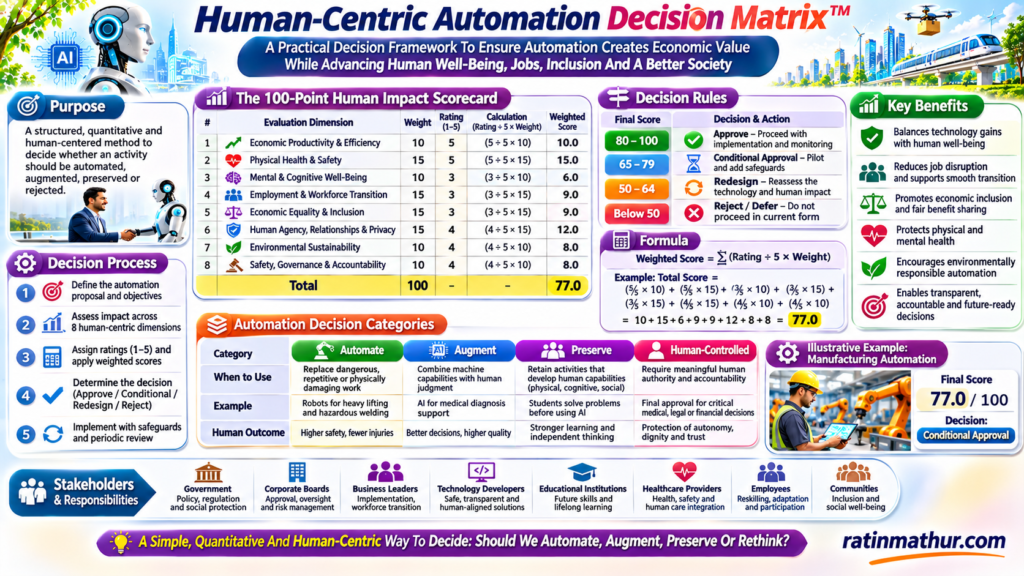
The Human-Centric Automation Decision Matrix™ is a strategic decision framework for determining whether an activity or process should be automated, augmented through human-machine collaboration, preserved for human participation, or subjected to mandatory human control. Its central premise is that technical feasibility and financial return alone should never determine whether an activity should be automated.
Every significant automation proposal should be examined in terms of its economic benefits, human consequences, safety implications, employment impact, privacy risks, and long-term societal value.
The framework establishes four automation classifications.
| Classification | Strategic Treatment | Practical Example | Intended Human Outcome |
|---|---|---|---|
| Automate | Replace dangerous, repetitive, or physically damaging activities | Industrial robots handling heavy components and hazardous welding | Reduced injuries and physical strain |
| Augment | Combine machine capabilities with human intelligence and judgment | AI supports doctors in diagnostic assessment while clinicians retain responsibility for treatment | Better decision support |
| Preserve | Retain activities that develop physical, cognitive, and social capabilities | Students independently solve problems before consulting AI | Stronger learning and independent thinking |
| Human-Controlled | Require meaningful human authority and accountability | Human approval of consequential medical, legal, employment, and financial decisions | Protection of autonomy and dignity |
For example, a manufacturing company introducing robotic material handling should prioritize automation because it reduces hazardous physical work. However, the company must also assess employment consequences and provide reasonable redeployment and training opportunities. Similarly, a household may adopt robotic cleaning but should continue encouraging walking, gardening, recreational exercise, and other forms of beneficial physical activity.
Stakeholder Decision And Accountability Matrix
The framework requires different stakeholders to take explicit responsibility for technology-related decisions. This is particularly important because automation decisions are frequently made by companies, while the economic and social consequences extend to workers, households, communities, and governments.
| Stakeholder | Critical Decision | Strategic Responsibilities | Success Measures |
|---|---|---|---|
| Government and Policymakers | What should be encouraged, regulated, or protected? | Establish AI and robotics policy, worker protection, social security, safety standards, and inclusive technology access | Employment quality, income security, health and inequality |
| Corporate Boards | Should an automation investment proceed? | Evaluate financial returns alongside human impact, employment, governance, and long-term risks | Sustainable returns, workforce transition and safety |
| Business Management | Which processes and jobs should change? | Redesign work, redeploy employees, provide training, monitor outcomes, and share productivity gains | Productivity, redeployment, retention and workforce capability |
| Technology Developers | How should machines interact with humans? | Ensure reliability, cybersecurity, privacy, accessibility, and appropriate human oversight | System reliability, safety and privacy |
| Employees and Labor Organizations | How should workers prepare for changing roles? | Participate in reskilling, consultations, and workplace redesign | Employability, wage progression and job quality |
| Educational Institutions | Which capabilities must future generations develop? | Integrate AI literacy, independent thinking, physical education, creativity, and practical learning | Learning outcomes, reasoning and practical competency |
| Healthcare and Care Institutions | How should automation support human care? | Use technology for assistance and monitoring without unnecessarily reducing human interaction | Health outcomes, independence and quality of care |
| Investors and Financial Institutions | Which automation investments create sustainable value? | Assess labor, environmental, governance, safety, and inclusion risks | Risk-adjusted returns and long-term resilience |
| Communities and Civil Society | How will automation affect local life? | Participate in consultations and protect vulnerable groups | Social participation, accessibility and inclusion |
| Individuals and Families | How much technology should enter everyday life? | Maintain physical activity, critical thinking, digital discipline, practical skills, and relationships | Health, independence and meaningful participation |
The Human-Centric Automation Decision Matrix™ therefore changes the fundamental investment question from “Can a machine perform this activity more cheaply?” to “Does automating this activity create sustainable economic value while protecting and advancing human interests?”
2. Human Productivity Dividend & Transition Compact™
The Human Productivity Dividend & Transition Compact™ proposes a new relationship between technological productivity, employment, income distribution, and workforce development. Its central principle is that the economic value created by automation should not benefit only technology owners and capital providers. A measurable portion of productivity gains should contribute to wider human prosperity.
Traditional automation business cases emphasize investment costs, labor savings, operating margins, productivity improvements, and payback periods. These measures remain important, but they do not adequately capture the broader consequences of workforce displacement and economic inequality.
The proposed framework establishes a structured approach to calculating productivity benefits, identifying affected workers, supporting occupational transitions, and sharing economic gains.
The first requirement is to identify the genuine incremental value created by automation after accounting for capital investment, maintenance, energy consumption, software, implementation expenses, and workforce transition costs. Organizations should then establish a transparent policy for distributing an appropriate portion of those benefits through employee incentives, capability development, improved working conditions, and employee participation in economic returns.
| Productivity Dividend Component | Strategic Mechanism | Practical Example | Intended Outcome |
|---|---|---|---|
| Income Dividend | Productivity-linked compensation and profit-sharing | Employees receive incentives linked to verified productivity improvements | Workers participate in financial gains |
| Capability Dividend | Funded reskilling and redeployment | Assembly employees receive practical robotics and maintenance training | Improved employability |
| Time Dividend | Reduced working hours where economically viable | A factory maintains output while introducing shorter working schedules | Better work-life balance |
| Ownership Dividend | Employee equity or participation in company returns | Employees receive access to structured share ownership or profit-sharing schemes | Broader wealth participation |
| Social Dividend | Investment in community health and education | A company supports vocational training and local healthcare services | Wider societal benefits |
Consider a company that achieves annual net productivity savings of ₹10 crore following automation, after accounting for relevant operating and transition expenses. It could retain a portion for reinvestment while allocating other portions to employee incentives, skills development, improved working conditions, and broader employee participation in returns.
There should be no universal fixed distribution formula. The appropriate arrangement must reflect the company’s financial position, investment requirements, workforce agreements, regulatory obligations, and long-term competitiveness. The principle is that productivity benefits should be transparently evaluated and not treated exclusively as an opportunity for workforce cost reduction.
Workforce Transition: From Job Displacement To Capability Development
The framework also addresses a critical weakness in conventional reskilling programs. Completing a training course does not necessarily translate into employment. Workers require a realistic pathway connecting their existing capabilities with emerging opportunities.
| Transition Stage | Required Intervention | Manufacturing Application | Services Application |
|---|---|---|---|
| Workforce Mapping | Identify activities likely to change | Evaluate assembly, inspection, and material handling | Evaluate documentation and routine customer support |
| Capability Assessment | Identify transferable skills and gaps | Assess mechanical, quality, and operational knowledge | Assess communication, analysis, and process knowledge |
| Role Redesign | Identify adjacent and emerging roles | Machine technician, production supervisor, process improvement specialist | AI operations analyst, compliance specialist, customer relationship manager |
| Practical Reskilling | Provide relevant training and experience | Robot operation, sensors, preventive maintenance | AI quality control, data interpretation, service management |
| Employment Transition | Connect training with actual vacancies | Redeploy qualified employees into maintenance and planning | Transition suitable employees into AI-assisted service roles |
| Outcome Measurement | Evaluate employment and income outcomes | Monitor redeployment, earnings, and retention | Monitor placement, retention, and wage progression |
For example, a manufacturing company automating selected assembly activities should assess the existing technical capabilities of affected workers before implementation. Some employees may transition into equipment maintenance, while others may be more suitable for quality control, production supervision, or process improvement. The objective should not be to force every displaced employee into a technology occupation, but to identify realistic opportunities based on individual aptitude and industry demand.
Governments can complement this model through portable learning accounts, apprenticeships, vocational education, employment transition assistance, and stronger social protection. Educational institutions should develop industry-linked programs that combine digital capabilities with practical experience.
Stakeholder Responsibilities For Economic Transition
| Stakeholder | Responsibility | Expected Contribution |
|---|---|---|
| Government | Establish social protection and lifelong learning infrastructure | Income security and accessible reskilling |
| Employers | Assess workforce exposure before automation | Redeployment and responsible restructuring |
| Corporate Boards | Review how productivity gains are distributed | Transparent benefit-sharing policies |
| Educational Institutions | Align training with emerging occupational requirements | Industry-relevant capabilities |
| Investors | Evaluate human capital and transition risks | Responsible long-term capital allocation |
| Employees | Participate in learning and adaptation | Improved occupational readiness |
The framework is particularly important for India, where informal workers, small enterprises, and employees in traditional manufacturing and service occupations may face different adoption constraints. NITI Aayog’s focus on AI inclusion for informal workers provides a relevant policy foundation. Affordable technology access, multilingual interfaces, digital literacy, and practical industry integration will be essential.
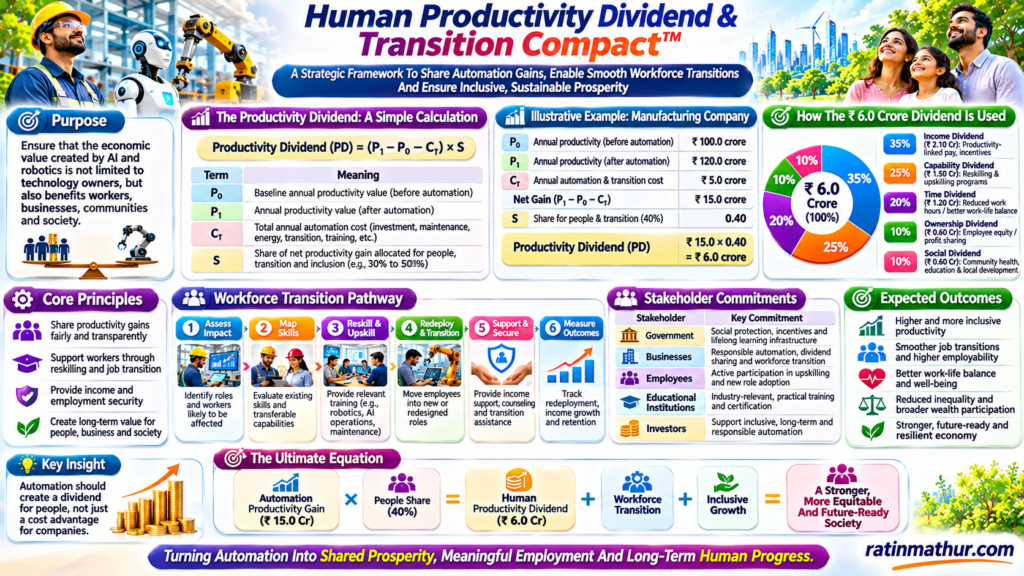
The larger economic proposition is that automation should create a productivity dividend for society, not simply a cost advantage for individual companies. Income security, access to productive capital, lifelong learning, and meaningful employment must become integral components of the automated economy.
3. Human Flourishing Architecture™
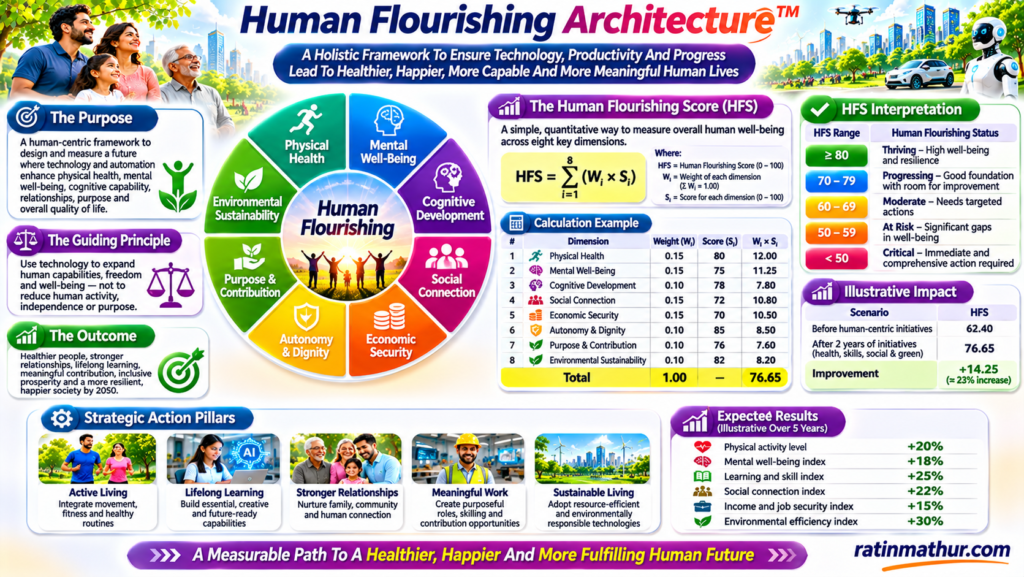
The Human Flourishing Architecture™ establishes the broader objective of technological progress: improving the quality of human life across physical, mental, cognitive, social, economic, and personal dimensions.
It responds to a fundamental weakness in conventional technology planning. Productivity, cost savings, convenience, and speed are relatively easy to measure, but the long-term consequences for health, relationships, independence, and purpose are much harder to quantify.
The framework therefore treats human well-being as a multidimensional outcome rather than an indirect benefit of economic growth.
| Human Development Dimension | Principal Risk From Poorly Managed Automation | Strategic Recommendation | Practical Example | Desired Outcome |
|---|---|---|---|---|
| Physical Health | Sedentary lifestyles and reduced movement | Integrate physical activity into daily life | Smart homes with automated cleaning but accessible exercise and walking facilities | Fitness and mobility |
| Mental Health | Digital overload, anxiety, and isolation | Encourage healthy digital routines and human support | Workplace policies that limit unnecessary digital interruptions | Psychological well-being |
| Cognitive Development | Excessive reliance on AI-generated answers | Preserve independent learning and critical thinking | Students attempt problems before using AI explanations | Intellectual independence |
| Social Connection | Reduced interpersonal interaction | Protect family, community, and human care | Care robots complement rather than replace human visits | Belonging and relationships |
| Economic Security | Employment uncertainty and unequal access | Connect productivity gains with income opportunities | Worker profit-sharing and occupational transition support | Financial resilience |
| Autonomy and Dignity | Surveillance, manipulation, and excessive dependency | Establish consent, privacy, transparency, and human control | Household robots with clear recording and data controls | Personal freedom |
| Purpose and Contribution | Loss of work identity and meaningful routines | Create opportunities for mentoring, volunteering, creativity, and social participation | Retired professionals mentoring young entrepreneurs | Meaningful participation |
| Environmental Sustainability | Higher energy and material demand | Promote efficient and circular technology | Repairable robots, responsible mineral sourcing, and energy-efficient infrastructure | Long-term ecological resilience |
Reimagining Homes, Workplaces And Cities
A human-centered automated society must be designed around the way people should live, not simply around the number of tasks machines can perform.
A smart residential community may employ autonomous transportation, robotic household services, AI-based security, and automated delivery. However, it should also provide accessible walking routes, public parks, sports infrastructure, community gardens, and social gathering spaces. Residents with disabilities or mobility limitations must receive suitable support, rather than being expected to undertake activities beyond their abilities.
Workplaces should combine automation with ergonomic design, physical activity, appropriate breaks, and opportunities for collaboration. Educational institutions should balance AI-assisted instruction with outdoor activities, practical learning, teamwork, independent assignments, and human mentorship.
Healthcare facilities should use robotics for rehabilitation, monitoring, and physical assistance while preserving human contact, professional responsibility, and patient autonomy.
Protecting Cognitive Independence And Human Relationships
The framework requires a deliberate balance between AI-assisted convenience and independent human capability.
Students should be encouraged to think independently before consulting AI. Professionals should examine AI-generated research and recommendations rather than accepting them without verification. Individuals should retain practical knowledge, independent decision-making skills, and the ability to operate when digital systems are unavailable.
Similarly, AI companions and care robots should provide assistance without systematically displacing genuine human interaction. An elderly person may benefit from automated medication reminders and emergency monitoring, but the overall care model should preserve appropriate family and professional engagement.
Governments, corporate boards, and technology developers should establish transparent safeguards covering data collection, informed consent, algorithmic decisions, privacy, and human escalation. Children and vulnerable individuals deserve particularly careful protection against manipulative digital interactions and excessive dependence.
Rebuilding Human Purpose Beyond Employment
Employment has historically provided income, daily structure, identity, recognition, and social participation. In an increasingly automated economy, these benefits cannot be allowed to disappear merely because production requires fewer human hours.
Societies must create meaningful opportunities in caregiving, education, mentorship, physical recreation, arts, entrepreneurship, environmental protection, community services, and skilled practical work.
Education should prepare individuals not only for occupations, but for active participation in society. Governments should invest in public spaces, sports, libraries, healthcare, cultural institutions, and community infrastructure. Businesses should recognize that human capital development includes more than technical training.
The objective is not to eliminate employment as a social institution. It is to ensure that people can find dignity, security, and meaningful contribution even when conventional employment structures change.
A Human Flourishing Measurement Dashboard
The framework should be supported by an annual Human Flourishing assessment at national level and a quarterly well-being and workforce dashboard at organizational level.
| Indicator | Measurement Approach | Desired Direction |
|---|---|---|
| Physical Health | Physical activity, mobility, and relevant health outcomes | Improvement |
| Mental Well-Being | Stress, psychological well-being, and access to support | Improvement |
| Cognitive Capability | Independent learning, critical thinking, and problem-solving | Improvement |
| Social Connection | Loneliness, family engagement, and community participation | Improvement |
| Economic Security | Employment quality, real income, and financial resilience | Improvement |
| Human Agency | Privacy, informed consent, and control over consequential decisions | Protection |
| Employment Transition | Redeployment, wage progression, and sustainable new employment | Improvement |
| Environmental Sustainability | Energy consumption, emissions, and material efficiency | Improvement |
These indicators should be interpreted with appropriate demographic, cultural, accessibility, and income considerations. The objective is not to impose uniform measures of a good life, but to ensure that technological advancement does not systematically weaken the conditions required for human well-being.
Integrating The Three Frameworks Into One Decision System
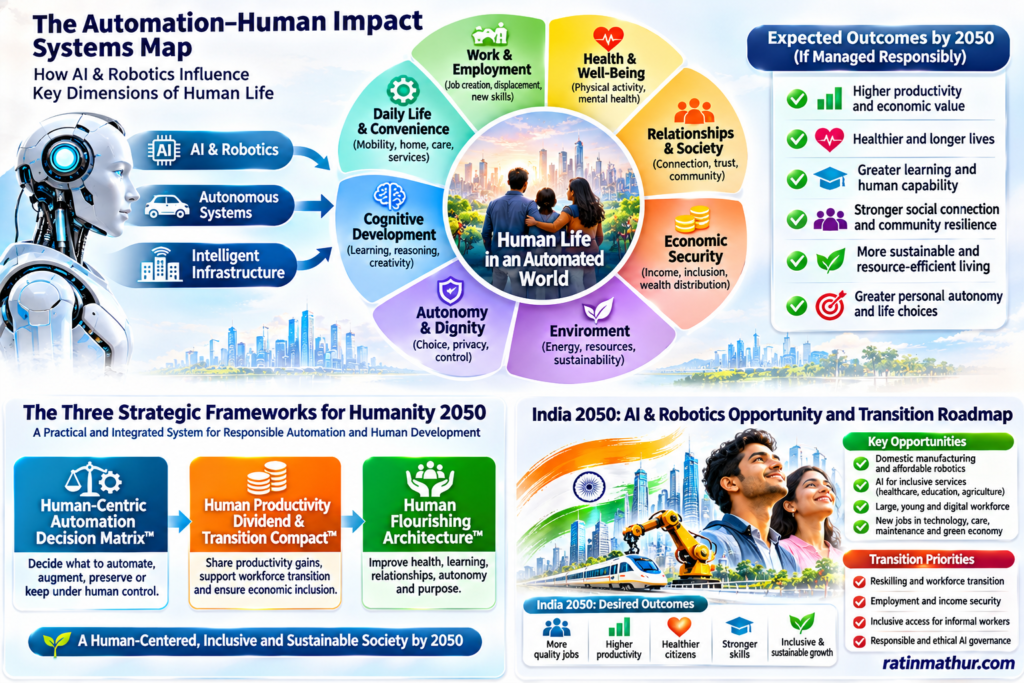
The three frameworks are designed to operate together rather than as independent initiatives. The Human-Centric Automation Decision Matrix™ determines whether and how an activity should be automated, and establishes stakeholder accountability. The Human Productivity Dividend & Transition Compact™ ensures that economic benefits and workforce transitions are addressed. The Human Flourishing Architecture™ evaluates whether the resulting changes improve human lives.
| Strategic Question | Framework | Principal Decision |
|---|---|---|
| Should this activity be automated, augmented, or preserved? | Human-Centric Automation Decision Matrix™ | Technology and investment approval |
| Who benefits from the productivity gains, and what happens to affected workers? | Human Productivity Dividend & Transition Compact™ | Economic distribution and employment transition |
| Does the resulting system improve health, relationships, autonomy, and purpose? | Human Flourishing Architecture™ | Human development and societal impact |
Together, these frameworks provide a practical basis for evaluating major technological investments. Governments can use them in policy design, businesses can integrate them into board oversight, investors can incorporate them into long-term risk assessments, and educational and healthcare institutions can adapt them to their operating environments.
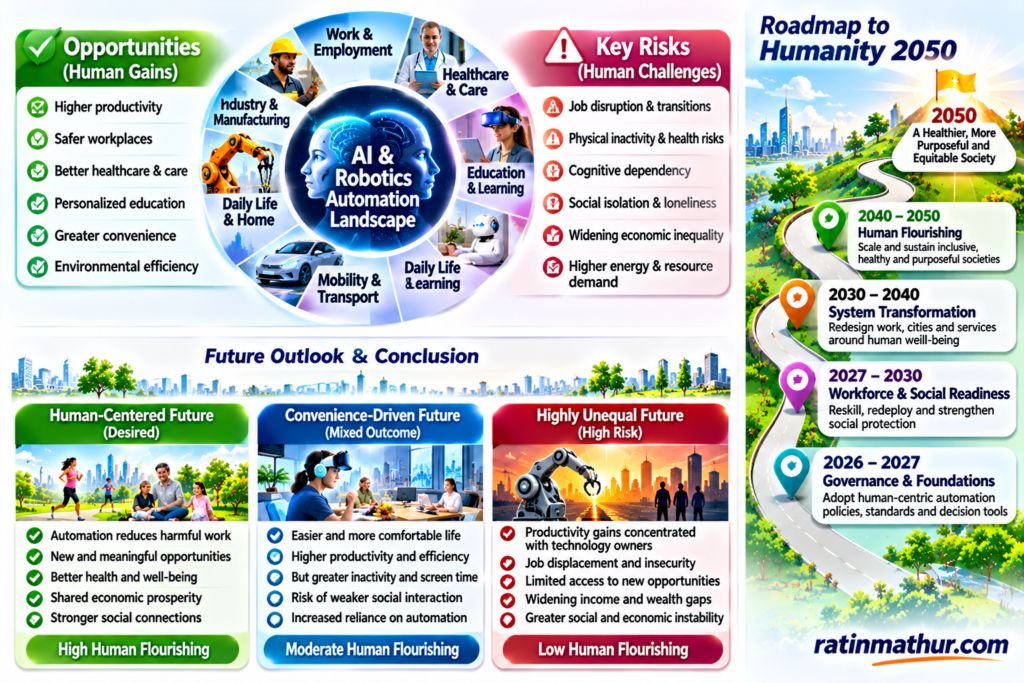
The desired outcome is a system in which technology improves productivity while strengthening, rather than diminishing, human capabilities.
Future Outlook & Conclusion
The period leading to 2050 could produce three broad societal outcomes.
A human-centered future would see automation reduce dangerous work, improve productivity, expand education and healthcare access, create new opportunities, and enable people to devote greater attention to meaningful activities. Productivity gains would be shared through stronger economic participation, occupational transitions, and improved public services.
A convenience-driven future could make daily life substantially easier while encouraging inactivity, digital dependence, reduced social interaction, and excessive reliance on automated systems. People could enjoy greater material convenience without necessarily achieving better health or greater personal fulfillment.
A highly unequal future could emerge if ownership of productive technology and automation infrastructure becomes excessively concentrated. Technology owners and capital holders could capture a disproportionate share of economic gains while certain groups experience employment instability, weaker bargaining power, and limited access to new opportunities.
These scenarios are strategic possibilities rather than predictions. The eventual outcome will depend on decisions made by governments, businesses, educational institutions, investors, technology developers, and individuals.
India has a particularly important opportunity to shape this transition. Its expanding technology ecosystem, manufacturing ambitions, young workforce, and digital infrastructure provide a foundation for developing affordable, inclusive, and locally relevant automation. However, economic policy must place equal emphasis on quality employment, worker transitions, preventive healthcare, educational reform, social protection, and human development.
The future of work must also be accompanied by a future of meaningful human activity. When machines take over repetitive production and administrative tasks, societies must create opportunities for people to contribute through care, education, mentoring, creativity, entrepreneurship, sports, culture, community service, and skilled human work. These activities are not secondary to economic development. They are essential to a fulfilling society.
The most important strategic change is philosophical. Progress should no longer be measured simply by the number of tasks automated, the number of employees replaced, or the increase in output per worker. It should be evaluated by whether people become healthier, more capable, financially secure, socially connected, and free to make meaningful choices.
The three proposed frameworks provide a foundation for this transition. The first introduces human accountability into automation decisions. The second connects technological productivity with economic participation and workforce security. The third makes human well-being the ultimate measure of technological advancement.
The future should not force humanity to compete with machines on the machines’ terms. Instead, technology should enable people to develop the qualities that make human life valuable: judgment, curiosity, empathy, creativity, physical vitality, responsibility, and purpose.
Humanity 2050 must represent a shift from maximizing machine capability to maximizing human potential. The ultimate measure of an intelligent society will not be how little work its citizens have to perform, but how well they are able to live, learn, create, contribute, and flourish.
References
- International Energy Agency. (2026, April 16). Data centre electricity use surged in 2025, even with tightening bottlenecks driving a scramble for solutions. https://www.iea.org/news/data-centre-electricity-use-surged-in-2025-even-with-tightening-bottlenecks-driving-a-scramble-for-solutions
- International Federation of Robotics. (2025, September 25). India rises to sixth in global factory robot installations. https://ifr.org/downloads/press_docs/2025-09-25-IFR_press_release_India_in_English.pdf
- International Labour Organization. (2025, May 20). Generative AI and jobs: A 2025 update. https://www.ilo.org/publications/generative-ai-and-jobs-2025-update
- International Monetary Fund. (2025). Rockall, E. J., Mendes Tavares, M., & Pizzinelli, C. AI adoption and inequality (IMF Working Paper No. 2025/068). https://doi.org/10.5089/9798229006828.001
- NITI Aayog. (2025, October 8). Roadmap on AI for inclusive societal development. Government of India. https://www.niti.gov.in/whats-new/roadmap-ai-inclusive-societal-development
- NITI Aayog. (2025, October 10). Roadmap for job creation in the AI economy. Government of India. https://www.niti.gov.in/whats-new/roadmap-job-creation-ai-economy
- United Nations Development Programme. (2025). Human development report 2025: A matter of choice: People and possibilities in the age of AI. https://hdr.undp.org/content/human-development-report-2025
- World Economic Forum. (2025). The future of jobs report 2025. https://www.weforum.org/publications/the-future-of-jobs-report-2025/
- World Health Organization. (2025, June 30). From loneliness to social connection: Charting a path to healthier societies. https://www.who.int/groups/commission-on-social-connection
- World Health Organization. (2026, November 4). Physical activity. https://www.who.int/news-room/fact-sheets/detail/physical-activity
Disclaimer
This article is intended for research, educational, strategic, and general informational purposes. It reflects an analysis of institutional research, publicly available evidence, and the author’s strategic interpretation of the potential implications of AI, robotics, and automation for human development through 2050.
Future employment, economic, technological, health, and social outcomes remain uncertain and will vary across countries, industries, and population groups. Projections and scenarios should not be interpreted as guaranteed outcomes or individual predictions.
The three frameworks introduced in this article are proposed conceptual frameworks developed for strategic discussion and practical application. Their names and associated approaches are presented as proposed intellectual-property identifiers using the ™ symbol, which does not by itself establish trademark registration or legal protection. Formal trademark availability, ownership, and registration should be independently verified before commercial use, licensing, or enforcement.
Nothing in this article constitutes medical, legal, financial, or investment advice. Any policy or commercial implementation should be supported by appropriate professional assessment, local evidence, and applicable regulatory requirements.