Rethinking CEO And Managing Director Appointments Through Independent Regulatory Oversight, Board Accountability And Shareholder Protection
1. Executive Summary
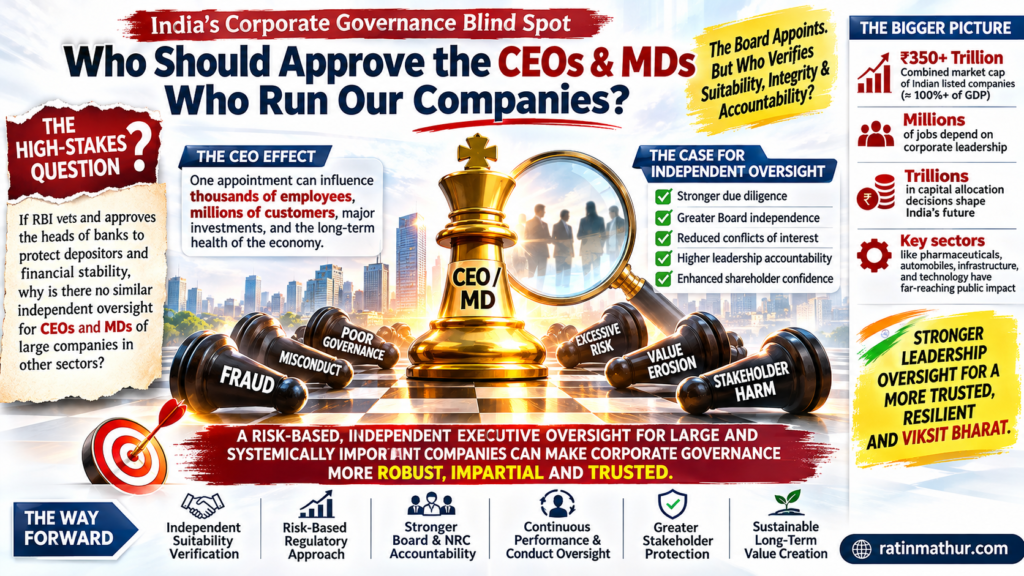
Corporate governance is fundamentally about accountability, transparency, ethical leadership and the protection of stakeholder interests. Yet, one of the most consequential decisions in any company, the appointment of its Chief Executive Officer (CEO) or Managing Director (MD), remains largely within the company’s own governance structure. While the Reserve Bank of India (RBI) exercises prior approval and suitability oversight over specified senior appointments in regulated financial institutions, most companies operating in manufacturing, automobiles, pharmaceuticals, infrastructure, information technology, FMCG, engineering and other sectors do not face an equivalent general external executive approval requirement.
This raises an important question: Should the appointment of the individual entrusted with managing a large corporation, deploying substantial capital, directing thousands of employees and influencing millions of stakeholders remain exclusively an internal corporate decision?
The question becomes more significant when corporate failures, financial irregularities, governance breakdowns and leadership misconduct are examined. The consequences of inappropriate executive appointments are rarely confined to promoters or controlling shareholders. They can affect minority investors, employees, creditors, customers, suppliers, pension funds and the wider economy. In strategically important industries, the consequences can extend to national infrastructure, economic security and public welfare.
India already has an extensive corporate governance architecture under the Companies Act, 2013, the Securities and Exchange Board of India (SEBI) Listing Obligations and Disclosure Requirements (LODR) Regulations, 2015, and sector-specific regulatory frameworks. These mechanisms establish responsibilities for Boards, Nomination and Remuneration Committees (NRCs), independent directors, auditors and executive management. However, they do not establish a universal independent pre-appointment suitability approval mechanism for CEOs and MDs across non-financial corporate sectors.
This paper examines the institutional gap between internal executive selection and independent regulatory oversight. It analyses India’s existing governance structure, the RBI’s approach to regulated financial institutions, the United Kingdom’s Senior Managers and Certification Regime, and international corporate governance principles.
The paper argues that neither unrestricted internal discretion nor universal government approval of every CEO appointment is an appropriate solution. Instead, India should consider a proportionate, risk-based Executive Leadership Oversight Framework for large listed companies, systemically important businesses and other entities whose failure could create substantial public or economic consequences.
Four original strategic frameworks are proposed: LIFT™ (Leadership Integrity and Fitness Test), SHIELD™ (Systemic and High-Impact Executive Leadership Due Diligence), CLEAR™ (Continuous Leadership Evaluation, Accountability and Responsibility) and TRUST™ (Transparent Responsibility, Unified Stakeholder Tracking). Together, these frameworks establish a proposed approach to executive suitability, independent verification, continuing accountability and stakeholder protection.
The central proposition is straightforward: The authority to appoint a CEO should remain with the Board, but the credibility, integrity and suitability of leadership in companies with significant public impact should be subject to stronger independent scrutiny.
2. Introduction
A company’s CEO is arguably the most influential individual in its operational and strategic hierarchy. The CEO determines business priorities, influences capital allocation, oversees financial and operational performance, shapes organizational culture, manages enterprise risks and translates the Board’s strategic direction into business outcomes.
The quality of executive leadership can determine whether a company creates sustainable shareholder value or gradually destroys it through poor capital allocation, excessive leverage, weak internal controls, unethical practices or strategic misjudgments.
Yet, an important governance question often receives insufficient attention: Who independently verifies the suitability of the person being appointed to this position?
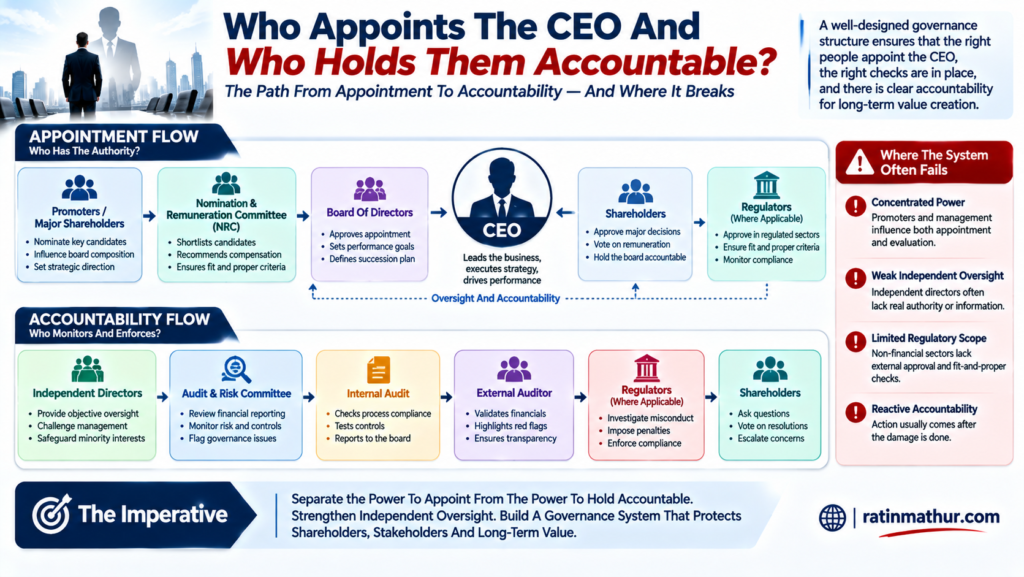
In India, the appointment of a CEO or MD in most companies is primarily governed by the Board’s decision-making process, NRC recommendations, applicable shareholder approvals and statutory requirements. Although these mechanisms are intended to promote merit, transparency and accountability, their effectiveness depends considerably on the independence and diligence of the individuals responsible for evaluating the candidate.
The RBI model offers an interesting point of comparison. Banking institutions operate under a distinct regulatory framework because their activities involve public deposits, financial intermediation, payment systems and systemic financial risks. Consequently, the regulator has statutory authority over specified senior appointments. The RBI’s regulatory approval, however, is not a blanket guarantee against subsequent misconduct and does not transfer the Board’s responsibilities to the regulator.
The question is whether certain non-financial companies have also reached a level of economic importance where executive suitability should be subject to an independent public-interest safeguard.
Consider a large automobile manufacturer employing thousands of people and supporting an extensive supplier ecosystem. Consider a pharmaceutical company whose products affect public health, an infrastructure company responsible for essential services, or a major technology company managing sensitive customer information. In each case, the decisions of one CEO can have consequences extending far beyond the company’s immediate shareholders.
Corporate governance should therefore evolve alongside the growing economic and social influence of corporations.
The objective is not to create another government-controlled appointment mechanism. It is to ensure that executive leadership decisions in high-impact companies are based on independently verifiable competence, integrity, professional conduct and accountability.
3. Problem Statement & Objectives
3.1 Problem Statement
India’s corporate governance framework establishes procedures for the appointment of directors, MDs, CEOs and senior management. However, the framework does not generally require an independent external authority to assess and clear the suitability of CEOs and MDs in non-financial companies before their appointment.
This creates a structural dependence on internal governance mechanisms, particularly the NRC and Board of Directors.
In companies with strong, genuinely independent Boards, this arrangement can work effectively. However, where promoter influence is substantial, Board independence is insufficient, or due diligence is inadequate, the executive appointment process may not provide the level of independent scrutiny expected by shareholders and other stakeholders.
The central concern is not that every company appoints unsuitable leaders. It is that the existing system does not provide a uniform, independently verifiable suitability assurance mechanism for companies with significant public impact.
3.2 Research Objectives
The primary objective is to examine whether India requires a more robust and independent framework for evaluating the suitability and accountability of CEOs and MDs in large and strategically important companies.
The research also seeks to distinguish regulatory approval from corporate governance responsibility, evaluate weaknesses in existing appointment mechanisms, examine international practices, propose an appropriate institutional architecture and develop practical frameworks that Independent Directors, regulators, companies and investors can use.
3.3 Central Research Question
Should India introduce an independent, risk-based executive leadership oversight mechanism for large and systemically important companies, while retaining the Board’s authority to select and appoint its CEO?
The supporting questions concern the independence of NRCs, the quality of candidate verification, the identification of executive conflicts, the continuing accountability of CEOs, the protection of minority shareholders and the institutional safeguards necessary to prevent regulatory interference.
4. Methodology
This paper adopts a qualitative, comparative and policy-oriented research methodology based on statutory analysis, regulatory examination, international benchmarking and corporate governance assessment.
The Indian regulatory assessment examines the Companies Act, 2013, SEBI LODR Regulations, RBI governance directions applicable to specified financial institutions and the respective responsibilities of corporate governance institutions.
The international comparison examines the United Kingdom’s Senior Managers and Certification Regime and the G20/OECD Principles of Corporate Governance 2023. These sources are used to identify institutional approaches to executive suitability, personal accountability, Board independence and continuing supervision.
The research also employs hypothetical corporate scenarios to demonstrate how weaknesses in executive selection and oversight can affect companies and stakeholders.
The four strategic frameworks proposed in this paper are original conceptual recommendations developed for policy discussion and practical corporate governance application. They are not existing statutory regulatory standards, and their names are proposed framework identities rather than claims of registered trademark ownership.
This is a desk-based policy study, not an empirical investigation of all Indian corporate appointments. It does not establish that the absence of external CEO approval has caused any particular corporate failure. Nor does it assume that regulatory approval would eliminate fraud, misconduct or commercial failure.
5. Landscape Analysis
5.1 India’s Existing Corporate Governance Architecture
India has progressively strengthened its corporate governance architecture through company law, securities regulation, sector-specific supervision and enhanced disclosure requirements.
The Companies Act, 2013 provides the statutory foundation for executive appointments and Board accountability.
Section 166 establishes the duties of directors, including acting in good faith, exercising due care and diligence, avoiding conflicts of interest and acting in the interests of the company and its stakeholders.
Section 178 provides for the NRC and its responsibilities concerning the identification of qualified candidates for directorships and senior management, recommendations relating to appointments and removals, and remuneration policy.
Section 196 governs the appointment and tenure of MDs, whole-time directors and managers, while Section 203 prescribes requirements relating to key managerial personnel for applicable classes of companies.
These provisions establish an important governance structure. However, they do not generally require an independent government authority to approve the appointment of the CEO of a non-financial company.
For listed entities, SEBI LODR Regulations add further requirements concerning Board composition, independent directors, committees, senior management and disclosures.
The NRC and Board remain central to executive selection. Shareholder approval also applies where prescribed by the Companies Act and applicable securities regulations.
The institutional distinction is important: India has an established system of internal corporate governance and external regulatory supervision, but these are not equivalent to a universal external CEO suitability clearance mechanism.
5.2 The RBI Model: Why Financial Institutions Receive Different Treatment
The RBI’s regulatory approach is based on the special nature of financial institutions.
Banks accept deposits, extend credit, operate within the payment ecosystem and participate in the country’s financial infrastructure. Their governance failures can affect depositors, financial markets and economic stability.
Under the Banking Regulation Act, 1949, and applicable RBI directions, prior regulatory approval is required for specified senior appointments in regulated banking institutions.
The RBI’s Commercial Banks Governance Directions, 2025, and Payments Banks Governance Directions, 2025, establish governance and appointment requirements for their respective categories.
The position is not identical across all financial institutions. For example, the RBI’s Scale-Based Regulation framework for NBFCs requires prior approval for certain changes in management involving more than 30% of directors, excluding independent directors. This should not be confused with a universal requirement for prior RBI approval of every individual NBFC CEO appointment. Asset Reconstruction Companies and certain other regulated entities have additional requirements under their applicable legislation.
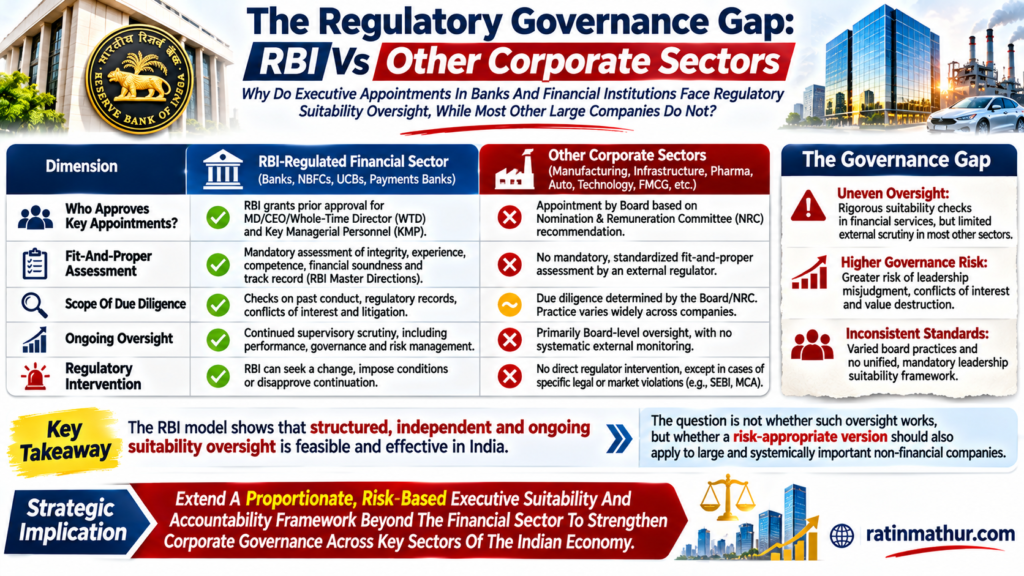
The broader principle is that the intensity of regulatory intervention is linked to the nature of the institution, its regulatory status and the consequences of management failure.
This raises a relevant policy question: Could similar risk-based logic be applied to large non-financial companies whose economic and stakeholder impact is substantial?
5.3 International Benchmark: United Kingdom
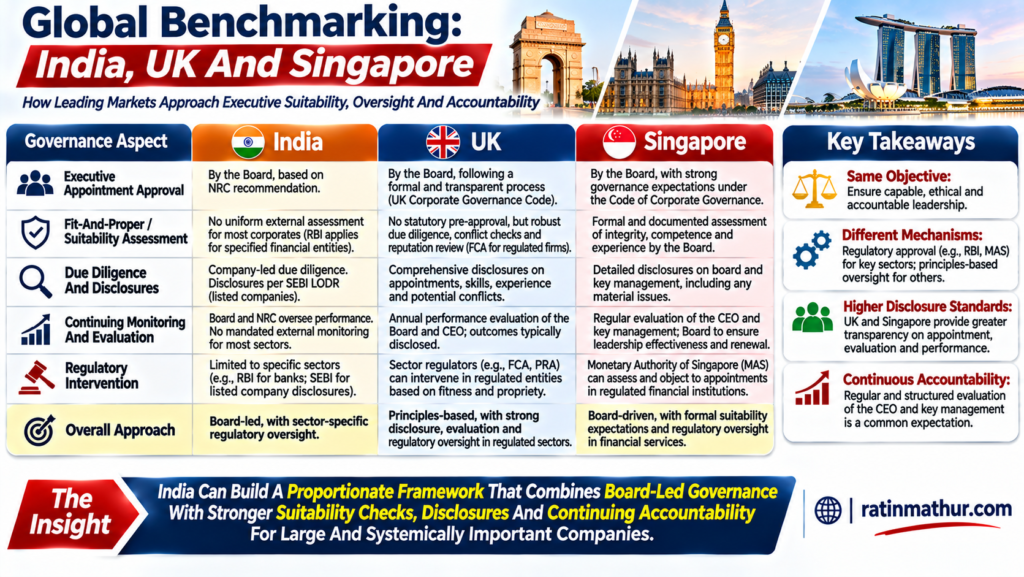
The United Kingdom provides an instructive example through its Senior Managers and Certification Regime (SM&CR).
Under this framework, individuals performing specified Senior Management Functions in regulated financial firms require approval from the Financial Conduct Authority (FCA) or Prudential Regulation Authority (PRA), as applicable.
The regime requires clear Statements of Responsibilities, fitness and propriety assessments and personal accountability.
The FCA’s fitness and propriety assessment considers honesty, integrity and reputation, competence and capability, and financial soundness.
The framework also provides for continuing suitability assessments. Certification staff, who are not individually approved by the FCA under the Certification Regime, must be assessed by their firms on appointment and at least annually.
The significance of the UK model is not merely pre-appointment approval. It is the combination of suitability, clearly allocated responsibilities and continuing accountability.
The SM&CR applies to specified regulated financial firms and functions, not every CEO in every UK industry. Nevertheless, its accountability architecture offers useful lessons for India.
5.4 International Corporate Governance Principles
The G20/OECD Principles of Corporate Governance 2023 emphasize the Board’s responsibility for strategic guidance, monitoring management, selecting and supervising key executives, succession planning and ensuring objective independent judgment.
The principles also recognize the importance of independent directors in areas involving potential conflicts of interest, including executive nomination and remuneration.
This is particularly relevant to the proposed Indian framework. International governance principles support strong Board accountability rather than automatically transferring executive selection powers to the state.
5.5 Comparative Regulatory Landscape
| Governance dimension | India: Most non-financial companies | India: Specified regulated financial institutions | United Kingdom: Specified regulated financial firms |
|---|---|---|---|
| CEO appointment | Primarily Board and applicable shareholder processes | Subject to sector-specific regulatory requirements | Regulatory approval for specified senior management functions |
| Candidate suitability | Company-led assessment and applicable statutory requirements | Regulatory fit-and-proper requirements | Formal fitness and propriety assessment |
| Responsibility allocation | Board and management structures | Regulatory and statutory responsibilities | Statements of Responsibilities |
| Continuing oversight | Board, NRC and regulatory supervision | Sector-specific supervision | Continuing suitability assessments |
| Personal accountability | Companies Act and applicable laws | Applicable statutory and regulatory framework | Duty of Responsibility for relevant senior managers |
| Universal external approval of every CEO | No | No, requirements vary by institution | No |
The comparative analysis demonstrates that regulatory oversight and Board autonomy are not mutually exclusive. They can coexist through clearly defined responsibilities and proportionate regulatory intervention.
6. Key Findings
6.1 Executive Appointment Is A Governance Decision, Not Merely An HR Decision
CEO selection determines the quality of leadership, strategic execution, risk management and organizational culture.
The process should therefore receive the same governance attention as major capital allocation decisions, mergers and acquisitions and other strategic Board matters.
6.2 Board Independence Is A Critical Determinant
The effectiveness of the existing system depends substantially on the NRC’s ability to evaluate candidates objectively.
Where controlling shareholders exert significant influence, the independence of the NRC and the willingness of independent directors to challenge recommendations become particularly important.
This does not mean promoter involvement is inherently inappropriate. Promoters may have legitimate strategic and ownership interests. The governance requirement is that the appointment process must remain transparent, merit-based and aligned with the company’s long-term interests.
6.3 Candidate Verification Needs To Go Beyond Professional Credentials
An impressive professional profile does not necessarily establish ethical leadership or sound governance practices.
A comprehensive assessment should examine the candidate’s actual responsibilities at previous employers, financial reporting history, regulatory record, professional conduct, conflicts of interest and approach to risk management.
Equally, pending allegations must not automatically be treated as established wrongdoing. Fairness, evidence and the candidate’s right to respond are essential.
6.4 Shareholders Need Better Assurance, Not Just More Disclosure
Shareholder approval is an important corporate governance safeguard. However, shareholders often depend on information supplied by the company when evaluating a proposed appointment.
Greater transparency about the selection process, qualifications, relevant conflicts, due diligence and performance-linked remuneration would improve the quality of shareholder decision-making.
6.5 Appointment Approval Alone Cannot Prevent Future Misconduct
A candidate may satisfy every suitability requirement and subsequently make unethical decisions.
Effective corporate governance therefore requires continuing oversight, clear accountability, independent investigations and appropriate enforcement.
6.6 Risk-Based Regulation Is More Appropriate Than Universal Licensing
The economic and systemic importance of companies differs significantly.
A small private business should not face the same regulatory requirements as a large listed infrastructure company or an enterprise whose failure could affect essential national services.
The appropriate approach is proportionality based on public impact, complexity, size, interconnectedness and risk.
6.7 The Independent Director’s Role Must Be Strengthened
Independent directors are central to maintaining a balance between promoters, executive management and shareholders.
They should have access to independently verified information, sufficient time for assessment and the authority to challenge executive appointments without fear of retaliation or commercial pressure.
7. Challenges & Opportunities
7.1 Challenges
Introducing independent executive oversight will require careful institutional design.
The first challenge is regulatory overlap. India already has MCA, SEBI, RBI, NFRA and several sector-specific regulators. A new institution could create duplication unless responsibilities are clearly allocated.
The second challenge is the risk of bureaucratic interference. Delayed approvals could disrupt leadership transitions, succession planning and business continuity.
The third challenge concerns regulatory capture. A body intended to protect shareholders could become vulnerable to political influence, corporate lobbying or preferential treatment.
The fourth challenge is the difficulty of assessing executives across different industries. The qualities required to lead a pharmaceutical company may differ considerably from those required to lead an automobile manufacturer, technology enterprise or infrastructure business.
The fifth challenge concerns procedural fairness. Candidates must be protected against arbitrary rejection based on unverified allegations, incomplete information or reputational prejudice.
The sixth challenge is cost. Mandatory external verification for every company could create disproportionate compliance burdens, particularly for smaller businesses.
7.2 Opportunities
A carefully designed framework could create meaningful opportunities for the Indian corporate ecosystem.
It could strengthen confidence among domestic and international investors, improve the quality of Board decisions, reduce information asymmetry and encourage professional leadership selection.
It could also strengthen the credibility of Independent Directors by providing them with access to standardized due diligence.
For companies, a transparent executive suitability process could improve succession planning, institutional continuity and leadership credibility.
For regulators, standardized executive disclosures could improve the identification of governance risks and support better coordination across sectors.
For shareholders, the most significant benefit would be greater assurance that leadership appointments in high-impact companies are supported by evidence, independent scrutiny and documented Board accountability.
8. Strategic Frameworks & Recommendations
The following four original frameworks constitute the proposed strategic architecture for strengthening executive leadership governance in India. Each addresses a different stage of the leadership lifecycle, from candidate identification to continuing accountability and stakeholder protection.
8.1 LIFT™ Framework: Leadership Integrity And Fitness Test
Concept: Establishing An Independent, Evidence-Based Standard For Executive Suitability
The LIFT™ Framework proposes a structured evaluation mechanism to determine whether a candidate possesses the integrity, competence, professional credibility, financial soundness and ethical judgment necessary to lead a company. It is designed to address the limitations of relying primarily on qualifications, professional experience, interviews and recommendations during CEO selection.
The fundamental principle is that professional success and leadership suitability are not necessarily synonymous. A candidate may have delivered exceptional revenue growth but may also have presided over aggressive accounting practices, excessive borrowing, regulatory non-compliance or weak internal controls. Conversely, a candidate may have experienced a business failure because of external economic conditions without demonstrating any misconduct. The assessment must distinguish between business outcomes and individual conduct.
LIFT™ proposes six assessment dimensions: Leadership Competence, Integrity and Ethics, Financial and Regulatory Track Record, Transparency and Conflict Management, Risk and Compliance Capability, and Long-Term Value Creation. Each dimension should be examined using independently verifiable evidence, structured interviews, candidate declarations and relevant regulatory or professional records.
Table 1: LIFT™ Executive Suitability Assessment Matrix
| Assessment dimension | Evaluation criteria | Illustrative verification |
|---|---|---|
| Leadership competence | Industry experience, strategic judgment and execution capability | Employment history, business achievements and role-specific assessment |
| Integrity and ethics | Honesty, ethical conduct and professional reputation | Regulatory orders, established disciplinary findings and references |
| Financial track record | Financial discipline and capital allocation | Previous company financial statements and audit qualifications during tenure |
| Transparency and conflicts | Related-party relationships and undisclosed interests | Conflict declarations and independent verification |
| Risk and compliance | Understanding of legal, operational and enterprise risks | Compliance history and documented risk management responsibilities |
| Long-term value creation | Sustainable performance and stakeholder orientation | Multi-year performance, investment outcomes and governance record |
The framework could use a 100-point internal assessment model, with illustrative weightings of 20 points for leadership competence, 20 for integrity and ethics, 15 for financial track record, 15 for transparency and conflicts, 15 for risk and compliance, and 15 for long-term value creation. However, certain serious integrity or legal disqualifications should operate as separate threshold conditions rather than being offset by a high aggregate score.
For example, consider a hypothetical candidate being considered for the CEO position of a large listed automobile manufacturer. The candidate previously led a manufacturing business that achieved significant revenue growth and expanded market share. However, during the candidate’s tenure, the previous company also experienced repeated audit qualifications, material compliance failures and unexplained related-party transactions.
Under a conventional selection process, impressive financial performance might dominate the assessment. Under LIFT™, the NRC would examine the candidate’s actual involvement, decision-making authority, knowledge of the problems and response to internal control weaknesses. The assessment would distinguish between matters established by regulatory findings and matters that remain allegations or unresolved investigations.
The framework would not automatically reject the candidate because the previous company encountered difficulties. It would assess whether the candidate exercised appropriate judgment and accountability.
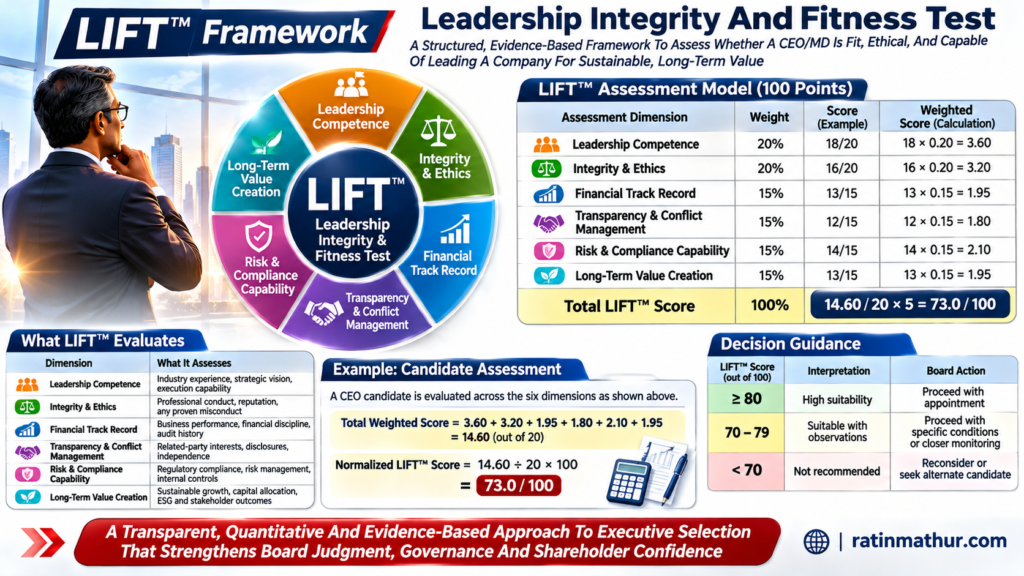
For implementation, the NRC should prepare a documented LIFT™ assessment before recommending a candidate. For companies falling within a proposed external oversight regime, the assessment could be independently verified by the designated authority. The final appointment decision would remain with the Board and shareholders wherever their approval is required.
The strategic benefit of LIFT™ is that it moves executive selection from reputation-led recruitment towards evidence-based suitability assessment. It also provides Independent Directors with a consistent basis for challenging recommendations and documenting their judgment.
8.2 SHIELD™ Framework: Systemic And High-Impact Executive Leadership Due Diligence
Concept: Applying Regulatory Scrutiny In Proportion To A Company’s Economic And Public Impact
The SHIELD™ Framework addresses a fundamental weakness in the idea of universal CEO approval: not every company requires the same degree of external oversight.
The framework proposes classifying companies according to their systemic importance, public exposure, economic significance and potential consequences of governance failure. It recognizes that a large infrastructure company, a major pharmaceutical manufacturer, a nationally significant technology enterprise and a small private business should not face identical executive appointment requirements.
SHIELD™ would establish a risk-based classification mechanism that determines the intensity of independent executive suitability assessment.
Table 2: SHIELD™ Corporate Risk Classification
| Proposed category | Company characteristics | Recommended executive oversight |
|---|---|---|
| Tier I: Systemically important | Critical infrastructure, substantial interconnectedness or significant national economic consequences | Mandatory independent suitability clearance under applicable legislation |
| Tier II: Large public-impact companies | Large listed entities, substantial customer exposure or significant employment and supply-chain impact | Enhanced independent verification and regulatory reporting |
| Tier III: Medium-sized enterprises | Companies with moderate scale and limited systemic exposure | Strengthened NRC-led assessment and standardized disclosures |
| Tier IV: Small businesses and startups | Limited public exposure and relatively low systemic risk | Existing statutory and Board-led governance requirements |
The classification should not depend exclusively on market capitalization or turnover. A company may have relatively modest revenue but operate an essential service or manage strategically important infrastructure. Similarly, a company with substantial revenue may have limited systemic exposure.
The SHIELD™ assessment could consider company size, assets, market concentration, public funds exposure, employment, customer base, critical supply-chain position, financial interconnectedness and the potential cost of business failure.
For example, consider a hypothetical company operating a substantial electricity transmission network. A CEO appointment at this company could influence infrastructure investment, service continuity, regulatory compliance, cybersecurity and public safety. Even if the company does not have the highest market capitalization in India, its public importance could justify enhanced independent scrutiny.
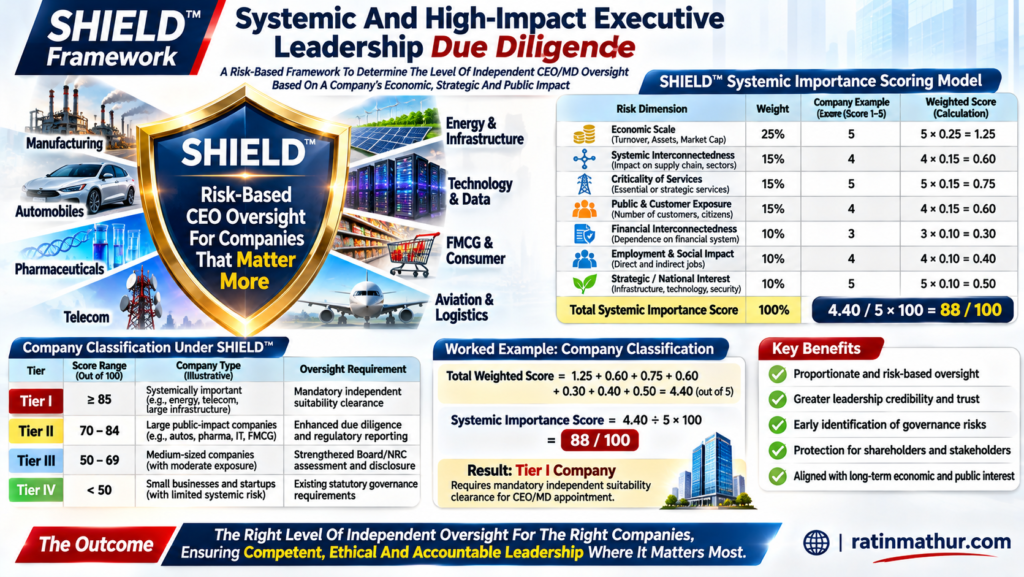
Under SHIELD™, the company’s NRC would first identify suitable candidates and undertake the LIFT™ assessment. The designated oversight authority would then examine the candidate’s suitability in the context of the company’s risk profile and the responsibilities attached to the position. The Board would retain its appointment authority, subject to applicable statutory and regulatory requirements.
In contrast, a small technology startup with limited customer exposure and no systemic significance would continue to operate under the existing Companies Act and applicable governance requirements without mandatory external CEO clearance.
Table 3: Illustrative SHIELD™ Risk Assessment Dimensions
| Risk factor | Strategic consideration | Possible regulatory implication |
|---|---|---|
| Economic scale | Assets, revenue and market presence | Higher scrutiny where scale creates material public exposure |
| Systemic importance | Impact of operational or financial failure | Enhanced executive suitability assessment |
| Critical infrastructure | Energy, transport, telecommunications and essential services | Sector-specific oversight |
| Public interest | Customer and citizen dependence | Stronger accountability and disclosure |
| Financial interconnectedness | Dependence on creditors, financial institutions and markets | Greater focus on financial integrity |
| Supply-chain concentration | Dependence of other businesses on the company | Assessment of operational resilience |
The framework should be introduced through a transparent classification methodology, periodic review and a right to appeal. Companies should not be classified through discretionary or undisclosed decisions.
SHIELD™ creates a bridge between corporate autonomy and public-interest protection. Its central principle is proportionality: the greater the potential consequences of leadership failure, the stronger the independent suitability safeguards should be.
8.3 CLEAR™ Framework: Continuous Leadership Evaluation, Accountability And Responsibility
Concept: Extending Executive Governance Beyond Appointment Into The Entire Leadership Lifecycle
The CLEAR™ Framework addresses the most important limitation of a pre-appointment approval system: regulatory clearance cannot guarantee responsible conduct throughout an executive’s tenure.
Corporate governance should not end when the CEO receives an appointment letter. It must continue through clearly defined responsibilities, measurable performance, ethical conduct, risk oversight and independent evaluation.
CLEAR™ proposes a structured accountability architecture that links the CEO’s appointment conditions, annual performance assessment, risk responsibilities and governance outcomes.
At the beginning of the appointment, the CEO should sign an Executive Accountability Statement defining responsibilities relating to financial reporting, internal controls, legal compliance, enterprise risk management, capital allocation, cybersecurity, workplace safety, stakeholder management and other material business obligations.
The statement should be approved by the Board and aligned with the company’s governance structure. It should identify the responsibilities assigned to the CEO and distinguish them from those assigned to the CFO, Chief Risk Officer, Chief Compliance Officer and other senior executives.
The framework should then introduce a continuing evaluation mechanism that assesses both financial outcomes and governance conduct.
Table 4: CLEAR™ Executive Accountability Scorecard
| Evaluation dimension | Illustrative performance indicators | Review responsibility |
|---|---|---|
| Financial performance | Revenue, EBITDA, cash flow and ROCE | Board and NRC |
| Capital allocation | Investment returns, debt discipline and acquisition performance | Board |
| Governance and compliance | Material breaches, audit observations and remediation | Audit Committee |
| Risk management | Risk exposure, control effectiveness and business continuity | Risk Management Committee |
| Human capital | Employee retention, succession and workplace safety | NRC and Board |
| Stakeholder management | Customer grievances, supplier conduct and service quality | Board |
| Sustainability | Material ESG targets and applicable regulatory obligations | Board and relevant committees |
| Ethical leadership | Conflicts, whistleblower matters and established misconduct | Audit Committee and Board |
The scorecard should be evaluated using multi-year performance rather than a single financial year. Financial performance should be assessed against the company’s industry, business cycle, approved strategy and relevant external conditions.
For example, consider a hypothetical infrastructure company whose CEO achieves rapid revenue growth through an aggressive acquisition strategy. The company reports improving earnings, but its debt increases significantly, integration risks remain unresolved and internal audit identifies weaknesses in procurement controls.
A conventional performance evaluation focusing mainly on revenue and EBITDA could produce a positive assessment. Under CLEAR™, the Board would also evaluate capital allocation quality, leverage, acquisition integration, control weaknesses and remediation.
If the CEO has ignored material warnings or failed to take reasonable corrective action within the responsibilities assigned to that individual, the matter should receive appropriate scrutiny. If the weaknesses arose from external circumstances or failures outside the CEO’s reasonable control, that context should also be considered.
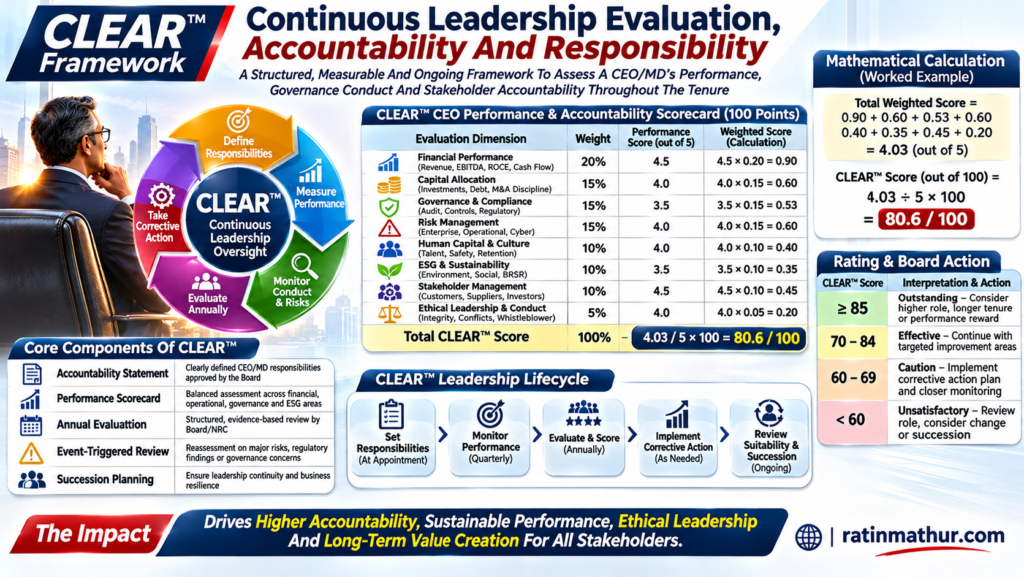
CLEAR™ should introduce an annual executive suitability review and event-triggered reassessment following material regulatory findings, serious governance failures or significant changes in responsibilities.
The framework should also support succession planning, ensuring that the Board does not become dependent on one individual and that leadership transitions do not destabilize the organization.
Its most important contribution is the creation of a continuous accountability relationship between the CEO, Board, shareholders and relevant oversight institutions.
8.4 TRUST™ Framework: Transparent Responsibility And Unified Stakeholder Tracking
Concept: Creating A Transparent And Accountable Corporate Leadership Ecosystem
The TRUST™ Framework addresses the relationship between executive accountability and stakeholder protection.
One of the limitations of traditional corporate governance is that responsibility can become fragmented. The CEO may attribute a failure to the CFO, the CFO may refer to inadequate internal systems, and the Board may claim that operational decisions were delegated to management.
While delegation is necessary for running a large organization, it must not create gaps in accountability.
TRUST™ proposes a unified system for documenting leadership responsibilities, tracking material governance risks, monitoring stakeholder concerns and ensuring that serious matters reach the appropriate oversight authority.
The framework is based on five interconnected governance dimensions: Transparency, Responsibility Allocation, Unified Reporting, Stakeholder Protection and Traceable Accountability.
Table 5: TRUST™ Governance Architecture
| Governance dimension | Proposed mechanism | Expected outcome |
|---|---|---|
| Transparency | Documented executive responsibilities and material governance disclosures | Better visibility |
| Responsibility allocation | Clear mapping of CEO and senior management responsibilities | Reduced accountability gaps |
| Unified reporting | Integrated governance and risk reporting | Improved Board oversight |
| Stakeholder protection | Whistleblower, grievance and escalation mechanisms | Stronger stakeholder confidence |
| Traceable accountability | Documented decisions, corrective actions and closure tracking | Better auditability |
For implementation, covered companies could maintain a secure Executive Governance and Accountability Register. This would record the CEO’s accountability statement, annual suitability assessments, material conflicts, significant regulatory findings, serious audit observations, whistleblower escalations and corrective actions.
Access would be role-based, with the Board, authorized regulators and relevant oversight committees receiving information according to their statutory responsibilities. Confidential personal information and legally protected investigations would remain subject to appropriate privacy and procedural safeguards.
Consider a hypothetical pharmaceutical company that receives repeated quality complaints involving one of its manufacturing facilities. The complaints initially appear operational. However, further investigation identifies repeated deviations from quality-control procedures, delayed internal escalation and inadequate corrective action.
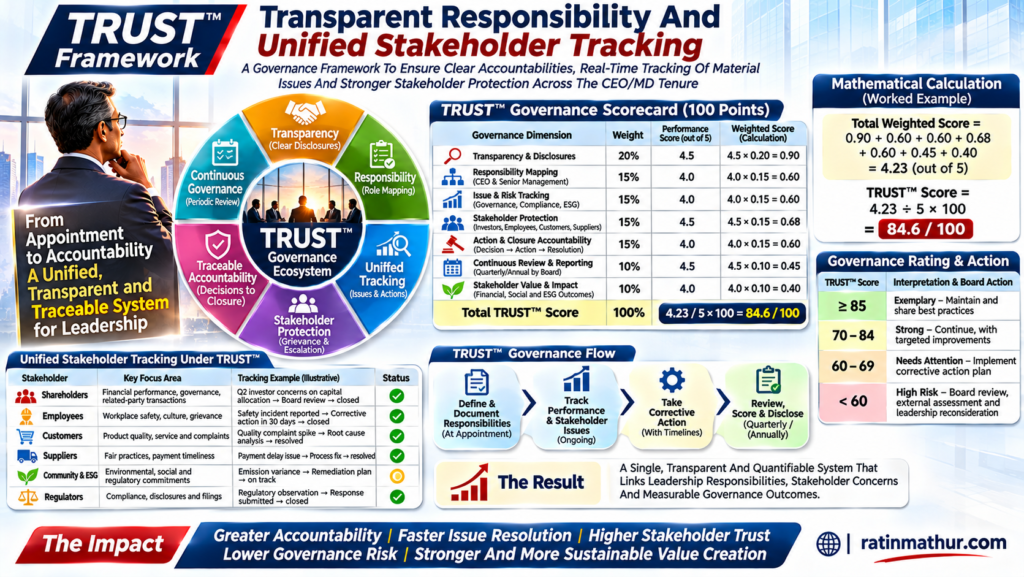
Under TRUST™, the issue would be recorded within the company’s governance escalation mechanism. The relevant executive responsibilities would be identified, the Audit Committee and Board would receive material information, and the company would document corrective actions and their closure. If the matter triggered statutory reporting or regulatory intervention requirements, the appropriate sector regulator would be informed.
The framework would also establish a stakeholder feedback mechanism covering investors, employees, customers, suppliers and other affected groups.
Table 6: TRUST™ Stakeholder Accountability Mechanism
| Stakeholder | Governance concern | Proposed monitoring mechanism |
|---|---|---|
| Shareholders | Financial integrity and executive accountability | Disclosures and Board reporting |
| Employees | Ethical conduct and workplace protection | Confidential grievance and whistleblower channels |
| Customers | Product quality and service failures | Complaint tracking and corrective action |
| Suppliers | Fair practices and payment discipline | Supplier grievance monitoring |
| Creditors | Financial discipline and risk exposure | Financial and covenant reporting |
| Regulators | Compliance and material governance failures | Statutory reporting and escalation |
TRUST™ should not become a public database containing unverified allegations against executives. Its purpose is to establish a secure, evidence-based governance record and ensure that material issues receive timely attention.
Its strategic value lies in making accountability traceable rather than dependent on informal assurances.
8.5 Integrating The Four Frameworks Into One Corporate Governance Architecture
The four frameworks are designed to work together rather than operate as independent assessment tools.
LIFT™ establishes whether the candidate is suitable. SHIELD™ determines the level of independent scrutiny required based on the company’s public and systemic importance. CLEAR™ monitors the executive’s conduct, responsibilities and performance throughout the tenure. TRUST™ ensures that governance information, stakeholder concerns and accountability actions are documented and appropriately escalated.
Table 7: Integrated Strategic Framework Architecture
| Framework | Primary governance question | Stage of application | Principal outcome |
|---|---|---|---|
| LIFT™ | Is this candidate fit and proper to lead the company? | Before appointment | Verified executive suitability |
| SHIELD™ | How much independent oversight does this company require? | Company classification and appointment | Risk-based regulatory scrutiny |
| CLEAR™ | Is the CEO fulfilling assigned responsibilities throughout the tenure? | During appointment | Continuing accountability |
| TRUST™ | Are material governance matters visible, traceable and appropriately addressed? | Throughout the corporate lifecycle | Stakeholder protection and transparency |
The proposed architecture can be implemented through existing corporate governance mechanisms initially, with statutory amendments introduced where mandatory external oversight is required.
The four frameworks collectively provide a basis for moving from appointment-focused compliance towards lifecycle-based corporate leadership governance.
8.6 Institutional Recommendation: Establish A National Executive Leadership Oversight Mechanism
India should examine establishing a National Corporate Leadership and Governance Authority (NCLGA), or an equivalent independent statutory mechanism, with a clearly defined and limited mandate.

The proposed institution should not select CEOs on behalf of companies. Its role should be to establish suitability standards, verify candidates in specified high-impact companies, coordinate with sector regulators and monitor compliance with the applicable executive accountability framework.
Its governing structure should include independent corporate governance experts, legal professionals, accounting and audit specialists, industry representatives, investor protection experts and relevant regulatory nominees.
The authority should operate under transparent appointment procedures, fixed terms, conflict-of-interest restrictions, independent appeals and judicial review where applicable.
An alternative would be to initially establish a dedicated executive oversight division under the Ministry of Corporate Affairs, with formal coordination arrangements involving SEBI and sector regulators. This could reduce institutional duplication while testing the effectiveness of the proposed system.
The appropriate institutional structure should be determined through a public consultation and legislative assessment rather than assumed in advance.
8.7 Proposed Implementation Roadmap
Table 8: Three-Year Implementation Strategy
| Phase | Timeline | Proposed actions |
|---|---|---|
| Policy design | 0–6 months | Expert committee, stakeholder consultation and legal assessment |
| Framework development | 6–12 months | Develop LIFT™, SHIELD™, CLEAR™ and TRUST™ standards |
| Pilot implementation | 12–18 months | Test suitability assessment and reporting with selected large companies |
| Regulatory integration | 18–24 months | Establish coordination, appeal and monitoring mechanisms |
| Wider implementation | 24–36 months | Extend requirements to qualifying companies based on risk classification |
The pilot should assess the cost of compliance, quality of due diligence, processing timelines, regulatory coordination, impact on Board independence and effectiveness of continuing accountability.
The government should publish an independent evaluation before expanding mandatory requirements.
9. Future Outlook & Conclusion
9.1 The Future Of Corporate Leadership Governance In India
India’s corporate governance framework is entering a period in which traditional Board oversight must respond to increasingly complex business risks.
Digital transformation, artificial intelligence, cybersecurity, global supply chains, climate-related risks, financial interconnectedness and growing institutional investor participation have expanded the responsibilities of corporate leadership.
A CEO today is not merely responsible for business growth and profitability. The position involves managing interconnected strategic, financial, operational, technological, regulatory and stakeholder risks.
The quality of executive leadership therefore has implications extending beyond annual financial results.
In the coming years, investors are likely to place increasing importance on leadership integrity, capital allocation discipline, risk governance, succession planning and transparency. Independent Directors will also face greater expectations to demonstrate that executive appointments and performance evaluations are based on documented evidence rather than informal assurances.
India has an opportunity to develop a corporate leadership governance model that combines the strengths of its existing Companies Act and SEBI framework with selected elements of international executive accountability practices.
However, reform must be proportionate. Universal external approval could create unnecessary bureaucracy, delay leadership transitions and weaken Board autonomy. Conversely, relying entirely on internal processes without adequate independence and verification may leave important governance risks insufficiently addressed.
The future framework should therefore focus on companies whose size, complexity, public exposure or systemic importance justifies stronger external oversight.
9.2 Policy Recommendations
The government should initiate a comprehensive review of executive appointment governance under the Companies Act and applicable securities regulations.
The review should examine whether specified categories of large and systemically important non-financial companies require independent executive suitability clearance, supported by the LIFT™ and SHIELD™ frameworks.
The NRC’s responsibilities should be strengthened through documented candidate assessments, independent verification and transparent reporting to the Board. Executive accountability statements and continuing suitability assessments, as proposed under CLEAR™, should be considered for covered companies.
The TRUST™ framework should provide an integrated mechanism for recording executive responsibilities, material governance concerns, stakeholder escalations and corrective actions.
Any new authority or oversight division should be institutionally independent, subject to due process and prevented from interfering in legitimate commercial decisions. The Board should retain responsibility for selecting and supervising its CEO, and shareholders should retain their statutory rights.

9.3 Conclusion: The Question India Must Address
Corporate governance is not tested when a company performs well. It is tested when leadership faces difficult decisions, when financial performance conflicts with ethical obligations, when promoters and minority shareholders have different interests, and when management must choose between short-term profitability and long-term institutional credibility.
The appointment of a CEO is therefore among the most important governance decisions a Board can make.
If the consequences of an unsuitable appointment can affect employees, shareholders, creditors, customers and the wider economy, should the assessment of executive suitability remain exclusively dependent on the company’s internal governance structure?
This is not an argument against corporate autonomy. It is an argument for making corporate autonomy more accountable.
India does not necessarily need a regulator that appoints CEOs. It needs to examine whether an independent mechanism should verify the suitability of those entrusted with leading companies whose decisions have significant public consequences.
The distinction is fundamental. The Board must retain the authority to choose its leadership, but it must also demonstrate that the appointment is based on merit, integrity, independent assessment and a clear understanding of the responsibilities involved.
The proposed LIFT™, SHIELD™, CLEAR™ and TRUST™ frameworks offer a structured approach to achieving this objective.
Ultimately, corporate governance should not be measured merely by the number of independent directors on a Board, the existence of an NRC or the publication of an annual governance report. It should be measured by the quality of decisions, the independence of oversight, the integrity of leadership and the ability of institutions to hold decision-makers accountable.
A company may be privately owned, but its economic influence and social consequences are not always private.
The CEO may be appointed by the Board, but the responsibility for ensuring that the appointment is credible, ethical and in the long-term interests of the company must extend to the entire governance ecosystem.
India’s next corporate governance reform should give serious consideration to this principle.
10. References
- Government of India. (2013). The Companies Act, 2013 (Act No. 18 of 2013). India Code, Ministry of Law and Justice. https://www.indiacode.nic.in/bitstream/123456789/2114/5/A2013-18.pdf
- Government of India, Ministry of Corporate Affairs. (2014). Companies (Appointment and Remuneration of Managerial Personnel) Rules, 2014. Ministry of Corporate Affairs. https://www.mca.gov.in/
- Securities and Exchange Board of India. (2015, as amended through October 15, 2026). Securities and Exchange Board of India (Listing Obligations and Disclosure Requirements) Regulations, 2015. https://www.sebi.gov.in/sebi_data/attachdocs/oct-2026/1792664915776.pdf
- Reserve Bank of India. (2025, updated October 1, 2026). Reserve Bank of India (Commercial Banks: Governance) Directions, 2025. https://www.rbi.org.in/Scripts/BS_ViewMasDirections.aspx?id=13161
- Reserve Bank of India. (2025, updated October 1, 2026). Reserve Bank of India (Payments Banks: Governance) Directions, 2025. https://www.rbi.org.in/Scripts/BS_ViewMasDirections.aspx?id=13099
- Reserve Bank of India. (2025, updated July 1, 2026). Reserve Bank of India (Non-Banking Financial Companies: Registration, Exemptions and Framework for Scale Based Regulation) Directions, 2025. https://www.rbi.org.in/scripts/NotificationUser.aspx?Id=12965
- Reserve Bank of India. (2025). Financial Stability Report and Handbook of Statistics on the Indian Economy. Reserve Bank of India. https://www.rbi.org.in/
- Financial Conduct Authority. (2026, September 11). Senior Managers Regime. https://www.fca.org.uk/firms/senior-managers-and-certification-regime/senior-managers-regime
- Financial Conduct Authority. (2026, March 27). How we assess senior management function applications. https://www.fca.org.uk/firms/senior-management-functions/how-we-assess
- Financial Conduct Authority. (2026, April 24). The Certification Regime. https://www.fca.org.uk/firms/senior-managers-and-certification-regime/certification-regime
- Financial Conduct Authority. (2026). Fitness and Propriety (F&P). https://www.fca.org.uk/firms/senior-managers-and-certification-regime/fitness-and-propriety-fp
- Organisation for Economic Co-operation and Development. (2023). G20/OECD Principles of Corporate Governance 2023. OECD Publishing. https://doi.org/10.1787/ed750b30-en
- Organisation for Economic Co-operation and Development. (2023). The responsibilities of the board: G20/OECD Principles of Corporate Governance 2023. OECD Publishing. https://www.oecd.org/en/publications/g20-oecd-principles-of-corporate-governance-2023_ed750b30-en/full-report/component-8.html
- Government of India. (1949). The Banking Regulation Act, 1949 (Act No. 10 of 1949). India Code. https://www.indiacode.nic.in/
- Government of India. (1992). The Securities and Exchange Board of India Act, 1992 (Act No. 15 of 1992). India Code. https://www.indiacode.nic.in/
11. Disclaimer
This article is an independent research and policy analysis prepared for academic, professional and corporate governance discussion. It does not constitute legal, financial, investment or regulatory advice. The regulatory descriptions reflect the statutory and regulatory materials consulted for this research, with the relevant dates identified in the references. Readers should consult the latest applicable legislation, regulations, circulars and directions before making legal or compliance decisions.
The proposed National Corporate Leadership and Governance Authority (NCLGA) is a conceptual institutional recommendation and does not represent an existing statutory authority. LIFT™, SHIELD™, CLEAR™ and TRUST™ are original conceptual frameworks proposed by the author for discussion and further development. Their use in this article does not imply registration or ownership of registered trademarks.
The examples used are hypothetical and are intended solely to illustrate governance principles. They do not refer to or allege misconduct by any specific company, executive or individual.
The views and recommendations expressed are those of the author in an independent professional capacity and should not be interpreted as representing the position of any company, institution, regulator or professional body with which the author may be associated.
© 2026 Ratin Mathur. All rights reserved.