Ferrari Is Not Just A Car Brand. It Is An Emotion.
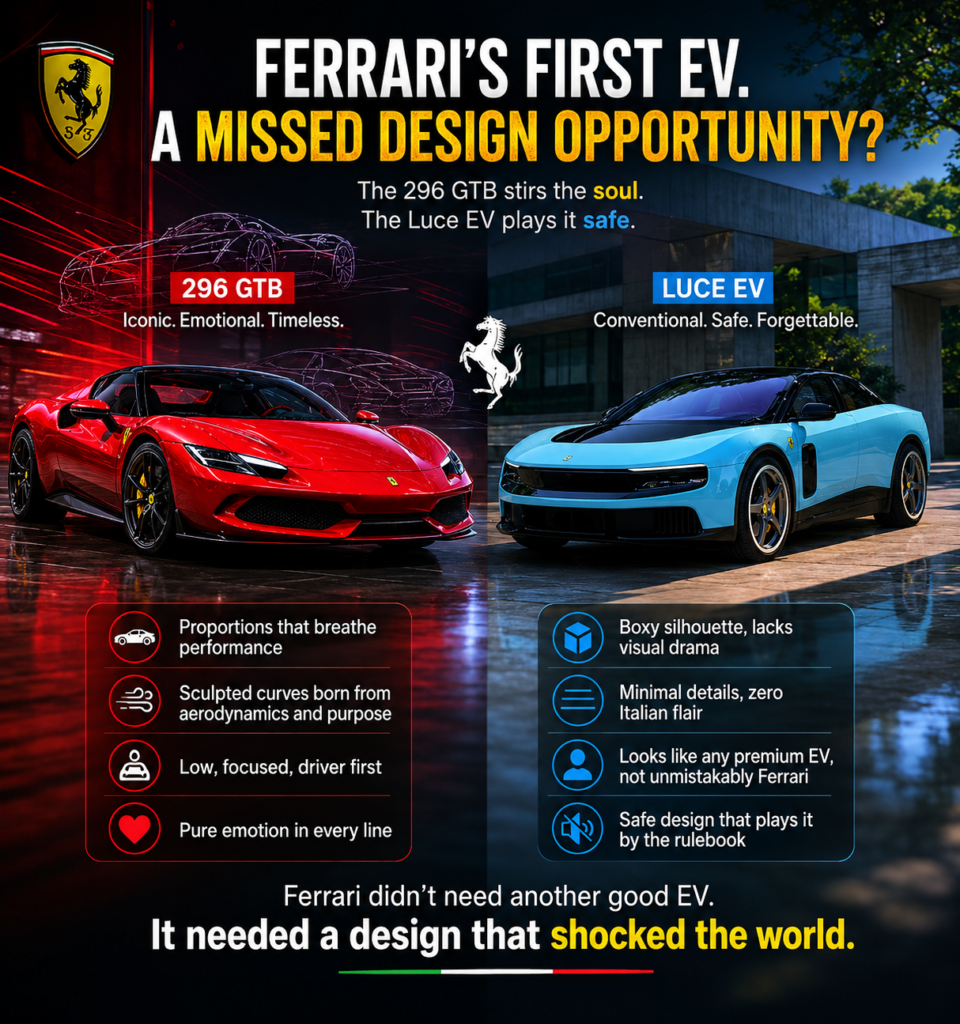
For decades Ferrari represented something larger than automotive engineering.
It represented obsession.
A Ferrari was never simply transportation. It was theatre on wheels. The sound of a naturally aspirated V12. The aggressive stance. The sculpted curves that looked alive even when parked. The emotional drama of speed and design working together as one masterpiece.
People did not buy Ferrari because it was rational.
People bought Ferrari because it made them feel something.
That is exactly why Ferrari’s entry into the EV era matters so much.
The world was waiting to see how one of the most emotionally charged automotive brands would redefine itself in a future powered by batteries instead of combustion engines.
This was not just another vehicle launch.
It was a cultural moment.
And that is why many automotive enthusiasts designers and brand observers feel Ferrari may have made a serious mistake with the design direction of its first EV.
The problem is not that Ferrari built an electric vehicle.
The problem is that the design appears to have lost the emotional intensity that made Ferrari legendary.
The EV Era Has Changed The Rules Of Competition
For decades performance differentiated supercars.
Horsepower.
Engine sound.
Acceleration.
Mechanical engineering.
Driving dynamics.
But the EV revolution has fundamentally changed the automotive battlefield.
Today almost every premium EV can deliver extraordinary acceleration.
Instant torque is no longer unique.
Brutal speed is becoming standardized.
This means the future winners of the automotive industry will not be defined only by engineering capability. They will be defined by emotional identity.
Design now matters more than ever.
Brand storytelling matters more than ever.
User experience matters more than ever.
The challenge for Ferrari was never building a fast EV.
The challenge was creating an EV that still felt unmistakably Ferrari.
That is where expectations became extremely high.
And perhaps where Ferrari became too cautious.
Ferrari’s Greatest Asset Was Never The Engine Alone
Many people assume Ferrari’s magic came only from the sound of its engines.
That is incomplete thinking.
Yes the V8 and V12 symphonies were iconic.
But Ferrari’s true strength was emotional architecture.
Every Ferrari looked dramatic.
Every Ferrari felt purposeful.
Every Ferrari communicated movement even when standing still.
Look at cars like the Ferrari F40.
The Enzo.
The LaFerrari.
The 296 GTB.
These vehicles were not simply products.
They were rolling sculptures.
They created desire before the engine even started.
That emotional tension between elegance aggression speed and beauty became Ferrari’s real competitive advantage.
The challenge with Ferrari’s first EV is that many observers believe this emotional design language has weakened.
Instead of looking revolutionary the EV direction appears restrained.
Safe.
Conventional.
Almost overly practical.
That is dangerous territory for Ferrari.
Because Ferrari was never built to feel ordinary.
The Problem With Playing Safe In The EV Market
The EV market is already crowded with brands chasing minimalism.
Smooth surfaces.
Simple lighting.
Aerodynamic shapes.
Clean futuristic styling.
Tesla normalized extreme simplicity.
Lucid pushed elegant efficiency.
Mercedes EQ embraced futuristic luxury.
Porsche evolved cautiously while maintaining identity.
In such a crowded environment Ferrari had the opportunity to shock the world with boldness.
Instead the design language appears too careful.
The proportions feel less emotional.
The visual drama feels reduced.
The presence lacks the intimidating beauty people expect from Ferrari.
And that creates a branding risk far larger than a single vehicle launch.
Because iconic brands do not survive through adaptation alone.
They survive through leadership.
Ferrari was supposed to define the future of emotional electric mobility.
Not blend into existing EV design trends.
Why The Ferrari 296 GTB Still Feels More Special
The comparison between Ferrari’s traditional design language and the new EV direction becomes especially visible when looking at the Ferrari 296 GTB.
The 296 GTB looks alive.
The low aggressive stance.
The flowing curves.
The aerodynamic sculpture.
The focused cockpit.
The proportions that scream performance.
Everything about the car creates emotional tension.
Even non-car enthusiasts can immediately recognize that it is special.
That is the power of emotional design.
Now compare that emotional intensity with the more conventional appearance of Ferrari’s EV direction.
The contrast becomes impossible to ignore.
The EV may be technologically advanced.
It may perform brilliantly.
It may even sell successfully.
But emotional greatness requires more than specifications.
Ferrari built its reputation on irrational desire.
And irrational desire cannot be engineered through efficiency alone.
The Real Risk Is Brand Dilution
Luxury brands do not collapse overnight.
They weaken slowly.
Usually through small compromises repeated over time.
A safer design here.
A broader market approach there.
A more practical product strategy somewhere else.
Eventually the emotional edge disappears.
That is the real danger Ferrari must avoid.
If Ferrari’s future EVs begin to resemble generic luxury electric vehicles the brand risks losing its distinctiveness.
And once emotional uniqueness disappears rebuilding it becomes extremely difficult.
History offers many examples.
Luxury brands lose relevance when they prioritize scale over identity.
Automotive history is filled with companies that became technically competent yet emotionally invisible.
Ferrari cannot afford that outcome.
Because Ferrari’s pricing power prestige and cultural status all depend on emotional exclusivity.
The moment Ferrari feels ordinary the brand loses its magic.
The EV Transition Needed Courage Not Caution
This was Ferrari’s opportunity to redefine automotive emotion for a new generation.
The company could have built something radical.
A machine that combined:
- Italian artistry
- futuristic design
- digital intelligence
- extreme aerodynamics
- emotional storytelling
- performance theatre
The EV era does not eliminate emotion.
It simply requires brands to reinvent it differently.
Without the sound of a V12 Ferrari needed to amplify every other sensory and emotional experience.
The visual identity should have become even more dramatic.
The proportions should have become even more daring.
The design should have felt impossible to ignore.
Instead the design direction feels constrained by caution.
And caution rarely creates legends.
Ferrari’s Biggest Competitor Is No Longer Lamborghini Or Porsche
The EV era has changed competition itself.
Ferrari is no longer competing only against traditional supercar manufacturers.
It is competing against:
- technology companies
- AI driven mobility brands
- luxury experience ecosystems
- futuristic startups
- software powered vehicles
That means Ferrari’s competitive advantage can no longer depend only on mechanical heritage.
It must evolve emotionally and digitally at the same time.
Younger generations are increasingly buying identity instead of machinery.
They care about:
- design storytelling
- futuristic aesthetics
- digital experience
- sustainability
- personalization
- immersive brand experiences
Ferrari needed an EV that emotionally captured this future.
Not a design that felt like a cautious transition product.
The Most Successful Future Brands Will Sell Emotion
The automotive industry is entering one of the biggest transformations in history.
Electric mobility.
AI integration.
Autonomous systems.
Connected ecosystems.
Software defined vehicles.
As technology becomes standardized emotional differentiation becomes even more valuable.
This is why companies like Apple built global loyalty.
Not because competitors could not build phones.
But because Apple sold emotion simplicity identity and aspiration.
Ferrari historically understood this principle better than almost any automotive company.
That is why the EV transition feels so important.
Because Ferrari should have been one of the brands best positioned to dominate the emotional side of electric mobility.
Instead the early design direction raises concerns that the company may be overprotecting its legacy instead of reinventing it boldly.
Ferrari Still Has Time To Correct The Direction
The story is not over.
Ferrari remains one of the most powerful automotive brands in the world.
The company still possesses:
- incredible engineering talent
- unmatched racing heritage
- emotional brand equity
- loyal customers
- global cultural prestige
But the EV era demands courage.
Future Ferrari EVs must become more emotionally aggressive.
More visually unforgettable.
More experimental.
More visionary.
Ferrari does not need to imitate Tesla.
It does not need to imitate Porsche.
It does not need to imitate Lucid.
Ferrari needs to rediscover Ferrari.
The world does not expect Ferrari to build the most practical EV.
The world expects Ferrari to build the most emotionally unforgettable EV.
That difference matters enormously.
The Future Of Ferrari Depends On One Question
Can Ferrari make people fall in love with electric performance the same way they once fell in love with the V12?
That is the real challenge.
Not batteries.
Not software.
Not charging infrastructure.
Not acceleration figures.
Emotion.
Because Ferrari was never simply about transportation.
It was about desire.
And desire is created through bold imagination.
The EV era does not reduce the importance of design.
It increases it.
The EV era does not eliminate storytelling.
It makes storytelling more critical.
The EV era does not destroy legendary brands.
But it punishes brands that become emotionally forgettable.
Ferrari still has the opportunity to lead this future.
But leadership requires bravery.
And iconic brands are remembered not for playing safe but for creating moments that change how the world feels.
Ferrari’s first EV may still succeed commercially.
But history will ultimately judge whether it inspired emotion.
Because that has always been Ferrari’s true currency.
Not horsepower.
Emotion.