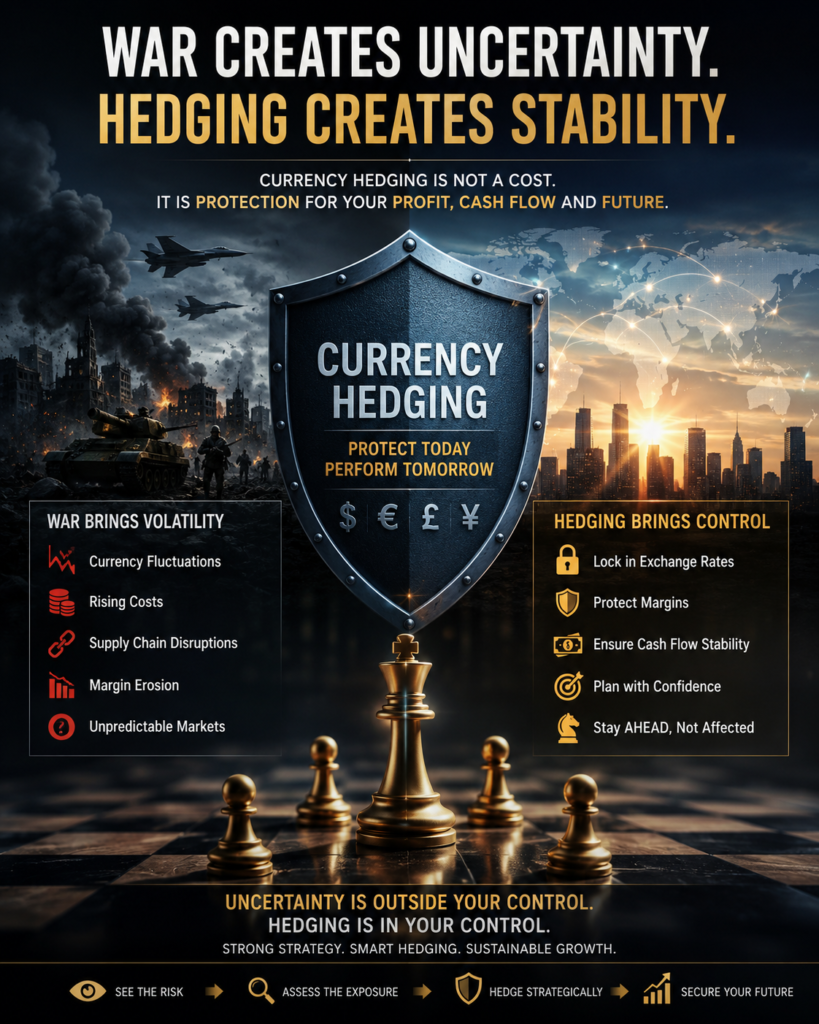
The world economy has entered a new era of instability.
For decades, businesses largely focused on growth, market expansion, operational efficiency and supply chain optimization. Currency volatility was often considered a secondary financial issue handled quietly by treasury departments and banking partners. Today that mindset is becoming increasingly dangerous.
Wars, geopolitical tensions, sanctions, inflation shocks, trade conflicts and central bank policy shifts are reshaping global business dynamics at an unprecedented pace. Currency markets are reacting faster and more aggressively than ever before. A single geopolitical event can move foreign exchange rates dramatically within hours and those movements can destroy business profitability even when operational performance remains strong.
In this environment, currency hedging is no longer a financial luxury. It has become a strategic necessity for survival, stability and long term sustainability.
The companies that understand this reality early will strengthen resilience and preserve profitability. The companies that ignore it may face unexpected financial damage despite having strong products, healthy customer demand and efficient operations.
The New Reality of Global Business
Modern businesses operate in an interconnected financial ecosystem. Even companies that primarily serve domestic markets are indirectly exposed to global currencies through raw materials, energy prices, logistics costs, imported machinery, technology subscriptions or international suppliers.
When war breaks out in one region, its impact spreads rapidly across global markets. Oil prices fluctuate, shipping routes become uncertain, commodity prices rise and investors shift capital toward safer currencies such as the US Dollar.
As currencies fluctuate, the impact on businesses can be immediate:
• Import costs rise unexpectedly
• Export profitability declines
• Raw material expenses increase
• Debt repayment burdens grow
• Cash flow planning becomes unstable
• Pricing strategies become ineffective
• Margins begin eroding silently
Many businesses underestimate how quickly foreign exchange volatility can impact profitability. A company may spend years improving operational productivity by 5% while a sudden currency movement can wipe out 15% to 20% of profitability within months.
This is why currency risk management has become a boardroom discussion rather than only a treasury discussion.
How War Impacts Currency Markets
Wars create fear and uncertainty in financial markets. Investors move capital toward stable economies and reserve currencies. Commodity prices become volatile and global trade routes face disruptions.
For example, during geopolitical conflicts involving major oil producing regions, crude oil prices often rise sharply. Countries dependent on oil imports experience pressure on their currencies because higher import bills increase demand for foreign currencies.
Similarly, sanctions imposed on nations can disrupt payment systems, global trade flows and currency availability. Businesses operating across borders may suddenly face exchange rate shocks, delayed payments or higher financing costs.
Central banks also respond differently during crises. Some increase interest rates to protect currencies while others reduce rates to stimulate economic activity. These policy differences further increase currency volatility.
As a result, companies engaged in international trade face a financial environment where exchange rates can no longer be predicted with confidence.
The Silent Threat to Profitability
Currency risk is often invisible during stable economic periods. Businesses focus heavily on sales growth and market share while exchange rate movements remain manageable.
However, during periods of geopolitical instability, currency movements can become a hidden destroyer of profitability.
Consider an Indian manufacturing company importing machinery from Europe.
The company negotiates a contract when the Euro exchange rate is relatively stable. Production planning, pricing and profit calculations are finalized accordingly. But before payment is completed, geopolitical tensions intensify and the Euro strengthens significantly against the Indian Rupee.
Suddenly:
• Import costs increase dramatically
• Planned profit margins shrink
• Selling prices become insufficient
• Cash flow pressures emerge
• Financial projections become inaccurate
The company may not have made any operational mistakes. Sales may remain strong and customer demand may continue growing. Yet profitability suffers purely because currency exposure was unmanaged.
This is the danger of foreign exchange volatility. It can silently erode financial performance even when the business appears healthy externally.
Exporters Face Equal Risk
Many exporters assume currency depreciation always benefits them. While weaker domestic currencies can increase export competitiveness temporarily, excessive volatility creates uncertainty and planning challenges.
For example, an exporter may secure large international orders expecting strong future revenue. But if the domestic currency strengthens unexpectedly before payments are received, the converted revenue may decline significantly.
This creates multiple business challenges:
• Lower realized revenue after conversion
• Reduced pricing competitiveness
• Margin uncertainty
• Difficulty in forecasting profitability
• Investor concerns regarding earnings volatility
Global customers also prefer working with financially stable suppliers. Companies unable to manage currency exposure may struggle to provide consistent pricing and long term contracts.
Therefore, exporters must understand that sustainable competitiveness depends not only on pricing but also on financial risk management capabilities.
Currency Hedging as a Strategic Shield
Currency hedging helps businesses reduce exposure to unfavorable exchange rate movements.
It is not about predicting currencies perfectly. It is about protecting business stability when uncertainty becomes unavoidable.
Strategic hedging allows companies to:
• Protect operating margins
• Stabilize cash flows
• Improve financial forecasting
• Reduce earnings volatility
• Strengthen investor confidence
• Support long term pricing commitments
• Improve business continuity during crises
In many ways, currency hedging functions like insurance for international business operations.
Companies insure factories against fire despite hoping fires never occur. Similarly, businesses hedge currency exposure not because they expect disaster but because uncertainty can create serious financial consequences.
Common Currency Hedging Strategies
Modern businesses use multiple approaches to manage foreign exchange risk.
Forward Contracts
Forward contracts are among the most widely used hedging tools.
A company locks in an exchange rate today for a future transaction. This protects the business from adverse currency movements before payment or settlement occurs.
For example, if an importer knows payment must be made in US Dollars after three months, a forward contract can secure the exchange rate immediately. Even if the currency fluctuates later, the company remains protected.
This improves budgeting accuracy and reduces uncertainty.
Natural Hedging
Natural hedging involves balancing foreign currency inflows and outflows.
For example, a company earning revenue in US Dollars may also purchase raw materials in US Dollars. Since both transactions occur in the same currency, exchange rate risk reduces naturally.
Many multinational corporations strategically align supply chains and revenue streams to create natural hedging structures.
Multi Currency Invoicing
Some companies negotiate contracts in multiple currencies rather than relying on a single dominant currency.
This reduces overdependence on one currency and distributes risk across several financial markets.
Businesses increasingly negotiate flexible pricing clauses to adjust for significant currency fluctuations during long term projects.
Currency Options
Currency options provide the right, but not the obligation, to exchange currencies at a predefined rate.
This allows businesses to protect against adverse movements while still benefiting from favorable market changes.
Although more complex and sometimes expensive, options offer flexibility during uncertain periods.
Treasury Risk Analytics
Advanced organizations now use data analytics, artificial intelligence and scenario planning to monitor global currency exposure in real time.
Technology driven treasury management helps companies evaluate risk across markets, simulate future scenarios and make proactive decisions before volatility escalates.
Why CFOs Must Lead Strategic Risk Management
In the past, many CFOs primarily focused on reporting, compliance and financial controls. Today the role has evolved significantly.
Modern CFOs are expected to function as strategic risk managers.
In periods of geopolitical instability, treasury decisions directly influence business survival. Currency exposure affects pricing, profitability, financing, investor confidence and long term strategy.
Forward looking CFOs are increasingly:
• Integrating currency planning into strategic decisions
• Conducting scenario based forecasting
• Building resilient treasury frameworks
• Strengthening banking partnerships
• Using digital financial risk management platforms
• Collaborating closely with procurement and operations teams
The finance function is no longer reactive. It must become predictive and strategically integrated across the enterprise.
The Growing Role of Artificial Intelligence in Currency Risk Management
Artificial intelligence is transforming treasury and foreign exchange management.
Traditional forecasting models often struggle during periods of extreme volatility because historical patterns become unreliable. AI driven systems can analyze larger data sets, identify early warning signals and respond faster to changing market conditions.
Modern treasury platforms now use AI for:
• Real time currency exposure monitoring
• Predictive analytics
• Volatility forecasting
• Automated risk alerts
• Scenario simulation
• Smart hedging recommendations
AI does not eliminate uncertainty but it improves decision making speed and accuracy.
In the future, companies that combine human financial expertise with intelligent analytics platforms will manage risk more effectively than competitors relying solely on traditional methods.
Supply Chain Strategy and Currency Risk
Currency exposure is closely connected to supply chain strategy.
Businesses dependent on a single country or supplier face higher vulnerability during geopolitical disruptions. When wars or sanctions impact specific regions, both logistics and currency risks increase simultaneously.
As a result, global companies are increasingly diversifying supply chains across multiple countries.
This approach offers several advantages:
• Reduced dependence on single currency regions
• Improved sourcing flexibility
• Better negotiation capabilities
• Greater operational resilience
• Lower geopolitical concentration risk
The future of global business will depend not only on efficient supply chains but also on geographically balanced supply networks.
Why Small and Mid Sized Companies Cannot Ignore Hedging
Many small and medium businesses believe currency hedging is relevant only for large multinational corporations. This assumption is dangerous.
Even mid sized companies importing equipment, software, chemicals, electronics or raw materials are exposed to foreign exchange volatility.
Smaller businesses are often more vulnerable because they operate with tighter margins and lower financial reserves.
A large corporation may absorb temporary currency losses. A smaller company may face severe liquidity stress from the same movement.
This is why SMEs increasingly need structured treasury practices and financial risk awareness.
Banks, fintech platforms and treasury technology providers are also creating simpler hedging solutions specifically for smaller businesses.
Financial resilience is becoming important for companies of every size.
Investors Are Watching Risk Management Closely
Investors no longer evaluate companies based only on revenue growth.
Modern investors analyze resilience, governance and risk management capabilities.
Businesses with strong treasury discipline are often viewed as more stable and strategically mature. Predictable earnings and disciplined risk management increase investor confidence during volatile periods.
On the other hand, unmanaged currency exposure can create unpredictable quarterly results, sudden margin collapses and reduced market credibility.
As geopolitical uncertainty increases globally, risk management quality may become a major differentiator in valuation and long term investment attractiveness.
The Psychological Shift Businesses Must Make
One of the biggest challenges is not technical capability. It is mindset transformation.
Many businesses still approach hedging reactively. They act only after major currency losses occur.
This approach is flawed because financial protection becomes more expensive and less effective once volatility escalates.
Businesses must shift from reactive thinking to proactive strategic planning.
Leadership teams must recognize that:
• Stability is a competitive advantage
• Predictability improves long term growth
• Financial resilience creates strategic flexibility
• Risk management protects innovation investments
• Sustainable growth requires disciplined treasury planning
The future belongs to companies that prepare before disruption occurs.
Lessons From Global Crises
Recent global crises have demonstrated how quickly financial conditions can change.
Pandemics disrupted supply chains worldwide. Wars created energy shocks and inflation pressures. Interest rates moved aggressively across economies. Currency volatility increased sharply across emerging and developed markets alike.
Businesses that survived successfully shared common characteristics:
• Strong balance sheet discipline
• Diversified supply chains
• Active treasury management
• Flexible sourcing strategies
• Scenario based planning
• Proactive leadership
These companies did not eliminate uncertainty. They built systems capable of functioning despite uncertainty.
That distinction is extremely important.
The Future of Currency Risk Management
The next decade will likely bring even greater volatility.
Several global trends are contributing to this reality:
• Rising geopolitical fragmentation
• Shifting trade alliances
• Energy transition pressures
• Increasing protectionism
• Central bank policy divergence
• Digital currency evolution
• Supply chain regionalization
As global systems become more fragmented, currency markets may experience more frequent structural shifts.
This means businesses must build permanent financial resilience capabilities rather than temporary crisis responses.
Currency risk management will increasingly become integrated into:
• Strategic planning
• Procurement decisions
• Market expansion strategies
• Capital allocation
• Supply chain design
• Investor communication
• Digital transformation initiatives
Treasury functions will evolve from support functions into strategic intelligence centers.
Conclusion: Resilience Is the New Competitive Advantage
The business world is entering a period where uncertainty may become permanent rather than temporary.
Growth alone is no longer enough. Profitability alone is no longer enough. Companies must build resilience into every layer of operations and finance.
Currency hedging is not about fear or pessimism. It is about discipline, preparation and intelligent leadership.
The companies that thrive during geopolitical uncertainty will not necessarily be the companies with the biggest factories, largest revenues or most aggressive expansion plans.
They will be the companies that understand risk deeply, act strategically and protect financial stability before disruption occurs.
In the modern economy, resilience has become a greater competitive advantage than unchecked expansion.
Wars may create uncertainty across global markets but disciplined businesses can still create stability through strategic financial planning.
The future belongs to companies that do not simply react to volatility.
The future belongs to companies that prepare for it.