Abstract
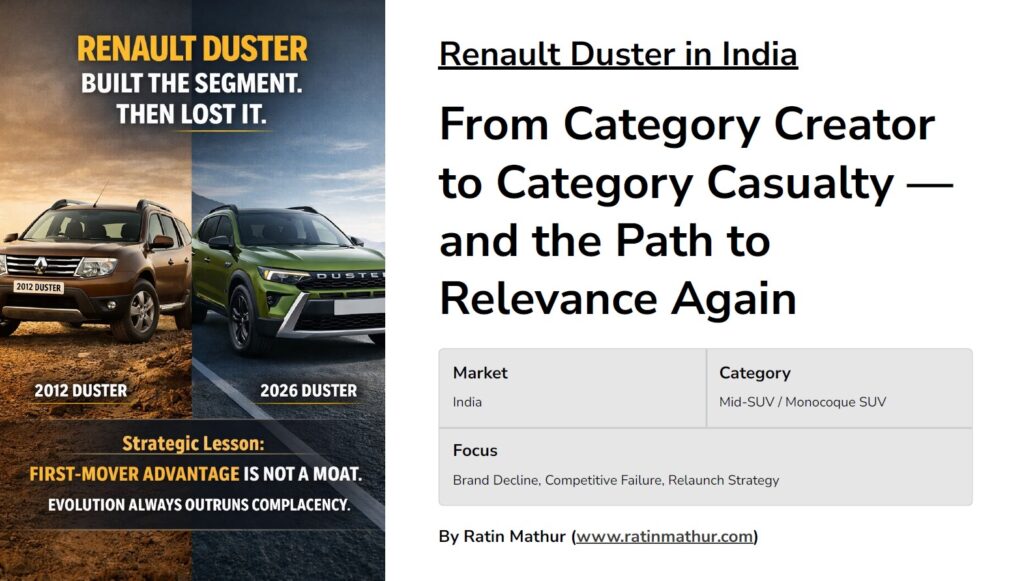
The Renault Duster is one of the most significant products in the history of India’s passenger vehicle market because it did not merely succeed within an existing category. It helped shape one. Launched in July 2012, the Duster entered India at a time when the SUV market was still fragmented and underdeveloped. It created a compelling bridge between rugged utility vehicles and urban passenger cars by combining road presence, practical usability, diesel efficiency, and rough-road capability. For a period, it was not only a successful product but a category-defining one.
Yet within a decade, the same product that once symbolized modern SUV aspiration in India lost momentum, lost market leadership, and was eventually discontinued. This case study examines how the Duster created a strong first-mover advantage, why Renault failed to convert that advantage into a durable competitive moat, what changed in the Indian SUV market, why production stopped, and how the Duster brand can still be repositioned for relevance in one of India’s most competitive automotive segments.
1. Introduction
The Renault Duster story in India is a classic case of early strategic brilliance followed by delayed strategic adaptation. It is not simply about one vehicle losing popularity. It is about how industries evolve, how customer expectations shift, and how first-mover advantage can disappear when a company does not renew its proposition aggressively enough.
At launch, the Duster solved a real and emerging market need. It offered Indian consumers a product that looked like an SUV, drove like a car, handled bad roads confidently, and still felt accessible enough to be a mainstream aspiration. It succeeded because it arrived before the market was fully organized around this demand.
Its decline, however, reveals a broader strategic lesson: creating a category is not the same as owning it permanently. Once the market matured, competitors redefined what success looked like in the segment. Renault did not keep pace with that redefinition.
This article presents the Renault Duster in India as a full case-study format strategic analysis, structured to answer the following questions:
| Case Questions | Focus |
|---|---|
| What made Renault Duster successful at launch? | Category creation and product-market fit |
| Was it a true first mover in India? | Strategic positioning and timing |
| Why did Renault Duster lose market leadership? | Competitive dynamics and strategic drift |
| Why was Duster discontinued in India? | Product lifecycle and business economics |
| Can Renault revive Duster successfully? | Repositioning and comeback strategy |
2. Industry Context: The Indian Passenger Vehicle Market Before Duster
To understand why the Duster mattered, it is necessary to understand the Indian market context before its arrival. In the early 2010s, the Indian passenger vehicle market was dominated by hatchbacks, compact sedans, and value-oriented fuel-efficient cars. SUVs existed, but they were either too expensive, too rugged, or too impractical for mass-market urban and family use.
Indian consumers, however, were beginning to show a visible shift in aspiration. Buyers increasingly wanted vehicles that projected more road presence, sat higher, looked tougher, and offered a sense of status. The problem was that the market had not yet fully organized itself around this aspiration in an accessible and scalable way.
This created a strategic whitespace. Renault entered that whitespace with precision.
| Indian Market Conditions Pre-2012 | Strategic Implication |
|---|---|
| Hatchback-dominated market | Strong demand for practical and value-oriented vehicles |
| Growing consumer aspiration | Buyers wanted more premium-looking, larger vehicles |
| Limited mainstream SUV options | Opportunity for a new, accessible SUV format |
| High diesel preference | Strong demand for efficient torque-rich powertrains |
| Mixed road conditions | Need for strong ride quality and ground clearance |
The Duster succeeded because it recognized this gap before most competitors did.
3. Renault in India Before Duster
Before the Duster, Renault India had not yet established itself as a strong mass-market player. The company had launched products such as the Fluence, Koleos, Pulse, and Scala, but none of them delivered the scale or brand impact required to establish Renault as a serious automotive force in India.
This is strategically important because the Duster was not just a successful product launch. It was the product that gave Renault India a meaningful identity.
Prior to Duster, Renault lacked:
- a high-visibility hero product,
- a segment association,
- and a scalable market narrative.
The Duster changed all three.
| Renault India Pre-Duster | Challenge |
|---|---|
| Limited portfolio traction | Weak brand visibility |
| Fragmented product positioning | No clear identity in the market |
| Low mass-market recall | Limited emotional connection with buyers |
| No category-defining product | Weak strategic relevance |
The Duster therefore became more than a product. It became Renault India’s strategic entry point into mass-market relevance.
4. Launch and Historical Significance of Renault Duster in India
The Renault Duster was launched in July 2012. Its arrival was significant because it offered a new product formula that was highly aligned with Indian market realities.
It combined:
- SUV styling and stance,
- monocoque comfort,
- high ground clearance,
- practical family usability,
- diesel efficiency,
- and road confidence.
This made the Duster neither a rugged utility-only product nor a soft urban crossover. It occupied a new middle ground, and that middle ground became extremely valuable.
The importance of the launch can be understood through the following strategic dimensions:
| Dimension | Why Duster Mattered |
|---|---|
| Product innovation | Introduced a new mainstream SUV ownership format |
| Consumer aspiration | Delivered SUV identity without premium pricing |
| Brand impact | Made Renault visible and desirable in India |
| Segment creation | Helped define the modern midsize SUV category |
| Market timing | Arrived before the segment became crowded |
The Duster’s significance lies in the fact that it did not merely participate in a trend. It accelerated one.
5. First-Mover Advantage: Was Renault Duster Truly a Pioneer?
From a strategic standpoint, the answer is yes. The Duster was not the first SUV in India in absolute terms, but it was among the first products to successfully mainstream the modern monocoque midsize SUV proposition in India.
This distinction matters. Before Duster, there were vehicles that had SUV characteristics, but very few had successfully combined:
- family practicality,
- car-like comfort,
- aspirational design,
- urban usability,
- and rugged capability
into a format that could scale in the mass market.
This gave Renault a meaningful first-mover advantage.
| Elements of Duster’s First-Mover Advantage | Strategic Benefit |
|---|---|
| Early entry into emerging SUV whitespace | Established category awareness |
| Distinctive product formula | Reduced direct substitution initially |
| Strong visual identity | Built fast consumer recall |
| Diesel-led value proposition | Aligned with dominant fuel preference |
| Limited early competition | Enabled pricing and perception leverage |
However, first-mover advantage is only powerful if it is defended. That is where Renault eventually faltered.
6. Why Renault Duster Became a Market Leader
The Duster’s success was not based on novelty alone. It became a market leader because it offered strong product-market fit and resonated deeply with how Indian consumers actually used their vehicles.
The Duster won because it felt designed for India’s reality, not just for brochures or urban image.
It appealed to:
- family buyers,
- highway users,
- semi-urban consumers,
- aspirational upgraders,
- and practical decision-makers.
Its market leadership was built on a combination of emotional and functional strengths.
| Why Duster Won Early | Strategic Interpretation |
|---|---|
| Strong suspension and ride quality | Built trust for Indian road conditions |
| Diesel efficiency | Matched dominant customer economics |
| SUV stance and road presence | Delivered aspiration and status |
| Everyday practicality | Expanded family use appeal |
| Reachable pricing | Opened the segment to wider audiences |
This is what made the Duster powerful. It did not win on one feature. It won on a complete and coherent value proposition.
7. Competitive Evolution: How the Segment Changed Around Duster
Once Duster proved that there was demand for this kind of SUV, the category began attracting stronger and better-resourced competitors.
Initially, Duster had breathing room. But as the market matured, the competitive environment changed rapidly.
The Ford EcoSport, launched in 2013, broadened SUV aspiration further, particularly among urban buyers. However, the more strategically important competitor was the Hyundai Creta, launched in 2015. Creta did not simply compete with Duster. It redefined what the segment would prioritize.
The category evolved from rugged practicality to premiumized, lifestyle-led family SUV ownership.
| Phase of Category Evolution | What Buyers Prioritized |
|---|---|
| Early phase (2012–2014) | Ruggedness, diesel, practicality, ride quality |
| Transition phase (2015–2017) | Design, interiors, convenience, premium feel |
| Mature phase (2018 onward) | Technology, lifestyle, safety, ownership confidence, status |
This evolution exposed a major strategic challenge for Renault. Duster’s original strengths remained relevant, but they were no longer sufficient to lead the category.
8. Problem Statement: Why Did Renault Duster Lose Leadership?
This is the core business problem at the heart of the case.
The Renault Duster did not lose because it became a fundamentally poor product. It lost because the category evolved and Renault did not evolve the product, proposition, and ownership experience aggressively enough to stay ahead.
This can be summarized as follows:
| Core Strategic Problem | Meaning |
|---|---|
| Early category leadership was not defended | Renault failed to convert first-mover advantage into long-term dominance |
| Product proposition became dated | Original strengths were not sufficiently modernized |
| Competitive expectations changed | Rivals reframed what success looked like |
| Brand and ecosystem lagged | Renault lost on trust, resale, and relevance |
This was not simply a product issue. It was a strategic adaptation issue.
9. Root Cause Analysis: Why Renault Could Not Keep Up
The decline of Duster can be traced to several interrelated strategic failures.
9.1 Renault Mistook Head Start for Moat
Duster’s early success gave Renault momentum, but momentum is not the same as structural advantage. A real moat would have required:
- faster refresh cycles,
- stronger dealer expansion,
- ecosystem trust,
- and deeper category ownership.
Renault had a winning product, but not a durable defensive system around it.
9.2 Renault Misread Category Migration
The category shifted from:
- practical SUV utility
to:
- premium, feature-rich, family-centric aspiration.
Renault stayed too closely tied to Duster’s original identity and did not sufficiently reinterpret that identity for the next stage of the market.
9.3 Product Refreshes Were Incremental, Not Transformational
Facelifts and updates helped prolong the lifecycle, but they did not restore competitive leadership. In high-velocity categories, incrementalism is often punished.
9.4 Ownership Confidence Became a Competitive Weapon
As the segment matured, buyers increasingly cared about:
- service quality,
- resale value,
- parts availability,
- and long-term confidence.
This is where stronger players such as Hyundai, Maruti Suzuki, and later Kia had a meaningful advantage.
These causes can be summarized below:
| Root Cause | Impact on Duster |
|---|---|
| Weak moat creation | First-mover advantage faded quickly |
| Poor category adaptation | Product lost alignment with new buyer expectations |
| Delayed full renewal | Rivals appeared fresher and more modern |
| Ecosystem weakness | Reduced trust among mainstream buyers |
| Narrow brand expansion | Duster remained one model instead of a franchise |
10. Why Production Stopped in India
The discontinuation of the Renault Duster in India was not caused by a single event. It was the outcome of declining strategic viability.
By the end of its lifecycle, Duster faced several overlapping challenges:
- an aging platform,
- reduced relevance,
- increased regulatory pressure,
- declining diesel advantage,
- and a hyper-competitive segment.
This weakened the business case for continuing production in its old form.
| Why Duster Production Stopped | Strategic Interpretation |
|---|---|
| Product obsolescence | Aging design and platform reduced competitiveness |
| BS6 and diesel economics | Original value proposition weakened structurally |
| Falling sales momentum | Reduced commercial viability |
| Capital allocation constraints | Harder to justify investment into an aging proposition |
| Portfolio shift within Renault India | Focus moved toward other scalable products |
The key point is this: Duster was not discontinued because the name lost all value. It was discontinued because Renault no longer had a winning business case around the product in its old form.
11. What Happened to This Iconic Brand?
The Duster brand did not disappear from memory. It transitioned from being a current aspiration to becoming a respected legacy.
That distinction is important.
A brand becomes strategically weak not only when it is disliked, but also when it stops feeling necessary in the present. That is what happened to Duster.
| Brand State Then | Brand State Later |
|---|---|
| Aspirational | Familiar |
| Current | Historical |
| Segment-defining | Segment-remembered |
| Dynamic | Static |
| High-energy | Low-momentum |
This is what strategic drift looks like in consumer markets. The brand still holds value, but that value becomes backward-looking unless it is actively reinterpreted.
12. SWOT Analysis: Renault Duster in India
A structured SWOT helps clarify the Duster’s strategic position.
| Strengths | Weaknesses |
|---|---|
| Strong brand recall | Delayed product renewal |
| Pioneer status in segment | Outdated interiors in later years |
| Strong ride and suspension | Weak feature competitiveness |
| Rugged SUV image | Lower ownership confidence vs leaders |
| Emotional legacy | Overdependence on diesel-era strengths |
| Opportunities | Threats |
|---|---|
| Re-enter as “authentic SUV” | Hyper-competitive segment |
| Leverage nostalgia with modern relevance | High customer expectations |
| Differentiate via capability and confidence | Stronger rivals with larger ecosystems |
| Build a lifestyle + practical franchise | Feature commoditization and pricing pressure |
| Hybrid / efficient powertrain opportunity | Fast product obsolescence cycle |
The SWOT makes one thing clear: Duster is not a dead asset. It is an under-leveraged one.
13. Strategic Options for Renault: What Could Have Been Done Better?
If Renault had acted differently during the maturity phase of Duster’s lifecycle, it may have prolonged leadership or at least preserved stronger relevance.
Several strategic moves could have improved Duster’s long-term position:
| Strategic Move | Potential Benefit |
|---|---|
| Faster next-generation product launch | Prevented relevance erosion |
| Stronger premium interior and feature upgrades | Improved showroom competitiveness |
| Duster sub-brand expansion | Increased mental availability and franchise value |
| Stronger ownership ecosystem investments | Improved trust and resale perception |
| Sharper repositioning during category migration | Kept brand aligned with market evolution |
This is important because it shows Duster’s decline was not inevitable. It was strategically avoidable to a significant extent.
14. Can Renault Duster Win Again?
Yes, but only if Renault treats Duster not as a nostalgia relaunch, but as a serious strategic growth platform.
The Duster still owns meaningful mental associations in India:
- ruggedness,
- authenticity,
- SUV credibility,
- rough-road confidence,
- and trust among many legacy buyers.
Those are valuable assets in a market where many SUVs increasingly feel similar.
However, a comeback will fail if Renault assumes that memory alone will drive demand.
The market now requires a sharper answer to a much harder question:
Why should a buyer choose Duster today over highly evolved rivals?
That question can only be answered through strong positioning and disciplined execution.
15. Recommended Repositioning Strategy for Duster in India
The strongest role for Duster in today’s market is not to be:
- the cheapest SUV,
- the most luxurious SUV,
- or the most feature-loaded SUV.
That battle is already crowded.
Instead, Duster should be repositioned as:
“The Authentic SUV for Modern India”
This positioning works because it combines:
- heritage,
- practical relevance,
- emotional differentiation,
- and functional credibility.
| Recommended Strategic Pillars | Execution Focus |
|---|---|
| Authenticity | Keep rugged DNA and real-world capability |
| Modern relevance | Upgrade interiors, infotainment, safety, convenience |
| Everyday usability | Family comfort, practicality, city-highway balance |
| Ownership confidence | Improve service, warranty, resale assurance |
| Distinctive market role | Avoid becoming a “me-too” feature-led SUV |
This is a sharper lane than trying to imitate incumbents.
16. Way Ahead
The way ahead for Renault Duster in India should be built on clarity, not nostalgia. The comeback opportunity exists, but it will only materialize if Renault understands that the market is no longer looking for the same product it wanted in 2012.
The next Duster must preserve the spirit of the original while fully meeting the expectations of today’s buyer.
That means Renault must focus on the following priorities:
| Way Ahead Priorities | Why They Matter |
|---|---|
| Relevance over memory | Buyers reward current value, not just legacy |
| Differentiation over imitation | Duster must stand for something distinct |
| Substance over gimmicks | Product credibility should remain central |
| Ecosystem strengthening | Ownership confidence now shapes conversion |
| Franchise thinking | Duster should become a long-term growth platform |
If Renault gets this right, Duster can once again become strategically important. Not because it will recreate the past, but because it can occupy a differentiated role in a highly homogenized market.
17. Conclusion
The Renault Duster in India is one of the most instructive business cases in modern Indian automotive strategy.
It succeeded because it:
- identified a whitespace,
- created a category,
- delivered strong product-market fit,
- and aligned with India’s roads and aspirations at exactly the right time.
It declined because:
- the category evolved,
- competitors modernized faster,
- customer expectations shifted,
- and Renault did not renew the product and proposition aggressively enough.
The Duster story therefore teaches a larger strategic lesson:
First-mover advantage is not a moat.
Leadership is not a moment. It is a continuous act of adaptation.
Duster’s future in India will depend not on how iconic it once was, but on whether Renault can make it strategically necessary again.
18. References
| S. No. | Reference Description | Link |
|---|---|---|
| 1 | Renault Group official website, company and brand updates | https://www.renaultgroup.com |
| 2 | Autocar India, vehicle reviews and market coverage | https://www.autocarindia.com |
| 3 | Autocar Professional, automotive industry and business analysis | https://www.autocarpro.in |
| 4 | SIAM (Society of Indian Automobile Manufacturers), industry data and reports | https://www.siam.in |
| 5 | Publicly available automotive market commentary and competitive analysis sources | Various public domain sources |