Introduction: When Geography No Longer Protects Economies
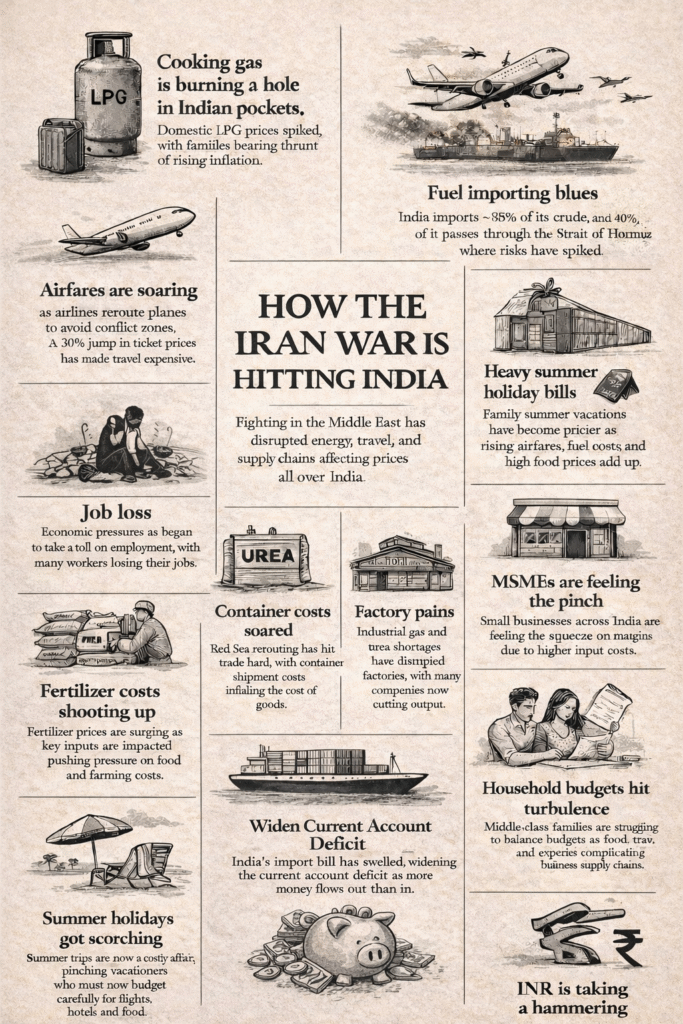
In an increasingly interconnected world, wars are no longer confined to borders. A conflict thousands of kilometers away can ripple through economies, industries, and households almost instantly. The ongoing tensions involving Iran are a classic example. While India is not directly involved militarily, the economic consequences are already being felt across sectors—from rising fuel costs to expensive airfares and increasing pressure on household budgets.
India’s dependence on global energy markets, especially the Middle East, makes it particularly sensitive to such geopolitical disruptions. This article explores what is happening in the Iran conflict, how it is affecting India in real terms, and what steps are needed to navigate this evolving crisis.
Understanding the Iran Conflict and Its Global Significance
The current tensions around Iran are rooted in geopolitical rivalries, control over strategic waterways, and broader power dynamics in the Middle East. One of the most critical aspects of this situation is the vulnerability of the Strait of Hormuz, a narrow but vital shipping route through which nearly one-fifth of the world’s oil supply passes.
When tensions escalate in this region, the immediate concern is not just military confrontation but disruption to global oil flows. Even the risk of disruption can push oil prices higher because markets react to uncertainty as much as actual supply shortages.
For example, when shipping routes become risky, insurance premiums for oil tankers increase. Ships may be rerouted, increasing transit time and cost. These costs are eventually passed down the chain—from governments to businesses and ultimately to consumers.
Why India Is Highly Vulnerable
India imports nearly 85% of its crude oil, and a large portion of that comes from the Middle East. This structural dependence means that any instability in the region directly impacts India’s energy security.
To understand this better, consider the following simplified representation:
| Dependency Factor | India’s Exposure |
|---|---|
| Crude Oil Imports | ~85% imported |
| Middle East Share | ~60% |
| LNG Dependence | ~50%+ |
| Trade via Hormuz | ~40% of energy trade |
This level of dependence means that even a modest increase in oil prices can significantly increase India’s import bill. Unlike oil-exporting countries, India does not benefit from higher prices—it absorbs the cost.
The Energy Shock: Where the Impact Begins
The most immediate effect of the Iran conflict is seen in global crude oil prices. When oil prices rise, the consequences for India are both direct and widespread.
For instance, a $10 increase in crude oil prices can add billions of dollars to India’s annual import bill. This increase is not just a macroeconomic number—it translates into real costs for fuel, transportation, and manufacturing.
Illustrative Impact of Oil Price Increase
| Crude Oil Increase | Estimated Impact on India |
|---|---|
| +$10/barrel | ~$15 billion additional import cost |
| +$20/barrel | Significant fiscal and inflationary pressure |
This increase affects everything from petrol and diesel prices to LPG cylinders used in households. Even if governments temporarily shield consumers through subsidies or tax adjustments, the financial burden does not disappear—it shifts elsewhere in the economy.
Inflation: The Invisible but Powerful Transmission Mechanism
One of the most critical ways the Iran conflict impacts India is through inflation. Energy costs are embedded in nearly every economic activity. When fuel becomes expensive, transportation costs rise, and that increase spreads across the supply chain.
For example, when diesel prices rise, transporting vegetables from farms to cities becomes more expensive. This leads to higher food prices in local markets. Similarly, manufacturing units face higher input costs due to increased logistics and energy expenses, which eventually raises the prices of consumer goods.
How Inflation Spreads Across the Economy
| Sector | Impact of Rising Energy Costs |
|---|---|
| Food | Higher due to transport & fertilizer costs |
| Aviation | Increased fuel (ATF) expenses |
| FMCG | Rising packaging and logistics costs |
| Construction | Costlier materials and transport |
This cascading effect makes inflation one of the most significant and immediate challenges arising from geopolitical conflicts.
Pressure on the Indian Rupee
Another critical consequence of rising oil prices is pressure on the Indian rupee. Since oil is traded globally in US dollars, higher oil prices mean India needs more dollars to pay for imports. This increases demand for dollars and weakens the rupee.
A weaker rupee further exacerbates inflation because imports become more expensive. For instance, not only does India pay more for oil due to higher global prices, but it also pays more because the rupee has depreciated.
This double impact can significantly strain the economy, especially if the trend persists over time.
Widening Current Account Deficit: A Structural Concern
The current account deficit (CAD) represents the gap between what a country imports and exports. When oil prices rise, India’s import bill increases significantly, widening this deficit.
A widening CAD is concerning because it indicates higher dependence on external financing. It can also affect investor confidence and lead to capital outflows, further weakening the currency.
CAD Impact Under Different Scenarios
| Oil Price Scenario | Impact on CAD |
|---|---|
| Stable prices | Manageable deficit |
| Moderate increase | Noticeable widening |
| Sustained high prices | Significant macroeconomic risk |
This is why policymakers closely monitor oil prices during geopolitical crises.
Sectoral Impact: From Airlines to Agriculture
The effects of the Iran conflict are not limited to macroeconomic indicators—they are deeply felt across industries.
The aviation sector, for instance, is highly sensitive to fuel prices. Aviation turbine fuel (ATF) accounts for a significant portion of airline operating costs. When fuel prices rise and air routes are disrupted due to conflict zones, airlines face higher costs, which are passed on to passengers in the form of increased ticket prices.
Similarly, agriculture is impacted through rising fertilizer costs. Many fertilizers depend on natural gas, and disruptions in supply chains can increase their prices. This raises the cost of farming and eventually contributes to food inflation.
Manufacturing and MSMEs face a dual challenge of rising input costs and weakening demand. Small businesses, in particular, struggle to absorb these shocks, leading to reduced profitability and, in some cases, job losses.
Impact on Households: The Real Frontline
While macroeconomic indicators tell one part of the story, the real impact is felt at the household level. Rising LPG prices, higher fuel costs, and increasing grocery bills directly affect disposable income.
For example, a middle-class household may experience:
- Higher monthly fuel expenses
- Increased cost of essential goods
- Expensive travel and vacations
Over time, this leads to reduced discretionary spending, which in turn affects businesses and economic growth.
Impact Flow: How the Crisis Translates into Economic Stress
Iran Conflict → Oil Price Increase → Import Bill Rises → Inflation Increases → Rupee Weakens → Consumption Declines → GDP Growth Slows
This chain reaction highlights how a geopolitical event transforms into an economic challenge.
What Needs to Be Done: Strategic Response
Addressing these challenges requires a combination of short-term management and long-term structural reforms.
In the short term, the government needs to manage inflation and ensure adequate energy supply. This may involve diversifying oil import sources, using strategic reserves, and adjusting taxes or subsidies.
From a business perspective, companies must focus on cost efficiency and supply chain resilience. For instance, firms can reduce dependence on single suppliers, invest in energy-efficient technologies, and hedge against currency and commodity risks.
In the long term, India must accelerate its transition toward renewable energy and reduce dependence on imported fossil fuels. Building resilient supply chains and strengthening domestic manufacturing capabilities will also be critical.
Conclusion: A Wake-Up Call for Economic Resilience
The Iran conflict is a stark reminder that economic vulnerabilities often lie far beyond national borders. For India, the challenge is not just to manage the current crisis but to build a more resilient and self-reliant economic structure.
The key takeaway is clear: India does not need to be in a war to experience its consequences.
The future will belong to economies that can anticipate global shocks, adapt quickly, and reduce structural dependencies. For India, this moment presents both a challenge and an opportunity—to transform vulnerability into strength.
References
International Energy Agency. (2024). Oil market report. Retrieved from https://www.iea.org/reports/oil-market-report
International Monetary Fund. (2024). World economic outlook: Navigating global divergence. Retrieved from https://www.imf.org/en/Publications/WEO
Reserve Bank of India. (2024). Monetary policy report. Retrieved from https://www.rbi.org.in
Ministry of Petroleum and Natural Gas, Government of India. (2024). Indian petroleum statistics. Retrieved from https://mopng.gov.in
World Bank. (2024). Global economic prospects. Retrieved from https://www.worldbank.org/en/publication/global-economic-prospects
Reuters. (2026). Middle East tensions and oil supply risks. Retrieved from https://www.reuters.com
Bloomberg. (2026). Energy markets and geopolitical risk analysis. Retrieved from https://www.bloomberg.com