Introduction
In today’s knowledge-driven economy, intellectual property has emerged as one of the most valuable strategic assets for organizations and nations alike. Among various forms of intellectual property, patents play a particularly critical role because they protect technological innovation, stimulate research and development, and enable companies to maintain competitive advantage in rapidly evolving markets.
Patents are no longer viewed merely as legal tools designed to prevent imitation. Instead, they have become strategic instruments that influence global competition, technology leadership, and long-term economic growth. Companies and countries that actively build strong patent portfolios gain the ability to shape industry standards, create barriers to entry, and unlock substantial financial value through licensing and commercialization.
This report provides a comprehensive overview of the global patent landscape, examining key trends in patent activity, leading countries and corporations, major technology sectors, and the strategic implications of intellectual property management in the modern innovation ecosystem.
Global Patent Landscape
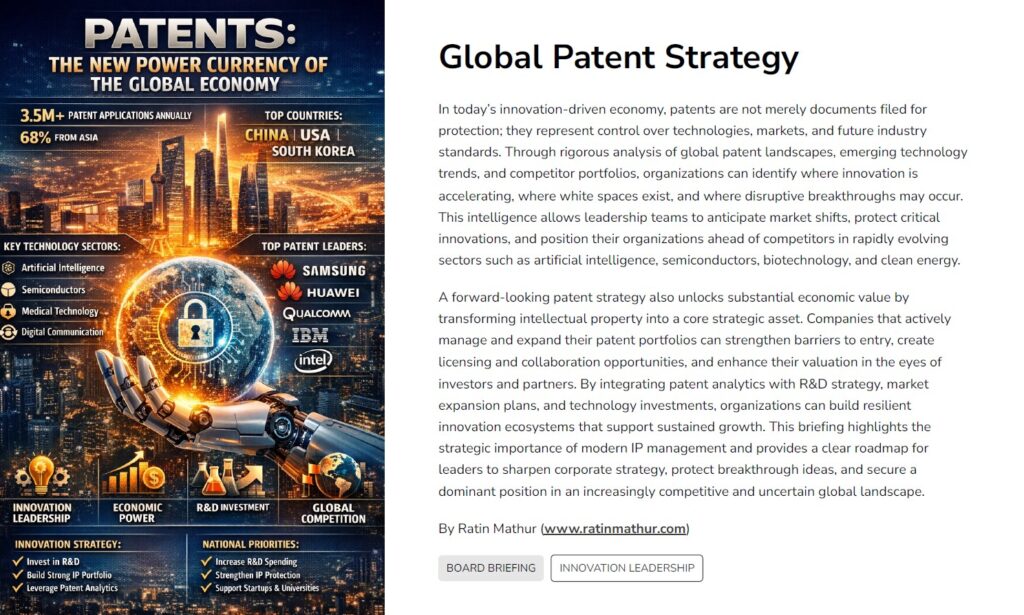
The volume of patent filings worldwide has increased dramatically over the past two decades, reflecting the accelerating pace of technological innovation and global competition. According to global intellectual property statistics, more than 3.5 million patent applications are filed annually worldwide.
A significant share of these filings originates from Asia, which has become the dominant center of global innovation activity.
Global Patent Distribution by Region
Asia
Approximately 68% of global patent applications
North America
Approximately 20%
Europe
Approximately 10%
Other regions
Approximately 2%
This geographic distribution highlights the increasing importance of Asian economies in driving technological development and intellectual property creation.
Top Patent Filing Countries
Patent activity is highly concentrated among a small number of technologically advanced countries. These nations have developed strong research ecosystems, high levels of R&D investment, and supportive intellectual property frameworks.
Leading Patent Countries
China
United States
Japan
South Korea
Germany
India
France
United Kingdom
Switzerland
Netherlands
China currently accounts for nearly half of all global patent applications, demonstrating the country’s aggressive investment in innovation and technology leadership.
The United States continues to maintain strong patent activity driven by its world-leading technology companies, research universities, and venture capital ecosystem.
Japan and South Korea remain highly innovative economies with strong patent portfolios in electronics, semiconductors, robotics, and automotive technologies.
Patent Intensity and Innovation Efficiency
Another important measure of innovation is the number of patents generated relative to population size. Some smaller economies achieve extremely high levels of innovation efficiency.
Countries such as South Korea, Switzerland, Japan, and Sweden produce a significantly higher number of patents per capita than most large economies. This indicates strong national innovation systems supported by advanced research infrastructure, skilled talent, and effective industrial policies.
Role of Research and Development Investment
Investment in research and development is one of the strongest predictors of patent output. Countries that allocate a larger share of their national income to R&D tend to generate higher levels of technological innovation.
Major global investors in R&D include:
United States
China
Japan
Germany
South Korea
South Korea and Israel currently invest close to five percent of their GDP in research and development, among the highest levels in the world. This sustained investment contributes directly to their strong patent performance and technological leadership.
Technology Areas Driving Patent Growth
Patent activity is heavily concentrated in specific technology sectors that are shaping the future global economy.
Leading Technology Fields
Computer Technology
Artificial Intelligence
Electrical Machinery
Medical Technology
Digital Communication
Semiconductors
Transportation and Mobility
Pharmaceuticals
Industrial Automation
Measurement and Sensors
Computer technology currently represents the largest share of global patent filings. This category includes innovations in software systems, artificial intelligence, data processing, cybersecurity, and cloud computing.
Medical technology and biotechnology have also experienced significant growth, particularly following global healthcare challenges that accelerated research in diagnostics, pharmaceuticals, and medical devices.
Semiconductors remain one of the most strategically important technology sectors because they underpin virtually all modern digital systems.
Corporate Leaders in Patent Innovation
Large multinational corporations play a dominant role in generating patents worldwide. Many of the world’s most innovative companies maintain extensive patent portfolios containing tens of thousands of active patents.
Leading Corporate Patent Holders
Huawei
Samsung Electronics
Qualcomm
LG Electronics
Mitsubishi Electric
IBM
Intel
Canon
Toyota
Panasonic
These organizations invest billions of dollars annually in research and development. Their patent portfolios serve several strategic functions including protecting proprietary technology, generating licensing revenue, and establishing technological standards within global industries.
For example, companies operating in telecommunications often earn significant revenue through licensing their patented technologies to device manufacturers and network operators around the world.
Strategic Value of Patents
Patents provide multiple strategic advantages that extend far beyond legal protection.
Competitive Advantage
Patents grant exclusive rights to commercialize an invention for a limited period, allowing companies to maintain technological leadership.
Market Barriers
Strong patent portfolios can create barriers that prevent competitors from entering specific technology domains.
Revenue Generation
Many companies monetize patents through licensing agreements, technology partnerships, or intellectual property sales.
Investor Confidence
Organizations with strong patent portfolios often attract greater investment because patents signal innovation capability and long-term value creation.
Patent Analytics and Competitive Intelligence
Modern organizations increasingly use patent analytics as a strategic decision-making tool. Patent data can reveal emerging technology trends, competitor innovation strategies, and potential areas for future research investment.
By analyzing patent filings, companies can identify technological “white spaces” where innovation opportunities exist and anticipate where competitors are directing their research efforts.
Patent analytics also helps organizations evaluate potential mergers, acquisitions, and strategic partnerships by assessing the strength and relevance of intellectual property portfolios.
Global Technology Competition
Patents have become central to global technological competition. Several advanced technology areas have emerged as key battlegrounds for innovation leadership.
Strategic Technology Domains
Artificial Intelligence
Semiconductors
Quantum Computing
Biotechnology
Clean Energy Technologies
Advanced Materials
Autonomous Transportation
Space Technologies
Countries and companies that dominate these areas are likely to shape the future global economy and define next-generation industrial capabilities.
Future Outlook
Global patent activity is expected to continue expanding as digital transformation accelerates across industries. Technological advancements in artificial intelligence, biotechnology, renewable energy, and advanced manufacturing will likely drive the next wave of innovation.
Industry experts estimate that global patent filings could reach five to six million annually by 2050 as emerging technologies mature and new innovation ecosystems develop around the world.
Countries investing heavily in research infrastructure, education, and technology development will likely strengthen their position in the global patent landscape.
Conclusion
Patents represent a powerful indicator of technological capability and economic competitiveness in the modern world. As innovation becomes increasingly central to economic growth, intellectual property strategy will play a critical role in determining which organizations and countries lead future technological revolutions.
Companies that actively manage their patent portfolios and integrate intellectual property strategy into their broader business planning will be better positioned to capture value from innovation. Likewise, countries that prioritize research investment, talent development, and supportive policy frameworks will continue to drive global technological progress.
Understanding the dynamics of the global patent landscape is therefore essential for leaders seeking to navigate the rapidly evolving innovation economy.
References
World Intellectual Property Organization
https://www.wipo.int
OECD Intellectual Property Statistics
https://www.oecd.org
WIPO World Intellectual Property Indicators
https://www.wipo.int/ipstats
World Bank Innovation Indicators
https://data.worldbank.org
Disclaimer
This report has been prepared using publicly available information and research from multiple sources. The analysis presented reflects the author’s interpretation of available data and is intended solely for informational and educational purposes. The report does not constitute legal advice, investment guidance, or strategic recommendations for implementation.
Readers are encouraged to conduct their own independent research and consult appropriate professionals before making decisions based on the information provided in this document.