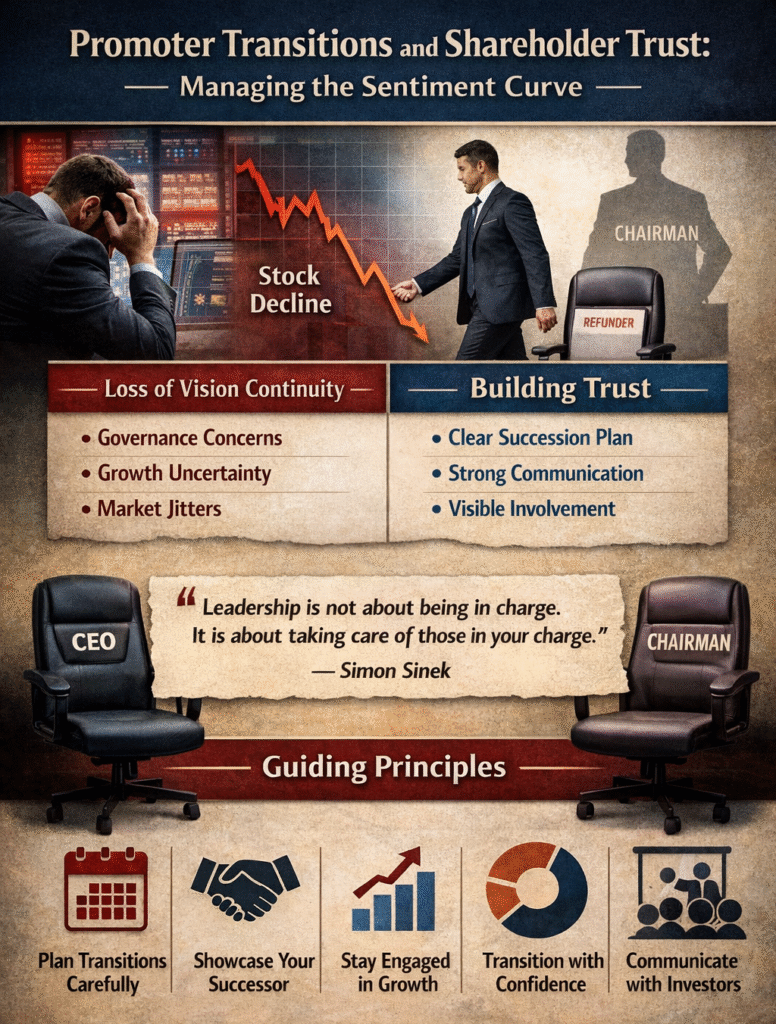
1. Introduction: Leadership Transitions Are Value Events
In the start-up ecosystem, leadership is not merely an organizational role. It is a market signal. Founders embody vision, culture, risk appetite, and long-term promise. Investors do not just invest in balance sheets. They invest in belief systems led by promoters.
When a start-up promoter steps down from the CEO position, even if by design, the market often interprets the move through a lens of uncertainty. Stock prices react, analysts reassess narratives, and stakeholders recalibrate expectations.
This reaction is not always rational. But it is real.
The promoter’s transition from CEO to Chairman must therefore be treated not as a role change, but as a value-sensitive strategic event requiring careful orchestration.
2. Why Founder CEOs Command a Market Premium
Founder-led companies historically enjoy a valuation premium. This “founder premium” stems from several structural advantages:
• Deep product and customer insight
• Long-term risk-taking ability
• Emotional ownership and resilience
• Faster decision velocity
• Cultural continuity
Markets associate founders with growth aggression and innovation continuity. When that anchor shifts, even strong financials may not immediately offset sentiment risk.
3. The Sentiment Curve: How Markets Typically React
Leadership transitions trigger a predictable sentiment cycle:
Phase 1: Shock
Sudden announcement creates speculation.
Phase 2: Narrative Vacuum
Lack of clarity fuels governance concerns.
Phase 3: Stock Volatility
Short-term investors exit.
Phase 4: Credibility Testing
New CEO performance comes under scrutiny.
Phase 5: Stabilization or Re-rating
Markets settle based on execution outcomes.
Understanding this curve is critical for promoters planning succession.
4. Real Start-up and Tech Transition Examples
4.1 Amazon: Structured Founder Exit Done Right
Jeff Bezos transitioning to Executive Chairman while Andy Jassy became CEO is widely seen as a gold-standard succession model.
Why markets stayed confident:
• Transition communicated well in advance
• Successor had proven P&L leadership (AWS)
• Founder remained strategically involved
• Timing aligned with business strength
Result: Minimal sentiment disruption despite leadership change.
4.2 Google: Institutionalization Over Individualization
Larry Page stepping aside for Sundar Pichai marked a shift from founder-driven to systems-driven leadership.
Stability drivers:
• Alphabet structure already in place
• Pichai had operational credibility
• Founders retained oversight roles
Markets interpreted this as maturation, not withdrawal.
4.3 Microsoft: Multi-Stage Founder Transition
Bill Gates moving from CEO to Chairman, followed by Steve Ballmer, and later Satya Nadella, reflects phased institutional evolution.
Initial transitions created strategic drift concerns. But Nadella’s leadership re-established market confidence through:
• Cloud pivot clarity
• Cultural reset
• Strong communication
Lesson: Succession alone does not guarantee stability. Strategy continuity does.
4.4 Uber: Forced Founder Exit and Trust Collapse
Travis Kalanick’s resignation amid governance crises triggered sharp sentiment deterioration.
Impact factors:
• Non-voluntary exit
• Cultural controversies
• Board conflict visibility
• Regulatory battles
Dara Khosrowshahi’s appointment stabilized governance perception, but valuation recovery took time.
Lesson: Context of exit matters as much as the exit itself.
4.5 WeWork: Extreme Case of Founder Dependency Risk
Adam Neumann’s exit before IPO exposed structural governance weaknesses.
Consequences included:
• IPO collapse
• Massive valuation erosion
• Investor lawsuits
• Business model scrutiny
This case redefined global investor expectations around founder oversight and board independence.
4.6 Twitter: Founder Return and Exit Volatility
Jack Dorsey’s leadership journey, exit, return, and final resignation created repeated sentiment swings.
Markets reacted to:
• Strategic inconsistency
• Monetization challenges
• Leadership bandwidth concerns
Founder presence alone did not guarantee investor confidence.
4.7 Freshworks: Planned Founder to Chairman Transition
Girish Mathrubootham moving to Executive Chairman while Dennis Woodside took over as CEO reflects a maturing SaaS governance model.
Key positives:
• Founder stayed product-focused
• External CEO brought scaling expertise
• Transition aligned with global expansion
Markets viewed this as capability augmentation, not promoter dilution.
4.8 Infosys: Founder Legacy to Professional Leadership
Though not a start-up anymore, Infosys provides a classic promoter transition journey.
Narayana Murthy handing leadership to professional CEOs marked institutionalization. However, leadership instability phases did trigger investor nervousness until strategic steadiness returned.
5. Core Reasons Stock Prices Fall After Founder CEO Exit
Even profitable companies face valuation corrections due to perception risks:
5.1 Vision Continuity Risk
Investors fear dilution of long-term strategic direction.
5.2 Execution Uncertainty
New CEOs lack founder instinct and agility initially.
5.3 Governance Speculation
Markets suspect undisclosed conflicts or pressures.
5.4 Growth Momentum Doubt
Founder aggression often fuels expansion bets.
5.5 Cultural Drift Concerns
Employee morale and innovation velocity may shift.
Sentiment, not fundamentals, drives short-term corrections.
6. Promoter’s Fiduciary Responsibility to Shareholders
Promoters must recognize that stepping down is not a personal decision alone. It is a fiduciary act affecting:
• Public shareholders
• Institutional investors
• Employees with ESOPs
• Customers and partners
• Market regulators
Respecting shareholders means managing perception risk with the same rigor as financial risk.
7. Chairman vs CEO: Role Clarity Matters
A common promoter mistake is assuming markets will see Chairman elevation as continuity.
But investors differentiate sharply:
| CEO Role | Chairman Role |
|---|---|
| Operational execution | Strategic oversight |
| Daily decision-making | Governance guidance |
| Growth accountability | Board leadership |
| Market-facing leadership | Institutional stewardship |
Unless founders remain visibly engaged, markets perceive distancing, not elevation.
8. When Should Founders Step Down?
Optimal transition timing aligns with strength, not stress.
Right Timing Indicators:
• Business model maturity
• Strong leadership bench
• Global scaling phase
• Institutional investor entry
• Governance evolution needs
Wrong Timing Indicators:
• Financial stress
• Regulatory scrutiny
• Internal conflicts
• Slowing growth
• Pre-funding or pre-IPO phases
Transitions during weakness amplify distrust.
9. The Psychology of Investors During Founder Exit
Investors subconsciously evaluate three questions:
- Is the founder leaving voluntarily?
- Is the successor equally credible?
- Will strategy remain intact?
If clarity on these is missing, sentiment deteriorates regardless of earnings performance.
10. Communication Strategy: The Most Underrated Lever
Poor communication destroys value faster than leadership change itself.
Best practices include:
• Advance transition signaling
• Joint founder-successor announcements
• Media and analyst briefings
• Investor townhalls
• Transition roadmaps
Transparency reduces speculation premiums.
11. Succession Planning: Build Before You Need It
Institutional investors assess succession depth as a governance KPI.
Effective succession models include:
• Internal leadership grooming
• Rotational CXO exposure
• Board mentoring
• External benchmarking
Sudden external hires signal unpreparedness unless well justified.
12. Founder Involvement Post Transition
Promoters must remain visibly engaged without operational interference.
High-confidence engagement areas:
• Vision and strategy
• Innovation investments
• Global partnerships
• Culture stewardship
• M&A direction
Low-confidence behaviors:
• Shadow management
• Public CEO contradiction
• Board micromanagement
Balance is critical.
13. Transition as a Value Creation Opportunity
Well-managed founder exits can unlock value through:
• Professional management scalability
• Governance premium expansion
• Institutional capital attraction
• Global credibility enhancement
Many PE and sovereign funds prefer professionally run founder-led firms post-transition.
14. Board’s Role in Protecting Shareholder Trust
Independent directors must ensure:
• Structured succession planning
• Transparent evaluation processes
• Founder role clarity
• Minority shareholder protection
Passive boards amplify sentiment shocks.
15. Cultural Continuity: The Invisible Risk
Founder exits often trigger:
• Talent attrition
• Innovation slowdown
• Risk aversion
• Bureaucratic layering
Mitigation requires codifying founder culture into systems, not personalities.
16. Market Case Comparison: Planned vs Forced Exits
| Parameter | Planned Exit | Forced Exit |
|---|---|---|
| Sentiment impact | Moderate | Severe |
| Stock volatility | Short-term | Prolonged |
| Governance perception | Positive | Negative |
| Investor trust | Stable | Eroded |
Preparation defines perception.
17. Strategic Transition Playbook for Promoters
Pre-Announcement
• Identify and groom successor
• Align board consensus
• Stress-test market reaction
Announcement Phase
• Co-present transition narrative
• Clarify founder role continuity
• Share strategic roadmap
Post-Announcement
• Conduct investor outreach
• Deliver early performance wins
• Reinforce governance signals
18. Leadership Lens
“Leadership is not about being in charge. It is about taking care of those in your charge.”
— Simon Sinek
For founders, this extends to shareholders whose trust fuels enterprise scale.
19. Conclusion: Evolution, Not Exit
Stepping down as CEO is not abdication. It is evolution.
But evolution must be architected, communicated, and institutionalized.
Promoters must remember:
Markets forgive performance volatility.
They rarely forgive trust volatility.
A founder leaving the CEO chair should signal governance maturity, strategic scale, and institutional readiness.
Not uncertainty.
20. Strategic Recommendations Summary
• Signal transitions early
• Build visible succession depth
• Align timing with business strength
• Stay strategically engaged
• Communicate relentlessly
• Strengthen board governance
• Protect cultural continuity
• Anchor investor confidence
Leadership transitions are inevitable.
Trust erosion is not.