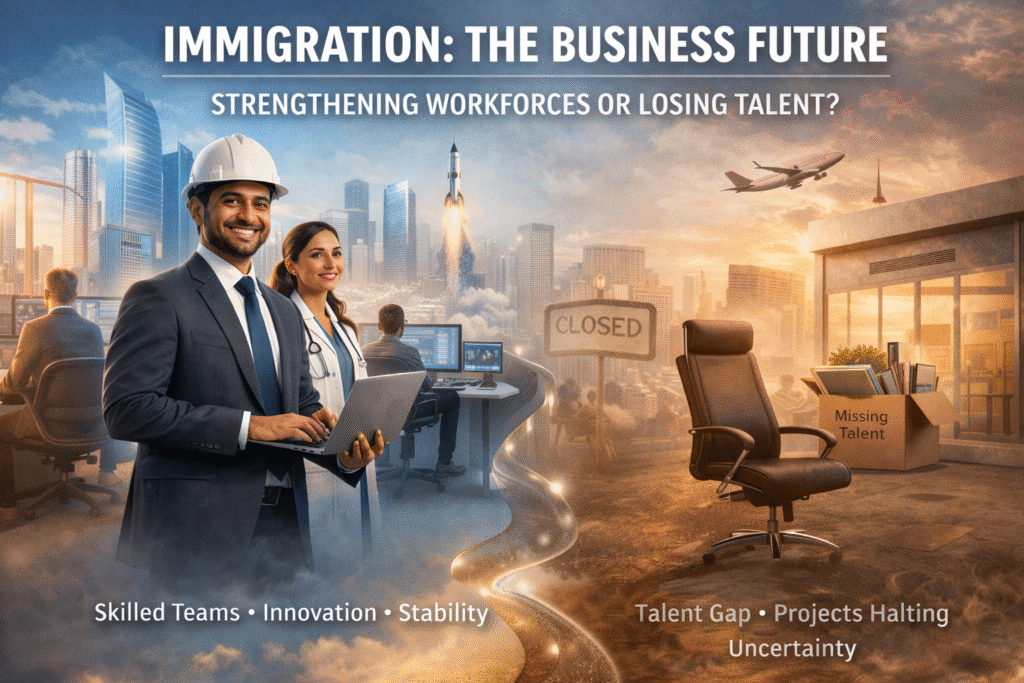
Immigration is often discussed in political rooms — debated through the lenses of borders, policies, and national priorities.
But its real impact is felt elsewhere.
Inside meeting rooms.
Across project floors.
Within innovation labs.
And across global delivery centers.
For companies, immigration is not an abstract policy issue — it is a workforce, capability, and competitiveness reality.
Immigration Is Already Embedded in Business Growth
Across industries today, immigrant employees are not just part of the workforce — they are part of the growth story.
They build products.
Run critical transformation projects.
Drive research and patents.
Support global delivery models.
Lead multicultural teams.
They are engineers, researchers, managers, healthcare professionals, data scientists, analysts — powering innovation and execution every day.
From technology and healthcare to construction, logistics, academia, and advanced research — immigrant talent is deeply embedded in business success.
In many organizations, innovation is already borderless.
The Environment Around Immigrant Talent Is Changing
While companies are becoming more global, immigration environments in many regions are becoming more complex.
Visa uncertainties are rising.
Policy frameworks are shifting.
Work permit rules are tightening.
Residency pathways feel unpredictable.
Relocation pressures are increasing.
Family security concerns are growing.
Even when employees are fully compliant — legally employed, tax-paying, and performance-driven — the fear of instability is real.
And this fear doesn’t stay outside the workplace.
It quietly impacts:
Productivity.
Engagement.
Retention.
Mobility decisions.
Career planning.
Many immigrant professionals today make life decisions — not based on opportunity — but based on visa timelines.
The Human Side Companies Often Overlook
Behind every work permit is a life structure.
Families relocating across continents.
Children adapting to new school systems.
Spouses rebuilding careers.
Financial commitments tied to host countries.
When policy uncertainties rise, it isn’t just an employee affected — it’s an entire ecosystem of human stability.
Future-focused companies are beginning to recognize this emotional and psychological dimension of workforce planning.
Because talent performance is deeply linked to talent security.
Why Immigration Disruption Is a Business Risk
When immigrant employees face forced exits or sudden mobility barriers, the consequences for companies are immediate and tangible.
Projects slow down.
Critical skills disappear.
Client commitments get disrupted.
Hiring costs increase.
Training investments are lost.
Delivery timelines slip.
In knowledge industries, replacing talent is not transactional — it is structural.
Years of domain expertise, institutional knowledge, and cultural integration cannot be replicated overnight.
Talent risk quickly becomes business continuity risk.
Sectoral Dependence on Immigrant Talent
Some industries are structurally dependent on global mobility.
Technology relies on cross-border engineering talent.
Healthcare systems depend on migrant doctors and nurses.
Construction sectors rely on international labor pools.
Logistics and supply chains function on migrant workforce layers.
Universities and research labs depend on global scholars.
Without immigration, many of these sectors would face capacity, cost, and innovation shocks.
How Future-Focused Companies Are Responding
Leading organizations are no longer treating immigration as an administrative function — they are treating it as a strategic workforce pillar.
They are moving from reactive compliance to proactive talent security models.
Key actions emerging:
Strengthening visa and legal assistance programs.
Providing transparent communication during policy changes.
Creating structured global mobility pathways.
Offering remote or cross-border role flexibility.
Building location-agnostic teams.
Designing multi-country workforce hubs.
Some firms are even integrating immigration risk into enterprise risk management frameworks.
Because they recognize a simple but powerful truth:
Talent security is business continuity.
The Strategic Reality Leaders Must Acknowledge
Global talent today has choices.
And talent decisions are increasingly shaped by security, stability, and long-term opportunity — not just compensation.
Key realities shaping the future workforce:
Talent feels before it delivers.
Security drives innovation.
Inclusion builds loyalty.
Support strengthens retention.
When immigrant employees feel supported, they stay focused on building — not worrying.
And when companies create that stability, they don’t just retain talent — they strengthen culture, innovation capacity, and organizational resilience.
Immigration as a Competitive Advantage
In the emerging global talent war, immigration posture is becoming a corporate differentiator.
Companies known for strong immigrant support systems attract better talent pipelines.
They build:
Stronger employer brands.
Higher retention rates.
More diverse innovation thinking.
Greater global market adaptability.
Immigration strategy is quietly becoming part of workforce strategy, location strategy, and innovation strategy.
A Question for Immigrant Professionals
If you are an immigrant employee reading this, you may resonate with some of these realities.
Have visa timelines ever influenced your career decisions?
Have policy shifts created uncertainty for your family?
Have you felt relocation pressure despite strong performance?
Have you wished your employer provided more structural support?
These experiences are more common than openly discussed.
The Leadership Imperative
The future of work will not be defined by geography.
It will be defined by how effectively organizations support the people who power global growth — regardless of where they come from.
Immigration is no longer just about mobility.
It is about:
Workforce stability.
Innovation continuity.
Business resilience.
Human dignity.
Final Perspective
From a company lens, immigration is not a disruption to manage.
It is a future to design.
Organizations that invest early in immigrant workforce security will not only protect operations — they will build stronger, more loyal, and more innovative enterprises.
Because when people feel secure, they don’t just work.
They build the future.
For more such insightful perspectives on workforce strategy, global talent mobility, and the future of work, explore additional articles available on our website.