
Executive Summary
When organizations face declining sales, intensifying competition and shrinking profitability, employee costs frequently become an immediate target for cost reduction. Senior and middle-management positions may be eliminated, experienced professionals may be replaced with lower-paid employees, and annual increments may be restricted. Such decisions can deliver visible short-term savings, but their long-term economic consequences are more complex.
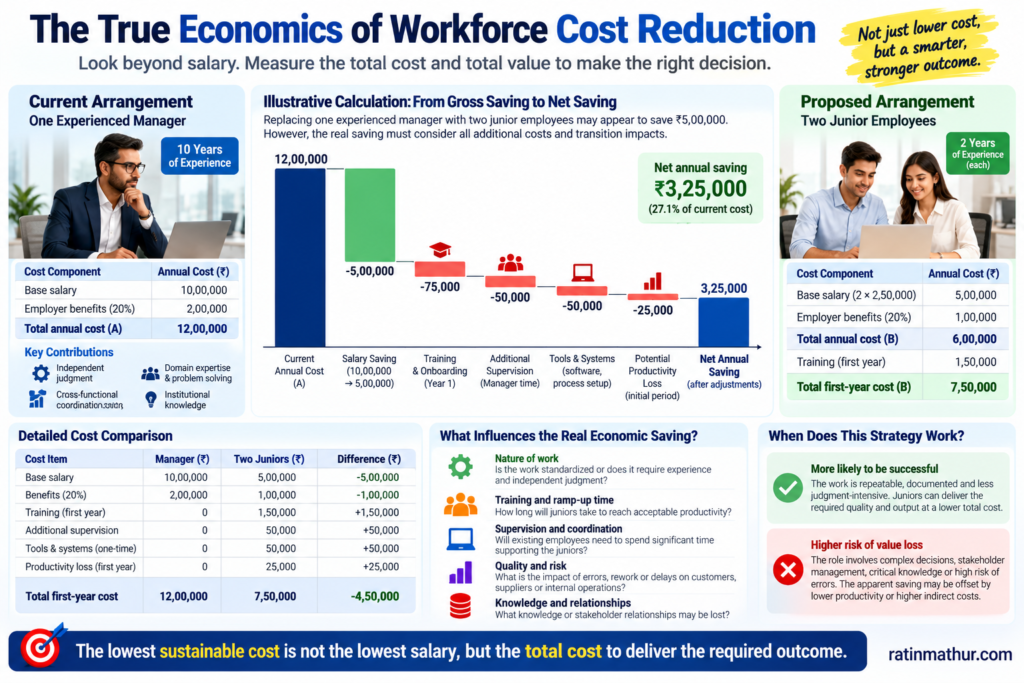
Consider an experienced manager earning ₹10 lakh annually who is replaced by two junior employees earning ₹2.5 lakh each. The apparent annual salary saving is ₹5 lakh, or 50%. However, this calculation excludes training, supervision, transition costs, institutional knowledge, decision-making capability and potential productivity losses. The actual economic benefit depends on whether the replacement arrangement can deliver the required outcomes at a lower total cost.
This paper argues that neither employee value nor cost reduction should be treated as an absolute priority. The appropriate decision criterion is sustainable economic value: the contribution generated or protected by a role, its total cost, its affordability under future business conditions and the availability of credible alternatives.
The challenge becomes particularly significant in flat organizations with relatively small workforces, experienced individual contributors, cross-functional responsibilities and compensation levels above industry benchmarks. Such organizations may have limited management layers to remove, while eliminating individual contributors can disrupt several functions simultaneously.
Drawing on research concerning workforce skills, productivity, employee engagement and organizational downsizing, this paper proposes three strategic frameworks: the Value–Cost Alignment Matrix™ for evaluating workforce decisions, the Work-to-Value Redesign Framework™ for reducing costs through work redesign, and the Sustainable Workforce Economics Framework™ for aligning employee costs with business performance.
The central recommendation is to replace salary-driven cost cutting with evidence-based cost optimization. Organizations should eliminate unnecessary work, improve productivity, review compensation growth, redeploy talent and selectively restructure roles where the economic case is demonstrated. Workforce reduction may be necessary, but it should be a considered business decision rather than an automatic response to financial pressure.
Introduction
Employees occupy a distinctive position in organizational economics. They are a recurring expense in the financial statements, but they also create, protect and coordinate the activities through which an organization generates revenue, controls costs, serves customers and manages risk.
This dual role creates a fundamental management dilemma during periods of financial pressure. Employee compensation is measurable, recurring and often relatively easy to change through hiring restrictions, restructuring or workforce reduction. The full value of employee experience, judgment, problem-solving and institutional knowledge is less visible and more difficult to quantify.
The dilemma is particularly acute when organizations operate in competitive markets where products become commoditized, new entrants challenge established players and customers increasingly compare suppliers on price. Revenue pressure can expose a cost structure that was sustainable under earlier market conditions but is no longer appropriate.
Management may respond by eliminating expensive positions and recruiting less-experienced employees at lower salaries. While such decisions can be economically justified in certain circumstances, they become problematic when salary is used as a substitute for a comprehensive assessment of value.
Research by Criscuolo et al. (2024) examines the relationship between workforce skills, firm productivity and wage differences, highlighting the importance of workforce composition and the allocation of skills. Similarly, OECD research by Criscuolo et al. (2021) finds that workforce skills and managerial capabilities are associated with differences in firm productivity. These findings reinforce the importance of evaluating the capabilities an organization requires rather than considering payroll expenditure in isolation.
The purpose of this paper is to establish a practical strategic approach to employee-cost optimization, particularly in organizations that already operate with lean structures and rely heavily on experienced individual contributors.
Problem Statement & Objectives
The central problem is that organizations under profitability pressure may optimize visible employee costs without adequately evaluating the capabilities, productivity and business outcomes those costs support.
A workforce reduction can improve financial performance when it removes unnecessary capacity or corrects a genuine mismatch between work requirements and resources. However, if it removes capabilities that remain essential, the organization may experience productivity deterioration, operational disruption, higher supervision costs, weaker customer relationships or the loss of knowledge that is difficult to replace.
The strategic problem can therefore be expressed as follows: How can an organization establish a sustainable employee-cost structure that supports profitability and competitiveness while preserving the capabilities necessary to execute its business strategy?
The objective is not to maximize employee retention regardless of cost, nor to minimize payroll regardless of consequences. It is to determine the most economical sustainable arrangement for delivering the work and outcomes the business requires.
| Strategic objective | Management question | Desired outcome |
|---|---|---|
| Establish economic affordability | Can the business sustain its current employee-cost structure? | A workforce budget aligned with business economics |
| Improve productivity | Can the same required outcomes be delivered with less effort or lower cost? | Higher output and efficiency |
| Protect critical capabilities | Which skills, relationships and decisions materially affect business performance? | Reduced risk of capability loss |
| Improve workforce economics | Can work be delivered through a better mix of skills, roles and compensation? | Lower sustainable cost per unit of output |
| Restore competitiveness | Are employee costs being addressed alongside commercial and operational pressures? | Improved profitability without avoidable damage to execution |
Methodology
This paper uses a structured strategic analysis combining conceptual problem decomposition, secondary research and illustrative economic calculations. It separates established research findings from strategic interpretations and hypothetical examples.
The research base includes OECD publications on workforce skills and productivity, Gallup’s meta-analysis of employee engagement and organizational outcomes, and peer-reviewed research on the financial consequences of organizational downsizing. These sources provide context for understanding why workforce composition, employee performance and restructuring outcomes matter.
The paper does not claim that one workforce model is optimal for every organization. Research findings differ across industries, economic conditions, restructuring approaches and measurement periods. Evidence that downsizing benefits some firms does not establish that layoffs are universally effective; equally, evidence of adverse outcomes does not establish that workforce reduction is never justified.
The financial example involving an experienced manager and two junior employees is illustrative. It demonstrates the difference between an apparent salary saving and a complete economic assessment; it does not represent an empirical estimate of the outcome of any specific restructuring decision.
Landscape Analysis
The economic pressures behind employee-cost reduction
Organizations facing competitive pressure often encounter several economic changes simultaneously. Price competition can reduce revenue per unit, new entrants can weaken market share, and commoditization can reduce customer willingness to pay a premium. Lower volumes may also make fixed overheads more difficult to absorb.
Under these conditions, a workforce that was affordable during a period of strong growth can become expensive relative to current business performance. The appropriate response is to determine whether the organization has a cost problem, a productivity problem, a commercial problem or a combination of these issues.
An organization with deteriorating product margins may need to address pricing, product mix, procurement and manufacturing efficiency alongside employee costs. An organization with unnecessary administrative complexity may achieve greater sustainable savings by redesigning work. A business with genuinely excess capacity may require selective workforce reduction. These situations should not be treated as identical.
Why employees become an immediate cost-cutting target
Employee expenditure is visible, recurring and relatively easy to quantify. Management can calculate salary savings from eliminating a position more easily than it can estimate the future value of experience, judgment or informal coordination.
This creates a measurement imbalance. The cost of an employee is recorded in financial systems, while the value created through preventing errors, resolving operational problems, retaining customers or coordinating departments may be distributed across several functions.
The imbalance can encourage decisions based on what is measurable rather than what is economically important. However, it does not mean that employees should be exempt from financial scrutiny. Compensation must remain consistent with the work required, the business’s ability to pay and the alternatives available.
The special economics of a flat organization
A flat organization has fewer management layers and often expects employees to work independently across functions. An experienced individual contributor may coordinate with Finance, Sales, Supply Chain, Operations and IT without formally managing any of these departments.
Removing that employee can therefore create several capability gaps even when only one position appears on the organization chart. The remaining employees may need to absorb the work, increasing workload, delays and error risk. Alternatively, the company may need to recruit several replacements or introduce additional coordination mechanisms.
Nevertheless, flat structures can also conceal inefficiencies. Broad cross-functional responsibilities may reflect valuable versatility, but they may also arise from poorly defined ownership, manual processes or excessive dependence on particular employees. Management must distinguish useful flexibility from avoidable organizational complexity.
What research indicates
Criscuolo et al. (2024) examine workforce skills and firm productivity using administrative data from Portugal. Their findings emphasize the relationship between workforce composition, productivity differences and wage premiums. The implication for workforce strategy is that the skill mix matters, not merely the number of employees or the average salary.
Gallup’s Q12 meta-analysis, published in 2024, combines 736 research studies across 347 organizations, covering more than 183,000 business and work units. It reports associations between employee engagement and outcomes including profitability, productivity, customer loyalty, quality and turnover (Gallup, 2024). These findings do not prove that every experienced employee creates greater value, but they reinforce the importance of considering workforce performance and organizational conditions when evaluating cost reductions.
Evidence on downsizing is more nuanced. Steel and House (2024) conducted a longitudinal meta-analysis of 905 effect sizes and reported heterogeneous financial outcomes, with little consistent evidence of long-term gains across the research examined. By contrast, Espahbodi et al. (2000) found operating-performance improvements following downsizing in a sample of 118 firms. These findings are not necessarily contradictory: outcomes depend on the circumstances, implementation and capabilities affected by restructuring.
The appropriate conclusion is that workforce reduction is a strategic intervention whose value must be demonstrated, rather than an automatically effective financial remedy.
Key Findings
Salary is a cost measure, not a complete measure of employee value
Salary identifies what the organization pays an employee. It does not establish the economic value generated by the role. A high-paid employee may be justified by superior output, independent judgment, specialist knowledge or the prevention of costly mistakes. Another highly paid employee may perform work that can be delivered more economically through a redesigned process.
Management should therefore compare total cost with contribution, capability requirements and realistic alternatives.
Experience creates potential value, not an automatic entitlement to retention
Ten years of experience and five years with the same organization may indicate substantial institutional knowledge. However, experience becomes economically valuable when it improves performance, decision quality, execution or risk management. Tenure alone is insufficient evidence.
Organizations should identify which capabilities depend on accumulated experience and which activities can be standardized, documented or transferred.
Junior replacement can create genuine savings, but the calculation must be complete
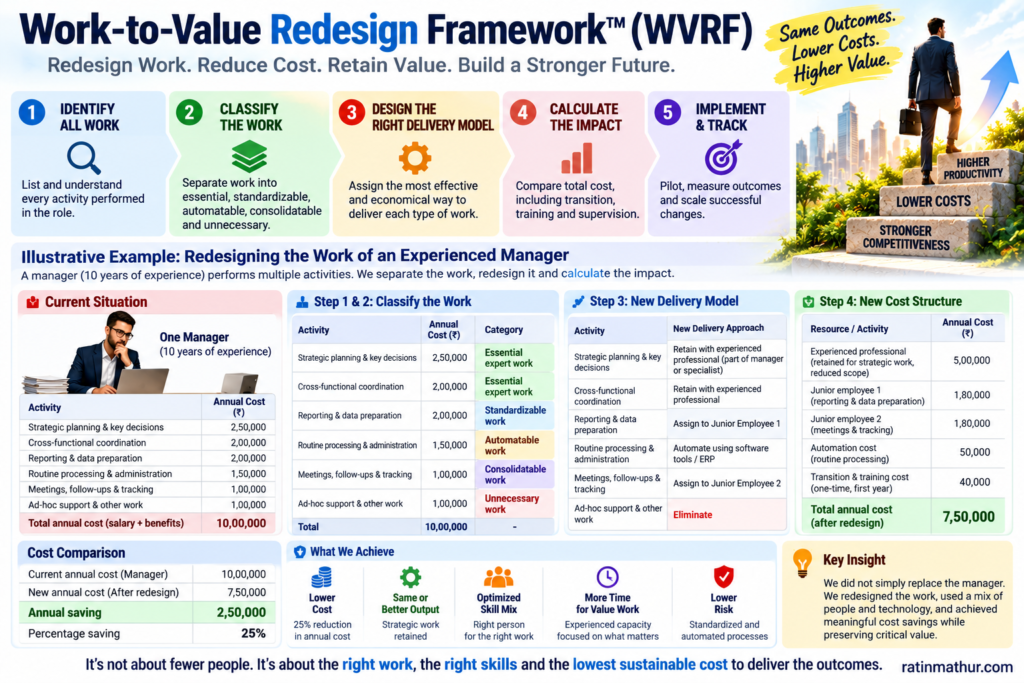
Replacing a ₹10 lakh employee with two employees earning ₹2.5 lakh each produces an apparent annual salary saving of ₹5 lakh. The saving is real only to the extent that the new arrangement delivers the required outcomes at lower total cost.
| Cost component | Existing arrangement | Proposed replacement arrangement |
|---|---|---|
| Annual salary | ₹10 lakh | ₹5 lakh combined |
| Employer benefits and related employment costs | Must be measured | Must be measured |
| Training and transition | Depends on the role | May be higher initially |
| Supervision and review | Depends on the existing arrangement | Must include additional support, if required |
| Output and quality | Establish a baseline | Demonstrate equivalence or acceptable improvement |
| Knowledge and continuity | Existing capability | Assess handover and replacement risk |
| Net economic saving | Baseline cost | Must be calculated after all relevant costs |
The strategic decision should be based on cost per acceptable unit of output rather than salary per employee.
Compensation growth requires an affordability discipline
Repeated increments can compound employee costs even when headcount remains unchanged. Organizations should review the relationship between compensation growth, role requirements, productivity, retention and business affordability.
An increment policy that ignores deteriorating business economics may create a structural mismatch. Conversely, indiscriminate pay restrictions can weaken retention and motivation. The appropriate response is a transparent compensation policy that accounts for both employee contribution and organizational affordability.
Workforce reduction is not a substitute for fixing the business model
Where competition and commoditization are reducing pricing power, employee-cost reductions may provide relief without resolving the underlying commercial problem. Sustainable profitability may also require better product mix, procurement, operational efficiency, customer retention and differentiation.
Challenges & Opportunities
The principal challenge is measurement. Organizations rarely have a complete, reliable measure of each role’s contribution to revenue, cost avoidance, productivity and risk. This makes simplistic comparisons between salaries difficult to defend.
A second challenge is organizational dependency. Experienced employees may possess knowledge that has never been documented, maintain relationships that are not visible in formal processes, or resolve exceptions through informal coordination. Removing these employees before transferring knowledge can create unexpected costs.
A third challenge is the risk of transferring work rather than eliminating it. When one employee leaves, the remaining workforce may absorb the responsibilities temporarily. The payroll reduction may look successful even though overtime, delays, rework and employee attrition subsequently increase.
These challenges create opportunities for better management. Organizations can improve cost transparency, standardize routine activities, clarify accountability, document critical knowledge and use selective automation. They can also improve workforce planning by matching skill requirements to the work actually needed.
The most attractive opportunity is not necessarily to employ the fewest people. It is to establish a workforce and operating model in which each significant cost supports a defined business requirement and the required outcome is delivered as efficiently as possible.
Strategic Frameworks & Recommendations
The following three proposed frameworks translate the analysis into practical management tools. The names are presented as proposed proprietary framework names for the author’s use; the frameworks are conceptual recommendations developed for this paper, not established academic models or independently validated instruments.
Framework 1: Value–Cost Alignment Matrix™ (VCAM)
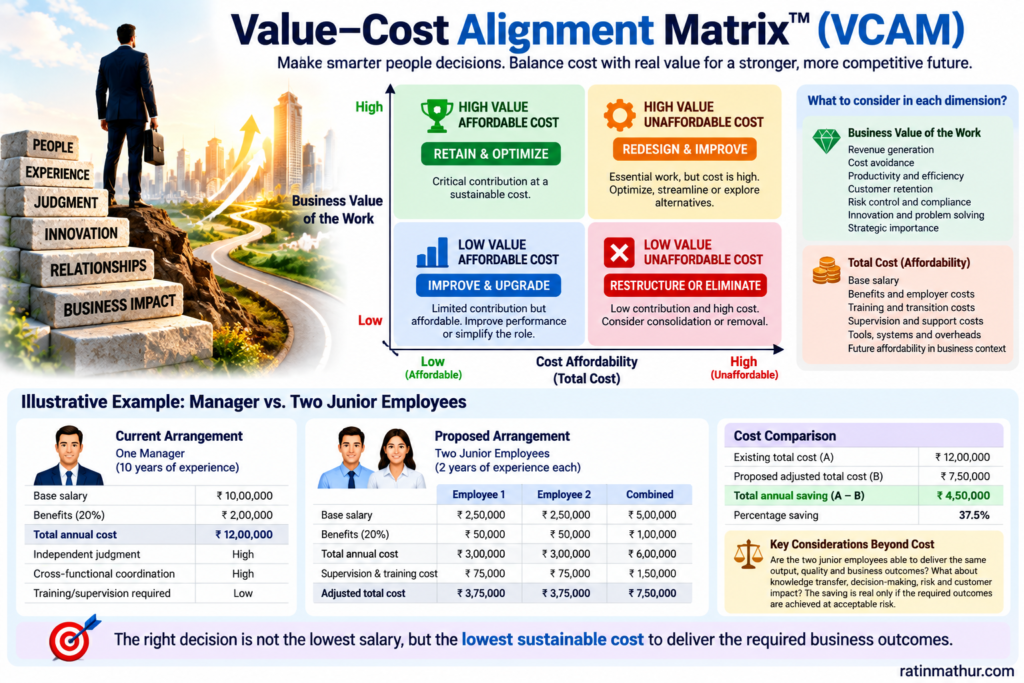
The Value–Cost Alignment Matrix™ evaluates workforce decisions using two primary dimensions: the business value of the work and the affordability of its total cost. Its central premise is that neither salary nor perceived contribution should determine a workforce decision independently.
Business value should be assessed using evidence of contribution to revenue, productivity, quality, customer retention, risk control, operational continuity and future strategic requirements. Affordability should consider salary, benefits, employer costs, training, supervision, transition costs and the financial outlook of the business.
The matrix distinguishes four situations. High-value and affordable roles should generally be retained and effectively deployed. High-value but unaffordable roles should trigger redesign, redeployment, productivity improvement or a review of sustainable compensation arrangements. Low-value but affordable roles should be improved or simplified. Low-value and unaffordable roles should be considered for consolidation, elimination or restructuring.
| Business value | Cost affordability | Recommended management response | Example |
|---|---|---|---|
| High | High | Retain and optimize deployment | A specialist who prevents production interruptions at a reasonable total cost |
| High | Low | Redesign work, improve productivity or examine alternatives | An experienced supply-chain professional whose expertise is essential but whose role contains substantial routine administration |
| Low | High | Improve performance or simplify the role | A reporting role that is affordable but produces limited management insight |
| Low | Low | Consider consolidation, elimination or restructuring | A recurring activity that has little decision value and consumes expensive employee capacity |
Consider a manager earning ₹10 lakh who independently coordinates suppliers, resolves complex operational issues and prevents costly disruptions. If these contributions are documented and the role remains essential, the company should first assess whether routine administrative work can be transferred to lower-cost resources. The role’s value may justify retaining its critical responsibilities even if its current design is too expensive.
Conversely, if the manager spends most of the working week preparing standardized reports that no longer influence decisions, the organization may be able to automate or eliminate much of the work. The appropriate intervention would be based on the activities and outcomes, not the manager’s title or tenure.
The framework should be implemented through a cross-functional assessment involving Finance, HR and the relevant business leader. Each proposed decision should have an evidence base, a total-cost comparison and an assessment of operational risks. The matrix is a decision aid, not a substitute for judgment: high-value work can still become unaffordable, and a role’s strategic importance may change as the business evolves.
Framework 2: Work-to-Value Redesign Framework™ (WVRF)
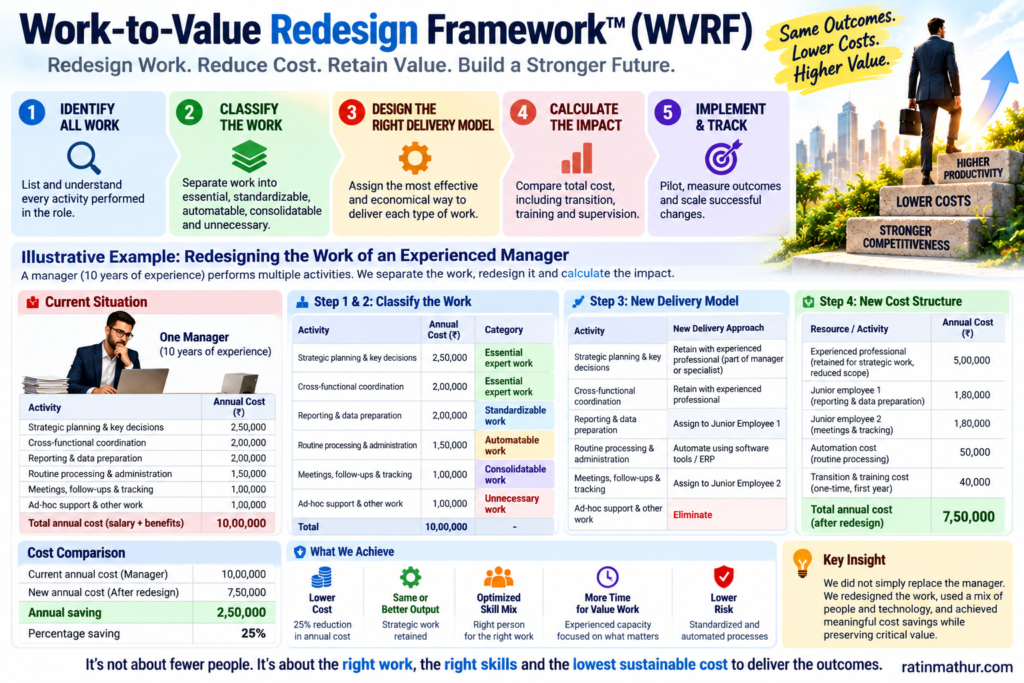
The Work-to-Value Redesign Framework™ begins with the work performed rather than the employee who performs it. Its premise is that sustainable cost reduction frequently becomes easier to identify after activities are separated into essential, standardizable, automatable, consolidatable and unnecessary work.
This approach is especially relevant in flat organizations where individual contributors have cross-functional responsibilities. A single role may combine specialist judgment, stakeholder coordination, repetitive data entry, reporting and exception management. Treating the entire position as indivisible can make the organization choose between retaining all the cost and losing all the capability.
The framework separates work into five categories and determines the most economical sustainable delivery method for each.
| Work category | Strategic question | Potential intervention | Illustrative example |
|---|---|---|---|
| Essential expert work | Does the activity require specialist judgment or experience? | Preserve or strengthen critical capability | Resolving complex supplier failures |
| Standardizable work | Can a consistent procedure deliver the required outcome? | Document and transfer to a suitable lower-cost role | Routine purchase-order processing |
| Automatable work | Can technology reliably perform the activity at an acceptable cost and risk? | Automate after testing and control design | Repetitive data consolidation |
| Consolidatable work | Can similar activities be combined without creating bottlenecks? | Consolidate ownership or use shared services | Common administrative reporting across departments |
| Unnecessary work | Does the activity create a useful business outcome or meet a genuine requirement? | Eliminate it | A recurring report that is neither used nor required |
Imagine an experienced Finance employee who supports reconciliations, investigates unusual transactions, prepares reports and coordinates with Supply Chain. The organization should not assume that all these responsibilities require the same level of expertise. Routine reconciliations may be standardized, report generation may be automated, and complex exceptions may remain with the experienced professional.
After redesign, management should calculate the capacity required to perform the remaining work. Only then should it assess whether the role count or skill mix needs to change. This sequence prevents a common failure in restructuring: reducing headcount first and discovering later that essential work still exists.
Implementation requires activity-level data, process mapping, service standards and clear accountability. For each proposed change, the business should establish baseline effort, volume, quality, turnaround time and cost. Pilot changes should be measured before wider implementation, with particular attention to rework, control failures and workload transferred to other employees.
The framework does not assume that automation or lower-cost staffing is always preferable. Some activities are inexpensive to perform manually, while others require judgment that is difficult to codify. The objective is to match the work to the most effective delivery method, not to replace human capability indiscriminately.
Framework 3: Sustainable Workforce Economics Framework™ (SWEF)
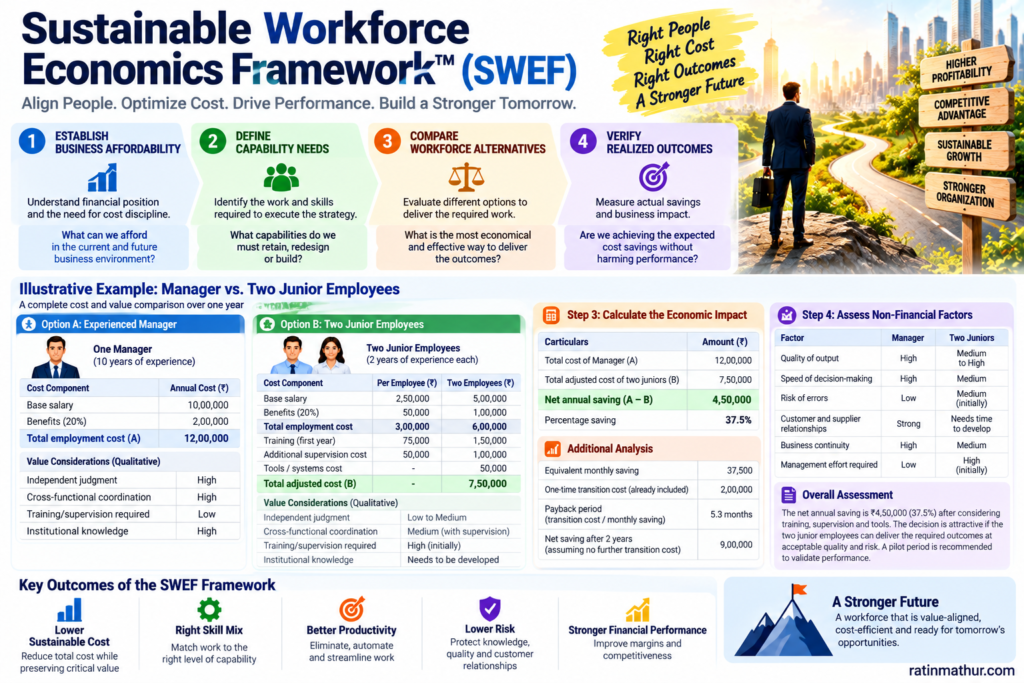
The Sustainable Workforce Economics Framework™ connects employee-cost decisions with the organization’s overall financial and competitive position. Its premise is that a workforce can be productive and still be unaffordable, while an apparently expensive workforce can be economically justified if it generates sufficient value.
The framework has four stages: establish business affordability, define required capabilities, compare workforce alternatives and verify realized outcomes. It encourages management to evaluate employee costs against revenue, gross profit, operating profit, workload and strategic priorities rather than using a universal salary benchmark or predetermined headcount-reduction percentage.
| Stage | Management activity | Core measure or evidence | Decision output |
|---|---|---|---|
| Establish affordability | Assess revenue, margins, operating costs and financial outlook | Profitability trends and employee-cost trajectory | Required level of cost discipline |
| Define capability needs | Identify essential work and future skill requirements | Workload, criticality, performance and risk | Required workforce capabilities |
| Compare alternatives | Evaluate current staffing, redesign, redeployment, attrition and replacement | Total cost, output, transition and risk | Preferred workforce arrangement |
| Verify outcomes | Compare realized savings with the business case | Net recurring savings and performance indicators | Continue, adjust or reverse the intervention |
Consider a company whose sales decline while salaries continue to increase. Management should first determine whether the pressure comes from lower volumes, reduced pricing power, unfavorable product mix, higher input costs or an employee-cost mismatch. If employee costs have grown faster than business output, the company may need to restrain compensation growth and improve productivity. If a role is no longer required, it may need to be consolidated or removed. If the primary problem is declining product margin, workforce changes should be accompanied by commercial and operational improvements.
The framework also changes how savings are measured. Suppose replacing an experienced employee produces an apparent annual salary saving of ₹5 lakh. Management should deduct additional employment costs, training and transition expenses, supervision, expected disruption and any other material costs. It should then verify whether the new arrangement produces acceptable output and quality. The financial benefit is the net recurring saving achieved without unacceptable damage to business performance.
A practical implementation would include an annual workforce-cost budget, a regular review of salary growth, a forward-looking capability plan and a formal approval process for material workforce changes. Finance should validate the financial calculation, HR should evaluate compensation and employment implications, and business leaders should remain accountable for productivity and service outcomes.
The framework is particularly valuable when a company needs to make repeated cost decisions rather than undertake a one-time restructuring. It links the workforce plan to changing business economics and creates a discipline for reassessing whether existing roles and compensation remain appropriate.
Integrated recommendations
The three frameworks should operate together. The Value–Cost Alignment Matrix™ identifies where attention is needed. The Work-to-Value Redesign Framework™ identifies how work can be delivered more efficiently. The Sustainable Workforce Economics Framework™ establishes whether the proposed changes are affordable, financially justified and sustainable.
| Time horizon | Recommended action | Management accountability | Evidence of success |
|---|---|---|---|
| First 30–60 days | Establish employee-cost baseline, identify profit drivers and map critical work | Finance, HR and functional leaders | Verified cost and workload baseline |
| Months 2–4 | Identify low-value work, standardize activities and assess role alternatives | Functional leaders with Finance support | Quantified opportunities and tested assumptions |
| Months 4–6 | Implement approved process, compensation and workforce changes | Executive leadership and HR | Initial savings with service and quality safeguards |
| Months 6–12 | Validate net savings, review productivity and correct unintended effects | Finance and business leaders | Sustainable recurring savings and stable business performance |
Management should track total employee cost, employee cost relative to revenue and gross profit, cost per unit of output, verified recurring savings, quality, turnaround time and the retention of critical capabilities. The company should also monitor whether work is simply being transferred to remaining employees.
No specific percentage reduction should be prescribed before the baseline is established. An arbitrary target can encourage managers to eliminate roles that are easy to count rather than costs that are genuinely unnecessary.
Future Outlook & Conclusion
The future of workforce cost management will increasingly depend on how effectively organizations combine human expertise, process design, technology and financial discipline. Automation and artificial intelligence may reduce the cost of certain routine activities, but they do not automatically eliminate the need for judgment, accountability, contextual knowledge or human oversight. Their economic value must be assessed against implementation costs, reliability and operational risk.
The distinction between employee cost and employee value will therefore become more important, not less. Organizations need better ways to understand the work being performed, the outcomes it creates, the capabilities on which those outcomes depend and the total cost of alternative delivery models.
For flat organizations with experienced individual contributors, the implications are particularly significant. Traditional restructuring methods that focus on eliminating management layers may offer limited savings. More effective opportunities may come from simplifying workflows, standardizing routine activities, controlling compensation growth, improving productivity and selectively changing the mix of skills and roles.
However, the objective should not be to preserve every experienced employee regardless of affordability. Organizations must be willing to redesign or remove roles when the work is no longer required or when credible alternatives deliver the necessary outcomes more economically. Equally, they must recognize that replacing experienced employees with lower-paid workers can destroy value if the organization loses critical knowledge, decision quality or execution capability.
The strongest management approach is therefore neither employee-first protection nor salary-first reduction. It is evidence-based economic decision-making that recognizes both the value and the cost of organizational capability.
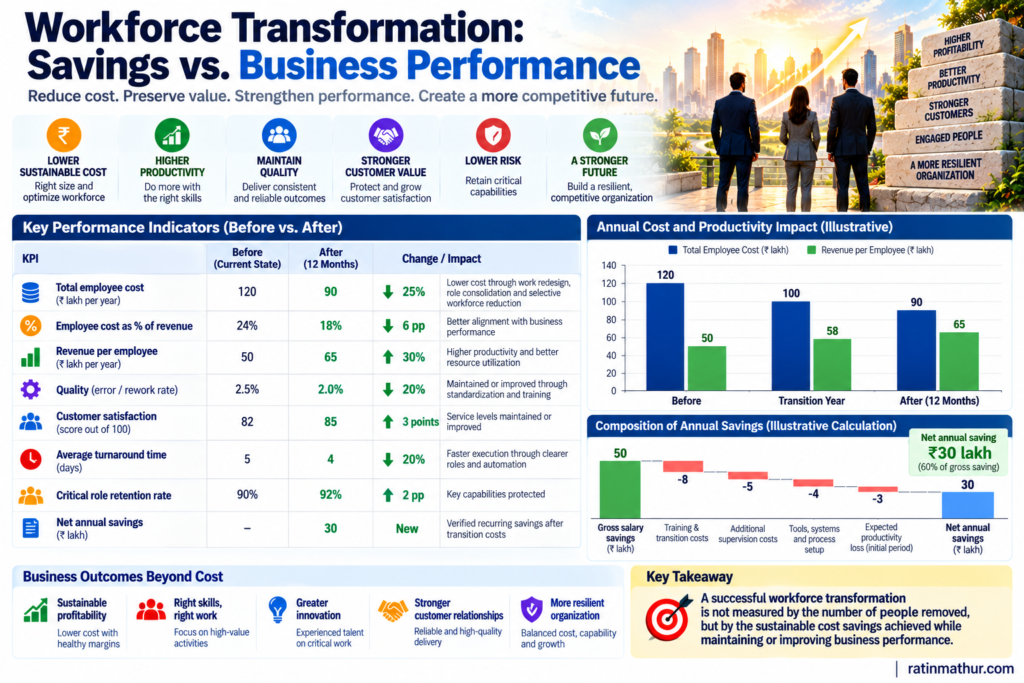
Ultimately, sustainable competitiveness requires organizations to ask a more demanding question than how many employees they can remove: What is the lowest sustainable cost at which the organization can deliver the capabilities, productivity and outcomes required to compete successfully?
Organizations that answer this question rigorously will be better positioned to reduce unnecessary expenditure, protect essential expertise and restore profitability without confusing short-term payroll savings with long-term economic value.
References
- Criscuolo, C., Gal, P., & Freund, L. (2024). Human capital at work: Five facts about the role of skills for firm productivity, growth, and wage inequality (OECD Productivity Working Papers No. 36). OECD Publishing. https://doi.org/10.1787/486c0289-en
- Criscuolo, C., Gal, P., Leidecker, T., & Nicoletti, G. (2021). The human side of productivity: Uncovering the role of skills and diversity for firm productivity (OECD Productivity Working Papers No. 29). OECD Publishing. https://doi.org/10.1787/5f391ba9-en
- Espahbodi, R., John, T. A., & Vasudevan, G. (2000). The effects of downsizing on operating performance. Review of Quantitative Finance and Accounting, 15, 107–127. https://doi.org/10.1023/A:1008321929083
- Gallup. (2024). The relationship between engagement at work and organizational outcomes: Q12 meta-analysis (11th edition). https://www.gallup.com/workplace/321725/employee-engagement.aspx
- Steel, P., & House, A. (2024). Short-term pain for long-term gain? A longitudinal meta-analysis of downsizing-financial performance relationships. Frontiers in Behavioral Economics, 3. https://doi.org/10.3389/frbhe.2024.1237750
Disclaimer
This article is intended for general informational and strategic management purposes. It does not constitute legal, financial, accounting, employment or investment advice. Organizational outcomes depend on industry conditions, business strategy, workforce characteristics, implementation quality and other factors. The examples are illustrative and should not be interpreted as empirical forecasts or guaranteed results.
The three frameworks introduced in this paper are proposed conceptual frameworks developed for strategic analysis. Their inclusion does not establish independent empirical validation, legal trademark registration or exclusive intellectual-property rights. Before commercial use, publication or formal trademark registration, the author should conduct appropriate name and intellectual-property clearance. Organizations should obtain qualified professional advice before implementing workforce reductions, compensation changes, automation initiatives or other material employment decisions.