Beyond the Badge: What Defines a Truly Exceptional Workplace?
Walk into the headquarters of any organization that has recently earned a “Great Place to Work” certification and you can almost feel the sense of pride. The badge appears on office walls, recruitment advertisements, corporate presentations, and LinkedIn announcements. Senior leaders celebrate the achievement. HR teams applaud months of effort. Employees are thanked for their participation in surveys and engagement initiatives.
From the outside, it appears to be a moment of collective success.
And perhaps it is.
After all, in an era where attracting and retaining talent has become one of the biggest challenges facing businesses, any recognition that signals a positive workplace culture is worth celebrating.
Yet behind the congratulatory messages and polished social media posts lies a more intriguing question that few people openly discuss.
Does receiving a “Great Place to Work” certification actually make a company great?
Or does it simply indicate that a company has met a set of standards at a particular point in time?
The distinction is important.
Because while certifications can recognize a workplace, they cannot fully define it.
A truly great company is not judged by what is displayed on its walls. It is judged by what employees experience when nobody is watching.
Why Companies Are So Eager to Earn Workplace Certifications
The growing popularity of workplace certifications is not difficult to understand.
In today’s competitive employment market, organizations are fighting not only for customers but also for talent. Skilled professionals have more choices than ever before. Before accepting a job offer, candidates research company reviews, browse social media, study leadership profiles, and seek opinions from current and former employees.
In such an environment, a respected workplace certification acts like a trust signal.
Imagine two companies offering similar salaries, similar roles, and similar career opportunities. One carries a recognized workplace certification while the other does not. For many candidates, the certified organization immediately gains a perception advantage.
From a business perspective, the benefits can be substantial.
Recruitment teams often report higher candidate interest. Employer branding becomes stronger. Existing employees feel a sense of pride. Investors and stakeholders view the organization as people-focused. Leadership teams gain independent validation that their culture initiatives are delivering results.
For HR departments, such recognition serves as both an achievement and a strategic asset.
However, there is also a danger.
When organizations become obsessed with earning the badge, they may lose sight of the very culture they are trying to build.
The focus gradually shifts from improving employee experiences to improving survey scores.
And that’s where the real challenge begins.
The Difference Between a Great Workplace and a Great Workplace Certification
Consider two hypothetical companies.
Company A proudly displays multiple workplace awards. Its offices are modern. Its employer branding campaigns are sophisticated. Employee engagement surveys generate respectable scores.
Yet behind the scenes, employees hesitate to challenge senior management. Promotions often depend more on politics than performance. Managers rarely provide meaningful feedback. Talented individuals leave after two or three years because they see limited growth opportunities.
Now consider Company B.
It has fewer awards and invests less in employer branding. It may not appear regularly on “best employer” lists. Yet employees stay for years. Teams collaborate openly. Leaders communicate transparently during difficult periods. People trust one another. Employees actively recommend the organization to friends and former colleagues.
Which company is truly the better workplace?
Most professionals would choose Company B without hesitation.
Because culture is not something employees read about.
It is something they feel.
The challenge with any certification is that it attempts to measure something deeply human using a structured framework. While these frameworks can provide valuable insights, they cannot always capture the subtle realities of everyday workplace life.
They cannot fully measure trust.
They cannot completely assess respect.
They cannot perfectly evaluate leadership character.
And they cannot predict how employees will feel six months after the certificate has been awarded.
The Culture Employees Experience Every Day
Many executives speak about culture as if it were a corporate program.
Employees experience it very differently.
For them, culture is not an initiative.
It is reality.
Culture reveals itself when a manager responds to a mistake.
It appears when an employee asks for support during a personal crisis.
It becomes visible when promotions are announced.
It is tested when budgets are cut or market conditions become difficult.
A company’s culture is not defined by how it behaves when everything is going well.
It is defined by how it behaves when things go wrong.
Consider the global economic disruptions experienced over the past several years. Some organizations responded with transparency, empathy, and collaboration. Leaders openly communicated challenges, involved employees in problem-solving, and prioritized long-term trust.
Others chose secrecy, uncertainty, and reactive decision-making.
The difference was not visible on a certificate.
But employees noticed.
And they remembered.
Years later, many still speak about how their employers treated them during those difficult periods.
That memory often matters more than any workplace award ever could.
What Today’s Employees Are Really Looking For
One of the biggest misconceptions in corporate life is that employees are primarily motivated by compensation.
While salary remains important, numerous studies and workplace trends suggest that professionals increasingly prioritize factors that contribute to long-term fulfillment.
Employees want leaders who inspire confidence.
They want meaningful work.
They want opportunities to learn and grow.
They want flexibility and trust.
They want recognition for their contributions.
Above all, they want to feel that they matter.
Consider a talented software engineer choosing between two employers. One offers a prestigious workplace certification. The other offers exceptional mentorship, challenging projects, and a clear path for professional development.
For many ambitious professionals, the decision becomes surprisingly easy.
Growth often outweighs recognition.
Similarly, an experienced manager may willingly leave a certified organization if they experience poor leadership, limited career opportunities, or a toxic work environment.
A certificate may attract talent.
But culture determines whether talent stays.
When Certifications Create Real Value
None of this means workplace certifications lack value.
In fact, many organizations have used certification frameworks to drive meaningful improvements.
The best companies treat certification not as a marketing achievement but as a diagnostic tool.
They view employee surveys as opportunities to listen.
They treat feedback as a gift.
They use results to identify gaps, strengthen leadership capabilities, improve communication, and create better employee experiences.
For these organizations, the badge becomes a by-product of genuine commitment.
The certification reflects the culture rather than defining it.
And that distinction makes all the difference.
The healthiest organizations understand a simple truth:
Recognition should follow culture.
Culture should never follow recognition.
The Ultimate Measure of a Great Company
Perhaps the most meaningful measure of workplace quality is not found in an award, a ranking, or a certification.
It is found in the conversations employees have when leadership is not present.
Do they speak positively about their managers?
Would they recommend the company to friends?
Do they believe their future is brighter because they work there?
Do they feel proud to be associated with the organization?
When employees become advocates, recruiters, ambassadors, and defenders of their company, something remarkable has happened.
Trust has been earned.
And trust cannot be certified.
It can only be built.
That is why the most admired organizations in the world focus less on collecting workplace awards and more on creating workplace experiences worth talking about.
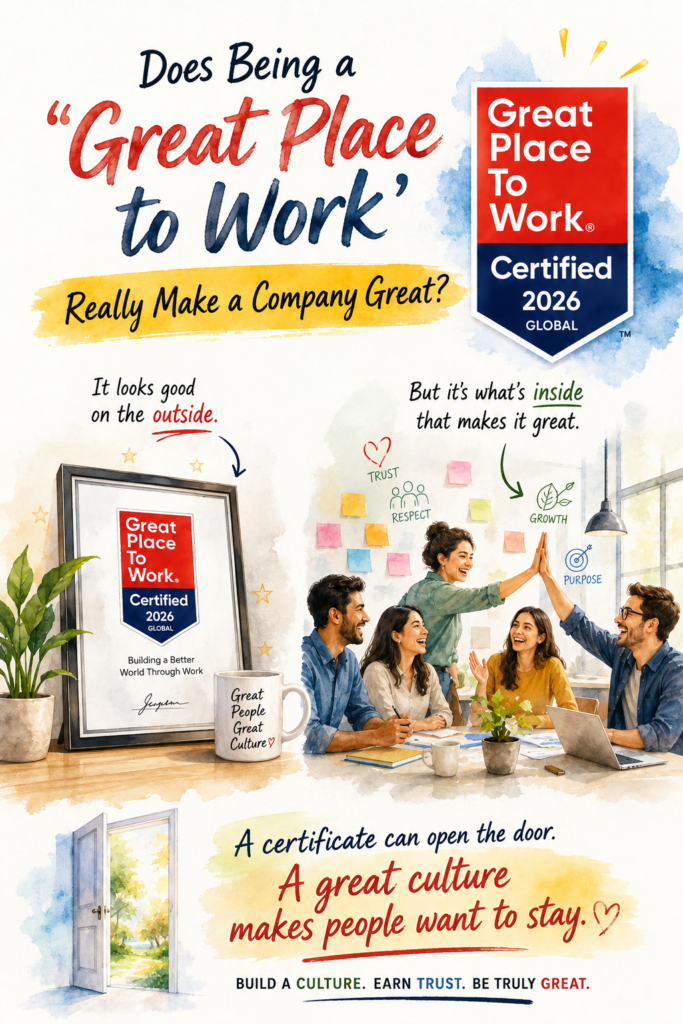
Because at the end of the day, a certificate may open the door.
But culture is what makes people want to stay, grow, contribute, and succeed.
And that is what truly makes a company great.