Introduction
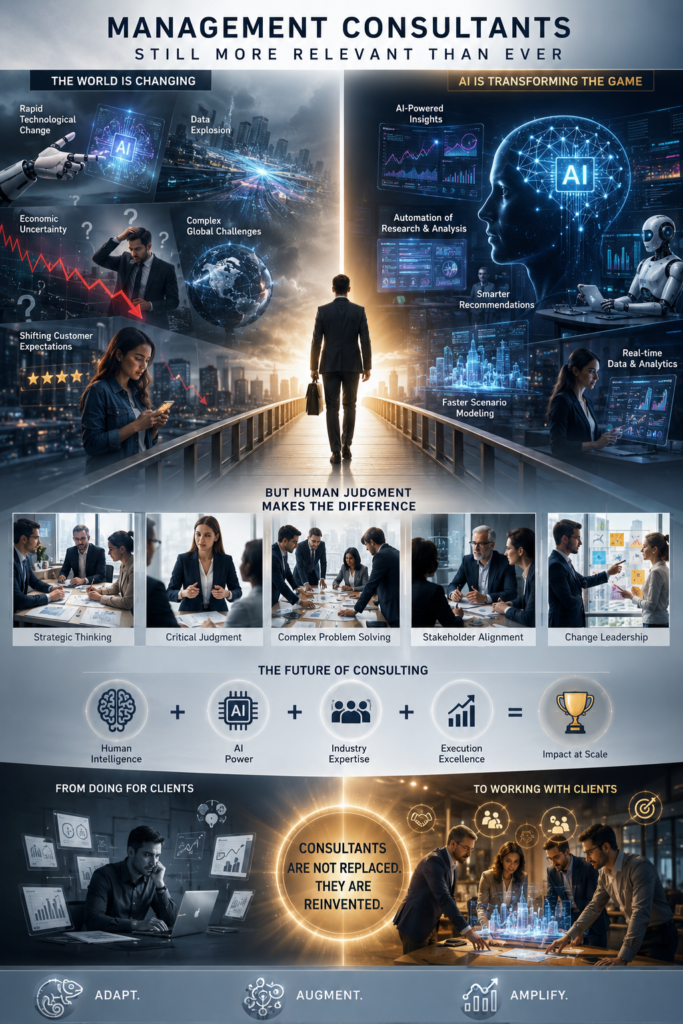
Artificial Intelligence (AI) is rapidly reshaping the global business landscape. From generating business strategies and conducting market research to forecasting demand and creating financial models, AI systems are increasingly capable of performing tasks that were once considered the exclusive domain of highly skilled professionals. This technological revolution has triggered an important debate within corporate boardrooms, academic institutions, consulting firms, and business communities worldwide: Are management consultants still relevant in the age of AI?
The question is neither surprising nor unreasonable. Modern AI systems can process vast amounts of information within seconds, identify hidden patterns across millions of data points, generate strategic recommendations, and produce detailed reports with remarkable speed. Activities that once required teams of consultants working for weeks can now be completed in minutes. As organizations increasingly gain direct access to sophisticated AI tools, many executives wonder whether traditional consulting firms will continue to play a significant role in shaping business decisions.
However, this perspective often overlooks the true nature of management consulting. Consulting has never been solely about gathering information, building spreadsheets, or creating presentation decks. At its core, management consulting is about helping organizations solve complex problems, make high-stakes decisions, align diverse stakeholders, manage uncertainty, and execute transformational change.
While AI is undoubtedly transforming the consulting industry, it is not eliminating the need for consultants. Instead, it is redefining what creates value in consulting. The future belongs to professionals and firms capable of combining artificial intelligence with human intelligence, strategic thinking, leadership influence, and implementation expertise.
This article explores the evolving relevance of management consultants in the AI era, examines the areas where AI is disrupting traditional consulting services, and explains why human judgment continues to remain indispensable in strategic decision-making.
Understanding the Traditional Role of Management Consultants
To understand the future of consulting, it is important first to understand why organizations hire consultants in the first place.
For decades, management consultants have served as trusted advisors to senior executives, boards of directors, investors, and government institutions. Their role extends far beyond providing recommendations. Consultants help organizations identify opportunities, diagnose challenges, develop strategies, improve operations, manage risks, and implement change.
Organizations often engage consultants when facing situations characterized by complexity, uncertainty, urgency, or a lack of internal expertise. Whether entering new markets, redesigning operating models, acquiring competitors, implementing digital transformation programs, or improving profitability, consultants bring structured methodologies and objective perspectives that help organizations navigate difficult decisions.
One of the most valuable contributions consultants provide is external objectivity. Internal teams often become constrained by organizational politics, historical assumptions, and departmental biases. Consultants offer independent viewpoints that challenge existing thinking and encourage organizations to explore alternative approaches.
The consulting profession has traditionally derived value from several key capabilities.
Table 1: Traditional Sources of Value in Management Consulting
| Consulting Capability | Primary Business Benefit |
|---|---|
| Strategic Planning | Long-term growth and competitive advantage |
| Market Analysis | Better market positioning and customer understanding |
| Operational Excellence | Improved efficiency and cost reduction |
| Organizational Design | Enhanced accountability and performance |
| Change Management | Successful transformation implementation |
| Executive Facilitation | Stakeholder alignment and decision-making |
| Industry Expertise | Faster and more informed business decisions |
| Program Governance | Improved execution and risk management |
Historically, consulting firms also benefited from information asymmetry. They possessed access to proprietary research, benchmarking databases, industry frameworks, and specialized expertise that many organizations lacked internally.
Today, that information advantage is gradually diminishing.
The Rise of Artificial Intelligence in Business
Artificial Intelligence has become one of the most disruptive business technologies of the twenty-first century. Unlike previous technological innovations that primarily automated physical tasks, AI is increasingly automating cognitive activities traditionally performed by knowledge workers.
Modern AI systems can analyze market trends, interpret financial statements, evaluate customer behavior, monitor competitor activities, generate forecasts, summarize reports, and even create strategic recommendations.
Organizations across industries are investing heavily in AI capabilities to improve productivity, enhance decision-making, reduce operational costs, and accelerate innovation. The widespread availability of generative AI platforms has democratized access to sophisticated analytical capabilities that were once available only to large enterprises and consulting firms.
The impact of AI on professional services has been particularly significant because consulting relies heavily on information processing, analysis, and communication.
Activities such as market research, data collection, benchmarking, financial analysis, and report preparation are becoming increasingly automated.
Table 2: Business Activities Being Transformed by AI
| Business Activity | Degree of AI Impact |
|---|---|
| Data Collection | Very High |
| Market Research | Very High |
| Financial Analysis | High |
| Reporting and Documentation | High |
| Competitive Intelligence | High |
| Forecasting and Modeling | High |
| Presentation Development | High |
| Strategic Decision Support | Moderate |
| Executive Advisory | Low |
| Leadership Development | Low |
These developments naturally raise concerns regarding the future role of management consultants.
If AI can analyze data faster, identify patterns more accurately, and generate recommendations more efficiently than humans, what unique value remains for consultants?
The answer lies in understanding the distinction between information and judgment.
Information Is Becoming a Commodity
For many years, consultants were hired because they possessed information that clients did not have. Access to industry data, market intelligence, best practices, and analytical frameworks created significant value.
Today, information is increasingly accessible to everyone.
Executives can access global market data in real time. AI systems can generate competitor analyses within minutes. Industry reports are widely available. Digital platforms provide extensive benchmarking information across virtually every business function.
As information becomes more abundant and accessible, its economic value decreases.
The consulting industry is therefore experiencing a fundamental shift. The source of value is moving away from information possession and toward insight generation.
Information answers questions.
Insight identifies which questions matter.
This distinction is becoming increasingly important in the AI era.
A company may possess thousands of pages of research and sophisticated AI-generated reports, yet still struggle to determine the best course of action. Leaders frequently face situations where multiple strategic options appear viable, each involving different risks, trade-offs, and implications.
In such situations, data alone rarely provides definitive answers.
Judgment becomes essential.
Why Human Judgment Still Matters
Business decisions rarely occur in environments characterized by perfect information and complete certainty.
Most strategic decisions involve ambiguity, conflicting priorities, political considerations, cultural dynamics, and human emotions. These factors are difficult to quantify and often impossible to model accurately using algorithms.
Consider a company evaluating a major acquisition opportunity. AI can assess financial performance, market conditions, customer trends, and operational synergies. However, the ultimate success of the acquisition may depend on leadership alignment, cultural compatibility, employee acceptance, stakeholder reactions, and integration effectiveness.
These factors require human judgment.
Experienced consultants help organizations navigate situations where data alone is insufficient. They understand organizational behavior, leadership psychology, stakeholder management, and change dynamics.
Their value lies not merely in generating answers but in helping leaders interpret those answers within the broader business context.
This ability remains one of the most significant differentiators between artificial intelligence and human expertise.
The Human Advantage That AI Cannot Easily Replicate
One of the most common misconceptions surrounding consulting is that organizations hire consultants primarily for answers. In reality, organizations often hire consultants because they need confidence in their decisions.
Major business decisions can affect thousands of employees, millions of customers, and billions of dollars in shareholder value. CEOs and boards are accountable for the consequences of those decisions and therefore seek perspectives that combine analytical rigor with practical experience.
Management consultants provide something that AI cannot fully replicate: judgment developed through years of exposure to diverse industries, business models, crises, transformations, and leadership challenges.
When experienced consultants evaluate a business situation, they are not merely processing information. They are drawing upon patterns observed across multiple organizations, industries, and economic cycles. They understand how seemingly logical strategies can fail because of cultural resistance, poor execution, leadership misalignment, or market timing.
AI can identify patterns from historical data. Human consultants understand how unique circumstances may require deviation from historical patterns.
This distinction becomes particularly important in environments characterized by rapid change, uncertainty, and disruption.
Table 3: Human Capabilities That Continue to Differentiate Consultants
| Human Capability | Importance in Strategic Consulting |
|---|---|
| Judgment | Very High |
| Leadership Influence | Very High |
| Stakeholder Management | Very High |
| Emotional Intelligence | High |
| Organizational Awareness | High |
| Conflict Resolution | High |
| Negotiation Skills | High |
| Executive Coaching | High |
| Ethical Decision-Making | Very High |
| Change Leadership | Very High |
While AI can enhance decision-making, it cannot fully replace the interpersonal and organizational dimensions that often determine whether business strategies succeed or fail.
Consulting Is Becoming More Strategic, Not Less Relevant
The emergence of AI is transforming consulting in much the same way that calculators transformed accounting.
Calculators did not eliminate accountants. They eliminated manual calculations and allowed accountants to focus on higher-value activities.
Similarly, AI is reducing the time consultants spend on research, data collection, analysis, and presentation preparation. As a result, consultants are increasingly focusing on more strategic and impactful activities.
This shift is fundamentally changing the consulting profession.
In the past, a consulting engagement might allocate significant resources toward gathering information and developing recommendations. In the future, much of that work will be accelerated through AI tools, allowing consultants to dedicate more time to decision facilitation, implementation support, stakeholder engagement, and transformation management.
The profession is evolving from knowledge delivery toward impact delivery.
Clients are becoming less interested in receiving lengthy reports and more interested in achieving measurable business outcomes.
This evolution is likely to strengthen rather than weaken the consulting industry.
Organizations will continue to require advisors capable of translating insights into action and helping leadership teams navigate increasingly complex business environments.
The New Consulting Model in the AI Era
As AI capabilities continue to advance, consulting firms are redesigning their business models to integrate technology more deeply into service delivery.
The consultant of the future will not compete against AI. Instead, the consultant will leverage AI as a strategic tool to improve productivity, accelerate analysis, and enhance decision quality.
Consultants who effectively utilize AI can deliver greater value to clients while spending less time on repetitive activities.
This evolution is creating a new consulting paradigm.
Table 4: Traditional Consulting Versus AI-Enabled Consulting
| Traditional Consulting | AI-Enabled Consulting |
|---|---|
| Manual research processes | AI-powered research |
| Large analyst teams | Smaller expert-led teams |
| Periodic insights | Real-time intelligence |
| Static reports | Dynamic decision support |
| Data gathering focus | Strategic advisory focus |
| Information advantage | Judgment advantage |
| Presentation-centric | Outcome-centric |
| Project-based support | Continuous advisory services |
The consulting firms most likely to thrive are those capable of combining advanced technology with deep industry expertise and strong execution capabilities.
Rather than replacing consultants, AI is raising the standard for what clients expect from consultants.
Why AI May Increase Demand for Consultants
Paradoxically, AI itself is creating substantial new opportunities for management consultants.
Organizations across industries are struggling to answer a range of AI-related questions.
How should AI investments be prioritized?
Which business processes should be automated?
How should AI governance frameworks be designed?
What ethical risks must be managed?
How should organizational structures evolve?
How should employees be reskilled?
How should AI initiatives be measured and governed?
These questions extend beyond technology.
They involve strategy, leadership, operating models, risk management, workforce transformation, and organizational change.
These are precisely the types of challenges that management consultants are uniquely positioned to address.
As AI adoption accelerates, organizations increasingly require external advisors capable of guiding enterprise-wide transformation initiatives.
The demand for consulting expertise may therefore increase rather than decrease.
Table 5: Emerging Consulting Opportunities Created by AI
| Opportunity Area | Strategic Importance |
|---|---|
| AI Strategy Development | High |
| Digital Transformation | High |
| AI Governance and Risk | High |
| Workforce Transformation | High |
| Change Management | High |
| Business Process Reinvention | High |
| Data Strategy | High |
| Responsible AI Implementation | High |
| Technology Investment Prioritization | High |
| Operating Model Redesign | High |
Many organizations possess AI technologies but lack clarity regarding how those technologies should be integrated into broader business strategies.
Consultants are increasingly helping organizations bridge that gap.
The Shift from Knowledge Advantage to Wisdom Advantage
Historically, consulting firms competed primarily through knowledge advantages.
They possessed proprietary frameworks, industry benchmarks, specialized methodologies, and extensive research capabilities.
AI is reducing the exclusivity of knowledge.
However, a new source of differentiation is emerging.
The future competitive advantage lies in wisdom.
Knowledge involves understanding what has happened.
Wisdom involves understanding what should happen next.
AI can generate hundreds of strategic options.
Leaders still need experienced advisors capable of evaluating those options, understanding organizational realities, and identifying the most practical path forward.
The consulting firms that succeed in the coming decade will not be those with the largest databases.
They will be those with the strongest ability to transform information into action.
That capability remains profoundly human.
The Future Consultant
The consultant of the future will look significantly different from the consultant of the past.
Future consultants will combine expertise in strategy, analytics, technology, behavioral science, organizational transformation, and AI-enabled decision-making.
Technical competence alone will not be sufficient.
Equally important will be the ability to influence executives, facilitate alignment, lead change, communicate effectively, and manage stakeholder expectations.
As AI assumes responsibility for many analytical tasks, human-centric capabilities will become increasingly valuable.
The future consultant will spend less time creating presentations and more time shaping decisions.
The future consultant will spend less time gathering information and more time generating insight.
The future consultant will spend less time analyzing the past and more time helping organizations create the future.
The Enduring Importance of Trust and Credibility
One of the most underestimated aspects of management consulting is trust.
Boards of directors, investors, regulators, and senior leadership teams often seek validation from independent experts before making major decisions. The presence of an experienced consulting firm can provide credibility and assurance that strategic alternatives have been evaluated objectively and rigorously.
This role becomes particularly important when organizations are facing transformational decisions such as mergers and acquisitions, restructuring programs, market entry initiatives, large-scale digital transformations, sustainability transitions, or significant capital investments.
Artificial Intelligence can generate recommendations, but it cannot assume accountability.
Consultants help organizations build confidence in their decisions by combining data-driven analysis with practical experience, industry context, and independent judgment.
In many situations, the value of consulting extends beyond the recommendation itself. The process of facilitating discussions, aligning stakeholders, managing conflicts, and creating consensus often contributes as much value as the final strategic decision.
Trust remains one of the most valuable assets in business.
It is also one of the most difficult capabilities for technology to replicate.
Will Large Consulting Firms Continue to Dominate?
Leading consulting firms such as McKinsey & Company, Boston Consulting Group (BCG), Bain & Company, Deloitte, Accenture, Kearney, Oliver Wyman, and other advisory organizations are already investing heavily in artificial intelligence capabilities.
These firms are developing proprietary AI platforms, advanced analytics engines, industry-specific intelligence solutions, and digital transformation methodologies.
Rather than viewing AI as a threat, they increasingly view it as a force multiplier.
The firms that successfully integrate AI into their service delivery models are likely to become more efficient, more scalable, and more impactful.
However, the structure of the consulting industry may change significantly.
Smaller boutique consulting firms and independent consultants can now leverage AI tools to access analytical capabilities that were once available only to large consulting organizations. This democratization of technology is creating new opportunities for specialized advisors and niche experts.
Consequently, the future consulting landscape may become more competitive, more specialized, and more focused on delivering measurable outcomes.
Success will increasingly depend on expertise, execution capability, and client impact rather than organizational size alone.
The Emerging Partnership Between Human Intelligence and Artificial Intelligence
The future of consulting should not be viewed as a competition between humans and machines.
Instead, it should be viewed as a partnership.
Artificial Intelligence excels at processing information, identifying patterns, generating alternatives, and accelerating analysis.
Human consultants excel at understanding context, exercising judgment, influencing stakeholders, managing uncertainty, and leading transformation.
When these capabilities are combined, the result is significantly more powerful than either capability operating independently.
Table 6: The Future Division of Responsibilities
| AI Strengths | Human Consultant Strengths |
|---|---|
| Data Processing | Strategic Judgment |
| Pattern Recognition | Executive Influence |
| Predictive Analytics | Leadership Alignment |
| Research Automation | Stakeholder Management |
| Scenario Modeling | Organizational Transformation |
| Knowledge Retrieval | Change Leadership |
| Continuous Monitoring | Relationship Building |
| Content Generation | Complex Decision-Making |
Organizations that effectively combine AI capabilities with human expertise are likely to outperform those relying exclusively on either approach.
The same principle applies to consulting firms.
The most successful firms of the future will be those capable of integrating technology and human insight into a unified value proposition.
Lessons for Current and Aspiring Consultants
The AI revolution carries important implications for consulting professionals.
First, consultants must embrace AI rather than resist it. Those who view AI as a productivity tool will gain significant competitive advantages over those who continue relying solely on traditional approaches.
Second, consultants must develop stronger business judgment and industry expertise. As information becomes increasingly commoditized, clients will place greater value on interpretation, insight, and practical guidance.
Third, consultants must strengthen human-centric capabilities such as communication, leadership, negotiation, stakeholder management, facilitation, and change management. These capabilities are becoming more valuable as AI automates analytical tasks.
Fourth, consultants must become outcome-oriented. Clients are increasingly interested in measurable business impact rather than reports and presentations.
Finally, consultants must continuously adapt. The consulting profession has evolved repeatedly throughout its history, and AI represents the latest stage in that evolution.
Those who adapt will thrive.
Those who resist change may struggle.
Conclusion
The question of whether management consultants remain relevant in the age of Artificial Intelligence reflects a broader misunderstanding of what consulting truly represents.
If consulting were merely about collecting information, conducting analysis, creating reports, and generating recommendations, AI would indeed pose a significant existential threat.
However, management consulting has always been about far more than information.
It is about helping organizations make difficult decisions in uncertain environments. It is about aligning stakeholders around a common vision. It is about managing transformation, overcoming resistance, building confidence, and driving execution.
Artificial Intelligence is exceptionally effective at generating information and accelerating analysis. Yet business success ultimately depends on leadership, judgment, trust, influence, and execution.
These capabilities remain deeply human.
The consulting profession is not disappearing. It is evolving.
Routine analytical activities are becoming automated. Strategic advisory work is becoming more important. Human expertise is shifting from information creation toward interpretation, decision-making, and implementation.
The future belongs neither to Artificial Intelligence alone nor to traditional consulting alone.
The future belongs to organizations and professionals capable of combining the speed and analytical power of AI with the judgment, wisdom, and leadership capabilities of experienced human advisors.
Management consultants who embrace this reality will become more valuable than ever before.
The age of AI is not the end of consulting.
It is the beginning of a more impactful, more strategic, and more transformative era for the consulting profession.
References
1. Brynjolfsson, E., & McAfee, A. (2017). Machine, platform, crowd: Harnessing our digital future. W.W. Norton & Company. Retrieved from https://wwnorton.com/books/machine-platform-crowd
2. Davenport, T. H., & Ronanki, R. (2018). Artificial intelligence for the real world. Harvard Business Review, 96(1), 108–116. Retrieved from https://hbr.org/2018/01/artificial-intelligence-for-the-real-world
3. Drucker, P. F. (2008). Management: Tasks, responsibilities, practices. HarperBusiness. Retrieved from https://www.harpercollins.com/products/management-peter-f-drucker
4. Iansiti, M., & Lakhani, K. R. (2020). Competing in the age of AI: Strategy and leadership when algorithms and networks run the world. Harvard Business Review Press. Retrieved from https://store.hbr.org/product/competing-in-the-age-of-ai/10230
5. Kaplan, A., & Haenlein, M. (2019). Siri, Siri, in my hand: Who’s the fairest in the land? On the interpretations, illustrations, and implications of artificial intelligence. Business Horizons, 62(1), 15–25. Retrieved from https://doi.org/10.1016/j.bushor.2018.08.004
6. Porter, M. E., & Heppelmann, J. E. (2014). How smart, connected products are transforming competition. Harvard Business Review, 92(11), 64–88. Retrieved from https://hbr.org/2014/11/how-smart-connected-products-are-transforming-competition
7. Russell, S., & Norvig, P. (2021). Artificial intelligence: A modern approach (4th ed.). Pearson. Retrieved from https://aima.cs.berkeley.edu
8. Susskind, R., & Susskind, D. (2022). The future of the professions: How technology will transform the work of human experts. Oxford University Press. Retrieved from https://global.oup.com
9. Teece, D. J. (2018). Business models and dynamic capabilities. Long Range Planning, 51(1), 40–49. Retrieved from https://doi.org/10.1016/j.lrp.2017.06.007
10. World Economic Forum. (2025). Future of jobs report 2025. Retrieved from https://www.weforum.org/reports/future-of-jobs-report-2025
Disclaimer
The views, interpretations, opinions, and conclusions expressed in this article are intended solely for informational, educational, and thought leadership purposes. The content is based on publicly available research, academic literature, industry reports, and professional observations regarding the evolving relationship between Artificial Intelligence and management consulting. The article should not be construed as professional consulting, legal, financial, investment, technological, or strategic advice. Readers are encouraged to conduct independent research and seek qualified professional guidance before making business decisions. Any references to organizations, consulting firms, technologies, products, or methodologies are made solely for analytical and illustrative purposes and do not imply endorsement, affiliation, sponsorship, or representation. The author and publisher disclaim any liability arising from actions taken based on the information presented in this article.