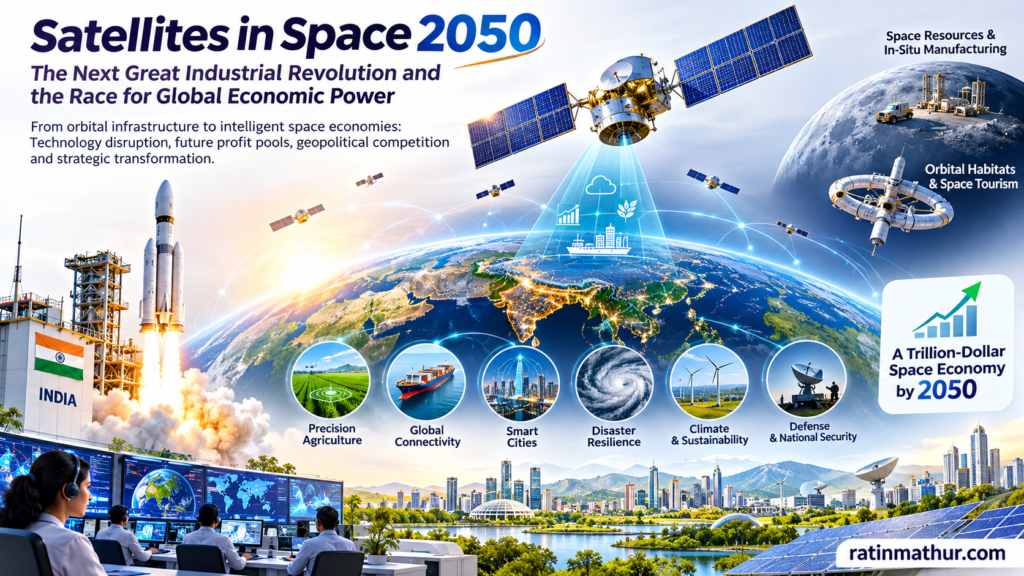
From Orbital Infrastructure to Intelligent Space Economies: Technology Disruption, Future Profit Pools, Geopolitical Competition and Strategic Transformation
An In-depth Strategic Industry Research Paper | 2026–2050
1. Executive Summary
The satellite industry is entering one of the most consequential periods of transformation in the history of modern technology. What began as a government-dominated domain of scientific exploration, military surveillance and telecommunications is evolving into a commercially driven, technology-intensive and strategically indispensable global industry. By 2050, satellites could become as fundamental to economic activity as semiconductor infrastructure, telecommunications networks, cloud computing and electricity distribution.
The transformation is being accelerated by artificial intelligence (AI), reusable launch systems, advanced semiconductor technologies, robotics, optical communications, miniaturization, autonomous operations and increasing demand for real-time global intelligence. These technologies are changing the economics of manufacturing, deploying and operating satellites while creating entirely new commercial markets.
The economic significance is already visible. According to the Satellite Industry Association (SIA, 2026), the global commercial satellite industry generated approximately US$303 billion in revenue during 2025, representing around 71% of the global space economy under its measurement methodology. The broader global space economy generated approximately US$429 billion under the same report. Separately, the Organisation for Economic Co-operation and Development (OECD, 2026) estimates global space-related revenues at approximately US$550–600 billion in 2025, reflecting a broader definition and different measurement coverage. These estimates should not be treated as directly comparable.
The World Economic Forum and McKinsey (2024) estimated that the wider global space economy could reach US$1.8 trillion by 2035, compared with US$630 billion in 2023. This growth is expected to extend beyond traditional aerospace manufacturing into telecommunications, navigation, logistics, agriculture, insurance, defense, environmental intelligence and digital infrastructure.
However, the central strategic question is not how many satellites will orbit Earth by 2050. It is who will control the technologies, networks, intellectual property, data ecosystems and commercial platforms that convert orbital infrastructure into economic power.
This paper analyzes the satellite industry’s future through market economics, technological disruption, investment trends, regulatory developments, competitive positioning and strategic foresight. It examines five major technological transformations, the emerging profit pools, India’s strategic opportunity, regulatory and geopolitical developments, future industry economics and the organizational capabilities required by 2050.
It also introduces three original strategic frameworks: ORBIT™ Strategic Transformation Framework, SCOPE™ Space Value Creation Framework and SPACEWISE™ Strategic Resilience Framework. These frameworks are designed to help organizations translate industry intelligence into investment priorities, commercial strategies and long-term competitive advantage.
The central thesis is that the future leaders of the satellite industry will not necessarily be the companies that manufacture or launch the largest number of spacecraft. They will be those capable of integrating intelligent infrastructure, proprietary technologies, valuable data, recurring-revenue platforms and sustainable orbital operations.
2. Introduction
Space is no longer simply an arena for scientific exploration or national prestige. It is becoming an essential operating environment for the global economy. Satellite-enabled infrastructure already supports telecommunications, financial transactions, navigation, weather forecasting, agricultural productivity, disaster management, defense and international logistics.
These services are becoming increasingly embedded in everyday economic activity. Financial markets depend on precise timing signals, shipping companies rely on satellite navigation, agricultural enterprises use remote sensing to monitor crop conditions, and governments depend on satellite imagery for security and disaster response.
The satellite industry is undergoing a fundamental structural transition from isolated, expensive spacecraft toward interconnected, software-defined and increasingly autonomous constellations. Lower launch costs, smaller satellite platforms, commercial manufacturing and rideshare missions are expanding access to orbit. At the same time, telecommunications networks are converging with satellite infrastructure, while Earth observation is evolving from imagery collection into predictive intelligence and decision-support services.
Three structural forces will determine the direction of this transformation. The first is technological convergence, particularly the integration of AI, robotics, advanced materials, semiconductor innovation and optical networking. The second is the commercialization of orbital infrastructure, through which satellites become components of recurring-revenue platforms rather than standalone capital assets. The third is geopolitical and economic competition, as governments and corporations increasingly recognize that control over space infrastructure represents control over critical information, connectivity and strategic capabilities.
This transformation also creates a paradox. As access to space becomes more commercially accessible, the ability to operate profitably and sustainably in orbit may become more difficult. Spectrum availability, orbital congestion, cybersecurity, capital intensity and regulatory fragmentation could determine which business models survive.
Consequently, the future satellite industry must be understood not merely as an aerospace manufacturing market but as an interconnected industrial ecosystem in which technology, infrastructure, information and geopolitical power converge.
3. Problem Statement & Objectives
The central problem confronting the satellite industry is the widening gap between the speed of technological advancement and the ability of businesses, investors and governments to develop sustainable economic models around it.
Traditional satellite economics were built around long development cycles, high capital expenditure, government procurement and relatively limited spacecraft deployments. Emerging satellite constellations are challenging this model through higher production volumes, shorter technology cycles, competitive connectivity services and increasing dependence on software and data monetization.
The resulting strategic challenge is that technological leadership does not automatically translate into sustainable profitability. A company may successfully manufacture and launch satellites yet struggle to generate attractive returns because of network deployment costs, pricing pressure, spectrum constraints, customer acquisition expenses or insufficient differentiation.
The research therefore examines the transition from asset-centric competition to ecosystem-based value creation.
| Research dimension | Strategic objective |
|---|---|
| Industry economics | Understand current value-chain economics and future revenue pools |
| Technology disruption | Evaluate the effects of AI, robotics, connectivity and advanced manufacturing |
| Competitive intelligence | Assess leading companies, countries and emerging ventures |
| Investment strategy | Identify commercially attractive technologies and services |
| Regulatory outlook | Examine spectrum, cybersecurity, sustainability and national policies |
| Geopolitical analysis | Understand sovereign infrastructure and strategic dependencies |
| Market forecasting | Develop conditional 2050 industry revenue scenarios |
| Capability transformation | Identify the capabilities required for future competitiveness |
| Strategic implementation | Develop a phased transformation roadmap for 2026–2050 |
The geographical perspective is global, with particular attention to India’s opportunity to strengthen its position in satellite manufacturing, advanced components, space-based services and downstream intelligence.
4. Methodology
This paper adopts an integrated strategic foresight methodology combining secondary research, value-chain analysis, technology assessment, competitive benchmarking, investment intelligence and scenario modeling.
The research draws on institutional publications from the OECD, World Economic Forum, McKinsey, European Space Agency (ESA), Satellite Industry Association, International Telecommunication Union (ITU), NASA and Government of India.
The satellite ecosystem is examined across seven dimensions: industry economics, manufacturing and deployment, communications infrastructure, downstream applications, technological disruption, regulation and future investment opportunities.
The analysis uses a 5W2H perspective, examining what the satellite industry will become, why transformation is occurring, who will control future value, where opportunities will concentrate, when major inflection points may emerge, how technologies and business models will evolve, and how much economic value could potentially be created.
The financial analysis uses the 2025 commercial satellite industry revenue estimate as a baseline for illustrative long-term scenarios. The technology roadmap distinguishes commercially deployed capabilities from early-stage technologies and speculative concepts.
The projections are conditional strategic scenarios rather than independently published market forecasts. This distinction is particularly important when assessing orbital computing, large-scale in-space manufacturing and space-based solar power, whose technical and commercial viability remains uncertain.
5. Landscape Analysis
5.1 Evolution of the Global Satellite Value Chain
The traditional satellite value chain consists of research and development, component manufacturing, spacecraft integration, launch and deployment, ground infrastructure, satellite operations and downstream service delivery.
Historically, considerable attention and capital were concentrated in spacecraft engineering, launch capability and government-funded programs. The emerging ecosystem is more distributed, involving semiconductor companies, AI developers, telecommunications operators, cloud providers, cybersecurity businesses and geospatial analytics companies.
| Value-chain segment | Traditional economic model | Emerging economic model | Future competitive advantage |
|---|---|---|---|
| Research and development | Government-funded innovation | Commercial and collaborative R&D | Proprietary IP |
| Components | Specialized hardware sales | Advanced modular components | Technology differentiation |
| Manufacturing | Project-based contracts | Standardized high-volume production | Cost and reliability |
| Launch | Mission-based services | Reusable and high-frequency deployment | Deployment economics |
| Operations | Ground-controlled fleets | AI-enabled autonomous networks | Operational productivity |
| Connectivity | Bandwidth sales | Integrated connectivity platforms | Network scale |
| Earth observation | Imagery licensing | Predictive intelligence and analytics | Data differentiation |
| Software | Supporting applications | Mission-critical operating platforms | Recurring revenue |
| Orbital services | Asset replacement | Inspection, maintenance and life extension | Infrastructure ownership |
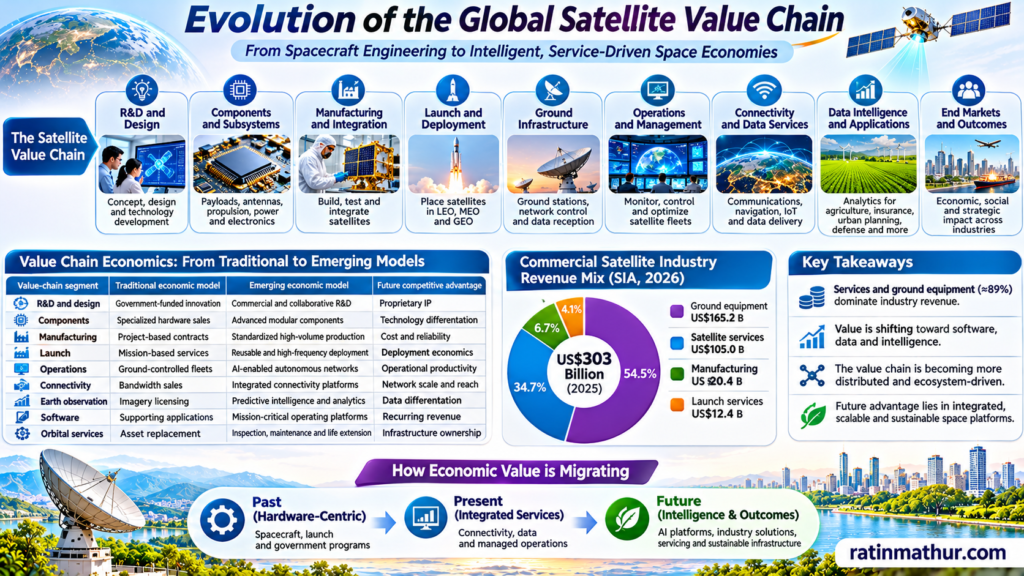
The SIA (2026) reported 2025 commercial satellite industry revenue of US$303 billion. Satellite services contributed US$105 billion, ground equipment US$165.2 billion, manufacturing US$20.4 billion and launch services US$12.4 billion.
These figures demonstrate that the commercial satellite economy is not primarily a spacecraft manufacturing market. Ground equipment and service delivery represent a much larger portion of reported industry revenue.
The strategic implication is that economic value may increasingly migrate toward software, data, network services and specialized technologies. Hardware will remain indispensable, but the ability to monetize what satellites enable could become a more powerful source of differentiation.
5.2 Orbital Infrastructure: The Emerging Multi-Orbit Economy
The satellite industry is increasingly developing around three major orbital environments.
| Orbital environment | Principal characteristics | Emerging economic applications |
|---|---|---|
| Low Earth Orbit (LEO) | Lower altitude and latency, larger constellations | Broadband, Earth observation, IoT and defense |
| Medium Earth Orbit (MEO) | Intermediate altitude and coverage | Navigation and specialized communications |
| Geostationary Orbit (GEO) | Wide-area coverage and apparent fixed position | Broadcasting, weather and communications |
LEO is becoming particularly important because of the expansion of broadband and Earth observation constellations. MEO remains important for global navigation systems, while GEO continues to serve applications requiring wide-area coverage.
The future architecture will increasingly involve interoperability across orbital layers and terrestrial networks. Rather than relying on a single orbit, operators may combine multiple orbital environments to optimize latency, capacity, resilience and geographic coverage.
The OECD (2026) reports that more than 14,000 operational satellites were in orbit by the end of 2025, rising to almost 15,000 by mid-2026. It also highlights the growing concentration of active satellites among a limited number of operators and countries.
This creates both commercial opportunity and strategic vulnerability. Orbital access is becoming more commercially accessible, but launch capacity, spectrum coordination and large-scale network ownership remain concentrated.
5.3 Global Competitive Landscape
The competitive landscape is evolving around five principal groups: government space agencies, commercial satellite network operators, spacecraft manufacturers, downstream intelligence businesses and emerging technology ventures.
| Competitive group | Representative organizations | Competitive strengths |
|---|---|---|
| Government space agencies | NASA, ISRO, ESA, CNSA | Research, national infrastructure and strategic missions |
| Satellite operators | SpaceX, Eutelsat, SES | Network ownership, spectrum and service delivery |
| Manufacturers | Airbus Defence and Space, Thales Alenia Space, MDA Space | Engineering and payload integration |
| Intelligence providers | Planet Labs, Maxar, ICEYE | Earth observation and geospatial analytics |
| Emerging technology companies | AST SpaceMobile, Rocket Lab, Loft Orbital | New network and infrastructure models |
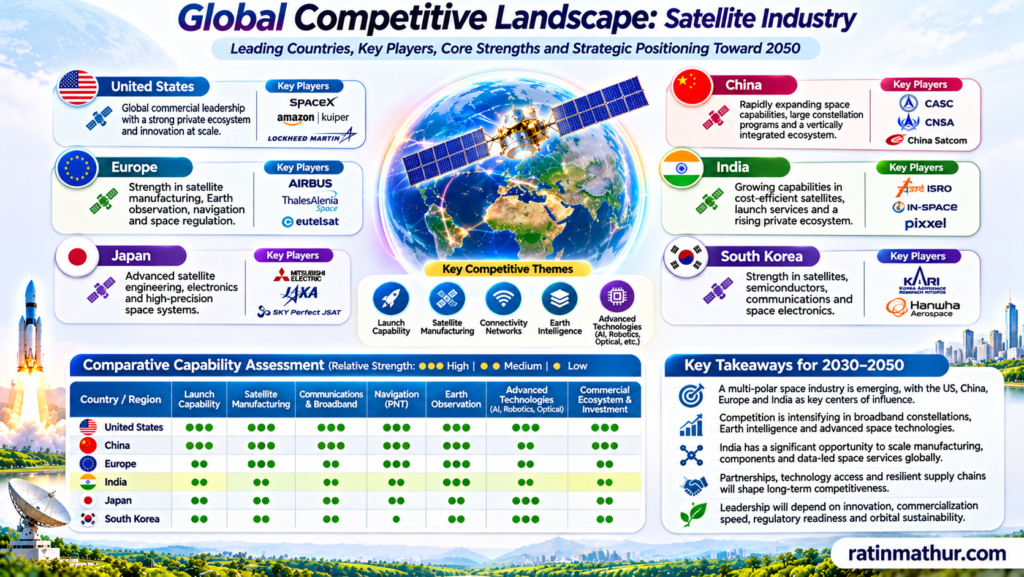
The United States benefits from a strong commercial ecosystem spanning launch, satellite broadband, defense, software and private investment. China is expanding sovereign space capabilities and constellation ambitions. Europe retains important strengths in satellite manufacturing, navigation, Earth observation and regulation. Japan and South Korea possess advanced engineering and electronics capabilities.
India has an opportunity to become a major global supplier of satellite systems, subsystems, components, data products and affordable space services.
5.4 Venture Capital, Startup Disruption and Innovation
Private capital is becoming increasingly important to commercial space development. The OECD (2026) estimates private capital flows into the space sector at approximately US$11–13 billion during 2025, depending on scope and methodology.
Investment interest extends beyond launch and spacecraft manufacturing into satellite communications, advanced payloads, Earth observation, AI software, cybersecurity and orbital infrastructure.
| Startup opportunity | Commercial offering | Strategic attractiveness |
|---|---|---|
| AI satellite software | Autonomous operations and fleet management | High |
| Optical communications | Laser-based inter-satellite links | High |
| Direct-to-device connectivity | Satellite-mobile services | High |
| Space cybersecurity | Secure networks and satellite protection | High |
| Earth intelligence | Predictive analytics and data platforms | High |
| Advanced payloads | Hyperspectral, SAR and RF sensing | High |
| In-orbit servicing | Refuelling, repair and inspection | Emerging |
| Debris removal | Orbital remediation | Emerging |
| Orbital computing | Space-based processing infrastructure | Speculative |
The principal investment opportunity is to identify businesses with defensible technology, recurring revenue, high switching costs, credible customers and sustainable capital requirements.
Patent intelligence should focus on autonomous control, optical communications, phased-array antennas, propulsion, radiation-hardened electronics, robotic servicing, cybersecurity and advanced sensing. Patent filings can indicate innovation priorities, but patent activity alone does not establish commercial viability.
6. Key Findings
The analysis identifies seven structural findings.
| Key finding | Strategic implication |
|---|---|
| Satellite infrastructure is becoming interconnected | Network orchestration will become essential |
| Economic value is expanding beyond hardware | Software and intelligence offer attractive opportunities |
| AI is transforming operations | Autonomous systems can improve productivity |
| Space is becoming contested infrastructure | Sovereignty and resilience will shape competition |
| Orbital sustainability is an economic necessity | Traffic management and remediation will create markets |
| Commercialization is expanding but capital requirements remain substantial | Financial discipline is critical |
| National space ecosystems are becoming strategically important | Governments and private enterprises must collaborate |
The first finding is that connectivity and intelligence will increasingly operate as complementary platforms. Satellites will not simply transmit information; they will collect, process and distribute intelligence across industries.
The second finding is that future competition will depend on control over technological bottlenecks. Advanced antennas, optical terminals, onboard computing, secure communications and proprietary analytics may create stronger competitive positions than undifferentiated satellite manufacturing.
The third finding is that recurring-revenue models will become increasingly important. Subscription services, data-as-a-service, connectivity-as-a-service and managed satellite operations can create more predictable cash flows than one-time hardware contracts.
The fourth finding is that governments will remain indispensable market participants. National security, strategic autonomy, spectrum allocation and public procurement will continue to shape commercial demand.
The fifth finding is that orbital sustainability will become inseparable from commercial viability. Increasing congestion creates risks that cannot be resolved through launch technology alone.
The sixth finding is that future industry leadership will require capabilities across several technology domains rather than excellence in a single engineering discipline.
The seventh finding is that commercially successful organizations will be those capable of translating technological innovation into measurable customer value and sustainable unit economics.
7. Challenges & Opportunities
The satellite industry faces interconnected technological, financial, regulatory, environmental and geopolitical challenges.
Capital intensity remains a major barrier, particularly for companies planning large constellations. Manufacturing, launch, ground infrastructure, spectrum access and customer acquisition can require substantial investment before commercial revenues reach scale.
Technology obsolescence creates another challenge. Long spacecraft development and operational lifecycles may conflict with rapid advances in communications, semiconductors and AI. Modular design and upgradeable architectures will become increasingly important.
Cybersecurity is critical because satellites, ground stations and communications networks form interconnected digital infrastructure. Jamming, spoofing, cyberattacks and supply-chain vulnerabilities can undermine mission reliability and national security.
Orbital congestion is becoming a serious structural constraint. ESA’s 2026 Space Environment Report identifies continued growth in orbital objects, increasing debris populations and rising collision concerns. It reports more than 300 launches and over 4,000 new payloads entering orbit during 2025 (ESA, 2026).
| Challenge | Emerging commercial opportunity |
|---|---|
| Orbital congestion | Space traffic management and collision-risk intelligence |
| Space debris | Active removal and sustainable satellite design |
| Cybersecurity threats | Secure satellite communications |
| High operational costs | AI-enabled autonomous operations |
| Limited connectivity | Direct-to-device and multi-orbit broadband |
| Data overload | AI-powered geospatial intelligence |
| Satellite replacement costs | In-orbit inspection and servicing |
| Technology dependence | Indigenous semiconductor and payload manufacturing |
| Climate uncertainty | Satellite-based environmental monitoring |
The most significant opportunity is the transition from selling satellite capacity to solving customer problems. Insurers may purchase predictive disaster intelligence rather than imagery. Agricultural enterprises may purchase crop-risk assessments rather than raw satellite data. Governments may procure integrated surveillance capabilities rather than individual spacecraft.
This transition from technology sales to measurable customer outcomes will define future competitive advantage.
8. Five Major Technological Transformations
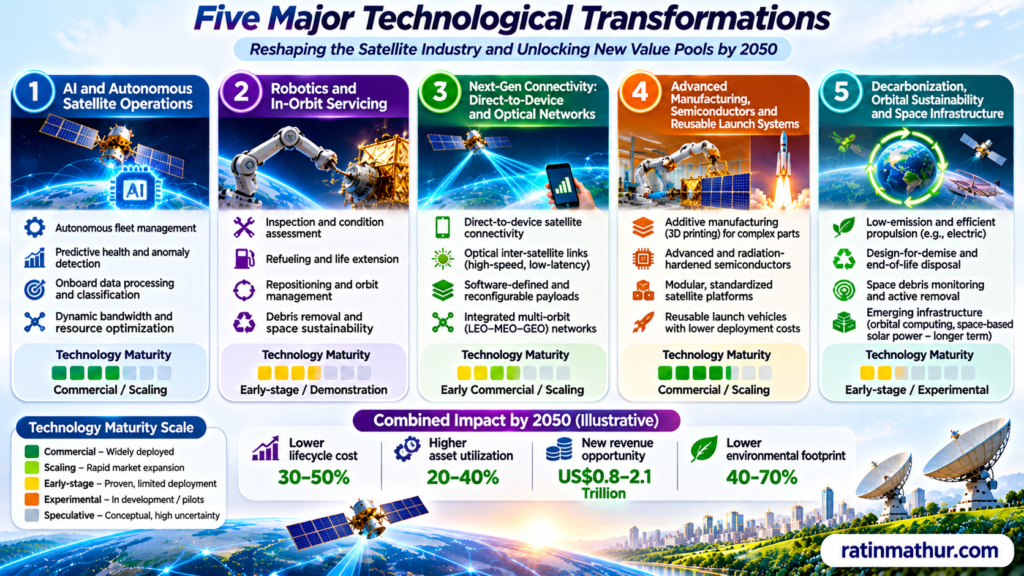
8.1 Artificial Intelligence and Autonomous Satellite Operations
AI could become the most influential productivity technology in the satellite industry. Traditionally, satellite fleets have depended heavily on ground-based control centers, human operators and centralized data processing. Future systems will increasingly incorporate onboard intelligence and autonomous decision-making.
AI-enabled satellites could detect operational anomalies, optimize power consumption, classify imagery, allocate communication bandwidth, assess collision risks and support autonomous maneuvers.
| Application | Current approach | Future AI-enabled approach | Business impact |
|---|---|---|---|
| Satellite health | Periodic monitoring | Predictive diagnostics | Reduced downtime |
| Image processing | Ground-based analysis | Onboard AI classification | Lower latency |
| Fleet management | Human-led coordination | Autonomous optimization | Lower operating costs |
| Collision avoidance | Ground-supported decisions | AI-assisted risk assessment | Improved safety |
| Communications | Predetermined allocation | Dynamic resource allocation | Higher utilization |
The strategic opportunity extends beyond developing AI-enabled satellites. Companies could build satellite operating systems, autonomous fleet-management platforms and specialized AI applications for mission-critical operations.
However, autonomous systems must be designed with robust verification, cybersecurity, explainability and human oversight. An incorrect autonomous maneuver can create consequences extending beyond a single spacecraft.
8.2 Robotics and the In-Orbit Servicing Economy
Robotics could transform satellites from largely disposable assets into potentially serviceable infrastructure.
Future robotic systems may conduct inspection, refuelling, repositioning, component replacement, assembly and debris removal. Such capabilities could improve asset utilization and extend the operational life of selected spacecraft.
| Emerging service | Potential business model | Commercial maturity |
|---|---|---|
| Robotic inspection | Inspection contracts | Early |
| Satellite life extension | Servicing agreements | Early |
| Refuelling | Fuel and service charges | Emerging |
| Orbital relocation | Mobility contracts | Emerging |
| Debris removal | Government and operator contracts | Early |
| In-orbit assembly | Infrastructure projects | Experimental |
The commercial challenges should not be underestimated. NASA discontinued its OSAM-1 project following technical, cost and schedule difficulties and the absence of a committed servicing partner (NASA, 2024). This demonstrates that engineering feasibility does not automatically translate into commercial viability.
The strategic priority should be to design future spacecraft with servicing interfaces, standardized docking arrangements and modular architectures rather than assuming that all existing satellites can be economically repaired.
8.3 Next-Generation Connectivity: Direct-to-Device and Optical Networks
Satellite connectivity is evolving from a specialized broadband service toward an integrated component of terrestrial telecommunications.
Direct-to-device technology aims to enable compatible mobile devices to communicate through satellites, extending connectivity into regions where conventional networks are unavailable or unreliable.
Optical inter-satellite communication could enable high-capacity data transfer between spacecraft without relying exclusively on terrestrial gateways.
| Technology | Potential application | Economic opportunity |
|---|---|---|
| Direct-to-device | Satellite-to-mobile connectivity | Consumer and enterprise subscriptions |
| Optical links | Inter-satellite data transmission | Network infrastructure |
| Software-defined payloads | Dynamic communications configuration | Flexible capacity services |
| Multi-orbit networks | Integrated LEO, MEO and GEO services | Wholesale connectivity |
| Satellite IoT | Remote monitoring | Industrial subscriptions |
The long-term opportunity is to integrate satellite and terrestrial networks into a continuous connectivity ecosystem. Telecommunications operators may become major commercial partners rather than competitors.
8.4 Advanced Manufacturing, Semiconductors and Reusable Launch Systems
Manufacturing economics will influence the industry’s competitive structure. Standardized satellite platforms, additive manufacturing, modular electronics, automated testing and advanced materials could reduce production costs and shorten development cycles.
Reusable launch systems may further reduce deployment costs, although actual savings depend on launch cadence, refurbishment, payload integration and operational reliability.
| Technology | Transformation | Strategic impact |
|---|---|---|
| Additive manufacturing | Complex lightweight components | Lower production complexity |
| Modular satellite buses | Standardized platforms | Faster manufacturing |
| Advanced semiconductors | More powerful onboard processing | Higher satellite capability |
| Radiation-hardened electronics | Improved reliability | Longer mission life |
| Electric propulsion | Efficient orbital maneuvering | Better operational flexibility |
| Reusable launch vehicles | Recovery and reuse of launch stages | Potentially lower deployment costs |
For India, this technology transition creates opportunities in satellite components, propulsion systems, power electronics, advanced materials and precision manufacturing.
8.5 Decarbonization, Orbital Sustainability and Space-Based Infrastructure
Sustainability will become an economic and regulatory requirement rather than a peripheral environmental consideration.
The environmental footprint of satellites includes manufacturing emissions, semiconductor supply chains, launch activity, atmospheric effects and orbital debris.
ESA’s 2026 analysis highlights the increasing importance of post-mission disposal, collision avoidance and active debris removal. It also reports a shift toward a five-year post-mission disposal target in relevant low-Earth-orbit mitigation practices, replacing the historically used 25-year guideline in some contexts.
Emerging business opportunities include sustainable propulsion, design-for-demise engineering, debris monitoring, active removal, collision-avoidance software and satellite life-extension services.
Space-based solar power and orbital computing may create new infrastructure markets, but their economics remain uncertain. High launch costs, thermal management, energy transmission, maintenance and deployment complexity must be resolved before large-scale commercial adoption can be assumed.
9. How Large Could the Satellite Industry Become by 2050?
The long-term economic potential must be evaluated carefully because different research organizations define the space economy differently.
The SIA (2026) estimates that the commercial satellite industry generated approximately US$303 billion in 2025. This includes satellite services, ground equipment, manufacturing and launch services.
The OECD (2026) estimates the broader global space economy at approximately US$550–600 billion in 2025, incorporating a wider range of space-related economic activities.
The World Economic Forum and McKinsey (2024) project that the wider space economy could reach US$1.8 trillion by 2035.
These figures establish the scale of the opportunity but do not provide a definitive satellite-industry forecast for 2050.
9.1 Three 2050 Satellite Industry Revenue Scenarios
An illustrative financial model can be developed using the 2025 satellite industry revenue estimate of US$303 billion as the baseline.
The model applies three annual nominal compound growth assumptions over 25 years.
The formula is:
R(2050) = R(2025) × (1 + g)^25
Where R represents annual industry revenue and g represents the assumed annual growth rate.
| Scenario | Assumed annual growth | Illustrative 2050 revenue | Strategic interpretation |
|---|---|---|---|
| Conservative | 4% | US$808 billion | Mature markets, price competition and slower adoption |
| Base | 6% | US$1.29 trillion | Continued connectivity, intelligence and service expansion |
| Upside | 8% | US$2.07 trillion | Strong technology adoption and new orbital infrastructure markets |
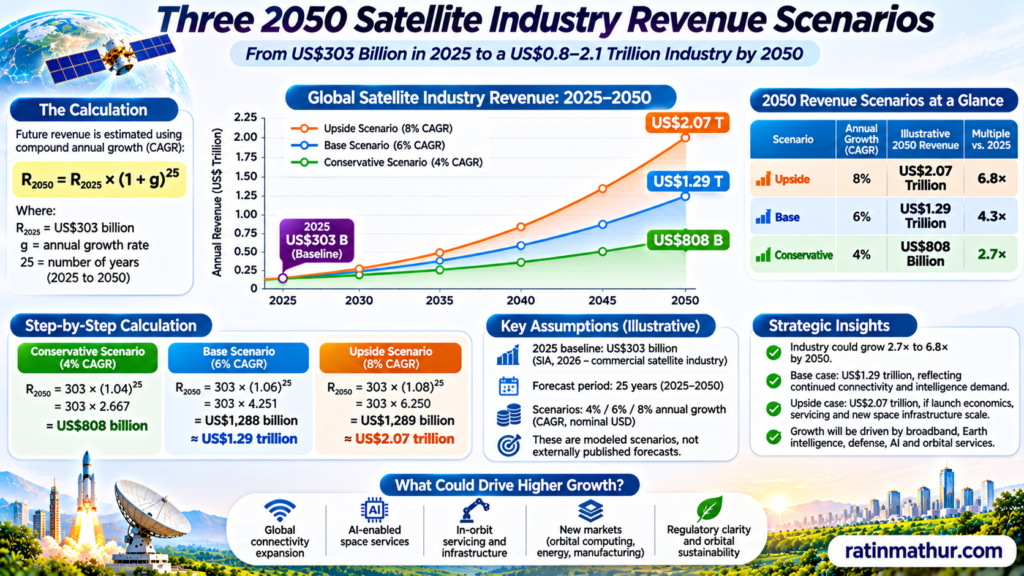
These are modeled scenarios, not externally published forecasts or probability-weighted predictions. They are expressed in nominal USD and are not adjusted for inflation.
The conservative scenario assumes that satellite connectivity matures, price competition increases and regulatory constraints limit expansion. The base scenario assumes continued adoption of broadband, Earth intelligence, AI-enabled operations and multi-orbit infrastructure. The upside scenario assumes substantial improvements in launch economics, successful servicing markets and wider commercialization of new space infrastructure.
9.2 Future Satellite Industry Profit Pools
Revenue growth does not automatically translate into profitability. The most attractive profit pools will depend on intellectual property, customer relationships, network effects, pricing power, capital requirements and barriers to entry.
| Segment | Growth potential | Profit-pool attractiveness | Principal constraint |
|---|---|---|---|
| Satellite broadband | Very high | High | Capital intensity |
| Direct-to-device | Very high | High | Spectrum and network economics |
| Earth intelligence | Very high | Very high | Data differentiation |
| AI satellite software | Very high | Very high | Reliability and IP |
| Advanced payloads | High | High | Technology barriers |
| Defense satellites | High | High | Procurement concentration |
| Space cybersecurity | High | High | Trust and security |
| In-orbit servicing | Medium–high | Emerging high-value opportunity | Technical maturity |
| Debris management | High potential | Emerging | Regulatory demand |
| Orbital computing | Uncertain | Uncertain | Deployment economics |
| Space-based energy | Uncertain | Uncertain | Technical and economic feasibility |
The five most strategically attractive profit pools are satellite data intelligence, connectivity platforms, satellite operating software, advanced components and orbital infrastructure services.
The key shift will be from selling physical capacity toward providing continuous intelligence, connectivity and mission-critical outcomes.
10. Regulatory, Policy and Geopolitical Outlook
The future satellite industry will operate within an increasingly complex international regulatory environment. Spectrum availability, orbital coordination, national licensing, cybersecurity, export controls, debris mitigation and national security requirements will influence market access and commercial competitiveness.
10.1 International Regulatory Architecture
The Outer Space Treaty of 1967 establishes foundational principles governing peaceful use, state responsibility and national supervision of space activities. The Convention on International Liability for Damage Caused by Space Objects and the Convention on Registration of Objects Launched into Outer Space provide additional international legal foundations.
The ITU coordinates international radio-frequency spectrum and associated satellite-orbit resources through its Radio Regulations and coordination processes. National administrations remain responsible for licensing satellite systems under their jurisdiction (ITU, n.d.).
The United Nations Committee on the Peaceful Uses of Outer Space (COPUOS) has developed guidelines for the long-term sustainability of outer space activities. These provide important international guidance on safety, sustainability, information sharing and debris mitigation.
However, there is no single comprehensive, universally binding global space traffic management regime covering all operational aspects of orbital coordination.
10.2 Regulatory Issues That Will Shape 2050
| Regulatory area | Emerging policy concern | Strategic business impact |
|---|---|---|
| Spectrum allocation | Increasing demand and interference | Market access and network capacity |
| Orbital coordination | Congestion and collision risk | Deployment costs |
| Debris mitigation | Post-mission disposal | Compliance and engineering |
| Cybersecurity | Attacks on satellite infrastructure | Security investment |
| Export controls | Dual-use technologies | Supply-chain restrictions |
| Data governance | Sensitive Earth observation data | Licensing and market access |
| Environmental policy | Launch and re-entry effects | Product redesign |
| Defense regulation | Sovereign and strategic systems | Government procurement |
| Foreign investment | National security screening | Partnership structures |
The United States Federal Communications Commission has adopted a five-year post-mission disposal requirement for specified low-Earth-orbit operations under its applicable rules. This is a jurisdiction-specific regulatory example, not a universal global requirement.
Future operators will need to incorporate regulatory compliance into spacecraft architecture, mission planning, data systems and business models from the beginning.
10.3 Geopolitical Competition and Space Sovereignty
Space infrastructure is becoming strategically important to national security and economic resilience.
Satellite systems support missile warning, military communications, navigation, intelligence, disaster response and critical infrastructure operations. Disruption to these services can have consequences extending into financial systems, transportation, energy and national defense.
The future geopolitical environment may involve competing national and regional space ecosystems, with governments prioritizing secure supply chains, domestic launch capabilities, sovereign communications and independent navigation systems.
| Geopolitical risk | Potential impact | Strategic response |
|---|---|---|
| Anti-satellite capabilities | Physical asset disruption | Distributed and resilient networks |
| Signal jamming and spoofing | Navigation and communications disruption | Multi-source positioning and encryption |
| Cyberattacks | Loss of control or service interruption | Secure architecture |
| Technology export restrictions | Supply-chain disruption | Indigenous and diversified sourcing |
| Spectrum competition | Reduced operational access | International coordination |
| Orbital congestion | Collision and deployment risks | Space traffic intelligence |
| Geopolitical fragmentation | Market-access restrictions | Strategic partnerships |
The most important strategic implication is that satellite infrastructure must be designed for resilience, redundancy and sovereignty rather than optimized exclusively for commercial efficiency.
11. India’s Strategic Opportunity: From Space Capability to Global Industrial Leadership
India has a significant opportunity to become one of the world’s most important satellite manufacturing and services ecosystems by 2050.
The country possesses an established space research foundation, a competitive engineering workforce, a growing private-sector technology ecosystem and experience in relatively cost-efficient satellite and launch development.
However, the opportunity is much larger than increasing the number of launches or manufacturing more spacecraft. India must capture greater value across the entire satellite ecosystem, particularly advanced components, semiconductor technologies, payloads, AI applications, telecommunications and downstream intelligence.
11.1 India’s Space Economy Ambition
According to the Government of India, India’s space economy was estimated at approximately US$8.4 billion in 2023, representing around 2% of the global space economy. The government’s stated ambition is to reach approximately US$44 billion by 2033 and US$100 billion by 2040 (Press Information Bureau, 2026).
These are national policy targets, not guaranteed outcomes.
| Indicator | Government-reported position or target |
|---|---|
| India’s estimated space economy, 2023 | US$8.4 billion |
| Estimated global share, 2023 | Approximately 2% |
| Target space economy, 2033 | US$44 billion |
| Target global share, 2033 | Approximately 8% |
| Target space economy, 2040 | US$100 billion |
| Target global share, 2040 | Approximately 10% |
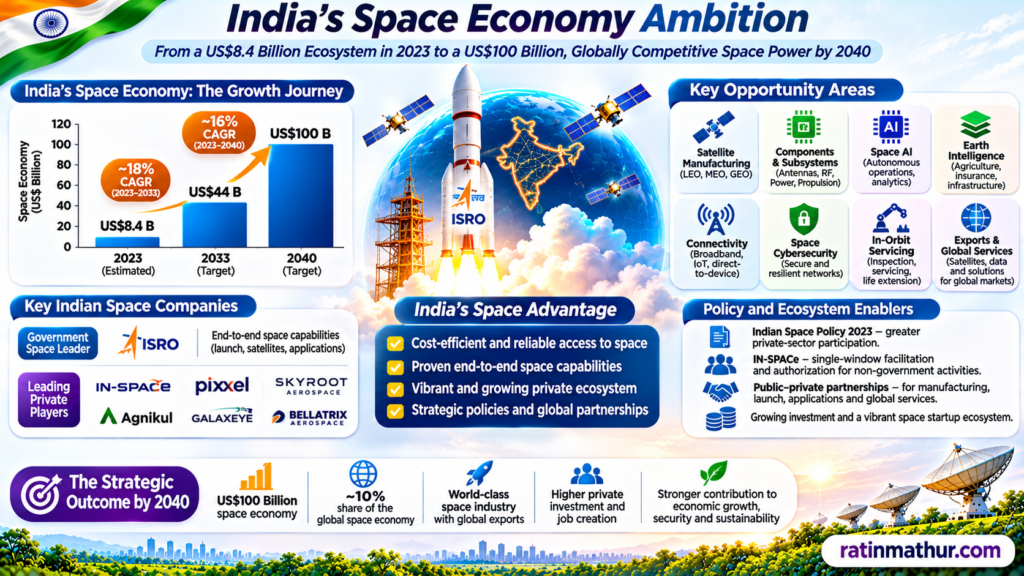
Achieving these targets will require a stronger industrial base, higher private investment, international partnerships, increased exports and the development of commercially successful Indian space companies.
11.2 Policy and Regulatory Enablers
The Indian Space Policy 2023 establishes a framework for expanding private-sector participation across the space value chain. It positions the government and ISRO as important enablers of a broader commercial ecosystem, with IN-SPACe responsible for promoting and authorizing non-governmental space activities.
The revised foreign direct investment framework provides additional investment flexibility.
| Space-sector activity | Automatic-route FDI limit | Beyond automatic route |
|---|---|---|
| Satellite manufacturing and operations, satellite data products, ground and user segments | 74% | Government route |
| Launch vehicles and associated systems, spaceports | 49% | Government route |
| Manufacturing of satellite components and subsystems | 100% | Subject to applicable policy conditions |
The policy is intended to attract investment, facilitate technology transfer and strengthen the participation of domestic and international businesses. Investors must still assess applicable authorizations, national security requirements and sector-specific regulations.
The government’s 2026 announcements concerning private-sector participation and Earth observation satellite constellation development further indicate a shift toward industry-led infrastructure and public-private partnership models.
11.3 India’s Priority Satellite Industry Opportunities
| Opportunity | Strategic rationale | Potential Indian positioning |
|---|---|---|
| Satellite manufacturing | Growing global demand | Export-oriented manufacturing |
| Advanced payloads | Increasing sensing requirements | Proprietary optical and SAR systems |
| RF and antenna systems | Connectivity expansion | Advanced component manufacturing |
| Semiconductor components | Strategic supply-chain importance | Radiation-hardened electronics |
| Satellite AI | Growing need for autonomous operations | Software and analytics exports |
| Earth intelligence | Demand from agriculture, insurance and infrastructure | Data platforms |
| Satellite connectivity | Remote and underserved market coverage | Telecom partnerships |
| Space cybersecurity | Strategic network protection | Secure digital infrastructure |
| Orbital servicing | Long-term emerging market | Robotics and propulsion |
| Debris management | Increasing orbital congestion | Space sustainability technology |
11.4 Building an Indian Satellite Industrial Ecosystem
India should develop a vertically integrated industrial ecosystem that connects research institutions, component suppliers, satellite manufacturers, launch providers, telecommunications companies, AI businesses, financial institutions and international customers.
The first priority should be advanced manufacturing. Indian companies must move beyond assembly toward proprietary satellite buses, high-performance antennas, power systems, optical terminals, propulsion technologies and specialized payloads.
The second priority should be downstream intelligence. Earth observation data can support agriculture, infrastructure, insurance, urban planning, maritime monitoring, disaster management and environmental compliance. Indian businesses should develop analytical platforms that convert data into commercial decisions.
The third priority should be software and connectivity. AI-enabled satellite operations, network management, cybersecurity and direct-to-device integration offer opportunities for Indian software and telecommunications companies.
The fourth priority should be international market access. Indian companies should develop partnerships with global satellite operators, aerospace manufacturers, cloud providers and telecommunications networks.
The fifth priority should be patient capital and commercial validation. Large-scale constellation deployment requires disciplined investment, anchor customers, regulatory readiness and demonstrable unit economics.
India’s long-term competitive advantage will depend on combining engineering cost efficiency with proprietary intellectual property, advanced technology and globally competitive service delivery.
12. Capability Shifts Required by 2050
The transition toward an intelligent satellite economy will require a fundamental change in the capabilities of companies, governments and the wider workforce.
Traditional aerospace engineering alone will no longer be sufficient. Competitive organizations will need expertise across software, semiconductors, AI, robotics, data science, telecommunications, cybersecurity, regulatory affairs and infrastructure finance.
12.1 Technology and Engineering Capability Transformation
| Existing capability | Required future capability | Strategic relevance |
|---|---|---|
| Conventional aerospace engineering | Integrated systems engineering | Complex multi-orbit architectures |
| Hardware manufacturing | Modular automated production | Cost and speed |
| Ground-controlled operations | Autonomous fleet management | Productivity |
| Traditional RF communications | Optical and multi-orbit networking | Network performance |
| Image processing | AI-enabled intelligence | Faster decision-making |
| Conventional electronics | Advanced and radiation-hardened semiconductors | Reliability |
| Manual maintenance concepts | Robotic in-orbit servicing | Asset longevity |
| Conventional cybersecurity | Space-specific cyber resilience | Infrastructure protection |
| Project-based procurement | Platform and service management | Recurring revenue |
| Traditional environmental compliance | Orbital sustainability engineering | Long-term access |
12.2 Future Workforce and Leadership Capabilities
The future satellite workforce will require expertise in AI and machine learning, aerospace robotics, optical communications, advanced semiconductors, geospatial analytics, satellite propulsion, cybersecurity, orbital mechanics, space law and financial engineering.
Leadership capabilities will also change. Executives must understand technology roadmaps, capital allocation, international regulation, geopolitical risk, digital platforms and long-term infrastructure economics.
Organizations should establish cross-functional transformation teams connecting engineering, product development, commercial strategy, finance, legal, sustainability and government relations.
12.3 Organizational Business Model Transformation
| Traditional organizational model | Future organizational model |
|---|---|
| Hardware manufacturer | Integrated technology and service provider |
| Project-based revenue | Recurring platform revenue |
| Isolated engineering departments | Cross-functional digital engineering |
| Ground-centric operations | Autonomous and distributed operations |
| Supplier-driven innovation | Collaborative innovation ecosystems |
| Product-centric customer relationships | Outcome-based customer partnerships |
| Replacement-oriented asset management | Lifecycle optimization and servicing |
The successful satellite company of 2050 may resemble a combination of a semiconductor business, telecommunications operator, cloud infrastructure provider, AI software company and aerospace engineering organization.
13. Satellite Industry Transformation Roadmap: 2026–2050
The transformation will occur progressively rather than through a single technological breakthrough. Companies should align investments with technology maturity, market demand and commercial readiness.
13.1 Five Phases of Industry Evolution
| Period | Transformation phase | Principal developments | Commercial priorities |
|---|---|---|---|
| 2026–2030 | Commercial expansion | Broadband constellations, D2D, AI integration, reusable launch | Connectivity, manufacturing and data |
| 2030–2035 | Network convergence | 5G/6G integration, optical links, software-defined satellites | Multi-orbit services and AI platforms |
| 2035–2040 | Autonomous infrastructure | Advanced fleet autonomy, robotic servicing demonstrations | Operational intelligence and servicing |
| 2040–2045 | Orbital infrastructure economy | More sophisticated in-space logistics and selective manufacturing | Infrastructure and lifecycle services |
| 2045–2050 | Integrated space economy | Mature multi-orbit systems and embedded satellite services | Platforms, data and orbital infrastructure |
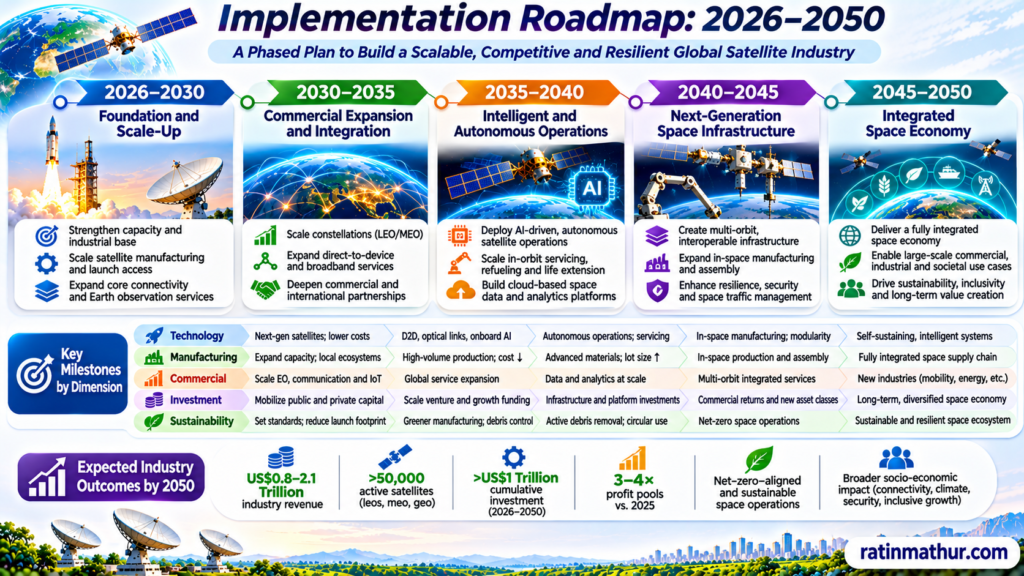
13.2 Detailed Transformation Milestones
2026–2030: Commercial Expansion and Constellation Competition
The first phase will be characterized by continued growth in commercial satellite networks, expanding direct-to-device capabilities, greater use of AI in satellite operations and increased Earth observation demand. Businesses should prioritize technology validation, customer acquisition, spectrum access and manufacturing efficiency.
The competitive advantage will depend on achieving reliable operations, attractive unit economics and commercially sustainable deployment strategies.
2030–2035: Network Integration and Service Convergence
The second phase will involve closer integration of terrestrial telecommunications and satellite systems. Software-defined satellites, optical inter-satellite links, AI-enabled data processing and multi-orbit networks may become more commercially established.
The strategic opportunity will shift toward integrated service platforms and specialized data applications.
2035–2040: Autonomous Space Infrastructure
The third phase may involve greater autonomous fleet management, expanded use of onboard AI, robotic inspection and selected servicing capabilities. Satellite networks will increasingly coordinate resources dynamically.
Companies will need capabilities in autonomy, robotics, cybersecurity and advanced mission management.
2040–2045: Space Infrastructure Economy
The fourth phase could see a more developed market for in-orbit maintenance, relocation, inspection and selected orbital manufacturing applications. Commercial satellite infrastructure may increasingly support complex logistics, scientific and industrial operations.
The market will reward organizations that can operate reliably across multiple orbital environments.
2045–2050: Integrated Space-Enabled Global Economy
The final phase could involve deeply integrated satellite networks supporting telecommunications, transportation, finance, agriculture, defense, climate intelligence and industrial systems.
Space-based computing, energy and advanced manufacturing may develop in specialized applications if technological and economic barriers are overcome.
13.3 Critical Inflection Points
| Inflection point | What to monitor | Strategic significance |
|---|---|---|
| Launch-cost reduction | Cost per kilogram and launch cadence | Determines deployment economics |
| Direct-to-device adoption | Subscribers and service quality | Expands connectivity market |
| AI operating maturity | Autonomy and cost reduction | Changes operating economics |
| Optical communication scale | Terminal performance and adoption | Enables network integration |
| Servicing viability | Demonstrated contracts and mission success | Extends asset economics |
| Orbital sustainability | Debris trends and regulation | Determines long-term access |
| Capital availability | Investment and financing costs | Determines commercial expansion |
These indicators should be monitored continuously and used to revise corporate investment and product roadmaps.
14. Implementation Roadmap: 2026–2050
The transformation of the satellite industry requires a disciplined implementation strategy connecting market intelligence, technology development, commercialization, partnerships, capital allocation and organizational change.
The roadmap should distinguish near-term commercial priorities from long-term strategic options.
14.1 Phase I: Strategic Positioning and Capability Development, 2026–2030
The first phase should focus on identifying commercially attractive positions in the value chain. Organizations should assess customer demand, competitor capabilities, regulatory requirements and technology maturity before committing significant capital.
The immediate priority should be to develop differentiated capabilities in AI-enabled operations, advanced payloads, Earth intelligence, satellite components and connectivity services.
| Strategic workstream | Recommended action | Expected deliverable |
|---|---|---|
| Market intelligence | Analyze customer demand and competitors | Market entry strategy |
| Technology | Assess proprietary IP and innovation gaps | Technology roadmap |
| Commercialization | Validate customer requirements | Pilot contracts |
| Investment | Evaluate build, buy or partner options | Capital allocation plan |
| Regulation | Assess licensing and spectrum requirements | Regulatory readiness |
| Organization | Develop specialist teams | Capability development plan |
14.2 Phase II: Commercial Scale-Up, 2030–2035
The second phase should convert technology capabilities into scalable products and services. Companies should expand manufacturing, establish international partnerships and develop recurring-revenue models.
Commercial priorities should include connectivity platforms, satellite data analytics, AI software, advanced components and managed satellite operations.
The focus should shift from proving technology to demonstrating profitable and repeatable commercial delivery.
14.3 Phase III: Technology Differentiation, 2035–2040
The third phase should focus on autonomous operations, optical networking, advanced robotics and integrated multi-orbit infrastructure.
Organizations should increase investment in proprietary technologies and develop partnerships across telecommunications, cloud computing, aerospace and defense ecosystems.
Technology investments should be linked to customer adoption and demonstrable returns rather than speculative capability expansion.
14.4 Phase IV: Infrastructure Expansion, 2040–2045
The fourth phase should prepare organizations for more complex orbital infrastructure markets. Selected companies may expand into servicing, mobility, inspection, logistics and specialized in-space manufacturing.
This phase will require greater technical standardization, insurance frameworks, regulatory coordination and commercial demand validation.
14.5 Phase V: Global Strategic Leadership, 2045–2050
The final phase should focus on global market leadership, proprietary platforms, international partnerships and long-term infrastructure ownership.
Organizations that have developed strong technology, customer relationships and operational capabilities may be positioned to participate in the highest-value segments of the space economy.
14.6 Integrated Corporate Implementation Plan
| Workstream | 2026–2030 | 2030–2035 | 2035–2040 | 2040–2045 | 2045–2050 |
|---|---|---|---|---|---|
| Market positioning | Select target markets | Expand customer base | Enter adjacent markets | Expand globally | Consolidate leadership |
| Technology | Develop core IP | Scale products | Advance autonomy | Develop infrastructure | Lead platforms |
| Manufacturing | Build capacity | Automate production | Modularize systems | Integrate servicing | Optimize lifecycle |
| Commercial | Validate revenue | Scale recurring services | Expand partnerships | Diversify markets | Build ecosystem |
| Sustainability | Establish compliance | Improve disposal | Adopt advanced tracking | Expand remediation | Lead orbital stewardship |
| Organization | Build capabilities | Scale specialist teams | Integrate AI and robotics | Develop ecosystem leadership | Continuous innovation |
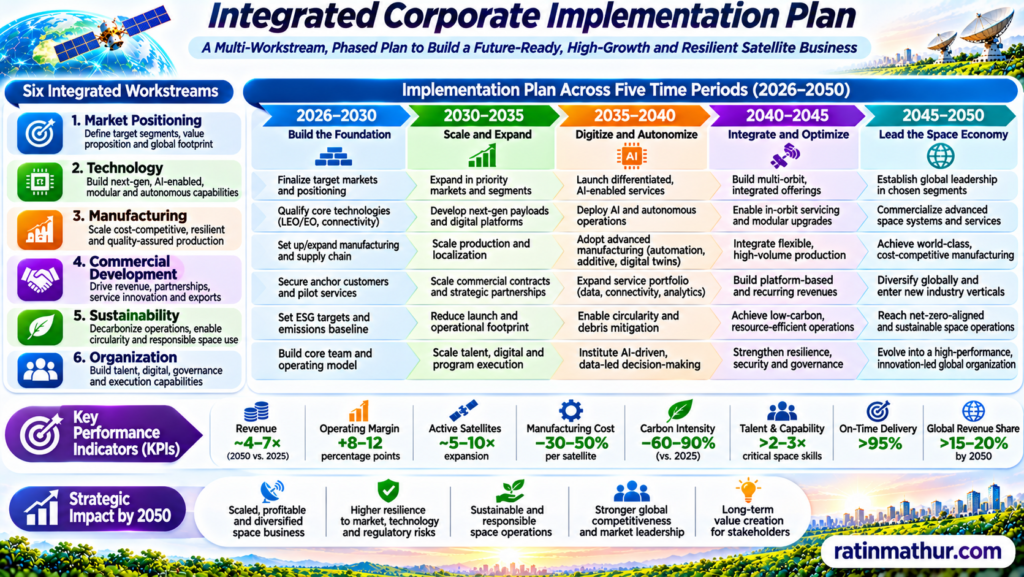
14.7 Strategic Performance Indicators
Transformation should be measured through financial, operational, commercial, technological and sustainability indicators.
| KPI category | Recommended measures |
|---|---|
| Financial performance | Revenue growth, gross margin, EBITDA and return on invested capital |
| Commercial performance | Recurring revenue, backlog, customer retention and contract conversion |
| Manufacturing | Production cost, yield and cycle time |
| Operations | Fleet uptime, utilization and service availability |
| Technology | Patent quality, technology readiness and R&D productivity |
| Data monetization | Revenue per dataset and analytics adoption |
| Cybersecurity | Incident response and system resilience |
| Sustainability | End-of-life compliance and collision avoidance |
| Innovation | Time to commercialization and pilot-to-contract conversion |
The most important implementation principle is that technology investment, customer demand and financial sustainability must evolve together.
15. Strategic Frameworks & Recommendations
The following three original strategic frameworks provide a structured management architecture for navigating the satellite industry’s transformation. They address three complementary strategic questions: how to transform the organization, where to capture economic value and how to sustain competitive advantage under uncertainty.
15.1 ORBIT™ Strategic Transformation Framework
The ORBIT™ Strategic Transformation Framework is designed for organizations seeking to reposition themselves across the evolving satellite value chain.
Its central proposition is that successful transformation requires alignment between technological innovation, commercial architecture, operational capabilities, ecosystem development and long-term strategic governance.
ORBIT™ represents five interconnected dimensions: Orbital Intelligence, Reinvention of Technology, Business Model Innovation, Integrated Ecosystems and Transformation Governance.
| Dimension | Strategic focus | Management priority | Expected outcome |
|---|---|---|---|
| O – Orbital Intelligence | Market and technology intelligence | Monitor customers, competitors and orbital developments | Strategic anticipation |
| R – Reinvention of Technology | AI, robotics and advanced systems | Develop proprietary technology | Differentiated capabilities |
| B – Business Model Innovation | Commercial transformation | Build recurring-revenue models | Financial sustainability |
| I – Integrated Ecosystems | Partnerships and interoperability | Connect value-chain participants | Market expansion |
| T – Transformation Governance | Execution and accountability | Establish KPIs and investment discipline | Measurable transformation |
Orbital Intelligence provides the foundation for identifying emerging customer needs, competitive threats and technology developments. Reinvention of Technology translates this information into innovation priorities. Business Model Innovation ensures that technical capabilities become commercially viable offerings. Integrated Ecosystems recognize that future satellite markets depend on partnerships among manufacturers, operators, software companies, governments and downstream customers. Transformation Governance connects these dimensions through investment discipline, accountability and performance measurement.
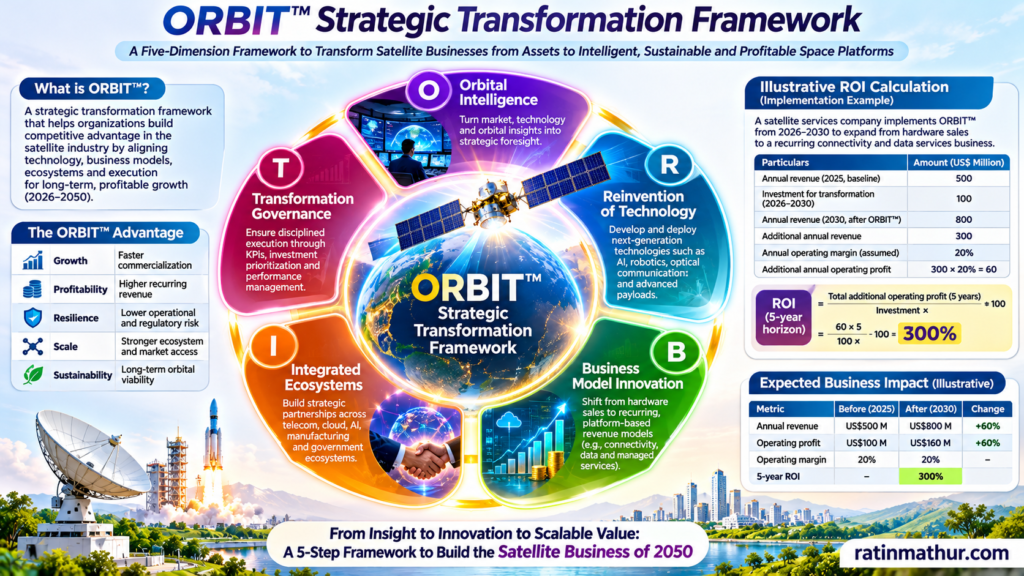
Consider an Indian satellite manufacturer that traditionally generates revenue through government and institutional spacecraft contracts. Applying ORBIT™, the company would first analyze demand for software-defined satellites and advanced Earth observation payloads. It would then invest in modular spacecraft architecture, AI-enabled operations and proprietary subsystems. Rather than relying exclusively on hardware contracts, it could introduce managed satellite services and data analytics partnerships. Collaboration with telecommunications providers, cloud companies and geospatial analytics businesses would expand its commercial reach. Finally, a transformation office would monitor R&D expenditure, product readiness, recurring revenue, customer acquisition and return on invested capital.
The framework encourages organizations to treat innovation as an integrated business transformation rather than an isolated research activity. It is particularly useful for established aerospace manufacturers, satellite operators and technology businesses seeking to enter new market segments.
15.2 SCOPE™ Space Value Creation Framework
The SCOPE™ Space Value Creation Framework identifies where economic value is generated, how it migrates across the satellite value chain and which positions offer the strongest opportunities for long-term profitability.
SCOPE™ comprises Satellite Infrastructure, Connectivity Networks, Operational Intelligence, Platform Economics and End-market Monetization.
| Dimension | Value-creation mechanism | Strategic question | Potential profit pool |
|---|---|---|---|
| S – Satellite Infrastructure | Manufacturing, payloads and orbital assets | Which physical capabilities are difficult to replicate? | Components and advanced hardware |
| C – Connectivity Networks | Broadband, D2D and optical communications | How can network capacity be monetized? | Connectivity subscriptions |
| O – Operational Intelligence | AI, autonomous control and analytics | How can data become more valuable? | AI software and intelligence |
| P – Platform Economics | Integrated satellite and digital ecosystems | How can recurring customer relationships be developed? | Software and managed services |
| E – End-market Monetization | Industry-specific applications | Which customer problems justify premium pricing? | Defense, insurance, agriculture and infrastructure |
The framework begins with the physical infrastructure that enables commercial activity but deliberately extends beyond hardware into connectivity, intelligence and platform economics. End-market Monetization ensures that strategic decisions are evaluated from the customer’s perspective rather than solely through technology performance.
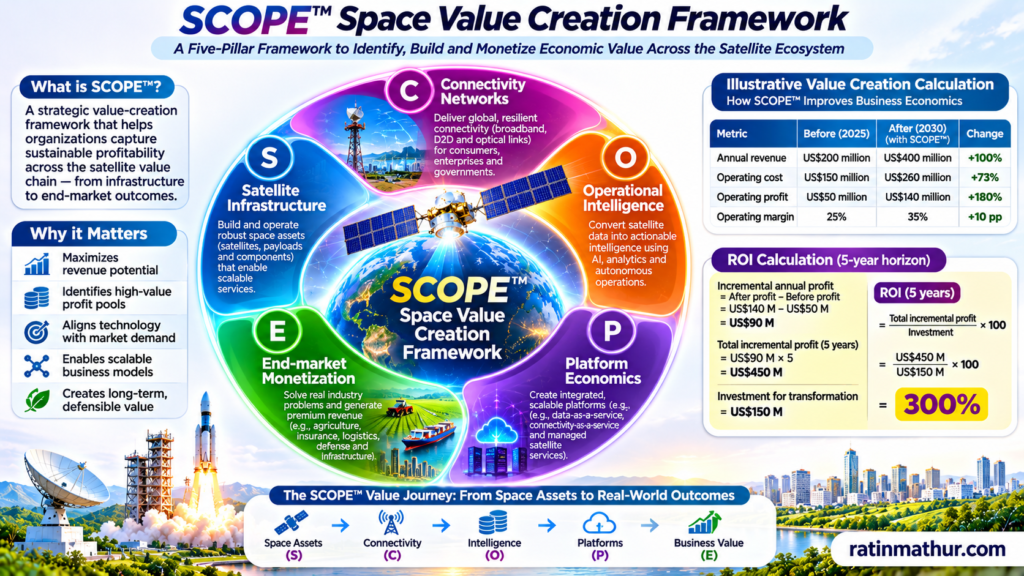
For example, an Earth observation company may initially generate revenue by licensing satellite imagery. Applying SCOPE™, it could develop AI-based infrastructure monitoring that detects changes in construction activity, industrial assets and environmental conditions. Its platform could provide insurers with risk intelligence, financial institutions with asset verification and governments with disaster monitoring. Instead of selling individual images, it could generate recurring subscription revenue from continuous monitoring and analytical services.
This approach creates a potentially stronger business model because the commercial proposition is linked to customer decisions and measurable outcomes rather than the underlying data product alone.
SCOPE™ also provides a framework for investors evaluating competing business models. A hardware manufacturer may possess excellent engineering capabilities but face price competition and capital-intensive operations. A specialized AI platform may offer recurring revenue and lower physical asset ownership requirements. The framework therefore encourages investment decisions based on differentiation, revenue quality, scalability, customer value and capital efficiency.
The principal recommendation is that companies should deliberately select their position in the value chain and build capabilities that allow them to capture a disproportionate share of the economic value generated by the satellite ecosystem.
15.3 SPACEWISE™ Strategic Resilience Framework
The SPACEWISE™ Strategic Resilience Framework addresses the uncertainty associated with technological disruption, orbital congestion, geopolitical competition, capital intensity and environmental sustainability.
Its central proposition is that long-term competitive advantage requires more than technological leadership. It requires the ability to anticipate disruption, protect critical assets, maintain operational continuity and adapt investment strategies as the industry evolves.
SPACEWISE™ comprises Strategic Foresight, Policy and Regulatory Readiness, Asset and Orbital Sustainability, Cybersecurity and Sovereignty, Ecosystem Resilience, Workforce and Capability Development, Investment Discipline, Scenario Adaptability and Execution and Performance.
| Dimension | Strategic priority | Illustrative management action |
|---|---|---|
| S – Strategic Foresight | Anticipate market and technology disruption | Monitor emerging technologies and competitor movements |
| P – Policy and Regulatory Readiness | Maintain regulatory compliance | Develop spectrum and licensing strategies |
| A – Asset and Orbital Sustainability | Protect orbital infrastructure | Adopt debris mitigation and end-of-life planning |
| C – Cybersecurity and Sovereignty | Protect critical assets | Implement secure communication architecture |
| E – Ecosystem Resilience | Reduce external dependencies | Diversify suppliers and launch providers |
| W – Workforce and Capability Development | Build future-ready expertise | Invest in AI, robotics and aerospace talent |
| I – Investment Discipline | Protect financial sustainability | Use phased investment and commercial validation |
| S – Scenario Adaptability | Prepare for alternative futures | Maintain best, base and worst-case plans |
| E – Execution and Performance | Translate strategy into measurable outcomes | Track financial, operational and sustainability KPIs |
The framework recognizes that satellite infrastructure is exposed to risks that conventional technology businesses may not encounter at the same scale. An operator can face simultaneous threats from cyberattacks, spectrum restrictions, supply-chain disruptions, launch delays and orbital collision risks. Resilience must therefore be embedded across technology, operations, governance and investment decisions.
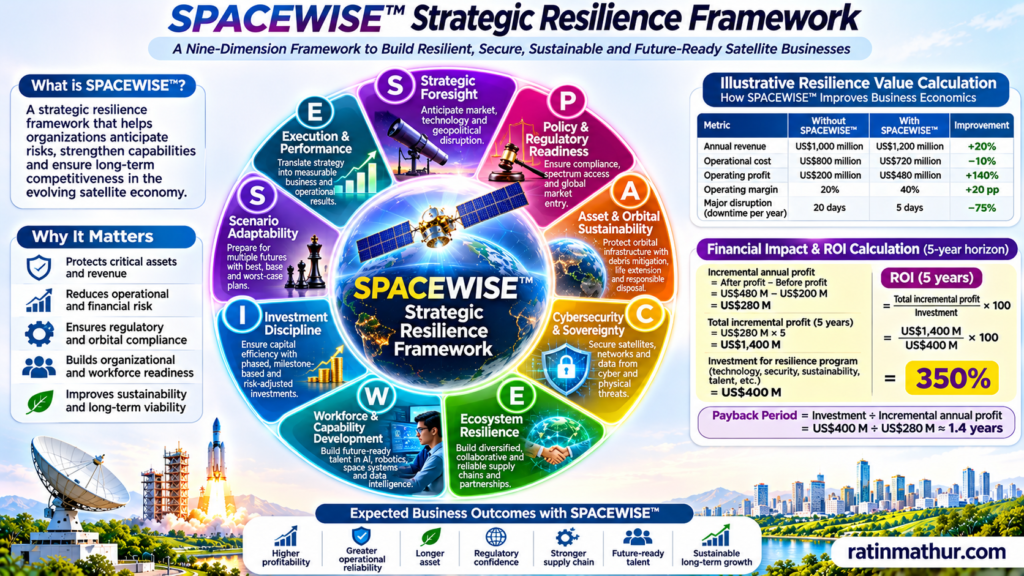
Consider a satellite broadband operator planning a large constellation. A conventional expansion strategy might prioritize deployment speed and customer acquisition. SPACEWISE™ requires a broader assessment of regulatory authorizations, orbital sustainability, cybersecurity, supplier concentration, capital requirements and alternative market scenarios. The operator could diversify launch providers, introduce autonomous collision avoidance, design satellites for responsible disposal and establish contingency arrangements for network disruptions.
Investment decisions would be staged against technical and commercial milestones. If direct-to-device adoption develops more slowly than anticipated, the operator could redirect capacity toward enterprise connectivity, maritime services or government customers.
SPACEWISE™ shifts resilience from a compliance function to a strategic source of competitive advantage. It enables organizations to protect capital, maintain customer trust and respond to disruption without abandoning long-term growth opportunities.
15.4 Integrated Application of the Three Frameworks
The three frameworks are designed to operate as a unified strategic management architecture rather than independent analytical models.
| Strategic requirement | ORBIT™ | SCOPE™ | SPACEWISE™ |
|---|---|---|---|
| Identify disruption | Market and technology intelligence | Value-chain analysis | Strategic foresight |
| Develop innovation | Technology reinvention | Intelligence and platform development | Capability resilience |
| Capture profit pools | Business model innovation | End-market monetization | Investment discipline |
| Build partnerships | Integrated ecosystems | Platform economics | Ecosystem resilience |
| Manage execution | Transformation governance | Revenue and value measurement | Scenario adaptability |
| Protect competitiveness | Organizational transformation | Defensible economic positioning | Sustainability and risk management |
A company entering the satellite industry could apply ORBIT™ to identify the transformation required, SCOPE™ to select the most attractive economic position and SPACEWISE™ to ensure that the strategy remains resilient under changing market, technological and regulatory conditions.
Together, these frameworks provide a pathway from industry foresight to strategic investment and implementation.
The framework names and marks are original proposed conceptual identifiers for this article. Their publication does not establish registered trademark ownership. Formal trademark searches, legal clearance and registration should be undertaken before commercial branding or licensing.
15.5 Overall Strategic Recommendations
The first recommendation is to prioritize technologies that combine strong market demand with defensible intellectual property. AI-enabled satellite operations, Earth intelligence, advanced payloads, optical communications and secure multi-orbit connectivity deserve particular attention.
The second recommendation is to move beyond hardware-centric business models. Companies should develop recurring revenue through managed services, connectivity platforms, software licensing and industry-specific intelligence.
The third recommendation is to develop resilient supply chains and strategic partnerships. Dependence on a single launch provider, component supplier, customer or jurisdiction can create significant operational risk.
The fourth recommendation is to embed sustainability and cybersecurity into product design. Responsible disposal, collision avoidance and secure communications should be treated as core commercial capabilities.
The fifth recommendation is to adopt disciplined investment strategies. Capital should be released against demonstrated technology maturity, customer demand and commercial milestones rather than speculative market assumptions.
The sixth recommendation is to develop international competitiveness through indigenous technology, manufacturing quality, regulatory readiness and export-oriented service delivery.
16. Future Outlook & Conclusion
By 2050, the satellite industry could become one of the most strategically significant components of the global infrastructure economy. Its evolution will be shaped by the convergence of AI, robotics, advanced communications, autonomous systems, semiconductor innovation and sophisticated data platforms.
The industry is likely to experience three fundamental transitions.
The first is the transition from individual satellites to interconnected constellations. Satellite infrastructure will increasingly operate as a coordinated network rather than a collection of isolated spacecraft.
The second is the transition from hardware to intelligent services. Software, analytics, connectivity and actionable intelligence could capture an increasing share of the economic value generated by orbital infrastructure.
The third is the transition from disposable spacecraft to serviceable and sustainable orbital infrastructure. Inspection, maintenance, mobility and debris management may become increasingly important as the number and economic value of orbital assets expand.
Three broad industry scenarios remain possible. An integrated space economy could emerge if launch economics improve, commercial networks scale and international sustainability cooperation strengthens. A more fragmented but commercially successful industry could develop if national ecosystems and regulatory regimes evolve independently. Alternatively, severe orbital congestion, geopolitical conflict and weak commercial returns could constrain industry expansion.
The most important strategic variable will be the ability to convert technological capability into sustainable economic value.
For businesses, the immediate priority is to identify where they can build defensible positions in the future value chain. For investors, it is to distinguish commercially viable innovation from speculative technology narratives. For governments, it is to establish regulatory certainty, strengthen national capabilities and enable responsible private-sector participation.
India has a particularly important opportunity. Its engineering ecosystem, industrial base, policy reforms and growing private-sector participation could support a much larger role in global satellite manufacturing, components, connectivity and intelligence services. However, realizing this potential will require a transition from cost-based competition toward intellectual property, technology leadership and globally competitive commercial platforms.
The future satellite industry will not be determined solely by the number of spacecraft launched, the size of constellations or the sophistication of individual missions. It will be determined by the economic value, strategic resilience and technological capabilities embedded within the orbital infrastructure ecosystem.
The organizations that succeed will be those that combine intelligent infrastructure, proprietary technology, trusted networks, valuable data and sustainable operations.
The strategic race for 2050 has already begun. The decisive question for businesses, investors and governments is whether they will remain participants in the emerging space economy or become architects of its next generation.
17. References
- European Space Agency. (2026). ESA space environment report 2026. https://www.esa.int/articles/esa-space-environment-report-2026
- Federal Communications Commission. (2022). Mitigation of orbital debris in the new space age: Second report and order (FCC 22-74). https://www.fcc.gov/document/fcc-adopts-new-5-year-rule-satellite-debris-disposal
- Government of India, Department for Promotion of Industry and Internal Trade. (2024). Press Note No. 1 (2024 Series): Review of foreign direct investment policy on space sector. https://www.dpiit.gov.in/static/uploads/2025/07/53ca8531250d55c237a49ab951567e97.pdf
- Government of India, Department of Space. (2023). Indian Space Policy 2023. https://www.mea.gov.in/Images/CPV/Indian-Space-Policy-2023-website-6.pdf
- Government of India, Press Information Bureau. (2026, April 2). Parliament question: Share in space economy. https://www.pib.gov.in/PressReleasePage.aspx?PRID=2248424&lang=1®=3
- Government of India, Press Information Bureau. (2026, August 12). Public-private partnership model for Earth observation satellite constellations. https://www.pib.gov.in/PressReleasePage.aspx?PRID=2298176&lang=1®=3
- International Telecommunication Union. (n.d.). Satellite regulation and coordination. https://www.itu.int/en/mediacentre/backgrounders/Pages/Regulation-of-Satellite-Systems.aspx
- McKinsey & Company, & World Economic Forum. (2024). Space: The $1.8 trillion opportunity for global economic growth. World Economic Forum. https://www.weforum.org/publications/space-the-1-8-trillion-opportunity-for-global-economic-growth/
- National Aeronautics and Space Administration. (2024, March 1). Update on status of NASA’s OSAM-1 project. https://www.nasa.gov/missions/update-on-status-of-nasas-osam-1-project/
- Organisation for Economic Co-operation and Development. (2026). The space economy at a glance 2026. OECD Publishing. https://www.oecd.org/en/publications/the-space-economy-at-a-glance-2026_cbf9b240-en.html
- Organisation for Economic Co-operation and Development. (2026). Strategic capabilities and competitiveness in the space economy. In The space economy at a glance 2026. OECD Publishing. https://www.oecd.org/en/publications/the-space-economy-at-a-glance-2026_cbf9b240-en/full-report/strategic-capabilities-and-competitiveness-in-the-space-economy_4d0bdf1c.html
- Organisation for Economic Co-operation and Development. (2026). Shifting market dynamics in the space economy: Concentration, diversification and value creation. In The space economy at a glance 2026. OECD Publishing. https://www.oecd.org/en/publications/the-space-economy-at-a-glance-2026_cbf9b240-en/full-report/shifting-market-dynamics-in-the-space-economy-concentration-diversification-and-value-creation_6d4bd29d.html
- Satellite Industry Association. (2026, May 13). Affordability and productivity drive historic satellite industry growth: Satellite Industry Association releases the 29th annual State of the Satellite Industry Report. https://sia.org/affordability-productivity-drive-historic-satellite-industry-growth-satellite-industry-association-releases-29th-annual-state-of-the-satellite-industry-report/
- United Nations Office for Outer Space Affairs. (2019). Guidelines for the long-term sustainability of outer space activities of the Committee on the Peaceful Uses of Outer Space. United Nations. https://www.unoosa.org/oosa/en/ourwork/topics/long-term-sustainability-of-outer-space-activities.html
- World Economic Forum. (2024). Space: The $1.8 trillion opportunity for global economic growth. https://www.weforum.org/reports/space-the-1-8-trillion-opportunity-for-global-economic-growth
18. Disclaimer
This article is intended for strategic research, industry analysis, educational and informational purposes. The assessments, interpretations, strategic recommendations and projections concerning the satellite industry through 2050 represent analytical perspectives based on publicly available information, institutional research and conditional scenarios.
The financial projections are illustrative modeling exercises and should not be interpreted as guaranteed market outcomes, independently verified forecasts, investment advice or financial recommendations. Actual industry developments will depend on technological maturity, commercial viability, geopolitical conditions, regulatory changes, capital availability, customer adoption and environmental constraints.
India’s space economy figures and future targets are based on government-reported estimates and policy ambitions. They should not be interpreted as guaranteed economic outcomes.
The ORBIT™, SCOPE™ and SPACEWISE™ frameworks are original conceptual frameworks proposed in this article for strategic analysis and discussion. The use of the ™ symbol identifies proposed framework names and does not establish registered trademark status or confer exclusive legal rights. Appropriate trademark searches, legal clearance and registration should be undertaken before commercial use, licensing or formal brand protection.
Third-party research, statistics, institutional publications and intellectual property remain the property of their respective authors and organizations and are acknowledged through the references. Market estimates may differ because of variations in scope, definitions, methodologies and reporting periods. Readers should consult the original publications for the latest verified information.
The views and strategic interpretations expressed in this article are analytical in nature and should not be construed as representing the official position of any government, space agency, company or international institution.