Why Startups and Corporates Must Shift from Revenue Maximisation to Sustainable Economic Value Creation
A Strategic Research Paper on Growth, Profitability, Financial Sustainability and Long-Term Shareholder Wealth

Executive Summary
The pursuit of growth has become one of the defining characteristics of modern entrepreneurship and corporate strategy. Startups raise substantial capital, enter new markets, acquire customers, expand distribution networks and pursue market leadership, often while reporting persistent operating losses, negative cash flows and increasing financial obligations. In many cases, investors continue to fund these businesses based on future market potential rather than demonstrated profitability. This has created an important strategic question: are companies building valuable enterprises, or merely building larger businesses at an increasingly higher financial cost?
Growth-first strategies are not inherently flawed. Amazon’s early expansion, Uber’s investment in platform development and the venture capital industry’s approach to technology businesses demonstrate that sacrificing short-term profitability can be economically justified when investment creates durable competitive advantages, network effects, operating leverage and future cash-generating capacity. However, the distinction between strategic investment and financial indiscipline is frequently overlooked.
Research published by McKinsey & Company (2021) establishes that revenue growth and economic-profit growth together provide a stronger explanation of shareholder returns than conventional earnings measures alone. Bessemer Venture Partners (2024), through its Rule of X framework, argues that efficient revenue growth can deserve greater valuation weight than free-cash-flow margin for certain late-stage cloud businesses. Conversely, research by JM Financial (2025) and Redseer (2026) highlights the increasing importance of profitability, operating maturity, capital efficiency and sustainable business economics in evaluating technology companies and new-age IPOs.
The fundamental issue is therefore not whether companies should prioritise growth or profitability. It is whether the growth being pursued generates attractive economic returns relative to the capital invested and risks undertaken.
This paper examines the structural reasons behind growth-first strategies, their implications for financial sustainability, their impact on listed-company shareholders and the changing expectations of investors. It proposes four proprietary strategic frameworks: the Growth-to-Value Gate™ Framework, the Capital Resilience and Runway™ Framework, the Incremental Return on Growth™ Framework and the Shareholder Value Alignment™ Framework.
The paper argues that businesses must transition from revenue-led expansion towards financially disciplined, capital-efficient and value-led growth. Growth should remain ambitious, but capital allocation must become increasingly accountable. Profitability should be sustainable, debt should remain manageable, cash generation should improve and incremental returns on capital should exceed the cost of capital.
Ultimately, the objective of corporate strategy should not be to maximise the size of the enterprise at any cost, but to maximise its long-term economic value.
1. Introduction
For decades, corporate success was conventionally associated with revenue growth, profitability, market share and shareholder returns. However, the emergence of venture-backed startups, technology platforms, digital marketplaces and new-age consumer businesses has significantly changed the traditional understanding of business growth.
Many modern companies deliberately pursue expansion before achieving profitability. Their strategies are based on acquiring customers, building networks, establishing market leadership, developing technology and securing competitive positions before competitors can replicate their business models.
The underlying economic argument is that early investment can create future advantages that are difficult to reproduce. A platform with millions of customers and a large supplier ecosystem may eventually benefit from network effects, stronger customer retention and lower incremental acquisition costs. A technology company may invest heavily in product development today to generate recurring revenues tomorrow.
Amazon’s 1997 shareholder letter provides an important illustration. Jeff Bezos explicitly prioritised long-term market leadership over short-term profitability, while also emphasising analytical evaluation of investments and discontinuation of programmes that failed to generate acceptable returns. Amazon’s philosophy was not unlimited expenditure; it was disciplined investment in an enduring economic franchise (Amazon.com, 1997).
This distinction is increasingly important because growth-first strategies are sometimes interpreted as justification for continuous losses, repeated fundraising, increasing debt and weak financial accountability.
The problem becomes particularly significant when a company continues expanding despite deteriorating unit economics, declining margins, poor cash conversion and insufficient returns on invested capital.
The central question is therefore whether management is investing in future economic value or simply financing present-day growth.
2. Problem Statement & Objectives
2.1 Problem Statement
An increasing number of startups and growth-oriented companies measure success through revenue growth, customer acquisition, market share, geographical expansion and valuation increases. However, these indicators do not necessarily establish whether the company is economically sustainable.
A company can increase revenue while operating losses expand. It can acquire millions of customers without generating sufficient customer lifetime contribution. It can report accounting profits while consuming substantial cash through working capital and capital expenditure. It can also increase borrowing to finance expansion without establishing a credible repayment capacity.
These circumstances create a structural disconnect between business growth and economic value creation.
The problem is further complicated when companies enter public markets. Public shareholders may invest based on growth expectations, while management continues to prioritise expansion over profitability. If the underlying economics fail to improve, shareholders can experience valuation compression, equity dilution, declining earnings visibility and potential capital impairment.
2.2 Research Objectives
| Objective | Strategic purpose |
|---|---|
| Examine growth-first behaviour | Understand why startups prioritise expansion over immediate profitability |
| Evaluate financial sustainability | Assess the implications of losses, debt and cash consumption |
| Examine shareholder consequences | Understand dilution, valuation risk and wealth destruction |
| Assess investment attractiveness | Identify conditions under which loss-making companies can remain attractive investments |
| Establish value-creation principles | Connect growth with ROIC, WACC and economic profit |
| Develop strategic frameworks | Provide practical tools for founders, boards and investors |
The overarching objective is to establish a corporate strategy model in which growth, profitability, cash generation, financial resilience and shareholder value operate as interconnected priorities.
3. Methodology
This paper adopts a qualitative, evidence-based strategic research methodology combining published institutional research, financial theory, regulatory documents, brokerage analysis, company disclosures and documented corporate experiences.
The research draws on McKinsey & Company’s corporate finance and economic-profit research, Bessemer Venture Partners’ Rule of X framework, JM Financial’s India SaaS thematic research, SEBI’s consultation paper on IPO pricing disclosures, Redseer’s India IPO research, Amazon’s original shareholder letter, Uber’s SEC filings and WeWork’s restructuring disclosures.
The methodology evaluates five dimensions of corporate performance: growth quality, operating profitability, cash-flow sustainability, capital efficiency and shareholder value creation.
The analysis also distinguishes between reported accounting profitability and economic profitability. EBITDA, net profit, operating cash flow and free cash flow are treated as different measures rather than interchangeable indicators.
The research is interpretative and strategic rather than a statistical causal study. Published findings are considered within their respective industry, geographical and methodological limitations. Brokerage research and proprietary consulting studies are treated as attributed research, not universal evidence.
4. Landscape Analysis
4.1 The Growth-First Business Model
The traditional corporate model generally emphasises profitability, retained earnings, capital efficiency and sustainable expansion. In contrast, many venture-backed startups follow a funding-led growth model in which equity capital is deployed to acquire customers, develop products, build distribution and capture market share.
| Traditional growth model | Venture-backed growth model |
|---|---|
| Growth funded substantially through internal cash generation | Growth frequently funded through external equity |
| Profitability is an important operating objective | Profitability may be a longer-term objective |
| Expansion follows demonstrated demand and cash generation | Expansion may precede demonstrated profitability |
| Capital allocation emphasises returns and payback | Capital allocation may prioritise market capture |
| Debt and liquidity are central financial considerations | Cash runway and fundraising access may dominate |
Neither model is universally superior. The appropriate approach depends on industry economics, competitive dynamics, company maturity and the cost of capital.
4.2 Why Companies Prioritise Growth
The growth-first philosophy is driven by several structural incentives.
| Driver | Management rationale | Potential risk |
|---|---|---|
| Network effects | Establish market leadership before competitors | Market share may not translate into pricing power |
| Venture capital expectations | Increase enterprise valuation | Management may optimise for fundraising |
| Customer acquisition | Build a large customer base | Acquired customers may not be profitable |
| Competitive pressure | Prevent competitors from capturing the market | Excessive discounting and expansion expenditure |
| Founder incentives | Increase long-term equity value | Incentives may favour valuation over economics |
| Technology investment | Build capabilities ahead of demand | Investment may not generate expected returns |
Growth can be economically rational when additional investment generates future recurring revenue, defensible capabilities and attractive incremental returns. It becomes questionable when management cannot demonstrate how expansion will eventually produce sustainable cash flows.
4.3 What Institutional Research Reveals
McKinsey & Company (2021), analysing more than 2,200 large global companies, concluded that economic-profit growth and revenue growth together provide a stronger explanation of total shareholder returns than earnings per share alone. The research reinforces the importance of generating returns above the cost of capital while continuing to grow the business.
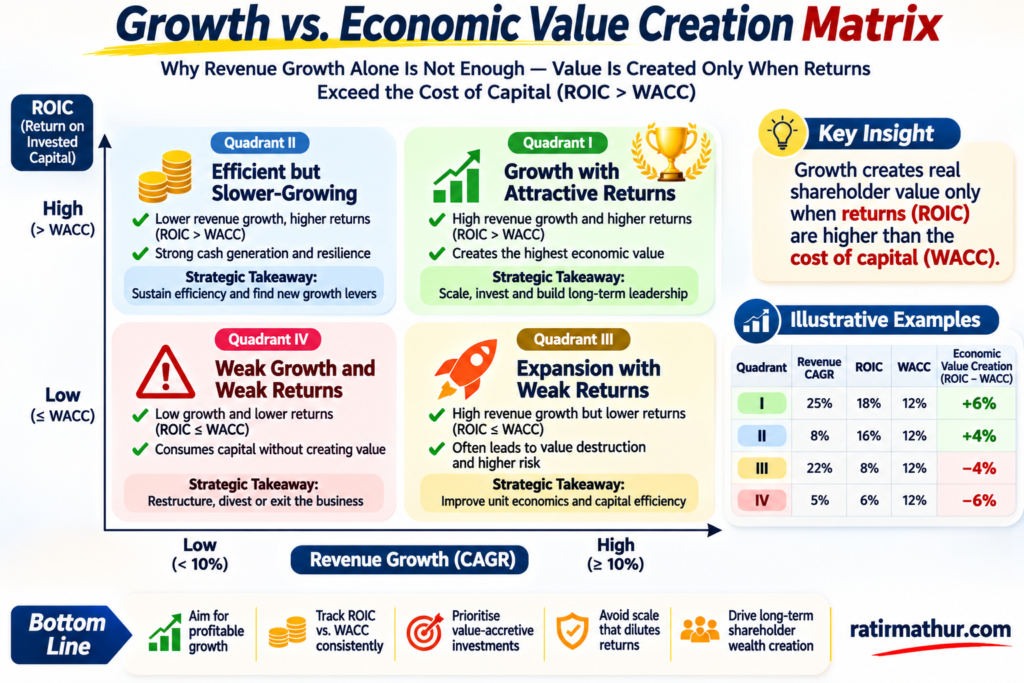
Bessemer Venture Partners (2024) introduced the Rule of X, which assigns greater importance to revenue growth relative to free-cash-flow margin for certain efficient, late-stage cloud businesses. However, the firm explicitly distinguishes early-stage businesses, where burn multiples, unit economics and the path to free-cash-flow positivity become particularly important. Its position is not that companies should ignore financial discipline, but that the appropriate growth-profitability balance depends on business maturity and economics.
JM Financial’s July 2025 report, India’s SaaS: Taking Wings, analysed approximately 250 Indian SaaS companies with at least US$10 million in annual recurring revenue. Its research estimated that this cohort generated more than US$15 billion in FY24 revenue, with collective EBITDA margins of approximately 6.5%. The report highlighted customer acquisition efficiency, retention, payback periods and free cash flow as important measures of business quality (JM Financial, 2025).
SEBI’s February 2022 consultation paper on IPO pricing disclosures recognised that new-age technology companies frequently remain loss-making for longer because they prioritise scale during their growth phase. It also highlighted the need for meaningful business KPIs and additional disclosures when conventional profitability-based valuation measures are insufficient (Securities and Exchange Board of India [SEBI], 2022). This was a consultation paper, not an endorsement of prolonged losses.
More recently, Redseer’s 2026 India IPO research reported that the proportion of profitable companies at listing among its new-age IPO cohorts increased from 50% in FY22 to 70% in FY26. It also reported a decline in median pre-IPO revenue growth from 50% to 33% across those cohorts. These findings suggest a shift towards greater emphasis on profitability and operating readiness, although they reflect Redseer’s proprietary sample and methodology (Redseer, 2026).
Collectively, these studies suggest that growth remains valuable, but investors increasingly require evidence that it can translate into sustainable operating economics.
4.4 Corporate Experiences: Growth, Investment and Financial Sustainability
Amazon demonstrates how long-term investment can create substantial economic value when accompanied by disciplined capital allocation. Its early strategy prioritised customer experience, infrastructure and market leadership while retaining the discipline to evaluate investment effectiveness.
Uber provides another illustration. Its 2023 SEC annual report showed revenue growth of 17%, operating income of US$1.11 billion, operating cash flow of US$3.585 billion and free cash flow of US$3.362 billion. Its reported net income of US$1.887 billion included a substantial unrealised investment revaluation gain, demonstrating why operating performance and accounting net income must be examined separately (Uber Technologies, Inc., 2024).
WeWork illustrates the opposite risk. The company commenced Chapter 11 restructuring proceedings in November 2023. Its SEC disclosures identified debt restructuring, financial obligations and lease rationalisation as central components of the restructuring. The case illustrates how ambitious expansion combined with significant fixed contractual commitments can create financial vulnerability when business economics and liquidity are insufficient (WeWork Inc., 2023).
These cases demonstrate that losses alone do not determine whether growth is strategically sound. The underlying quality of investment, contractual obligations, cash generation and eventual returns matter considerably more.
5. Key Findings
The research supports eight major findings.
| No. | Finding | Strategic implication |
|---|---|---|
| 1 | Growth can precede profitability without necessarily destroying value | Evaluate investment economics rather than losses alone |
| 2 | Revenue growth does not guarantee shareholder returns | Measure growth quality and valuation |
| 3 | Increasing losses without improving unit economics are a warning signal | Introduce investment milestones |
| 4 | Debt creates contractual financial obligations | Align borrowing with cash-flow capacity |
| 5 | Accounting profit does not necessarily translate into free cash flow | Monitor cash conversion and capital expenditure |
| 6 | ROIC relative to WACC is fundamental to economic value creation | Evaluate incremental returns |
| 7 | Management incentives influence capital allocation | Link compensation to sustainable performance |
| 8 | Public investors require transparent financial and operating KPIs | Improve disclosure and governance |
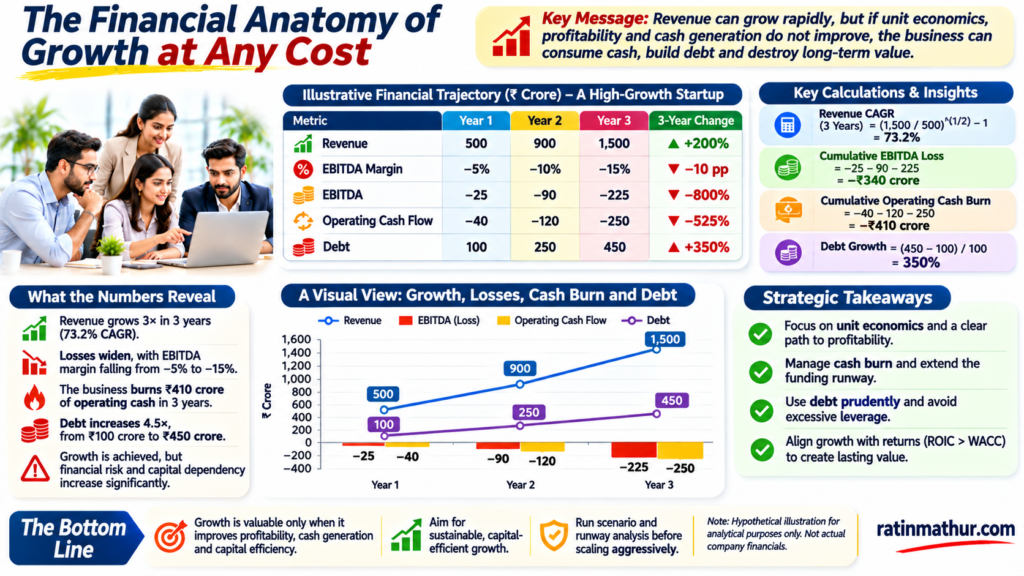
The most important finding is that a company can create substantial value while temporarily reporting losses, but only when those losses represent economically justified investments with a credible pathway to future returns.
Conversely, persistent losses accompanied by declining margins, weak cash conversion, rising financial obligations and repeated fundraising may indicate that growth is masking a structurally weak business model.
6. Challenges & Opportunities
6.1 The Challenge of Balancing Growth and Financial Discipline
Companies face a genuine strategic trade-off between investing in future opportunities and preserving current financial stability. Excessive cost reduction can weaken innovation, distribution and competitive positioning. Conversely, excessive expansion can create financial obligations that exceed the company’s capacity to generate cash.
The challenge is therefore not to minimise expenditure, but to distinguish productive investment from unproductive expenditure.
6.2 The Risk of Valuation-Led Management
When fundraising valuations become a primary management objective, companies may prioritise revenue growth and market share without sufficient consideration of profitability. This can result in capital allocation decisions designed to improve short-term investor perception rather than long-term enterprise economics.
6.3 The Shareholder Wealth Challenge
Public shareholders face valuation compression, dilution and uncertainty when a company repeatedly raises capital without demonstrating improving returns. Management must therefore establish a credible relationship between investment, operating performance and shareholder outcomes.
6.4 The Opportunity for Better Corporate Governance
Companies can address these challenges by introducing formal capital allocation policies, investment approval gates, financial resilience thresholds, management accountability and long-term performance incentives.
6.5 The Opportunity for Sustainable Competitive Advantage
Companies that combine customer value, operating efficiency, financial discipline and attractive capital returns can build more resilient competitive positions. Sustainable profitability can also reduce dependence on external capital, improve strategic flexibility and increase the capacity to invest during economic downturns.
7. Strategic Frameworks & Recommendations
The following four proprietary frameworks are proposed as practical management tools for founders, corporate promoters, investors, boards and conglomerates. They are designed to complement existing financial and strategic frameworks rather than replace established accounting, valuation or risk-management methodologies.
7.1 Growth-to-Value Gate™ Framework (GVG)
Purpose: Establish whether growth is creating economic value or merely increasing business scale.
The Growth-to-Value Gate™ Framework introduces a structured investment approval mechanism that evaluates growth opportunities across strategic attractiveness, commercial viability, financial feasibility and economic returns.
The central premise is that revenue growth should not be accepted as sufficient justification for investment. Every major expansion decision must demonstrate how the additional revenue will translate into contribution margin, operating profit, cash flow and long-term economic value.
The framework contains four sequential decision gates. The first gate assesses market attractiveness and strategic fit. The second evaluates customer demand, pricing power, retention and unit economics. The third assesses funding requirements, cash burn, debt obligations and liquidity. The fourth evaluates incremental ROIC, WACC, NPV and payback.
| Decision gate | Evaluation criteria | Approval requirement |
|---|---|---|
| Gate 1: Strategic attractiveness | Market size, competitive position, customer demand | Clear strategic justification |
| Gate 2: Commercial viability | Gross margin, contribution margin, CAC, retention | Demonstrable or credible improving unit economics |
| Gate 3: Financial feasibility | Capex, opex, cash burn, debt, liquidity | Adequate funding and downside resilience |
| Gate 4: Economic value | Incremental ROIC, WACC, NPV, payback | Credible long-term value creation |
Illustrative application: Consider a startup planning to invest ₹100 crore in geographical expansion. Management forecasts ₹150 crore in additional annual revenue. Under a conventional growth-oriented approval process, the revenue potential may be sufficient to justify the investment. Under the Growth-to-Value Gate™ Framework, the board would also examine contribution margins, customer acquisition costs, operating expenditure, working capital, capital employed and expected cash flows.
If the expansion produces an incremental ROIC of 18% against an assumed WACC of 12%, the investment may be economically attractive. If the expected incremental ROIC is only 7%, the board should reconsider the investment, reduce its scale or redesign the business model.
The framework also introduces a staged approval mechanism. Initial capital is released for a pilot, followed by additional investment only when commercial and financial milestones are achieved.
| Investment stage | Illustrative allocation | Performance milestone |
|---|---|---|
| Pilot | ₹15 crore | Product-market validation and positive contribution potential |
| Initial expansion | ₹25 crore | Customer retention and operating efficiency |
| Scale-up | ₹35 crore | Improving unit economics and credible payback |
| Final expansion | ₹25 crore | Demonstrable incremental returns and funding capacity |
| Total | ₹100 crore | Investment justified through measurable economics |
The allocation is illustrative and should be adjusted to the actual business model.
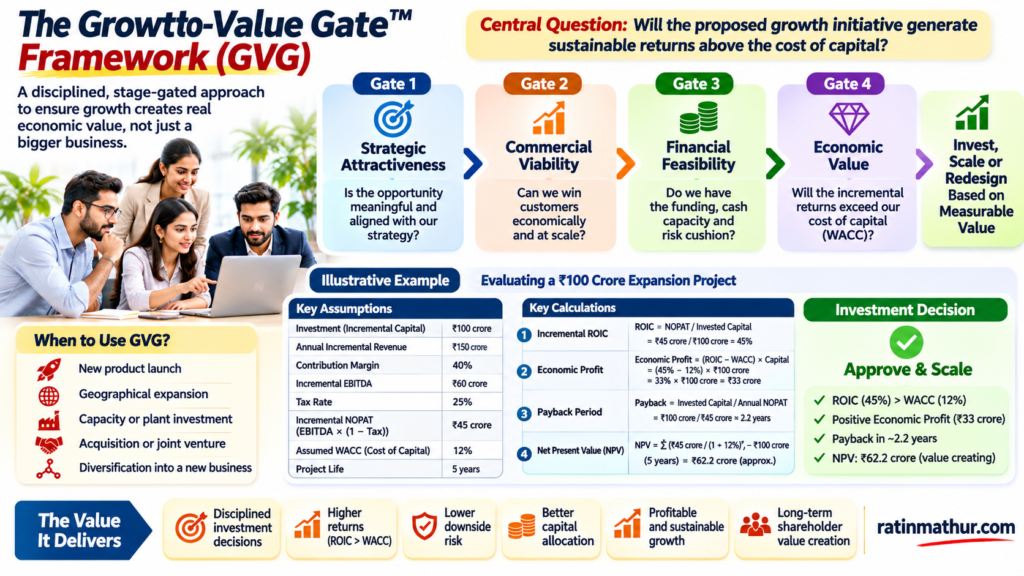
Strategic recommendation: Every company should institutionalise investment approval gates for new products, geographical expansion, acquisitions, manufacturing facilities and major technology investments. Revenue projections should never be considered independently of capital requirements, risk and expected economic returns.
7.2 Capital Resilience and Runway™ Framework (CRR)
Purpose: Ensure that growth ambitions never compromise the company’s ability to survive, service obligations and finance its operations.
The Capital Resilience and Runway™ Framework addresses a major weakness in growth-oriented businesses: management often focuses on revenue growth and fundraising while insufficiently examining cash runway, debt maturity, interest obligations and working capital.
The framework integrates liquidity planning, cash-flow forecasting, debt management, funding diversification and downside scenario analysis.
Its central proposition is that growth should be financed through a funding structure appropriate to the company’s business maturity and cash-generating capacity.
The framework distinguishes between equity-funded growth, debt-funded growth and internally funded growth. Equity may be suitable for uncertain early-stage investments, while debt is more appropriate when cash flows can support contractual repayment. Internally generated cash is generally the most sustainable source of expansion capital, provided reinvestment opportunities offer attractive returns.
| Capital resilience dimension | Key assessment | Management requirement |
|---|---|---|
| Cash runway | Available unrestricted cash relative to expected net cash burn | Maintain a credible funding horizon |
| Debt maturity | Principal repayment schedule | Avoid excessive refinancing concentration |
| Interest burden | Interest expense relative to cash earnings | Maintain debt-service capacity |
| Working capital | Receivables, inventory and payables | Prevent growth from creating excessive cash requirements |
| Funding concentration | Dependence on individual investors or lenders | Diversify funding sources |
| Downside resilience | Impact of revenue shortfalls and cost increases | Establish contingency funding plans |
Cash runway can be estimated as follows:
Cash Runway (months) = Available Unrestricted Cash / Average Monthly Net Cash Burn.
For example, a company with ₹240 crore in available cash and monthly net cash burn of ₹20 crore has an estimated runway of 12 months. This is a simplified measure and should be adjusted for committed capital expenditure, restricted cash, debt maturities and seasonal working capital.
The framework requires management to construct at least three financial scenarios.
| Scenario | Revenue assumption | Financial response |
|---|---|---|
| Bull case | Revenue exceeds plan | Invest selectively in attractive opportunities |
| Base case | Revenue broadly meets plan | Maintain approved expenditure and liquidity reserves |
| Bear case | Revenue is materially below plan | Reduce discretionary expenditure and activate funding contingencies |
Illustrative application: Consider a manufacturing startup with ₹500 crore in outstanding debt, ₹50 crore in annual interest obligations and uncertain operating cash flows. Management proposes a further ₹200 crore expansion investment.
Under the Capital Resilience and Runway™ Framework, the board would first evaluate the repayment schedule, interest coverage, working capital requirements, existing liquidity and downside operating scenarios. If the business cannot comfortably service its obligations under a realistic downside case, the expansion should be phased, financed through an appropriate equity partnership or deferred.
The framework does not recommend eliminating all debt. Debt can be a productive source of capital when its cost, maturity and repayment obligations are aligned with the company’s cash-generation capacity.
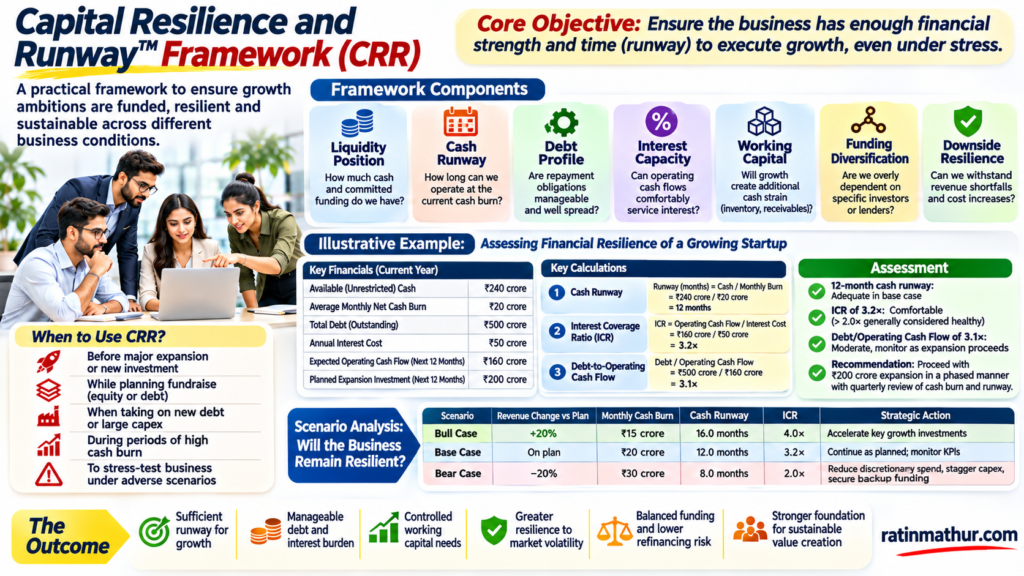
Strategic recommendation: Every growth-oriented company should maintain a board-approved capital resilience policy, including liquidity thresholds, debt-service limits, cash runway monitoring and predetermined management actions when financial thresholds are breached.
7.3 Incremental Return on Growth™ Framework (IRG)
Purpose: Determine whether each additional rupee invested is generating an attractive economic return.
The Incremental Return on Growth™ Framework moves capital allocation decisions beyond historical profitability towards the economics of incremental investment.
A company may have a profitable core business but destroy value through poorly selected expansion projects. Equally, a currently loss-making startup may create substantial future value if incremental investments generate progressively higher returns.
The framework evaluates the relationship between additional capital invested and additional operating returns generated.
Its central financial principle is:
Economic Profit = (ROIC − WACC) × Invested Capital.
The framework also examines incremental ROIC, which assesses the return generated by newly invested capital rather than the average return of the existing business.
| Evaluation dimension | Management question | Strategic implication |
|---|---|---|
| Incremental revenue | What additional revenue will the investment generate? | Establish genuine growth potential |
| Incremental EBITDA | What additional operating earnings will be created? | Evaluate operating leverage |
| Incremental cash flow | When will the investment generate cash? | Assess funding sustainability |
| Incremental capital employed | How much additional capital is required? | Measure investment intensity |
| Incremental ROIC | What operating return will additional capital generate? | Evaluate economic attractiveness |
| Payback and NPV | How quickly will capital be recovered and what is its present value? | Compare investment alternatives |
Illustrative application: Consider a retail company evaluating two expansion opportunities.
| Particulars | Project A | Project B |
|---|---|---|
| Additional capital employed | ₹100 crore | ₹100 crore |
| Incremental NOPAT | ₹20 crore | ₹8 crore |
| Incremental ROIC | 20% | 8% |
| Assumed WACC | 12% | 12% |
| Economic profit | ₹8 crore | -₹4 crore |
Project A creates positive economic profit, while Project B generates returns below the assumed cost of capital.
Although both projects may increase revenue, they do not create equal economic value.
The framework also introduces a portfolio-level capital allocation approach. Investments are classified according to their strategic fit, risk-adjusted returns, capital intensity and time to value creation. Capital is preferentially allocated to opportunities with attractive incremental economics, while investments with persistently negative returns are redesigned, reduced or exited.
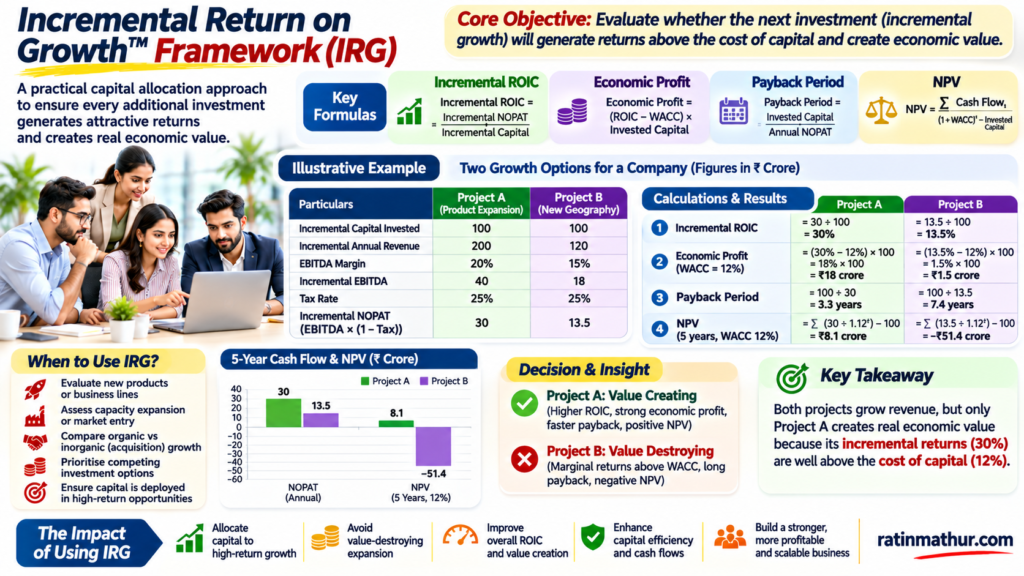
Strategic recommendation: Boards should require major business divisions to report incremental ROIC and economic profit alongside revenue growth and EBITDA. Expansion should be justified through future economic returns rather than market-share targets alone.
7.4 Shareholder Value Alignment™ Framework (SVA)
Purpose: Align founders, professional management, boards and investors around sustainable long-term enterprise value.
The Shareholder Value Alignment™ Framework addresses the governance and incentive problems associated with growth-first management philosophies.
In many companies, executive performance is measured primarily through revenue growth, customer acquisition, market share and valuation. Such metrics can encourage management to pursue aggressive expansion without sufficient accountability for capital efficiency, profitability or cash generation.
The framework proposes a balanced performance architecture that connects management compensation, investment decisions, financial reporting and shareholder outcomes.
| Performance dimension | Suggested weight | Principal measurement |
|---|---|---|
| Sustainable revenue growth | 15% | Organic and recurring revenue growth |
| Operating profitability | 20% | Contribution margin and EBITDA progression |
| Cash generation | 20% | Operating cash flow and free cash flow |
| Capital efficiency | 20% | ROIC and economic profit |
| Financial resilience | 15% | Debt, liquidity and funding runway |
| Governance and accountability | 10% | Capital allocation performance and transparency |
| Total | 100% | Balanced management performance |
These weightings are illustrative and should be adjusted for business maturity and industry economics. Early-stage startups may appropriately place greater emphasis on product-market validation and customer economics, while mature listed companies should assign greater importance to cash generation, capital returns and shareholder outcomes.
Illustrative application: Consider a listed company whose CEO receives an annual performance bonus based primarily on achieving 40% revenue growth. Management may pursue aggressive discounts, acquisitions and geographical expansion to meet the target.
Under the Shareholder Value Alignment™ Framework, the CEO’s performance would also depend on incremental profitability, free cash flow, ROIC, liquidity and the economic returns generated by expansion investments.
A company achieving 40% growth with declining cash flow and deteriorating returns would not automatically receive the same management performance assessment as a company achieving 20% growth with improving margins, cash generation and capital efficiency.
The framework also introduces multi-year performance measurement. Executive incentives should incorporate performance over three to five years, subject to appropriate vesting, risk adjustment and clawback arrangements. This reduces the incentive to maximise short-term financial metrics at the expense of sustainable enterprise value.

Strategic recommendation: Corporate boards should redesign executive compensation, investor disclosures and management scorecards around long-term economic performance. Promoters and professional management should be accountable not merely for the amount of capital raised or revenue generated, but for the quality of capital deployment and value created for shareholders.
7.5 Integrated Implementation of the Four Frameworks
The four frameworks should operate as a connected management system rather than independent analytical tools.
| Framework | Primary responsibility | Key management outcome |
|---|---|---|
| Growth-to-Value Gate™ | Evaluate growth opportunities | Approve economically justified investments |
| Capital Resilience and Runway™ | Protect financial sustainability | Maintain liquidity and debt-service capacity |
| Incremental Return on Growth™ | Optimise capital allocation | Improve incremental economic returns |
| Shareholder Value Alignment™ | Strengthen governance and accountability | Align management with long-term shareholder wealth |
Together, they create a closed-loop corporate management process. Growth opportunities are evaluated before capital is committed, funding resilience is assessed before expansion, incremental returns are monitored after investment and management performance is measured against sustainable economic outcomes.
The combined objective is to transform growth from a revenue-maximisation exercise into a disciplined enterprise-value creation process.
8. Future Outlook & Conclusion
The next phase of corporate growth will increasingly be defined by the quality of capital allocation rather than the sheer speed of expansion.
Technology, artificial intelligence, digital platforms, consumer businesses and new manufacturing ventures will continue to create significant opportunities for entrepreneurs and investors. Many of these businesses will require substantial upfront investment before achieving profitability. Therefore, it would be strategically incorrect to demand immediate profitability from every startup.
However, the tolerance for losses must be accompanied by measurable progress. Management must demonstrate improving unit economics, credible customer economics, operating leverage, financial resilience and an increasingly attractive return on incremental capital.
Public-market investors are also likely to scrutinise the sustainability of growth more carefully. Revenue expansion, customer acquisition and market leadership will remain relevant, but their investment significance will depend increasingly on the company’s ability to convert them into cash flows and economic returns.
The distinction between temporary investment losses and structural financial weakness must become central to corporate governance.
For founders, the priority should be building a defensible business model rather than continuously pursuing higher valuations. For corporate promoters, it should be profitable diversification and disciplined capital allocation. For professional management, it should be accountability for the returns generated by the capital entrusted to them. For investors, it should be evaluating business quality and valuation together rather than treating growth as a sufficient investment thesis.
The four proprietary frameworks proposed in this paper provide a practical foundation for implementing this philosophy. Their combined application can help companies assess growth opportunities, protect financial resilience, improve capital efficiency and align management incentives with long-term shareholder value.
The ultimate principle is straightforward: growth should not be abandoned, but it must be earned through sound economics.
A company should not be judged merely by how quickly it grows, how much revenue it generates or how much capital it raises. It should be judged by the strength of its business model, its ability to generate sustainable cash flows, its financial resilience and the economic returns it creates from the capital invested.
The future belongs not necessarily to the companies that grow the fastest, but to those that convert growth into enduring economic value.
References
- Amazon.com, Inc. (1997). 1997 letter to shareholders. https://www.aboutamazon.com/news/company-news/amazons-original-1997-letter-to-shareholders
- Bessemer Venture Partners. (2024, January 2). The Rule of X: The proper way cloud leaders should think about the growth vs. profit tradeoff. https://www.bvp.com/atlas/the-rule-of-x
- Damodaran, A. (2012). Investment valuation: Tools and techniques for determining the value of any asset (3rd ed.). John Wiley & Sons. https://www.wiley.com/en-us/Investment+Valuation%3A+Tools+and+Techniques+for+Determining+the+Value+of+Any+Asset%2C+3rd+Edition-p-9781118011522
- Jensen, M. C. (1986). Agency costs of free cash flow, corporate finance, and takeovers. The American Economic Review, 76(2), 323–329. https://www.jstor.org/stable/1818789
- JM Financial Institutional Securities Limited. (2025, July 18). India’s SaaS: Taking wings [Thematic research report]. https://jmflresearch.com/JMnew/JMCRM/analystreports/pdf/SaaS_18July25.pdf
- Koller, T., Goedhart, M., & Wessels, D. (2020). Valuation: Measuring and managing the value of companies (7th ed.). John Wiley & Sons. https://www.wiley.com/en-us/Valuation%3A+Measuring+and+Managing+the+Value+of+Companies%2C+7th+Edition-p-9781119611868
- McKinsey & Company. (2021, October 19). Which metrics really drive total returns to shareholders? https://www.mckinsey.com/capabilities/strategy-and-corporate-finance/our-insights/which-metrics-really-drive-total-returns-to-shareholders
- McKinsey & Company. (2025, September 4). Global economic profit bounces back to an all-time high. https://www.mckinsey.com/capabilities/strategy-and-corporate-finance/our-insights/global-economic-profit-bounces-back-to-an-all-time-high
- Myers, S. C. (1984). The capital structure puzzle. The Journal of Finance, 39(3), 574–592. https://doi.org/10.1111/j.1540-6261.1984.tb03646.x
- Redseer Strategy Consultants. (2026). Redseer India IPO report: New-age IPO market insights. https://redseer.com/reports/redseer-india-ipo-report-2026/
- Securities and Exchange Board of India. (2022, February 18). Consultation paper on disclosures for ‘Basis of Issue Price’ section in offer document under SEBI (Issue of Capital and Disclosure Requirements) Regulations, 2018. https://www.sebi.gov.in/reports-and-statistics/reports/feb-2022/consultation-paper-on-disclosures-for-basis-of-issue-price-section-in-offer-document-under-sebi-issue-of-capital-and-disclosure-requirements-regulations-2018_56218.html
- Uber Technologies, Inc. (2024). Annual report 2023 (Form 10-K). U.S. Securities and Exchange Commission. https://www.sec.gov/Archives/edgar/data/1543151/000154315124000012/uber-20231231.htm
- WeWork Inc. (2023, November 6). Current report (Form 8-K): Chapter 11 proceedings and restructuring support agreement. U.S. Securities and Exchange Commission. https://www.sec.gov/Archives/edgar/data/1813756/000119312523271902/d522028d8k.htm
- WeWork Inc. (2023). Quarterly report (Form 10-Q), quarter ended September 30, 2023. U.S. Securities and Exchange Commission. https://www.sec.gov/Archives/edgar/data/1813756/000181375623000067/wework2023q310q.htm
Disclaimer
This paper is intended for general educational, research and strategic management purposes. It presents an independent analytical perspective on corporate growth, financial sustainability, capital allocation and shareholder value creation. The four frameworks introduced in this paper are proposed proprietary strategic methodologies and are not established regulatory, accounting or valuation standards. Their names and underlying methodologies should be independently reviewed for intellectual property and trademark availability before commercial registration or formal use.
Published research findings are attributed to their respective institutions and should be interpreted within their original scope, sample sizes, assumptions and methodologies. The views and recommendations expressed in this paper are strategic interpretations and do not necessarily represent the views of the cited institutions or companies.
The discussion does not constitute investment advice, a recommendation to purchase or sell securities, a credit assessment or a prediction of future company performance. Actual investment decisions require independent due diligence, current financial information, valuation analysis and consideration of individual risk circumstances.
The author makes no representation or warranty regarding the completeness or future accuracy of the information presented. Readers should consult qualified financial, legal, tax and investment professionals before making material business or investment decisions.