A Strategic Case For Next-Generation Tire Materials That Deliver Conventional Strength And Durability With A Lower Environmental Footprint
Executive Summary
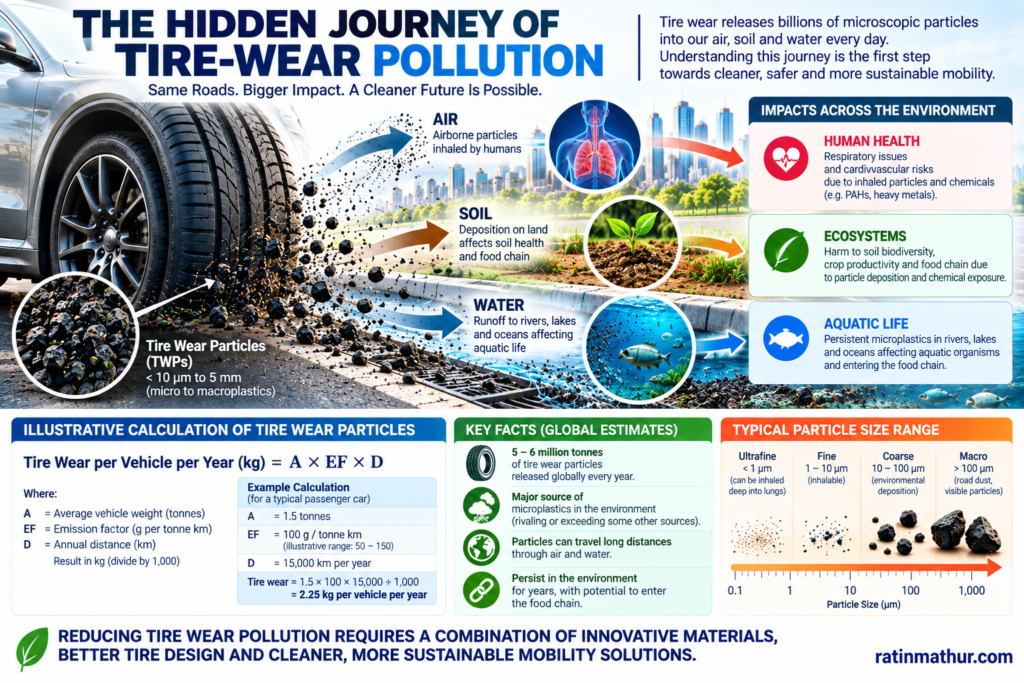
The tire industry stands at an important technological crossroads. Tires are indispensable to mobility, industrial productivity, agriculture, logistics, and aviation. Yet the materials that make tires strong, flexible, durable, and capable of maintaining contact with the road also create an environmental challenge that extends beyond manufacturing and disposal. During operation, tire tread wears and releases particles containing tire-derived materials, road debris, and associated chemical constituents into the surrounding environment. Conventional tire recycling and sustainable sourcing initiatives address important parts of the problem, but they do not eliminate pollution generated throughout a tire’s operating life.
Scientific literature has increasingly examined tire-wear particles, their chemical releases, environmental fate, and potential ecological and health effects. A comprehensive review by Yoganandham et al. (2024) highlights the complexity of tire-wear particles and their associated contaminants, including the possibility that transformation products may have different or greater toxicity than their parent compounds [1]. Research has also demonstrated that the environmental persistence of tire-tread particles cannot be assumed away through general claims of biodegradability. Nielsen et al. (2024), for example, measured limited biodegradation of ground tire-tread particles in a controlled 28-day laboratory test [2]. These findings strengthen the case for addressing environmental performance at the material-design stage.
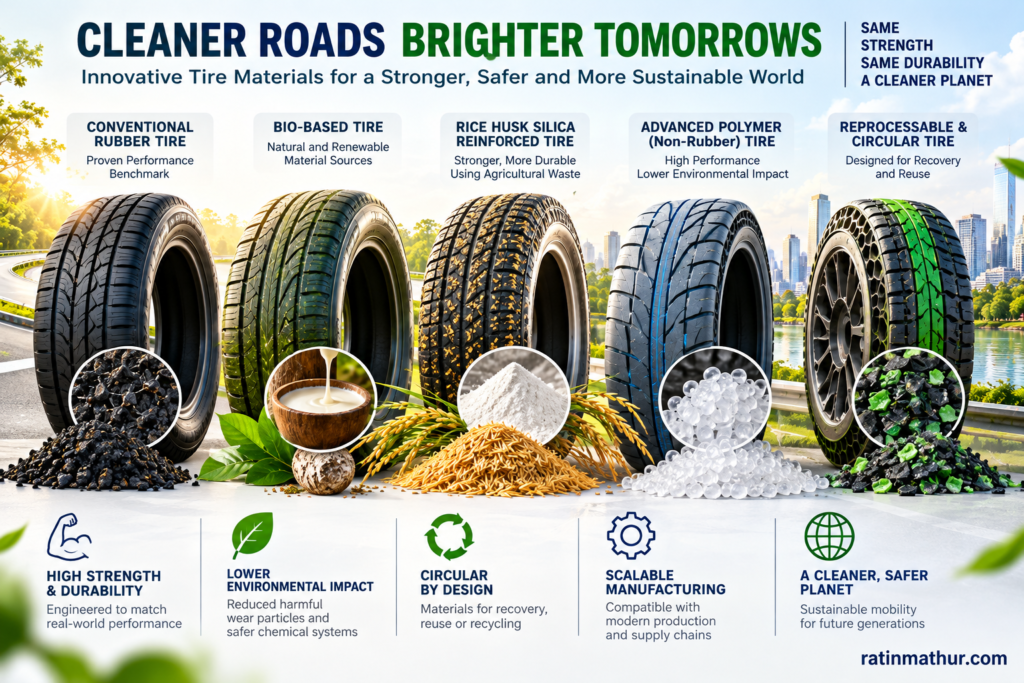
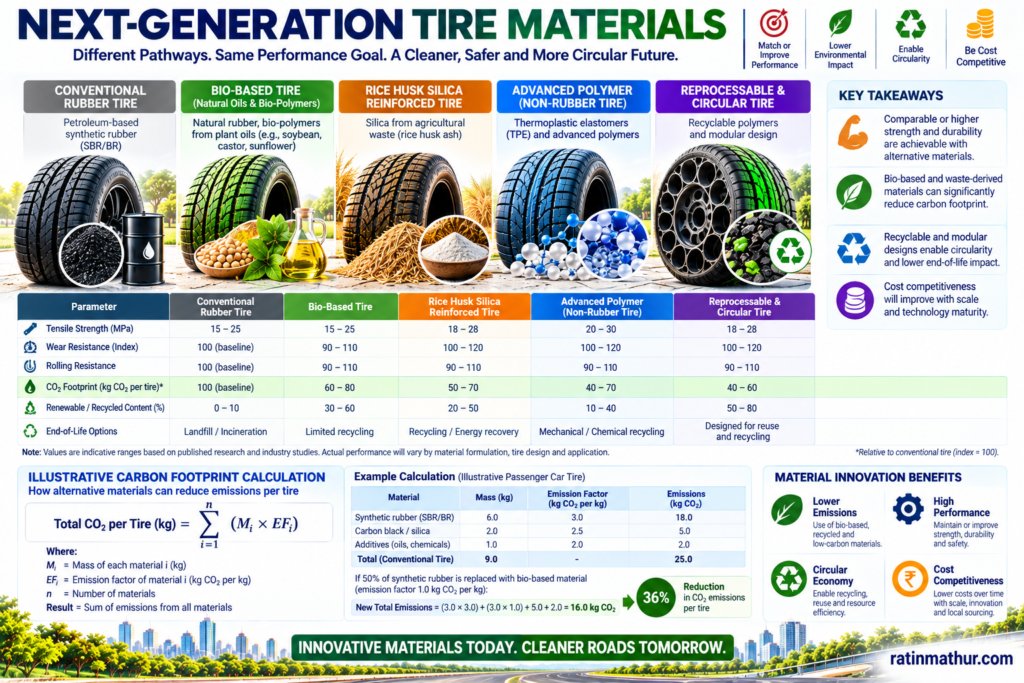
The strategic opportunity is to move beyond incremental improvements in conventional tire formulations and investigate whether next-generation materials can deliver equivalent or better mechanical strength, durability, traction, thermal stability, and safety while materially reducing harmful environmental impacts. Candidate research pathways include advanced elastomers, thermoplastic polymers, reprocessable polymer networks, bio-derived reinforcing materials, safer chemical systems, and hybrid material architectures. Structural innovation, including replaceable contact surfaces and non-pneumatic designs, may complement material research, although these approaches do not automatically eliminate tire wear or pollution.
This article proposes that tire manufacturers make environmentally superior, performance-equivalent materials a deliberate research and development priority. It presents four original strategic frameworks to guide material selection, pollution measurement, innovation portfolio management, and Board oversight. The central recommendation is to establish a long-term, evidence-led research programme that treats safety as a non-negotiable requirement and measures environmental improvement across the complete product life cycle.
The objective is not to assume that a universal rubber-free tire already exists. It is to challenge the industry to investigate whether the next generation of tire materials can preserve the performance on which mobility depends while significantly reducing the environmental burden associated with delivering that performance.
Introduction
The modern tire is an advanced engineered composite rather than a simple rubber product. It combines elastomers, reinforcing fillers, steel or textile reinforcement, processing oils, stabilizers, curing systems, and other functional additives. These components collectively determine tensile strength, elasticity, abrasion resistance, heat management, traction, fatigue life, rolling resistance, and structural integrity. Any material innovation must therefore address a complex combination of interacting properties rather than replace rubber based on a single characteristic.
For more than a century, tire development has focused on making this engineered system safer, more durable, more efficient, and more economical. These objectives remain essential. However, environmental performance now requires a broader definition of product quality. A tire must not only perform effectively during use; its material inputs, wear emissions, chemical releases, energy requirements, and end-of-life pathways must also be considered.
The environmental challenge is not limited to the origin of the rubber. Natural rubber sourcing can raise questions about land use, biodiversity, traceability, and agricultural resilience, while synthetic polymers and processing chemicals can create separate resource and environmental concerns. The industry must consequently consider both the sustainability of the supply chain and the environmental behaviour of the finished product.
The distinction is important. A tire containing more renewable material is not necessarily less polluting during use. A tire made from recycled feedstock may still generate persistent particles. A tire that loses less mass during abrasion may still release a more concerning chemical mixture. Likewise, a material described as biodegradable may not degrade sufficiently under real environmental conditions, and its degradation products may require separate assessment.
The next stage of tire innovation should therefore be defined by a more demanding question: can the industry develop materials that deliver the mechanical performance of conventional tire compounds while reducing the harmful consequences of wear and improving the environmental profile of the entire product system?
This is a strategic research question for corporate Boards, not merely a formulation problem for laboratory chemists. It concerns future product differentiation, research investment, intellectual property, supply-chain resilience, regulatory preparedness, environmental credibility, and long-term competitiveness.
Problem Statement & Objectives
The central problem is that conventional tire technology has been optimized primarily around safety, performance, durability, manufacturability, and cost, while the environmental consequences of tire wear and associated chemical releases require further innovation. Current sustainability initiatives can reduce specific impacts, but they do not establish that the fundamental material system has reached its environmental limits or that a superior alternative is impossible.
The objective should not be to eliminate rubber regardless of consequences. Rubber has valuable properties, including elasticity, resilience, tear resistance, and fatigue performance. A replacement material that compromises braking, handling, load capacity, or service life would not constitute meaningful progress. The objective is to identify and validate a material system that matches or improves the required performance while demonstrating a lower environmental footprint under comparable operating conditions.
The research challenge can be framed through five connected objectives.
| Objective | Strategic question | Evidence required |
|---|---|---|
| Performance equivalence | Can an alternative material match the strength, durability, traction, fatigue resistance, and thermal performance of the reference tire? | Comparative laboratory and application-specific testing |
| Pollution reduction | Can the material reduce harmful wear particles or associated chemical releases? | Wear measurements, particle characterization, leachate analysis, and relevant toxicity testing |
| Life-cycle improvement | Does the candidate reduce total environmental impact rather than shifting it to manufacturing or disposal? | Comparative life-cycle assessment |
| Industrial feasibility | Can the material be processed consistently, manufactured at scale, and supplied at competitive cost? | Manufacturing trials, quality specifications, supply-chain assessment, and cost modelling |
| Strategic defensibility | Can the resulting technology provide a differentiated, protectable, and commercially relevant advantage? | Patent landscape, intellectual-property analysis, and customer validation |
The research should cover two complementary dimensions. The first is material innovation, which investigates alternatives to existing tread polymers, fillers, additives, and associated compounds. The second is structural innovation, which investigates whether reusable support structures, replaceable contact surfaces, or other architectures can reduce material consumption and improve circularity. These dimensions should initially be evaluated separately so that the contribution of each can be measured.
The intended outcome is a validated research pathway, not a predetermined commercial product. If no candidate achieves the required combination of performance and environmental benefit, the programme should identify the limitations and redirect its research rather than weaken safety requirements.
Methodology
This article uses a structured desk-based synthesis of peer-reviewed reviews, experimental research, international testing standards, and published work on alternative tire architectures. It is intended as a strategic research paper for corporate decision-makers, not as a systematic review, experimental study, or legal opinion. The proposed frameworks are original decision-making constructs developed for this article and should be validated before use in formal corporate investment processes.
The evidence is classified into three broad categories. Established engineering knowledge concerns the functional requirements of tire materials and the need to balance strength, wear, traction, heat, and durability. Emerging research concerns alternative polymers, bio-derived additives, non-pneumatic architectures, and improved environmental characterization. Strategic hypotheses concern whether particular combinations of these approaches can achieve equivalent performance with lower environmental impact. These hypotheses require experimental validation before they can support product claims.
The analysis evaluates candidate technologies against six dimensions: mechanical performance, wear-particle generation, chemical and ecological risk, life-cycle impact, circularity, and manufacturing feasibility. It also distinguishes replacing a tire’s primary elastomer from replacing selected ingredients or redesigning the wheel structure. This distinction is necessary because much of the current bio-derived materials literature focuses on additives and reinforcing fillers rather than complete replacement of the tire’s elastomeric matrix.
The research uses the conventional tire as the reference point. Any claimed improvement must be measured against a functionally equivalent product under comparable conditions. The relevant unit of comparison could be a vehicle-kilometre, operating hour, load carried, or another defined service unit appropriate to the application. This prevents a material from appearing environmentally superior simply because it contains more renewable ingredients or has a lower manufacturing footprint per kilogram.
The analysis does not assume that a candidate material is safer because it is natural, recycled, recyclable, or biodegradable. It also does not assume that non-pneumatic architecture is inherently pollution-free. The proposed research direction is therefore technology-neutral: the best candidate is the one that demonstrates the required performance and a measurable, credible reduction in total environmental harm.
Landscape Analysis
The Environmental Challenge Extends Beyond End-Of-Life Waste
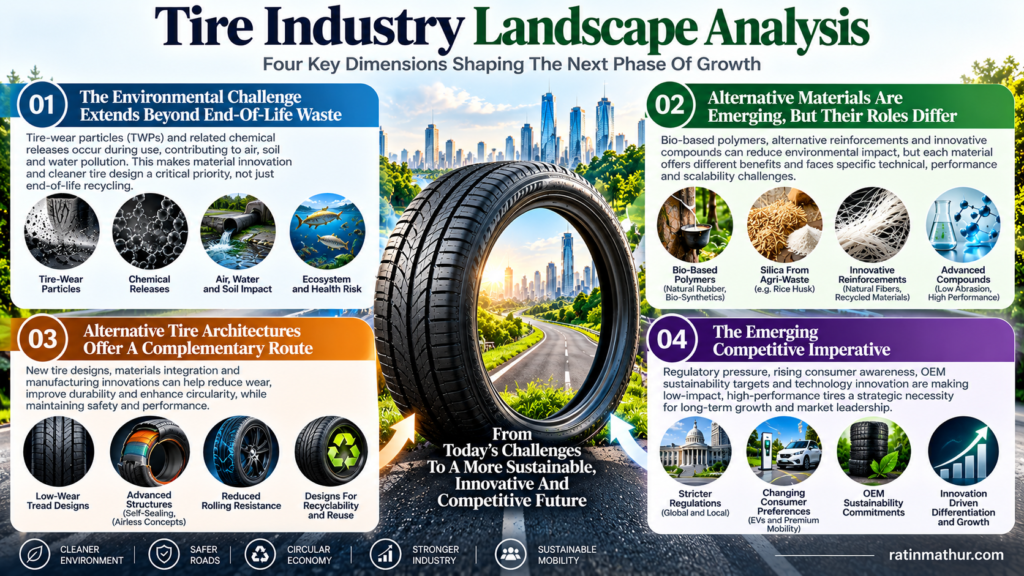
Tire-wear particles are generated through the interaction between tire tread and the road surface. Their characteristics depend on material formulation, vehicle loading, driving behaviour, road texture, temperature, moisture, and other operating conditions. These particles can enter air, soil, and water systems, while associated chemicals may leach or transform after release. Yoganandham et al. (2024) emphasize that the risks cannot be understood solely by measuring particle mass because particle composition, transformation, and chemical interactions also matter [1].
The scale of tire-wear emissions is significant, although estimates vary with the definition of tire-wear particles, the inclusion of road-derived material, the geographical area, and the modelling method. Ospital et al. (2025) developed a regionalized life-cycle inventory model that incorporates factors such as road texture, driving behaviour, load, speed, and environmental conditions. Their work highlights the importance of context-specific emission estimates and the uncertainty associated with incomplete data [3]. For manufacturers, this means that material performance must be evaluated through standardized, reproducible testing and then interpreted against realistic operating conditions.
Recent research is moving from identifying tire-wear pollution toward developing life-cycle mitigation strategies. Liao et al. (2026) reviewed measures covering tire manufacturing, vehicle operation, particle capture, and environmental management. Their analysis reinforces the importance of addressing particle generation and associated chemical releases at source, while recognizing the role of operational and downstream interventions [4]. For tire manufacturers, material design is therefore a particularly important point of intervention because it can influence the composition, durability, and wear behaviour of the product before it reaches the road.
Alternative Materials Are Emerging, But Their Roles Differ
Research into sustainable tire materials is expanding, but the candidate technologies serve different purposes. Some may replace a portion of a conventional filler. Others may improve processing, reduce dependence on petroleum-derived additives, or provide a new structural material. A much smaller and more technically demanding question is whether an alternative elastomeric system can replace the primary tread material while matching the performance of conventional tires.
Bardha et al. (2024) reviewed waste biomass-derived additives for rubber composites and found that agricultural and other biological waste streams offer potential sources of reinforcing fillers, processing aids, and protective additives. However, the review also identified gaps in areas such as fully bio-derived cross-linking systems and comprehensive formulations [5]. The implication is clear: agricultural waste can be a valuable research input, but its presence in a compound does not demonstrate that the tire’s principal elastomer has been replaced or that pollution has been reduced.
Rice-husk-derived silica, selected biochars, lignocellulosic fibres, and other waste-derived materials warrant investigation where their chemistry and physical properties match a defined technical requirement. Each candidate must be assessed for consistency, processing energy, contaminants, mechanical performance, durability, and environmental consequences. A low-cost waste feedstock can become an expensive or environmentally inferior ingredient if it requires intensive purification, special processing, frequent replacement, or additional hazardous chemicals.
Alternative Tire Architectures Offer A Complementary Route
Material innovation need not operate in isolation. Non-pneumatic tire research explores structures that replace the conventional pressurized air cavity with engineered support systems. Deng et al. (2023) reviewed developments in non-pneumatic tire structures, materials, mechanical behaviour, manufacturing, and performance optimization [6]. Sun et al. (2024) further reviewed material and processing options for these designs [7].
These technologies demonstrate that the architecture of the tire can be reimagined, but they also expose important challenges. Load capacity, fatigue, vibration, heat generation, durability, noise, cost, and manufacturing consistency remain critical. An airless tire can still use conventional rubber in its tread and may still produce tire-wear particles. Structural innovation should therefore be considered a complementary pathway, not a substitute for environmental material research.
The Emerging Competitive Imperative
The strategic landscape is shifting from a narrow focus on sustainable inputs toward broader questions of product-life environmental performance. Manufacturers that invest only in sourcing improvements or recycling may continue to make progress, but they could miss opportunities to develop fundamentally differentiated material technologies.
This does not mean that conventional tire compounds should be abandoned before alternatives are proven. Existing technologies remain essential to safety and mobility. Instead, companies should maintain a disciplined research portfolio that improves current products while exploring technologies that could eventually deliver a more substantial environmental breakthrough.
The opportunity lies in combining the tire industry’s deep engineering expertise with advances in polymer science, composite materials, material modelling, environmental toxicology, and circular product design. Such collaboration can make environmental performance a core engineering parameter rather than a downstream reporting metric.
Key Findings
Finding 1: The Material Itself Must Become A Strategic Innovation Priority
The environmental consequences of tire wear cannot be fully addressed through end-of-life recycling alone. Recycling can recover material value, but it does not prevent particles from being generated while a tire is in service. Material research must therefore examine what is released during wear, how the released material behaves in the environment, and whether the chemical system creates avoidable hazards.
The strategic implication is that Boards should treat environmental material innovation as a long-term technology priority alongside safety, performance, cost, and manufacturing productivity. It should have a defined research mandate, measurable objectives, and executive accountability.
Finding 2: Performance Equivalence Is The Essential Technical Threshold
The strongest environmental proposition will fail commercially if it compromises vehicle safety or operating performance. A candidate must be evaluated for tensile and tear strength, fatigue, abrasion, traction, thermal stability, rolling resistance, and service life as appropriate to its application. The relevant properties will differ across two-wheelers, passenger cars, commercial vehicles, tractors, off-road machinery, industrial wheels, and aircraft.
Research should begin with a clearly defined application rather than assume that a single formulation can serve every category. A material that performs adequately in a low-speed industrial wheel may not be suitable for a high-speed passenger-car tire. Similarly, an alternative that works in one climate or operating environment may fail under different temperatures, moisture, or loading conditions.
The Board should consequently require performance equivalence to be demonstrated through application-specific evidence. Environmental ambition must not become a reason to relax engineering standards.
Finding 3: Lower Wear Mass Does Not Automatically Mean Lower Environmental Harm
Wear reduction is important, but particle quantity is only one part of the environmental assessment. Particle size, chemical composition, leachates, degradation products, persistence, and toxicity may differ between materials. A candidate that sheds less mass but releases a more concerning chemical mixture may not deliver the intended benefit.
The same caution applies to biodegradability. Nielsen et al. (2024) measured 4.5% biodegradation of pristine ground tire-tread particles during a controlled 28-day laboratory test, increasing to 6.7% and 8.0% under two ultraviolet-weathered test conditions [2]. These results are specific to the study’s test conditions, but they demonstrate why general claims of biodegradability should not substitute for measured evidence.
The appropriate research objective is to reduce harmful environmental impact, not merely to optimize a single metric. This requires standardized wear testing, chemical characterization, toxicity assessment, and life-cycle analysis.
Finding 4: Bio-Derived Ingredients Are A Starting Point, Not The Final Destination
Waste-derived materials may reduce dependence on selected conventional ingredients and create value from agricultural residues. Their potential deserves serious investigation, particularly where feedstocks are locally available and can be processed consistently. Nevertheless, current evidence on bio-derived additives should not be presented as proof that a complete tire can be manufactured from agricultural waste while matching conventional performance.
A more credible research strategy distinguishes between partial substitution, alternative elastomer systems, and complete material replacement. Each represents a different level of technical difficulty. Early successes in filler substitution may provide useful learning, but the larger ambition should remain open: determine whether a new material architecture can achieve a substantially improved environmental profile without compromising tire performance.
Finding 5: Circular Design And Material Innovation Should Be Evaluated Together
A tire’s environmental performance depends on its material composition, service life, maintenance, manufacturing process, and end-of-life pathway. Replaceable contact surfaces and reusable structures may reduce the quantity of material discarded when a component wears out. Reprocessable polymers may create new recovery opportunities. However, these benefits must be demonstrated over equivalent service, accounting for additional parts, attachment systems, replacement frequency, and processing requirements.
The strongest strategy may combine a safer wear material with a design that extends the life of reusable components. This combination is a research hypothesis, not an established solution. Its value will depend on comparative testing and life-cycle results.
Finding 6: The Board Must Sponsor The Research Before The Technology Becomes Obvious
Material breakthroughs require long development cycles, specialized expertise, experimental failures, and sustained investment. If companies wait until a replacement technology is commercially mature, they may have fewer opportunities to shape its development or secure differentiated intellectual property.
Boards do not need to select a winning polymer or dictate laboratory formulations. Their responsibility is to establish the strategic mandate, allocate disciplined exploratory funding, approve appropriate partnerships, define performance and environmental gates, and review the evidence at agreed milestones.
The correct Board decision is therefore to authorize structured research, not to assume that a proven universal replacement already exists.
Challenges & Opportunities
The Technical Challenge Of Replacing A High-Performance Composite
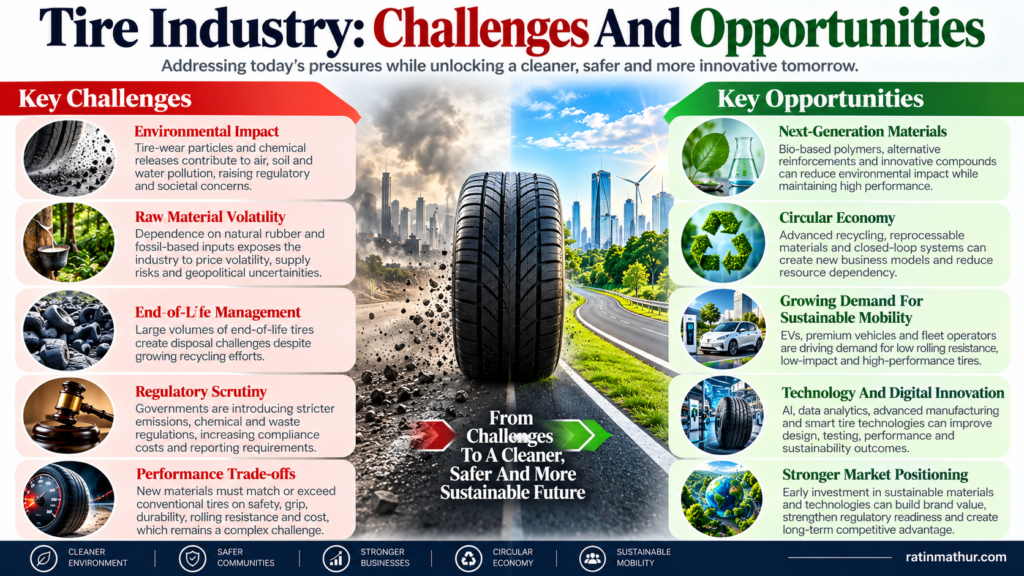
Tires are engineered to meet competing requirements. Increasing stiffness may improve one property while reducing flexibility. Increasing durability may affect grip or rolling resistance. Changing the polymer can alter its interaction with reinforcing fillers, curing systems, protective additives, and reinforcement materials. The resulting compound must perform as an integrated system.
An alternative material must therefore be assessed through a portfolio of properties rather than a single laboratory result. It must withstand repeated deformation, frictional heating, moisture, environmental exposure, and the operating loads relevant to its intended application. Manufacturing repeatability is equally important because performance that can be achieved in one experimental specimen but not consistently reproduced at scale is not commercially sufficient.
The opportunity is to use advances in polymer chemistry, composite engineering, material modelling, and manufacturing to explore combinations that were previously impractical. Research should investigate whether new material systems can decouple some of the traditional trade-offs between durability, grip, heat generation, rolling resistance, and environmental impact.
The Environmental Challenge Of Avoiding Burden Shifting
A replacement material should not be judged environmentally superior merely because it contains less conventional rubber. Its production may require more energy, more water, additional chemical treatments, or inputs with other environmental costs. It may also create a different class of wear particles or prove difficult to recover after use.
A credible comparison must therefore cover the material’s complete life cycle, including raw material extraction, feedstock processing, manufacturing, transport, use, replacement, and end-of-life treatment. It must also consider the effect of service life. If an alternative requires more frequent replacement, the additional material and manufacturing impacts may offset some of its apparent advantages.
The opportunity is to embed environmental assessment at the beginning of material development. This can help researchers eliminate weak concepts earlier and focus resources on candidates with a plausible pathway to measurable improvement.
The Commercial Challenge Of Scaling An Alternative Material
Even if a candidate passes laboratory tests, commercial adoption will depend on material availability, processing compatibility, quality control, tooling, cost, supplier capability, and customer acceptance. Established tire production systems are optimized around mature materials and processes. A new material may require changes to mixing, curing, moulding, reinforcement, or quality assurance.
The initial research should therefore investigate manufacturability early enough to avoid developing a technically impressive but economically impractical solution. Collaboration with established manufacturers and specialist laboratories can help identify process constraints before substantial capital is committed.
The opportunity is to develop the material through a staged partnership model. Universities and research institutions can investigate fundamental chemistry, specialist laboratories can perform characterization, and manufacturers can assess processing and application requirements. The Board can authorize incremental investment as evidence improves.
The Intellectual-Property Challenge
The fields of alternative elastomers, sustainable fillers, non-pneumatic tires, and modular tire structures already contain extensive research and patent activity. A broad aspiration to create an environmentally friendly tire is unlikely, by itself, to constitute a defensible invention.
A stronger intellectual-property strategy would identify specific technical advances, such as a novel formulation, a processing method that improves material consistency, a demonstrably safer wear system, or an architecture that achieves a measurable performance and environmental advantage. Patentability and freedom to operate must be assessed separately by qualified professionals.
The opportunity is to build a research programme that produces protectable knowledge and commercially relevant evidence. This requires documented experiments, careful management of confidential information, and an intellectual-property strategy established before public disclosure of potentially patentable technical details.
The Governance Challenge
Environmental innovation can lose momentum when it is treated as a collection of disconnected projects. Materials teams may optimize strength, sustainability teams may emphasize renewable content, procurement teams may focus on cost, and commercial teams may prioritize immediate customer demand. Without a shared evaluation system, these objectives may conflict.
The Board should establish a common decision framework that requires every candidate to satisfy safety requirements, demonstrate measurable environmental value, and provide a credible route to manufacturing and commercialization. This will allow the company to pursue ambitious research without confusing scientific promise with proven product readiness.
The opportunity is to make environmental material innovation a repeatable organizational capability. The company would not merely fund isolated experiments; it would build the ability to identify, test, compare, protect, and scale new material technologies over time.
Strategic Frameworks & Recommendations
The following four frameworks are proposed specifically for this article to translate the environmental material challenge into a structured Board-level research agenda. Their names are proposed branded frameworks, not claims of registered trademarks or established industry standards.
Framework 1: TPRAME™: Tire Pollution Reduction And Alternative Materials Evaluation
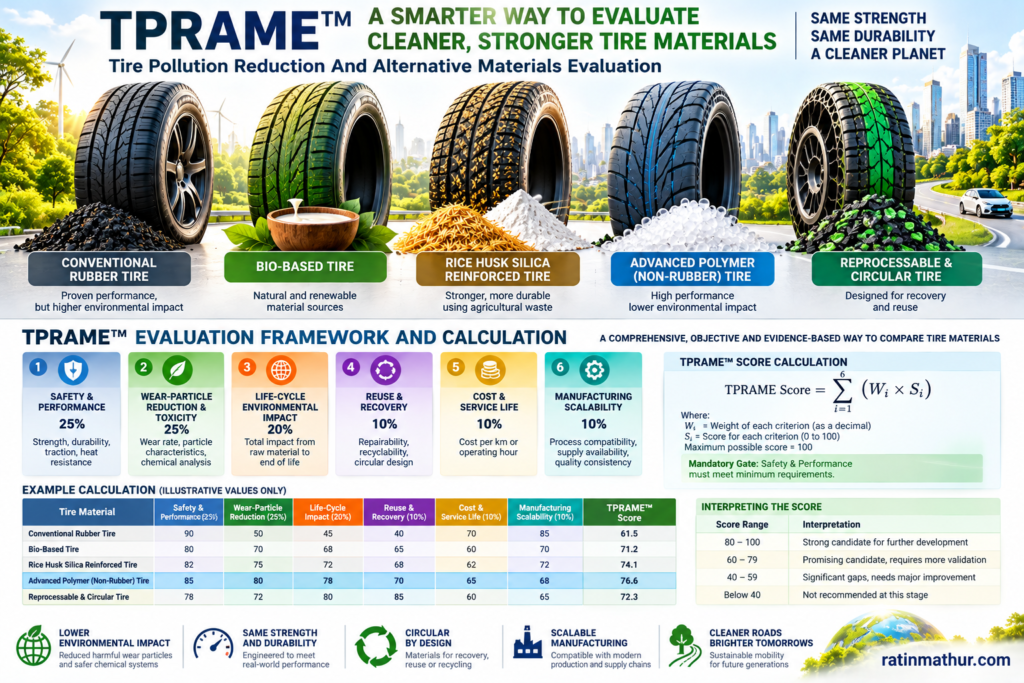
The TPRAME™ Framework is designed to prevent a common decision error: declaring a candidate successful because it is renewable, recycled, lightweight, or resistant to abrasion without examining its overall performance and environmental consequences. It establishes a common scorecard for comparing material candidates and requires safety to operate as a mandatory gate before any weighted score is considered.
The framework uses six evaluation dimensions: safety and performance, wear-particle reduction and toxicity, life-cycle environmental impact, reuse and recovery, cost and service life, and manufacturing scalability. The weighting is intended to guide research prioritization rather than replace formal engineering standards, regulatory approval, or application-specific qualification.
| Evaluation dimension | Proposed weight | Key question | Required evidence |
|---|---|---|---|
| Safety and performance | 25% | Does the candidate meet all essential application requirements? | Mechanical, fatigue, thermal, traction, and durability tests |
| Wear-particle reduction and toxicity | 25% | Does it reduce harmful emissions rather than merely alter their composition? | Comparative wear, particle analysis, chemical characterization, and relevant toxicity tests |
| Life-cycle environmental impact | 20% | Does the candidate reduce overall impact across its life cycle? | Comparative life-cycle assessment |
| Reuse and recovery | 10% | Can materials or components be recovered, repaired, or reused effectively? | Demonstrated recovery and end-of-life pathways |
| Cost and service life | 10% | Is the candidate commercially credible over equivalent service? | Cost-per-kilometre or operating-hour analysis |
| Manufacturing scalability | 10% | Can it be produced consistently at scale? | Process trials, feedstock specifications, and quality-control evidence |
| Total | 100% |
The safety requirement is a pass/fail gate, not a compensatory score. A material that fails an essential braking, load-bearing, fatigue, or durability requirement cannot qualify merely because it scores highly on environmental criteria. Unknown evidence must be recorded as unestablished rather than treated as a positive result.
For example, suppose a rice-husk-derived filler performs comparably to a conventional filler in selected mechanical tests. TPRAME™ would not automatically declare it environmentally superior. The company would still need to establish the feedstock’s consistency, manufacturing energy requirements, wear behaviour, particle characteristics, chemical risks, and cost over equivalent service. The candidate would advance only if the combined evidence justified further development.
The Board should use TPRAME™ at defined investment gates. Early screening would require only a subset of the evidence, while prototype and industrial evaluations would demand progressively stronger proof. This creates a disciplined path from exploratory science to commercial consideration.
Framework 2: MATERIAL SHIFT™: Strategic Portfolio For Next-Generation Tire Materials
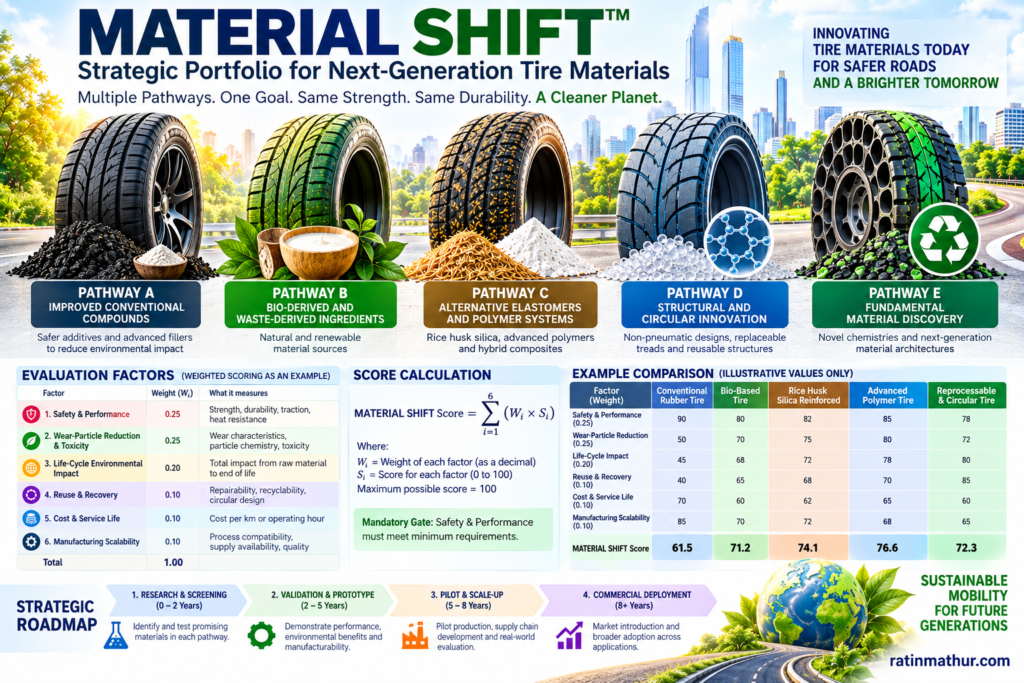
MATERIAL SHIFT™ is a proposed research-portfolio framework that prevents the company from placing all its resources behind a single material concept. The underlying premise is that no candidate should be assumed to replace conventional tire rubber until its performance and environmental behaviour have been demonstrated. Research should therefore proceed across several technically distinct pathways, with funding linked to evidence and uncertainty.
The portfolio separates incremental improvements to existing compounds from more ambitious alternatives to the primary elastomeric material. It also recognizes that structural innovations may reduce material consumption even when they do not eliminate rubber. This enables the Board to pursue near-term learning while retaining a longer-term ambition for more fundamental material change.
| Research pathway | Candidate technologies | Research question | Strategic horizon |
|---|---|---|---|
| Pathway A: Improved conventional compounds | Safer additives, alternative fillers, improved wear-resistant formulations | Can existing materials deliver lower environmental impact through better formulation? | Near to medium term |
| Pathway B: Bio-derived and waste-derived ingredients | Rice-husk-derived silica, selected biochars, other characterized waste-derived additives | Can renewable or recovered inputs replace selected ingredients without compromising performance? | Near to medium term |
| Pathway C: Alternative elastomers and polymer systems | Thermoplastic elastomers, reprocessable polymer networks, selected silicone or other elastomeric systems | Can a different material system achieve the required strength, fatigue, grip, heat resistance, and wear profile? | Medium to long term |
| Pathway D: Structural and circular innovation | Replaceable contact surfaces, reusable support structures, selected non-pneumatic architectures | Can the design reduce material consumption and improve recovery over equivalent service? | Near to long term, depending on application |
| Pathway E: Fundamental material discovery | Novel polymer chemistry, hybrid composites, new material architectures | Can a new system deliver equivalent or better tire performance with substantially lower environmental impact? | Long term |
For example, the company could screen an agricultural-waste-derived filler while also commissioning a literature and laboratory review of alternative elastomers. If the filler offers a modest but reproducible improvement, it may provide a near-term development opportunity. If an alternative polymer initially fails fatigue testing but shows a promising wear profile, it could remain in fundamental research while its formulation is improved.
MATERIAL SHIFT™ therefore distinguishes between research value and immediate commercial readiness. A candidate that fails an early commercial threshold may still generate useful scientific knowledge, but it should not receive unlimited funding. Each pathway should have explicit milestones, a defined budget, a responsible technical owner, and a documented decision to advance, reformulate, pause, or stop.
The Board’s role is to balance incremental improvements with exploratory research. This prevents short-term commercial pressures from eliminating potentially important long-term innovations while ensuring that ambitious research remains accountable.
Framework 3: LIFE-TREAD™: Life-Cycle Impact And Functional Performance Assessment
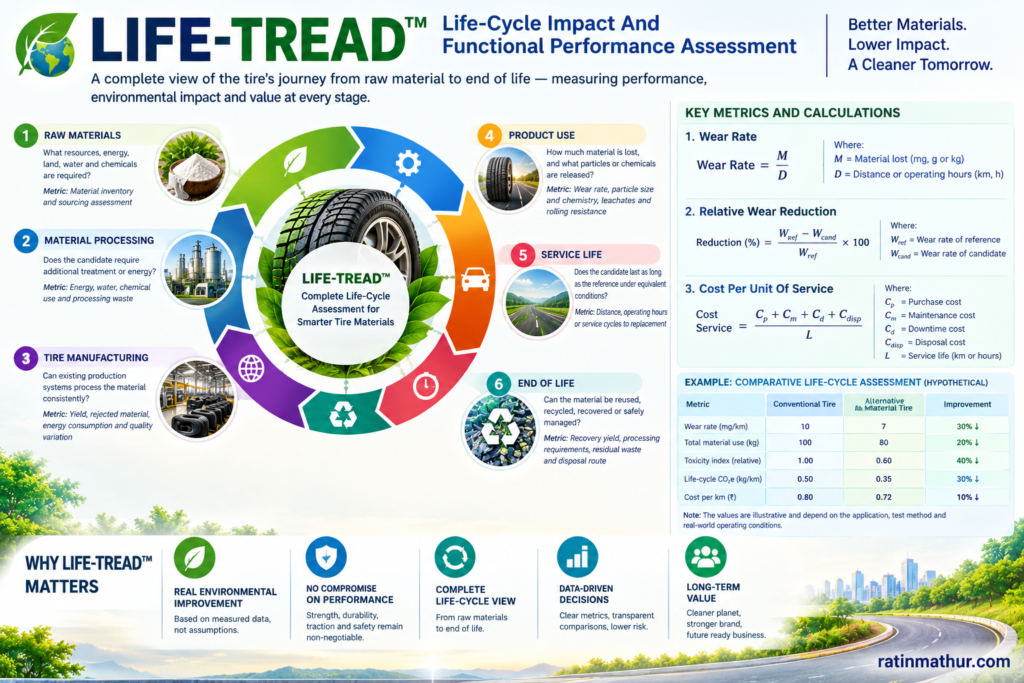
LIFE-TREAD™ is a proposed framework for evaluating the environmental performance of a tire over its complete service life. Its central principle is that environmental comparisons should be based on equivalent useful service rather than the mass of renewable material in a tire or its manufacturing footprint alone.
The framework connects material composition, manufacturing impacts, wear emissions, chemical releases, service life, replacement frequency, energy performance, and end-of-life recovery. It requires the research team to investigate whether improvements in one phase create disadvantages in another. This is particularly important when considering alternative polymers or biodegradable materials because their production, wear behaviour, and environmental fate may differ substantially from conventional tire compounds.
| Life-cycle stage | Questions to investigate | Example measurement |
|---|---|---|
| Raw materials | What resources, energy, land, water, and chemicals are required? | Material inventory and sourcing assessment |
| Material processing | Does the candidate require additional treatment or energy? | Energy, water, chemical use, and processing waste |
| Tire manufacturing | Can existing production systems process the material consistently? | Yield, rejected material, energy consumption, and quality variation |
| Product use | How much material is lost, and what particles or chemicals are released? | Wear rate, particle size and chemistry, leachates, and rolling resistance |
| Service life | Does the candidate last as long as the reference under equivalent conditions? | Distance, operating hours, or service cycles to replacement |
| End of life | Can the material be reused, recycled, recovered, or safely managed? | Recovery yield, processing requirements, residual waste, and disposal route |
Consider a hypothetical alternative tread that generates less wear mass in a laboratory test but requires more energy-intensive processing and has a shorter service life. A narrow wear test might favour the candidate. LIFE-TREAD™ would require the company to model the additional manufacturing and replacement impacts before making a comparative environmental claim.
The framework should also distinguish measured results from assumptions. Tire-wear emissions vary with vehicle loading, driving behaviour, road surface, temperature, and other factors, as demonstrated by Ospital et al. (2025) [3]. The company should therefore use standardized testing, application-specific assumptions, sensitivity analysis, and uncertainty reporting. International Standard ISO 22638:2024 provides a laboratory road-simulator method for generating and collecting tire and road-wear particles under defined conditions [8]. The appropriate method for a novel material or architecture should be confirmed with the testing laboratory.
LIFE-TREAD™ would give the Board a more credible basis for environmental decisions. It would help distinguish a genuine reduction in life-cycle impact from a shift in pollution between manufacturing, use, and end of life.
Framework 4: BOARD-TO-BENCH™: Governance And Stage-Gate Model For Material Innovation
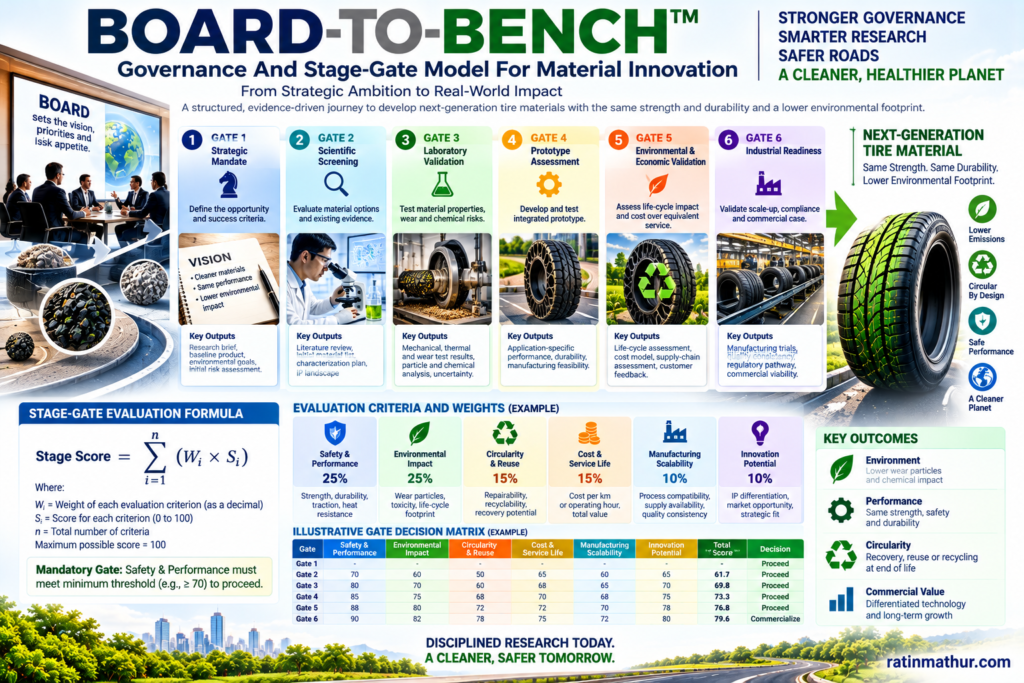
BOARD-TO-BENCH™ is a proposed governance framework that connects Board-level ambition with laboratory execution. It addresses a central challenge in long-term innovation: the Board may approve a broad sustainability objective, but the organization still needs a clear mechanism to turn that objective into research priorities, experimental evidence, investment decisions, and accountable outcomes.
The framework establishes staged approval gates. Each stage has a defined question, a required body of evidence, and a decision owner. Funding increases only when the candidate satisfies the requirements of the preceding stage. This allows the company to explore high-potential concepts without treating exploratory research as an unconditional commitment to commercialization.
| Stage | Primary activity | Evidence required | Board or management decision |
|---|---|---|---|
| Gate 1: Strategic mandate | Define the environmental problem and required performance | Research brief, baseline product, environmental objective, and initial risk assessment | Approve exploratory research |
| Gate 2: Scientific screening | Review candidate materials and existing evidence | Literature review, material characterization plan, preliminary IP assessment | Select candidates for testing |
| Gate 3: Laboratory validation | Test mechanical properties, wear, and relevant chemical risks | Reproducible comparative data and documented uncertainty | Advance, reformulate, or stop |
| Gate 4: Prototype assessment | Test an integrated material or structural design | Application-specific performance, durability, and manufacturing evidence | Approve limited prototype investment |
| Gate 5: Environmental and economic validation | Assess full-life impacts and cost over equivalent service | Comparative life-cycle assessment, cost model, and supply-chain assessment | Consider a controlled industrial trial |
| Gate 6: Industrial readiness | Evaluate repeatability, customer relevance, qualification, and scalability | Manufacturing trials, customer evidence, compliance pathway, and commercial case | Decide whether to pursue commercialization |
For example, a company may identify a thermoplastic elastomer as a potential alternative tread material. Gate 1 would define the required performance and environmental objective. Gate 2 would establish whether published evidence and material properties justify testing. Gate 3 would determine whether the material warrants further formulation work. Gate 4 would test the integrated prototype. Gates 5 and 6 would establish whether the candidate has a defensible environmental and commercial advantage.
At each gate, the company should document unresolved questions and the cost of answering them. If a candidate repeatedly fails a critical requirement, the programme should stop or be redirected. If the results are promising but incomplete, the next investment should be limited to the specific experiment needed to resolve the uncertainty.
BOARD-TO-BENCH™ also clarifies accountability. The Board sets strategic ambition and risk tolerance, executive leadership allocates resources, R&D teams own the experimental programme, environmental specialists validate life-cycle and chemical claims, and manufacturing and commercial teams assess scale-up and customer relevance. Independent technical review should be used where the consequences of failure or the complexity of the environmental claim justify it.
The framework’s purpose is to make fundamental material innovation a governed corporate capability. It allows the company to pursue a long-term environmental objective while preserving capital discipline, safety standards, and transparency in decision-making.
Future Outlook & Conclusion
The Next Generation Of Tire Innovation
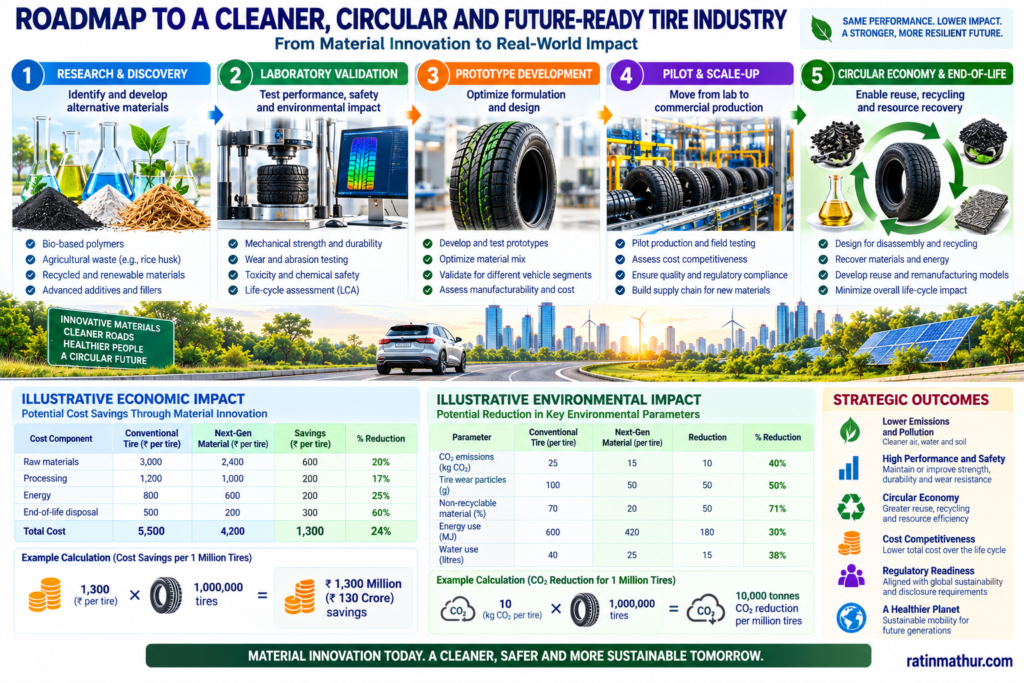
The next generation of tire technology will be shaped not only by improvements in conventional rubber compounds but also by the industry’s willingness to investigate fundamentally different material systems. Advances in polymer chemistry, composite engineering, bio-derived feedstocks, material modelling, and manufacturing offer several research pathways. None should be presumed to deliver the required combination of strength, durability, safety, and environmental performance without evidence.
The most important opportunity is to change the definition of successful tire innovation. Historically, a tire has been judged primarily by how effectively it performs its intended function. Increasingly, its environmental performance must be evaluated alongside those established engineering requirements. The industry needs materials that preserve mobility while reducing harmful emissions, minimizing resource consumption, and enabling more effective recovery at the end of their useful lives.
Research should initially prioritize well-defined applications and progress through evidence-based stages. Industrial and low-speed applications may provide useful environments for investigating replaceable surfaces, alternative polymers, and reusable structures. More demanding applications, including passenger vehicles, commercial vehicles, tractors, off-road machinery, and aircraft, would require their own technical assessments and qualification pathways. Success in one category must not be treated as proof of suitability in another.
The industry should also avoid defining the objective exclusively as a rubber-free tire. A completely different material may ultimately offer advantages, but an improved elastomer or hybrid material system could also produce meaningful environmental gains. The decisive question is whether the complete technology performs as required and reduces environmental harm over equivalent service. Research must remain open to both evolutionary improvements and fundamental material breakthroughs.
The Board’s Strategic Responsibility
Corporate Boards have a distinctive role in determining whether long-term material challenges receive sustained attention. They can establish environmental material innovation as a strategic priority, ensure that R&D investment extends beyond incremental product improvements, encourage collaboration with scientific institutions and specialist technology partners, and require measurable evidence before approving further investment.
This responsibility is not to predict which polymer will win or to promise that a replacement material is immediately available. It is to ensure that the company is systematically investigating the opportunity rather than assuming that conventional materials represent the only practical future.
A well-governed programme would combine scientific discipline with commercial ambition. It would protect safety requirements, evaluate environmental claims rigorously, preserve unsuccessful experimental results as learning, and allocate funding according to evidence. The four proposed frameworks, TPRAME™, MATERIAL SHIFT™, LIFE-TREAD™, and BOARD-TO-BENCH™, provide a starting structure for this approach.
Conclusion: The Strategic Question The Tire Industry Must Confront
Tires are essential to the modern economy, but their environmental footprint should not be treated as an unavoidable consequence of mobility. The industry has the scientific expertise, engineering capability, manufacturing knowledge, and research partnerships needed to investigate alternatives. What is required now is a deliberate commitment to make environmentally superior, performance-equivalent materials a long-term innovation objective.
The goal is ambitious: a tire material that matches the strength, durability, safety, and operating performance of conventional rubber while materially reducing harmful wear particles, chemical releases, and total life-cycle impact. The technical feasibility of achieving this combination remains to be established. That uncertainty is a reason to invest in disciplined research, not a reason to dismiss the opportunity.
The companies that begin asking the right questions today may be better positioned to shape the technologies, intellectual property, partnerships, and manufacturing capabilities of tomorrow. The immediate priority is to move environmental material innovation from a peripheral sustainability initiative into the core of long-term product and technology strategy.
The question for every tire manufacturer’s Board is straightforward: will the company continue to optimize the environmental performance of today’s materials alone, or will it also invest in discovering materials that could fundamentally redefine the tire of tomorrow?
The answer could influence not only the future competitiveness of the tire industry but also its contribution to a more environmentally responsible mobility system.
References
1. Yoganandham, S. T., Daeho, K., Heewon, J., Shen, K., & Jeon, J. (2024). Unveiling the environmental impact of tire wear particles and the associated contaminants: A comprehensive review of environmental and health risk. Journal of Hazardous Materials, 480, 136155. https://doi.org/10.1016/j.jhazmat.2024.136155
2. Nielsen, A. F., Polesel, F., Ahonen, T., Palmqvist, A., Baun, A., & Hartmann, N. B. (2024). Assessing the biodegradability of tire tread particles and influencing factors. Environmental Toxicology and Chemistry, 43(1), 31–41. https://doi.org/10.1002/etc.5757
3. Ospital, L., Margni, M., & Boulay, A.-M. (2025). Development of a parametrized and regionalized life cycle inventory model for tire and road wear particles. Journal of Hazardous Materials, 495, 138986. https://doi.org/10.1016/j.jhazmat.2025.138986
4. Liao, K., Yu, J., Huang, R., Zhou, W., Zhou, Y., Guo, J., Zhang, S., Cai, C., Peng, K., Huang, X., & Liu, J. (2026). Co-mitigating tire wear particles and their leachates across the life cycle: A critical review. Water Research, 301, 125994. https://doi.org/10.1016/j.watres.2026.125994
5. Bardha, A., Prasher, S., & Dumont, M.-J. (2024). Waste biomass-derived rubber composite additives: Review of current research and future investigations into biowaste tire formulation. Biomass and Bioenergy, 183, 107149. https://doi.org/10.1016/j.biombioe.2024.107149
6. Deng, Y., Wang, Z., Shen, H., Gong, J., & Xiao, Z. (2023). A comprehensive review on non-pneumatic tyre research. Materials & Design, 227, 111742. https://doi.org/10.1016/j.matdes.2023.111742
7. Sun, M., Zhong, H., Qin, K., Xu, T., Yang, W., Zhang, Y., & Lu, L. (2024). The development of processing methods and materials used for non-pneumatic tires: A review. Materials, 17(22), 5660. https://doi.org/10.3390/ma17225660
8. International Organization for Standardization. (2024). ISO 22638:2024: Rubber: Generation and collection of tyre and road wear particles (TRWP): Road simulator laboratory method. https://www.iso.org/standard/84313.html
Disclaimer
This article is an independent strategic research perspective intended to encourage discussion and further investigation by tire manufacturers, corporate Boards, R&D leaders, materials scientists, and environmental specialists. It is based on published literature and conceptual analysis, not original laboratory experiments, product qualification, or a comprehensive systematic review. The proposed frameworks are original conceptual tools for strategic assessment and are not established industry standards. Their names are presented with the ™ symbol as proposed branding; this does not imply registered trademark status or legal clearance.
No claim is made that a commercially available material currently satisfies every requirement for replacing conventional tire rubber across all vehicle categories. Candidate materials and architectures require application-specific testing, environmental assessment, regulatory review, and commercial validation. The article does not constitute engineering certification, investment advice, legal advice, or a guarantee of environmental benefit. All technical, commercial, and regulatory decisions should be supported by qualified professional assessment and verifiable evidence.