Executive Summary
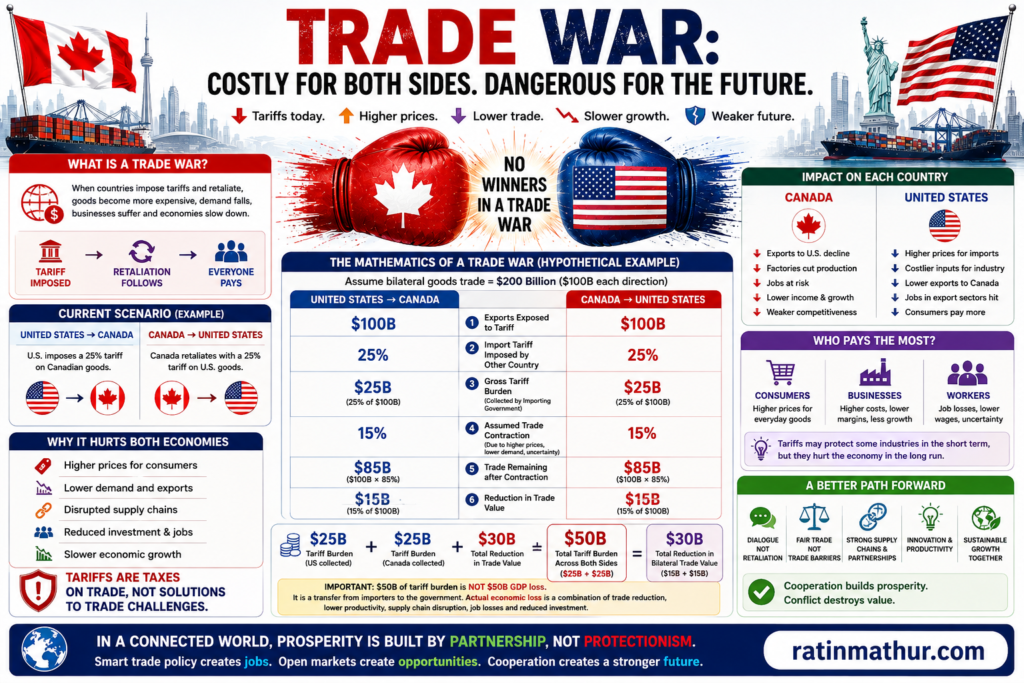
Trade wars are often framed as a contest over tariffs, exports and market access. That interpretation is too narrow. The deeper strategic issue is economic concentration. A country that derives an unusually large share of its trade, investment, supply chains and industrial activity from one external market can enjoy extraordinary efficiency during stable times, but it also accumulates systemic vulnerability when political or commercial relations deteriorate. The Canada-U.S. relationship is perhaps one of the clearest examples of this paradox.
Canada has historically benefited from extraordinary economic integration with the United States. In 2024, approximately 76% of Canada’s merchandise exports were destined for the United States, while 62% of its merchandise imports originated there. OECD estimates indicate that Canada-U.S. trade represented approximately 16% of Canadian GDP and more than 2.6 million Canadian jobs in 2023 when direct and indirect effects are considered. That degree of integration creates significant exposure when tariffs and trade restrictions emerge.
Yet the Canadian experience also demonstrates the other side of the equation. In 2025, Canadian merchandise exports to the United States declined 5.8%, while exports to non-U.S. markets increased 17.2%. The U.S. share of Canadian merchandise exports consequently fell from 75.9% in 2024 to 71.7% in 2025. Total merchandise trade with non-U.S. countries increased from $484 billion to $553 billion. More broadly, Canada’s goods and services exports to non-U.S. markets increased by $33 billion in 2025, while the non-U.S. share of Canadian exports reached 32.8%, its highest level in more than four decades.
These developments reveal an important strategic truth. Trade wars can inflict substantial short-term economic damage, but they can simultaneously accelerate diversification, expose structural weaknesses and create incentives for new investment, logistics infrastructure and commercial partnerships. The key question is therefore not whether Canada can replace the United States. It cannot realistically do so quickly. The more strategically relevant question is whether Canada can transform the United States from an overwhelmingly dominant market into one of several indispensable global markets.
Canada’s emerging trade strategy suggests that this transformation is already underway. Ottawa has established an objective of doubling non-U.S. exports over the next decade, potentially generating an additional $300 billion of exports, backed by infrastructure investment, trade agreements and a Strategic Exports Office. The Canada-EU relationship reached $178.6 billion in combined goods and services trade in 2025, while Canada and India are pursuing a Comprehensive Economic Partnership Agreement with an ambition to more than double bilateral trade to $70 billion annually by 2030. Canada has also regained significant agricultural market access in China, including a major reduction in tariffs on canola seed effective March 1, 2026.
This article argues that the central lesson of the Canadian case extends well beyond Canada. In an increasingly fragmented global economy, economic resilience should not be defined as autarky or decoupling. It should be defined as the ability to preserve prosperity when individual markets become inaccessible or politically unreliable. The countries that succeed will be those that combine market diversification with domestic competitiveness, infrastructure, supply-chain optionality and strategic economic diplomacy.
Introduction
The global trading system is entering a structural period of transformation. The era in which firms could optimise almost exclusively for cost, scale and proximity is being replaced by an environment in which geopolitical risk, regulatory volatility, supply-chain security and market concentration increasingly influence economic decisions. The return of tariffs and strategic trade restrictions has therefore transformed trade policy from a narrow economic instrument into a national strategy issue.
Canada offers a particularly instructive case. Its geographic proximity to the United States created a powerful economic logic for deep integration. Shared infrastructure, common industrial standards, cross-border supply chains, complementary resource endowments and the existence of successive North American trade agreements encouraged Canadian companies to concentrate heavily on the U.S. market. This model was economically rational. It reduced transportation costs, enlarged addressable markets and supported highly efficient manufacturing and resource value chains.
The vulnerability emerged because economic efficiency and strategic resilience are not identical concepts. A company that derives 80% of its revenue from its largest customer may be highly efficient, but it is also highly exposed. A nation can face the same structural problem at macroeconomic scale.
Current events make this issue particularly important. As of August 2026, the United States has imposed a 50% tariff on $27.6 billion of Canadian goods, while Canada has announced matching counter-tariffs on selected U.S. products effective September 8, 2026. The Bank of Canada has acknowledged that Canada’s economy has been operating on a lower path than before the tariff shock, while also noting that Canadian businesses are adapting to the new trade environment.
The Canadian experience consequently raises a larger question for policymakers globally: are trade wars purely destructive, or can they become catalysts for the redesign of national economic strategies?
Problem Statement & Objectives
The conventional interpretation of a trade war is straightforward. One country imposes tariffs, exports decline, domestic industries suffer, retaliation follows and both economies lose. This mechanism is real, but incomplete.
Tariffs affect more than exporters. They can increase the cost of imported inputs, alter corporate investment decisions, disrupt integrated production networks, reduce economies of scale, change relative competitiveness and generate inflationary pressures. The Bank of Canada has described tariff-related adjustment as a structural drag on Canada’s productive capacity, while weaker business investment can reduce productivity and the economy’s ability to expand without creating inflation.
The central problem is therefore not simply lost export sales. It is the temporary and potentially persistent loss of economic efficiency created by the disruption of established trade relationships.
This article has four objectives. First, it examines why trade wars can be economically dangerous even when the targeted country possesses alternative export markets. Second, it evaluates Canada’s capacity to diversify away from excessive U.S. dependence. Third, it distinguishes genuine diversification from simply replacing one dependency with another. Fourth, it proposes three strategic frameworks designed to help governments and businesses manage trade concentration as a portfolio-risk problem rather than as a bilateral trade dispute.
Methodology
This analysis adopts a strategic macroeconomic and trade-policy perspective. It combines publicly available evidence from Statistics Canada, the Bank of Canada, the Organisation for Economic Co-operation and Development, Global Affairs Canada, Transport Canada, the Canada Energy Regulator, the World Trade Organization and the Government of Canada.
The analysis evaluates five interconnected dimensions: trade concentration, economic transmission mechanisms, sectoral and supply-chain exposure, alternative market capacity, and enabling infrastructure. Quantitative indicators are used where relevant, but the primary objective is strategic interpretation rather than econometric forecasting.
The Canadian case is examined as a living policy experiment. The analysis therefore considers both the economic shock created by U.S. trade measures and the diversification response that is already visible in Canadian trade flows, infrastructure policy and international commercial engagement.
Landscape Analysis
Canada entered the current trade conflict with an unusually concentrated export structure. In 2024, approximately 76% of Canadian goods exports went to the United States. Trade with the United States represented about 16% of Canadian GDP and more than 2.6 million Canadian jobs when direct and indirect effects were included. This degree of integration means that a tariff shock cannot be evaluated simply by measuring the value of goods directly affected.
The automotive sector illustrates the structural challenge. Canadian and U.S. production systems have been integrated for decades, with components and intermediate goods crossing borders before finished products reach consumers. Similar dynamics exist in metals, machinery, energy and advanced manufacturing. Diversifying such trade is fundamentally more complicated than redirecting a bulk commodity from one port to another.
Energy illustrates the same paradox from a different perspective. Canada exported $157.5 billion of hydrocarbons to the United States in 2025. The United States received approximately 63.4% of its crude oil imports and nearly all of its natural gas imports from Canada. Canada therefore possesses significant bargaining relevance within the relationship even as it remains highly dependent on the American market.
The first clear sign of diversification occurred in 2025. Canadian exports to the United States fell by 5.8%, while exports to countries other than the United States grew by 17.2%. Non-U.S. trade activity increased 14.3% to $553 billion. Statistics Canada also found that non-U.S. energy exports increased 22.3% to $28.8 billion in 2025, while Canadian aluminum exports rose from $738 million to $2.1 billion, led by higher shipments to the Netherlands and Italy.
The current policy response is increasingly explicit. Canada seeks to double non-U.S. exports over the next decade, creating an estimated additional $300 billion in trade. The government has introduced a $5 billion Trade Diversification Corridors Fund to strengthen ports, railways, airports, highways and other trade-enabling infrastructure.
The European Union is already a credible second pillar. Canada-EU trade in goods and services reached $178.6 billion in 2025, making the EU Canada’s second-largest global trading partner for goods and services after the United States.
India represents another potentially transformative market. Canada is pursuing a Comprehensive Economic Partnership Agreement covering goods, services, investment, agriculture, digital trade, mobility and sustainable development, with the objective of more than doubling bilateral trade to $70 billion annually by 2030.
China provides both opportunity and strategic caution. In March 2026, China suspended certain tariffs affecting Canadian canola meal, peas, lobster and crab, while reducing the combined tariff on Canadian canola seed to 14.9% from almost 85%. These developments demonstrate that market diversification can produce substantial gains, but they also illustrate why diversification should not become a transfer from one dominant dependency to another.
Key Findings
The first finding is that trade concentration is itself a form of national risk. A highly concentrated export market can produce superior efficiency during stable conditions, but the same concentration amplifies the economic consequences of political disruption. Canada’s experience demonstrates that the greatest vulnerability was not its lack of market access elsewhere. It was the exceptionally low friction of the U.S. market, which encouraged decades of commercial concentration.
The second finding is that trade diversion is real but cannot automatically replace lost economic value. In 2025, non-U.S. Canadian exports grew rapidly enough to offset much of the decline in U.S.-bound merchandise exports. However, Statistics Canada notes that a substantial share of the increase was connected to precious metals, while government analysis indicates that diversification remains more limited in tariff-exposed industries such as steel, softwood lumber and motor vehicles and parts because these sectors are deeply embedded in North American production networks.
The third finding is that the transition cost can exceed the tariff cost. Companies may preserve physical export volume by redirecting products to alternative destinations, yet still suffer lower margins because of longer supply chains, different pricing structures, customer-acquisition costs, certification requirements and logistics expenses. Diversification therefore becomes economically meaningful only when alternative markets become commercially competitive rather than merely technically accessible.
The fourth finding is that infrastructure is trade policy. Canada’s $5 billion Trade Diversification Corridors Fund recognises that trade agreements have little value if products cannot reach target markets efficiently. Modern ports, rail systems, roads, logistics hubs, digital infrastructure and energy corridors are therefore strategic trade assets rather than merely transportation investments.
The fifth finding is that services may provide a structurally better diversification engine than some merchandise categories. Global Affairs Canada reports that Canadian services exports, particularly digitally enabled services, have proved more diversified and resilient than merchandise exports. This has important implications because digital services can cross borders without the same physical logistics constraints faced by bulk commodities or manufactured goods.
The sixth finding is that trade wars can change investment geography. Persistent uncertainty encourages companies to build more flexible production networks and can increase the attractiveness of countries with reliable institutions, energy resources, critical minerals, skilled workers and access to multiple markets. Canada’s challenge is to convert its structural advantages into investable propositions.
Challenges & Opportunities
Canada’s largest challenge is timing. The economic costs of a trade shock arrive immediately, while alternative trade relationships take years to establish. A new customer may require new regulatory approvals, shipping routes, distributors, financing arrangements and product adaptation. A new factory can require several years of capital expenditure before it creates meaningful export capacity.
A second challenge is that not every market is equally substitutable. The United States combines scale, proximity, purchasing power and deeply integrated supply chains. Europe offers scale and institutional compatibility but is geographically distant. India offers long-term growth potential but has more complex market-entry conditions. China offers scale but carries significant geopolitical and regulatory risks. Japan, South Korea and ASEAN economies offer further opportunities but require tailored strategies.
A third challenge is productivity. Diversification that merely shifts exports to higher-cost routes without improving productivity could preserve sales while weakening margins. Canada therefore needs an integrated strategy in which trade expansion is accompanied by investment in technology, automation, skills, digital infrastructure, energy competitiveness and capital intensity.
The opportunity is nevertheless substantial. Canada’s natural resources, energy, agricultural capabilities, critical minerals, institutional stability and skilled workforce provide a foundation for global competitiveness. Its existing agreements with Europe and other markets shorten the pathway to diversification. The government’s own target of doubling non-U.S. exports is evidence that policymakers increasingly recognise this strategic opportunity.
Canada’s energy sector demonstrates what diversification can look like when infrastructure is available. In 2025, Canada exported crude oil to markets outside the United States at significantly higher levels, while LNG exports to East Asia commenced from the LNG Canada facility at Kitimat. The lesson is direct: alternative markets become economically meaningful when infrastructure transforms theoretical market access into physical market reach.
Strategic Frameworks & Recommendations
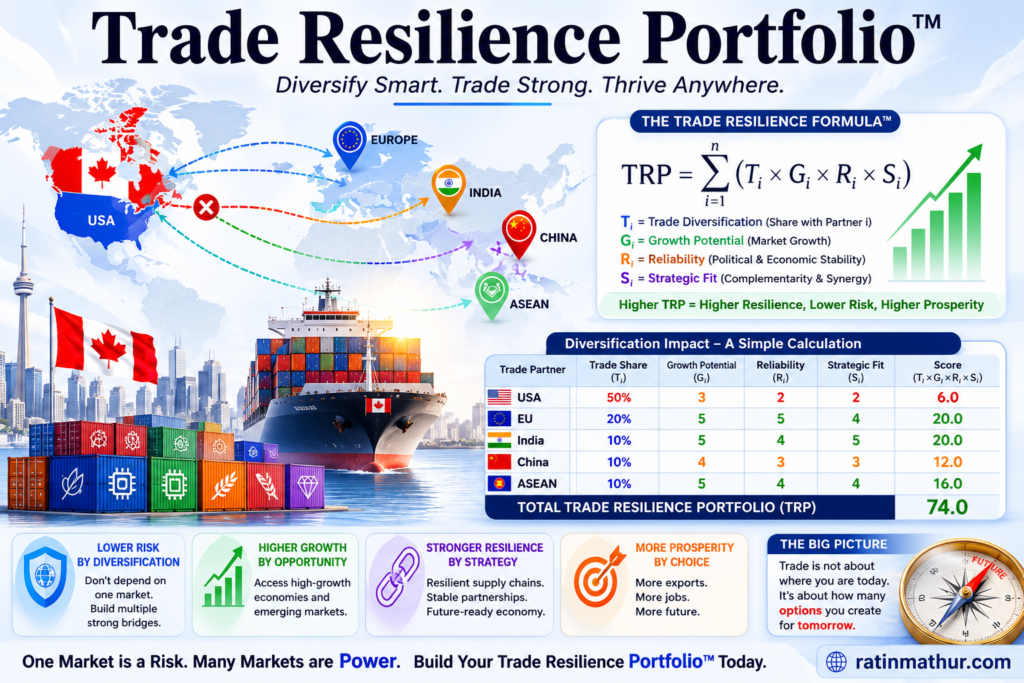
Trade Resilience Portfolio™ Framework
The Trade Resilience Portfolio™ Framework treats a country’s export markets as an investment portfolio rather than as a collection of bilateral relationships. The underlying premise is that concentration generates systemic risk in the same way that excessive exposure to a single asset creates financial risk. The objective is not to eliminate the largest market but to limit the economic damage that would result from its disruption.
The framework begins by segmenting export exposure according to market share, strategic substitutability, switching cost, geopolitical reliability and value-chain criticality. A country should then establish explicit concentration thresholds for strategic industries. Energy, automotive, agriculture, critical minerals and advanced manufacturing should be assessed differently because their ability to switch destinations varies considerably.
Canada provides a practical example. The United States should remain a core market because of geography and supply-chain integration. Europe should serve as a large developed-market diversification pillar. India should become a long-term growth pillar. Japan, South Korea and ASEAN should provide additional Indo-Pacific diversification, while China should be managed selectively according to sector and strategic risk.
| Portfolio Dimension | Strategic Question | Canadian Application |
|---|---|---|
| Market concentration | How dependent is the sector on one destination? | Reduce excessive U.S. concentration without abandoning North America |
| Market substitutability | Can another market absorb the same product? | High for some commodities, lower for integrated automotive products |
| Switching cost | What is required to redirect sales? | Low for some commodities, high for regulated manufactured products |
| Strategic reliability | Could political risk disrupt access? | Balance U.S., EU, India, Indo-Pacific and selective China exposure |
| Value concentration | Where does the highest economic value originate? | Prioritise high-value manufacturing and services, not only commodity volume |
The framework can be applied at both national and corporate levels. A Canadian steel producer, for example, should not simply ask whether Europe can absorb displaced U.S. shipments. It should compare European pricing, logistics, certification, competitive intensity and margin potential against North American opportunities. Similarly, a technology company should assess India, Europe and Asia not merely by market size but by customer acquisition costs, data requirements, regulatory barriers and recurring-revenue potential.
The strategic recommendation is to establish a National Trade Concentration Dashboard reporting export exposure by country, sector and strategic value chain. This should become an economic-security metric reviewed alongside inflation, employment, productivity and fiscal indicators.
Market Optionality Matrix™ Framework
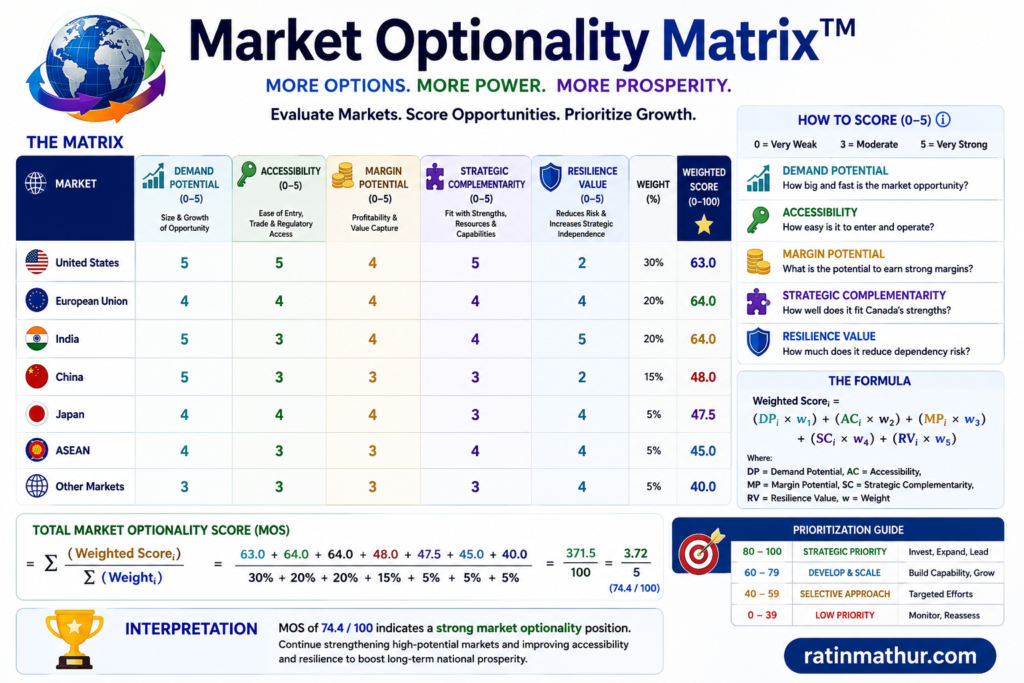
The Market Optionality Matrix™ Framework addresses the central weakness of conventional trade diversification policy: the assumption that every alternative market is equally valuable. It is not enough to have a trade agreement or a potential customer. A market is strategically useful only when it is commercially accessible, economically attractive, scalable and sufficiently independent of the same geopolitical risk.
The framework scores markets across five dimensions: demand growth, market accessibility, margin potential, strategic complementarity and resilience value. The resulting matrix allows policymakers and corporations to differentiate between markets that should be developed immediately, markets that require capability building and markets that should be approached selectively.
| Market | Demand Potential | Accessibility | Strategic Complementarity | Key Opportunity | Strategic Caution |
|---|---|---|---|---|---|
| United States | Very High | Very High | Very High | Integrated manufacturing, energy, services | Concentration and policy volatility |
| European Union | High | High | High | Advanced manufacturing, minerals, energy, services | Distance and competition |
| India | Very High | Medium | High | Energy, agriculture, technology, services, infrastructure | Regulatory and market complexity |
| China | Very High | Selective | High in commodities and agriculture | Canola, agriculture, resources | Geopolitical and regulatory risk |
| Japan | High | High | High | Energy, minerals, advanced manufacturing | Mature market |
| South Korea | High | High | High | Energy, minerals, technology | Strong domestic competition |
| ASEAN | High | Medium | High | Manufacturing, agriculture, consumer markets | Fragmented market structure |
The Canadian policy implication is clear. Europe should be treated as a scale market, India as a high-growth strategic market, China as a selective opportunity and the broader Indo-Pacific as a diversification ecosystem rather than a collection of isolated bilateral markets. The United States remains a core market but should no longer be the assumed default destination for incremental Canadian production.
The framework can also be used to allocate government resources. Trade diplomacy, export financing and senior-level commercial engagement should be concentrated on markets where the combination of economic scale and strategic diversification value is highest.
A hypothetical Canadian advanced-manufacturing company illustrates the model. Rather than attempting to enter ten countries simultaneously, it could identify Germany and the Netherlands as immediate European opportunities, India as a high-growth expansion market and Japan as a strategic technology partner. Government agencies could then align diplomatic access, financing, market intelligence and certification support around those markets. This turns diversification from a general aspiration into a prioritised capital-allocation exercise.
Corridor-to-Customer Flywheel™ Framework
The Corridor-to-Customer Flywheel™ Framework is based on a simple observation: market access has little economic value without physical and digital capability to reach the customer competitively. Trade agreements create rights; infrastructure converts those rights into revenue.
The framework links five interconnected stages: production capability, logistics corridor, market access, commercial distribution and reinvestment. Once an alternative market generates sufficient volume, that volume justifies more infrastructure investment, which lowers logistics costs and attracts further production and investment, reinforcing the cycle.
| Flywheel Stage | Strategic Requirement | Canadian Priority |
|---|---|---|
| Production | Competitive supply and scale | Productivity, automation, processing and capacity |
| Corridor | Reliable route to market | Ports, rail, roads, pipelines and digital systems |
| Market Access | Trade and regulatory access | CETA, India CEPA and Indo-Pacific agreements |
| Customer Conversion | Local commercial ecosystem | Distributors, partnerships, financing and after-sales capability |
| Reinvestment | Scale and cost reduction | Private capital and infrastructure expansion |
Canada’s $5 billion Trade Diversification Corridors Fund is directionally aligned with this framework because it targets ports, railways, highways, airports and other trade-enabling assets and is explicitly designed to help diversify trade partners.
The Port of Vancouver demonstrates why this approach matters. The port is Canada’s largest and most cargo-diverse port, connects Canada to approximately 170 markets and handles about 40% of Canada’s trade in goods beyond North America. The government has identified expanded capacity and infrastructure optimisation at the port as necessary to achieve Canada’s diversification objectives.
The strategic recommendation is that Canada should evaluate infrastructure not only by domestic transportation metrics but also by its capacity to unlock specific export markets. A railway upgrade in Alberta, for example, should be evaluated in relation to energy, grain and mineral exports to Asia; Atlantic port capacity should be evaluated in relation to European markets; and digital infrastructure should be assessed in relation to services exports.
The ultimate objective is a self-reinforcing economic flywheel in which new trade corridors generate new customers, new customers generate new investment, new investment generates greater scale and greater scale improves Canada’s international competitiveness.

Future Outlook & Conclusion
The next decade may fundamentally redefine how national governments think about trade security. The old model placed exceptional emphasis on efficiency. The emerging model places greater emphasis on resilience, optionality and strategic flexibility.
Canada’s experience demonstrates that both sides of the equation matter. A country cannot casually abandon its largest market without imposing severe short-term costs. At the same time, excessive dependence on one external market creates a strategic vulnerability that becomes increasingly expensive when political relations deteriorate.
The appropriate objective is therefore neither protectionism nor decoupling. It is diversification with competitiveness.
Canada should preserve the commercial relationship with the United States while simultaneously building much stronger economic relationships with Europe, India, Japan, South Korea, ASEAN and other markets. The country’s relationship with China should be managed selectively rather than through indiscriminate dependence. Domestic economic policy should focus on productivity, infrastructure, innovation, energy competitiveness, advanced manufacturing, critical minerals and digitally enabled services.
The evidence suggests that this transformation is already underway. Non-U.S. exports increased materially during 2025, Canada’s non-U.S. export share reached its highest level in more than four decades, Canada has expanded overseas energy sales, Europe remains a substantial second market, India is moving toward a comprehensive economic partnership and Chinese market access has improved in selected sectors.
The deeper lesson extends beyond Canada.
Trade wars are dangerous because the economic system is interconnected. They can reduce exports, raise costs, weaken investment, disrupt supply chains and reduce productivity. The World Trade Organization has warned that widespread trade fragmentation could substantially reduce global economic output and that trade diversion creates both opportunities and risks for third countries.
But the same disruption can force countries to correct structural weaknesses that were tolerated during periods of stability.
That is the strategic paradox of trade wars.
They destroy value in the short term, but they can also expose concentration risk, accelerate market diversification, stimulate infrastructure investment and create a more resilient economic architecture.
Canada’s strategic objective should therefore not be to replace the United States.
It should be to ensure that the United States is one of several indispensable markets.
The difference is profound.
A country that depends upon one customer possesses little bargaining power.
A country that can credibly serve several global customers possesses optionality.
And in the emerging global economy, optionality may become one of the most valuable forms of national economic power.
The ultimate measure of trade resilience is therefore not how much a country exports to the world today.
It is how quickly, profitably and strategically it can redirect that trade tomorrow.
References
- Bank of Canada. (2026, July 15). Monetary Policy Report: Outlook. Bank of Canada. https://www.bankofcanada.ca/publications/mpr/mpr-2026-07-15/canadian-outlook/
- Bank of Canada. (2026, July 15). Monetary Policy Report: Overview. Bank of Canada. https://www.bankofcanada.ca/publications/mpr/mpr-2026-07-15/overview/
- Bank of Canada. (2026, July 15). Tariff and other assumptions. Bank of Canada. https://www.bankofcanada.ca/publications/mpr/mpr-2026-07-15/tariff-assumptions/
- Canada Energy Regulator. (2026, May 27). Market Snapshot: Overview of 2025 Canada-U.S. energy trade. Government of Canada. https://www.cer-rec.gc.ca/en/data-analysis/energy-markets/market-snapshots/2026/market-snapshot-overview-of-2025-canada-us-energy-trade.html
- Department of Finance Canada. (2026, August 26). List of products from the United States subject to counter-tariffs effective September 8, 2026. Government of Canada. https://www.canada.ca/en/department-finance/news/2026/08/list-of-products-from-the-united-states-subject-to-counter-tariffs-effective-september-8-2026.html
- Department of Finance Canada. (2025). Budget 2025: Chapter 2, Shifting from reliance to resilience. Government of Canada. https://budget.canada.ca/2025/report-rapport/chap2-en.html
- Global Affairs Canada. (2026). Canada and the European Union. Government of Canada. https://www.international.gc.ca/world-monde/international_relations-relations_internationales/eu-ue/index.aspx?lang=eng
- Global Affairs Canada. (2026). Canada-India relations. Government of Canada. https://www.international.gc.ca/country-pays/india-inde/relations.aspx?lang=eng
- Global Affairs Canada. (2026). Diversifying Canada’s trade. Government of Canada. https://international.canada.ca/en/global-affairs/campaigns/diversifying-trade
- Global Affairs Canada. (2026). State of Trade 2026: The rise of services in Canada’s trade landscape. Government of Canada. https://international.canada.ca/en/global-affairs/corporate/reports/chief-economist/state-trade/2026
- Government of Canada. (2026, March). Canada secures renewed market access with China to boost exports and strengthen economic collaboration. https://www.canada.ca/en/global-affairs/news/2026/03/canada-secures-renewed-market-access-with-china-to-boost-exports-and-strengthen-economic-collaboration.html
- Organisation for Economic Co-operation and Development. (2025). OECD Economic Surveys: Canada 2025. OECD Publishing. https://www.oecd.org/en/publications/oecd-economic-surveys-canada-2025_28f9e02c-en/full-report/macroeconomic-developments-and-policy-challenges_fc10c1ae.html
- Statistics Canada. (2026, February 19). Canadian international merchandise trade, December 2025. Government of Canada. https://www150.statcan.gc.ca/n1/daily-quotidien/260219/dq260219a-eng.htm
- Statistics Canada. (2026). Recent developments in the Canadian economy: Spring 2026. Government of Canada. https://www150.statcan.gc.ca/n1/en/pub/36-28-0001/2026004/article/00005-eng.htm
- Transport Canada. (2026). Trade Diversification Corridors Fund. Government of Canada. https://tc.canada.ca/en/programs/trade-diversification-corridors-fund
- World Trade Organization. (2025). Global trade outlook and statistics: April 2025. World Trade Organization. https://www.wto.org/english/res_e/booksp_e/trade_outlook25_e.pdf
- World Trade Organization. (2025, April 9). Statement by the Director-General on escalating trade tensions. World Trade Organization. https://www.wto.org/english/news_e/news25_e/dgno_09apr25_e.htm
Disclaimer
This article is intended for strategic, educational and analytical purposes only. It reflects an interpretation of publicly available information and does not constitute investment advice, legal advice, economic policy advice or a recommendation to buy or sell any security, commodity or financial instrument. Trade policies, tariffs, international agreements, economic forecasts and geopolitical conditions can change rapidly. While reasonable efforts have been made to use reliable and current sources, no representation is made that every fact, forecast or interpretation will remain accurate after publication. Readers should conduct independent due diligence and consult appropriate professional advisers before making financial, commercial, investment or policy decisions.