Will Artificial Intelligence Push Women Out of the Workforce or Unlock a New Era of Inclusion?
Introduction
Artificial Intelligence is reshaping the global economy at an unprecedented pace. From automation of routine processes to the emergence of entirely new digital professions, AI is transforming how businesses operate and how people work. However, as technological revolutions historically reshape labor markets, they also raise critical questions about who benefits and who risks being left behind.
A recent article published in The Economic Times titled “AI may push more women out of workforce: Study” has sparked debate across policy, corporate, and academic circles. The article references a study by diversity consulting firm Avtar Career Creators, suggesting that AI-driven automation may disproportionately impact women workers in India.
The argument centers on the idea that women are concentrated in job roles that are more vulnerable to automation, while structural barriers such as skill gaps, limited access to training, and unequal domestic responsibilities may make it harder for them to transition into emerging AI-enabled professions.
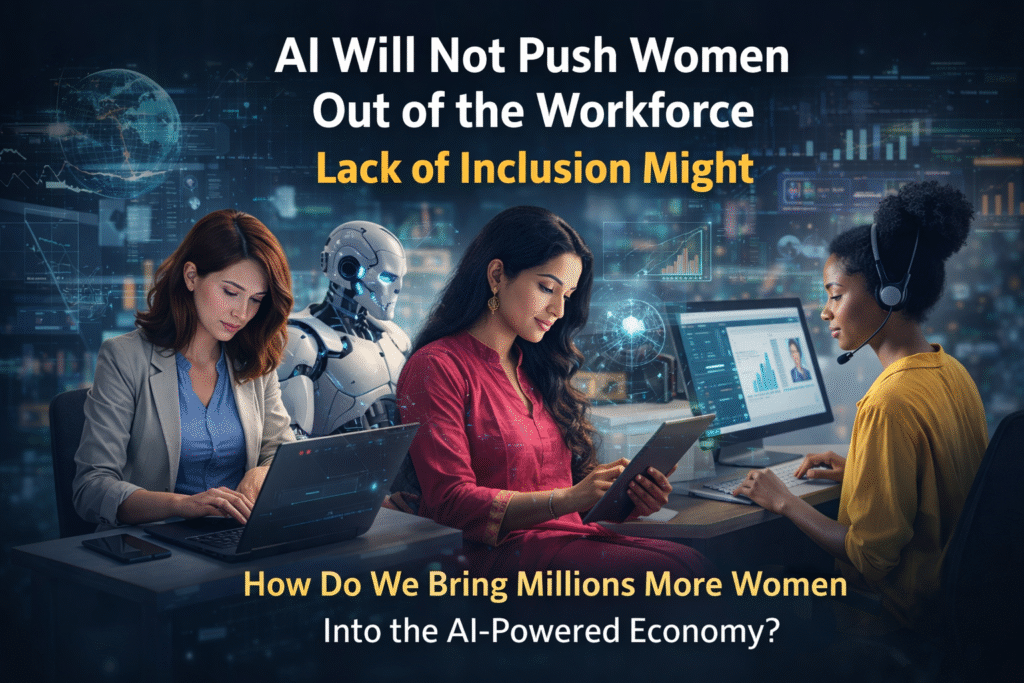
While these concerns are valid, the narrative that AI will inevitably push women out of the workforce risks oversimplifying a far more complex transformation. Technological change does not automatically create inequality. Instead, inequality often emerges from how societies design the adoption of technology, distribute opportunities, and support workforce transitions.
This article presents a comprehensive examination of the issue. It evaluates the findings of the study referenced in the Economic Times article, analyzes structural barriers affecting women’s participation in the workforce, and explores the transformative opportunities AI can create for women if implemented with inclusive policies.
More importantly, it argues that Artificial Intelligence may become one of the most powerful drivers of women’s economic participation in the modern era, provided that organizations, governments, and institutions take deliberate steps to ensure inclusive adoption.
The Context: AI and the Changing Nature of Work
Technological disruption has always been a defining feature of economic progress. The industrial revolution mechanized production, the digital revolution transformed information processing, and today the AI revolution is redefining knowledge work.
Artificial Intelligence is capable of performing tasks such as:
- Data analysis and pattern recognition
- Customer interaction through conversational systems
- Document processing and administrative work
- Predictive analytics and decision support
- Process automation across industries
These capabilities are leading organizations to rethink workforce structures and productivity models.
However, it is important to understand that AI rarely replaces entire jobs outright. Instead, it typically automates specific tasks within a job. Most professions consist of a combination of routine, analytical, interpersonal, and creative activities. While AI may automate repetitive elements, human workers remain essential for strategic thinking, problem solving, collaboration, and leadership.
This distinction between task automation and job displacement is critical when evaluating the potential impact on women’s employment.
The Study Highlighted in the Economic Times Article
🔗 Read the ET article: AI may push more women out of workforce: Study
The Economic Times article references research conducted by Avtar Career Creators, a diversity and inclusion consulting organization.
According to the report, AI adoption could disproportionately affect women due to several structural factors. The study reportedly analyzed workforce data from around 350 companies, examining how technological changes may impact employment patterns.
Several key concerns were highlighted.
Concentration in Automatable Roles
Many women are employed in sectors where routine administrative tasks are common. These include customer service, data processing, clerical roles, and certain back-office functions.
Because AI systems are increasingly capable of performing these activities, the study suggests that women may face higher displacement risk.
Skill Gaps in Emerging Technologies
Another concern raised is the potential skill gap between current workforce capabilities and the requirements of AI-driven jobs. Emerging roles often require competencies such as data analysis, digital literacy, and familiarity with AI tools.
If women have less access to training opportunities, they may struggle to transition into these roles.
Workplace Barriers
The study also identifies structural issues such as:
- gender bias in hiring practices
- lack of mentorship and leadership opportunities
- limited workplace flexibility
These barriers can limit career mobility and slow adaptation to technological change.
The Double Burden of Work
One of the most important observations referenced in the article relates to the National Time Use Survey, which found that women spend significantly more time on unpaid domestic work than men.
This imbalance reduces the time available for professional development, reskilling, and career progression.
While the study raises important concerns, its conclusions require deeper examination.
Evaluating the Study: Strengths and Limitations
Research that highlights gender disparities in technological transitions is valuable. However, to fully understand the implications of AI on women’s employment, it is important to critically assess the scope and methodology of such studies.
Strengths of the Research
The study brings attention to several real structural challenges that continue to shape labor markets.
First, it highlights the concentration of women in specific occupational segments. Occupational segregation is a documented phenomenon across many economies, where women are more likely to work in service-oriented roles.
Second, the research draws attention to the role of unpaid care work, which remains one of the most significant barriers to women’s workforce participation.
Third, it emphasizes the need for proactive workforce planning to ensure inclusive participation in emerging industries.
These contributions are important for raising awareness and prompting policy discussions.
However, there are also several limitations that must be considered.
Sample Size and Representation
The study reportedly analyzed data from around 350 companies. While this provides useful insights into corporate employment patterns, it may not fully represent the broader workforce landscape.
In India, a large portion of employment occurs outside formal corporate environments.
Many workers are engaged in:
- small and medium enterprises
- self-employment
- gig work
- informal sector occupations
Without capturing these segments, the study may not provide a comprehensive picture of women’s employment dynamics.
Informal Sector Exclusion
One of the most significant limitations is the potential underrepresentation of the informal economy.
India’s labor market is heavily dominated by informal employment, particularly for women. Activities such as home-based production, small-scale retail, domestic services, and agricultural work employ millions of women.
Automation may affect these sectors differently than corporate office environments.
For example:
- AI-powered marketplaces may expand opportunities for home-based businesses.
- Digital payment platforms may increase financial inclusion.
- Online platforms may connect informal workers with global customers.
Without analyzing these dynamics, conclusions about workforce displacement remain incomplete.
Lack of Task-Level Analysis
Another methodological limitation relates to how automation risk is measured.
Many studies categorize entire job roles as “automatable.” However, in practice, automation usually targets specific tasks rather than entire occupations.
For example, a customer service role may include:
- responding to routine inquiries
- handling complex problem resolution
- relationship management
- emotional intelligence in communication
AI may automate basic queries, but human agents remain essential for nuanced interactions.
Therefore, analyzing automation at the task level rather than the job level provides a more accurate understanding of workforce impact.
Short-Term vs Long-Term Impact
AI adoption is still in its early stages in many industries.
Early evidence from multiple global surveys suggests that most organizations are currently using AI to augment human productivity rather than eliminate jobs.
Employees increasingly work alongside AI tools that assist with analysis, automation, and decision support.
Over time, new roles often emerge that did not previously exist.
Examples include:
- AI trainers
- prompt engineers
- data curators
- digital platform managers
Historical experience from previous technological revolutions suggests that while some jobs disappear, many new professions emerge.
Structural Challenges Facing Women in the Workforce
To understand the potential impact of AI, it is necessary to examine the broader structural barriers affecting women’s participation in the workforce.
Informal Employment and Economic Vulnerability
A large percentage of women in developing economies work in informal sectors.
These jobs often lack:
- employment contracts
- social security benefits
- formal training pathways
- career advancement opportunities
Informal workers may be particularly vulnerable to economic disruptions because they lack institutional support systems.
However, digital technologies also provide new pathways for these workers to transition into more formalized economic activities.
The Care Economy Burden
Women continue to bear the majority of unpaid care responsibilities.
These responsibilities include:
- childcare
- elder care
- household management
- community responsibilities
This phenomenon is often referred to as the “double burden” of paid and unpaid work.
The unequal distribution of domestic responsibilities significantly limits women’s ability to participate fully in the labor market.
Digital Access and Skill Gaps
Digital literacy remains uneven across gender lines in many regions.
Barriers may include:
- limited access to personal devices
- lack of digital training programs
- cultural restrictions on technology use
Addressing these gaps is essential for enabling women to participate in AI-driven industries.
AI as a Catalyst for Women’s Economic Participation
Despite concerns about automation, Artificial Intelligence also creates significant opportunities for expanding women’s participation in the workforce.
Remote Work Transformation
The rise of digital collaboration platforms has enabled location-independent work.
AI-powered productivity tools allow professionals to:
- manage projects remotely
- analyze data from home offices
- collaborate with global teams
This shift reduces geographic and mobility barriers that previously limited workforce participation.
Low-Code and No-Code Technology Platforms
AI-driven development platforms are lowering the barriers to entry in technology fields.
Individuals can now create applications, automate workflows, and build digital products without extensive programming knowledge.
This democratization of technology opens new career pathways for individuals without traditional technical backgrounds.
AI-Enabled Entrepreneurship
Artificial Intelligence is transforming entrepreneurship by making advanced capabilities accessible to small businesses.
Entrepreneurs can now use AI tools for:
- marketing automation
- customer analytics
- supply chain optimization
- content creation
These tools allow small enterprises to compete with larger organizations.
For women entrepreneurs, this creates unprecedented opportunities to scale businesses.
Global Digital Marketplaces
Freelance platforms and digital marketplaces have expanded access to global clients.
Professionals can now offer services such as:
- design and digital media
- research and analytics
- AI data labeling
- virtual consulting
These platforms enable individuals to participate in the global economy without relocating.
Strategic Pathways for Inclusive AI Growth
Ensuring that women benefit from the AI economy requires coordinated action across multiple stakeholders.
Women-Centered AI Skill Development
Governments and corporations must invest in large-scale training initiatives focused on women.
Priority areas include:
- digital literacy
- data analytics
- AI tools and applications
- cybersecurity fundamentals
- digital entrepreneurship
Accessible online learning platforms can play a major role in scaling these programs.
Flexible Workforce Structures
Organizations should redesign workplace policies to support diverse workforce needs.
Key initiatives include:
- hybrid work arrangements
- flexible scheduling
- project-based employment models
- childcare support programs
These policies can significantly increase workforce participation.
Inclusive Technology Design
AI systems must be developed using diverse datasets and inclusive design principles.
Without careful oversight, algorithmic bias can reinforce existing inequalities.
Organizations should implement:
- bias audits
- ethical AI frameworks
- transparent decision-making systems
Strengthening Women Entrepreneurship Ecosystems
Supporting women entrepreneurs requires:
- access to financing
- mentorship programs
- digital infrastructure
- global market access
Technology incubators and startup accelerators can play a critical role.
The Strategic Imperative for Businesses and Policymakers
Artificial Intelligence will fundamentally reshape the global workforce.
However, the impact will depend on policy decisions, corporate strategies, and educational systems.
Organizations that prioritize inclusive workforce development will gain several advantages.
These include:
- access to broader talent pools
- improved innovation through diverse perspectives
- stronger brand reputation
- long-term workforce sustainability
For policymakers, inclusive digital strategies can drive economic growth while reducing inequality.
Conclusion
The narrative that Artificial Intelligence will push women out of the workforce reflects legitimate concerns about structural inequality. However, it risks overlooking the transformative opportunities that AI can create.
Technology itself is neither inclusive nor exclusionary. Its impact depends on the systems that govern its adoption.
If governments, businesses, and educational institutions proactively design inclusive strategies, AI can become a powerful catalyst for expanding women’s economic participation.
The future of work is not predetermined by technology alone.
It will be shaped by the decisions societies make today about who is given access to opportunity, skills, and digital empowerment.
Artificial Intelligence has the potential to redefine the global workforce.
The challenge ahead is ensuring that this transformation expands opportunity rather than narrowing it.
The goal should not simply be adapting women to the AI economy.
The goal should be building an AI economy that fully includes women.