Why Traditional Growth Models Are Failing and How Future-Ready Organizations Can Unlock the World’s Largest Consumer Opportunity
Abstract
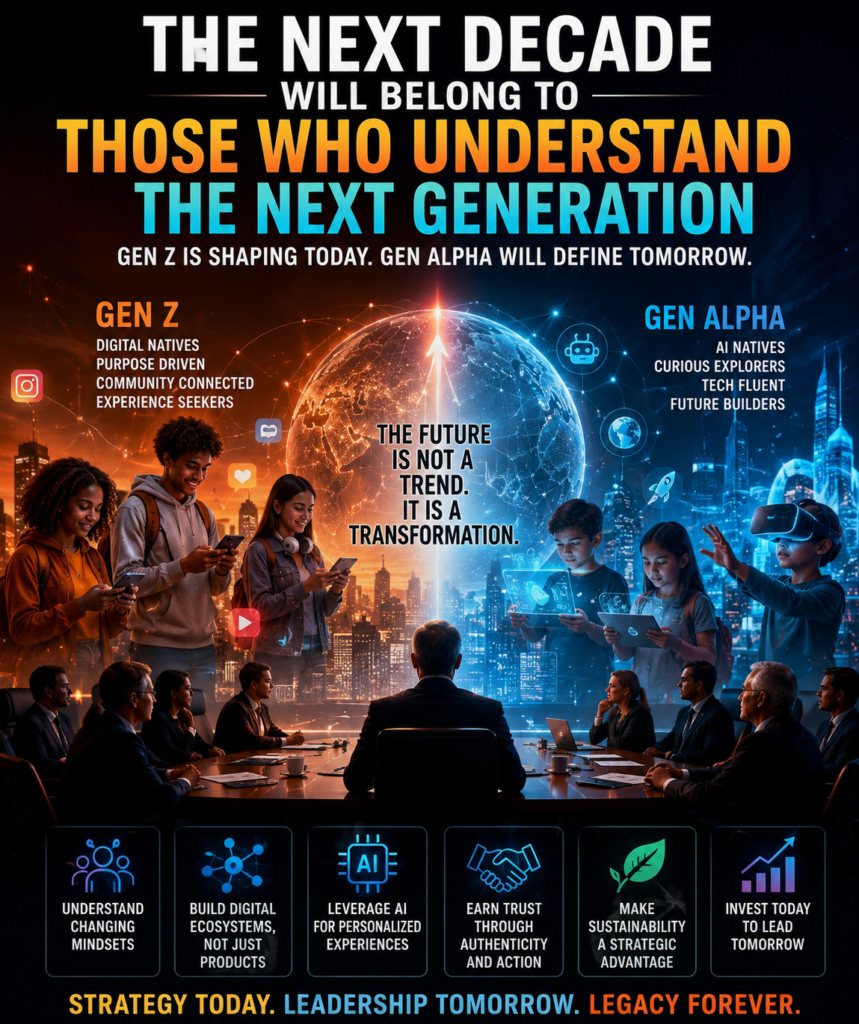
The global consumer economy is undergoing one of the most profound transformations since the Industrial Revolution. Every major business disruption over the past century has been driven by demographic change coupled with technological innovation. Today, these two forces are converging simultaneously. Generation Z has emerged as the world’s first economically influential digital-native generation, while Generation Alpha is becoming the first AI-native generation. Together, these two cohorts will redefine consumer demand, reshape business models, influence family purchasing decisions, transform workplace expectations, and determine the future competitive landscape across nearly every industry.
Many organizations continue to design products, services, marketing campaigns, and customer experiences using assumptions built around Baby Boomers, Generation X, and Millennials. Although these generations continue to contribute significantly to global purchasing power, their consumption behaviors differ fundamentally from those of younger consumers who have never experienced a world without smartphones, high-speed internet, social media, cloud computing, artificial intelligence, and instant access to information.
The consequence is increasingly visible across industries. Companies with strong legacy brands are witnessing declining engagement among younger consumers despite maintaining product quality. Marketing investments are generating diminishing returns because traditional advertising no longer commands attention. Customer loyalty is eroding as digital communities replace institutional trust. Sales funnels designed around awareness, consideration, and purchase are being compressed into minutes through social commerce and AI-assisted recommendations.
This paper argues that the future of corporate growth will depend less on product superiority alone and more on an organization’s ability to understand, engage, and continuously evolve alongside Generation Z and Generation Alpha. Businesses that fail to redesign their marketing and sales strategies for these emerging generations risk gradual irrelevance regardless of brand heritage or market leadership.
The article presents a strategic framework explaining how organizations can transition from product-centric selling to experience-centric value creation while leveraging artificial intelligence, data analytics, digital ecosystems, creator economies, immersive commerce, and community-driven engagement. Rather than treating Generation Z and Generation Alpha as merely younger customers, organizations must recognize them as architects of an entirely new economic system.
Introduction
History demonstrates that every dominant consumer generation reshapes the global economy according to its values, technologies, and aspirations. Baby Boomers created the age of mass manufacturing and institutional brands. Generation X accelerated globalization, operational excellence, and corporate professionalism. Millennials transformed commerce through smartphones, digital platforms, and e-commerce.
Generation Z and Generation Alpha are introducing a far more disruptive transition.
Unlike previous generations that adapted to technology, these generations have developed alongside technology. Artificial intelligence is not viewed as innovation but as infrastructure. Social media is not entertainment but social identity. Digital ecosystems are not channels but living environments. Brands are no longer evaluated solely by price or quality; they are assessed by authenticity, transparency, sustainability, inclusivity, digital convenience, and social relevance.
This shift represents a structural transformation rather than a cyclical market trend.
For business leaders, the implications extend far beyond advertising strategy. Product innovation, customer acquisition, pricing architecture, sales enablement, channel management, organizational design, and corporate governance must all evolve to remain competitive.
The emergence of these generations also coincides with unprecedented advances in artificial intelligence. AI is transforming consumer discovery, recommendation systems, search behavior, personalized marketing, dynamic pricing, predictive analytics, customer service, and post-purchase engagement. Consequently, organizations must simultaneously redesign for a new generation of consumers and a new generation of technology.
The convergence of demographic transformation and AI-driven commerce is creating what may be described as the AI Generation Economy.
The Economic Rise of Generation Z and Generation Alpha
Generation Z already represents one of the largest demographic cohorts in modern history. Across developed and emerging economies, they are entering the workforce, establishing independent purchasing power, influencing family consumption, and shaping social trends.
Generation Alpha, although still largely dependent on parents, is rapidly influencing household purchasing decisions. Studies consistently demonstrate that children increasingly influence spending decisions related to consumer electronics, education, entertainment, healthcare, food, travel, apparel, financial products, and household technology.
The purchasing influence of these two generations extends well beyond direct spending. They act as digital advisors within families by comparing products, reading reviews, validating brand claims, and recommending alternatives based on online communities.
Consequently, organizations must recognize that purchasing authority is becoming increasingly decentralized.
The customer is no longer the only decision-maker.
The family has become an interconnected digital buying committee.
Table 1. Evolution of Consumer Influence Across Generations
| Generation | Primary Buying Driver | Decision Influencer | Information Source | Purchase Validation |
| Baby Boomers | Brand reputation | Self | Newspapers, TV | Company credibility |
| Generation X | Product quality | Family | Websites | Expert reviews |
| Millennials | Convenience | Peers | Google, Social Media | Customer ratings |
| Generation Z | Authenticity | Digital communities | Short-form content | Influencers and creators |
| Generation Alpha | Experience | AI and family | AI assistants, immersive platforms | Community and AI recommendations |
The transformation illustrated above fundamentally changes marketing economics. Traditional media influence continues to decline while algorithmic discovery increasingly determines which products consumers encounter.
Companies are therefore competing not only against rival brands but also against platform algorithms.
Why Traditional Marketing Models Are Losing Effectiveness
For nearly seven decades, organizations relied upon a relatively stable marketing architecture.
Mass advertising generated awareness.
Retail generated accessibility.
Sales promotions stimulated purchases.
Brand equity sustained loyalty.
This model assumed that customers consumed information sequentially and made relatively rational purchasing decisions.
Generation Z has disrupted each of these assumptions.
Consumers increasingly skip traditional advertising through subscription platforms and ad-blocking technologies. Search behavior has shifted from search engines toward social platforms where discovery occurs through creators rather than corporations. Product evaluation happens within digital communities instead of company websites. Purchase decisions are increasingly influenced by peer-generated content rather than professionally designed advertising campaigns.
Generation Alpha is expected to accelerate these behavioral changes even further through conversational AI interfaces that recommend products automatically based upon contextual understanding.
Marketing therefore shifts from interruption to participation.
Companies no longer control the customer conversation.
Customers control the corporate narrative.
Table 2. Traditional Marketing versus AI Generation Marketing
| Traditional Marketing | AI Generation Marketing |
| Brand speaks | Community speaks |
| Advertising | Authentic storytelling |
| Corporate messaging | Creator ecosystems |
| Television | Mobile-first platforms |
| Campaign-based | Always-on engagement |
| Mass communication | Hyper-personalization |
| Annual strategy | Real-time optimization |
| Customer segmentation | Individual personalization |
| Product promotion | Experience creation |
| Loyalty programs | Community belonging |
Organizations failing to recognize this transition often experience declining customer acquisition efficiency despite increasing marketing expenditure.
The problem rarely lies in media budgets.
The problem lies in strategic assumptions.
The New Consumer Decision Architecture
Consumer behavior has evolved dramatically over the past decade.
Traditional purchase journeys followed a linear progression.
Need recognition.
Information search.
Evaluation.
Purchase.
Post-purchase evaluation.
Generation Z increasingly follows an entirely different pathway.
Discovery occurs unexpectedly through social feeds.
Interest develops within seconds.
Community validation happens instantly.
AI summarizes product comparisons.
Purchases occur within the same platform.
Recommendations generate additional purchases.
The journey has become circular rather than linear.
Every customer simultaneously acts as buyer, reviewer, marketer, and influencer.
Table 3. Consumer Journey Evolution
| Traditional Funnel | AI Generation Consumer Loop |
| Awareness | Discovery |
| Interest | Community Interaction |
| Consideration | AI Validation |
| Purchase | Social Sharing |
| Loyalty | Creator Advocacy |
| Repeat Purchase | Community Growth |
This evolution requires organizations to redesign every customer touchpoint.
Marketing, sales, customer service, technology, and product development must operate as a unified ecosystem rather than independent business functions.
Understanding the Psychology of Generation Z
Generation Z is frequently misunderstood because organizations often interpret their behavior through historical frameworks.
This generation is not merely younger Millennials.
Their worldview has been shaped by continuous digital connectivity, economic uncertainty, climate discussions, pandemic disruptions, rapid technological advancement, and unprecedented access to information.
Consequently, they evaluate brands differently.
They expect transparency before trust.
Experience before ownership.
Purpose before promotion.
Speed before process.
Authenticity before perfection.
This psychological profile has profound implications for marketers.
Consumers increasingly reward brands that demonstrate genuine values rather than polished messaging.
Corporate hypocrisy is identified rapidly.
Brand promises are verified instantly.
Reputational crises spread globally within hours.
Trust therefore becomes operational rather than promotional.
Organizations must demonstrate values continuously rather than communicate them periodically.
Table 4. Generation Z Consumer Psychology
| Psychological Characteristic | Marketing Implication |
| Values authenticity | Transparent communication |
| Highly informed | Data-backed claims |
| Digital-first | Mobile-first experiences |
| Community-driven | Social engagement |
| Low institutional trust | User-generated credibility |
| High personalization expectations | AI-driven recommendations |
| Instant gratification | Fast customer experiences |
| Social responsibility | ESG integration |
| Experience-oriented | Experiential marketing |
| Continuous learning | Educational content marketing |
The most successful organizations no longer ask how to sell products.
They ask how to create meaningful participation within customers’ digital lives.
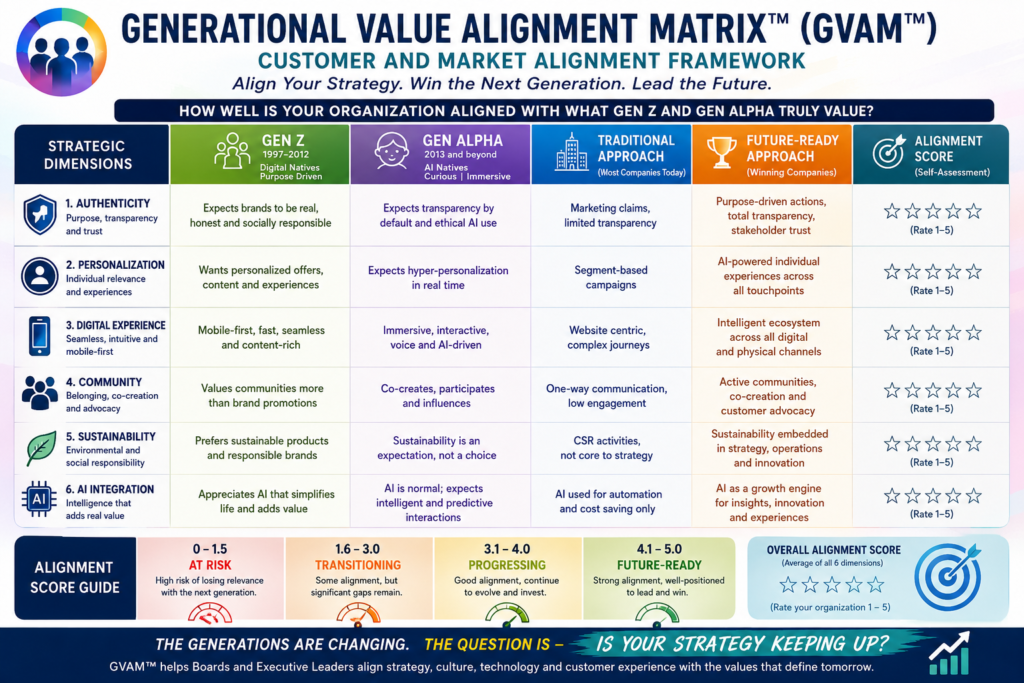
The Generational Value Alignment Matrix™ (GVAM™)
The transition from product-centric organizations to customer-centric enterprises requires more than marketing innovation. It requires strategic alignment between organizational capabilities and the evolving expectations of future consumers. To help Boards and executive leadership teams evaluate this transformation, I propose the Generational Value Alignment Matrix™ (GVAM™).
The framework enables organizations to measure whether their products, customer experience, digital capabilities, sustainability initiatives, AI investments, and brand strategy are aligned with the values that increasingly influence Generation Z and, eventually, Generation Alpha.
Table 5. Generational Value Alignment Matrix™ (GVAM™)
| Strategic Dimension | Traditional Company | Future-Ready Company |
| Authenticity | Marketing claims | Transparent actions |
| Personalization | Customer segments | Individual experiences |
| Digital Experience | Website | Intelligent ecosystem |
| Community | Customer database | Brand community |
| Sustainability | CSR initiative | Business strategy |
| AI Integration | Operational tool | Customer growth engine |
Organizations with consistently high alignment across these dimensions are likely to experience stronger customer trust, improved engagement, lower acquisition costs, and greater long-term brand relevance. For Boards, GVAM™ provides an early warning system that identifies capability gaps before they become revenue gaps.
Generation Alpha: Preparing for the Next Consumer Revolution
If Generation Z transformed digital commerce, Generation Alpha is likely to redefine intelligent commerce.
Children born after 2013 are growing up in environments where artificial intelligence assists education, entertainment, communication, creativity, healthcare, and everyday decision-making.
Unlike previous generations, AI will not represent technological disruption.
It will represent normal life.
These consumers will expect every interaction to be intelligent, predictive, personalized, and conversational.
Static websites will appear outdated.
Traditional customer service may become largely obsolete.
Search engines may increasingly be replaced by conversational AI assistants capable of recommending products based on contextual understanding rather than keyword matching.
Organizations that continue optimizing solely for search engines risk becoming invisible within future AI ecosystems.
Marketing strategy must therefore evolve from Search Engine Optimization toward Answer Engine Optimization, Knowledge Graph Optimization, and AI Discoverability.
Table 6. Evolution Toward AI-Native Commerce
| Current Digital Commerce | AI-Native Commerce |
| Search-based | Conversation-based |
| Websites | AI interfaces |
| Product catalogues | Intelligent recommendations |
| Customer support | Autonomous AI agents |
| Email campaigns | Predictive engagement |
| Static pricing | Dynamic contextual pricing |
| Human segmentation | AI individualization |
| Manual customer journeys | Autonomous customer experiences |
The organizations investing today in AI-enabled customer engagement, intelligent CRM systems, conversational commerce, predictive analytics, and hyper-personalized digital ecosystems will likely establish enduring competitive advantages as Generation Alpha matures into independent consumers.
The strategic imperative is clear. Companies must stop preparing only for the next marketing campaign and begin preparing for the next consumer civilization.
Strategic Marketing and Sales Framework for Winning Generation Z and Generation Alpha
The transition toward the AI Generation Economy demands a fundamental redesign of corporate strategy. Organizations that continue to optimize marketing around products, pricing, and promotions alone will increasingly lose relevance. The future belongs to companies that create ecosystems rather than transactions, relationships rather than campaigns, and communities rather than customer databases.
The next decade will not be won by organizations with the largest advertising budgets. It will be won by organizations capable of creating intelligent, adaptive, and emotionally engaging customer experiences powered by data, artificial intelligence, and human creativity.
The Strategic Shift from Product-Centric to Customer-Centric Growth
For decades, businesses competed by improving product quality, expanding distribution, and increasing promotional expenditure. Although these remain important, they are no longer sufficient.
Generation Z and Generation Alpha evaluate an organization as an integrated experience rather than a collection of products.
Every digital interaction contributes to brand perception.
Website performance communicates operational excellence.
Customer service demonstrates organizational culture.
Packaging reflects sustainability commitment.
Social media interactions reveal authenticity.
Artificial intelligence capabilities indicate future readiness.
Consequently, competitive advantage increasingly emerges from organizational alignment rather than isolated marketing initiatives.
Table 7. Strategic Evolution of Competitive Advantage
| Traditional Growth Driver | Future Growth Driver |
| Product Features | Customer Experience |
| Market Share | Customer Lifetime Value |
| Advertising Reach | Community Engagement |
| Sales Volume | Customer Advocacy |
| Brand Awareness | Brand Trust |
| Price Competition | Experience Differentiation |
| Physical Distribution | Digital Ecosystem |
| Customer Acquisition | Customer Retention |
| Campaign ROI | Relationship ROI |
| Market Presence | Digital Relevance |
Organizations capable of integrating these dimensions consistently outperform competitors because they reduce customer acquisition costs while simultaneously increasing customer lifetime value.
The Rise of Community-Led Marketing
Perhaps the most significant transformation in modern marketing is the shift from audience-building to community-building.
Traditional marketing treated consumers as passive recipients of corporate communication.
Generation Z expects participation.
Generation Alpha will expect co-creation.
Successful organizations increasingly involve customers in product development, content creation, innovation feedback, sustainability initiatives, and brand storytelling.
Communities create emotional ownership.
Ownership creates advocacy.
Advocacy creates sustainable growth.
The strongest brands of the next decade will therefore resemble digital communities rather than conventional corporations.
Table 8. Audience Marketing versus Community Marketing
| Audience Model | Community Model |
| Customers receive messages | Customers participate |
| Brand controls communication | Community shapes communication |
| Marketing campaigns | Continuous conversations |
| Transactions | Relationships |
| Followers | Members |
| Promotions | Shared experiences |
| Customer satisfaction | Customer belonging |
| Brand awareness | Brand advocacy |
Community-led organizations consistently experience stronger customer retention, higher referral rates, greater resilience during market disruptions, and superior long-term profitability.
Artificial Intelligence as the New Sales Engine
Artificial intelligence is transforming every stage of the modern sales process.
Lead generation is becoming predictive.
Customer segmentation is becoming dynamic.
Pricing is becoming contextual.
Sales forecasting is becoming increasingly accurate.
Customer support is becoming conversational.
Product recommendations are becoming individualized.
Instead of replacing sales professionals, AI is augmenting human decision-making by eliminating repetitive activities and enabling more meaningful customer engagement.
The highest-performing sales organizations increasingly combine emotional intelligence with artificial intelligence.
Sales representatives become consultants.
AI becomes the analytical partner.
Together they create significantly higher conversion rates.
Table 9. AI Across the Modern Sales Funnel
| Sales Function | AI Capability | Business Impact |
| Lead Generation | Predictive prospect identification | Higher quality leads |
| Prospect Qualification | Behavioral analysis | Better conversion rates |
| Pricing | Dynamic optimization | Increased revenue |
| Customer Support | Conversational AI | Faster response time |
| Sales Forecasting | Predictive analytics | Improved planning |
| Cross-selling | Recommendation engines | Higher average order value |
| Customer Retention | Churn prediction | Improved loyalty |
| CRM | Intelligent automation | Increased productivity |
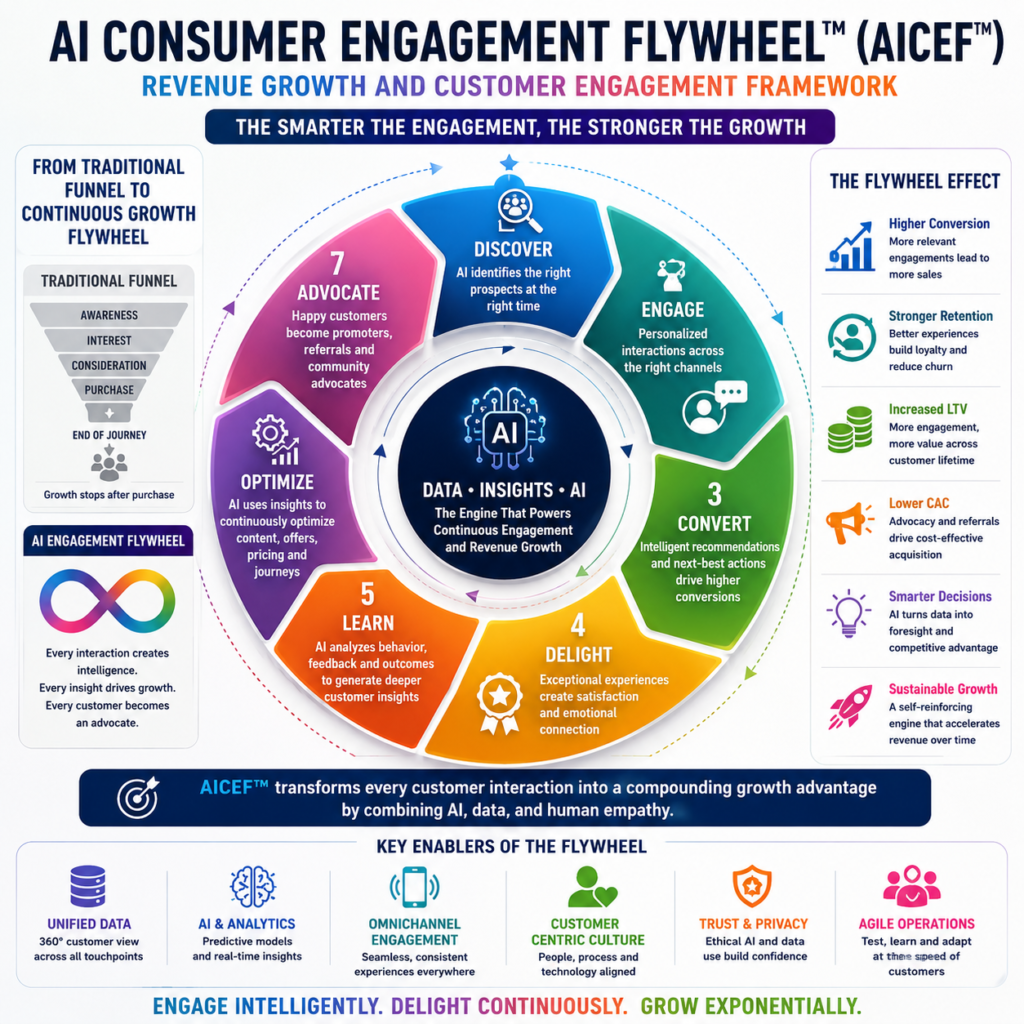
The AI Consumer Engagement Flywheel™ (AICEF™)
Organizations that delay AI adoption may find themselves competing against companies capable of delivering faster, smarter, and more personalized customer experiences at significantly lower operating costs.
While artificial intelligence is transforming individual sales activities, its greatest strategic value lies in creating a continuous learning system that improves every customer interaction. Rather than viewing AI as another automation initiative, organizations should deploy it as a self-reinforcing growth engine.
To operationalize this concept, I propose the AI Consumer Engagement Flywheel™ (AICEF™).
Table 10. AI Consumer Engagement Flywheel™ (AICEF™)
| Stage | Strategic Objective | Business Outcome |
| Discover | AI identifies prospects | Better targeting |
| Engage | Personalized interactions | Higher engagement |
| Convert | Intelligent recommendations | Increased conversions |
| Delight | Exceptional experiences | Higher satisfaction |
| Learn | Customer behavior analytics | Better insights |
| Optimize | AI improves engagement | Higher efficiency |
| Advocate | Customers become promoters | Organic growth |
Unlike the traditional sales funnel, which effectively ends after purchase, the AICEF™ framework demonstrates how every customer interaction generates new intelligence that improves future engagement, increases personalization, strengthens advocacy, and continuously lowers customer acquisition costs. The flywheel transforms marketing expenditure into a compounding strategic asset.
The Creator Economy and the New Sales Channel
The traditional relationship between brands and consumers has evolved into a triangular relationship involving creators, communities, and companies.
Influencers have expanded into trusted educators, product reviewers, niche experts, and community leaders.
Consumers increasingly trust individuals with demonstrated expertise more than corporate advertising.
This does not imply that celebrity endorsements are universally effective.
Instead, authenticity has become the dominant currency.
Micro-creators often generate stronger engagement than global celebrities because they possess higher credibility within specialized communities.
Organizations should therefore evaluate creators based on relevance, audience trust, engagement quality, and long-term alignment rather than follower counts alone.
Table 11. Evolution of Influencer Marketing
| Traditional Celebrity Marketing | Creator Economy Strategy |
| Mass reach | Niche influence |
| One-way promotion | Community engagement |
| High-cost endorsements | Long-term partnerships |
| Campaign-based | Continuous collaboration |
| Awareness focused | Trust focused |
| Visibility | Credibility |
| Paid advertisements | Authentic storytelling |
The creator economy represents not merely a marketing channel but an entirely new distribution ecosystem capable of accelerating customer acquisition while strengthening brand authenticity.
Personalization at Scale
One of the defining characteristics of Generation Z and Generation Alpha is their expectation of individualized experiences.
Consumers increasingly assume that companies understand their preferences, anticipate their needs, and simplify decision-making.
Artificial intelligence enables organizations to personalize recommendations, communications, pricing strategies, loyalty programs, educational content, and after-sales engagement without proportionally increasing operational complexity.
Personalization no longer represents competitive differentiation.
It has become an operational expectation.
Table 12. Evolution of Personalization
| Traditional Personalization | AI Personalization |
| Demographic segmentation | Individual behavior |
| Monthly campaigns | Real-time engagement |
| Email targeting | Omnichannel intelligence |
| Static offers | Dynamic recommendations |
| Historical analysis | Predictive anticipation |
| Manual optimization | Autonomous learning |
Organizations capable of responsibly leveraging customer data while maintaining privacy and transparency will establish stronger trust and significantly improve commercial performance.
Sustainability as a Revenue Strategy
Environmental responsibility is often perceived as a compliance obligation.
For Generation Z and Generation Alpha, sustainability increasingly influences purchasing decisions.
Consumers seek evidence rather than promises.
Organizations must therefore integrate sustainability into product design, packaging, logistics, manufacturing, sourcing, communication, and governance.
Greenwashing creates reputational damage.
Transparency creates competitive advantage.
Companies capable of quantifying environmental impact through measurable data are likely to outperform organizations relying upon emotional sustainability messaging alone.
Table 13. Sustainability and Commercial Value
| Traditional ESG Approach | Growth-Oriented ESG Strategy |
| Compliance | Competitive advantage |
| Annual reporting | Continuous transparency |
| Corporate responsibility | Customer value proposition |
| Cost center | Revenue accelerator |
| Marketing message | Operational commitment |
The convergence of sustainability and digital transparency will increasingly determine purchasing preferences among younger consumers.
The Future Sales Organization
Sales organizations are evolving from transactional structures toward intelligent customer engagement systems.
The future sales professional will possess analytical capability, emotional intelligence, digital fluency, AI literacy, strategic consulting skills, and customer success orientation.
Routine selling will increasingly be automated.
Complex selling will become more valuable.
Organizations should therefore invest in continuous capability development alongside technology modernization.
Table 14. Sales Professional of the Future
| Traditional Salesperson | Future Sales Consultant |
| Product expert | Business advisor |
| Relationship manager | Ecosystem orchestrator |
| Negotiator | Problem solver |
| CRM user | AI collaborator |
| Territory manager | Customer success leader |
| Quarterly targets | Lifetime value management |
| Sales reporting | Predictive analytics |
Organizations that modernize both technology and talent simultaneously will enjoy sustainable competitive advantages.
The CEO’s Strategic Agenda
The implications of demographic transformation extend beyond marketing departments.
Boards of directors, chief executive officers, chief marketing officers, chief digital officers, and chief human resource officers must collectively redesign organizational strategy around future consumer expectations.
The AI Generation Economy requires enterprise-wide transformation.
Marketing becomes data science.
Sales becomes consulting.
Customer service becomes intelligent engagement.
Innovation becomes continuous.
Culture becomes competitive advantage.
Organizations capable of integrating these capabilities will define market leadership over the coming decades.
Table 15. Executive Priorities for the AI Generation Economy
| Executive Function | Strategic Priority |
| CEO | Digital transformation and customer-centric growth |
| Board of Directors | Long-term demographic strategy |
| CMO | AI-enabled marketing ecosystems |
| Chief Sales Officer | Intelligent revenue generation |
| CIO/CDO | Data and AI infrastructure |
| CHRO | Future workforce capability |
| COO | Customer experience integration |
Leadership alignment across these functions determines whether organizations merely adopt technology or successfully transform business models.
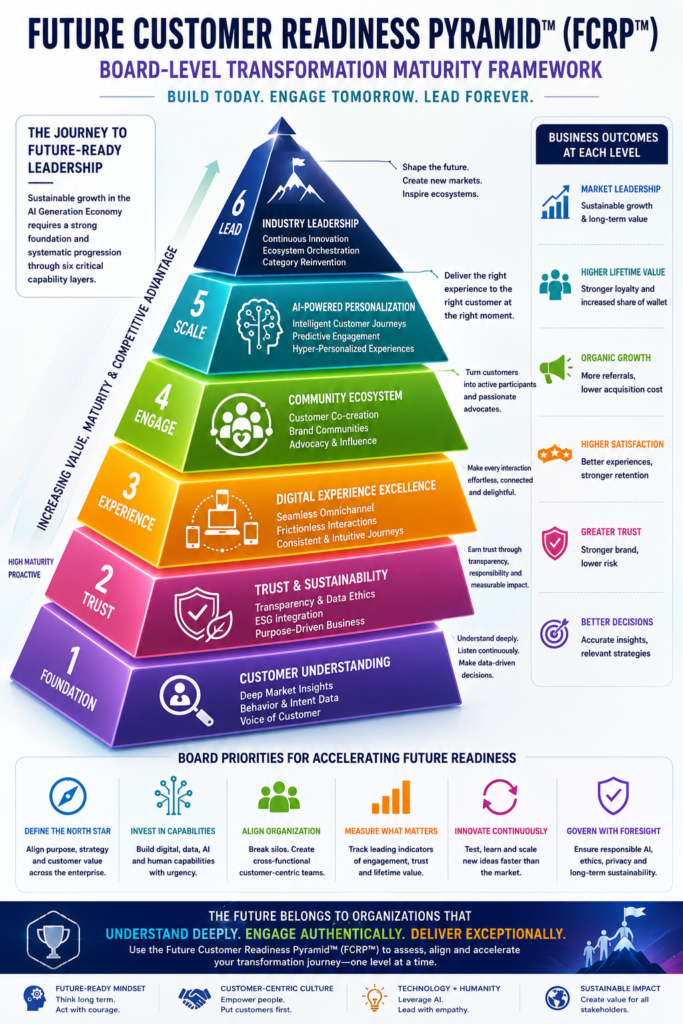
The Future Customer Readiness Pyramid™ (FCRP™)
Many organizations attempt digital transformation through isolated investments in technology, AI, or marketing automation. Sustainable competitive advantage, however, requires a systematic progression of organizational capabilities.
To assist Boards in evaluating transformation maturity, I propose the Future Customer Readiness Pyramid™ (FCRP™).
Table 16. Future Customer Readiness Pyramid™ (FCRP™)
| Pyramid Level | Strategic Capability | Organizational Focus |
| Level 6 | Industry Leadership | Continuous innovation |
| Level 5 | AI-Powered Personalization | Intelligent customer journeys |
| Level 4 | Community Ecosystem | Customer advocacy |
| Level 3 | Digital Experience Excellence | Seamless omnichannel engagement |
| Level 2 | Trust & Sustainability | Transparency and ESG integration |
| Level 1 | Customer Understanding | Behavioral insights and market intelligence |
The framework illustrates that future competitiveness is not built through technology alone. It begins with deep customer understanding, progresses through trust and digital experience, expands into community-led engagement, scales through AI-enabled personalization, and ultimately culminates in continuous innovation. Organizations that attempt to skip foundational layers often struggle to realize returns from advanced digital investments.
Conclusion
The emergence of Generation Z and Generation Alpha represents far more than a demographic transition. It marks the beginning of a fundamentally different economic paradigm where artificial intelligence, digital ecosystems, community influence, immersive experiences, and continuous personalization redefine the relationship between organizations and consumers.
Businesses that continue relying upon twentieth-century marketing assumptions will encounter declining engagement, rising customer acquisition costs, diminishing loyalty, and increasing competitive pressure from digitally native organizations.
Conversely, companies that embrace intelligent marketing, community-driven engagement, AI-enabled sales, ethical data practices, sustainable business models, and customer-centric innovation will position themselves for long-term leadership.
The next decade will not reward the organizations that communicate the loudest.
It will reward those that understand the deepest.
Marketing will evolve from persuasion to participation.
Sales will evolve from transactions to trusted advisory relationships.
Brands will evolve from products to ecosystems.
Artificial intelligence will transition from operational support to strategic growth infrastructure.
Generation Z and Generation Alpha are not simply the consumers of tomorrow.
They are already redefining the marketplace of today.
Organizations that recognize this transformation early will not merely increase revenue. They will build resilient, future-ready enterprises capable of sustaining competitive advantage in an increasingly intelligent, connected, and experience-driven global economy.
The AI Generation Economy has already begun.
The only remaining strategic question is whether organizations choose to lead it or struggle to catch up.
References
- Deloitte. (2025). 2025 Gen Z and Millennial Survey. https://www.deloitte.com/global/en/issues/work/content/genzmillennialsurvey.html
- McKinsey & Company. (2024). The State of the Consumer. https://www.mckinsey.com/capabilities/growth-marketing-and-sales
- PwC. (2024). Global Consumer Insights Survey. https://www.pwc.com/gx/en/industries/consumer-markets/consumer-insights-survey.html
- Bain & Company. (2024). Consumer Products and Retail Insights. https://www.bain.com/industries/consumer-products
- Accenture. (2024). Life Trends Report. https://www.accenture.com/us-en/insights/song/life-trends
- World Economic Forum. (2024). The Future of Jobs Report. https://www.weforum.org/reports/the-future-of-jobs-report
- Harvard Business Review. (2024). Marketing in the Age of AI. https://hbr.org
- MIT Sloan Management Review. (2024). Artificial Intelligence and Customer Experience. https://sloanreview.mit.edu
- Gartner. (2024). Future of Sales Research. https://www.gartner.com/en/sales
- Salesforce Research. (2024). State of the Connected Customer. https://www.salesforce.com/resources/research-reports
- NielsenIQ. (2024). Global Consumer Intelligence Series. https://nielseniq.com
- Kantar. (2024). Global BrandZ Report. https://www.kantar.com/campaigns/brandz
- IBM Institute for Business Value. (2024). Consumer Research Insights. https://www.ibm.com/thought-leadership/institute-business-value
- Euromonitor International. (2024). Top Global Consumer Trends. https://www.euromonitor.com/insights
- Statista. (2025). Global Digital Consumer Statistics. https://www.statista.com
Disclaimer
This article presents the author’s original strategic perspectives, proprietary frameworks, and independent analysis on the evolving marketing, sales, and business implications of Generation Z and Generation Alpha within the emerging AI-driven economy. The frameworks introduced in this article, including the Generational Value Alignment Matrix™ (GVAM™), AI Consumer Engagement Flywheel™ (AICEF™), and Future Customer Readiness Pyramid™ (FCRP™), are original intellectual property developed by the author and are intended to provide conceptual guidance for strategic planning, boardroom discussions, executive decision-making, organizational transformation, and management education.
The analysis has been developed using insights synthesized from publicly available academic literature, industry research, government publications, consulting reports, and globally recognized business institutions. While every effort has been made to ensure the accuracy, relevance, and reliability of the information presented, market conditions, consumer preferences, technological developments, competitive dynamics, regulatory environments, and macroeconomic factors continue to evolve and may influence the applicability of the observations and recommendations contained herein.
The strategic models, frameworks, interpretations, forecasts, and recommendations presented in this article are intended solely for educational, research, knowledge-sharing, and thought leadership purposes. They should not be construed as legal, financial, investment, accounting, taxation, or professional consulting advice. Organizations should undertake their own market research, customer analysis, financial evaluation, risk assessment, and professional due diligence before implementing any strategic, operational, investment, or commercial decisions based on the concepts discussed in this publication.
The author makes no representation or warranty, express or implied, regarding the completeness, accuracy, suitability, or future performance of the strategies described and shall not be held liable for any direct, indirect, incidental, consequential, commercial, or financial loss arising from the use of, or reliance upon, the information contained in this article.
All trademarks, registered trademarks, company names, brand names, logos, and product names referenced remain the property of their respective owners and are used solely for identification, commentary, research, educational, or comparative purposes. Any resemblance between the proprietary frameworks presented in this article and existing commercial methodologies is purely coincidental unless explicitly acknowledged.
Copyright © Ratin Mathur. All Rights Reserved. No part of this publication, including its original strategic frameworks, conceptual models, diagrams, visualizations, methodologies, or written content, may be reproduced, adapted, translated, distributed, published, transmitted, stored in any retrieval system, or used for commercial purposes without the prior written permission of the author, except where permitted under applicable copyright laws for citation, review, or academic reference with appropriate attribution.