A Strategic Research Paper On Workforce Expansion, Employee Well-Being, Cognitive Overload, And The Future Of Human-Agent Collaboration
Executive Summary
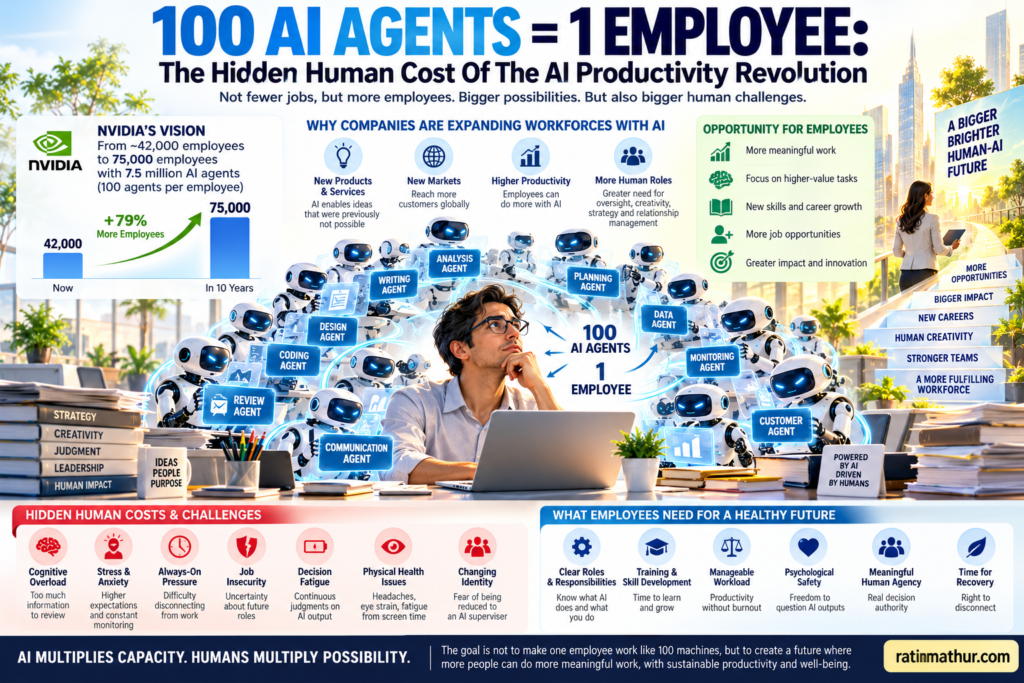
What if the next artificial intelligence revolution does not primarily reduce the number of employees in a company, but dramatically increases the amount of work each employee can undertake? And what if the greatest challenge of this transformation is not a shortage of jobs, but the growing psychological and cognitive burden placed on the people expected to manage millions of autonomous digital workers?
At NVIDIA’s GTC conference in March 2026, CEO Jensen Huang described a possible future in which the company employs 75,000 people working alongside 7.5 million AI agents by approximately 2036. NVIDIA had around 42,000 employees at the end of its fiscal year 2026. Huang’s projection therefore implies a potential increase of approximately 33,000 employees, or nearly 79% above that workforce baseline, alongside the deployment of millions of agents (Angelo, 2026; NVIDIA Corporation, 2026). This is a vision of workforce expansion, not an announcement of planned layoffs.
That distinction fundamentally changes the discussion about AI and employment. Huang’s vision suggests that AI could expand organizational capacity, enable businesses to pursue previously impractical opportunities, and create demand for more human talent. Agents would perform routine and repetitive tasks while employees concentrate on higher-value work, manage complex projects, and solve problems that organizations previously lacked the capacity to address.
However, workforce expansion does not automatically guarantee a healthier workforce. An organization can employ more people, create new opportunities, and still expose its employees to excessive workloads, persistent monitoring, decision fatigue, technological anxiety, and declining psychological recovery. When AI makes it possible to complete more work, management may continuously raise expectations about what employees should accomplish.
Emerging research illustrates this tension. The International Labour Organization’s 2026 review of empirical evidence found that productivity gains from generative AI are real but uneven, with significant questions about their translation into measurable output, employment, and job quality (Merola et al., 2026). Research from Anthropic, published in October 2026, similarly describes how expanding agent use can increase employee output while making human attention a bottleneck. In its own AI-intensive workplace, the company found that reading all output generated in interactive agent sessions could consume more than half a working week for some nontechnical employees (Wilmers et al., 2026).
This paper examines the implications for employees when AI creates more work capacity rather than simply eliminating jobs. It explores cognitive overload, mental fatigue, stress, job insecurity, professional identity, physical discomfort, workplace relationships, and the difficulty of disconnecting from continuously operating agents. It proposes three conceptual frameworks: the Human-Centered AI Workforce Framework (HCAW™), the Cognitive Load And Recovery Equilibrium Framework (CLRE™), and the Human Agency And Psychological Safety Framework (HAPS™).
The central argument is that the next competitive advantage will not come from maximizing the number of AI agents or the output demanded from employees. It will come from building organizations that use AI to expand human potential, create meaningful employment opportunities, and achieve sustainable productivity without exhausting the people responsible for converting technological capacity into business value.
Introduction
The history of technological progress is not simply a history of machines replacing human labor. It is also a history of new industries, new occupations, new products, and new forms of economic activity that were difficult to imagine before the technology emerged.
Computers created demand for software developers, systems analysts, cybersecurity professionals, and digital marketers. The internet enabled new business models, global digital commerce, and entirely new categories of employment. Industrial automation transformed manufacturing while increasing demand for specialized engineering, maintenance, logistics, and technical skills.
Artificial intelligence could initiate another such transformation. Its importance lies not only in its ability to automate existing activities, but also in its potential to make new activities economically viable. Organizations may be able to explore more markets, develop products faster, provide more personalized services, conduct more research, and solve problems that previously required excessive time or financial resources.
This is the optimistic interpretation of Jensen Huang’s vision. A company employing 75,000 people alongside 7.5 million agents would have substantially greater execution capacity than a traditional organization of comparable human size. AI agents could work continuously, while human employees determine priorities, supply judgment, supervise consequential decisions, and pursue opportunities made possible by the additional capacity.
Yet an important question remains. If AI enables employees to do five times, ten times, or potentially much more work, will employees receive the benefits of that productivity through better work, greater opportunities, and improved working conditions? Or will organizations continuously increase expectations until the human workload expands to absorb every efficiency gain?
The distinction matters because human beings have finite attention, working memory, emotional capacity, and physical stamina. Machines may be able to execute tasks around the clock, but the people responsible for evaluating their output cannot indefinitely increase their concentration or eliminate their need for rest.
The future of work must therefore be understood through two interconnected transformations. The first is economic: AI can expand what businesses can accomplish and potentially increase demand for employees. The second is human: AI can change the intensity, structure, meaning, and psychological demands of the work employees perform.
The strategic challenge is to ensure that the first transformation does not undermine the second.
Problem Statement & Objectives
The central problem is not that AI agents will inevitably eliminate employment. It is that expanding technological capacity can create an expectation of continuously expanding human performance.
When an employee can delegate research, reporting, analysis, and administration to AI agents, management may expect the employee to undertake more projects, respond to more customers, evaluate more alternatives, and deliver more decisions within the same working day. The employee’s role expands from executing tasks to orchestrating systems that generate an increasing volume of work.
This creates a new productivity paradox. AI may reduce the time required to perform an individual task while increasing the number of tasks assigned to the employee. It may eliminate repetitive work while creating new responsibilities involving validation, coordination, exception handling, and accountability. The employee can become more productive and more exhausted at the same time.
The objectives of this paper are to examine how workforce expansion through AI may influence employee well-being, explain why the volume of AI-generated work can exceed human review capacity, identify the organizational conditions that distinguish sustainable growth from work intensification, and propose practical frameworks for protecting employees while enabling business expansion.
The paper does not assume that workforce growth eliminates job insecurity or that AI necessarily causes stress and physical symptoms. Instead, it examines how the design of AI-enabled work, managerial expectations, job control, employee training, and psychological safety influence the outcomes of technological transformation.
The central proposition is that AI should expand the organization’s capacity to create value without creating an unlimited obligation for employees to absorb more work.
Methodology
This paper adopts a qualitative, exploratory approach based on secondary research, organizational psychology, occupational health guidance, and strategic analysis. It draws on the Fortune report describing Huang’s workforce vision, NVIDIA’s fiscal 2026 workforce disclosure, research from the International Labour Organization and OECD, the American Psychological Association’s workplace research, Microsoft’s Work Trend Index, and recent research on AI-intensive work and employee well-being.
The analysis distinguishes company-specific projections from broader employment trends. NVIDIA’s proposed increase to 75,000 employees is treated as a future scenario rather than a guarantee. Evidence from other organizations is used to illustrate potential mechanisms of change, not to establish that every enterprise will experience identical outcomes.
Three types of claims are considered. Published research findings are identified through citations. Potential psychological and operational consequences are described as risks whose severity depends on implementation. The proposed strategic frameworks are conceptual management models that require practical evaluation and empirical testing.
This approach is intended to support strategic decision-making rather than provide a clinical diagnosis, a universal forecast of AI-related employment, or a definitive prediction of future workforce size.
Landscape Analysis
NVIDIA’s Vision: More Employees, Millions Of Agents
Huang’s statement deserves to be interpreted accurately. The NVIDIA scenario does not describe a plan to replace 75,000 employees with AI agents. It describes a possible future in which the company employs 75,000 people and uses 7.5 million agents alongside them.
NVIDIA’s fiscal 2026 annual report disclosed approximately 42,000 employees as of January 25, 2026, compared with approximately 36,000 a year earlier (NVIDIA Corporation, 2026). The projected 75,000-person workforce would therefore represent an increase of approximately 33,000 employees from the fiscal 2026 baseline.
Table 1. NVIDIA’s Workforce Expansion Scenario
| Measure | Workforce Figure | Interpretation |
|---|---|---|
| NVIDIA Employees At Fiscal 2026 Year-End | 42,000 | Reported workforce baseline |
| Huang’s Illustrative Workforce In Ten Years | 75,000 | Future projection, not a guarantee |
| Potential Increase In Employees | 33,000 | Approximately 79% growth from baseline |
| Illustrative AI Agent Population | 7,500,000 | Projected digital workforce capacity |
| Agents Per Employee | 100 | Illustrative human-agent ratio |
Source: Angelo (2026) and NVIDIA Corporation (2026). Calculations are based on the reported and projected figures.
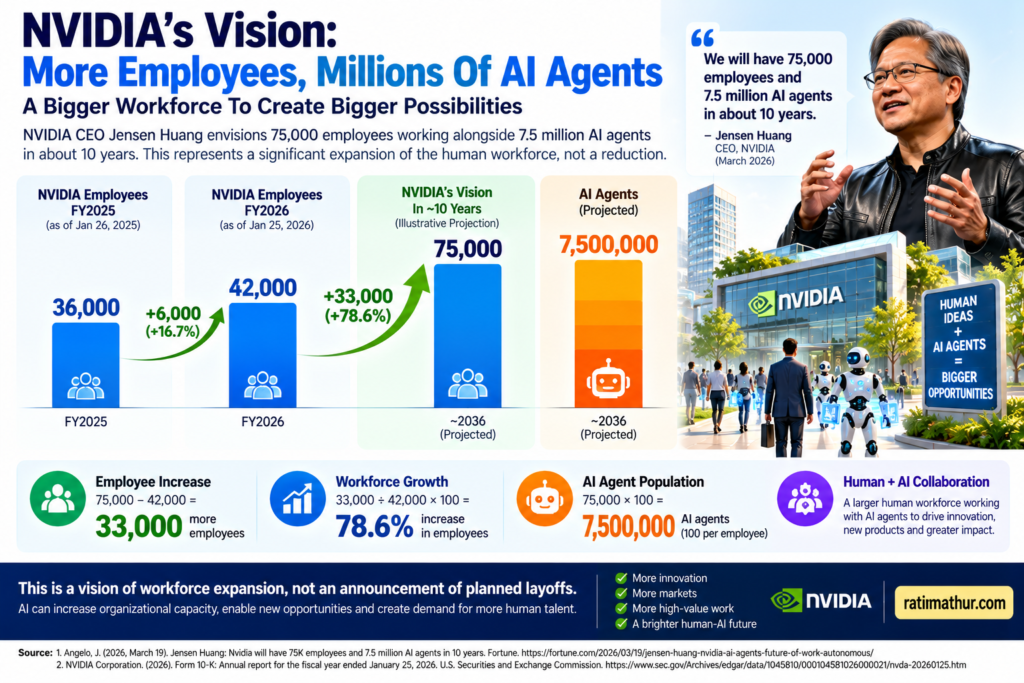
The implication is significant. Huang’s vision suggests that AI could enable an organization to expand both its digital capacity and its human workforce. The agents would undertake large volumes of work, while employees would remain responsible for defining objectives, solving problems, and converting the additional capacity into business outcomes.
However, this projection should not be interpreted as a guarantee that NVIDIA will create exactly 33,000 net new jobs, that every existing employee will remain employed, or that the company’s future hiring will follow a predetermined trajectory. It is a strategic vision, not a binding employment commitment.
The broader lesson is that AI adoption and workforce growth are not mutually exclusive. An organization can automate tasks while expanding into new markets, products, and research opportunities. The important question is whether the resulting growth creates meaningful employment and sustainable working conditions.
The Economic Mechanism: Productivity Can Expand Demand
AI can influence employment through several channels. It can automate tasks within existing jobs, complement employees by making them more productive, create new tasks and occupations, and reduce the cost of activities that previously were not commercially viable.
The OECD’s 2026 report on skills in the AI age emphasizes that these effects can coexist. AI exposure does not automatically translate into job destruction because productivity improvements and the creation of new activities can increase demand for human labor. Nevertheless, displacement remains a risk, particularly where work consists of routine and repetitive activities (OECD, 2026).
The International Labour Organization’s 2025 assessment similarly concluded that transformation of jobs is more likely than the complete replacement of entire occupations in most cases, because human input remains necessary across many tasks (Gmyrek et al., 2025). Its 2026 review of empirical evidence found that large-scale displacement had remained limited in the evidence examined, while warning that younger workers’ employment opportunities, worker autonomy, and job quality require attention (Merola et al., 2026).
These findings support a balanced interpretation of Huang’s vision. AI can contribute to workforce expansion, but that outcome depends on the economic opportunities created, the demand for the company’s products and services, the skills available, and management’s decisions about hiring and organizational design.
The Emerging Challenge: Human Attention Becomes Scarce
If agents increase the volume of work that can be produced, human attention may become a constraint on how much of that output can be evaluated and used.
Research published by Anthropic in October 2026 offers a particularly relevant illustration. Its study of employment and work organization at an AI-intensive company found that employee output increased as AI tools were adopted, but employees also faced a growing volume of agent-generated work. The researchers estimated that reading all output from interactive agent sessions could consume more than half the working week for some nontechnical employees (Wilmers et al., 2026).
This finding does not mean every employee supervising agents will experience the same burden. Anthropic is an AI company with unusually high levels of internal AI adoption. However, it demonstrates a plausible mechanism: when automated execution expands faster than the ability to review its output, human attention becomes a bottleneck.
The organization may need more employees precisely because AI enables more activity. Yet without thoughtful workflow design, those employees may spend an increasing share of their time monitoring machines rather than applying their own expertise.
The Human Cost Of An Expanding Workday
Microsoft’s 2025 Work Trend Index described a working environment in which digital communications and interruptions were already contributing to what it called an “infinite workday.” Its analysis of Microsoft 365 activity and a survey of 31,000 knowledge workers found that many employees struggled to keep pace with the volume and fragmentation of work (Microsoft, 2025).
AI agents could help address this problem by handling repetitive tasks and organizing information. They could also intensify it if management uses their availability to demand faster responses, additional deliverables, and continuous employee oversight.
The World Health Organization identifies excessive workloads, long working hours, low job control, unclear roles, and job insecurity as potential workplace risks to mental health (World Health Organization, 2026). These factors are not unique to AI. The concern is that AI may amplify them if productivity improvements are translated into permanently higher expectations.
The relevant strategic question is therefore not simply how much more work AI enables an employee to perform. It is how much additional work can be sustained without undermining concentration, judgment, recovery, and well-being.
Key Findings
Finding 1: Workforce Expansion Does Not Automatically Mean Workload Reduction
An expanding workforce can create more opportunities for employment, collaboration, and specialization. However, if AI increases the number of tasks that each employee is expected to complete, workload may continue to rise despite the addition of staff.
An employee who previously managed five projects may now manage ten because agents perform much of the underlying research and reporting. The organization has gained capacity, but the employee may face more decisions, more exceptions, and greater responsibility.
The critical measure is not the number of tasks completed but the total effort required to deliver reliable outcomes. Businesses should evaluate whether AI reduces overall effort, improves the quality of work, and creates time for higher-value activities, rather than automatically converting every time saving into additional targets.
Finding 2: The Productivity Paradox Can Create Cognitive Overload
AI agents can generate recommendations, summaries, analyses, and alerts faster than humans can review them. Employees must then filter information, evaluate reliability, resolve contradictions, and determine which issues require action.
When these activities become continuous, the employee may experience fragmented attention and cognitive overload. The difficulty is especially pronounced when several agents operate independently, use different assumptions, or produce conflicting results.
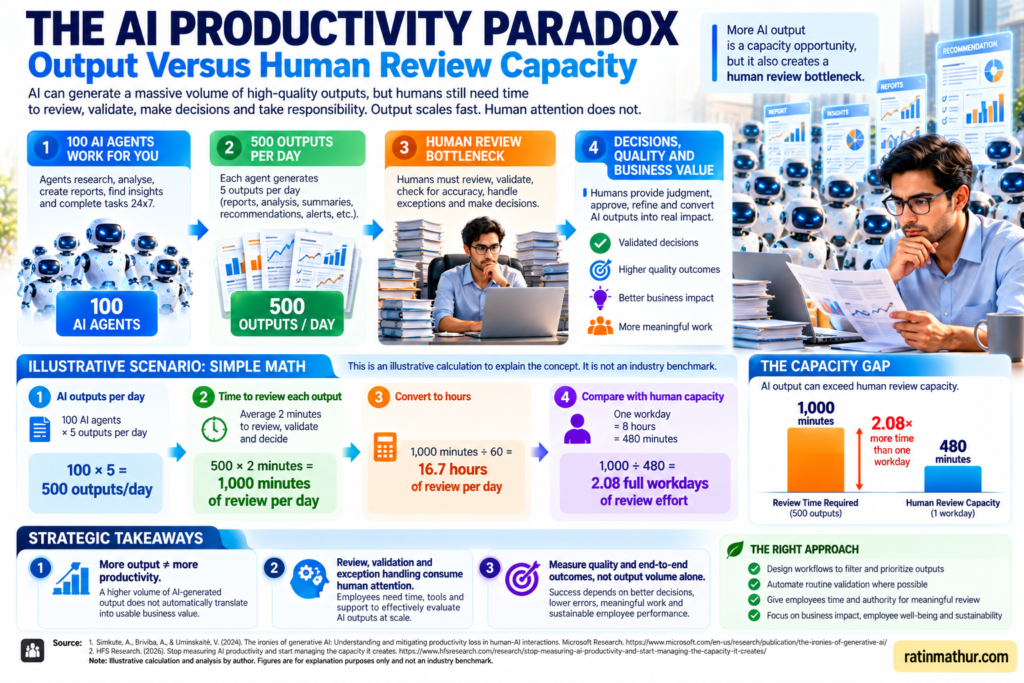
The solution is not necessarily to reduce the number of agents. It is to design workflows that consolidate information, validate routine outputs automatically, and prioritize only the exceptions that genuinely require human judgment.
Finding 3: More Employment Opportunities Can Coexist With Job Insecurity
Even when a company expects to expand its workforce, employees may remain uncertain about which roles will grow, which skills will become less valuable, and whether their own jobs will change.
The American Psychological Association’s 2025 Work in America survey found that 30% of surveyed workers worried they would fall behind colleagues if they did not use AI. Its findings also indicated that concerns about the future of job duties varied by organizational position (American Psychological Association, 2025).
These concerns demonstrate why workforce expansion announcements alone may not eliminate employee anxiety. Workers need clarity about how their responsibilities will change, how performance will be evaluated, and whether they will receive meaningful opportunities to learn and progress.
Finding 4: Continuous Monitoring Can Undermine Psychological Recovery
Agents may work around the clock, but employees need time away from work to recover. If a worker remains concerned about automated processes, feels compelled to check agent outputs after hours, or receives frequent notifications, psychological disengagement becomes more difficult.
Research on AI delegation and work-related rumination suggests that delegating a task does not necessarily remove the mental burden associated with it (Zhang et al., 2026). Organizations should therefore establish clear boundaries between continuous machine operation and continuous human availability.
Finding 5: Mental Toughness Is Valuable, But It Is Not An Unlimited Resource
Employees will need adaptability, critical thinking, emotional regulation, and the confidence to learn unfamiliar technologies. However, these capabilities cannot indefinitely compensate for excessive workloads or poor management practices.
The World Health Organization recommends organizational interventions that address working conditions and psychosocial risks, alongside training and individual support (World Health Organization, 2022, 2026). This approach recognizes that employee well-being is shaped by the work environment, not simply by individual resilience.
The responsibility should not be placed entirely on employees to become tougher. Organizations must also design work that remains manageable.
Finding 6: Physical Symptoms Can Signal Poor Work Design
Longer periods of screen-based review, fewer breaks, poor posture, and extended working hours can contribute to physical discomfort. Employees may experience digital eye strain, headaches, or neck and back discomfort.
These symptoms are multifactorial and cannot be attributed to AI agents alone. Nevertheless, they should prompt organizations to review screen exposure, ergonomics, working hours, and recovery opportunities rather than dismissing them as an unavoidable cost of technological progress.
Finding 7: AI Can Expand Human Potential When Employees Retain Agency
AI can help employees pursue work that was previously constrained by time, resources, or access to expertise. It can support new product development, improve research, expand customer service, and enable employees to explore more ambitious problems.
These benefits are more likely to be sustainable when employees retain meaningful decision authority, can challenge incorrect outputs, and are supported in developing new capabilities.
The objective should be to create employees who are more capable because of AI, not employees who are merely expected to tolerate more work because AI is available.
Challenges & Opportunities
The first challenge is ensuring that productivity gains translate into genuine business growth rather than an endless escalation of employee expectations. When AI reduces the cost of executing a task, management may see an opportunity to increase output. If this happens repeatedly without considering human capacity, the employee’s workload may expand even as the organization becomes more efficient.
The second challenge is developing a workforce capable of directing autonomous systems. Employees will need to define objectives, assess evidence, identify unreliable outputs, manage exceptions, and understand the consequences of automated decisions. These skills require training, practice, and time. An organization that expects immediate proficiency without providing sufficient support risks creating anxiety and avoidable errors.
The third challenge is preserving professional identity. Employees who have spent years developing expertise may question their value when AI performs parts of their work. Organizations must demonstrate how human judgment, contextual understanding, creativity, relationship management, and accountability contribute to the next generation of roles.
The fourth challenge is protecting psychological recovery. Continuous digital activity can create an expectation of continuous human availability. Businesses must separate the ability of an AI agent to operate at midnight from the obligation of an employee to monitor it at midnight.
These challenges create significant opportunities. AI can enable employees to pursue more complex projects, serve more customers, conduct deeper research, and develop new products and services. Organizations can expand into previously uneconomic markets and create demand for new capabilities in AI orchestration, verification, governance, cybersecurity, and human-agent workflow design.
The decisive factor is whether these opportunities are converted into meaningful employment, professional growth, and sustainable productivity. Workforce expansion should not simply create more jobs in which employees supervise machines under continuously increasing performance targets. It should create better-designed jobs in which technology removes unnecessary effort and enables people to accomplish more valuable work.
Strategic Frameworks & Recommendations
The following three proposed frameworks are designed to help organizations translate AI-enabled capacity into sustainable workforce growth. They focus on the employee’s experience of work, the cognitive demands of supervising AI, and the preservation of meaningful human authority.
Framework 1: Human-Centered AI Workforce Framework (HCAW™)
The Human-Centered AI Workforce Framework (HCAW™) proposes that AI transformation should be designed around the development and contribution of employees, rather than treating human labor as a fixed cost to be minimized. Its central principle is that when AI expands organizational capacity, businesses should deliberately create opportunities for employees to undertake higher-value activities, develop new capabilities, and participate in the growth that technology enables.
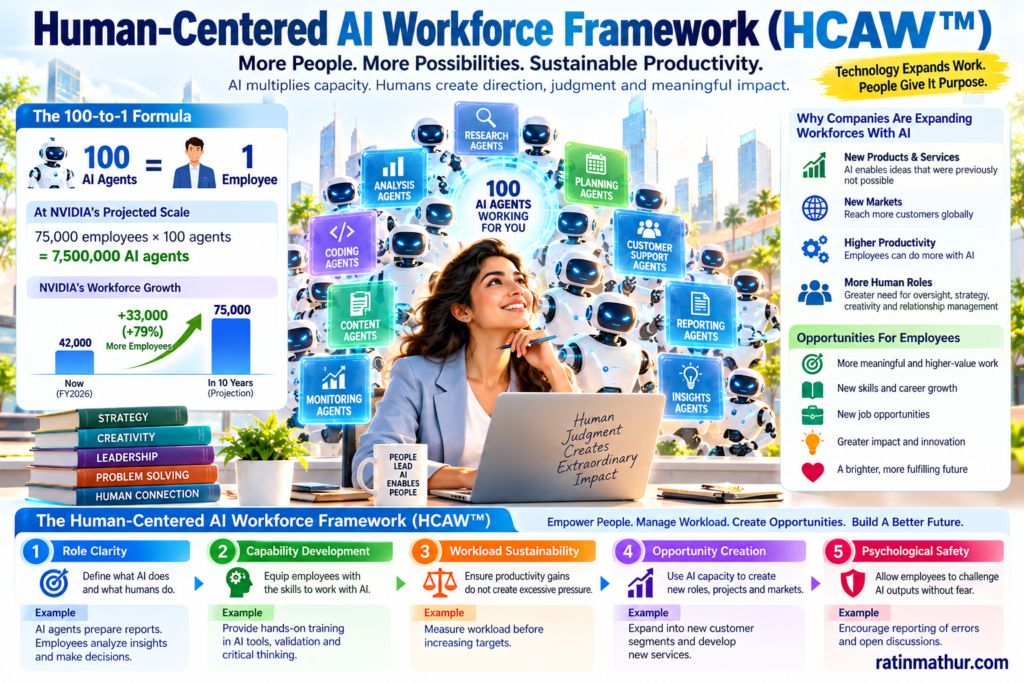
The framework has five dimensions: role clarity, capability development, workload sustainability, opportunity creation, and psychological safety. Role clarity defines which activities are delegated to AI and which require human judgment. Capability development provides employees with training and protected learning time. Workload sustainability ensures that productivity improvements do not automatically become unlimited performance demands. Opportunity creation identifies new roles, projects, and business activities enabled by AI. Psychological safety allows employees to question machine-generated recommendations and report problems without fear of retaliation.
Table 1. HCAW™: Human-Centered Workforce Expansion
| Dimension | Strategic Objective | Recommended Practice |
|---|---|---|
| Role Clarity | Define the changing relationship between humans and AI | Establish explicit human-agent responsibilities |
| Capability Development | Prepare employees for higher-value work | Provide practical training and protected learning time |
| Workload Sustainability | Prevent efficiency gains from creating excessive pressure | Assess workload before revising performance targets |
| Opportunity Creation | Translate AI capacity into new business activities | Identify new products, services, markets, and roles |
| Psychological Safety | Enable employees to challenge AI outputs | Establish non-punitive reporting and escalation mechanisms |
Consider a manufacturing company that introduces agents for demand forecasting, supplier analysis, inventory monitoring, and production planning. The initial benefit is faster analysis and more frequent recommendations. Under HCAW™, management would examine what the planning team could accomplish with the additional capacity.
Instead of simply increasing the number of reports each planner must review, the company could assign employees to supplier development, demand-scenario analysis, customer collaboration, and new product planning. Agents would handle repetitive information processing, while employees would focus on decisions requiring commercial understanding and cross-functional coordination.
The company would also provide training on data validation, AI limitations, exception management, and decision accountability. Managers would assess whether employees are experiencing a genuine improvement in their work or simply receiving more responsibilities.
HCAW™ also encourages organizations to connect workforce planning with business expansion. If AI makes it economical to serve additional customers or enter new markets, the company should assess the skills and roles needed to pursue those opportunities. This does not guarantee that every existing job will be preserved, but it creates a deliberate mechanism for connecting technological capacity with employment development.
Table 2. HCAW™: Linking AI Productivity To Employee Opportunity
| Business Outcome | Potential Employee Opportunity | Measurement |
|---|---|---|
| Faster Research | Market intelligence and strategic analysis | Time allocated to higher-value work |
| Improved Forecasting | Scenario planning and commercial collaboration | Forecast quality and planning effectiveness |
| Automated Reporting | Process improvement and decision support | Reduction in low-value administrative work |
| Expanded Customer Capacity | Account development and customer problem-solving | Customer outcomes and employee workload |
| New AI-Enabled Services | New roles and specialized capabilities | New projects, internal mobility, and skills development |
The framework should be introduced before large-scale deployment and reviewed as the business expands. Management should compare productivity improvements with changes in workload, employee capability, internal mobility, and the creation of new activities.
HCAW™ is particularly relevant to HR leaders, strategy teams, business heads, and boards overseeing AI transformation. Its central recommendation is to treat AI as a potential engine of workforce capability and business expansion, while ensuring that the benefits are not undermined by unreasonable expectations placed on employees.
Framework 2: Cognitive Load And Recovery Equilibrium Framework (CLRE™)
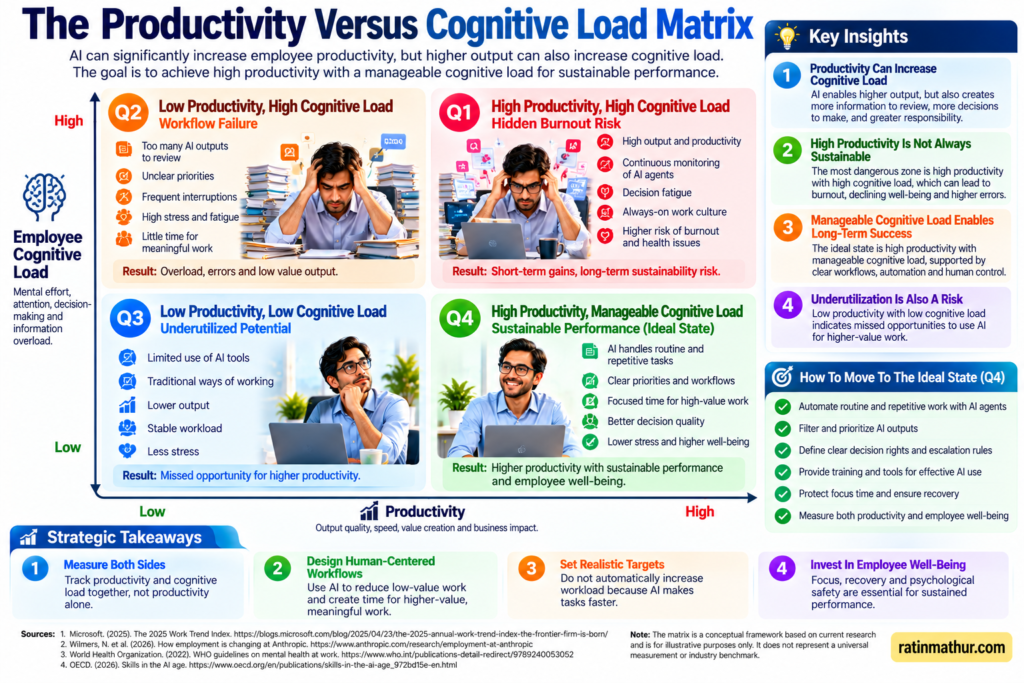
The Cognitive Load And Recovery Equilibrium Framework (CLRE™) addresses the relationship between AI-generated activity, human attention, monitoring requirements, and recovery from work. It proposes that an organization can sustain AI-enabled productivity only when the cognitive demands placed on employees remain manageable.
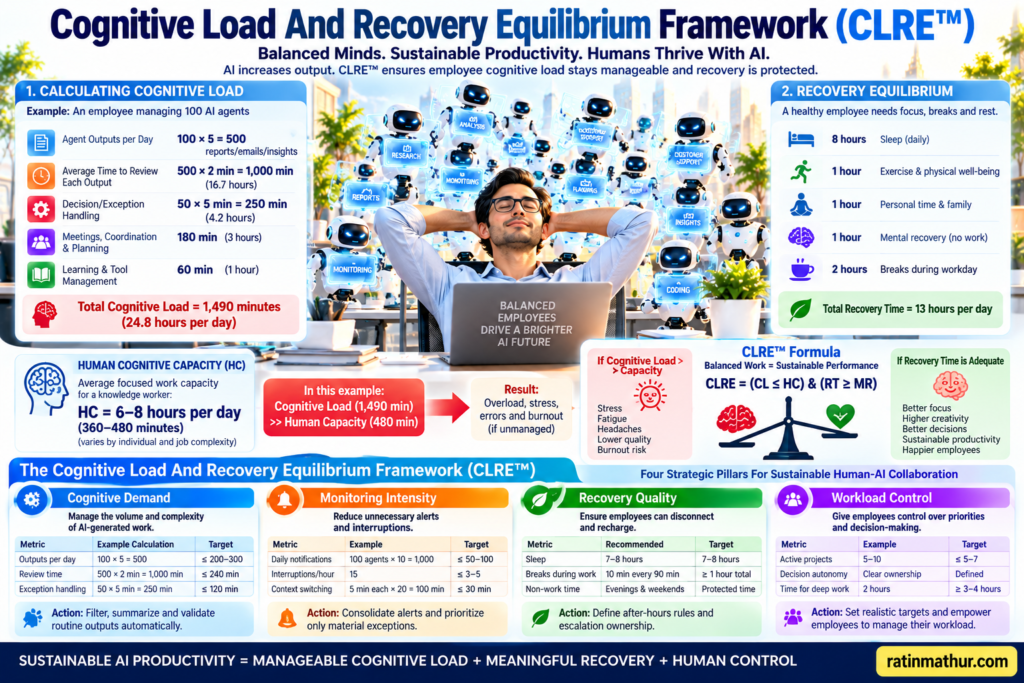
The framework has four dimensions: cognitive demand, monitoring intensity, recovery quality, and workload control. Cognitive demand measures the effort required to interpret and validate AI output. Monitoring intensity captures the frequency of alerts, interruptions, and exceptions. Recovery quality considers whether employees can disconnect from work outside working hours. Workload control assesses whether employees have sufficient authority to prioritize tasks and manage competing demands.
The framework recognizes that AI can reduce cognitive effort when it eliminates repetitive tasks. However, if agents generate more recommendations than employees can meaningfully review, the technology may create a new burden involving constant supervision and decision-making.
Table 3. CLRE™: Managing Cognitive Demands
| Source Of Pressure | Potential Consequence | Recommended Intervention |
|---|---|---|
| Excessive AI notifications | Fragmented attention | Consolidate alerts and prioritize material exceptions |
| High volumes of generated output | Review overload | Filter, summarize, and validate routine outputs automatically |
| Unclear system reliability | Persistent checking and uncertainty | Establish transparent validation standards |
| After-hours agent activity | Difficulty disconnecting | Define escalation schedules and response expectations |
| Prolonged screen exposure | Eye discomfort and physical fatigue | Encourage breaks and ergonomic working practices |
| Conflicting recommendations | Decision fatigue | Establish clear decision ownership and escalation rules |
Consider a finance manager responsible for several agents that prepare forecasts, variance reports, and competitor updates. The agents complete their tasks overnight, but the manager receives dozens of notifications and feels compelled to review every output before the morning meeting.
Under CLRE™, the company would consolidate routine updates, validate calculations automatically, and escalate only material anomalies. The manager would concentrate on significant deviations, business implications, and consequential decisions rather than repeatedly checking every report.
The organization would also establish boundaries around after-hours monitoring. Continuous agent availability should not create an expectation that employees remain permanently available. Routine tasks should be allowed to proceed within approved limits, while genuine emergencies should follow a defined escalation process.
Table 4. CLRE™: Indicators Of Sustainable Work
| Indicator | What It Measures | Management Response |
|---|---|---|
| Interruption Frequency | Disruptions to focused work | Reduce unnecessary notifications |
| Review Burden | Time spent checking AI output | Improve validation and task prioritization |
| Exception Backlog | Unresolved issues requiring human attention | Rebalance workload and clarify responsibilities |
| Recovery Quality | Employee-reported ability to disconnect | Review after-hours expectations |
| Work-Related Fatigue | Employee-reported cognitive exhaustion | Investigate workload and work design |
| Error And Rework Trends | Quality of outcomes under existing conditions | Improve reliability and verification controls |
CLRE™ should be implemented through baseline assessments and periodic reviews. Organizations should measure employee workload and recovery before introducing AI and compare those measures with outcomes during pilots and subsequent scaling. Employee feedback should be confidential and used to improve work design rather than create additional surveillance.
The framework’s central recommendation is that human attention and recovery must be treated as finite organizational resources. An AI-enabled business should expand its productive capacity without assuming that its employees can indefinitely absorb more decisions, more interruptions, and more responsibility.
Framework 3: Human Agency And Psychological Safety Framework (HAPS™)
The Human Agency And Psychological Safety Framework (HAPS™) addresses the relationship between AI autonomy, employee control, professional confidence, trust, and accountability. It proposes that employees can work effectively with autonomous systems only when they understand their responsibilities, retain appropriate authority, and feel safe questioning machine-generated recommendations.
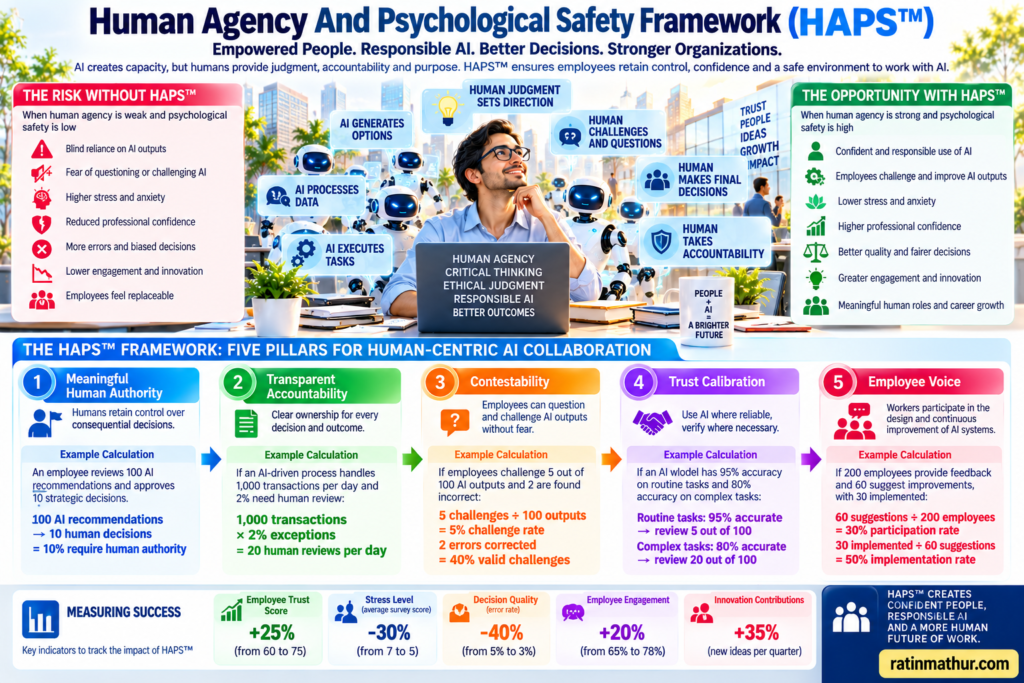
The framework has five dimensions: meaningful human authority, transparent accountability, contestability, trust calibration, and employee voice. Meaningful human authority preserves appropriate decision rights. Transparent accountability identifies who is responsible for consequential decisions. Contestability allows employees to challenge questionable outputs. Trust calibration helps employees understand when AI is reliable and when additional verification is required. Employee voice ensures that workers can influence the design of systems affecting their jobs.
Table 5. HAPS™: Preserving Human Agency
| Dimension | Organizational Principle | Recommended Mechanism |
|---|---|---|
| Human Authority | Consequential decisions retain appropriate human ownership | Defined approval thresholds |
| Accountability | Responsibility remains identifiable | Named decision owners and documented records |
| Contestability | Employees can challenge questionable outputs | Escalation channels and independent review |
| Trust Calibration | Reliance reflects demonstrated reliability | Training and transparent performance assessments |
| Employee Voice | Workers participate in decisions affecting their roles | Consultation and structured feedback |
Consider a company using AI to evaluate employee performance. If managers rely entirely on automated productivity scores, they may overlook the complexity of individual assignments, the quality of collaboration, mentoring contributions, or the consequences of difficult decisions. Employees may then feel that their professional value is being reduced to measurements they cannot challenge.
Under HAPS™, AI-generated assessments would be treated as evidence rather than unquestionable conclusions. Managers would remain accountable for consequential decisions, employees would have appropriate channels to challenge inaccurate information, and the company would periodically assess whether the system produces unfair outcomes.
The framework also addresses professional confidence. Employees should be encouraged to challenge AI recommendations when their expertise or evidence suggests that the system is wrong. Identifying a material error is a demonstration of professional judgment, not a failure to adopt technology.
Table 6. HAPS™: Governance And Employee Trust
| Indicator | Management Objective | Recommended Action |
|---|---|---|
| Employee Trust | Understand appropriate confidence in AI | Gather confidential feedback |
| Challenge Rate | Identify whether questionable outputs are escalated | Encourage good-faith challenges |
| Decision Accountability | Ensure consequential decisions have an owner | Define decision rights and approval requirements |
| Perceived Autonomy | Assess meaningful employee control | Review responsibilities and workload |
| Fairness And Transparency | Reduce unexplained automated decisions | Audit outcomes and review contested cases |
| Psychological Safety | Enable disclosure of uncertainty and errors | Establish non-retaliation principles |
HAPS™ should be embedded in corporate governance, HR policy, and AI risk management. Senior management should establish minimum standards for human oversight, while boards should periodically review the effects of AI on employee rights, working conditions, and accountability.
The framework’s central recommendation is that human involvement must be meaningful rather than symbolic. Employees who are held responsible for AI decisions must have the time, information, authority, and practical ability to challenge them.
Integrating The Three Frameworks
The three frameworks are complementary. HCAW™ connects AI-enabled productivity with workforce development and business expansion. CLRE™ protects the attention and recovery required to sustain performance. HAPS™ preserves meaningful human authority, trust, and accountability.
Table 7. Integrated Human-Centered AI Strategy
| Strategic Question | Framework | Desired Outcome |
|---|---|---|
| Is AI creating meaningful opportunities for employees? | HCAW™ | Better role design, skills, and career opportunities |
| Is the additional workload sustainable? | CLRE™ | Manageable cognitive demands and recovery |
| Do employees retain meaningful control? | HAPS™ | Trust, accountability, and psychological safety |
| Is the organization achieving sustainable growth? | All Three | Business expansion alongside employee well-being |
Organizations should apply the frameworks through controlled pilots, employee consultation, baseline measurements, and periodic reviews. Productivity, quality, workforce growth, employee workload, and well-being should be assessed together.
The objective is not to minimize the number of agents or maximize the number of employees in every situation. It is to build an operating model in which additional AI capacity supports business growth, meaningful employment, and sustainable human performance.
Future Outlook & Conclusion
Jensen Huang’s vision deserves attention because it presents a different possibility for the AI era. Rather than depicting artificial intelligence exclusively as a replacement for human workers, it imagines a company employing more people while deploying millions of agents to expand its productive capacity.
NVIDIA’s projected workforce of 75,000, compared with approximately 42,000 employees at the end of fiscal 2026, represents a potential increase of around 79%. This is a substantial expansion scenario, although it remains a projection rather than a guaranteed hiring outcome.
The broader lesson is that AI can create opportunities as well as disruption. By reducing the cost and time required to execute tasks, it may enable businesses to pursue more ambitious projects, develop new products, enter new markets, and create demand for capabilities that are not yet widely established.
However, workforce expansion is only one dimension of the future of work. The quality of employment matters as much as the quantity. An organization may hire more people while simultaneously increasing the pressure on each employee to supervise agents, evaluate recommendations, respond to continuous notifications, and meet rising productivity expectations.
The emerging research on AI-intensive workplaces indicates that human attention can become a bottleneck even when the technology increases output. This makes employee-centered work design a strategic necessity rather than a peripheral HR consideration.
The three proposed frameworks provide a practical foundation for that approach. HCAW™ connects technological capacity with employee development and new opportunities. CLRE™ emphasizes sustainable cognitive demands and psychological recovery. HAPS™ preserves human agency, trust, and accountability.
Together, they encourage organizations to pursue a more balanced model of AI adoption: expand what the business can accomplish, develop the people who make that expansion possible, and ensure that productivity gains do not depend on permanently increasing human pressure.
For boards and executive leaders, the question should not simply be how many agents each employee can manage. It should be how the organization can use agents to create more value, better employment opportunities, and healthier working conditions.
The real promise of AI is not to make a limited number of employees work like an unlimited number of machines. It is to give more people the capacity to accomplish what was previously beyond their reach.
References
- Angelo, J. (2026, March 19). Jensen Huang: Nvidia will have 75K employees and 7.5 million AI agents in 10 years. Fortune. https://fortune.com/2026/03/19/jensen-huang-nvidia-ai-agents-future-of-work-autonomous/
- American Psychological Association. (2025). The experience of working in America during times of change: Work in America survey 2025. https://www.apa.org/pubs/reports/work-in-america/2025/2025-full-report.pdf
- Gmyrek, P., Berg, J., Kamiński, J., Kononowicz, A., Nafradi, B., Rosłaniec, K., & Troszyński, M. (2025). Generative AI and jobs: A refined global index of occupational exposure (ILO Working Paper No. 140). International Labour Organization. https://www.ilo.org/publications/generative-ai-and-jobs-2025-update
- International Labour Organization. (2023, August 21). Generative AI likely to augment rather than destroy jobs. https://www.ilo.org/global/about-the-ilo/newsroom/news/WCMS_890740/lang–en/index.htm
- International Labour Organization. (2026). The impact of GenAI on jobs, productivity and work organization: A review of the empirical evidence. https://doi.org/10.54394/00034628
- Merola, R., Ernst, E., Samaan, D., del Rio-Chanona, M., & Teutloff, O. (2026). The impact of GenAI on jobs, productivity and work organization: A review of the empirical evidence. International Labour Organization. https://www.ilo.org/publications/impact-genai-jobs-productivity-and-work-organization-review-empirical
- Microsoft. (2025, April 23). The 2025 annual Work Trend Index: The Frontier Firm is born. https://blogs.microsoft.com/blog/2025/04/23/the-2025-annual-work-trend-index-the-frontier-firm-is-born/
- NVIDIA Corporation. (2026). Form 10-K: Annual report for the fiscal year ended January 25, 2026. U.S. Securities and Exchange Commission. https://www.sec.gov/Archives/edgar/data/1045810/000104581026000021/nvda-20260125.htm
- OECD. (2026). Skills in the AI age. Organisation for Economic Co-operation and Development. https://www.oecd.org/en/publications/skills-in-the-ai-age_972bd15e-en/full-report/component-4.html
- World Health Organization. (2022). WHO guidelines on mental health at work. https://www.who.int/publications-detail-redirect/9789240053052
- World Health Organization. (2026, September 15). Mental health at work. https://www.who.int/news-room/fact-sheets/detail/mental-health-at-work
- Wilmers, N., Catipon, R., Massenkoff, M., & McCrory, P. (2026, October 16). How employment is changing at Anthropic. Anthropic. https://www.anthropic.com/research/employment-at-anthropic
- Zhang, Y., Li, T., & Chen, C. (2026). When AI works, employees worry: The vigilance cost of AI delegation in hybrid work. Frontiers in Psychology, 17, Article 1914119. https://doi.org/10.3389/fpsyg.2026.1914119
Disclaimer
This article is intended for informational, educational, and strategic discussion purposes. It does not constitute medical, psychological, legal, occupational health, investment, or professional consulting advice. The relationship between AI-enabled work and employee well-being varies according to individual circumstances, organizational practices, and the nature of the technology. The discussion of stress, headaches, fatigue, sleep disruption, and other symptoms does not establish that AI agents directly cause those conditions. Individuals experiencing persistent or concerning symptoms should seek appropriate professional medical advice.
The NVIDIA workforce figures distinguish reported historical employment from a projected future workforce. The projection should not be interpreted as a guaranteed hiring commitment or proof that AI adoption will never result in layoffs at NVIDIA or other companies. The workforce scenarios and strategic examples presented in this article are intended to illustrate potential outcomes rather than guarantee future performance.
The Human-Centered AI Workforce Framework (HCAW™), Cognitive Load And Recovery Equilibrium Framework (CLRE™), and Human Agency And Psychological Safety Framework (HAPS™) are proposed conceptual frameworks developed for this article. They have not been independently validated through empirical research. The ™ symbol indicates a proposed trademark designation and does not confirm registration, legal exclusivity, or trademark availability. Appropriate trademark searches and legal advice should be obtained before commercial use.
Research findings should be interpreted within their respective study designs, samples, and limitations. Evidence from an AI-intensive organization should not automatically be generalized to every industry or employee population. Organizations should conduct appropriate assessments before implementing AI systems or making decisions affecting employees.