A Strategic Research Paper On Agentic AI, Operational Excellence, And The Future Of Intelligent Manufacturing
Executive Summary
Manufacturing is entering a new competitive era in which the ability to convert industrial data into coordinated decisions may become as important as production capacity, automation, and economies of scale. The next evolution of Industry 4.0 is not simply a connected factory. It is a factory in which intelligent software agents can investigate operational problems, coordinate specialized systems, recommend corrective actions, and execute authorized workflows with measurable business objectives.
Conventional automation follows predefined instructions. Predictive artificial intelligence (AI) identifies patterns and forecasts outcomes. Agentic AI goes a step further by combining reasoning, access to business systems, specialized analytical tools, and the ability to coordinate actions toward a defined goal. In manufacturing, this can mean diagnosing a production bottleneck, preparing a maintenance intervention, investigating a quality failure, revising a production schedule, or coordinating a supplier response.
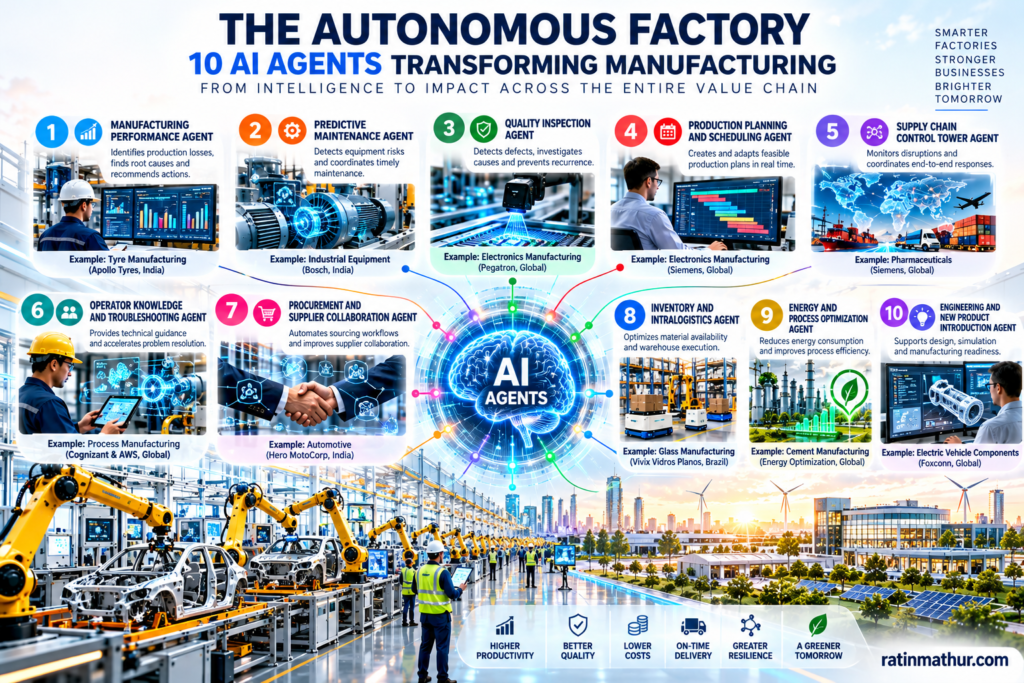
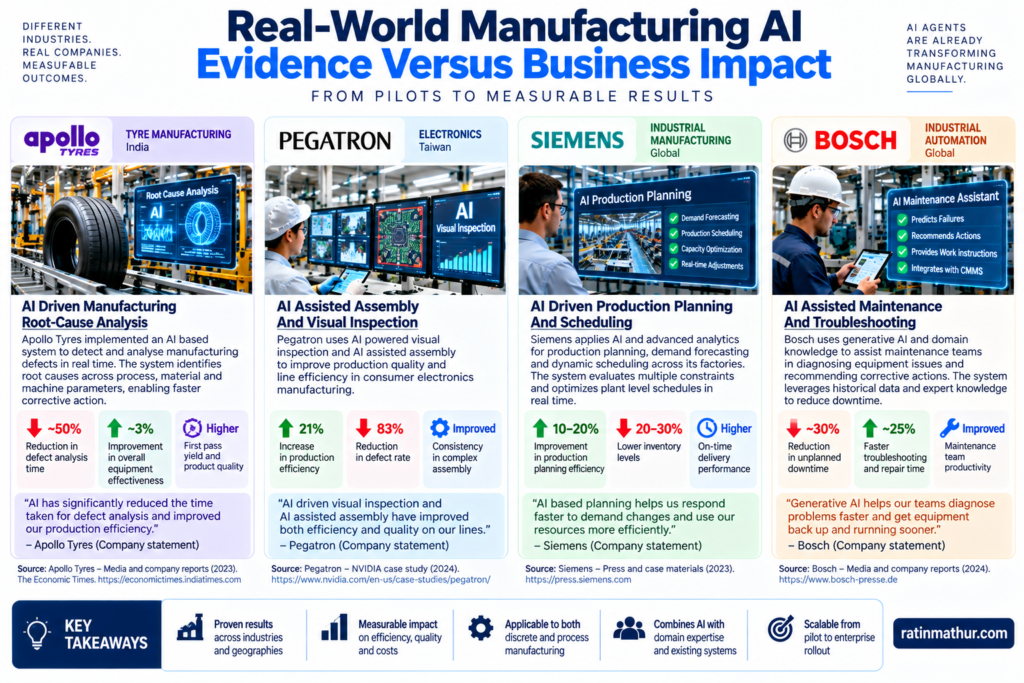
Industrial deployment is already progressing beyond experimentation. Apollo Tyres has reported an approximately 88% reduction in root-cause analysis effort using its agentic AI-powered Manufacturing Reasoner. Bosch has deployed agentic AI solutions for machine troubleshooting in Germany and maintenance-related recommendations at its Jaipur plant in India. Electronics manufacturer Pegatron has implemented visual AI agents to guide assembly activities and identify procedural deviations. Siemens has described AI-driven production planning at its Erlangen electronics factory, while other industrial deployments demonstrate how agents can coordinate information across quality, logistics, maintenance, and supply chain functions.
These examples show that manufacturing AI is not one technology serving one purpose. It is an emerging portfolio of specialized agents operating across production, maintenance, quality, planning, procurement, inventory, energy, and engineering.
This paper examines ten such applications and explains how they work, where they create value, what organizations need to implement them, and which performance indicators should determine success. The evidence includes manufacturer and technology-provider case studies, industrial research, and documented deployment examples. Reported financial outcomes are attributed to their publishers and are not assumed to be independently verified.
The central conclusion is that industrial competitiveness will depend less on the number of AI agents deployed than on how effectively they connect trusted data with accountable decisions and measurable operational improvements. To guide that transition, the paper proposes four proprietary management frameworks covering value realization, operational execution, autonomy and governance, and enterprise-wide scaling.
Introduction
Manufacturing companies operate through complex networks of interdependent decisions. A machine breakdown affects production capacity. Reduced capacity changes the schedule. The revised schedule alters material requirements, workforce allocation, and customer commitments. A quality failure may require containment, process investigation, supplier involvement, and changes to subsequent production.
Although many manufacturers have invested in ERP platforms, manufacturing execution systems, industrial sensors, analytics, robotics, and digital twins, the intelligence required to resolve operational problems often remains distributed across departments and applications.
A production dashboard may reveal declining output, but identifying the underlying cause can require an engineer to examine machine alarms, historical work orders, product specifications, process settings, and shift records. A purchasing team may know that a supplier is late, but determining which production orders and customer commitments will be affected may require coordination across procurement, inventory, manufacturing, and logistics.
AI agents can help connect these activities. They are capable of gathering information from authorized systems, invoking relevant analytical tools, preparing evidence-based recommendations, and coordinating predefined workflows. When multiple agents work together, they can support decisions across functions that previously operated independently.
The technology does not eliminate the need for engineering expertise, deterministic automation, or human judgment. Instead, it can reduce the time spent collecting information, reconciling disconnected records, and coordinating routine actions, allowing employees to concentrate on complex diagnosis, operational improvement, and strategic decisions.
For Indian manufacturers, the opportunity is especially relevant. As companies compete across automotive components, electronics, pharmaceuticals, engineering, consumer goods, and industrial equipment, AI agents can support productivity, quality, delivery performance, working-capital efficiency, and the ability to scale manufacturing operations without proportionate increases in administrative effort.
The strategic question is therefore not whether manufacturing companies should adopt AI agents. It is which agents should be adopted first, how their results should be measured, and how their authority should be governed.
Problem Statement & Objectives
The principal challenge in manufacturing AI is the gap between digital visibility and operational action. Many factories possess enough data to identify production losses, equipment anomalies, quality deviations, and supply chain risks, yet the resolution of these problems can remain slow and heavily dependent on manual investigation.
Four constraints are particularly important. Fragmented data limits the ability to develop a complete understanding of operational events. Inconsistent master data weakens analytical reliability. Knowledge concentrated among experienced employees creates dependency on individuals. Finally, disconnected workflows can prevent useful insights from translating into corrective action.
Agentic AI can address these constraints, but it can also introduce risks. An agent operating with inaccurate data may recommend an inappropriate intervention. Excessive autonomy can create quality, safety, financial, or cybersecurity problems. Poorly designed automation may simply accelerate an inefficient process.
The objective of this paper is to identify ten manufacturing AI agents with strong strategic potential, explain each through a distinct industrial application, and provide practical guidance for implementation. The paper also develops four proposed proprietary frameworks that help organizations select use cases, connect intelligence to execution, establish appropriate autonomy, and replicate successful deployments across multiple plants.
The intended audience includes manufacturing leaders, plant managers, operations and supply chain executives, industrial engineers, digital transformation teams, and business strategists seeking an actionable understanding of agentic AI.
Methodology
The analysis combines desk research, manufacturer case studies, technology-provider documentation, and recent industrial research. The ten agents were selected according to their potential to improve productivity, cost, quality, reliability, resilience, and engineering performance.
The assessment distinguishes between demonstrated deployments, company-reported outcomes, research prototypes, and emerging applications. This distinction is essential because the presence of AI in a manufacturing environment does not necessarily mean that the entire workflow is autonomously controlled by an AI agent.
For example, a digital twin can simulate a factory without being an AI agent. A predictive model can forecast equipment failure without automatically coordinating maintenance. An AI inspection model can detect a missing component without managing the subsequent investigation and corrective-action process.
The analysis therefore evaluates the capabilities of each agent in its actual operating context. Financial and productivity metrics are presented with appropriate attribution, and results from specific organizations are not treated as universal industry benchmarks.
The four strategic frameworks developed in the final substantive section are original proposed management frameworks for this paper. Their purpose is to translate the research into a practical approach to investment, implementation, governance, and scaling. They are not represented as formally registered trademarks or externally validated industry standards.
Landscape Analysis
Manufacturing AI agents can be organized according to the business problem they address, the systems they connect, and the operational decisions they support. Some operate close to machines and production processes, while others coordinate enterprise workflows across procurement, logistics, engineering, and customer delivery.
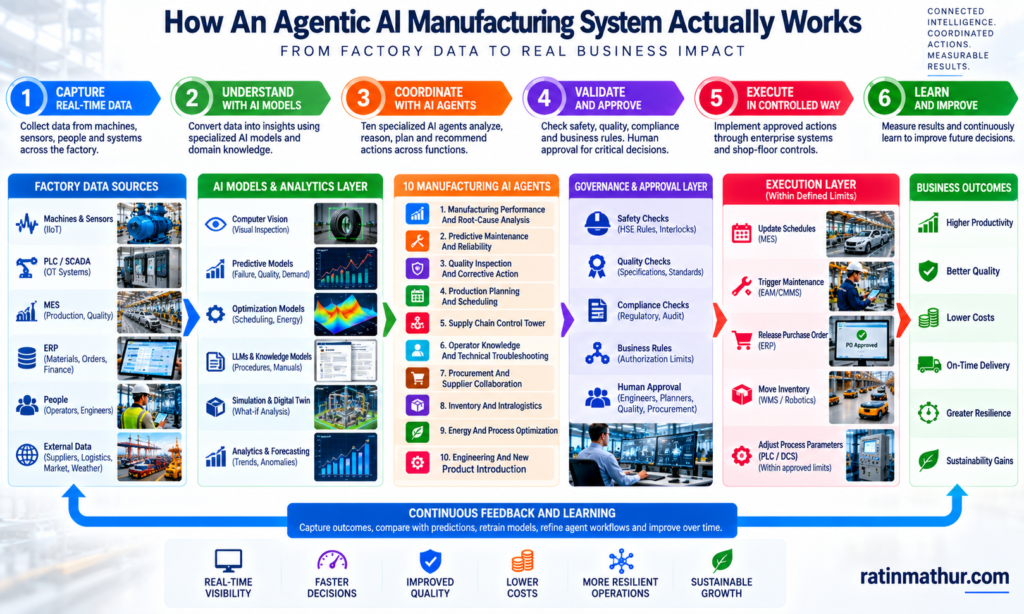
The following table provides an overview of the ten priority applications.
| Rank | Agentic AI Agent | Primary Business Objective | Typical Performance Measures |
|---|---|---|---|
| 1 | Manufacturing Performance And Root-Cause Analysis Agent | Identify production losses and accelerate corrective action. | OEE, cycle time, throughput, downtime |
| 2 | Predictive Maintenance And Reliability Agent | Diagnose equipment problems and coordinate timely maintenance. | Unplanned downtime, MTTR, first-time fix rate, maintenance cost |
| 3 | Quality Inspection And Corrective-Action Agent | Detect defects, identify causes, and prevent recurrence. | First-pass yield, scrap, rework, defect rate |
| 4 | Production Planning And Scheduling Agent | Create and revise feasible production plans as conditions change. | Schedule adherence, changeover time, on-time delivery |
| 5 | Supply Chain Control Tower Agent | Coordinate responses to material, supplier, and logistics disruptions. | Material shortages, supplier performance, OTIF, recovery time |
| 6 | Operator Knowledge And Technical Troubleshooting Agent | Make technical knowledge accessible and accelerate problem resolution. | Troubleshooting time, first-time fix rate, training time |
| 7 | Procurement And Supplier Collaboration Agent | Improve sourcing workflows, supplier communication, and purchasing productivity. | RFQ-to-PO time, purchasing cycle time, supplier performance |
| 8 | Inventory And Intralogistics Agent | Improve material availability and warehouse execution. | Stockouts, inventory accuracy, picking productivity, handling cost |
| 9 | Energy And Process Optimization Agent | Reduce energy consumption and process variability. | Energy per good unit, yield, energy cost, emissions intensity |
| 10 | Engineering And New Product Introduction Agent | Improve factory design, engineering coordination, and launch readiness. | Engineering cycle time, launch time, change orders, time to production |
The distinction between these agents is functional rather than purely technical. Several may use the same underlying AI models, data platforms, or orchestration infrastructure, but they operate against different business objectives and require different approval mechanisms.
A manufacturing performance agent investigates output losses. A maintenance agent focuses on asset condition and repair decisions. A quality agent manages defects and corrective actions. A planning agent evaluates production alternatives, while a supply chain agent coordinates cross-functional responses to disruptions.
This specialization makes it possible to develop and validate agents around specific workflows before connecting them into a broader manufacturing intelligence architecture.
Key Findings
1. Manufacturing Performance And Root-Cause Analysis Agent
The Manufacturing Performance And Root-Cause Analysis Agent investigates why actual production performance differs from the expected result. Instead of merely displaying downtime or cycle-time deviations, it correlates information from machines, products, production shifts, process parameters, and historical incidents to identify plausible causes and recommend corrective actions.
Apollo Tyres provides a relevant Indian manufacturing example. Its Manufacturing Reasoner uses agentic AI and industrial information to investigate cycle-time behavior in tyre curing presses. The company reported reducing root-cause analysis time from as much as seven hours to under ten minutes, with approximately 88% less analysis effort. It also reported a targeted annual benefit of approximately ₹1.5 crore across three passenger-car radial plants (Vardhan et al., 2025).
The practical application extends beyond tyres. A metal fabrication plant could use an agent to investigate recurring CNC cycle-time deviations, identify machine or product combinations associated with longer processing times, and prepare an evidence-based investigation for the production engineer.
Its primary KPIs should include Overall Equipment Effectiveness, cycle time, throughput, downtime, and time to resolve production losses. The agent should explain the evidence behind its findings and avoid presenting correlation as proof of causation.
2. Predictive Maintenance And Reliability Agent
The Predictive Maintenance And Reliability Agent combines asset data, maintenance history, technical documentation, and failure patterns to assist with diagnosis and maintenance planning. Its role extends beyond generating an alert: it helps determine what should be investigated, which repair actions are appropriate, what resources are needed, and when intervention should occur.
Bosch’s India organization provides a documented example involving the Jaipur plant’s high-pump-set service and maintenance workflow. A generative AI-powered recommendation agent interacts with databases and technical manuals and examines historical failure information to improve repair recommendations and first-time-right problem resolution. Bosch Global Software Technologies reported estimated annual savings of approximately ₹10 lakh for this application (Bosch Global Software Technologies, 2025).
The example demonstrates an important distinction. Predicting that a machine may fail requires adequate condition-monitoring information and a validated predictive model. Coordinating the response requires additional agent capabilities, such as retrieving the relevant manual, identifying comparable failures, preparing maintenance recommendations, and supporting work-order processes.
At a chemical plant, the same architecture could investigate recurring pump seal failures by correlating pressure fluctuations, repair histories, operating conditions, and equipment specifications before a maintenance team commits to a repair.
Relevant performance measures include unplanned downtime, Mean Time To Repair, first-time fix rate, maintenance cost, and repeat-failure frequency. The agent should support maintenance decisions without independently overriding equipment protection or safety procedures.
3. Quality Inspection And Corrective-Action Agent
The Quality Inspection And Corrective-Action Agent connects defect detection with investigation, containment, and prevention. It combines inspection images, process data, product specifications, and batch history to help determine whether a defect is isolated or symptomatic of a wider process problem.
Pegatron, a major electronics manufacturer, has implemented an Assembly Guiding Agent that uses visual AI to monitor assembly activities and alert workers to possible deviations. A practical example is an assembly step in which a screw is omitted during phone or laptop assembly. The agent can identify the deviation and alert the operator while the issue can still be corrected. NVIDIA’s customer case study reports a 67% decrease in defect rates and a 7% reduction in labor cost per assembly line for the relevant deployment (NVIDIA, n.d.-a).
The commercial lesson is that quality agents can move inspection closer to the point of production rather than relying exclusively on end-of-line inspection. In pharmaceutical tablet manufacturing, a comparable agent could combine validated process-monitoring models with batch records to identify process deviations, assemble evidence for investigation, and prepare a corrective-action report for the quality team.
Useful measures include defect rate, first-pass yield, scrap, rework, customer complaints, and corrective-action closure time. Quality release and regulated decisions must remain subject to the applicable validation and approval requirements.
4. Production Planning And Scheduling Agent
The Production Planning And Scheduling Agent evaluates production orders, available capacity, materials, changeovers, maintenance windows, and delivery priorities to develop and revise feasible schedules. Its advantage over a static planning tool is the ability to coordinate changes, explain trade-offs, and present alternatives when operating conditions shift.
Siemens described an AI-driven planning application at its Erlangen electronics factory in October 2026. The agent generates alternative production plans, evaluates them against operational indicators, and uses a digital twin to validate proposed plans before implementation. Siemens reported potential production-planning cost savings of up to 20% for the application (Siemens AG, 2026).
Consider a contract electronics manufacturer receiving an urgent order while one assembly line is unavailable. The agent could compare alternate line assignments, batch sizes, component availability, and changeover sequences. It would present the feasible options along with their effects on delivery dates, overtime, and production cost. The planner could approve the preferred option before the production schedule is changed.
The planning engine and digital twin remain essential because an AI-generated schedule must respect actual engineering and capacity constraints. Relevant KPIs include schedule adherence, changeover time, capacity utilization, overdue orders, and on-time delivery.
5. Supply Chain Control Tower Agent
The Supply Chain Control Tower Agent monitors supplier commitments, inventory availability, demand changes, logistics disruptions, and production requirements. When an exception occurs, it traces the consequences across the business and coordinates a response rather than simply notifying individual departments.
An example from the life sciences sector is Siemens’ published customer story about a global pharmaceutical manufacturer using Intelligence Center X. The company reportedly established a cross-domain view of manufacturing, quality, and supply chain information spanning 15 billion data points. Queries that previously required hours or sometimes days could be answered in seconds, and the connected information supported batch rerouting decisions that had previously been difficult to make (Siemens, n.d.).
The application is strategically important because pharmaceutical supply chains must balance product availability, quality requirements, manufacturing constraints, and traceability. If a production batch cannot proceed as planned, an agent can help evaluate alternative routing, inventory implications, and downstream delivery commitments using authorized records.
The same logic applies to an automotive manufacturer confronting a delayed semiconductor shipment. The agent can identify affected production orders, assess available inventory, calculate the potential plant impact, and present alternatives for approval.
Relevant measures include material-shortage hours, supplier delivery performance, recovery time, premium freight, and on-time in-full delivery. The agent must respect product traceability, contractual obligations, and quality constraints.
6. Operator Knowledge And Technical Troubleshooting Agent
The Operator Knowledge And Technical Troubleshooting Agent provides operators, maintenance technicians, and process engineers with contextual access to approved technical knowledge. It draws on manuals, SOPs, alarm histories, equipment records, diagrams, and previous investigations to help users resolve problems consistently.
Cognizant and AWS have described the APEx Factory Whisperer application, which combines manufacturing data, equipment alarms, historical trends, technical manuals, standard procedures, and engineering information to support troubleshooting in factory operations (Baskar et al., 2024).
This is particularly useful when the answer to a manufacturing problem is scattered across several documentation repositories or depends heavily on the experience of a small number of employees. An operator may ask why an alarm repeatedly occurs after a product changeover. The agent can retrieve the relevant procedure, identify similar historical incidents, and present the appropriate diagnostic sequence with source references.
In an industrial equipment factory, the same agent could guide a new technician through an approved inspection procedure and prepare a structured handover report if the problem remains unresolved.
The primary measures are troubleshooting time, Mean Time To Repair, first-time fix rate, training time, and repeat incidents. Its value depends on current, approved documentation and the ability to distinguish verified instructions from AI-generated interpretation.
7. Procurement And Supplier Collaboration Agent
The Procurement And Supplier Collaboration Agent automates routine procurement coordination while improving the quality of purchasing decisions. It can compare supplier quotations, prepare RFQs, retrieve prior prices, monitor acknowledgements, track promised dates, and flag deviations requiring buyer attention.
An Indian example is Ajuni’s published case study concerning Hero MotoCorp. According to the technology provider, its agents connected a 48-hour rolling demand forecast with SAP S/4HANA and dealer-distribution information while automating procurement RFQ coordination. Ajuni reports 92% forecast accuracy, an RFQ-to-purchase-order cycle of four days, and annual working-capital savings of ₹4.2 crore for the deployment (Ajuni, n.d.). These are provider-reported customer outcomes and have not been independently verified here.
The example highlights the value of connecting purchasing actions with demand signals rather than treating procurement as an isolated administrative workflow. For example, an automotive component supplier could use an agent to compare quotations for bearings, identify lead-time differences, check minimum order quantities, and prepare a commercial comparison for buyer approval.
Routine supplier reminders and documentation checks can be automated within defined limits. Strategic supplier selection, contract commitments, and purchases above delegated authority should remain subject to established commercial controls.
Relevant KPIs include RFQ-to-PO time, purchase-order cycle time, purchase price variance, supplier on-time delivery, and contract compliance.
8. Inventory And Intralogistics Agent
The Inventory And Intralogistics Agent connects stock availability with production requirements, warehouse locations, material staging, and internal logistics. It identifies shortages and misplaced materials, recommends replenishment, and coordinates movements to prevent production interruptions.
Brazilian flat-glass manufacturer Vivix Vidros Planos provides a useful illustration of multi-agent industrial coordination. Siemens reports that its Intelligence Center X deployment helped integrate people, operational data, and AI-enabled workflows. The published customer story reports an 85% reduction in production-issue resolution time, approximately 6,000 hours of manual work recovered over one year, and a reduction in customer complaint resolution time from five days to less than one day (Siemens, n.d.).
The company’s deployment includes thermal inspection and logistics-related workflows. These results illustrate how connecting operational information with coordinated actions can improve factory responsiveness, although the aggregate benefits should not be attributed to a single inventory agent in isolation.
At an electronics factory, an inventory agent could identify a component shortage on an assembly line, locate usable stock elsewhere in the facility, prepare a replenishment task, and alert the warehouse team before the shortage interrupts production. Integration with warehouse systems or mobile robots can further coordinate the physical movement of materials.
The most relevant indicators include material-related line stoppages, stockouts, inventory accuracy, picking productivity, handling cost, and inventory days. Inventory reduction must be balanced against service requirements and production continuity.
9. Energy And Process Optimization Agent
The Energy And Process Optimization Agent identifies inefficient operating conditions and recommends adjustments that reduce energy or material consumption without compromising product quality or throughput. It connects energy meters, process settings, production volumes, environmental conditions, and operating schedules to investigate deviations in resource intensity.
Wistron, an electronics manufacturer, has developed digital-twin capabilities that connect simulated factory environments with operational information. NVIDIA’s published customer story describes AI-enabled analysis and cooling optimization, including an estimated 10% reduction in total energy consumption across Wistron’s facilities. The same account describes Wistron’s development and orchestration of AI agents for factory operations; the energy figure should therefore be understood as a reported result of its broader AI and digital-twin work, not exclusively as the measured effect of a standalone energy agent (NVIDIA, n.d.-b).
For a cement manufacturer, an energy optimization agent could monitor kiln operating conditions, fuel usage, output quality, and production load. It could identify operating periods with higher specific energy consumption, compare feasible alternatives using engineering models, and recommend an adjustment for the process engineer to review.
A recent study of dry-process cement manufacturing estimated potential reductions of approximately 3% to 9% in primary energy demand and associated carbon dioxide emissions under specified AI-deployment scenarios. These results were modelled and assumption-dependent, rather than validated outcomes from a deployed autonomous agent (Zuberi et al., 2026).
Key indicators include energy per good unit, fuel consumption, yield, utility cost, and emissions intensity. Any changes to critical process parameters must remain within validated operating limits.
10. Engineering And New Product Introduction Agent
The Engineering And New Product Introduction Agent helps coordinate product specifications, engineering changes, bills of materials, design constraints, simulations, supplier inputs, and manufacturing readiness. Its objective is to reduce repeated engineering effort and identify problems before they become costly changes during launch.
Foxconn has developed digital-twin capabilities for factory design, layout evaluation, production-line planning, and operational simulation. Its published case study describes using physically accurate virtual factory models to evaluate manufacturing layouts and robot operations before real-world deployment. NVIDIA reports that Foxconn’s platform can accelerate computational fluid dynamics simulations for thermal analysis by up to 150 times using AI models. Foxconn has also described its ambition to reduce factory setup and planning time substantially through virtual modelling (NVIDIA, n.d.-c).
The digital twin is not itself an autonomous engineering agent. It provides a validated simulation environment that an engineering agent can use to evaluate options, coordinate information, and prepare recommendations.
For example, when introducing a new electric-vehicle component, an engineering agent could compare design requirements against existing tooling, machine capabilities, material specifications, and plant capacity. It could identify missing approvals, flag conflicts in engineering-change documentation, and coordinate simulation requests before a launch-readiness review.
Useful KPIs include engineering change cycle time, design validation time, number of late changes, prototype iterations, and time to production. Engineers must retain responsibility for design approval, regulatory compliance, and safety-critical decisions.
Challenges & Opportunities
The first challenge is data quality. Manufacturing agents depend on consistent equipment identifiers, accurate process histories, reliable master data, and current technical documentation. Poor data can cause an agent to recommend an incorrect solution with considerable confidence. Companies should therefore establish clear data ownership and validation standards before expanding autonomy.
The second challenge is integration across IT and operational technology. ERP, MES, SCADA, quality, maintenance, warehouse, and engineering platforms may use different data models, interfaces, and permission structures. Successful deployment requires controlled integration and a clear definition of which systems own records and which are authorized to execute actions.
The third challenge is organizational adoption. Employees need to understand how the agent works, when to trust its recommendations, how to challenge an incorrect conclusion, and when to escalate a problem. Domain experts should participate in testing and validation because they understand the operating conditions that may not be visible in the data.
The fourth challenge is governance. An agent that prepares a report does not pose the same operational risk as an agent that changes a production schedule or initiates a physical process action. Organizations require role-based permissions, auditable records, approval thresholds, tested fallback procedures, and monitoring for incorrect or unauthorized actions.
The National Institute of Standards and Technology’s AI Risk Management Framework and its Generative AI Profile provide useful guidance for identifying and managing AI risks throughout the system lifecycle (Autio et al., 2024). Its operational technology security guidance is also important because industrial systems must protect safety, reliability, and availability alongside information security (Stouffer et al., 2023).
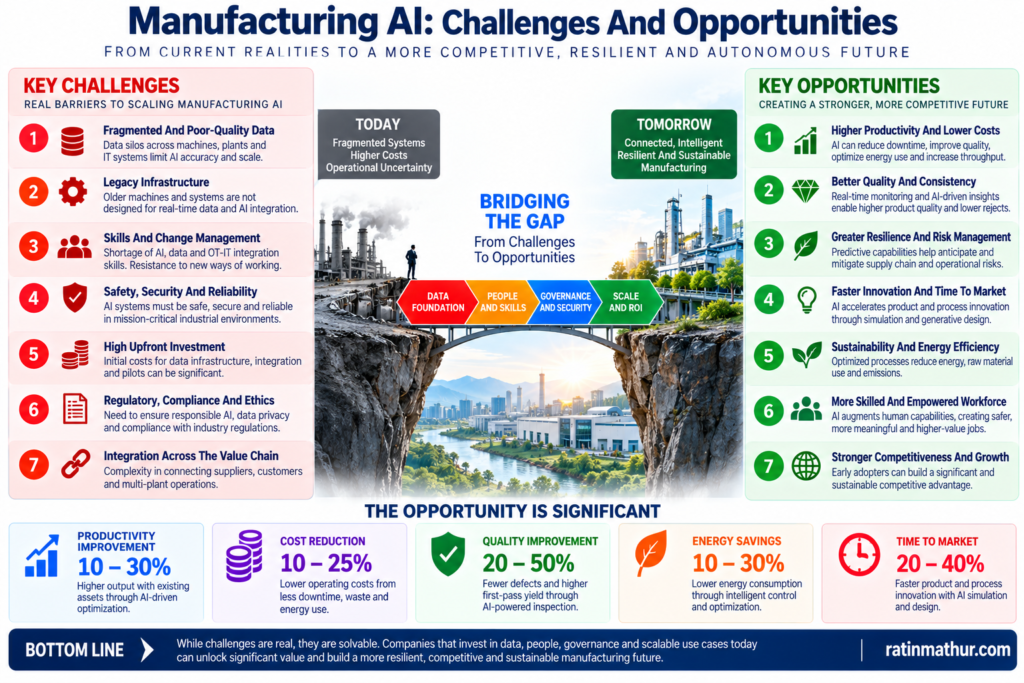
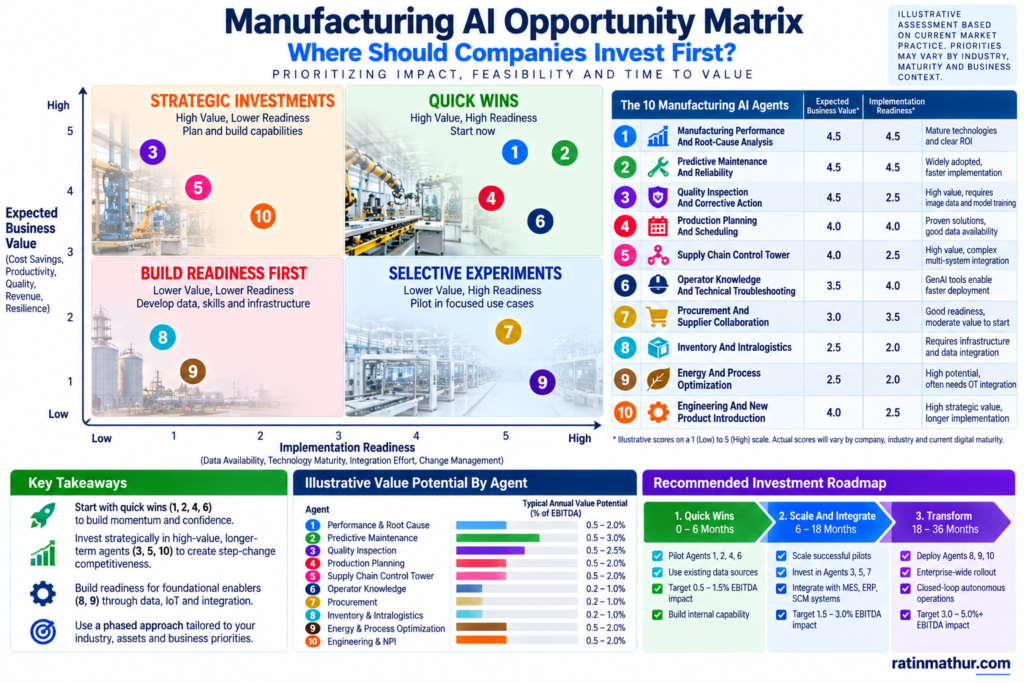
These challenges create an opportunity for manufacturers to build an AI capability around existing digital investments. Companies with a reliable data foundation can begin with production analysis, troubleshooting, or procurement coordination and gradually introduce more complex multi-agent workflows. Organizations with weaker data maturity can begin by improving documentation and information access before attempting predictive or closed-loop applications.
Strategic Frameworks & Recommendations
The following four proprietary strategic frameworks are proposed to help manufacturing leaders convert agentic AI from isolated initiatives into a disciplined operating capability. Each framework addresses a distinct management question: where to invest, how to translate intelligence into action, how to control autonomy, and how to replicate successful applications.
1. FACTORY Value Realization Framework™
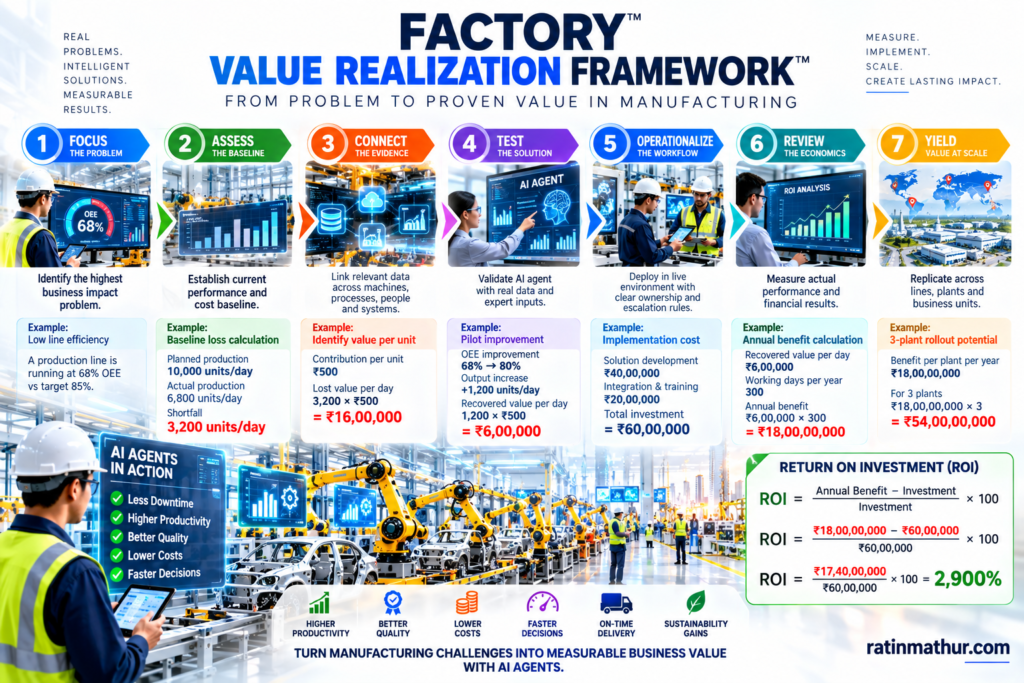
The FACTORY Value Realization Framework™ establishes a business-led method for identifying, testing, and scaling manufacturing AI opportunities. It is designed to prevent organizations from selecting AI technology before clearly defining the operational problem it must solve.
The framework comprises seven stages: Focus the problem, Assess the baseline, Connect the evidence, Test the solution, Operationalize the workflow, Review the economics, and Yield value at scale. Each stage establishes an explicit decision gate, ensuring that technical progress remains connected to measurable operating performance.
Table 1. FACTORY Value Realization Framework™
| Stage | Management Question | Required Output | Example |
|---|---|---|---|
| Focus | Which operating loss has the greatest business impact? | Defined problem and accountable owner | Recurring machine cycle-time losses reduce daily production. |
| Assess | What is the verified baseline? | Agreed KPIs and baseline period | Establish actual cycle time, capacity loss, and associated costs. |
| Connect | Which information is required to investigate the problem? | Data map and quality assessment | Link machine data with SKU, shift, maintenance, and process history. |
| Test | Does the proposed agent generate reliable findings? | Validated prototype and test results | Compare the agent’s investigations against expert-reviewed incidents. |
| Operationalize | Who acts on the recommendation? | Approved workflow and escalation path | The engineer reviews and assigns a corrective action. |
| Review | Has the intervention created measurable value? | Verified performance and financial results | Compare cycle time and output after deployment with the baseline. |
| Yield | Can the benefit be replicated elsewhere? | Scaling decision and implementation standard | Deploy the validated workflow to comparable machines or plants. |
Consider a manufacturing company whose production dashboard repeatedly identifies lower-than-target output but provides limited explanation. FACTORY begins by determining the economic impact of the recurring loss, identifying the production line with the strongest business case, and verifying the availability of relevant machine and process data.
Only then does the company build an agent to investigate the issue. Engineers validate its findings against historical incidents before the solution is connected to live workflows. Following deployment, finance and operations verify the resulting improvement and calculate realized value after implementation costs.
The same principle applies to procurement. Rather than automating every purchasing activity, management can identify a high-volume workflow, establish its current processing cost and cycle time, test a specialized agent, and verify whether it improves buyer productivity and supplier responsiveness.
The framework’s principal recommendation is that financial and operational owners jointly approve the baseline, benefit calculation, and scaling decision. Avoided costs, recovered capacity, incremental revenue, and working-capital release should be measured separately to prevent double counting.
2. SENSE-TO-ACTION Manufacturing Intelligence Framework™
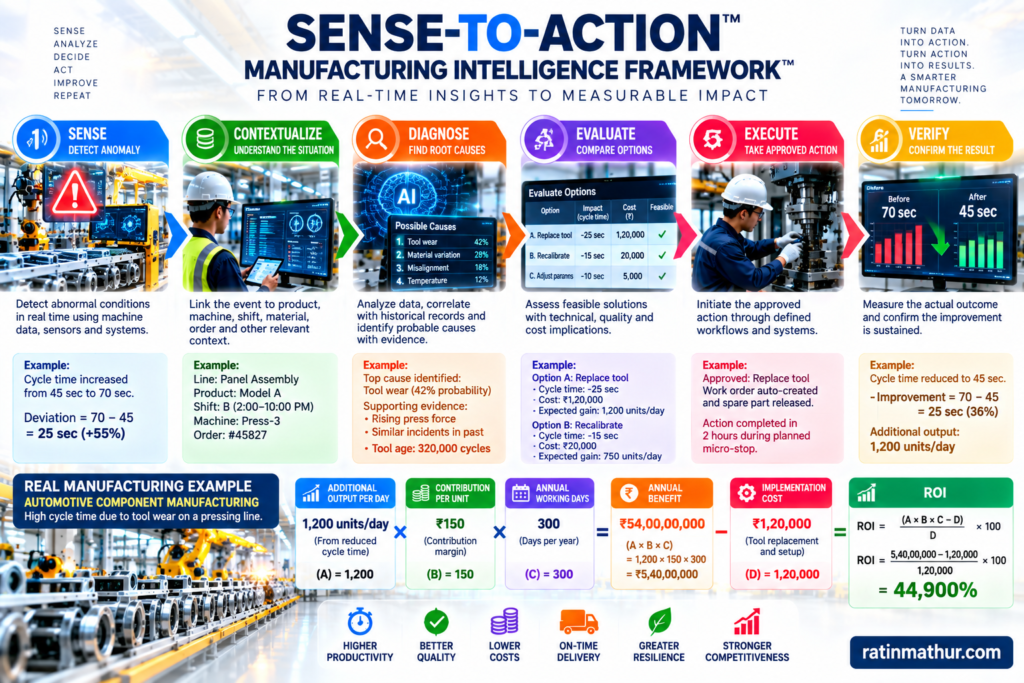
The SENSE-TO-ACTION Manufacturing Intelligence Framework™ defines how a manufacturing AI system should move from detecting an exception to verifying a successful intervention. Its central principle is that an insight has limited value unless it leads to an appropriate action and a measurable outcome.
The six stages are Sense, Contextualize, Diagnose, Evaluate, Execute, and Verify. A single agent may perform some of these activities, but complex industrial applications are generally better served by coordinated agents and specialized analytical tools.
Table 2. SENSE-TO-ACTION Manufacturing Intelligence Framework™
| Stage | Functional Responsibility | Manufacturing Example | Required Output |
|---|---|---|---|
| Sense | Detect an anomaly or exception. | A production line’s cycle time increases. | A validated alert or event. |
| Contextualize | Establish relevant operating conditions. | Identify the affected machine, product, shift, and order. | A complete operational context. |
| Diagnose | Investigate possible causes. | Compare process parameters and historical incidents. | Evidence-supported hypotheses. |
| Evaluate | Compare feasible responses. | Calculate capacity, cost, and quality implications. | Ranked alternatives and trade-offs. |
| Execute | Initiate the authorized intervention. | Prepare an approved maintenance or process-improvement task. | A documented action. |
| Verify | Check whether the intervention worked. | Compare subsequent cycle time, yield, and downtime. | A verified operating result. |
Consider a pharmaceutical packaging line that experiences recurring stoppages during a changeover. The agent first identifies the increase in stoppages, then retrieves the affected product and line context, compares historical incidents, and evaluates relevant maintenance and operating procedures. It prepares a recommendation for the authorized engineer and records the approved action. Subsequent production records determine whether the stoppages actually decline.
This structure prevents a common failure in AI projects: generating a plausible diagnosis without changing the process that caused the problem. It also makes it possible to identify whether an intervention failed because the diagnosis was incorrect, the action was not implemented, or the operating conditions changed.
The recommendation is to require every consequential manufacturing agent to have a defined action path and a verification measure. For higher-risk interventions, engineering controls and explicit human approvals must govern execution. A language-model agent should not directly bypass safety interlocks or independently issue uncontrolled machinery commands.
3. TRUSTED Autonomy And Industrial Governance Framework™
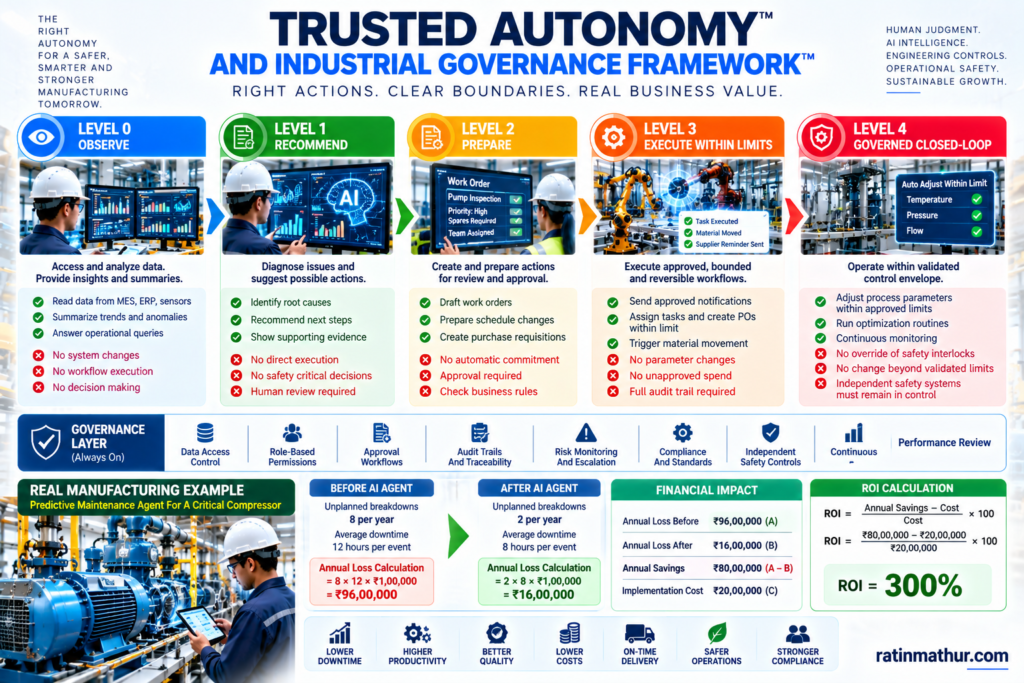
The TRUSTED Autonomy And Industrial Governance Framework™ defines the authority that a manufacturing AI agent should receive according to the consequences of its actions, the strength of its evidence, and its demonstrated reliability.
The framework distinguishes between information access, recommendations, preparation of actions, bounded execution, and validated closed-loop operation. This ensures that autonomy is earned through testing and governance instead of being granted simply because an AI system can technically perform an action.
Table 3. TRUSTED Autonomy And Industrial Governance Framework™
| Level | Permitted Behavior | Example | Governance Requirement |
|---|---|---|---|
| Observe | Read information and summarize events. | Summarize overnight downtime. | Authorized access and traceable sources. |
| Recommend | Diagnose issues and propose responses. | Recommend checks for abnormal equipment vibration. | Evidence-based recommendations and human judgment. |
| Prepare | Create draft actions for review. | Prepare a maintenance work order. | Approval before commitment. |
| Execute Within Limits | Perform approved, bounded, reversible workflows. | Send an approved supplier reminder. | Role-based permissions, transaction limits, and audit logs. |
| Governed Closed-Loop Operation | Work within an independently validated control envelope. | A validated process controller adjusts parameters within approved limits. | Safety engineering, deterministic controls, independent interlocks, and tested fallback procedures. |
The levels are proposed management categories rather than a formal industrial standard. The final level does not permit an unrestricted language model to control safety-critical equipment. Physical control must remain subject to appropriate engineering validation and independent safety mechanisms.
An agent supporting aircraft-component manufacturing, for example, might retrieve approved inspection criteria, correlate previous nonconformances, and prepare a quality investigation. It should not independently authorize the release of a safety-critical component. A procurement agent might send routine follow-up communications automatically, while purchases beyond a predefined commercial limit still require approval.
The organization must also maintain agent identity, source traceability, decision logs, access restrictions, and periodic performance evaluations. These controls should be incorporated into the system design rather than added after the agent begins operating.
The recommendation is to begin with the lowest autonomy level that delivers meaningful value and increase authority only after the system demonstrates reliability under realistic operating conditions.
4. MULTIPLANT SCALE Manufacturing AI Framework™
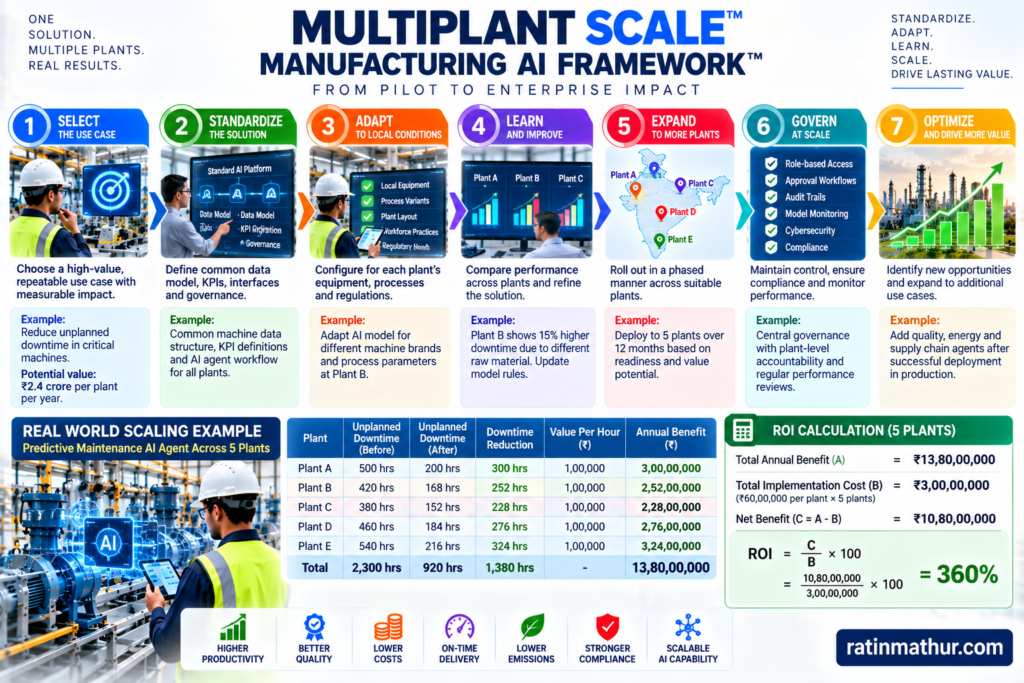
The MULTIPLANT SCALE Manufacturing AI Framework™ addresses the challenge of extending an effective AI agent from one machine or factory to an enterprise-wide capability. A solution that performs well at one plant may not transfer automatically because equipment, product mix, data structures, operating procedures, and engineering constraints vary among facilities.
The framework distinguishes reusable components from site-specific configuration. Common diagnostic logic, workflow patterns, security standards, and performance definitions can be shared, while machine mappings, approved procedures, and local constraints require validation at each deployment site.
Table 4. MULTIPLANT SCALE Manufacturing AI Framework™
| Stage | Management Priority | Example Deliverable |
|---|---|---|
| Select | Identify a high-value, repeatable use case. | A validated business case for a recurring production problem. |
| Standardize | Establish shared data definitions, interfaces, and governance. | Common KPI definitions and an approved agent architecture. |
| Adapt | Configure the solution for local operating conditions. | Site-specific equipment mappings and validated procedures. |
| Learn | Compare outcomes and improve the implementation. | Cross-plant performance assessments and refined test cases. |
| Expand | Replicate the solution at suitable additional sites. | A phased deployment roadmap. |
| Govern | Establish ownership, access controls, and lifecycle management. | Documented accountability for agent performance and changes. |
| Optimize | Verify sustained business value and identify improvements. | Periodic benefit reviews and a prioritized improvement plan. |
Consider a manufacturer operating three plants with similar packaging equipment. The company first validates a troubleshooting agent at the site with the most significant downtime and strongest data foundation. It standardizes diagnostic workflows and defines common downtime indicators before preparing the second deployment.
The second plant may use different machine models or work procedures. Its configuration must therefore be tested against local operating conditions. Only after validating the results should the company expand the solution to the third plant.
The same approach applies to procurement and quality agents. Enterprise standards can define which actions require approvals, how nonconformances are classified, and how suppliers are assessed, while individual plants retain validated local records and operational constraints.
A central AI governance team should maintain reusable components and common standards. Plant managers should remain accountable for local data quality, workforce adoption, process validation, and realized benefits.
The recommendation is to scale the operating capability, not simply copy the software. Enterprise-wide deployment is justified only when the solution can be configured safely, supported consistently, and measured against the economics of each new site.
Future Outlook & Conclusion
Agentic AI will increasingly connect manufacturing intelligence with operational workflows. The most consequential developments will occur where specialized models, industrial applications, enterprise data, and human expertise work together to solve problems across production and business functions.
Production agents will help recover lost capacity. Maintenance agents will improve diagnosis and intervention planning. Quality agents will connect inspection with containment and corrective action. Planning and supply chain agents will coordinate resources under changing conditions. Procurement and inventory agents will reduce administrative delays and improve material availability. Engineering agents will help validate factory and product changes before expensive commitments are made.
The adoption path will vary by application. Documentation-based troubleshooting and procurement coordination may offer relatively accessible starting points. Real-time planning requires reliable master data and integration. Closed-loop process optimization demands greater engineering validation and stronger safety controls.
The strategic opportunity for Indian manufacturers is to use these capabilities to strengthen global competitiveness through better productivity, quality, delivery, resilience, and working-capital management. Success will depend on the discipline of implementation rather than technological ambition alone.
The four proposed frameworks provide a practical management sequence. FACTORY establishes the link between AI investment and verified business value. SENSE-TO-ACTION connects information with corrective action. TRUSTED defines acceptable autonomy and accountability. MULTIPLANT SCALE enables disciplined replication across the enterprise.
Together, they position agentic AI as an operating capability rather than a collection of isolated technology pilots.
The future of manufacturing will not be determined solely by how many robots a factory deploys or how much data it generates. It will increasingly depend on how effectively the organization converts trusted data into better decisions, executes those decisions within appropriate boundaries, and verifies their impact on industrial performance.
The competitive factory of the future will not simply automate production. It will coordinate intelligence, action, and accountability across the entire manufacturing enterprise.
References
- Ajuni. (n.d.). Hero MotoCorp: Demand forecasting and procurement across plants. https://ajuni.io/case-studies/hero-motocorp
- Autio, C., Schwartz, R., Dunietz, J., Jain, S., Stanley, M., Tabassi, E., Hall, P., & Roberts, K. (2024). Artificial intelligence risk management framework: Generative artificial intelligence profile (NIST AI 600-1). National Institute of Standards and Technology. https://doi.org/10.6028/NIST.AI.600-1
- Baskar, V. K., Joshi, A., White, N., & Roy, S. (2024, September 5). Powering intelligent factory operations with Cognizant’s APEx Factory Whisperer and AWS. Amazon Web Services. https://aws.amazon.com/blogs/industries/powering-intelligent-factory-operations-with-cognizants-apex-factory-whisperer-and-aws/
- Bosch Global. (2026). The Bosch Shopfloor Agent: Artificial intelligence for competitive factories. https://www.bosch.com/stories/agentic-ai-manufacturing-production/
- Bosch Global Software Technologies. (2025). The future of work is agentic: Are you ready? https://www.bosch-softwaretechnologies.com/media/documents/downloads/2025/agentic_ai_the_time_is_now.pdf
- NVIDIA. (n.d.-a). Pegatron scales factory operations with visual AI agents and digital twins. https://www.nvidia.com/en-us/case-studies/pegatron-scales-factory-operations-with-visual-ai-digital-twins/
- NVIDIA. (n.d.-b). Wistron accelerates AI infrastructure manufacturing. https://www.nvidia.com/en-us/case-studies/wistron/
- NVIDIA. (n.d.-c). Foxconn develops physical AI-enabled smart factories with digital twins. https://www.nvidia.com/en-in/case-studies/foxconn-develops-physical-ai-enabled-smart-factories-with-digital-twins/
- Siemens AG. (2026, October 19). Siemens partners with NVIDIA to advance AI-driven, autonomous factories. https://press.siemens.com/global/en/pressrelease/siemens-partners-nvidia-advance-ai-driven-autonomous-factories
- Siemens. (n.d.). Intelligence Center X: Agentic enterprise AI. https://www.siemens.com/en-gb/products/intelligence-center-x/
- Stouffer, K., Pease, M., Tang, C., Hahn, A., Gilsinn, J., Rebori-Carretero, D., et al. (2023). Guide to operational technology (OT) security (NIST Special Publication 800-82, Revision 3). National Institute of Standards and Technology. https://csrc.nist.gov/pubs/sp/800/82/r3/final
- Vardhan, H., Dixit, D., & Kumar, G. (2025, June 16). How Apollo Tyres is unlocking machine insights using agentic AI-powered Manufacturing Reasoner. Amazon Web Services. https://aws.amazon.com/blogs/machine-learning/how-apollo-tyres-is-unlocking-machine-insights-using-agentic-ai-powered-manufacturing-reasoner/
- Zuberi, J., Laarabi, H., Smith, S. J., & Shehabi, A. (2026). Can AI be energy positive in cement manufacturing? Evaluating AI-driven efficiency through a first-order framework and case study. Energy and AI, 25, 100789. https://doi.org/10.1016/j.egyai.2026.100789
Disclaimer
This article is intended for general informational, educational, and strategic management purposes. It does not constitute engineering certification, operational safety approval, investment advice, or a guarantee of financial performance. Case-study results and estimates are attributed to their publishers and may not be independently verified or directly transferable to other manufacturing environments.
Manufacturers should independently validate proposed AI agents against their operating conditions, data quality, business objectives, cybersecurity requirements, and applicable safety and regulatory obligations. AI agents should not be granted uncontrolled authority over safety-critical equipment, industrial control systems, product-release decisions, or material financial commitments.
The four frameworks introduced in this article are proposed conceptual management frameworks attributed to Ratin Mathur for this publication. The ™ symbol identifies proposed framework names and does not assert that any name is a registered trademark. Their legal status and availability for commercial use have not been independently assessed; appropriate intellectual property and trademark searches should be conducted before adoption or commercialization.
Copyright © 2026 Ratin Mathur. All rights reserved. Website: https://ratinmathur.com.