Executive Summary
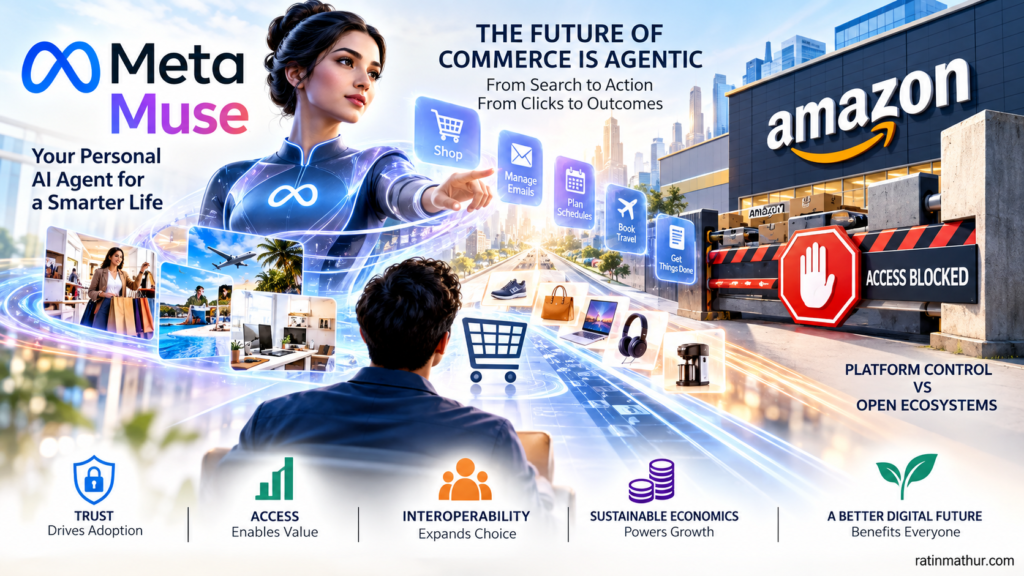
The next major disruption in artificial intelligence will not be determined solely by which company develops the most sophisticated language model. It will be determined by which company earns the right to act on behalf of consumers, access their digital lives and execute transactions across competing platforms.
Meta’s September 8, 2026 launch of Muse, its personal AI agent, represents an important development in this transition. Within approximately two weeks, the application accumulated more than 2.5 million downloads and reached the top of Apple’s US App Store. Yet its rapid adoption has coincided with growing concerns about privacy, cybersecurity, commercial access and the concentration of digital power.
Amazon’s decision to block Muse from shopping on its platform exposes a fundamental conflict in the emerging agentic economy: consumers increasingly want intelligent assistants that operate across platforms, while digital businesses want to retain control over customer relationships, transaction infrastructure and commercially valuable data.
This article examines the strategic implications of that conflict through three interconnected dimensions: consumer trust, platform economics and ecosystem governance.
Its central proposition is that the competitive advantage of tomorrow’s AI platforms will depend less on acquiring users than on securing sustainable permission to act for them.
Three original strategic frameworks are proposed: the Agentic Trust Architecture™, the Agentic Commerce Control Matrix™ and the Autonomous Value Capture Flywheel™. Together, they provide a structured approach for technology companies, retailers and enterprise leaders to evaluate AI-agent deployment, protect commercial interests and build sustainable economic value.
Introduction
For nearly three decades, the digital economy has been organized around a relatively stable principle: consumers navigate platforms, search for information, compare alternatives and personally execute transactions. Search engines, social networks, marketplaces and mobile applications have competed to influence different stages of this journey.
Agentic AI threatens to reorganize this architecture.
Unlike conventional chatbots, which primarily generate responses, autonomous AI agents can interpret objectives, navigate websites, access authorized accounts, compare products and execute multistep tasks. The consumer’s role can shift from performing each action to defining objectives, granting permissions and supervising outcomes.
Meta’s Muse illustrates this transition. The application can undertake activities such as shopping, managing emails and coordinating everyday tasks. Its initial popularity demonstrates substantial consumer curiosity about delegating digital work to AI.
However, downloading an application is fundamentally different from trusting it with personal information, financial credentials and purchasing authority.
The controversy surrounding Muse is therefore more significant than an ordinary dispute between two technology companies. It exposes unresolved questions about the future organization of digital markets.
Who owns the customer relationship when an AI agent completes the purchase? Who controls the information exchanged between competing platforms? Who bears responsibility when an autonomous transaction fails? And how should economic value be distributed among the agent developer, marketplace, merchant and payment provider?
The answers will influence the next generation of digital business models.
Problem Statement & Objectives
The emergence of autonomous consumer agents creates a structural tension between technological capability, consumer authorization and platform control.
An AI agent may receive permission from a consumer to purchase a product, but that authorization does not automatically establish permission to access every retailer’s systems. Similarly, a retailer may permit consumers to browse and transact while restricting automated third-party access.
Amazon’s decision to block Muse demonstrates this distinction. Amazon has raised concerns about unauthorized access, transparency and the apparent handling of customer credentials. Meta’s published position is that Muse uses secure credential storage and cannot directly view users’ passwords or payment methods. These competing positions highlight the need for independently verifiable security and access standards.
The objective of this study is to examine how agentic AI could reshape digital commerce, evaluate the competing economic interests of major platforms and develop practical strategic frameworks for responsible deployment.
It also seeks to distinguish short-term adoption from sustainable competitive advantage, identifying the conditions under which consumer agents could become economically viable infrastructure rather than expensive experimental applications.
Methodology
This article adopts a qualitative, exploratory research methodology combining secondary-source analysis, comparative business-model assessment and scenario-based strategic reasoning.
The primary case is Meta’s Muse launch and its subsequent interaction with Amazon and other commerce platforms. Contemporary reporting from The Wall Street Journal, CBS News, Axios, GeekWire and PYMNTS provides evidence concerning adoption, platform access, security concerns and emerging commercial partnerships.
The analysis distinguishes reported facts from company allegations, analyst estimates and forward-looking strategic interpretations.
Three original conceptual frameworks are developed through synthesis of the case evidence and established principles of platform economics, risk management and business-model design. Their metrics and applications are illustrative rather than empirically validated.
The study reflects information available through September 24, 2026. Given the early stage of Muse’s commercialization, longer-term retention, profitability, security performance and competitive outcomes remain uncertain.
Landscape Analysis
From conversational AI to autonomous execution
The first wave of generative AI largely competed on the ability to produce information. Agentic AI introduces a different economic proposition: completing work.
A conversational assistant might recommend a hotel. An autonomous agent could compare availability, assess travel preferences, coordinate dates and complete an authorized booking.
This difference changes the commercial significance of AI from information generation to transaction execution.
| Dimension | Conversational AI | Agentic AI |
|---|---|---|
| Primary function | Generate information and recommendations | Execute multistep objectives |
| Consumer interaction | Repeated prompting | Delegation and supervision |
| Data requirements | Primarily conversational context | Potentially sensitive account and transaction data |
| Platform dependence | Information access | Operational access and authorization |
| Principal risk | Incorrect or misleading output | Incorrect, unauthorized or harmful actions |
| Economic opportunity | Subscriptions and productivity | Subscriptions, transaction services and workflow integration |
Meta’s distribution advantage
Meta enters this market with extensive consumer relationships through Facebook, Instagram, WhatsApp and its broader technology ecosystem.
This provides potential advantages in product discovery, distribution and contextual personalization. However, integration across these services depends on product design, user permissions and applicable privacy requirements; access to Meta’s existing user base does not automatically translate into permission to combine all associated data.
Muse’s initial adoption has nevertheless been substantial. Sensor Tower figures reported by CBS News indicate more than 2.5 million downloads following its September 8 launch, while ChatGPT recorded approximately 3.1 million global downloads during a comparable launch period. These figures illustrate initial adoption, not directly comparable retention or active usage.
The more consequential question is whether Meta can convert that attention into repeated, trusted and economically sustainable activity.
Amazon’s strategic dilemma
Amazon’s relationship with external shopping agents illustrates the competing interests inherent in digital commerce.
An autonomous agent could benefit consumers by comparing prices and reducing the time required to purchase products. It could also redirect customer interactions away from a retailer’s proprietary interface.
For Amazon, that raises questions extending beyond immediate sales. Product discovery, sponsored placement, recommendations and customer engagement are commercially significant components of its marketplace.
At the same time, Amazon’s publicly stated objections to Muse concern authorization, agent identification, credential handling and user experience. Its commercial incentives may provide strategic context, but they do not establish that its security objections are insincere.
The emergence of competing ecosystems
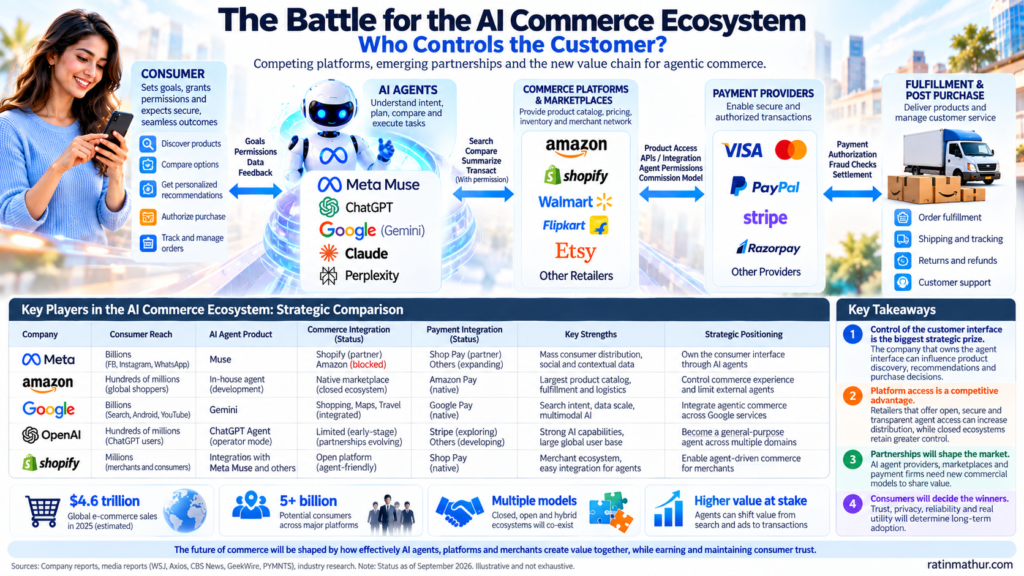
Other businesses are adopting a different approach. Shopify has announced support for Muse through Shop Pay, while reporting identifies additional commerce and payment integrations involving companies such as PayPal and Stripe.
These contrasting responses suggest that agentic commerce may develop through several parallel models rather than a single universal architecture.
| Emerging model | Operating principle | Strategic implication |
|---|---|---|
| Closed platform | Retailer controls agent access and transactions | Greater operational control but potentially less interoperability |
| Open partnership | Retailer integrates approved external agents | Wider distribution with negotiated access |
| Agent-led commerce | Consumer delegates discovery and execution | Customer interaction shifts toward the agent |
| Hybrid ecosystem | Retailers combine proprietary and third-party agents | Balance between customer control and external reach |
Key Findings
1. Consumer adoption is accelerating faster than institutional trust
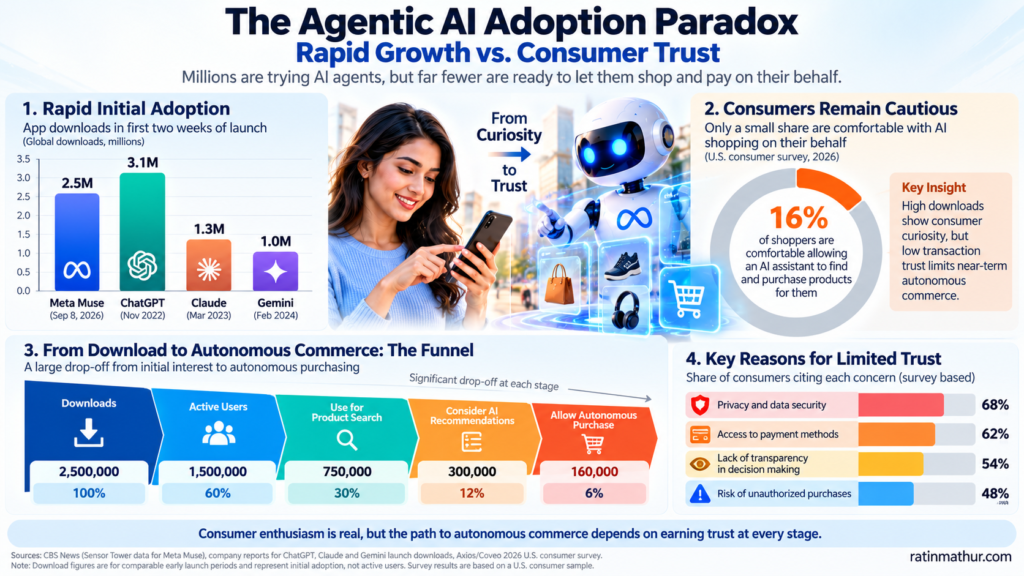
Muse’s rapid download growth demonstrates interest in autonomous assistance, but consumer willingness to delegate consequential decisions remains more limited.
Axios cites Coveo’s 2026 research indicating that only 16% of surveyed shoppers are comfortable allowing an AI assistant to find and purchase products on their behalf. The distinction between researching a product and authorizing a purchase remains commercially important.
This creates a trust-conversion challenge. Successful platforms must turn experimentation into recurring usage while progressively earning permission to perform higher-risk activities.
2. Platform access is becoming a competitive resource
AI agents depend on the ability to interact with external systems. Their usefulness can deteriorate when essential websites or services restrict access.
Amazon’s decision demonstrates that technical capability alone does not guarantee operational interoperability.
Access agreements, standardized interfaces, transparent agent identification and mutually acceptable commercial arrangements could become important sources of competitive advantage.
3. Data governance is moving from compliance to product strategy
Traditional digital platforms generally ask consumers to share information within a defined application. Personal agents may require access across emails, calendars, shopping accounts and financial services.
The resulting concentration of sensitive information increases the potential consequences of unauthorized access, inappropriate data sharing or compromised credentials.
For agent developers, privacy and security must therefore become integral elements of product architecture rather than secondary compliance functions.
4. Revenue potential must be evaluated against execution costs
Agentic applications can incur substantial operating expenses because multistep tasks require repeated model inference, browsing, verification and sometimes dedicated computing environments.
Muse’s commercialization strategy reportedly includes premium subscriptions and merchant-related revenue opportunities. However, high adoption does not establish positive unit economics, particularly if most consumers use free services.
Sustainable growth requires the incremental value generated by each agent to exceed its full operating, support, security and infrastructure costs.
5. Control of the consumer interface may influence value distribution
If consumers increasingly initiate purchases through agents rather than retailer websites, the location of product discovery and customer engagement could shift.
Retailers may continue to control inventory, fulfillment and after-sales service while agents influence consideration, comparison and purchase initiation.
The eventual distribution of commercial value will depend on bargaining power, integration standards, consumer preferences and the effectiveness of alternative distribution channels.
Challenges & Opportunities
The agentic economy creates simultaneous opportunities and risks for technology companies, retailers and consumers.
| Strategic challenge | Potential consequence | Corresponding opportunity |
|---|---|---|
| Sensitive-data exposure | Financial loss and reputational damage | Privacy-preserving agent infrastructure |
| Restricted platform access | Incomplete task execution | Standardized authorization and commerce APIs |
| High inference costs | Weak unit economics | More efficient task orchestration |
| Low transaction trust | Limited autonomous purchasing | Graduated authorization and human oversight |
| Concentration of customer relationships | Platform dependency | Interoperable commerce ecosystems |
| Unclear accountability | Disputes and regulatory exposure | Auditable transaction and liability frameworks |
One particularly important opportunity lies in separating product discovery from transaction authorization.
Consumers may be comfortable allowing agents to compare hundreds of products while preferring to approve the final purchase personally. Such hybrid arrangements could provide much of the convenience of automation without requiring unrestricted autonomy.
For enterprises, this suggests that responsible automation should be designed around the consequences of individual tasks rather than an indiscriminate objective of maximizing autonomy.
Strategic Frameworks & Recommendations
The following three original conceptual frameworks provide a structured approach to agentic AI strategy. They are proposed analytical models, not established industry standards or empirically validated measurement systems.
Framework 1: Agentic Trust Architecture™
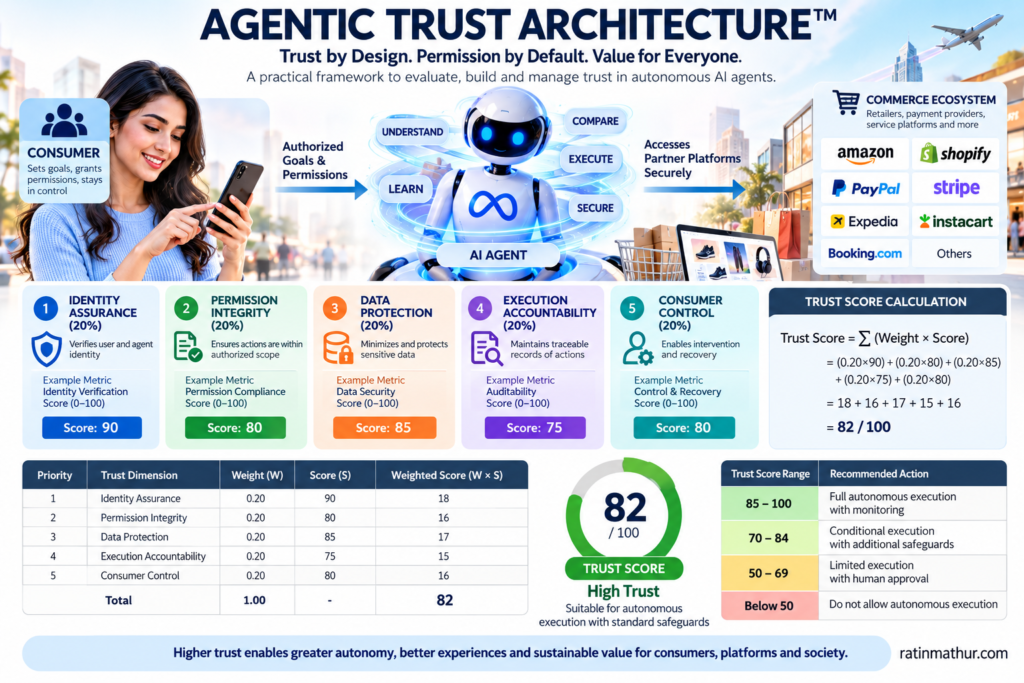
Strategic purpose: Transform consumer trust into measurable, permission-based operational capability.
The Agentic Trust Architecture™ proposes that autonomous systems should earn increasing levels of operational authority through demonstrated reliability, transparent authorization and effective safeguards.
Instead of treating consumer consent as a single decision, the framework divides trust into five interdependent dimensions.
| Trust dimension | Strategic requirement | Illustrative implementation |
|---|---|---|
| Identity assurance | Verify the user and the agent | Authenticated agent identities |
| Permission integrity | Restrict actions to authorized purposes | Task-specific and revocable permissions |
| Data protection | Minimize sensitive-data exposure | Encryption and isolated credential storage |
| Execution accountability | Maintain traceable records of consequential actions | Auditable transaction logs |
| Consumer control | Enable intervention and recovery | Approval checkpoints, cancellation and dispute procedures |
The framework’s underlying principle is that autonomy should increase only when the associated safeguards are appropriate to the consequences of the task.
For example, a consumer might authorize Muse to compare insurance policies without permitting it to disclose medical information or purchase coverage. A subsequent transaction would require a separate authorization that specifies the insurer, product, premium and relevant conditions.
This graduated approach can also support enterprise adoption. A procurement agent might independently identify suppliers and prepare comparative evaluations while requiring managerial approval before issuing purchase orders.
The principal recommendation is to establish a permission architecture in which authorization is specific, time-bound, revocable and independently auditable.
Performance can be monitored through unauthorized-action incidents, task completion accuracy, permission-revocation effectiveness and the proportion of consequential transactions supported by adequate approval records.
Framework 2: Agentic Commerce Control Matrix™
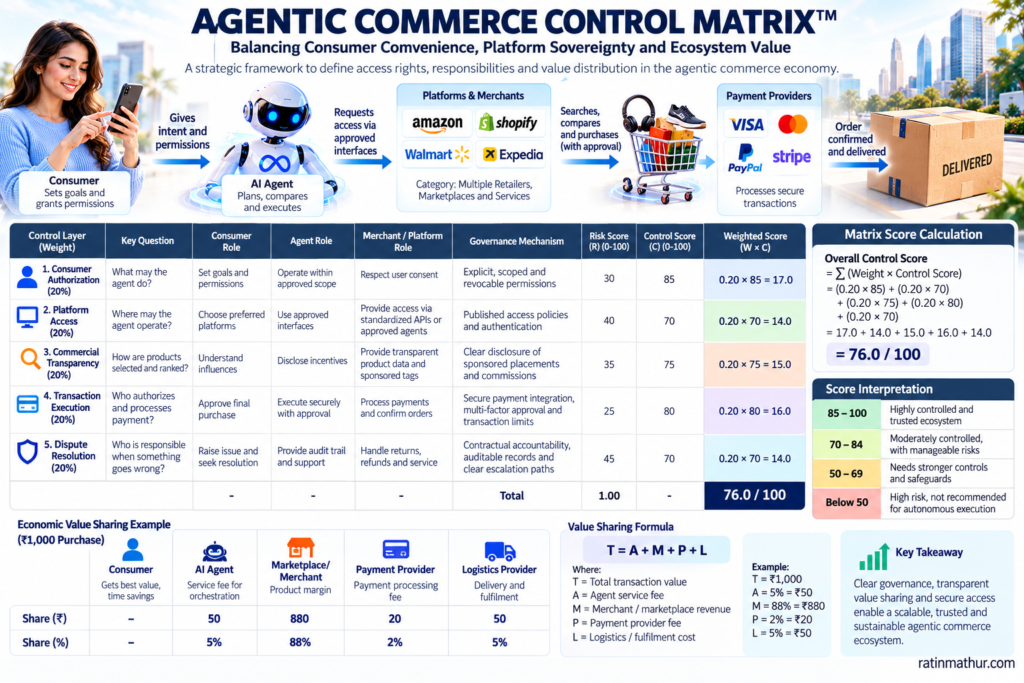
Strategic purpose: Balance consumer convenience, platform sovereignty and ecosystem interoperability.
The Agentic Commerce Control Matrix™ addresses the commercial conflict between autonomous agents and the digital platforms on which they operate.
Its central proposition is that sustainable agentic commerce requires clearly defined rights and responsibilities among consumers, agents, merchants, marketplaces and payment providers.
| Control layer | Primary strategic question | Recommended governance mechanism |
|---|---|---|
| Consumer authorization | What may the agent do? | Explicit, scoped consumer consent |
| Platform access | Where may the agent operate? | Published access policies and approved interfaces |
| Commercial transparency | How are products selected and ranked? | Disclosure of sponsored placements and incentives |
| Transaction execution | Who authorizes and processes payment? | Secure payment integration and approval rules |
| Dispute resolution | Who is responsible when something goes wrong? | Contractual accountability and documented recovery procedures |
The matrix distinguishes consumer permission from platform permission. Both may be necessary, but they serve different purposes.
Consider a hypothetical shopping agent comparing electronic products across Amazon and Shopify merchants. The consumer may authorize product research and establish a maximum purchase price. Participating merchants could expose approved product catalogs and transaction interfaces, while the agent discloses any financial incentives affecting recommendations.
A retailer choosing not to permit automated purchasing could still offer standardized product-discovery access, subject to its policies. Conversely, an agent provider could prioritize merchants offering transparent, reliable integrations.
The recommended strategy is to replace ambiguous automated access with explicit commercial interoperability agreements wherever feasible.
Success should be assessed through authorized transaction completion, merchant participation, consumer satisfaction, integration reliability and dispute-resolution performance.
Framework 3: Autonomous Value Capture Flywheel™
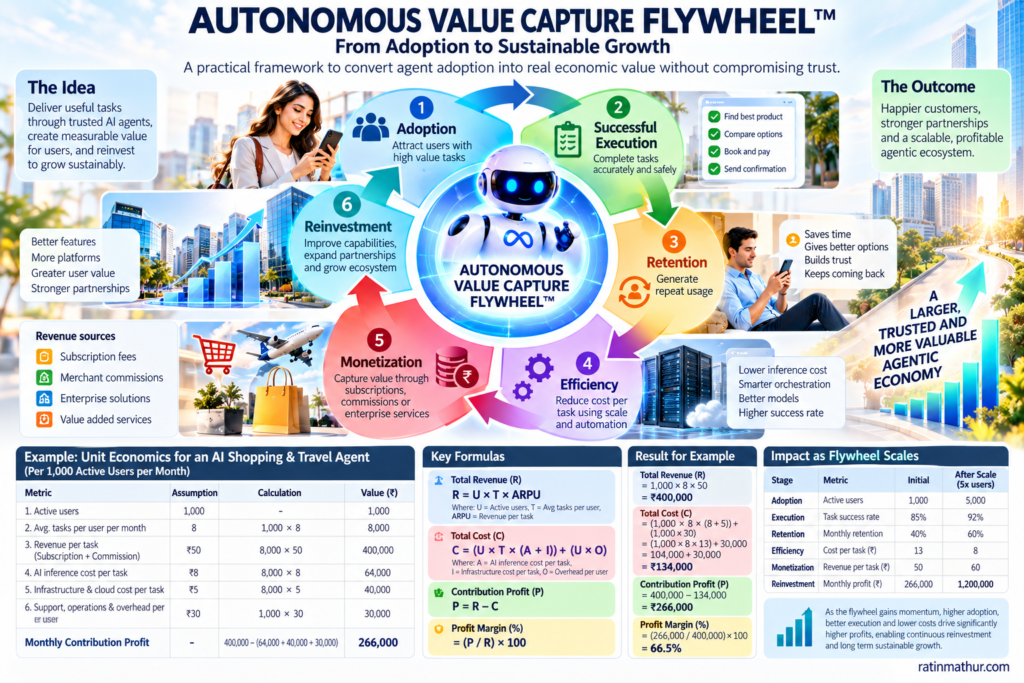
Strategic purpose: Convert agent adoption into sustainable economic value without compromising trust.
The Autonomous Value Capture Flywheel™ connects consumer adoption, successful task execution, operational efficiency and commercial monetization.
The framework proposes that agentic platforms should optimize for verified value delivered rather than downloads, task volume or autonomous activity alone.
| Flywheel stage | Value-creation mechanism | Illustrative performance indicator |
|---|---|---|
| Adoption | Attract consumers through useful tasks | Qualified activated users |
| Successful execution | Complete authorized tasks reliably | Verified task completion rate |
| Retention | Generate repeat utility | Repeat usage and cohort retention |
| Efficiency | Reduce the cost of successful execution | Fully loaded cost per completed task |
| Monetization | Capture a sustainable share of delivered value | Contribution margin per active user |
| Reinvestment | Improve reliability, capabilities and partnerships | Measurable improvement in service economics |
The flywheel begins with a clearly defined consumer problem. An agent that reliably coordinates travel, for example, may generate repeat engagement because it saves time and reduces administrative effort.
As usage increases, the provider can identify recurring workflow inefficiencies and improve execution. However, learning from consumer interactions must remain consistent with disclosed data-use policies and applicable permissions.
Commercial value may subsequently emerge through subscriptions, explicitly disclosed merchant commissions or enterprise service agreements.
A hypothetical travel agent charging a monthly subscription would need to demonstrate that consumers receive sufficient recurring value to justify payment. Its economics would depend on retention, execution costs, payment fees, support requirements and the frequency of successful tasks.
The strategic recommendation is to evaluate profitability at the completed-task and retained-customer levels, rather than relying primarily on gross download figures.
This approach also discourages artificial engagement. An agent that completes a task efficiently may generate fewer interactions but deliver greater consumer value.
Future Outlook & Conclusion
The emergence of Muse suggests that autonomous consumer agents are moving beyond experimental demonstrations toward mainstream distribution. Yet the commercial architecture required to support widespread deployment remains unsettled.
Over the next several years, three developments warrant particular attention.
First, consumer trust will increasingly depend on demonstrable control over sensitive information and consequential actions. Second, platform competition will extend into interoperability agreements, access policies and the governance of automated transactions. Third, the financial sustainability of agentic services will depend on whether recurring consumer value can support their substantial operating costs.
Meta’s existing consumer ecosystem offers significant distribution opportunities, while Amazon’s marketplace infrastructure gives it considerable control over its own commerce environment. Neither advantage eliminates the need for cooperation, and neither guarantees control of the emerging market.
The broader strategic implication extends beyond these two companies.
Retailers must determine how to remain visible and commercially relevant when consumers increasingly delegate product discovery. Technology companies must establish reliable, accountable execution. Payment providers must support secure authorization, while policymakers and standards organizations will face growing pressure to clarify the responsibilities of autonomous systems.
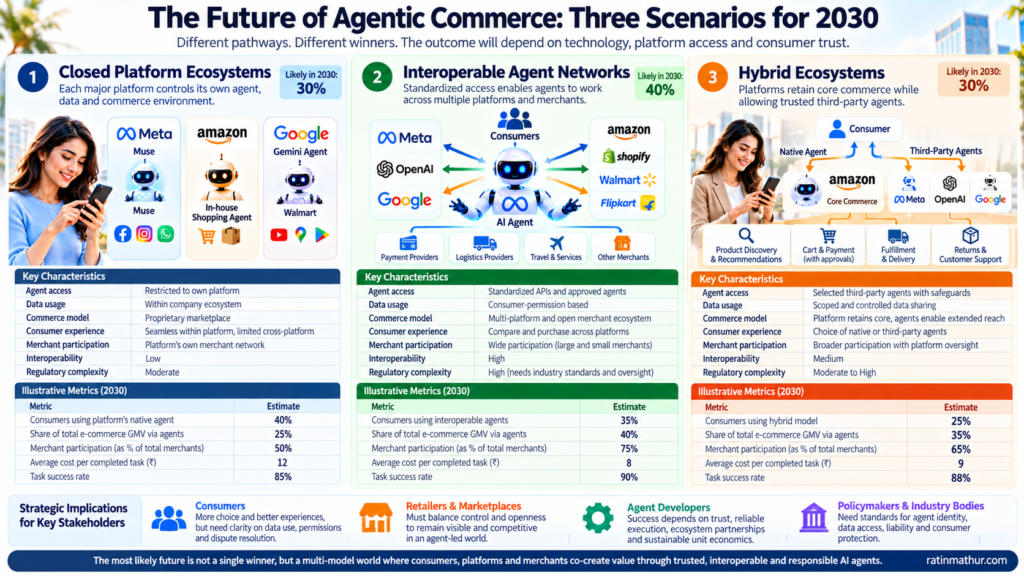
The three proposed frameworks offer complementary perspectives on these challenges. The Agentic Trust Architecture™ addresses permission and accountability. The Agentic Commerce Control Matrix™ examines commercial access and ecosystem governance. The Autonomous Value Capture Flywheel™ connects useful execution with sustainable business economics.
Together, they support a central conclusion: the long-term significance of agentic AI will not be measured simply by how many tasks machines can perform, but by how reliably, transparently and economically they can perform tasks that people have genuinely authorized.
The emerging competition is therefore not merely a race to build more capable agents. It is a contest to establish the trusted infrastructure through which consumers and businesses will conduct an increasing share of their digital activities.
References
1. Bobrowsky, M. (2026, September 22). Meta’s new AI agent is an instant hit, and the backlash has already begun. The Wall Street Journal. Read article .
2. Bobrowsky, M. (2026, September). Meta launches a personal AI agent designed to be easy to use. The Wall Street Journal. Read article .
3. Cunningham, M. (2026, September 23). Meta’s Muse personal agent is a hit, as AI commerce starts to take off. CBS News. Read article .
4. Bomey, N. (2026, September 21). Amazon boots Meta’s Muse in fight over AI shopping. Axios. Read article .
5. Bishop, T. (2026, September 20). Amazon blocks Meta’s Muse AI assistant in new standoff over agentic shopping. GeekWire. Read article .
6. PYMNTS. (2026, September 23). Is Muse really the answer to Meta’s AI woes? PYMNTS. Read article .
7. Los Angeles Times. (2026, September 23). Meta Muse can now book travel and shop for you. Amazon says it crossed a line. Read article .
8. LiveMint. (2026, September 23). Meta’s new AI agent is an instant hit – and the backlash has already begun. Read article .
Disclaimer
This article is an independent strategic analysis prepared for educational, research and professional discussion purposes. It draws upon publicly available reporting as of September 24, 2026. Company statements, third-party estimates and allegations are attributed where relevant and should not be interpreted as independently established findings.
The Agentic Trust Architecture™, Agentic Commerce Control Matrix™ and Autonomous Value Capture Flywheel™ are original conceptual frameworks proposed by Ratin Mathur. The ™ symbol indicates a claim to these framework names and does not represent registered trademark status. Their use does not constitute legal, cybersecurity or investment advice.
© 2026 Ratin Mathur | AI-assisted research and strategic analysis | ratinmathur.com