Executive Summary
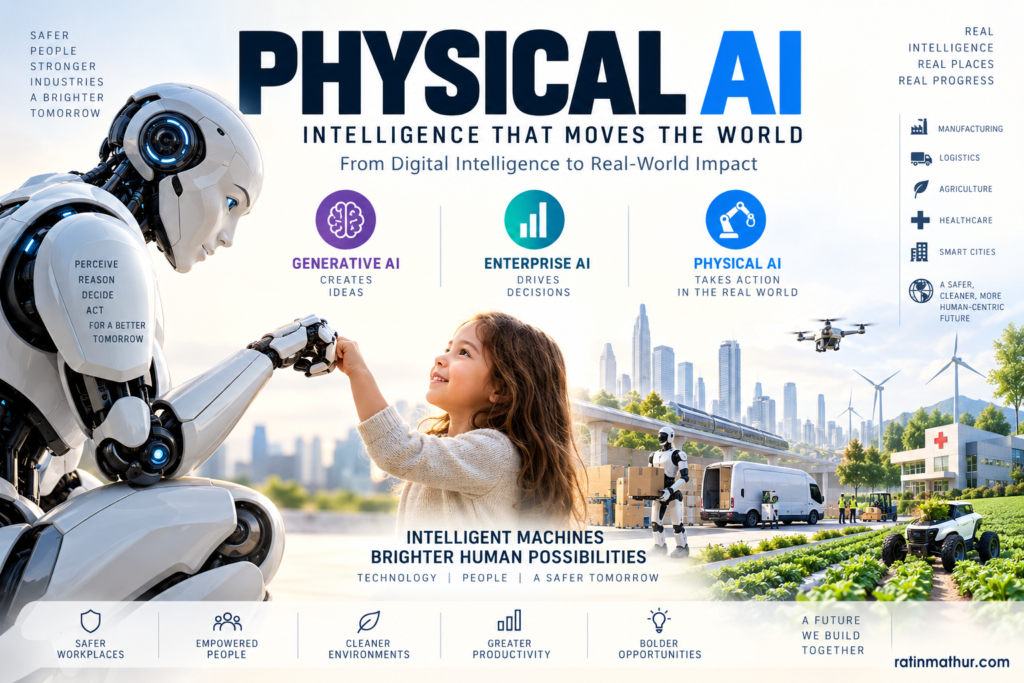
Artificial intelligence is entering a fundamentally different phase. Generative AI transformed how machines create and manipulate information. Enterprise AI is transforming how organizations analyze data, make decisions, and automate digital workflows. Physical AI extends this progression into the physical world by enabling machines to perceive environments, interpret situations, make decisions, move, manipulate objects, and learn from real-world interactions.
This distinction is strategically important because Physical AI introduces something earlier generations of AI largely did not possess: direct physical agency. A generative AI system can produce an incorrect answer. An enterprise AI system can make a flawed recommendation or execute a bad digital transaction. A Physical AI system can translate an incorrect perception or decision into physical movement, potentially causing equipment damage, operational disruption, or human injury.
The opportunity is nevertheless enormous. A McKinsey Live webinar held on September 9, 2026, argues that humanoid robots are likely to represent only a small portion of the total Physical AI opportunity and identifies software, data, and orchestration platforms as major future value pools, with that layer potentially reaching $330 billion by 2035. The broader strategic opportunity lies across robotics, autonomous machinery, industrial automation, logistics, transportation, agriculture, healthcare, inspection, infrastructure, and other forms of embodied intelligence.
The challenge is that Physical AI combines the complexity of software with the consequences of physical action. Reliability therefore becomes more important than demonstration capability. NIST identifies a significant gap between embodied AI demonstrated in research and what can be practically implemented in real-world manufacturing environments, emphasizing the need for metrics, test methods, standards, datasets, and evaluation frameworks. (NIST)
The central thesis of this paper is that Physical AI should not be evaluated simply on the question of whether machines can become more intelligent. The more important question is whether they can become sufficiently reliable, secure, constrained, transparent, and controllable to operate safely alongside humans.
The strategic objective should consequently shift from maximum autonomy to safe, economically valuable autonomy. The organizations that ultimately lead this market may not be those with the most impressive robots, but those capable of creating trustworthy physical intelligence at scale.
Introduction
Every major technological wave expands what machines can do. Industrial machinery amplified human physical strength. Computers amplified calculation. Networks amplified communication. Enterprise software amplified organizational coordination. Generative AI amplified cognitive content production. Physical AI represents the next transition: machine intelligence acquiring the ability to perceive and act within the physical world.
This is not simply “AI inside a robot.” Physical AI represents an integrated system of artificial intelligence, sensors, perception, planning, control, mechanical systems, actuators, connectivity, and continuous environmental feedback. Its fundamental operating loop is different from conventional software AI: the machine senses the environment, interprets it, determines an action, executes that action, observes the result, and adjusts its behavior.
The strategic difference can be expressed simply. Generative AI creates. Enterprise AI analyzes, predicts, recommends, and increasingly executes digitally. Physical AI perceives, reasons, decides, and acts physically.
That final transition from decision to action changes the nature of risk. In a digital environment, many errors can be reversed, corrected, rolled back, or compensated for. In the physical world, an error may occur within milliseconds and may not be reversible. A mistaken software instruction can become a robotic movement. A mistaken perception can become a collision. A compromised digital system can become a cyber-physical incident.
The implications extend far beyond humanoids. Artificial intelligence is increasingly being applied to industrial robots, autonomous mobile systems, manufacturing, computer vision, inspection, navigation, manipulation, and other robotic applications. The International Federation of Robotics has identified AI as a major driver of the next generation of robotics while highlighting issues involving reliability, cybersecurity, software quality, and safety. (IFR International Federation of Robotics)
Physical AI therefore represents both an economic opportunity and a governance challenge. It could transform the economics of physical work, but the transition must be managed with a level of caution that reflects the consequences of putting increasingly autonomous intelligence into machines with physical power.
Problem Statement & Objectives
The central problem is a widening gap between the speed of AI innovation and the maturity of the systems required to govern AI-enabled physical action. Much of the public discourse focuses on spectacular demonstrations, humanoid robotics, automation, and productivity. Yet the more difficult questions concern what happens when machines operate under uncertainty, around humans, at scale, across changing environments.
The relevant question is not simply whether a robot can perform a task. It is whether it can perform that task repeatedly and safely despite changes in lighting, object position, floor conditions, human movement, sensor quality, network availability, software versions, maintenance condition, and other variables.
NIST explicitly describes a gap between embodied AI shown in academic research and what manufacturers and robotics integrators can realistically implement in operational environments. Its current program focuses on developing AI-specific productivity metrics, test methods, standards, software, prototypes, and datasets to enable better evaluation of AI-enhanced robotics. (NIST)
This paper therefore has five objectives: to clarify how Physical AI differs from Generative AI and Enterprise AI; examine the economic and operational potential of Physical AI; analyze its major risks, with particular emphasis on AI-enabled robots; assess the conditions under which Physical AI can be considered safe for humans; and provide strategic frameworks for leaders seeking to capture value while maintaining human oversight, accountability, and trust.
| Dimension | Generative AI | Enterprise AI | Physical AI |
|---|---|---|---|
| Primary environment | Digital information | Business and organizational systems | Physical and digital environments |
| Core function | Generate | Analyze, predict, optimize, decide | Perceive, reason, decide, act |
| Main interface | Text, image, audio, code | Applications, APIs, dashboards | Sensors, cameras, controllers, actuators |
| Typical failure | Incorrect information | Incorrect business decision | Incorrect physical action |
| Reversibility | Generally high | Moderate | Potentially low |
| Safety requirement | Important | High | Potentially life-critical |
| Capital intensity | Relatively low | Moderate | High |
| Data | Digital information | Enterprise information | Sensor, video, trajectory, force, and interaction data |
| Primary challenge | Model quality | Integration and organizational adoption | Reliability, safety, hardware, environment, and human interaction |
Methodology
This paper follows a strategic research methodology based on synthesis of current industry research, robotics standards, AI risk-management work, and the September 9, 2026 McKinsey Live webinar, Physical AI: The hidden value pools leaders are missing. The webinar highlights that humanoids may represent only a sliver of the wider Physical AI opportunity and identifies software, data, and orchestration as strategically significant value pools.
The analysis is complemented by NIST research on Physical AI and AI-enabled robotics, International Federation of Robotics research on artificial intelligence in robotics, and ISO 10218-1:2025 covering safety requirements for industrial robots. NIST emphasizes testing, metrics, and real-world deployment feasibility, while ISO 10218-1:2025 establishes requirements related to inherently safe design, risk reduction, and information for the safe use of industrial robots. (NIST)
The paper distinguishes source-supported findings from strategic interpretation. Market projections are treated as forward-looking scenarios rather than guaranteed outcomes because Physical AI remains an emerging technological and commercial domain.
Landscape Analysis
Physical AI is broader than humanoid robotics. The category includes robotic arms, autonomous mobile robots, warehouse systems, autonomous vehicles, agricultural machinery, drones, inspection robots, industrial machinery, medical robotics, collaborative robots, autonomous forklifts, and future household robots. The strategic market is therefore not a single product category but an ecosystem.
The September 9, 2026 McKinsey Live webinar explicitly argues that excessive attention to humanoid robots risks understating the broader Physical AI opportunity. Its framing places significant value in the software, data, and orchestration platforms that allow autonomous systems to learn from experience and scale, with that layer potentially reaching $330 billion by 2035. This creates an important strategic distinction between the visible machine and the less visible intelligence infrastructure that makes the machine useful.
| Physical AI layer | Strategic role | Potential value creation |
|---|---|---|
| Hardware | Sensing, mobility, manipulation, actuation | Physical capability, precision, endurance |
| Perception and AI | Understand the environment | Object recognition, scene understanding |
| Planning and control | Convert intelligence into movement | Navigation, manipulation, task execution |
| Data and learning | Improve performance from experience | Better reliability and adaptation |
| Orchestration | Coordinate machines and workflows | Fleet optimization and system-level efficiency |
| Deployment | Integrate technology into operations | Process transformation |
| Field operations | Sustain performance after deployment | Maintenance, monitoring, remote support |
The market also combines the economics of technology with the economics of industrial equipment. Software can scale rapidly, while robots must be manufactured, maintained, upgraded, tested, insured, integrated, and operated. This tension helps explain why Physical AI is likely to develop multiple commercial models, including equipment sales, robotics-as-a-service, software subscriptions, fleet management, deployment services, and outcome-based automation.
Key Findings
The first key finding is that Physical AI could become significantly broader than the current humanoid narrative suggests. The strategic market includes specialized and semi-general-purpose machines, autonomous systems, software platforms, deployment infrastructure, operational services, and data. Humanoids may be highly visible, but visibility should not be confused with total economic value.
The second finding is that the most commercially attractive early applications are likely to be those in which the environment is structured and the economic benefits are measurable. Manufacturing, logistics, inspection, packaging, material handling, agriculture, mining, and other controlled environments offer more manageable conditions than households, crowded public spaces, or highly unpredictable environments.
The third finding is that real-world data is becoming a strategic asset. Physical AI models need information about how objects move, how surfaces behave, how humans interact with machines, how failures occur, and how systems recover. The transition from laboratory capability to production reliability therefore depends heavily on real-world development and deployment data. NIST’s work is explicitly aimed at developing methods for evaluating these systems under practical manufacturing conditions. (NIST)
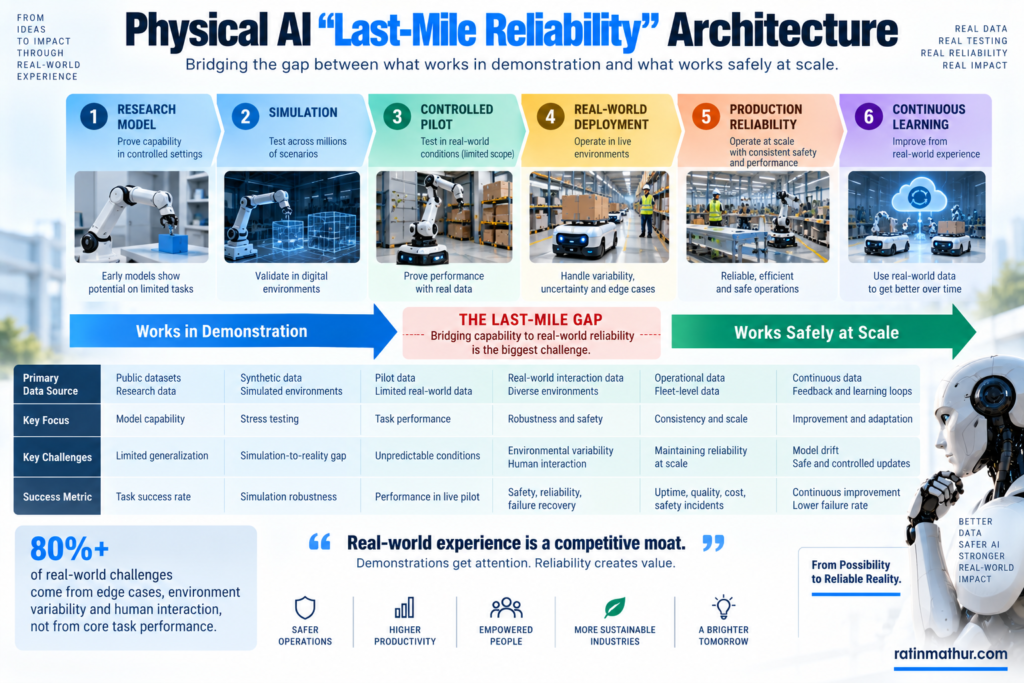
The fourth finding is that safety cannot be separated from system architecture. ISO 10218-1:2025 emphasizes inherently safe design and risk reduction for industrial robots, illustrating the principle that safety cannot be treated solely as an operational procedure after the technology has been built. (ISO)
The fifth finding is that cybersecurity becomes physical security. Connected robots create potential attack surfaces across software, networks, cloud infrastructure, operational technology, and AI systems. IFR’s current position on AI in robotics identifies cybersecurity vulnerabilities and data-related threats among the emerging concerns surrounding intelligent robotics. (IFR International Federation of Robotics)
The sixth finding is that Physical AI may reshape work rather than merely automate it. Machines can increasingly perform tasks requiring strength, repetition, endurance, or exposure to hazardous environments. Humans may consequently move toward supervision, exception handling, problem-solving, judgment, and coordination. But that transition may also create significant displacement pressure in occupations where physical tasks constitute a large share of work.
| Finding | Strategic implication |
|---|---|
| Physical AI extends far beyond humanoids | Portfolio strategies are more resilient than single-product bets |
| Software, data, and orchestration matter greatly | The highest-value layer may not be the robot itself |
| Real-world experience is critical | Deployment data can become a competitive moat |
| Safety is intrinsic to system design | Safety engineering must begin at architecture |
| Cybersecurity can become physical risk | AI security and operational technology security must converge |
| Automation can redesign work | Workforce strategy must accompany technology strategy |
| Reliability is the adoption bottleneck | Demonstrations cannot substitute for production validation |
Challenges & Opportunities
The economic opportunity is substantial. Physical AI can increase throughput, reduce repetitive manual labor, improve inspection, operate continuously, enter hazardous environments, and enable new operating models. A machine that can safely perform a physically demanding task for extended periods can create value that conventional software cannot.
The opportunity is especially compelling in sectors where human labor is constrained, expensive, hazardous, or difficult to sustain. In manufacturing, for example, intelligent machines could perform manipulation and inspection. In warehouses, mobile robots could move products continuously. In agriculture, autonomous systems could perform monitoring and repetitive field tasks. In hazardous environments, machines could reduce human exposure.
However, the risks deserve substantially more attention.
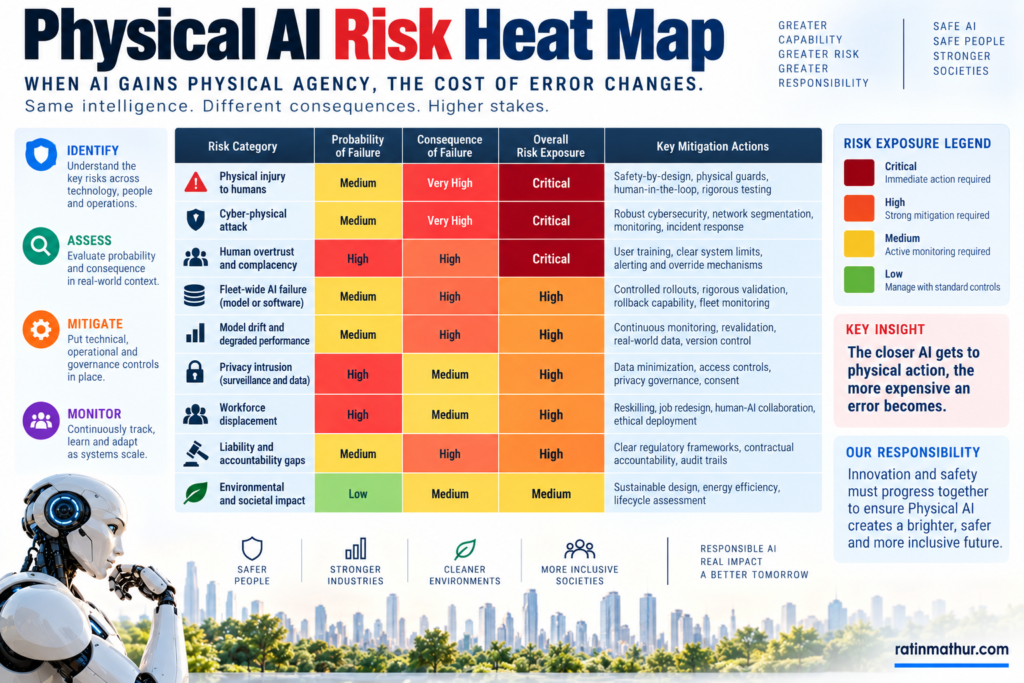
The first major risk is physical injury. A machine operating under an incorrect perception or decision can collide with a person, drop a load, apply excessive force, misjudge distance, lose balance, or perform a movement that was safe under one condition but unsafe under another. IFR has highlighted that AI malfunctions in physical environments can have more severe consequences than conventional software failures. (IFR International Federation of Robotics)
The second risk is unpredictability. The real world is not a clean dataset. People change direction unexpectedly. Objects break. Lighting changes. Sensors become dirty. Network connections disappear. Floor conditions vary. Machines degrade. A Physical AI system must therefore remain safe even when its assumptions are wrong.
The third risk is automation complacency. As machines become more capable, people may become less attentive. The paradox is that increasing reliability can sometimes increase behavioral risk because humans may assume that a system which succeeds repeatedly will also succeed under unusual conditions.
The fourth risk is systemic failure. One faulty human action usually affects a limited area. One flawed algorithm deployed to a fleet can potentially reproduce the same mistake thousands of times. AI scalability therefore amplifies both productivity and failure.
The fifth risk is liability. Responsibility becomes difficult to assign when the robot, AI model, sensors, cloud system, integrator, operator, and enterprise are supplied by different organizations. Physical AI will therefore require clearer contractual and regulatory accountability.
The sixth risk is privacy. A household robot or service robot with continuous access to cameras, microphones, location data, and behavioral information could become one of the most intimate data-collection platforms in a person’s environment.
The seventh risk is workforce polarization. Physical AI may complement some employees while displacing others. The distributional outcome will depend heavily on whether organizations use automation to augment employees, redesign jobs, or replace labor without corresponding investments in reskilling.
| Opportunity | Principal challenge | Strategic response |
|---|---|---|
| Productivity improvement | Labor displacement | Workforce redesign and reskilling |
| Hazardous-work automation | Physical injury | Independent safety controls |
| Continuous operations | Human complacency | Human oversight and training |
| Fleet automation | Scaled failure | Controlled rollout and fleet governance |
| Smart homes and services | Privacy | Data minimization and strict permissions |
| Connected robotics | Cyber attack | Cyber-physical security architecture |
| Adaptive learning | Model drift | Controlled updates and revalidation |
| General-purpose robotics | Unpredictability | Bounded autonomy |
Strategic Frameworks & Recommendations
Strategic Framework #1: The Embodied AI Value-Trust Architecture™
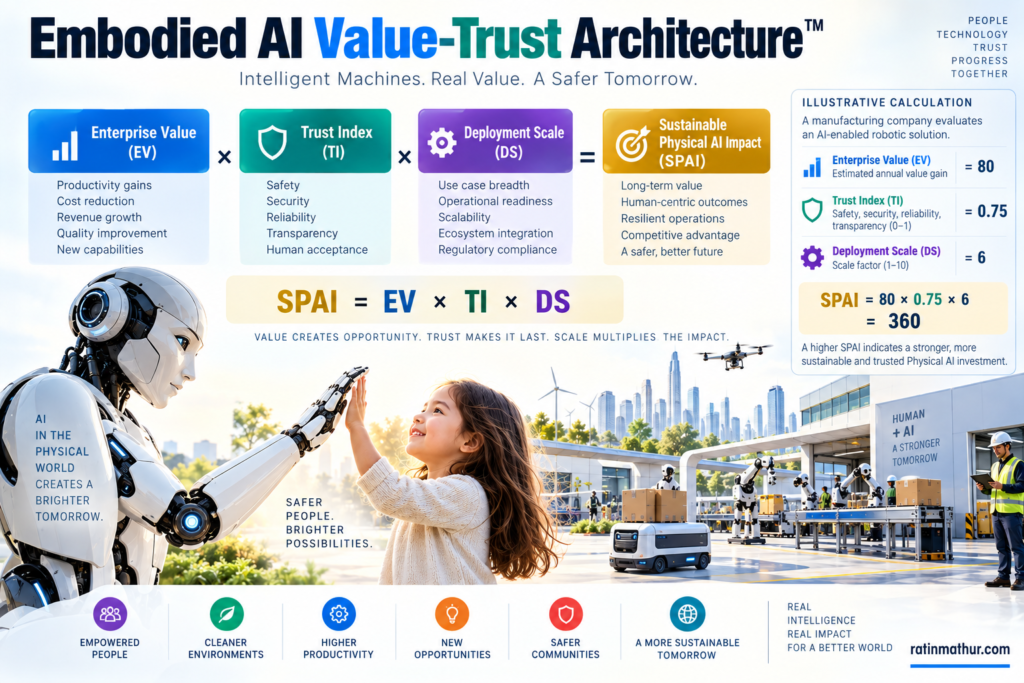
The Embodied AI Value-Trust Architecture™ establishes that Physical AI creates sustainable enterprise value only when technological capability, economic value, and human trust develop together. The framework prevents leaders from evaluating robotics purely through technical performance or labor-cost savings. A robot can be highly capable yet economically unattractive, or economically attractive yet unacceptable because of safety or security concerns.
Capability measures what the machine can actually perceive and execute. Value measures whether that capability improves productivity, quality, capacity, revenue, or cost structure. Trust measures whether people and organizations can safely rely on the system. Trust includes safety, security, transparency, auditability, controllability, and predictable behavior.
| Dimension | Core leadership question | Warehouse example |
|---|---|---|
| Capability | Can the machine reliably perform the task? | Can it identify and transport different packages? |
| Economic value | Does the system improve economics? | Does it reduce cycle time and operating cost? |
| Trust | Can humans safely operate around it? | Does it stop when a worker enters its path? |
| Scalability | Can it work across environments? | Can it operate across multiple facilities? |
| Governance | Can management control and audit it? | Can incidents, updates, and overrides be traced? |
A distribution company using this framework would not approve an autonomous robot merely because it demonstrates high picking accuracy. It would also assess failure recovery, human interaction, software-update controls, cybersecurity, maintenance requirements, incident reporting, and operator override. The investment case would therefore become a Safety-Adjusted AI ROI rather than a simple labor-savings calculation.
The central recommendation is that executives should treat trust as part of the product rather than as a compliance activity. This is consistent with NIST’s emphasis on measurement and testing and with ISO’s emphasis on safe design and risk reduction. (NIST)
Strategic Framework #2: The Bounded Autonomy Safety Matrix™
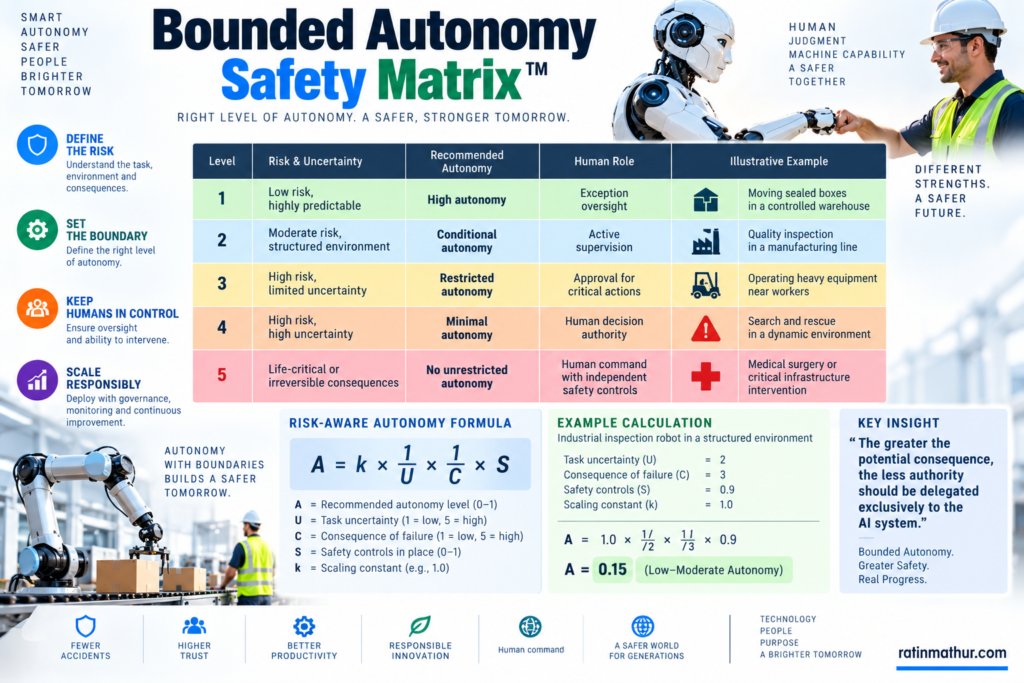
The Bounded Autonomy Safety Matrix™ proposes that autonomy should be proportional to task uncertainty and the consequence of failure. Autonomy should not be treated as a binary condition in which a robot is either autonomous or human-controlled. Instead, organizations should establish explicitly defined permission boundaries.
Low-risk activities conducted in highly structured environments can justify greater autonomy. High-risk activities involving human proximity, hazardous materials, public spaces, or irreversible outcomes should retain stronger human authority and independent safety mechanisms.
| Risk and uncertainty | Recommended autonomy | Human role | Illustrative application |
|---|---|---|---|
| Low risk, highly predictable | High autonomy | Exception oversight | Internal warehouse transport |
| Moderate risk, controlled environment | Conditional autonomy | Active supervision | Industrial inspection |
| High risk, human proximity | Restricted autonomy | Approval and intervention | Heavy equipment operation |
| High risk, unpredictable environment | Minimal autonomy | Human decision authority | Emergency response |
| Life-critical or irreversible | No unrestricted autonomy | Human command plus independent controls | Critical intervention |
The crucial principle is the separation of intelligence from authority. An AI model may determine that a movement appears beneficial, but a separate safety controller should determine whether that movement is permissible. A robot should have a defined operating envelope covering location, speed, force, objects, people, time, and environmental conditions.
For example, a humanoid robot in a commercial kitchen could be permitted to move ingredients autonomously but prevented from entering designated human zones while carrying hazardous objects or applying force above established thresholds. A change to the AI model should trigger safety revalidation rather than automatic release.
This framework directly addresses one of the defining problems of Physical AI: when AI reasoning produces a physical action, uncertainty must be contained before it becomes movement. The principle is therefore simple: the higher the consequence of failure, the less authority should be delegated exclusively to the AI system.
Strategic Framework #3: The Physical AI Adoption Flywheel™
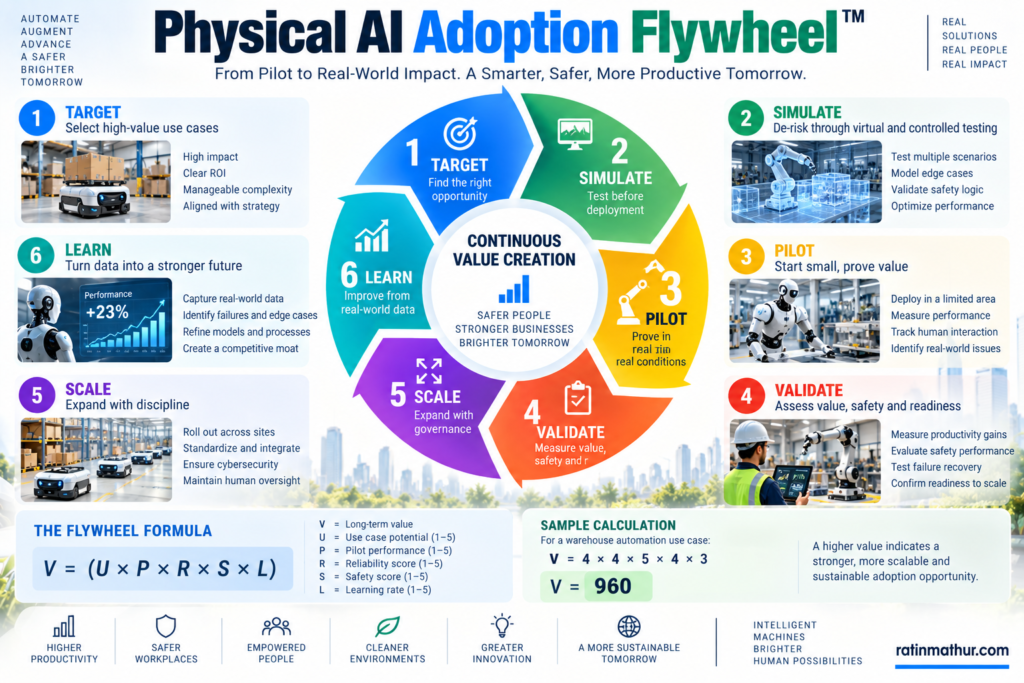
The Physical AI Adoption Flywheel™ provides an enterprise path from experimentation to scale. It consists of six stages: Target, Simulate, Pilot, Validate, Scale, and Learn. The framework is designed to prevent a common organizational mistake: moving from a successful demonstration directly into large-scale deployment.
Target identifies economically important tasks that are sufficiently structured to make automation realistic. Simulate allows organizations to evaluate scenarios before exposing physical equipment or people to risk. Pilot establishes whether the system can perform in controlled live conditions. Validate measures productivity, reliability, safety, cybersecurity, human interaction, and failure recovery. Scale expands deployment after performance thresholds are achieved. Learn captures real-world operating data and feeds it back into improvement.
| Stage | Strategic objective | Illustrative example |
|---|---|---|
| Target | Identify high-value use case | Warehouse material movement |
| Simulate | Test scenarios safely | Variable loads and human movement |
| Pilot | Prove performance | One operating zone |
| Validate | Test productivity and safety | Errors, near misses, recovery |
| Scale | Expand controlled deployment | Multiple facilities |
| Learn | Improve from experience | Better navigation and handling |
The importance of this model is reinforced by NIST’s focus on the practical evaluation of AI-enabled robotics and by the emphasis on real-world development data in Physical AI deployment. (NIST)
An enterprise introducing autonomous inspection robots, for example, should start with one production line rather than immediately deploying hundreds of machines. It should collect data on false positives, false negatives, unexpected objects, sensor failures, operator interventions, downtime, and near misses. Only after defined thresholds are achieved should the deployment expand.
The resulting operational data becomes more than a by-product. It can become a strategic asset. Competitors may purchase similar robots, but they cannot immediately replicate years of accumulated experience operating them safely in a specific environment. The adoption process therefore becomes a potential source of competitive advantage.
Future Outlook & Conclusion
Physical AI is likely to become one of the defining technological developments of the next decade because it extends artificial intelligence into a domain in which software alone has historically had limited reach: physical work and physical environments.
The market is unlikely to evolve in a single dramatic leap toward universal humanoids. A more plausible trajectory is the progressive expansion from specialized robotics to increasingly adaptive systems, followed by broader general-purpose machines in environments where their economics and safety are compelling.
Humanoids will remain strategically important because the world is designed around the human body. Doors, stairs, shelving, tools, workstations, vehicles, and many industrial environments are built around human proportions and capabilities. Yet the commercial question is not whether a humanoid looks impressive. It is whether a machine can achieve sufficient reliability, economics, safety, and maintainability to justify deployment.
The more consequential development may occur beneath the physical robot. Software, data, orchestration, simulation, control, and deployment infrastructure may become critical sources of value. The September 9, 2026 McKinsey Live webinar specifically identifies software, data, and orchestration platforms as a major emerging value pool and argues that humanoids may account for only a small portion of the broader Physical AI opportunity.
The central strategic paradox is clear. Physical AI can reduce dangerous work while introducing new risks. It can improve productivity while displacing workers. It can increase operational consistency while scaling mistakes. It can increase autonomy while potentially reducing human agency. It can produce enormous economic value while concentrating power among organizations that control the technology stack, data, manufacturing infrastructure, and intellectual property.
The question “Is AI safe for humans?” therefore cannot be answered by measuring model intelligence alone. Safety is an emergent property of the complete system: hardware, software, sensors, controls, data, human oversight, operating environment, cybersecurity, testing, standards, and governance.
NIST’s work illustrates the increasing importance of formal measurement and test methods, while ISO 10218-1:2025 illustrates the movement toward more rigorous safety engineering for industrial robotics. (NIST)
The defining principle for the next stage of AI should therefore not be maximum autonomy. It should be bounded, accountable, safety-adjusted autonomy.
Generative AI changed the economics of content and information.
Enterprise AI is changing the economics of decision-making.
Physical AI may change the economics of physical work.
But the most important question is not how intelligent machines become.
It is whether humans can remain safe, informed, empowered, and ultimately accountable while sharing the physical world with increasingly autonomous machines.
The future will not belong simply to machines that can act.
It will belong to systems that can act safely, predictably, economically, and accountably.
That is the real frontier of Physical AI.
References
- International Federation of Robotics. (2026). Artificial Intelligence in Robotics. International Federation of Robotics. International Federation of Robotics: Artificial Intelligence in Robotics
- International Federation of Robotics. (2026). The impact of robots on employment, productivity and competitiveness. International Federation of Robotics. International Federation of Robotics: Research and positioning papers
- International Organization for Standardization. (2025). ISO 10218-1:2025 Robotics: Safety requirements — Part 1: Industrial robots. ISO. ISO 10218-1:2025
- National Institute of Standards and Technology. (2026). Physical AI and data generation for robotics. U.S. Department of Commerce. NIST: Physical AI and Data Generation for Robotics
- McKinsey & Company. (2026, September 9). Physical AI: The hidden value pools leaders are missing [McKinsey Live webinar]. McKinsey: Physical AI and related insights
- National Institute of Standards and Technology. (n.d.). AI Risk Management Framework. U.S. Department of Commerce. NIST AI Risk Management Framework
- European Commission. (2026). AI Act: High-risk AI systems and implementation framework. European Commission. European Commission: AI Act and high-risk AI systems
Disclaimer
This article is intended solely for strategic, educational, and informational purposes. Market estimates, technological forecasts, adoption scenarios, and projected economic values are inherently uncertain and may change as technology, regulation, capital availability, labor markets, and user behavior evolve. The article does not constitute investment, legal, regulatory, engineering, workplace-safety, cybersecurity, or other professional advice. Organizations considering Physical AI deployment should conduct appropriate technical, operational, safety, cybersecurity, legal, and regulatory assessments and should consult qualified professionals where required.
The Embodied AI Value-Trust Architecture™, Bounded Autonomy Safety Matrix™, and Physical AI Adoption Flywheel™ are original conceptual strategic frameworks developed for analytical and business-strategy purposes. They are not certified safety standards, legal frameworks, compliance methodologies, or substitutes for applicable technical standards and professional risk assessments.