Executive Summary
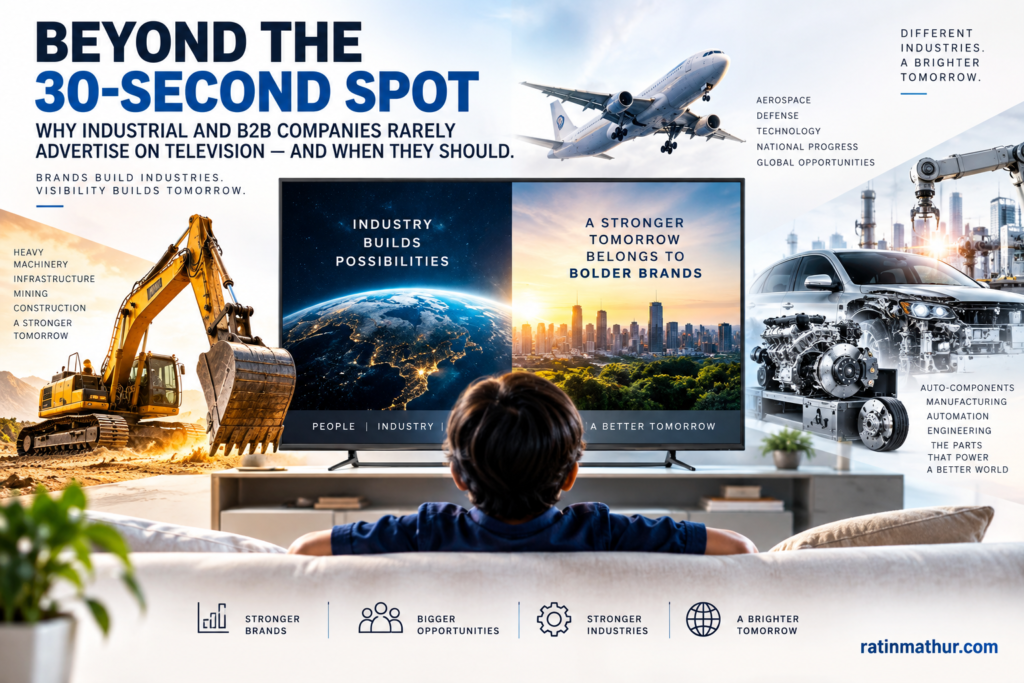
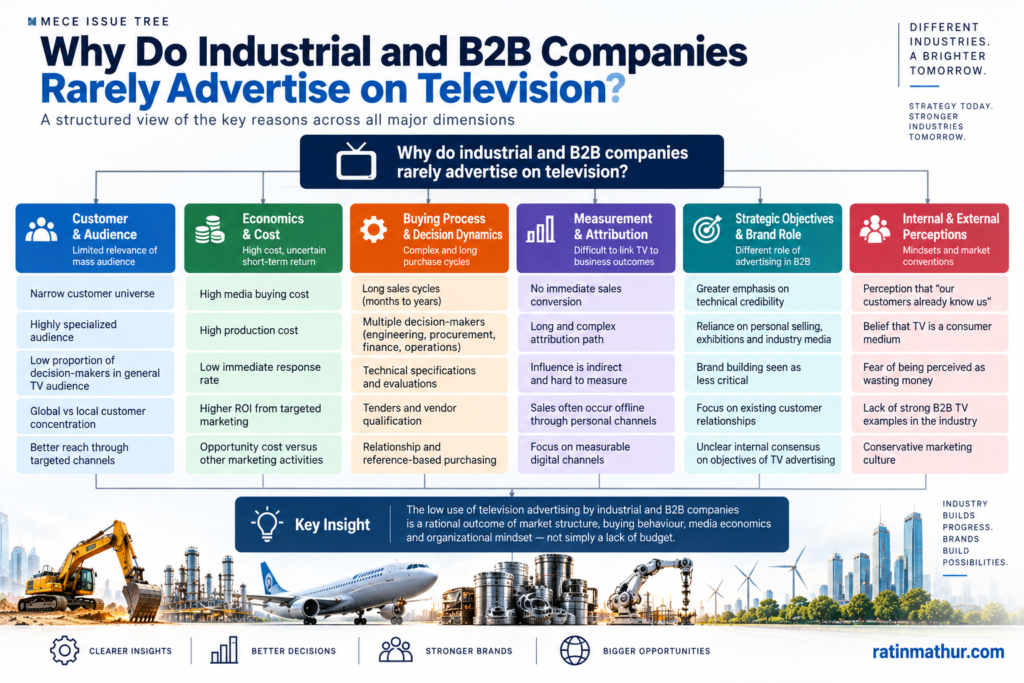
Television advertising is overwhelmingly associated with consumer brands. Automobiles, financial services, FMCG, telecom, consumer electronics and e-commerce companies compete intensely for television attention, while manufacturers of heavy machinery, aerospace systems, defence technologies, auto components, industrial automation, capital equipment and specialized engineering solutions are comparatively invisible. This raises a fundamental strategic question: are these companies avoiding television because advertising is too expensive, because their customers already know them, because B2B purchasing does not require mass communication, or because management considers television advertising an inefficient use of capital?
The analysis suggests that none of these explanations is sufficient on its own. The deeper reason is an economic mismatch between the traditional television model and the structure of many B2B markets. A highly specialized industrial company may have hundreds or a few thousand economically relevant customers, whereas television is designed to reach millions of people. Industrial purchasing is also typically characterized by long sales cycles, technical specifications, vendor qualification, tenders, demonstrations, service requirements and multiple decision-makers. A television commercial therefore has limited ability to generate an immediate transaction.
This does not mean that industrial companies do not need advertising or brands. It means that the role of advertising is different. For a pure B2B company, television may be inefficient as a direct-response sales channel but valuable as a brand-building, reputation-building and future-demand-generation medium. The objective may be to ensure that the company is remembered, trusted and considered when a purchasing requirement eventually emerges.
Research supports the broader economic importance of industrial brands. McKinsey’s research across more than 5,300 industrial brands found that highly visible industrial brands achieved stronger economic performance and that strong industrial brands could command price premiums of approximately 5–10 percent. These findings do not prove that television caused the performance, but they do challenge the assumption that industrial brand visibility is commercially irrelevant.
The Indian context makes the issue even more interesting. Television remains a mass-reach medium, with approximately 745 million weekly viewers in 2025, while digital media, connected television and OTT continue to reshape how audiences consume video. The strategic question is therefore no longer simply “TV or no TV.” It is increasingly about how linear TV, connected TV, digital video, professional media, technical content and sales activation can work together.
The central conclusion of this paper is that industrial companies should not blindly adopt television advertising, but neither should they dismiss it because they are B2B. The appropriate decision depends on customer-universe size, customer value, purchase frequency, buying-process complexity, consumer influence, importance of brand in supplier selection, geographic ambitions and the relative economics of alternative media.
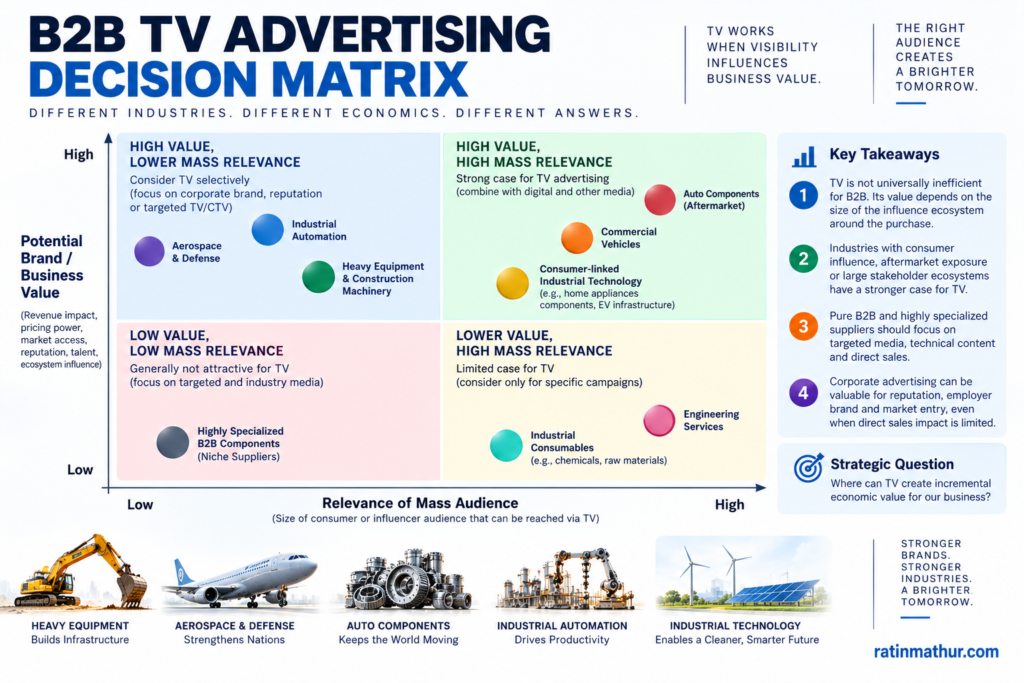
The strongest opportunity exists where industrial companies have broad stakeholder ecosystems, meaningful B2B2C relationships, aftermarket businesses, dealer networks, large addressable markets or significant corporate-reputation objectives. Heavy equipment, construction machinery, industrial technology and aftermarket auto components therefore have a stronger potential television case than highly specialized aerospace or defence suppliers.
The future of industrial advertising is likely to be a mass-to-precision model: television and large-screen video create memory and credibility; CTV and digital improve targeting; industry media and technical content provide proof; and sales organizations convert awareness into RFQs, tenders, contracts and long-term relationships.
Introduction
A television advertising break provides an interesting picture of the modern economy. The products that appear most frequently are often those purchased directly by households. Cars, smartphones, banks, insurance, food, beverages, consumer electronics and online services compete for consumer attention. Yet the companies manufacturing the machines, components, systems and technologies that make the economy function are frequently absent.
This is particularly noticeable in heavy machinery, aerospace, defence, industrial equipment, capital goods, auto components, engineering, automation and specialized manufacturing. Many of these companies are financially substantial, technologically sophisticated and strategically important, yet remain largely invisible to the general public.
At first glance, this seems counterintuitive. If branding matters for a consumer automobile, why would it not matter for an industrial machine? If trust matters when buying insurance, why would it not matter when selecting an engineering supplier? If familiarity influences consumer choice, why would industrial procurement managers be completely immune to brand perception?
The answer lies in the structure of industrial markets.
A consumer may see an advertisement today and make a purchase tomorrow. An industrial buyer may begin a purchasing process months or even years before the transaction is completed. The decision can involve engineering, procurement, finance, operations, safety, senior management and external consultants. Product specifications, certifications, total cost of ownership, service capability, delivery reliability and supplier qualification may matter more than advertising exposure.
Industrial companies consequently developed a marketing model dominated by personal relationships, technical selling, distributors, exhibitions, tenders, demonstrations and customer references. This historical model remains rational in many categories.
However, the market is changing. Buyers have access to substantially more information, new suppliers can become visible without an existing relationship, procurement personnel move between companies and younger decision-makers increasingly conduct independent digital research before contacting vendors. A supplier that becomes visible only when the RFQ is issued may be entering the decision process too late.
The strategic question is therefore not whether industrial companies should imitate FMCG companies. It is whether they should deliberately build the level of brand visibility necessary to remain relevant in future buying situations.
Problem Statement & Objectives
The central problem addressed in this paper is:
Why do many B2B and industrial companies underinvest in television advertising, and under what conditions can television or connected television generate sufficient strategic and economic value to justify investment?
The objective is to determine whether the absence of television advertising reflects rational economics or an outdated assumption about industrial marketing.
The analysis also seeks to distinguish between product advertising, corporate brand advertising, demand generation, reputation building and B2B2C communication. These activities have different objectives and should not be evaluated using the same ROI criteria.
A further objective is to determine whether companies in sectors such as heavy machinery, aerospace and defence, and auto components should treat end consumers as irrelevant or as part of a wider stakeholder ecosystem.
The analysis follows the supplied 7-Step Consulting Framework, which emphasizes rigorous problem definition, MECE issue structuring, issue prioritization, explicit hypotheses, evidence-based analysis, “So What?” synthesis and actionable recommendations.
Methodology
The analysis begins by challenging the initial assumption that “B2B companies do not advertise because they do not need advertising.” The issue is instead decomposed into customer economics, buying-process characteristics, media economics, strategic objectives, business-model characteristics and execution.
The principal hypotheses are that narrow customer universes reduce the efficiency of mass television; long and technical buying processes weaken television’s direct-response economics; existing customer familiarity is insufficient to guarantee future market visibility; television is more valuable for brand building than immediate B2B lead generation; and the economics improve significantly when a company has consumer influence, aftermarket exposure or a large stakeholder ecosystem.
The analysis combines industry research, academic literature, B2B brand research and current Indian media-market information. Sourced facts are distinguished from strategic inference. The purpose is not to establish that television advertising always causes higher industrial sales, for which sector-specific causal evidence would be required, but to identify the circumstances under which the strategic proposition becomes compelling.
Landscape Analysis
The fundamental economic difference between consumer and industrial marketing is audience concentration.
A consumer company may have hundreds of millions of potential buyers. An industrial company selling highly specialized equipment may have only a few hundred or thousand realistic customers. A national television campaign therefore produces very different levels of audience efficiency.
Suppose a consumer brand can sell to 200 million households while an industrial equipment company has 2,000 potential purchasing organizations. A television campaign reaching 30 million people can expose a substantial portion of the consumer brand’s potential market, while the industrial company may reach only a tiny number of relevant buyers. The remainder of its television audience cannot realistically become customers.
This does not mean the industrial company’s audience has zero value. Employees, investors, dealers, regulators, contractors, consultants and future customers may all be relevant. It does mean that the business case cannot be built purely around immediate customer acquisition.
The second difference is the buying process. Industrial procurement can involve technical evaluation, certification, demonstrations, financial approval, vendor qualification and negotiation. The advertisement is therefore only one possible influence among many.
The third difference is customer concentration. A company whose top 20 customers account for 70 percent of revenue has a very different marketing problem from a company serving 100,000 independent customers. For the first business, account-based marketing and executive relationships may be more economically rational than national television.
The fourth difference is purchase frequency. An industrial consumable purchased monthly has very different advertising economics from an aircraft component purchased only when a major programme is initiated. High purchase frequency creates more opportunities for advertising to influence behaviour.
The fifth difference is the degree of consumer involvement. An auto component sold to an OEM has little direct consumer visibility. The same company’s aftermarket business may have millions of potential end users. The business model, rather than the industry label, determines advertising attractiveness.
India’s media environment further complicates the decision. Television remains a mass-reach platform, but its role is changing as digital, OTT and connected television expand. The FICCI-EY report indicates that India’s media and entertainment sector continued to grow strongly in 2025, with digital media becoming the largest segment while television remained a major component of the ecosystem.
The result is an emerging opportunity: industrial companies no longer need to choose between the extreme reach of television and the precision of digital media. Connected television and digital video can increasingly bridge the two.
Key Findings
#1: The absence of television advertising is primarily an audience-economics issue, not simply a budget issue.
Many industrial companies can afford television but cannot justify its opportunity cost. When the economically relevant customer universe is small, mass reach produces substantial wastage. A company serving 500 strategic accounts may obtain more immediate commercial value from account-based marketing, technical events and direct sales than from reaching millions of households.
The crucial distinction is therefore not whether a company has money to spend, but whether the additional reach creates incremental economic value.
#2: “Our customers already know us” is true for existing relationships but insufficient as a long-term brand strategy.
Industrial companies often possess strong awareness among current customers. However, customer organizations change personnel, new competitors enter markets, companies expand into new geographies and new decision-makers join procurement committees. The brand that is known today may not automatically be known tomorrow.
B2B brand research emphasizes the importance of building mental availability before a purchasing event occurs because most potential buyers are not actively in-market at any particular moment.
#3: Industrial purchasing is rational, but the decision environment is not purely rational.
Specifications, price, reliability and technical capability remain fundamental. Yet buyers also need confidence that a supplier will survive, deliver, provide service, protect its reputation and support a major project. Brand can therefore act as a risk-reduction mechanism.
Academic research on industrial brands has found evidence linking brand credibility with willingness to pay a price premium, reinforcing the idea that brand can influence industrial economics beyond simple awareness.
#4: Television is generally weaker for immediate B2B lead generation than for long-term brand building.
A television advertisement cannot explain a complex industrial product in sufficient technical depth, nor can it reproduce a tender, demonstration or engineering evaluation. Its more defensible role is to create awareness, memory, familiarity, credibility and consideration.
The commercial effect may therefore appear months later when a requirement emerges.
#5: Industrial brand visibility can have economic value even when television is not the cause.
McKinsey’s research into industrial brands found that visibility was associated with stronger financial performance and that highly visible industrial brands could command meaningful price premiums. These findings challenge the belief that branding is merely cosmetic in industrial markets.
The important qualification is that correlation should not be interpreted as causation. Strong companies may also have stronger brands because they are already successful. The evidence nevertheless establishes that industrial brand visibility deserves strategic consideration.
#6: The stronger the B2B2C connection, the stronger the case for television.
A pure aerospace component supplier has few potential customers. An aftermarket auto-component brand may have millions of potential users. A heavy-equipment company may influence contractors, operators, dealers and fleet owners. These ecosystems expand the audience that can economically benefit from brand communication.
#7: Corporate advertising and product advertising must be treated as different strategic instruments.
For defence or aerospace companies, a television advertisement saying “buy our product” is difficult to justify. A corporate campaign communicating technological leadership, engineering excellence, national capability or innovation has a different objective and potentially a different return.
#8: Television should increasingly be defined as a cross-screen medium rather than linear TV alone.
The rise of CTV, OTT and digital video allows companies to combine large-screen storytelling with greater audience precision. India’s media market is increasingly converging across these formats.
#9: The most valuable B2B advertising outcome may occur before the lead.
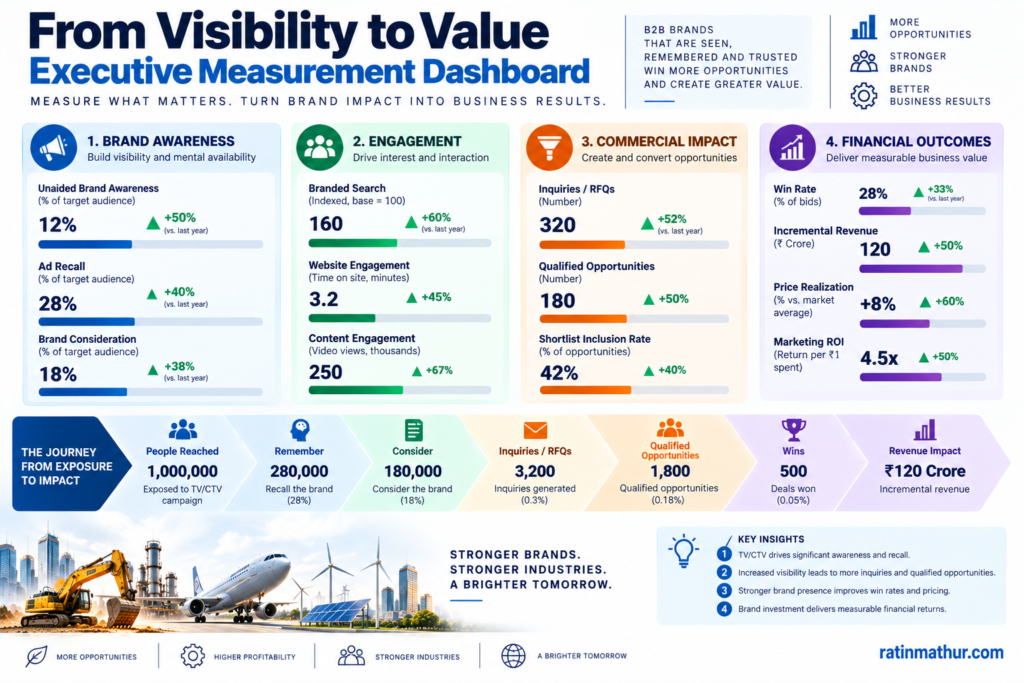
Awareness can influence consideration. Consideration can influence shortlist inclusion. Shortlist inclusion can influence RFQs. RFQs can influence sales opportunities. This means that measuring only leads generated by a television campaign can systematically underestimate its potential strategic contribution.
#10: The right answer is neither “advertise on TV” nor “don’t advertise on TV.”
The correct strategic decision depends on audience size, customer value, purchase frequency, consumer influence, brand importance, competitive visibility, geographic ambition and alternative media economics.
Challenges & Opportunities
#1: Challenge — Mass television can produce significant audience wastage for narrow B2B markets.
A highly specialized company may reach millions of people who have no economic relationship with its products. This makes conventional national TV difficult to justify unless the campaign has broader corporate or institutional objectives.
#2: Challenge — B2B advertising has an attribution problem.
Industrial sales cycles can extend for months or years. Several variables influence the final contract, making it difficult to isolate the effect of television. This creates a bias toward channels that generate easily measurable clicks or leads, even when those channels may be weaker at creating long-term brand memory.
#3: Challenge — Industrial companies often communicate like engineering organizations rather than brands.
Corporate advertisements frequently become lists of capabilities, factories, patents, certifications and products. Such communication may be factually impressive but psychologically weak. Television requires a memorable idea, not a compressed corporate brochure.
#4: Challenge — Management may confuse visibility with vanity.
A television campaign can easily become an expensive exercise in corporate self-expression. Without a clearly defined audience, proposition and commercial objective, the campaign can generate attention without strategic value.
#5: Challenge — Linear television faces structural pressure from digital video.
Television remains large, but audiences increasingly consume content across OTT, CTV, YouTube and other platforms. A strategy based exclusively on linear TV may therefore become progressively less efficient.
#1: Opportunity — Industrial brands can build mental availability before a purchasing event.
Most potential customers are not actively purchasing today. Creating memory before the buying event can increase the probability of future consideration.
#2: Opportunity — B2B2C ecosystems create larger addressable audiences.
Auto aftermarket, heavy machinery, mobility, construction materials and other categories have stakeholders beyond procurement departments. Advertising can influence the wider ecosystem.
#3: Opportunity — CTV can bridge mass reach and precision.
Connected television provides an opportunity to retain the visual and emotional power of large-screen video while moving toward more targeted audience strategies.
#4: Opportunity — Corporate advertising can strengthen institutional reputation.
Aerospace, defence, infrastructure and advanced engineering companies can use television to communicate technological leadership, national capability and societal contribution rather than attempting direct product sales.
#5: Opportunity — Brand visibility can support pricing and competitive differentiation.
Industrial branding research suggests that stronger brands can achieve economic advantages, including price premiums.
#6: Opportunity — Television can amplify sales and channel activities.
A television campaign becomes more valuable when it is synchronized with dealer recruitment, exhibitions, product launches, customer events, digital campaigns and sales outreach. Instead of replacing sales, television can make sales conversations easier.
Strategic Frameworks & Recommendations
Industrial Brand Visibility-to-Value™ Framework
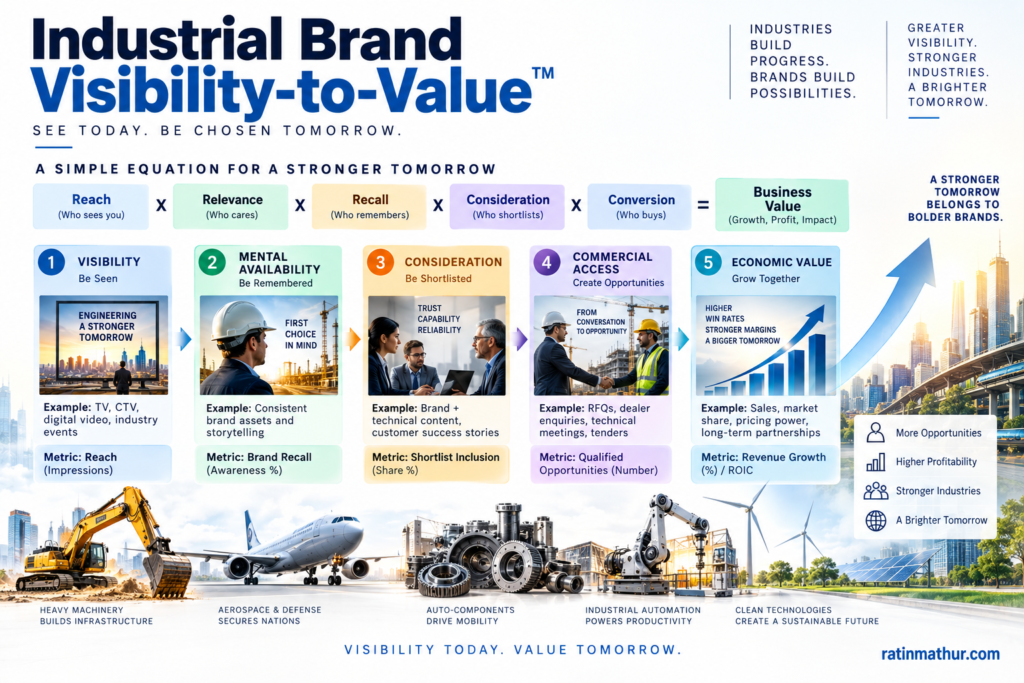
The Industrial Brand Visibility-to-Value™ Framework proposes that industrial advertising should be evaluated as a chain rather than as a direct transaction. The chain begins with Visibility, progresses to Mental Availability, then Consideration, Commercial Access and finally Economic Value. The model is designed to prevent management from asking an inappropriate question such as “How many sales did TV generate?” before asking whether the campaign changed the probability that the company would be remembered and considered.
| Stage | Strategic question | Typical role of TV/CTV | Heavy-equipment example | Aerospace example |
|---|---|---|---|---|
| Visibility | Do stakeholders know the brand exists? | Reach and recognition | “The machines behind India’s progress” | “Engineering the future of flight” |
| Mental Availability | Will the brand come to mind when a need emerges? | Repeated distinctive brand exposure | Contractor remembers brand during fleet planning | Engineering executive recalls supplier during a new programme |
| Consideration | Does the company enter the shortlist? | Credibility and familiarity | Brand is considered alongside established competitors | Company becomes part of technology discussions |
| Commercial Access | Does awareness create an opportunity? | Media linked to sales activation | Dealer enquiry, RFQ or demonstration | Technical meeting or qualification opportunity |
| Economic Value | Does the brand improve business economics? | Sustained brand investment | Higher win rate, market access or price realization | Reputation, talent, institutional access and strategic opportunities |
The framework changes the role of television from “sales machine” to “future-demand infrastructure.” For example, an excavator manufacturer could run a campaign demonstrating how its machines contribute to roads, metros and industrial projects. The immediate viewer may not buy an excavator. But contractors, entrepreneurs, dealers and equipment operators may develop stronger familiarity with the brand. When a procurement requirement arises, the brand begins from a position of recognition rather than anonymity.
The framework also explains why “our customers already know us” is strategically incomplete. The relevant question is not whether today’s customer knows the company. It is whether the next customer, the next procurement manager, the next geography and the next buying committee will know and consider it.
B2B2C Brand Bridge™ Framework
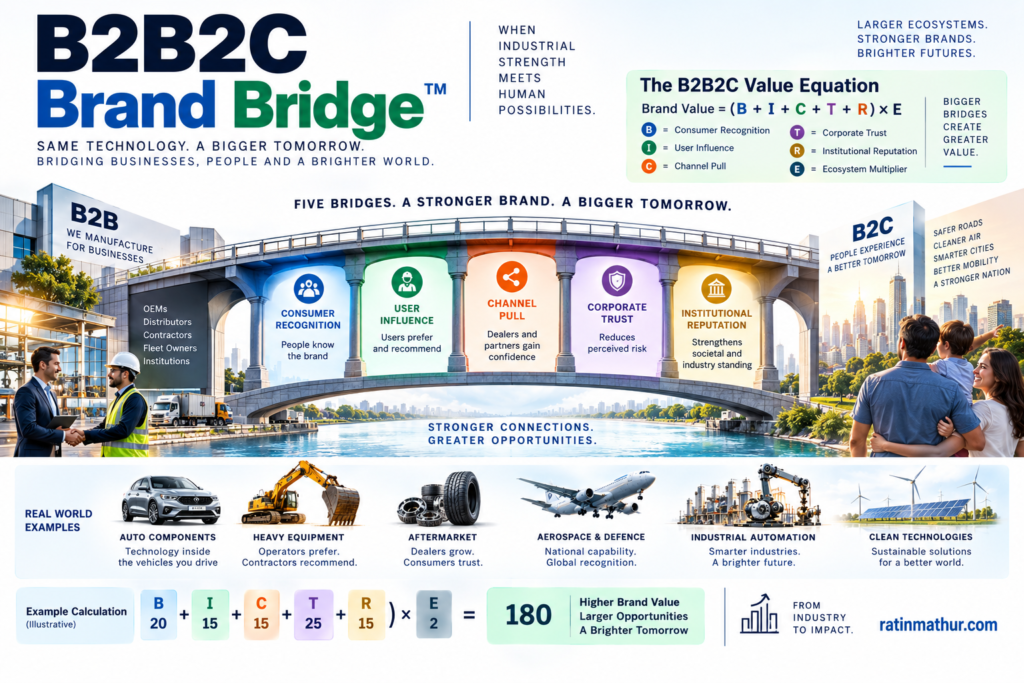
The B2B2C Brand Bridge™ Framework addresses the mistaken assumption that an industrial company can ignore consumers simply because its invoice is issued to another business. The framework examines the mechanisms through which an industrial brand can influence an ecosystem extending from supplier to business customer to end user.
| Bridge | Mechanism | Relevant sectors | Illustrative application |
|---|---|---|---|
| Recognition Bridge | Consumers recognize the technology or component brand | Auto components, electronics | “Technology inside the vehicle you drive” |
| Influence Bridge | Users influence organizational purchasing | Heavy equipment, machinery | Operators and contractors develop brand preference |
| Channel Bridge | Public visibility strengthens dealer confidence | Machinery, aftermarket | Dealer perceives the manufacturer as a strong national brand |
| Trust Bridge | Visibility reduces perceived supplier risk | Capital goods, engineering | Large project buyer sees the supplier as established |
| Reputation Bridge | Consumer and institutional perception reinforce corporate value | Aerospace, defence, infrastructure | “Technology that strengthens India’s capabilities” |
An auto-component company illustrates the framework particularly well. An OEM-only supplier may have limited reason to advertise to consumers because the consumer never chooses the component. However, the same company may operate an aftermarket business where consumers, mechanics and dealers influence the purchase. In that situation, consumer awareness can create an additional layer of commercial value.
Heavy machinery offers a different bridge. The final buyer may be a construction or mining company, but operators, contractors, entrepreneurs, rental companies and dealers may influence preferences. A campaign that creates familiarity with reliability, productivity and service can therefore influence the wider decision environment.
For aerospace and defence, the bridge is primarily reputational rather than transactional. Consumers will not purchase fighter aircraft or radar systems, but they can understand technological leadership, national capability and engineering achievement. The resulting corporate reputation can influence talent, investors, institutional relationships and broader stakeholder confidence.
The strategic implication is that management should map who experiences, influences, recommends, specifies, finances and ultimately purchases the company’s offering. Television becomes more attractive as the number and importance of these stakeholders increase.
Mass-to-Precision Media Flywheel™ Framework
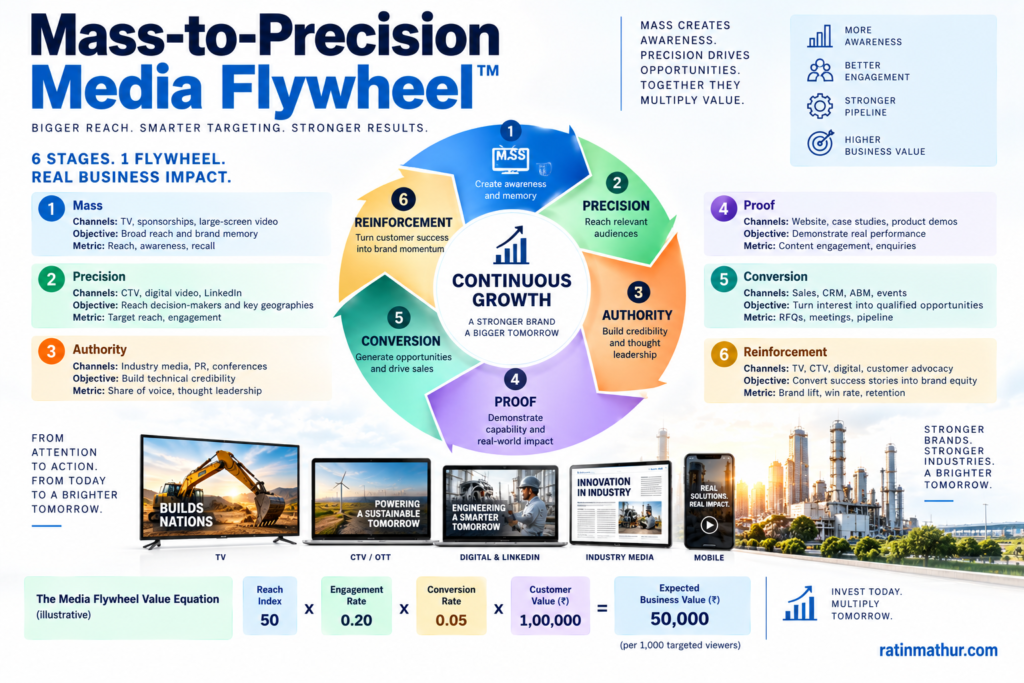
The Mass-to-Precision Media Flywheel™ Framework addresses the central media dilemma: mass media provides scale but can waste reach, while precision media provides targeting but may lack sufficient scale and emotional impact. The framework proposes that industrial companies combine both rather than choosing between them.
| Flywheel stage | Objective | Primary channel | Example | Measurement |
|---|---|---|---|---|
| Mass | Build awareness and memory | TV, sponsorship, large-screen video | National industrial brand film | Reach, recall, awareness |
| Precision | Reach economically relevant audiences | CTV, digital video, LinkedIn | Target industrial clusters and decision-makers | Target reach, engagement |
| Authority | Establish professional credibility | Industry media, conferences, PR | Engineering success story | Share of voice, authority |
| Proof | Demonstrate capability | Website, case studies, technical video | Customer productivity case | Engagement, enquiries |
| Conversion | Create commercial opportunities | Sales, CRM, ABM, events | Sales team follows up with target accounts | RFQs, meetings, pipeline |
| Reinforcement | Feed customer proof back into brand | TV, CTV, PR, advocacy | Customer becomes part of next campaign | Awareness, preference, win rate |
Under this model, a television commercial does not need to communicate every technical feature. Its job is to establish the emotional and strategic proposition. Digital video can explain the technology. LinkedIn and industry publications can reach professional audiences. Technical content can demonstrate performance. Sales teams can then convert interest into commercial discussions.
Consider an industrial automation company. Its television campaign could communicate that Indian manufacturing is entering a new era of intelligent production. CTV could concentrate exposure in manufacturing-heavy markets. LinkedIn could reach plant heads, operations executives and technology leaders. A technical video could demonstrate measurable productivity improvement. The sales organization could then target identified accounts. The campaign becomes an integrated commercial system rather than an isolated media purchase.
This approach is increasingly relevant because India’s media ecosystem is becoming more digitally integrated while television remains a major reach platform. The future opportunity is therefore not to defend traditional television against digital media, but to combine the strengths of both.
The three frameworks lead to several strategic recommendations. Pure B2B companies with highly concentrated customer bases should generally avoid using national television as a direct-response mechanism. Their priority should remain targeted account-based marketing, technical content, industry events, professional media and sales relationships. Television can still be considered when the objective is corporate reputation, market entry, employer branding or long-term brand building.
Heavy machinery and equipment companies have a stronger case for television because their stakeholder ecosystem extends beyond procurement departments. They should test television and CTV with themes around productivity, infrastructure, reliability, entrepreneurship and national development rather than relying on technical specifications.
Auto-component companies should be divided into OEM-only and aftermarket businesses. OEM-only companies have a weaker mass-media case, while aftermarket brands have a substantially stronger case because consumers, mechanics, retailers and distributors become relevant audiences.
Aerospace and defence companies should generally avoid treating television as a product-sales channel. Their stronger opportunity lies in institutional brand advertising built around technological capability, innovation, national development, engineering excellence and talent. The business case should therefore include reputation, employer brand and institutional influence rather than only direct leads.
The recommended measurement system should also change. Awareness should be measured first, followed by consideration and preference, then digital behaviour, RFQs, shortlist inclusion, pipeline, win rates and ultimately financial outcomes. Where possible, companies should use geographic or audience-based experiments to estimate incremental impact rather than relying solely on correlation.
A useful economic decision rule is to compare incremental economic value created by advertising with the incremental cost and opportunity cost of the media investment. The value should include incremental demand, improved win rates, pricing power, market access, dealer acquisition, talent effects and corporate reputation where those outcomes are material and measurable.
Future Outlook & Conclusion
The distinction between consumer and industrial marketing is becoming less absolute. Industrial buyers increasingly behave like informed consumers: they search, compare, watch videos, consult peers, examine reputation and investigate suppliers before entering formal procurement processes. At the same time, consumer brands increasingly build communities, ecosystems and professional relationships.
This convergence does not mean every industrial company should become a television advertiser. The economics remain decisive. A niche aerospace supplier with 50 global customers should not spend as though it were a mass consumer brand. A defence contractor should not expect a television commercial to influence a complex procurement process. A specialized engineering company may achieve substantially higher returns through targeted professional communication.
But the opposite assumption is equally dangerous. Industrial companies that remain invisible because “our customers already know us” may be optimizing for the present while weakening future demand. Customers change, markets expand, competitors emerge and decision-makers move. Brand familiarity must therefore be treated as an asset that requires maintenance rather than as a permanent condition.
The most attractive opportunity is likely to emerge in the middle of the spectrum. Heavy machinery, industrial technology, infrastructure-related businesses, aftermarket auto components and other B2B2C categories can potentially use mass video to create broad familiarity while using digital and sales channels for precision.
The fundamental strategic lesson is that B2B does not mean “no advertising”; it means “different advertising economics.”
Television is usually a poor tool when the objective is to explain a complex specification to a handful of procurement executives and generate an immediate order. It can become a powerful tool when the objective is to build mental availability across a broad ecosystem, establish corporate credibility, enter new markets, support dealers, influence future decision-makers or create a recognizable industrial brand.
The most sophisticated strategy is therefore neither “TV is essential” nor “TV is a waste of money.” It is a deliberate allocation of media according to the economics of the buying system.
The winning industrial companies of the next decade will likely be those that combine engineering credibility with brand visibility, mass reach with precision targeting, emotional storytelling with technical proof, and marketing with sales activation.
The ultimate question for an industrial CEO should therefore not be:
“Why should we advertise on television when our customers already know us?”
It should be:
“Who must know, remember and trust us before our next major growth opportunity arrives—and what is the most economically efficient way to make that happen?”
That is the question that transforms television from a media expense into a strategic business decision.
References
- McKinsey & Company. (2021). The rising value of industrial brands. McKinsey & Company. McKinsey & Company — The Rising Value of Industrial Brands
- LinkedIn B2B Institute. (n.d.). Advertising effectiveness and the 95-5 rule. LinkedIn. LinkedIn B2B Institute — Advertising Effectiveness and the 95-5 Rule
- LinkedIn B2B Institute. (n.d.). How B2B brands grow. LinkedIn. LinkedIn B2B Institute — How B2B Brands Grow
- LinkedIn B2B Institute. (n.d.). Better, bolder B2B branding. LinkedIn. LinkedIn B2B Institute — Better, Bolder B2B Branding
- EY India. (2026). India’s M&E sector grew 9% to INR 2.78 trillion in 2025, driven by digital and live experiences: FICCI-EY report. EY India. EY India — FICCI-EY Media & Entertainment Report 2026
- FICCI & EY India. (2026). Stories, scale and impact: Unlocking India’s media and entertainment economy. FICCI-EY. FICCI-EY Media and Entertainment Report 2026
- Credibility and price premium-based competitiveness for industrial brands. (2023). Journal of Retailing and Consumer Services, 74, 103418. ScienceDirect — Credibility and Price Premium-Based Competitiveness for Industrial Brands
- Global Consulting Team. (n.d.). 7-Step Consulting Framework Training. Supplied methodology document.
Disclaimer
This article is intended for strategic, educational and thought-leadership purposes and should not be interpreted as financial, investment, legal, media-buying or advertising advice. The three frameworks presented as the Industrial Brand Visibility-to-Value™, B2B2C Brand Bridge™ and Mass-to-Precision Media Flywheel™ are conceptual frameworks developed for this article and are presented using the ™ designation as branded concepts; the designation does not imply registration of the trademarks. Before commercial use, trademark availability and legal protection should be independently verified. Statistics and research findings cited in this article belong to their respective sources and should not be interpreted as proof that television advertising itself caused the reported financial outcomes. Correlation between brand visibility and business performance does not establish causality. Television, CTV, OTT and digital-media economics vary materially according to industry, geography, customer concentration, audience composition, purchase frequency, media pricing, competitive intensity and business model. Companies considering investment should conduct company-specific customer, financial, brand, media and incrementality analysis before allocating capital.
:::