Executive Summary
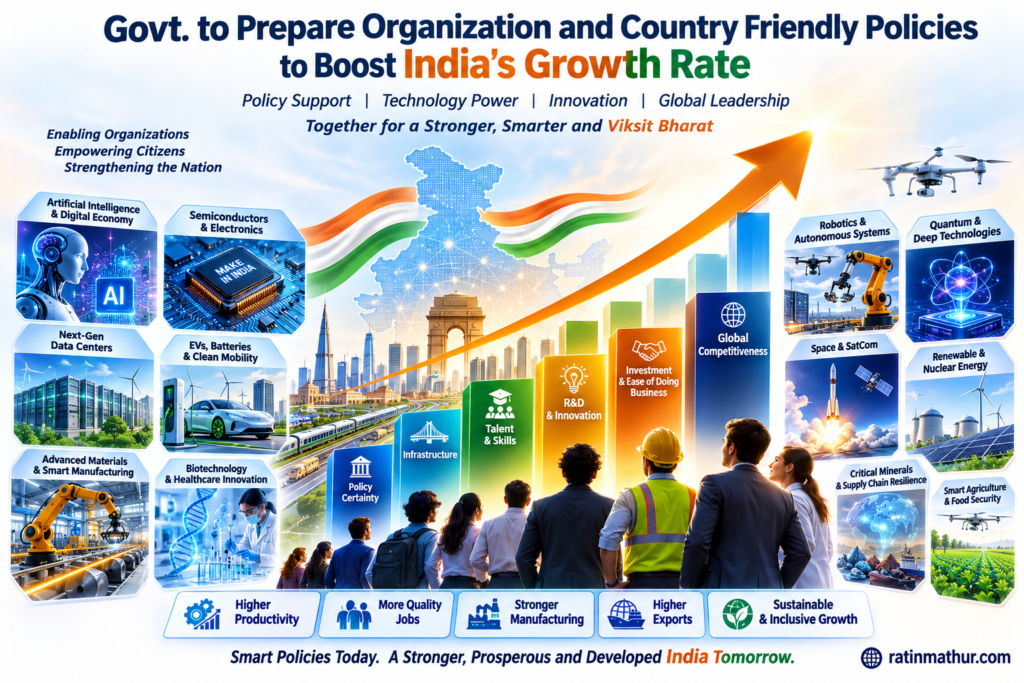
India stands at an unusual economic inflection point. The country is no longer competing only on labor cost, domestic consumption, infrastructure or traditional services. The next phase of competitiveness will be shaped by artificial intelligence, advanced semiconductors, hyperscale data centers, robotics, advanced materials, next-generation batteries, critical minerals, biotechnology, quantum technologies, clean energy, advanced manufacturing and autonomous systems. These technologies are simultaneously transforming industries, organizations, supply chains, capital allocation and national economic strategy.
India has already established important building blocks. The Economic Survey 2025-26 identifies structural transformation in manufacturing, increasing adoption of frontier technologies, infrastructure expansion, AI development and global integration as important components of India’s growth agenda. Medium- and high-technology activities now account for 46.3 percent of manufacturing value added, while the country’s competitive industrial position has improved. Government initiatives including the IndiaAI Mission, India Semiconductor Mission, Production Linked Incentive schemes and the National Critical Mineral Mission demonstrate that India is moving toward technology-led strategic capability.
The next challenge, however, is not simply to create more schemes. It is to create a policy environment in which Indian organizations can invest, innovate, scale and compete globally with greater certainty and lower friction. India’s future growth rate will increasingly depend on how quickly policy converts technological change into organizational productivity, investment, employment, exports and domestic value creation.
This paper argues that India should move from an incentive-centric policy architecture toward a growth architecture built around policy predictability, regulatory simplicity, technology readiness, capital formation, innovation, talent, infrastructure and strategic resilience. The objective should be to make India simultaneously organization-friendly and country-friendly: a country where businesses can build faster, innovators can experiment responsibly, investors can commit long-term capital, workers can continuously reskill, and national strategic interests remain protected.
Three strategic frameworks are proposed: the Policy-to-Productivity Transformation Framework™, the Organization-Country Alignment Framework™, and the Technology-to-Growth Multiplier Framework™. Together, they provide a practical architecture for converting emerging technologies and policy reform into sustained productivity and higher potential growth.
Introduction
Economic growth is entering a new technological era. Previous industrial transformations were powered primarily by machines, electricity, transportation, computing and the internet. The emerging transformation is different because multiple technology revolutions are occurring simultaneously. Artificial intelligence is changing knowledge work; robotics is transforming physical work; advanced materials are redefining batteries and industrial systems; semiconductors are becoming strategic infrastructure; data centers are becoming energy-intensive economic assets; biotechnology is reshaping healthcare and manufacturing; and clean-energy technologies are changing the economics of electricity and mobility.
For India, this convergence creates a historic opportunity. A country with a large domestic market, substantial human capital, growing digital infrastructure, improving manufacturing capabilities and expanding global relevance can potentially move from being primarily a consumer and services economy toward becoming a major producer, technology developer and strategic supplier.
The Economic Survey 2025-26 recognizes that India’s industrial transformation is moving toward higher-value manufacturing and that technology adoption, infrastructure and global integration are becoming increasingly important. It also identifies generative AI, cloud adoption, cybersecurity and data engineering as structural sources of productivity-enhancing demand, while highlighting gaps in technology diffusion and skills.
The central policy question is therefore changing. It is no longer simply whether India should promote investment. It is whether India’s policies can enable organizations to make long-term investment decisions with sufficient confidence while simultaneously advancing national priorities such as employment, technology sovereignty, energy security, supply-chain resilience and strategic competitiveness.
India’s next growth acceleration will depend on this balance.
Problem Statement & Objectives
India’s policy architecture has evolved significantly over the last decade. Digital public infrastructure, infrastructure investment, manufacturing incentives, semiconductor initiatives, AI programs and critical-mineral strategies have created important foundations. Yet emerging technologies are developing faster than conventional policy cycles.
A company deciding whether to establish an AI data center, semiconductor facility, advanced-materials plant, battery gigafactory, robotics operation or biotechnology laboratory may need clarity across land, electricity, water, environmental approvals, taxation, import duties, intellectual property, data governance, financing, skilled talent, logistics and export regulations. Policy uncertainty across any one of these dimensions can increase the cost of capital and delay investment.
The objective should therefore be to create policies that simultaneously satisfy organizational and national requirements.
| Policy objective | Organization-friendly outcome | Country-friendly outcome |
|---|---|---|
| Predictability | Long-term investment confidence | Stable economic planning |
| Regulation | Faster execution and lower compliance costs | Stronger standards and accountability |
| Technology | Faster adoption and innovation | Strategic technological capability |
| Capital | Greater private investment | Higher capital formation |
| Talent | Better access to skilled workers | Higher productivity and employment |
| Infrastructure | Lower operating costs | Stronger national competitiveness |
| Data | Responsible access and interoperability | Digital sovereignty and security |
| Minerals | Reliable raw-material supply | Strategic resilience |
| Energy | Reliable and competitive power | Energy security |
| Innovation | Faster commercialization | Higher domestic value creation |
The fundamental objective should be to raise India’s potential growth rate by increasing productivity, investment, innovation, formal employment, export competitiveness and domestic value addition rather than relying primarily on cyclical demand.
Methodology
This paper uses a strategic policy-analysis methodology combining technology scanning, economic-policy assessment, industry transformation analysis and institutional evaluation. The analysis considers emerging technologies across AI, semiconductors, data centers, EVs, advanced materials, energy, robotics, biotechnology, quantum technologies, critical minerals and advanced manufacturing.
The methodology evaluates technologies not only according to their technical maturity but also according to their potential economic multiplier, infrastructure requirements, strategic importance, organizational adoption barriers and relevance to India’s development objectives.
The analysis also considers India’s existing policy direction through official government documents, including the Economic Survey 2025-26, Ministry of Electronics and Information Technology programs, IndiaAI initiatives, semiconductor policies and the National Critical Mineral Mission. The IndiaAI ecosystem, for example, is explicitly designed to expand access to AI computing infrastructure for startups, MSMEs, academia, researchers and government entities.
Landscape Analysis
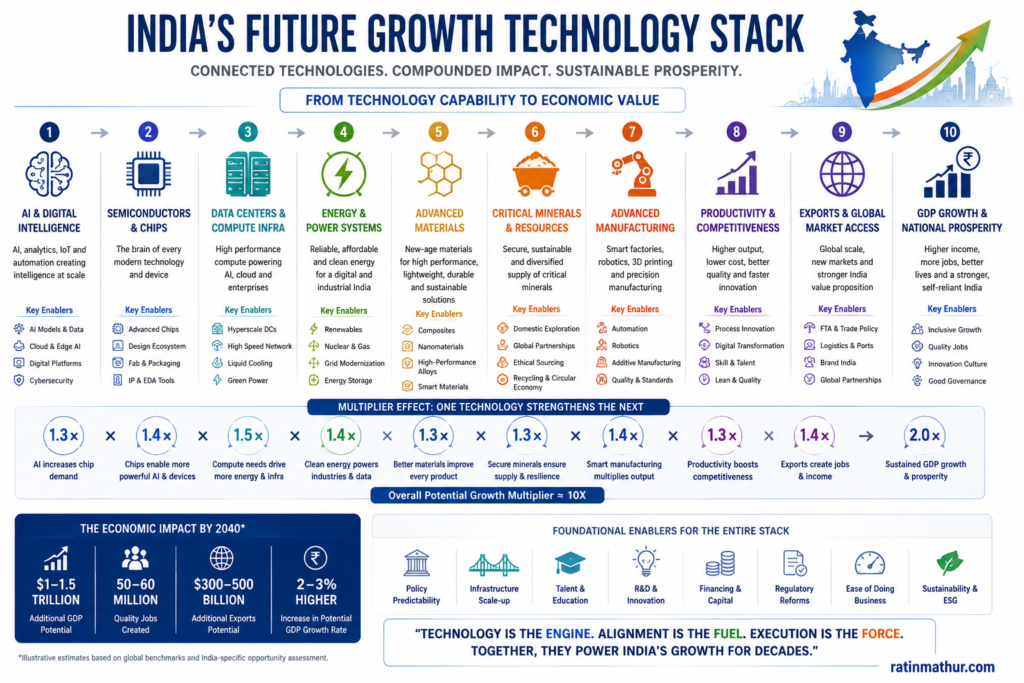
The emerging technology landscape can be understood as a connected economic system rather than a collection of individual technologies.
| Technology domain | Transformation underway | Strategic economic impact |
|---|---|---|
| Artificial intelligence | Generative, agentic, multimodal and physical AI | Productivity and new business models |
| Data centers | AI factories, liquid cooling and high-density computing | Digital infrastructure and energy demand |
| Semiconductors | Advanced nodes, chiplets, HBM and packaging | Technology sovereignty |
| EVs | Advanced batteries and software-defined vehicles | Mobility and energy transformation |
| Advanced materials | Graphene, composites, high-entropy alloys and new battery materials | Manufacturing competitiveness |
| Critical minerals | Lithium, graphite, rare earths and strategic metals | Supply-chain resilience |
| Robotics | Humanoid, industrial and autonomous systems | Labor productivity |
| Energy | Nuclear, storage, renewables and grid modernization | Energy security |
| Biotechnology | Synthetic biology, AI-designed proteins and gene technologies | Healthcare and bio-manufacturing |
| Quantum | Computing, sensing and communications | Strategic technology |
| Photonics | Silicon photonics and optical computing | AI infrastructure |
| Space | Satellites, reusable launch systems and space services | New industrial frontier |
The most important characteristic is convergence. AI requires semiconductors. Semiconductors require advanced materials and sophisticated manufacturing. Data centers require electricity, cooling, water and networks. EVs require batteries, critical minerals, power electronics and software. Robotics requires AI, sensors, semiconductors, batteries and advanced materials.
This creates a multiplier effect. Policy directed at one technology can influence several adjacent industries.
India is already building some of these capabilities. The India Semiconductor Mission seeks to develop a semiconductor and display ecosystem and position India as a global electronics manufacturing and design hub. India’s National Critical Mineral Mission recognizes that the energy transition will substantially increase demand for minerals needed for EVs, renewable energy and battery storage.
Key Findings
The first finding is that India’s next growth opportunity is likely to come from technology-enabled productivity rather than technology adoption alone. Buying AI software does not automatically create productivity. Organizations must redesign processes, skills, governance and operating models around the technology.
The second finding is that policy certainty can become an economic asset in itself. A company may tolerate high initial investment if it can predict taxation, regulation, infrastructure availability and market access over a sufficiently long horizon. Conversely, even generous incentives may not compensate for persistent uncertainty.
The third finding is that India needs to move from component manufacturing toward ecosystem manufacturing. Semiconductor fabrication, for example, creates greater economic value when accompanied by packaging, testing, equipment, materials, design, electronics manufacturing, research and talent.
The fourth finding is that advanced technology will create an increasing relationship between industrial policy and energy policy. AI data centers, semiconductor fabs, battery plants and advanced manufacturing facilities require reliable electricity. Competitive energy therefore becomes an industrial competitiveness issue.
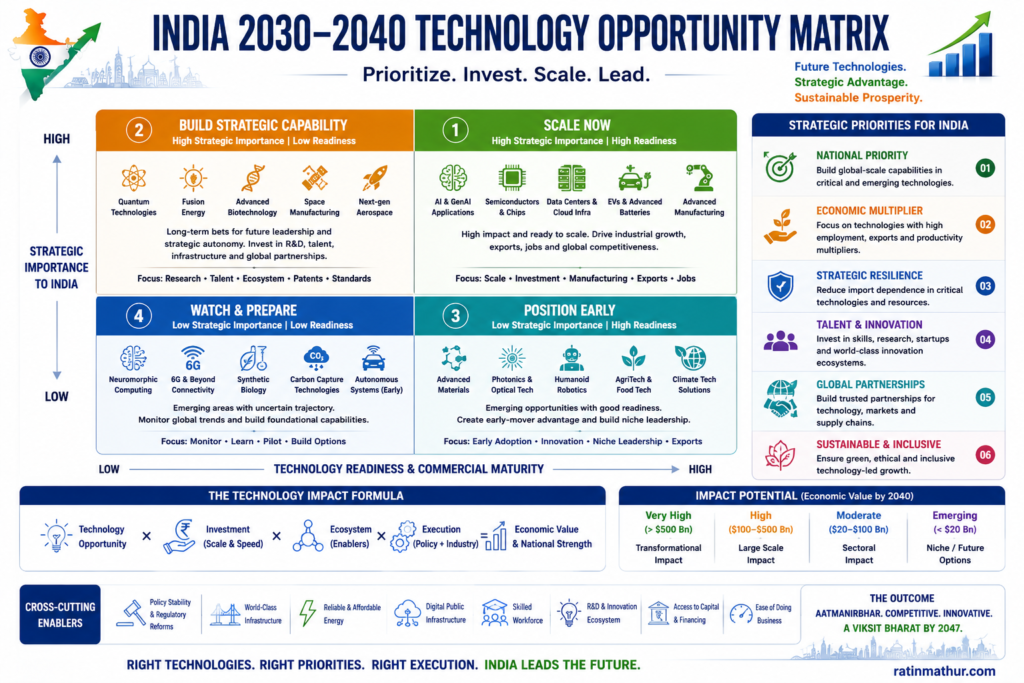
The fifth finding is that the country’s policy architecture must become more technology-neutral at the foundational level while remaining strategically targeted at critical capabilities. Government should avoid prematurely deciding which commercial technology will win, but it should actively support infrastructure, R&D, standards, talent and strategic capabilities.
The sixth finding is that regulatory speed will increasingly influence investment location. When technology cycles move rapidly, a six-month approval delay can materially affect the commercial viability of a project. Regulatory competitiveness can therefore become as important as tax competitiveness.
The seventh finding is that the greatest opportunity may lie in the intersection between Indian strengths and emerging technology. India’s software capabilities, engineering talent, digital public infrastructure, pharmaceutical ecosystem, large domestic market and expanding manufacturing base can become foundations for AI, biotech, advanced manufacturing and digital industrial systems.
Challenges & Opportunities
India’s central challenge is execution. Policy announcements create direction, but economic value is created when projects are implemented, scaled and integrated into supply chains.
A second challenge is talent. Frontier technologies require researchers, engineers, technicians, data scientists, semiconductor specialists, robotics engineers, materials scientists and skilled manufacturing workers. The Economic Survey has emphasized that frontier-technology diffusion remains constrained by ICT penetration and skills, while highlighting the importance of timely reskilling.
A third challenge is fragmented decision-making. Emerging technologies frequently cross traditional ministry boundaries. AI touches electronics, education, industry, data, labor and national security. EVs touch transportation, energy, mining, manufacturing and taxation. Critical minerals touch mining, foreign policy, manufacturing and energy.
A fourth challenge is financing. Frontier technologies often require large upfront capital and long development cycles. Traditional bank lending may be insufficient for high-risk technology commercialization. India therefore needs deeper pools of patient private capital, venture capital, development finance and institutional investment.
The opportunity is enormous because India can potentially leapfrog selected stages of industrial development. Digital public infrastructure has already demonstrated that India can create national-scale platforms. The next step is to build national-scale technological and industrial ecosystems.
| Challenge | Current implication | Strategic opportunity |
|---|---|---|
| Regulatory complexity | Slower project execution | Time-bound single-window approvals |
| Skills gap | Technology adoption constraints | Continuous industry-linked reskilling |
| R&D fragmentation | Lower commercialization | Mission-oriented R&D |
| Capital constraints | Slower scaling | Patient and blended capital |
| Energy requirements | Higher operating costs | Integrated industrial-energy planning |
| Critical minerals | Import exposure | Domestic exploration and global partnerships |
| Technology dependence | Strategic vulnerability | Indigenous capability and trusted partnerships |
| Regional imbalance | Concentration of investment | Technology corridors beyond major metros |
| MSME technology gap | Uneven productivity | Shared AI, robotics and digital infrastructure |
| Policy fragmentation | Higher transaction costs | Cross-ministry technology missions |
Strategic Frameworks & Recommendations
Policy-to-Productivity Transformation Framework™ (PPTF™)
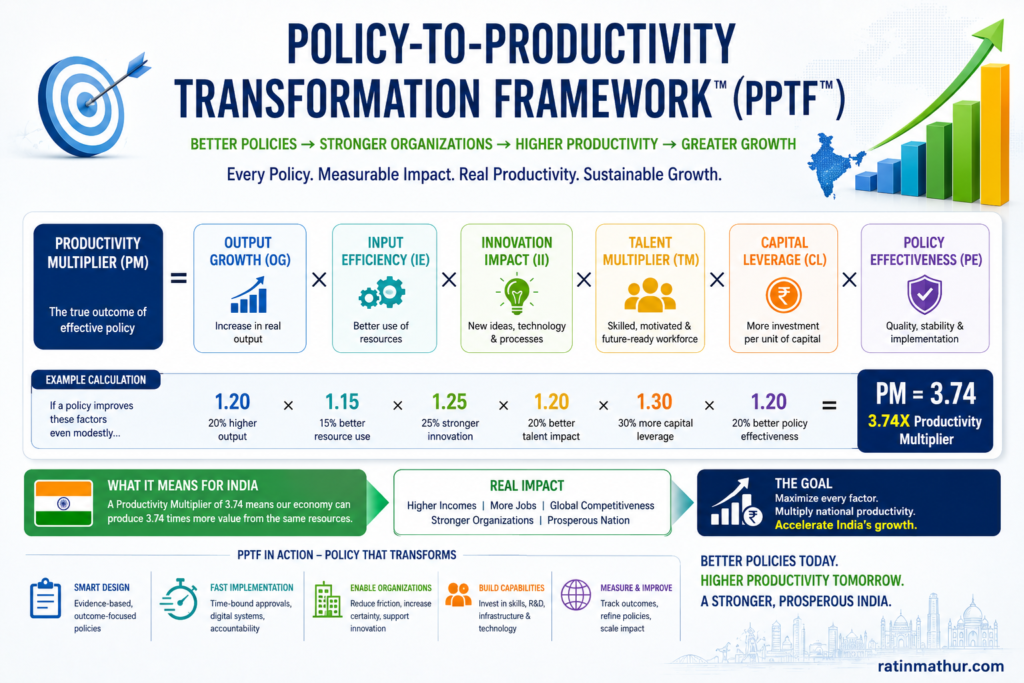
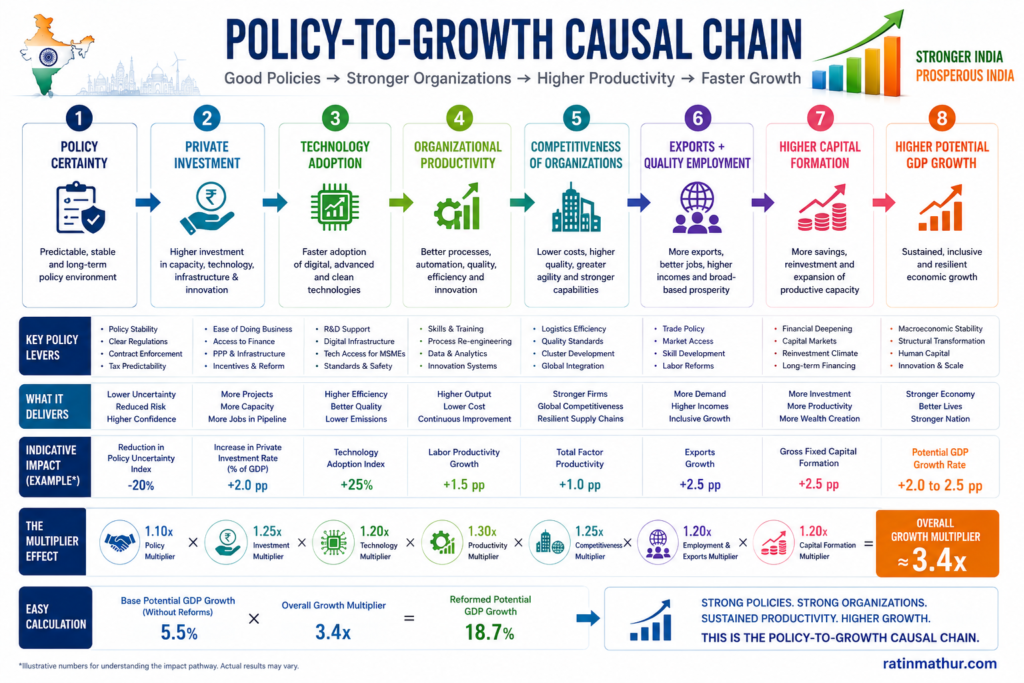
The Policy-to-Productivity Transformation Framework™ proposes that every major economic policy should ultimately be evaluated through its measurable effect on organizational productivity. The framework shifts the policy conversation from “How much incentive is provided?” to “What additional economic output, investment, employment, exports, innovation and productivity does the policy create?”
The principle is particularly important for emerging technologies because incentives can attract investment without necessarily creating deep domestic capability. India should increasingly connect incentives with measurable outcomes such as R&D expenditure, domestic value addition, technology transfer, workforce development, export intensity, energy efficiency and supplier development.
| Policy layer | Policy question | Organizational metric | National metric |
|---|---|---|---|
| Investment | Is capital formation increasing? | Capex deployed | Gross fixed capital formation |
| Productivity | Is technology improving output? | Output per worker | Economy-wide productivity |
| Innovation | Is new IP being created? | Patents and R&D | Domestic technology capability |
| Talent | Are skills improving? | Skilled workforce | Human-capital productivity |
| Supply chain | Is local value increasing? | Supplier localization | Domestic value addition |
| Exports | Is global competitiveness improving? | Export revenue | Market share |
| Employment | Are quality jobs created? | Skilled employment | Formal employment |
| Resilience | Is dependency falling? | Supply continuity | Strategic autonomy |
Consider an advanced battery policy. A conventional policy might reward manufacturing capacity. Under PPTF™, the policy would additionally measure domestic material sourcing, battery-management-system capability, recycling, R&D, export competitiveness, local supplier development and workforce skills. The result would be a policy that builds an ecosystem rather than merely a factory.
The same principle can apply to AI data centers. Incentives should be linked not only to installed computing capacity but also to renewable or firm power integration, domestic data-center equipment, AI startup access, research utilization, energy efficiency and employment.
Organization-Country Alignment Framework™ (OCAF™)
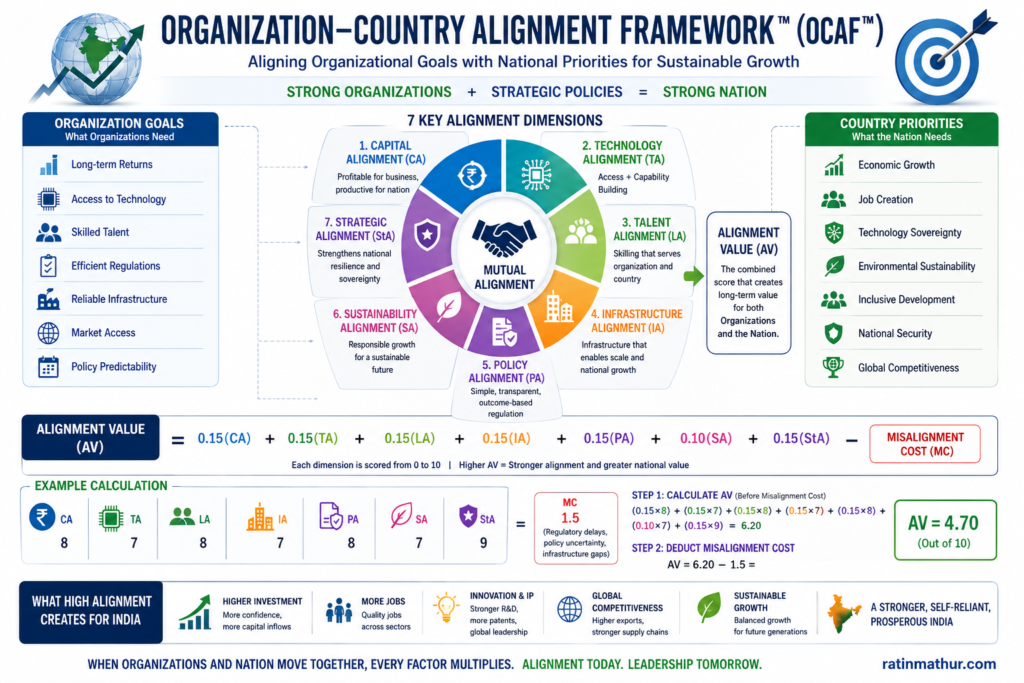
The Organization-Country Alignment Framework™ is designed to resolve a fundamental policy tension: what is good for an individual company is not always sufficient for the country, while what is strategically desirable for the country may not always be economically viable for an organization.
OCAF™ proposes that major policy interventions should optimize simultaneously for organizational competitiveness and national strategic value. The objective is not to maximize government control or corporate freedom independently, but to create alignment between the two.
| Dimension | Organization requirement | Country requirement | Alignment mechanism |
|---|---|---|---|
| Capital | Predictable returns | Long-term investment | Stable policy horizon |
| Technology | Access to global technology | Strategic capability | Trusted technology partnerships |
| Data | Commercial usability | Security and sovereignty | Risk-based governance |
| Talent | Skilled workforce | National capability | Industry-linked education |
| Energy | Reliable power | Energy security | Long-term industrial power planning |
| Minerals | Stable supply | Strategic resilience | Domestic and international sourcing |
| Regulation | Speed and clarity | Safety and accountability | Outcome-based regulation |
| Innovation | IP protection | Technology diffusion | Strong IP plus research collaboration |
For example, a semiconductor company needs global equipment, materials and technical partnerships. India needs domestic semiconductor capability and resilience. OCAF™ would therefore favor policies that allow access to global technology while simultaneously developing Indian design, packaging, testing, materials, engineering talent and supplier ecosystems.
The framework also changes how policymakers should engage with industry. Instead of treating organizations primarily as recipients of incentives, government should treat them as strategic partners in national capability creation. A semiconductor manufacturer, AI company, battery producer or advanced-materials company should have clearly defined mutual commitments with government.
This approach can create a “policy compact” in which government provides infrastructure, predictable regulation and targeted support while organizations commit to investment, skills, R&D, local supplier development and strategic capability.
Technology-to-Growth Multiplier Framework™ (TGMF™)
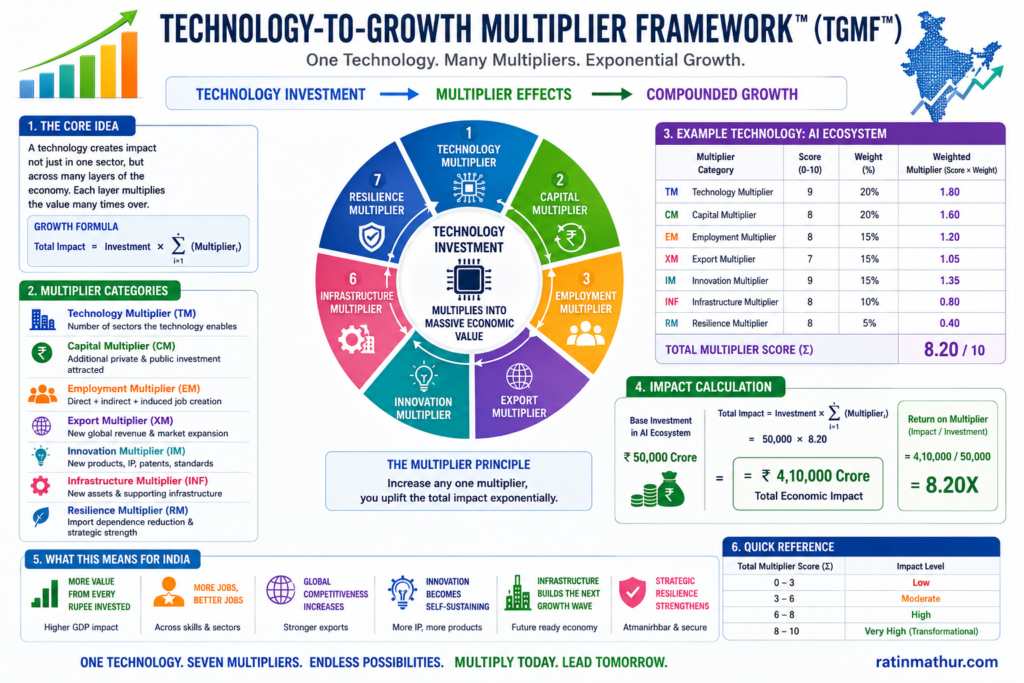
The Technology-to-Growth Multiplier Framework™ recognizes that the economic impact of a technology depends on the number of sectors and value chains it transforms.
AI is a prime example. Its impact does not stop at software. AI can increase productivity in manufacturing, banking, healthcare, agriculture, logistics, energy, education and government. Similarly, advanced batteries influence transportation, electricity storage, mining, chemicals, materials and recycling.
TGMF™ evaluates technologies according to their ability to create cascading economic effects.
| Multiplier | Measurement | Example |
|---|---|---|
| Technology multiplier | Number of sectors enabled | AI across finance, manufacturing and healthcare |
| Capital multiplier | Additional private investment | Data-center ecosystem |
| Employment multiplier | Direct and indirect jobs | Semiconductor ecosystem |
| Export multiplier | New global revenue | Electronics and AI services |
| Innovation multiplier | New products and IP | AI-designed materials |
| Infrastructure multiplier | New supporting assets | Power and cooling for data centers |
| Resource multiplier | Efficiency gains | AI-driven energy optimization |
| Resilience multiplier | Import dependence reduced | Critical-mineral ecosystem |
Suppose India develops a large AI infrastructure ecosystem. The direct outcome is computing capacity. The second-order effects include data centers, power generation, cooling technology, fiber networks, semiconductor demand, cybersecurity, AI startups, research institutions and skilled employment. The third-order effect is productivity improvement across traditional sectors.
Similarly, investment in advanced battery technology can generate demand for critical minerals, chemical processing, manufacturing equipment, recycling, power electronics, software and EV infrastructure.
TGMF™ therefore recommends that government prioritize technologies capable of producing multiple layers of economic value rather than evaluating projects solely on direct employment or direct tax revenue.
The three frameworks should operate together. PPTF™ asks whether policy improves productivity. OCAF™ asks whether organizational and national interests are aligned. TGMF™ asks whether the technology creates economic multipliers beyond its immediate industry.
| Framework | Core question | Primary outcome |
|---|---|---|
| Policy-to-Productivity Transformation Framework™ | Does policy increase productivity? | Higher potential growth |
| Organization-Country Alignment Framework™ | Do organizational and national interests reinforce each other? | Sustainable competitiveness |
| Technology-to-Growth Multiplier Framework™ | How many economic layers can the technology transform? | Greater economic multiplier |
Future Outlook & Conclusion
India’s next economic transformation will not be determined by a single technology, ministry or policy. It will emerge from the interaction of technology, capital, talent, infrastructure, energy, regulation and organizational capability.
The country has already moved beyond the question of whether it should participate in the technology revolution. The more consequential question is whether India can convert technological opportunity into sustained productivity and globally competitive organizations.
The policy architecture should therefore evolve from an incentive-driven model toward an ecosystem-driven model. Incentives remain useful, but they should increasingly become conditional on measurable outcomes. Regulation should protect citizens and national interests without creating unnecessary barriers to experimentation and investment. Government should provide strategic direction while allowing markets and organizations to determine commercial winners.
India’s emerging technology agenda already provides a foundation. The IndiaAI Mission is building access to computing, datasets, models, talent and startup support. The India Semiconductor Mission is building capabilities across semiconductor and display ecosystems. The National Critical Mineral Mission recognizes the strategic importance of securing mineral supplies for energy transition and industrial development.
The next phase requires integration.
India should think of AI policy together with energy policy, semiconductor policy together with materials policy, EV policy together with mining and recycling policy, and manufacturing policy together with skills and technology policy.
The ultimate objective should be simple: make India one of the world’s easiest major economies in which to build, innovate, scale and compete, while ensuring that the resulting economic value strengthens national resilience and broad-based prosperity.
A country-friendly policy does not have to be organization-unfriendly. An organization-friendly policy does not have to compromise national interests. The strongest policy architecture makes the two reinforce each other.
India’s opportunity is therefore not merely to grow faster.
It is to build a growth system in which technology accelerates productivity, productivity accelerates investment, investment accelerates employment and exports, and rising national capability accelerates India’s strategic relevance.
The next decade could determine whether India merely participates in the next technological revolution or becomes one of its principal architects.
References
- Government of India, Ministry of Finance. (2026). Economic Survey 2025-26. Government of India. Economic Survey 2025-26
- Government of India, Ministry of Finance. (2026). Economic Survey 2025-26: Industry’s next leap: Structural transformation and global integration. Government of India. Industry chapter
- Government of India, Ministry of Finance. (2026). Economic Survey 2025-26: Evolution of the AI ecosystem in India: The way forward. Government of India. Economic Survey AI chapter
- Government of India, Ministry of Electronics and Information Technology. (2026). AI & Emerging Technologies Group. MeitY AI & Emerging Technologies Group
- Government of India, Ministry of Electronics and Information Technology. (2026). India Semiconductor Mission. India Semiconductor Mission
- Government of India, Ministry of Electronics and Information Technology. (2026). IndiaAI Mission. IndiaAI Mission
- Government of India, Ministry of Mines. (2025). National Critical Mineral Mission. Government of India. National Critical Mineral Mission
- Government of India, Ministry of Electronics and Information Technology. (2026). IndiaAI Compute. IndiaAI Compute Portal
- Government of India, Ministry of Electronics and Information Technology. (2026). Scheme for Promotion of Manufacturing of Electronic Components and Semiconductors. MeitY electronics and semiconductor manufacturing scheme
- World Economic Forum. (2026). Top 10 emerging technologies of 2026. World Economic Forum. World Economic Forum Emerging Technologies 2026
Disclaimer
This article is intended solely for strategic, educational and informational purposes. It represents an independent analytical perspective and does not constitute investment, legal, financial, tax, policy or professional advice. References to technologies, industries, companies, government programs or potential economic outcomes should not be interpreted as forecasts or guarantees. Policy priorities, regulations, technology maturity, market conditions and commercial outcomes can change rapidly. Readers and decision-makers should undertake independent due diligence and consult appropriate professional advisers before making investment, business or policy decisions. The frameworks presented in this article are original strategic constructs for analytical and discussion purposes and should not be interpreted as official government policy or as a guarantee of economic outcomes.