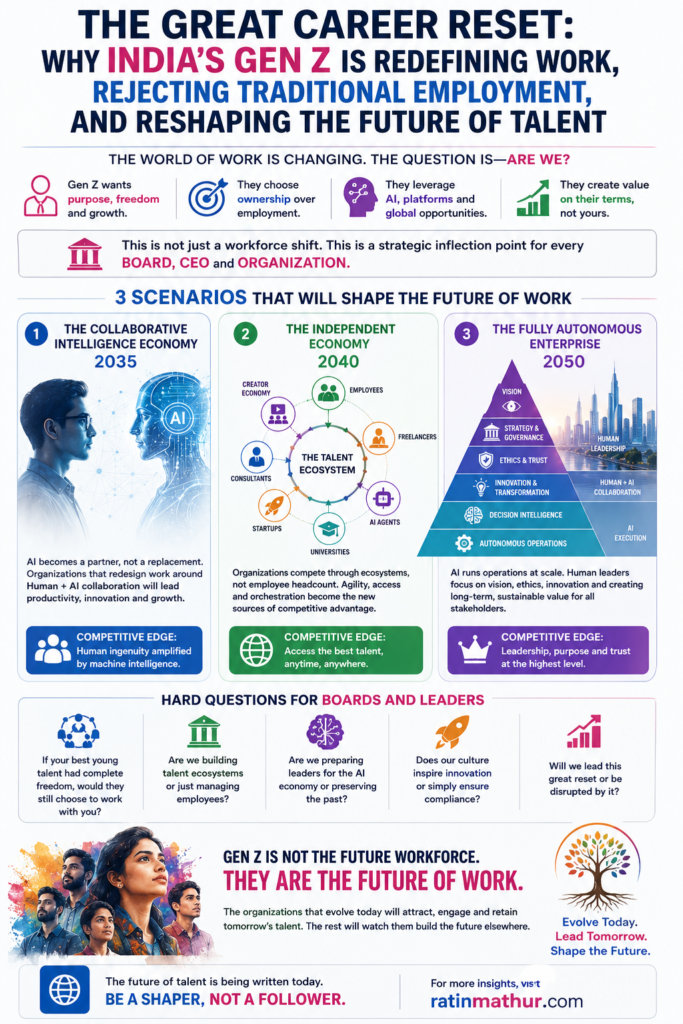
Part 1: The Beginning of India’s Employment Revolution
Abstract
India is experiencing one of the most significant labour-market transformations since the economic liberalisation of 1991. For generations, higher education followed a familiar path: earn a degree, secure a stable corporate job, progress steadily through organizational hierarchies, and retire after decades of employment. That model is steadily giving way to a fundamentally different reality. Across the country, an increasing number of graduates, particularly those belonging to Generation Z, are choosing entrepreneurship, freelancing, consulting, content creation, digital businesses, and portfolio careers over conventional employment. This transition is not a temporary response to economic uncertainty but a structural shift driven by technological disruption, artificial intelligence, digital platforms, changing social values, and the democratization of entrepreneurship.
India stands at the centre of this global transformation. While organizations continue to report shortages of skilled professionals in technology, manufacturing, healthcare, consulting, engineering, and financial services, millions of graduates remain unemployed or underemployed. This contradiction suggests that the challenge facing India’s labour market is no longer the availability of educated people but the declining attractiveness of traditional employment as the preferred pathway to professional success.
This report examines the economic, technological, psychological, and societal forces reshaping India’s employment landscape. It explores why Gen Z increasingly values ownership over employment, flexibility over hierarchy, and wealth creation over salary growth. It also investigates how artificial intelligence is transforming entry-level work, why organizations may struggle to attract future talent despite India’s demographic advantage, and what governments, educational institutions, and business leaders must do to remain competitive in an increasingly independent economy.
Introduction: India Has Entered a New Era of Work
Every industrial revolution has fundamentally changed the relationship between people and work. The First Industrial Revolution mechanized production through steam power. The Second Industrial Revolution introduced electricity, enabling mass production and global manufacturing. The Third Industrial Revolution transformed industries through computers and automation. The Fourth Industrial Revolution connected businesses, consumers, and machines through digital technologies, cloud computing, and the internet. Today, the world is entering a new phase where artificial intelligence is no longer simply improving productivity but redefining how work is created, distributed, and performed.
India occupies a unique position within this transition. Home to one of the world’s youngest populations, the country has long been expected to benefit from an enormous demographic dividend. Every year, millions of graduates enter the workforce, creating the assumption that businesses would continue to enjoy an abundant supply of talent for decades. Policymakers, economists, and corporate leaders have traditionally viewed this growing workforce as one of India’s greatest competitive advantages.
However, the employment landscape is changing far more rapidly than anticipated.
Despite record numbers of graduates entering the labour market, employers across multiple industries report increasing difficulty in attracting and retaining qualified professionals. Simultaneously, many graduates either remain unemployed, reject traditional corporate careers, or actively pursue entrepreneurship, freelancing, digital businesses, consulting, creator-led professions, or other forms of independent work. Rather than competing exclusively for salaried positions, young professionals are increasingly seeking opportunities that provide autonomy, scalability, flexibility, and long-term wealth creation.
This emerging reality represents far more than a generational preference. It signals the beginning of a structural transformation in the relationship between education, employment, and economic value creation. Previous generations measured career success through organizational loyalty, predictable promotions, and stable monthly salaries. Generation Z increasingly measures success through ownership, independence, flexibility, meaningful work, continuous learning, and financial freedom.
As these changing aspirations intersect with rapid advances in artificial intelligence, automation, remote work, and digital platforms, India is entering one of the most important labour-market transitions in its modern history.
Understanding India’s Employment Paradox
At first glance, India’s labour market appears contradictory. Businesses consistently report shortages of skilled professionals capable of leading digital transformation, artificial intelligence initiatives, advanced manufacturing, strategic consulting, healthcare delivery, and innovation. Yet graduate unemployment remains persistently high, with many young professionals unable or unwilling to enter conventional employment.
This paradox cannot be explained simply by the number of available jobs. Instead, it reflects a growing disconnect between what organizations offer and what graduates increasingly seek from their careers.
The employment market is gradually shifting from an employer-driven ecosystem to a talent-driven marketplace. Skilled individuals today possess more career choices than any previous generation. Digital technologies have significantly lowered the barriers to entrepreneurship by providing affordable access to cloud computing, artificial intelligence, e-commerce platforms, digital payment systems, global marketplaces, and social media. As a result, graduates are no longer limited to choosing between different employers. They are choosing between fundamentally different career models.
Corporate organizations therefore compete not only with rival companies but also with startups, freelance platforms, creator economies, digital marketplaces, online consulting opportunities, and independent businesses. This represents one of the most significant structural changes in India’s labour market.
The evolution of career models is illustrated below.
| Traditional Employment Economy | Emerging Independent Economy |
| Single employer | Multiple clients and diversified income sources |
| Fixed monthly salary | Scalable and performance-based earnings |
| Career ladder | Portfolio career |
| Promotion-driven growth | Ownership-driven growth |
| Office-centric work | Remote and digital-first work |
| Employer identity | Personal brand identity |
| Job security | Financial adaptability and income diversification |
| Retirement planning | Continuous wealth creation |
This comparison illustrates that the modern employment debate is no longer employment versus unemployment. Increasingly, it is employment versus independence.
The Structural Forces Driving Gen Z’s Career Choices
The growing preference for independent careers is the result of several long-term structural forces reinforcing one another. Technology has undoubtedly been the most powerful catalyst. Two decades ago, building a business required significant capital, physical infrastructure, distribution networks, and extensive technical expertise. Today, cloud computing, artificial intelligence, software-as-a-service platforms, digital marketing, and online payment systems have dramatically reduced these barriers. A graduate equipped with a laptop, internet connectivity, and specialized knowledge can establish a business serving customers across India or even internationally without maintaining a physical office.
Equally transformative has been the changing perception of wealth creation. Previous generations viewed employment as the primary route to financial stability. Today’s graduates increasingly distinguish between earning income and creating wealth. Salaries provide predictable monthly cash flow, but ownership of businesses, intellectual property, software products, digital assets, investments, or strong personal brands offers the possibility of scalable and recurring returns.
The rapid expansion of digital platforms has reinforced this mindset. Consultants now advise global clients through virtual meetings, educators monetize online courses, designers sell digital products worldwide, software developers build subscription-based applications, and financial experts distribute research directly to paying audiences. Knowledge itself has become a commercial asset capable of generating income without geographic limitations.
Social visibility has further accelerated this transformation. Through social media and digital communities, young professionals regularly observe entrepreneurs, investors, creators, startup founders, consultants, and independent professionals building substantial wealth outside conventional employment. These highly visible examples have expanded career aspirations by demonstrating that success no longer depends exclusively on securing a prestigious corporate position.
Collectively, these developments have transformed entrepreneurship from a high-risk alternative into an increasingly attractive first-choice career.
Why Traditional Employment Has Become Less Attractive
The changing aspirations of young professionals are only one side of the equation. The appeal of traditional employment has also weakened considerably.
For much of the twentieth century, organizations offered three compelling advantages: financial stability, structured career progression, and long-term employment security. Employees expected to spend significant portions of their careers within one or two organizations, gradually advancing through promotions while benefiting from continuous learning and institutional support.
Today’s corporate environment presents a different reality. Global competition, technological disruption, restructuring, mergers, automation, and periodic layoffs have reduced confidence in long-term employment stability. Graduates increasingly recognize that organizational loyalty no longer guarantees predictable career progression.
The COVID-19 pandemic further accelerated this shift by proving that productive work could be performed remotely. The psychological importance of traditional office environments diminished, while flexibility became an essential component of career satisfaction. Young professionals now evaluate employers not only on compensation but also on autonomy, learning opportunities, innovation, organizational culture, purpose, flexibility, and work-life integration.
Consequently, employment is increasingly viewed as one option among many rather than the only legitimate path toward professional success.
Understanding the Psychology of India’s Gen Z Workforce
Every generation enters the workforce shaped by the economic, technological, and social environment in which it grows up. India’s Generation Z has matured during an era defined by smartphones, high-speed internet, social media, startup ecosystems, artificial intelligence, digital payments, online education, the COVID-19 pandemic, and unprecedented global connectivity.
Unlike previous generations, they have never experienced a world without instant access to information or digital opportunities. They have watched startup founders build billion-dollar companies, creators establish global audiences, consultants operate international practices from home offices, and individuals transform specialized expertise into thriving digital businesses.
These experiences have fundamentally altered how young professionals perceive work and career success.
For many graduates, employment is no longer viewed as a destination but as one possible stage within a broader professional journey. They are significantly more comfortable experimenting with different career paths, changing industries, building multiple income streams, and continuously acquiring new skills throughout their working lives.
This generation also places greater emphasis on purpose, flexibility, creativity, inclusion, learning, and personal well-being than previous generations. Rather than asking which organization they should spend their careers with, many instead ask which opportunities will maximize their ability to create value, remain adaptable, and achieve long-term financial independence.
These evolving priorities reflect not simply generational attitudes but a rational response to a rapidly changing economic environment.
Artificial Intelligence Is Reshaping Career Decisions Before Careers Even Begin
Artificial intelligence has become one of the most influential factors affecting career decisions among today’s graduates.
Historically, entry-level corporate positions enabled young professionals to acquire experience by performing routine operational work before progressing into more strategic responsibilities. These foundational roles served as the primary training ground for future managers and leaders.
Artificial intelligence is rapidly transforming this model. Activities such as report generation, document preparation, coding assistance, data analysis, customer support, translation, presentation development, and basic research can increasingly be completed by AI systems with remarkable efficiency. As organizations automate routine work, graduates naturally question whether traditional entry-level employment will continue to provide the same learning opportunities available to previous generations.
Many are therefore investing in broader capabilities that combine artificial intelligence, entrepreneurship, digital marketing, communication, consulting, product development, financial literacy, design thinking, and business strategy. Their objective is no longer simply to become employable. Instead, they seek to become economically resilient and professionally adaptable in an environment where technological disruption is expected to remain constant.
This represents one of the most significant psychological shifts occurring within India’s labour market.
The Rise of the Optionality Economy
Perhaps the defining characteristic of India’s emerging workforce is the pursuit of optionality. Rather than committing permanently to a single career path, graduates increasingly seek to preserve multiple future opportunities.
Optionality enables individuals to combine employment with consulting assignments, investments, digital businesses, freelancing, intellectual property creation, teaching, content development, or entrepreneurial ventures. This diversified approach reduces dependence on a single employer while creating greater financial resilience and professional flexibility.
As a result, career success is increasingly measured not only by designation or salary but also by freedom of choice, ownership creation, adaptability, influence, and long-term wealth generation. This changing definition of success will fundamentally reshape how organizations recruit talent, how universities prepare students, and how governments formulate employment policies over the coming decades.
The transformation currently unfolding represents the beginning of a new employment era in India. It is a transition in which careers become increasingly dynamic, technology becomes an indispensable collaborator, and individuals gain unprecedented control over how they create economic value. The implications of this shift extend far beyond graduates themselves and will influence every institution connected to India’s future workforce.
Part 2: The Future of Employment in India (2035–2050): Talent Scarcity, AI Disruption, and the Rise of the Independent Economy
The transformation discussed in Part 1 is only the beginning of a much larger economic shift. Over the next two decades, India will move beyond the traditional debate of employment versus unemployment and enter a period where organizations may face an entirely different challenge: finding enough people who actually want conventional jobs. While India will continue producing millions of graduates every year, a growing proportion of them will choose entrepreneurship, freelancing, consulting, investing, digital businesses, and creator-led careers over long-term corporate employment.
This distinction is critical. India is unlikely to experience a shortage of educated people. Instead, it may experience a shortage of individuals willing to participate in traditional employment models. The country’s demographic dividend will therefore evolve into a talent availability challenge rather than a population challenge.
From Demographic Dividend to Talent Availability Crisis
For decades, India’s young population has been regarded as one of its greatest strategic advantages. Governments promoted higher education, industries expanded recruitment, and multinational corporations established large operations based on the assumption that the country would continue supplying skilled employees for decades.
However, demographic strength alone no longer guarantees workforce availability.
Employment decisions are increasingly influenced by aspiration rather than necessity. Earlier generations pursued salaried employment primarily for financial security because alternative opportunities were limited. Today’s graduates operate in a fundamentally different environment where technology allows individuals to create businesses, reach global customers, develop intellectual property, and generate multiple income streams without relying exclusively on a single employer.
Consequently, the traditional equation that shaped workforce planning is beginning to lose relevance.
| Traditional Labour Market Assumption | Emerging Labour Market Reality |
| More graduates create more employees | More graduates create more entrepreneurs, consultants, creators, and business owners |
| Population growth ensures labour supply | Career preference determines labour availability |
| Companies compete primarily with other employers | Companies compete with entrepreneurship and digital independence |
| Salary is the primary attraction | Ownership, flexibility, and purpose influence career decisions |
This emerging reality suggests that the future challenge for organizations will not be recruiting graduates but persuading talented graduates that conventional employment remains an attractive career choice.
Artificial Intelligence Is Restructuring the Career Ladder
Artificial intelligence is accelerating this transformation by fundamentally changing how careers begin. Historically, entry-level positions served as structured learning environments where graduates developed expertise through repetitive operational work before progressing into strategic roles. These positions were considered essential because they provided practical experience, organizational exposure, and mentorship.
Artificial intelligence is rapidly reducing the need for many of these repetitive responsibilities. Activities such as preparing reports, summarizing research, analyzing structured data, writing routine documents, generating presentations, coding standard applications, responding to customer queries, and translating documents can increasingly be completed with AI-assisted systems.
The impact extends far beyond productivity. It challenges the traditional mechanism through which professionals gained experience.
| Traditional Entry-Level Responsibility | AI Capability Today |
| Data entry | Fully automated |
| Routine report preparation | AI generated |
| Basic coding support | AI-assisted development |
| Presentation drafting | AI generated |
| Market research summaries | AI-assisted research |
| Customer support | Conversational AI |
| Translation | Near human quality |
| Standard documentation | AI generated |
| Financial reconciliation | Highly automated |
As organizations automate foundational work, graduates naturally question whether corporate employment continues to provide the learning opportunities that justified accepting relatively modest entry-level salaries in the past. Many therefore choose to develop broader capabilities independently through entrepreneurship, consulting, freelancing, digital products, and practical business experience.
Why Companies May Face Hiring Difficulties Despite Millions of Graduates
Conventional economic theory suggests that labour shortages occur primarily when populations decline. India’s future labour market may demonstrate that this assumption is incomplete.
A nation can simultaneously possess a large youth population and experience significant talent shortages if highly skilled individuals increasingly prefer independent careers over conventional employment.
The first reason is the growing desire for ownership. Young professionals increasingly seek to build assets rather than simply earn salaries. Ownership may take many forms, including software products, digital businesses, consulting firms, online education platforms, intellectual property, investment portfolios, or scalable subscription-based services. These assets provide the possibility of recurring income that is not directly proportional to time worked.
The second reason is the rapid growth of multiple-income career models. Instead of depending on one employer, professionals increasingly combine employment with consulting assignments, investments, online teaching, content creation, software development, advisory services, and entrepreneurial ventures. This diversified approach reduces financial dependence on a single organization while improving long-term resilience.
The third reason is artificial intelligence itself. AI dramatically lowers the cost of launching and operating businesses. Tasks that previously required specialized teams can now be completed efficiently by individuals using AI-powered tools. As entrepreneurship becomes less capital-intensive, independent careers become increasingly attractive relative to traditional employment.
Collectively, these developments reduce the relative attractiveness of conventional corporate careers, particularly for highly ambitious graduates seeking autonomy and scalability.
The Rise of the One-Person Enterprise
One of the defining economic trends between 2035 and 2050 is likely to be the emergence of millions of AI-enabled micro-enterprises. Unlike traditional businesses that required departments for finance, marketing, customer support, design, operations, and research, future businesses may consist of a single founder supported by multiple AI systems performing specialized functions.
This transformation dramatically increases individual productivity while reducing operating costs. A consultant can produce research previously requiring an analytical team. A designer can deliver professional creative work with AI-assisted software. A software developer can create applications using AI coding assistants. An educator can design courses, generate learning materials, and reach global audiences through digital platforms.
The productivity gap between individuals and corporations is therefore narrowing.
| Business Model | Traditional Structure | Future AI-Assisted Structure |
| Consulting Firm | Multiple analysts and consultants | Independent consultant supported by AI |
| Marketing Agency | Specialized creative and media teams | Founder with AI-assisted content and analytics |
| Design Studio | Team of designers | Individual designer using AI tools |
| Software Company | Large development teams | Small AI-enabled engineering teams |
| Education Business | Faculty and administrative staff | Subject expert supported by AI platforms |
The emergence of these highly productive one-person enterprises will reshape competition across virtually every knowledge-intensive industry.
The Creator Economy Is Becoming a Mainstream Profession
A decade ago, careers in content creation, digital education, online communities, and personal branding were often viewed as unconventional or financially uncertain. Today, they represent one of the fastest-growing segments of the digital economy.
Professionals increasingly generate income through educational content, newsletters, podcasts, consulting, online communities, subscription-based knowledge platforms, affiliate partnerships, and digital products. These activities transform expertise into scalable intellectual assets capable of serving audiences far beyond geographic boundaries.
For graduates, the creator economy offers more than financial opportunity. It provides independence, creative freedom, personal branding, and direct relationships with audiences. As digital trust becomes increasingly valuable, individuals who establish recognized expertise in specific domains can compete effectively with much larger organizations.
Knowledge itself has become a commercial product.
Consulting Is Becoming an Entrepreneurial Career Rather Than a Corporate Profession
Consulting is also undergoing structural transformation. Traditional consulting firms historically depended upon large analytical teams responsible for research, data analysis, presentation preparation, and documentation. Artificial intelligence increasingly performs much of this foundational work.
Future consultants will compete less through information gathering and more through strategic judgment, implementation capability, leadership, negotiation, creativity, industry expertise, and complex problem-solving.
This change significantly increases the attractiveness of independent consulting. Experienced professionals can now establish specialized advisory practices without the infrastructure previously required by traditional consulting organizations. As AI continues reducing administrative workloads, independent consulting is expected to become one of India’s largest knowledge industries.
Universities Must Prepare Students for Enterprise, Not Just Employment
The changing labour market also demands a fundamental rethinking of higher education.
Universities were originally designed to prepare graduates for industrial employment. Curricula emphasized technical competence, standardized knowledge, and discipline suited to organizational careers. While these foundations remain important, they are no longer sufficient.
Future graduates will require broader capabilities that combine technical expertise with entrepreneurship, artificial intelligence, financial literacy, communication, innovation, digital marketing, consulting, leadership, negotiation, systems thinking, and continuous learning.
Educational institutions that continue preparing students exclusively for traditional employment risk producing graduates who are less competitive in an economy increasingly driven by innovation and independent value creation.
Corporations Must Compete for Talent in New Ways
The competition for talent will become substantially more sophisticated.
Organizations can no longer rely exclusively on salary, employer reputation, or long-established recruitment practices. Future professionals will increasingly evaluate employers according to flexibility, purpose, innovation, learning opportunities, leadership quality, organizational culture, career mobility, ownership opportunities, and AI adoption.
The most successful employers will position themselves not merely as workplaces but as platforms for continuous growth, experimentation, innovation, and long-term professional development.
This represents a significant shift in employer branding. Companies will increasingly compete not only on compensation but on the quality of the professional ecosystem they create for employees.
Government Policy Must Shift from Employment Generation to Enterprise Generation
Public policy will also require substantial adaptation.
For decades, employment generation has served as one of the principal measures of economic success. Over the coming decades, governments may increasingly evaluate progress through enterprise creation, innovation, intellectual property, technology exports, startup formation, productivity growth, and global competitiveness.
Policies supporting entrepreneurship, artificial intelligence adoption, digital infrastructure, venture financing, startup ecosystems, research commercialization, and lifelong learning will become increasingly important for sustaining economic growth.
The objective will gradually evolve from creating more jobs to creating more opportunities for value creation.
Employment Will Become Increasingly Global
Digital connectivity has fundamentally altered the geography of work.
An Indian consultant can advise clients in New York, a software developer can build products for European companies, a financial analyst can support organizations in Singapore, and a designer can serve businesses in Australia without relocating. Remote collaboration and digital platforms have effectively created a global labour marketplace.
Consequently, graduates compare domestic employment opportunities with international freelance markets, global consulting assignments, digital entrepreneurship, and remote work opportunities.
Indian companies therefore compete not only with domestic employers but with organizations and clients located around the world.
Industries Most Likely to Experience Talent Scarcity
The labour shortages of the future are unlikely to affect every sector equally. Knowledge-intensive industries requiring continuous learning, creativity, strategic thinking, and advanced technical capabilities are expected to experience the greatest competition for skilled professionals.
| Industry | Primary Driver of Talent Scarcity |
| Artificial Intelligence | Rapid technological expansion |
| Semiconductor Manufacturing | Strategic national investment |
| Cybersecurity | Increasing digital threats |
| Renewable Energy | Energy transition initiatives |
| Healthcare | Aging population and specialized care |
| Robotics | Industrial automation |
| Aerospace and Defence | Advanced engineering requirements |
| Advanced Manufacturing | Smart factory transformation |
| Strategic Consulting | Increasing business complexity |
| Data Science and Analytics | Enterprise-wide digital transformation |
Ironically, these industries may report persistent vacancies despite India continuing to produce record numbers of graduates. The constraint will increasingly be talent preference rather than talent availability.
Redefining Career Success in the Twenty-First Century
Perhaps the most important transformation is philosophical rather than technological.
For much of the twentieth century, professional success was measured through salary, designation, promotions, organizational prestige, and years of service. These indicators remain relevant but no longer represent the complete picture.
Today’s graduates increasingly define success through ownership, adaptability, influence, financial independence, multiple income streams, lifelong learning, and the freedom to choose meaningful work.
| Traditional Definition of Success | Emerging Definition of Success |
| Monthly salary | Multiple income streams |
| Organizational promotion | Ownership creation |
| Job security | Career adaptability |
| Employer brand | Personal brand |
| Office presence | Global digital reach |
| Years of experience | Demonstrated capability |
| Organizational hierarchy | Professional influence |
| Retirement savings | Financial independence |
India is therefore approaching a future in which the most valuable professionals may no longer seek traditional employment as their primary objective. Instead, they will pursue careers built around innovation, entrepreneurship, intellectual property, consulting, and technology-enabled independence. Organizations that recognize this transition early will be better positioned to attract exceptional talent, while those relying on twentieth-century employment models may find recruitment becoming progressively more difficult.
Part 3: India 2035–2050: Future Scenarios, Emerging Industries, and the Strategic Reinvention of Business
The future of employment cannot be predicted with absolute certainty. Economic growth, technological breakthroughs, geopolitical developments, climate change, demographic shifts, education reforms, and public policy will all influence how India’s workforce evolves over the coming decades. However, strategic planning is not about predicting a single future. It is about preparing for multiple plausible futures and ensuring that organizations remain resilient regardless of which scenario unfolds.
Scenario planning has long been used by governments, multinational corporations, consulting firms, and military organizations to anticipate uncertainty. Rather than asking what will happen, scenario planning asks what could happen and how leaders should prepare. Applying this approach to India’s labour market reveals three distinct but interconnected futures that may emerge between 2035 and 2050.
Scenario One: The Collaborative Intelligence Economy (2035)
The first and most optimistic scenario assumes that artificial intelligence augments rather than replaces human capability. Organizations successfully redesign work, educational institutions modernize curricula, and governments create policies that encourage innovation while protecting employment transitions. AI becomes a productivity multiplier instead of a substitute for human talent.
Under this scenario, employment continues to grow, but the nature of work changes significantly. Routine operational activities become increasingly automated, allowing professionals to focus on strategic thinking, creativity, innovation, customer engagement, leadership, and complex decision-making. Rather than reducing employment, AI creates demand for entirely new occupations that currently exist only in limited form.
Graduates entering the workforce in 2035 are expected to possess strong technical foundations while also demonstrating adaptability, communication skills, business understanding, ethical judgment, and continuous learning capabilities. Organizations prioritize learning agility over narrow specialization because technological change remains constant.
Business performance improves as AI increases productivity, lowers operating costs, accelerates decision-making, and enables faster innovation. Employees become supervisors of intelligent systems rather than performers of repetitive operational work.
The defining characteristic of this scenario is collaboration. Humans and artificial intelligence work together, each complementing the strengths of the other.
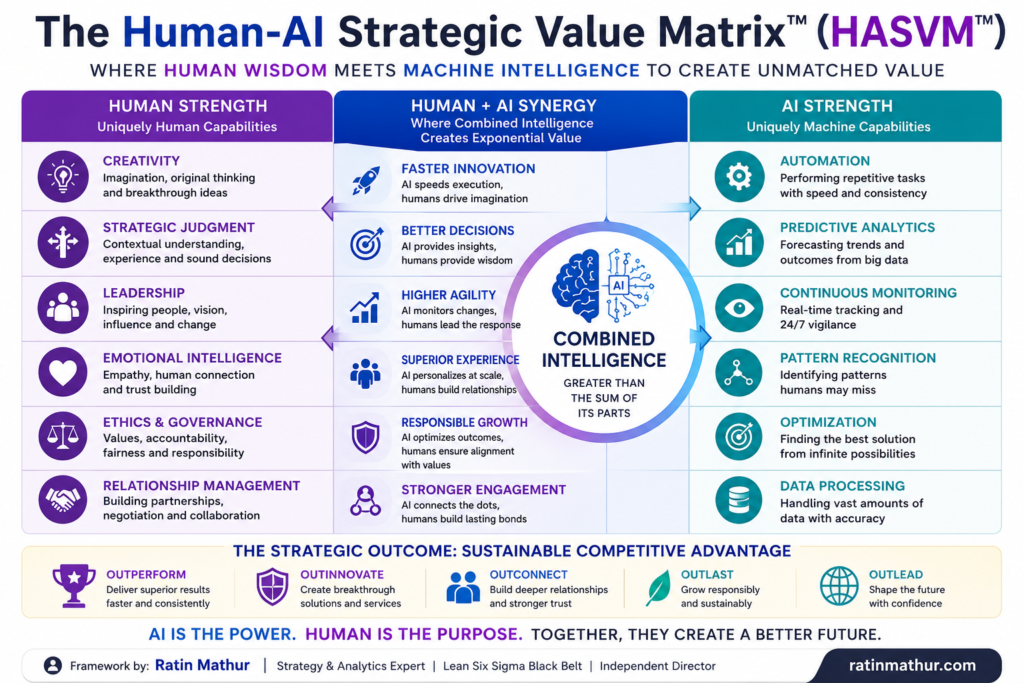
The Human-AI Strategic Value Matrix™ (HASVM™)
The Collaborative Intelligence Economy assumes that artificial intelligence will augment human capability rather than replace it. In this environment, organizations achieve sustainable competitive advantage by designing work around the complementary strengths of people and intelligent systems. The Human-AI Strategic Value Matrix™ provides executives with a structured approach for determining which activities should remain human-led, which should be AI-enabled, and which should be executed collaboratively. Instead of viewing AI as a substitute for employees, the framework encourages organizations to redesign business processes so that artificial intelligence performs routine, data-intensive, and repetitive work while people focus on creativity, judgment, innovation, ethics, and leadership.
The framework demonstrates that the greatest organizational value is created when human capabilities and AI capabilities reinforce each other. Artificial intelligence contributes speed, scalability, accuracy, and analytical power, while humans contribute contextual understanding, emotional intelligence, strategic thinking, governance, and purpose. Together, these complementary capabilities create higher-quality decisions, stronger customer relationships, faster innovation, and greater organizational resilience.
| Human Capability | AI Capability | Strategic Business Outcome |
| Creativity | Automation | Faster innovation and product development |
| Strategic Judgment | Predictive Analytics | Better business decisions |
| Leadership | Continuous Monitoring | Higher organizational agility |
| Emotional Intelligence | Pattern Recognition | Superior customer experience |
| Ethics and Governance | Optimization | Responsible and trustworthy AI adoption |
| Relationship Management | Data Processing | Stronger stakeholder engagement |
The framework can be applied across industries. In healthcare, artificial intelligence can identify abnormalities within medical images, while physicians interpret the findings within the broader clinical context and recommend treatment. In manufacturing, AI predicts equipment failures before they occur, while plant managers decide production priorities and investment strategies. In consulting, AI accelerates research and data analysis, enabling consultants to devote more time to solving strategic business problems. Organizations adopting this framework shift their AI strategy from cost reduction to value creation, positioning human capability as an increasingly valuable asset in an AI-enabled economy.
Scenario Two: The Independent Economy (2040)
The second scenario assumes that entrepreneurship, digital platforms, and artificial intelligence dramatically reduce barriers to business creation. Independent professionals become the dominant force within knowledge industries, while traditional employment gradually becomes one option among many rather than the default career path.
By 2040, millions of highly skilled professionals operate as consultants, creators, educators, software developers, designers, researchers, analysts, financial advisors, legal experts, healthcare specialists, and engineering consultants serving multiple organizations simultaneously.
Corporate structures become considerably smaller because businesses increasingly access specialized expertise on demand rather than maintaining large permanent workforces. Employment shifts toward project-based collaboration, with professionals joining organizations for specific assignments before moving to new opportunities.
Technology platforms facilitate global matching between expertise and business requirements, allowing Indian professionals to serve international clients without geographic relocation.
Career progression changes fundamentally. Rather than climbing organizational hierarchies, professionals build portfolios consisting of successful projects, intellectual property, business ventures, research publications, patents, investments, certifications, and global client relationships.
Organizations compete for talent by offering meaningful work, innovation opportunities, learning ecosystems, and flexible engagement models rather than relying exclusively on long-term employment contracts.
This scenario transforms India into one of the world’s largest knowledge-exporting economies.
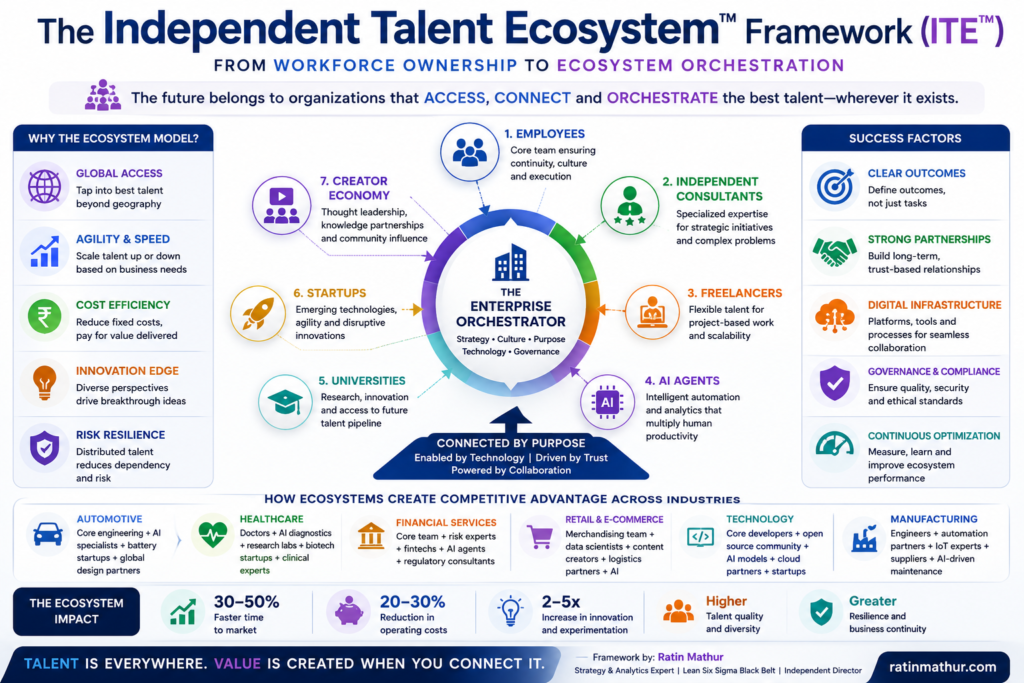
The Independent Talent Ecosystem™ Framework (ITE™)
The Independent Economy assumes that organizations will increasingly access expertise rather than permanently employ it. The Independent Talent Ecosystem™ Framework explains how the traditional workforce evolves into a dynamic network of employees, independent professionals, universities, startups, digital platforms, and artificial intelligence. Instead of measuring organizational capability by employee headcount, future enterprises will measure capability through the strength, diversity, and quality of their talent ecosystem.
The framework recognizes that digital technologies have significantly reduced the cost of collaboration across geographical boundaries. Organizations can now engage highly specialized consultants, freelance professionals, AI agents, research institutions, startup partners, and global experts on demand. This approach provides greater flexibility, accelerates innovation, reduces fixed costs, and enables businesses to access world-class expertise without maintaining large permanent workforces.
| Talent Source | Primary Strategic Role | Value Delivered |
| Permanent Employees | Core business continuity | Organizational stability and institutional knowledge |
| Independent Consultants | Specialized strategic expertise | High-value business solutions |
| Freelancers | Flexible project execution | Agility and scalability |
| AI Agents | Intelligent process automation | Productivity and operational efficiency |
| Universities | Research and innovation | Future capabilities and talent pipeline |
| Startups | Emerging technologies | Innovation and disruption |
| Creator Economy | Knowledge partnerships | Brand influence and specialized learning |
A practical example of this framework can be observed in the electric vehicle industry. A future automotive manufacturer may employ engineers responsible for core technologies while collaborating with independent AI specialists, battery researchers, university laboratories, software developers, startup partners, and specialized consultants across different countries. Similarly, pharmaceutical companies increasingly integrate biotechnology startups, AI-driven drug discovery platforms, clinical research organizations, academic institutions, and regulatory experts into a single innovation ecosystem. Organizations that master ecosystem orchestration rather than workforce ownership will achieve higher innovation rates and greater competitive flexibility.
Scenario Three: The Fully Autonomous Enterprise (2050)
The third scenario represents the most disruptive possibility. Artificial intelligence becomes capable of performing a substantial proportion of knowledge work previously requiring human professionals. Autonomous systems manage logistics, manufacturing, customer service, financial analysis, legal documentation, software development, supply chain optimization, and administrative decision-making with minimal human intervention.
Organizations become significantly leaner. Many operational functions disappear entirely or operate under AI supervision. Human employment concentrates around activities requiring judgment, ethics, creativity, innovation, emotional intelligence, diplomacy, governance, scientific discovery, strategic leadership, and complex relationship management.
Rather than employing thousands of people performing routine work, enterprises rely upon relatively small teams of highly skilled professionals directing intelligent systems capable of executing large-scale operations.
Economic productivity reaches unprecedented levels, but societies face important policy questions concerning income distribution, lifelong learning, taxation, workforce participation, and social inclusion.
Success within this scenario depends less upon technical knowledge and increasingly upon uniquely human capabilities that artificial intelligence struggles to replicate.
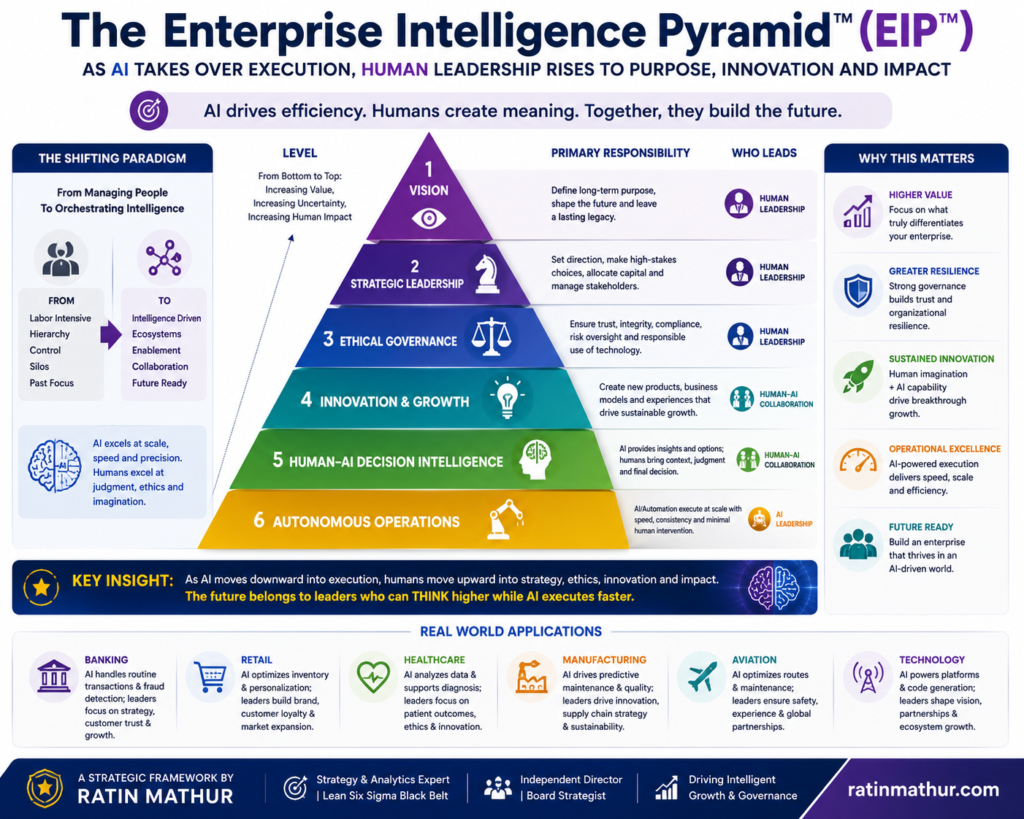
The Enterprise Intelligence Pyramid™ (EIP™)
The Fully Autonomous Enterprise assumes that artificial intelligence will perform a significant proportion of operational and analytical activities, allowing human professionals to concentrate on leadership, governance, innovation, and long-term strategy. The Enterprise Intelligence Pyramid™ illustrates how organizational responsibilities shift as automation increases. Rather than replacing leadership, artificial intelligence elevates the importance of executive decision-making by removing routine operational responsibilities from human managers.
The framework proposes that organizational value progressively increases from the operational layer to the strategic layer. Autonomous systems deliver maximum efficiency in repetitive execution, while human leadership becomes increasingly essential as decisions involve uncertainty, ethics, stakeholder management, innovation, and long-term vision. Consequently, future competitive advantage will depend less on operational efficiency alone and more on the quality of strategic leadership and governance.
| Enterprise Layer | Primary Responsibility | Human or AI Leadership |
| Vision | Defining long-term organizational purpose | Human-led |
| Strategic Leadership | Business strategy and capital allocation | Human-led |
| Ethical Governance | Risk management, trust, and compliance | Human-led |
| Innovation | Business model creation and transformation | Human-AI Collaboration |
| Human-AI Decision Intelligence | Strategic decision support | Human-AI Collaboration |
| Autonomous Operations | Routine execution and optimization | AI-led |
The framework applies across industries. In banking, artificial intelligence may approve loans, detect fraud, and optimize financial operations, while executives determine expansion strategies, mergers, regulatory responses, and capital allocation decisions. In retail, AI forecasts demand, optimizes inventory, and personalizes customer experiences, while leadership defines brand positioning, market expansion, customer strategy, and corporate culture. The Enterprise Intelligence Pyramid™ demonstrates that as artificial intelligence assumes greater operational responsibility, leadership becomes increasingly focused on vision, governance, ethics, innovation, and sustainable value creation. Organizations that understand this transition will develop stronger leadership capabilities while simultaneously achieving higher operational efficiency.
Why these three frameworks work well
These frameworks are tightly aligned with the three scenarios:
| Scenario | Proprietary Framework™ | Primary Strategic Question Answered |
| Scenario 1: Collaborative Intelligence Economy (2035) | Human-AI Strategic Value Matrix™ (HASVM™) | How should humans and AI work together? |
| Scenario 2: Independent Economy (2040) | Independent Talent Ecosystem™ Framework (ITE™) | Where will organizations source future talent? |
| Scenario 3: Fully Autonomous Enterprise (2050) | Enterprise Intelligence Pyramid™ (EIP™) | What will leadership look like in AI-driven organizations? |
These three frameworks form a coherent progression—from work redesign, to workforce redesign, to enterprise redesign—making them well suited to the structure of your article and distinctive as recurring strategic models under your thought leadership.
Comparing the Three Scenarios
| Dimension | Collaborative Intelligence (2035) | Independent Economy (2040) | Autonomous Enterprise (2050) |
| Primary Workforce Model | Human-AI collaboration | Independent professionals | AI-led organizations |
| Dominant Career | Corporate employment with AI | Portfolio careers | Strategic leadership and innovation |
| Organization Size | Medium to large | Smaller, project-based | Lean AI-enabled enterprises |
| AI Role | Productivity partner | Business enabler | Operational decision maker |
| Human Value | Creativity and judgment | Entrepreneurship and expertise | Ethics, leadership, innovation |
| Competitive Advantage | AI adoption | Intellectual capital | Strategic thinking and governance |
These scenarios are not mutually exclusive. Different industries may experience different futures simultaneously, creating a highly diversified employment landscape across the Indian economy.
Industries Expected to Expand Rapidly
Technological disruption rarely eliminates economic activity altogether. Instead, it reallocates investment toward emerging industries while transforming existing sectors. India is expected to witness significant expansion across industries driven by artificial intelligence, sustainability, healthcare, advanced manufacturing, and digital infrastructure.
| High-Growth Industry | Growth Driver |
| Artificial Intelligence | Enterprise automation and intelligent systems |
| Semiconductor Manufacturing | National strategic investments |
| Robotics and Automation | Smart manufacturing |
| Cybersecurity | Digital risk management |
| Renewable Energy | Decarbonization initiatives |
| Electric Mobility | Sustainable transportation |
| Biotechnology | Personalized healthcare |
| Aerospace and Defence | Strategic modernization |
| Space Technology | Commercial satellite economy |
| Climate Technology | Environmental resilience |
| Digital Education | Lifelong learning |
| Wealth Management | Expanding middle class |
| Advanced Healthcare | Aging population and preventive medicine |
These industries will generate substantial economic value while requiring highly specialized expertise, interdisciplinary collaboration, and continuous innovation.
Industries Most Likely to Experience Structural Transformation
Transformation does not necessarily imply decline. Many traditional industries will remain economically significant but will operate with fewer employees and greater technological sophistication.
| Industry | Expected Transformation |
| Banking | AI-driven advisory services and digital operations |
| Insurance | Automated underwriting and claims management |
| Manufacturing | Smart factories and autonomous production |
| Retail | AI-enabled personalized commerce |
| Logistics | Autonomous supply chains |
| Legal Services | AI-assisted documentation and research |
| Accounting | Intelligent financial reporting |
| Human Resources | Skills-based workforce planning |
| Customer Service | Conversational AI platforms |
| Media | AI-assisted content production |
Organizations within these industries will increasingly require professionals capable of managing transformation rather than performing repetitive operational tasks.
Skills That Will Define Employability
The future labour market will increasingly reward individuals who combine technical competence with strategic and interpersonal capabilities. Knowledge will remain important, but the ability to continuously acquire new knowledge will become even more valuable.
| Declining Advantage | Growing Advantage |
| Memorization | Critical thinking |
| Routine execution | Creative problem-solving |
| Single specialization | Interdisciplinary expertise |
| Administrative reporting | Strategic interpretation |
| Manual analysis | AI-assisted decision-making |
| Technical competence alone | Leadership and collaboration |
| Following instructions | Independent judgment |
| Individual productivity | Innovation capability |
This shift reinforces the importance of lifelong learning as the defining characteristic of successful careers.
How Business Models Will Change
Organizations will increasingly transition from labour-intensive operating models toward intelligence-intensive operating models. Competitive advantage will depend less upon workforce size and more upon organizational agility, innovation capability, intellectual property, and technology integration.
Permanent employment will gradually be supplemented by ecosystems consisting of employees, independent consultants, specialized freelancers, research partners, startups, universities, AI systems, and strategic alliances. Organizations will function as orchestrators of talent networks rather than solely as employers.
Decision-making will become faster because artificial intelligence will process operational information continuously, allowing executives to concentrate on long-term strategy, customer relationships, innovation, governance, and capital allocation.
The boundary between organizations and external expertise will become increasingly fluid.
Reinventing Universities for the Future Economy
Higher education institutions face one of the greatest transformation challenges.
The industrial education model emphasized standardized knowledge, examinations, and preparation for stable employment. The future economy requires graduates capable of adapting repeatedly throughout careers spanning forty to fifty years.
Universities must therefore shift from teaching fixed knowledge toward developing adaptive capability.
Future curricula should integrate artificial intelligence, entrepreneurship, behavioural economics, systems thinking, sustainability, digital business, financial literacy, innovation management, ethics, communication, negotiation, consulting, and interdisciplinary problem-solving. Industry collaboration should become continuous rather than occasional, ensuring that graduates develop practical capabilities alongside academic knowledge.
The most successful universities will become lifelong learning institutions supporting professionals throughout their careers rather than only during early adulthood.
The Strategic Challenge for Corporate Leaders
For CEOs, CHROs, and boards, the emerging workforce presents both an opportunity and a challenge.
Organizations can no longer assume that talented graduates will naturally prefer corporate employment. Instead, they must continuously demonstrate why joining the organization creates greater long-term value than pursuing independent careers.
Future talent strategies will emphasize meaningful work, accelerated learning, internal entrepreneurship, flexible career paths, AI-enabled productivity, innovation culture, and opportunities for ownership. Companies that successfully combine these elements are likely to enjoy significant competitive advantages in attracting and retaining exceptional professionals.
Leadership itself will evolve from managing employees toward building ecosystems that enable people, technology, and external partners to create value collectively.
India’s Strategic Opportunity
India possesses several structural advantages that position it favourably for the coming transformation. The country combines one of the world’s youngest populations with expanding digital infrastructure, globally competitive technology capabilities, a vibrant startup ecosystem, strong engineering talent, increasing AI adoption, and one of the fastest-growing digital economies.
If education reforms, policy initiatives, and corporate transformation progress together, India has the potential to become the global leader in knowledge services, AI-enabled entrepreneurship, digital innovation, and technology-driven consulting.
The challenge lies not in producing more graduates but in enabling those graduates to become globally competitive creators of economic value.
Part 4: Strategic Recommendations, Policy Imperatives, Risks, and the Road Ahead
The transformation of India’s labour market is not an isolated employment trend. It represents a structural reconfiguration of how economic value will be created, distributed, and sustained during the coming decades. The rise of artificial intelligence, entrepreneurship, digital platforms, remote work, and independent careers is reshaping the relationship between individuals, organizations, educational institutions, and governments.
Every major economic transition creates winners and losers. Countries, organizations, and individuals that recognize these shifts early are more likely to benefit from them, while those that remain committed to outdated assumptions risk falling behind. India’s demographic advantage alone will not guarantee economic leadership. Success will depend upon how effectively the country transforms its education system, business practices, labour policies, and innovation ecosystem.
The future therefore demands coordinated action across multiple stakeholders.
Strategic Priorities for Corporate Leaders
Business leaders must recognize that attracting talent in the future will require more than competitive compensation packages. The next generation of professionals increasingly evaluates organizations based on learning opportunities, flexibility, innovation culture, purpose, leadership quality, and opportunities for ownership.
Organizations should redesign work around human strengths rather than routine execution. Artificial intelligence should automate repetitive activities while employees concentrate on strategic thinking, innovation, customer relationships, problem-solving, and leadership.
Corporate learning must also evolve. Annual training programs are unlikely to remain sufficient in an environment where technology changes continuously. Organizations should establish lifelong learning ecosystems that encourage employees to regularly acquire new technical, managerial, and entrepreneurial capabilities.
Internal entrepreneurship represents another important opportunity. Companies that enable employees to experiment with new products, develop innovative business models, and participate in value creation are likely to retain ambitious professionals more effectively than organizations relying solely on traditional career progression.
Future-ready organizations will therefore become talent platforms rather than simply employers.
Recommendations for Chief Human Resource Officers
Human resource functions will undergo one of the most significant transformations of any corporate discipline.
Recruitment strategies should increasingly focus on capabilities rather than degrees alone. Adaptability, learning agility, creativity, collaboration, and problem-solving will become stronger predictors of long-term success than narrow technical specialization.
Performance management systems should reward innovation, knowledge sharing, experimentation, customer impact, and interdisciplinary collaboration rather than merely measuring activity or tenure.
Career development should become increasingly personalized. Instead of standardized promotion pathways, organizations should provide flexible career experiences that allow employees to move across functions, technologies, projects, and business units throughout their professional journey.
Employee engagement strategies must also acknowledge that many professionals seek purpose alongside compensation. Organizations capable of demonstrating meaningful societal impact are likely to strengthen both recruitment and retention.
Recommendations for CEOs and Boards of Directors
Boards should treat workforce strategy as a long-term strategic issue rather than an operational human resource function.
Future board discussions should regularly examine workforce demographics, artificial intelligence adoption, capability development, succession planning, innovation culture, leadership readiness, and organizational resilience.
Artificial intelligence governance will become equally important. Boards should establish clear oversight mechanisms addressing ethics, cybersecurity, algorithmic accountability, regulatory compliance, transparency, and responsible AI deployment.
Capital allocation decisions should increasingly prioritize investment in technology, employee capability development, innovation ecosystems, and digital infrastructure alongside conventional physical assets.
The organizations that create sustainable competitive advantage will not necessarily employ the largest workforce. Instead, they will build the most capable workforce supported by intelligent technologies.
Recommendations for Universities and Educational Institutions
Higher education must transition from preparing students for jobs to preparing them for careers that may continuously evolve over four or five decades.
Curricula should integrate artificial intelligence, entrepreneurship, systems thinking, financial literacy, sustainability, digital business, consulting, communication, behavioural economics, ethics, negotiation, leadership, and interdisciplinary problem-solving. These subjects should complement rather than replace technical education.
Universities should also strengthen collaboration with industry through internships, live consulting projects, startup incubation centres, research partnerships, and innovation laboratories. Students should graduate with practical business experience alongside academic knowledge.
Assessment methods require modernization as well. Memorization-based examinations measure knowledge acquisition but do not adequately evaluate creativity, strategic thinking, teamwork, adaptability, or leadership. Future education systems should increasingly emphasize project-based learning, case studies, simulations, and real-world problem-solving.
Learning itself should become lifelong. Universities may increasingly support alumni throughout their careers by offering continuous executive education, professional certifications, and AI-enabled learning platforms.
Recommendations for Government and Policymakers
Governments will play a central role in ensuring that technological transformation produces inclusive economic growth.
Employment policy should gradually expand into enterprise policy. Success should not be measured solely through the number of jobs created but also through startup formation, innovation, intellectual property generation, technology exports, productivity growth, and global competitiveness.
Public investment should prioritize digital infrastructure, semiconductor manufacturing, artificial intelligence research, cybersecurity, renewable energy, advanced manufacturing, biotechnology, and skill development. These sectors are expected to generate high-value employment while strengthening India’s strategic competitiveness.
Labour regulations should evolve to accommodate independent professionals, freelancers, consultants, and digital entrepreneurs. Social security, healthcare benefits, retirement planning, taxation, and financial inclusion frameworks will require modernization to reflect increasingly diverse career models.
Finally, governments should promote lifelong learning by encouraging continuous reskilling through industry partnerships, online education platforms, vocational training, and public-private collaboration.
The Role of Independent Directors
The evolving workforce presents a significant governance challenge for corporate boards.
Independent Directors should ensure that organizations are adequately preparing for artificial intelligence adoption, workforce transformation, cybersecurity risks, ethical governance, and changing employee expectations. Human capital should increasingly be viewed as a strategic asset requiring board-level oversight.
Board discussions should include workforce resilience, succession planning, leadership development, digital capability, innovation readiness, and organizational culture alongside financial performance.
Independent Directors should also encourage organizations to adopt responsible artificial intelligence frameworks that balance productivity with employee development, transparency, privacy, and ethical accountability.
Governance excellence in the AI era will depend as much on managing people and technology together as on managing financial performance.
Risks That Could Slow India’s Workforce Transformation
Although the long-term outlook appears promising, several risks could delay or complicate this transition.
| Risk | Potential Impact | Strategic Response |
| Slow education reform | Skill mismatch | Curriculum modernization and industry collaboration |
| Unequal digital access | Regional inequality | Investment in digital infrastructure |
| Rapid AI displacement | Temporary unemployment | Large-scale reskilling initiatives |
| Cybersecurity threats | Business disruption | National cybersecurity capability |
| Startup funding volatility | Slower entrepreneurship | Diversified financing ecosystem |
| Regulatory uncertainty | Reduced investment | Stable and predictable policy frameworks |
| Global economic slowdown | Lower exports and hiring | Domestic innovation and productivity growth |
| Climate change | Sectoral disruption | Sustainable infrastructure and green technologies |
Recognizing these risks early enables organizations and governments to prepare proactive rather than reactive strategies.
Opportunities That Could Define India’s Competitive Advantage
India enters this transformation with several unique strengths rarely found together in a single economy.
| Strategic Advantage | Long-Term Opportunity |
| Young population | Largest knowledge workforce globally |
| Strong IT ecosystem | Global AI and digital services leadership |
| Expanding startup ecosystem | Innovation-driven economic growth |
| Digital public infrastructure | Inclusive digital economy |
| Engineering talent | Advanced manufacturing and technology leadership |
| Growing domestic market | Rapid commercialization of innovation |
| Global services reputation | Expansion into high-value consulting and research |
If supported by appropriate education reforms, governance, infrastructure, and policy, these advantages could position India as one of the world’s leading knowledge economies by the middle of this century.
The New Social Contract Between Employers and Employees
The relationship between organizations and professionals is entering a new phase.
The industrial economy emphasized stability, hierarchy, and long-term organizational loyalty. The emerging knowledge economy emphasizes collaboration, flexibility, learning, innovation, and shared value creation.
Employers will increasingly provide opportunities for continuous development, meaningful work, technological enablement, and career mobility. Employees, in return, will contribute adaptability, creativity, specialized expertise, innovation, and lifelong learning.
This evolving relationship represents a partnership rather than a traditional employer-employee hierarchy.
Organizations that embrace this new social contract will be better positioned to compete in an increasingly knowledge-intensive global economy.
Conclusion
India stands at the beginning of one of the most important workforce transformations in its economic history. The convergence of artificial intelligence, digital platforms, entrepreneurship, demographic change, and evolving career aspirations is redefining how value will be created during the coming decades.
The central finding of this report is that the future challenge for India is unlikely to be producing enough graduates. Instead, it will be creating sufficiently attractive opportunities for talented graduates to participate in the formal economy while simultaneously encouraging entrepreneurship, innovation, and independent value creation.
Traditional employment will not disappear. It will evolve. Organizations will become leaner, more intelligent, more technology-enabled, and increasingly dependent on professionals capable of solving complex problems, exercising sound judgment, and leading innovation. Routine work will continue shifting toward automation, while uniquely human capabilities such as creativity, ethics, empathy, leadership, and strategic thinking will become even more valuable.
Universities must educate adaptable learners rather than narrowly trained specialists. Businesses must compete for talent by offering purpose, growth, flexibility, and continuous learning. Governments must shift from measuring employment alone to fostering enterprise creation, innovation, and productivity. Boards must oversee not only financial performance but also workforce resilience and responsible AI governance.
India possesses a rare opportunity to convert its demographic dividend into a lasting competitive advantage. Whether this opportunity is fully realized will depend upon decisions made today by educators, policymakers, corporate leaders, entrepreneurs, investors, and professionals themselves.
The future of work in India will not be defined solely by technology. It will be defined by how effectively people, institutions, and intelligent systems learn to create value together.
References
- World Economic Forum. (2025). The Future of Jobs Report 2025. https://www.weforum.org
- International Labour Organization. (2024). World Employment and Social Outlook. https://www.ilo.org
- NITI Aayog. National Strategy for Artificial Intelligence. https://www.niti.gov.in
- McKinsey Global Institute. The Future of Work. https://www.mckinsey.com/mgi
- Deloitte. 2025 Global Human Capital Trends. https://www.deloitte.com
- PwC. Workforce of the Future. https://www.pwc.com
- World Bank. World Development Report. https://www.worldbank.org
- OECD. Employment Outlook. https://www.oecd.org
- Ministry of Skill Development and Entrepreneurship. https://www.msde.gov.in
- Ministry of Statistics and Programme Implementation (MOSPI). https://mospi.gov.in
Disclaimer
This report is intended solely for educational, research, strategic planning, and discussion purposes. The analysis is based on publicly available research, economic literature, industry reports, and the author’s interpretation of emerging trends in technology, labour markets, artificial intelligence, and business strategy. Future scenarios presented in this report are analytical projections rather than forecasts or guarantees of future outcomes. Readers should independently evaluate business, investment, policy, employment, and strategic decisions before acting upon the information contained herein. The author and publisher disclaim responsibility for any loss or liability arising from the use of this report.