Abstract
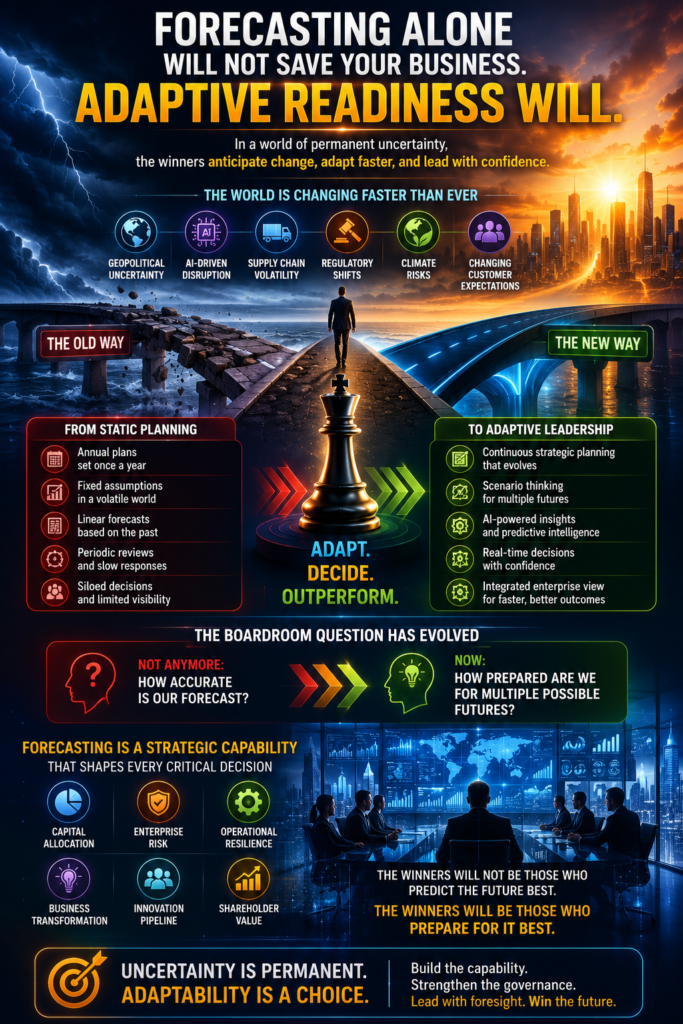
The assumptions that shaped corporate planning for decades have fundamentally changed. Stable economic cycles, predictable customer behavior, linear technological evolution, and relatively transparent geopolitical environments have been replaced by an era characterized by continuous disruption. Organizations are simultaneously navigating geopolitical conflicts, artificial intelligence disruption, climate transition, supply chain fragmentation, regulatory volatility, cyber threats, demographic shifts, and unprecedented technological acceleration. Traditional Annual Operating Plans (AOPs), once developed through historical trend extrapolation and annual budgeting exercises, are increasingly becoming obsolete within months of approval. As a result, organizations that continue relying on deterministic planning approaches expose themselves to significant strategic, operational, and financial risks.
This paper argues that modern organizations must replace deterministic forecasting with adaptive strategic forecasting built upon uncertainty management, probabilistic thinking, scenario intelligence, artificial intelligence, dynamic financial modeling, and continuous strategic sensing. Rather than attempting to predict one future accurately, successful organizations should prepare for multiple plausible futures while maintaining strategic flexibility. The objective of planning is no longer prediction accuracy alone but organizational resilience, strategic agility, and capital allocation confidence.
Drawing upon extensive research from leading consulting firms including McKinsey & Company, Boston Consulting Group (BCG), Bain & Company, Deloitte, PwC, EY, Kearney, Accenture, IBM Institute for Business Value, Gartner, and Harvard Business Review, alongside academic literature on strategic foresight, scenario planning, forecasting sciences, behavioral economics, complexity theory, and financial planning, this paper develops an integrated framework for preparing Annual Operating Plans alongside five-year and beyond strategic targets.
Unlike conventional planning methodologies that primarily optimize budget accuracy, the proposed framework focuses on adaptive capability, strategic resilience, early-warning intelligence, continuous learning, and organizational optionality.
Introduction
Business planning has entered one of the most significant transformations since modern strategic management emerged during the second half of the twentieth century. For decades, annual planning cycles were based on a relatively simple assumption that the future would resemble the past with incremental adjustments. Historical sales trends, macroeconomic projections, inflation expectations, market demand, competitive behavior, and capital investments followed relatively stable trajectories. Organizations therefore developed annual budgets by extrapolating historical performance while adjusting for expected market growth.
This assumption no longer holds true.
Today’s global business environment resembles a complex adaptive system rather than a predictable economic machine. A single geopolitical conflict can reshape global logistics overnight. Artificial intelligence can redefine competitive advantage within months rather than decades. New environmental regulations can fundamentally alter capital investment priorities. Consumer behavior can shift rapidly due to technological disruption, social media influence, economic anxiety, or generational change. Cybersecurity incidents can halt operations globally within hours. Climate events can simultaneously disrupt suppliers across multiple continents.
Consequently, the planning challenge has shifted from forecasting certainty toward managing uncertainty.
The traditional budgeting philosophy can be summarized by one fundamental question:
“What will happen next year?”
Modern strategic organizations instead ask a fundamentally different question:
“What could happen, how prepared are we for each possibility, and how quickly can we adapt?”
This subtle shift changes every aspect of corporate planning.
Annual Operating Plans are no longer static financial documents prepared once each year. They are becoming dynamic strategic operating systems integrating finance, operations, technology, human capital, risk management, supply chain, customer intelligence, artificial intelligence, sustainability, and corporate strategy into one continuously evolving decision-making platform.
Likewise, five-year strategic plans can no longer be viewed as fixed roadmaps. Instead, they must function as strategic direction systems capable of adjusting while preserving long-term organizational purpose.
This distinction represents one of the most important developments in modern strategic management.
Why Traditional Forecasting is Becoming Increasingly Ineffective
The historical budgeting process generally followed a straightforward sequence. Finance teams collected previous year performance, business units estimated next year’s growth, departmental budgets were negotiated, assumptions were consolidated, executive management finalized targets, and the Board approved the Annual Operating Plan.
This process worked reasonably well because uncertainty remained relatively low.
Today’s environment invalidates many of those assumptions.
Several structural forces have fundamentally altered planning complexity.
| Traditional Planning Environment | Modern Planning Environment |
| Stable macroeconomic cycles | Continuous macroeconomic volatility |
| Predictable customer demand | Rapid behavioral changes |
| Linear technology adoption | Exponential technological disruption |
| Annual budgeting | Continuous forecasting |
| Historical trends dominate | Leading indicators dominate |
| Fixed strategic plans | Adaptive strategic frameworks |
| Incremental competition | Platform disruption |
| Localized risks | Global interconnected risks |
| Periodic crises | Permanent uncertainty |
The consequences of relying solely on historical forecasting are becoming increasingly visible.
Many organizations still construct forecasts using three primary assumptions.
The first assumption is that historical growth trends will continue.
The second assumption is that business drivers remain relatively stable.
The third assumption is that management can reasonably predict external conditions over twelve months.
Research across multiple consulting studies consistently demonstrates that these assumptions frequently fail under volatile conditions.
Economic shocks, geopolitical disruptions, pandemics, technological breakthroughs, trade policy changes, climate risks, cybersecurity incidents, and consumer sentiment shifts create structural breaks in historical datasets. Statistical models trained solely on historical information often become unreliable precisely when executives require forecasts the most.
Historical accuracy no longer guarantees future accuracy.
In fact, during periods of high uncertainty, organizations often become victims of what behavioral economists describe as “forecasting illusion,” the belief that more data automatically improves prediction accuracy.
In reality, increasing uncertainty reduces forecasting precision regardless of data availability.
The implication for executives is profound.
The objective should not be to predict a single future perfectly.
The objective should be to prepare the organization for multiple possible futures.
The New Philosophy of Strategic Forecasting
Modern forecasting is undergoing a paradigm shift from deterministic planning toward probabilistic strategic intelligence.
Instead of producing one revenue forecast, organizations should estimate probability distributions.
Instead of assuming one economic scenario, organizations should prepare several plausible futures.
Instead of optimizing one operating model, organizations should create strategic optionality.
This philosophy resembles how sophisticated investment funds manage uncertainty.
Investment managers do not invest based on one economic prediction.
They allocate capital across multiple scenarios.
Similarly, organizations should allocate strategic investments according to probabilities rather than certainty.
This transformation changes forecasting from prediction into decision support.
The following comparison illustrates this shift.
| Traditional Forecasting | Strategic Forecasting |
| One future | Multiple futures |
| Point estimates | Probability ranges |
| Fixed budgets | Dynamic allocation |
| Historical trends | Leading indicators |
| Annual review | Continuous learning |
| Financial orientation | Enterprise-wide intelligence |
| Reactive management | Anticipatory management |
| Accuracy focus | Adaptability focus |
Strategic forecasting therefore becomes an organizational capability rather than merely a finance process.
Finance remains an important participant, but forecasting increasingly requires contributions from economics, data science, artificial intelligence, supply chain management, customer analytics, geopolitical intelligence, sustainability experts, operations research, behavioral science, and executive leadership.
Organizations capable of integrating these diverse perspectives consistently demonstrate higher resilience during uncertainty.
The Evolution of Annual Operating Plans
Annual Operating Plans have historically been viewed primarily as financial documents.
Their objectives focused on revenue targets, operating expenses, profitability, working capital, cash flow, capital expenditure, and departmental budgets.
Modern organizations increasingly recognize that this perspective is incomplete.
Today’s AOP represents the operational expression of corporate strategy.
Rather than asking whether revenue targets are achievable, organizations must ask whether their operating model remains resilient under multiple scenarios.
An effective Annual Operating Plan should simultaneously answer several strategic questions.
| Strategic Planning Question | Modern AOP Perspective |
| Can we achieve growth? | Under which scenarios? |
| Can we protect margins? | Under multiple demand conditions? |
| Can we invest? | With acceptable financial risk? |
| Can we scale operations? | While maintaining resilience? |
| Can we attract talent? | Under demographic uncertainty? |
| Can we remain competitive? | Against technological disruption? |
| Can we sustain shareholder value? | Across multiple economic cycles? |
This transformation elevates AOP preparation from budgeting toward enterprise strategy execution.
Annual planning therefore becomes the bridge connecting long-term vision with short-term execution.
Without this connection, organizations frequently experience one of two common failures.
The first failure occurs when ambitious long-term strategies remain disconnected from operational execution.
The second failure occurs when annual budgets optimize short-term financial performance while gradually weakening long-term competitiveness.
Strategic organizations avoid both extremes.
Understanding the Nature of Business Uncertainty
One of the most important mistakes organizations make is treating all uncertainty equally.
In reality, uncertainty exists across multiple dimensions.
Each dimension requires different forecasting approaches.
| Uncertainty Type | Examples | Planning Response |
| Macroeconomic | GDP, inflation, interest rates | Economic scenarios |
| Geopolitical | Wars, sanctions, trade restrictions | Regional diversification |
| Technological | AI, automation, platform disruption | Technology roadmaps |
| Market | Customer demand, competition | Customer intelligence |
| Regulatory | ESG, taxation, compliance | Policy monitoring |
| Operational | Supply chain, logistics | Resilience planning |
| Environmental | Climate events | Physical risk assessment |
| Financial | Currency, liquidity, capital markets | Dynamic financial modeling |
| Social | Workforce, demographics | Talent forecasting |
These uncertainties rarely occur independently.
Instead, they interact.
A geopolitical conflict may increase energy prices.
Higher energy prices increase inflation.
Higher inflation influences central bank decisions.
Interest rate changes affect consumer spending.
Lower consumer spending reduces demand.
Reduced demand influences hiring.
Hiring reductions affect innovation capacity.
Innovation affects future competitiveness.
This interconnectedness explains why linear forecasting models increasingly struggle.
Organizations therefore require systems thinking rather than isolated forecasting models.
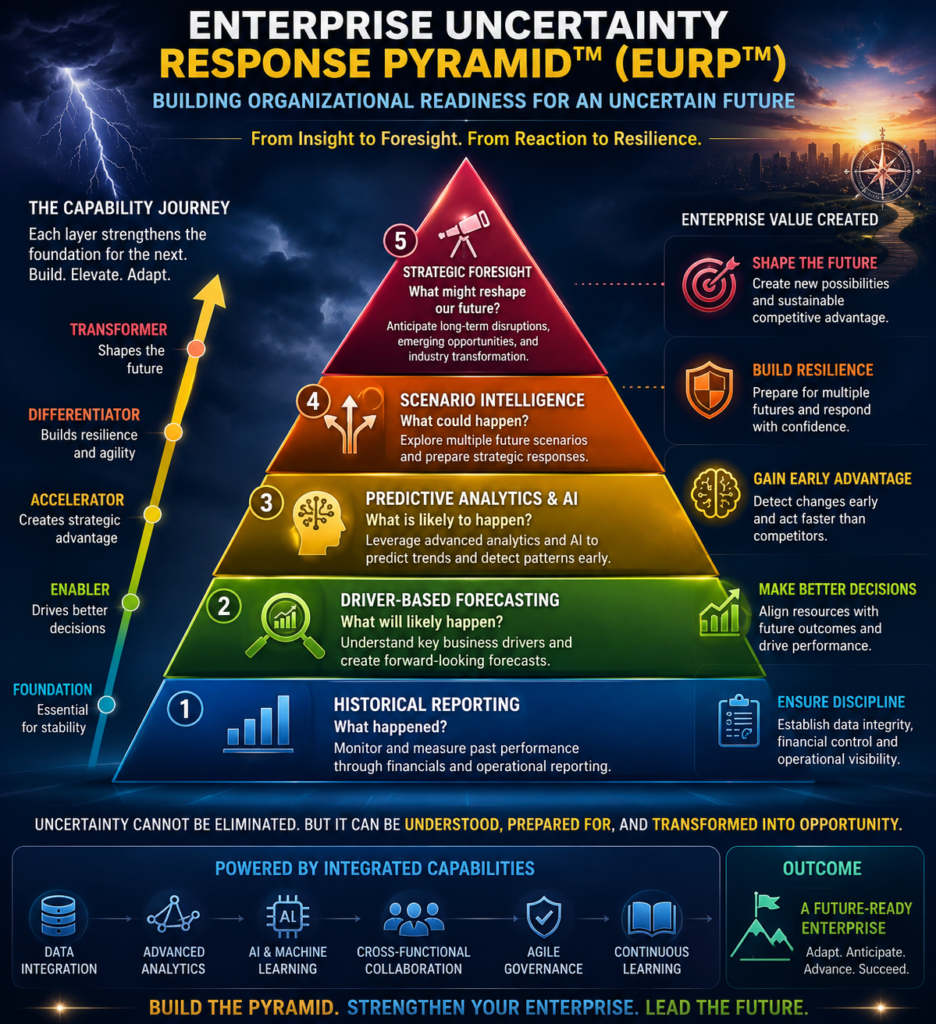
Enterprise Uncertainty Response Pyramid™ (EURP™): Building Organizational Readiness for an Uncertain Future
Business uncertainty cannot be eliminated; it can only be understood, monitored, and strategically managed. The Enterprise Uncertainty Response Pyramid™ (EURP™) illustrates the progressive capabilities organizations must develop to respond effectively to increasing levels of uncertainty.
The framework demonstrates that organizations cannot successfully implement Artificial Intelligence, strategic foresight, or advanced scenario planning without first establishing strong foundations in financial reporting, operational forecasting, and driver-based planning. Each layer strengthens the capability required to support the next level of organizational maturity.
Rather than representing isolated planning tools, the pyramid illustrates an integrated capability-building journey in which each level reinforces enterprise resilience. Organizations that attempt to deploy advanced forecasting technologies without strengthening their foundational planning processes often experience disappointing outcomes because technology alone cannot compensate for weak governance or poor decision-making.
Table: Enterprise Uncertainty Response Pyramid™ (EURP™)
| Pyramid Layer | Organizational Capability | Primary Objective | Strategic Contribution |
| Strategic Foresight | Future industry transformation | Shape long-term strategy | Sustainable competitive advantage |
| Scenario Intelligence | Multiple future planning | Prepare strategic alternatives | Organizational resilience |
| Predictive Analytics & AI | Pattern recognition | Improve forecasting accuracy | Faster decision-making |
| Driver-Based Forecasting | Operational forecasting | Understand business drivers | Better resource allocation |
| Historical Reporting | Performance measurement | Monitor past performance | Financial discipline |
Organizations capable of operating effectively across all five layers become significantly more resilient because they continuously anticipate future change rather than reacting only after disruption occurs.
Complexity versus Complicated Systems
Understanding the distinction between complicated and complex systems is essential for modern planning.
Complicated systems follow predictable rules.
Aircraft engines are complicated.
Financial accounting systems are complicated.
Manufacturing production lines are complicated.
Complex systems behave differently.
Global markets.
Consumer behavior.
Political systems.
Technology ecosystems.
Innovation.
Climate.
Financial markets.
These systems evolve continuously because participants adapt to each other’s actions.
Consequently, forecasting complex systems requires adaptive learning rather than deterministic prediction.
Organizations must therefore transition from optimization toward resilience.
Rather than designing one perfect strategy, they must design organizations capable of succeeding under changing conditions.
This philosophy fundamentally changes executive decision-making.
Instead of asking:
“Is this forecast correct?”
Leadership should ask:
“What assumptions make this forecast valid?”
“What indicators tell us those assumptions are changing?”
“How rapidly can we respond?”
These three questions increasingly define strategic excellence.
Leading Indicators versus Lagging Indicators
Traditional planning relies heavily upon lagging indicators.
Revenue.
Profit.
EBITDA.
Market share.
Cash flow.
Return on investment.
These metrics describe past performance.
Modern forecasting requires increasing emphasis on leading indicators that anticipate future outcomes.
| Lagging Indicator | Leading Indicator |
| Revenue | Customer inquiries |
| Sales | Pipeline conversion |
| Production | Capacity utilization |
| Market share | Customer preference shifts |
| EBITDA | Pricing power |
| Cash flow | Working capital cycle |
| Employee turnover | Employee engagement |
| Supply shortages | Supplier delivery reliability |
| Innovation output | Patent activity and R&D intensity |
Leading indicators provide organizations with valuable reaction time.
Instead of discovering problems after financial statements are published, executives detect changes while corrective actions remain possible.
This transition represents one of the most important shifts in modern corporate forecasting.
Organizations increasingly compete not on forecasting accuracy alone but on forecasting speed and response capability.
Advanced Forecasting Methodologies for Building Adaptive Annual Operating Plans and Long-Term Strategic Targets
Organizations operating in today’s environment require forecasting systems that continuously learn, adapt, and evolve as new information becomes available. Modern forecasting is therefore no longer a single statistical exercise performed by the finance department before the beginning of the financial year. It has become an enterprise-wide capability integrating economics, technology, customer intelligence, competitive strategy, operational excellence, artificial intelligence, and executive judgment. The organizations consistently outperforming their industries rarely rely on a single forecasting model. Instead, they combine multiple complementary methodologies that together improve decision quality while reducing strategic blind spots.
The most resilient organizations recognize that every forecasting technique possesses inherent strengths and limitations. Historical statistical models perform exceptionally well in stable environments but often fail during structural disruptions. Human judgment provides valuable contextual understanding but may introduce cognitive biases. Artificial Intelligence excels at discovering hidden patterns but may not fully comprehend unprecedented geopolitical or regulatory shocks. Consequently, modern forecasting systems integrate quantitative analytics with qualitative strategic foresight to produce more balanced and resilient business decisions.
Table 1 presents the evolution of forecasting methodologies that leading organizations increasingly employ to strengthen both Annual Operating Plans and long-term strategic planning.
| Forecasting Method | Primary Objective | Planning Horizon | Major Strength | Primary Limitation |
| Historical Trend Analysis | Predict continuation of past trends | Short-term | Simple and inexpensive | Weak during disruptions |
| Time Series Forecasting | Demand prediction | Monthly to Annual | High accuracy in stable markets | Sensitive to structural breaks |
| Regression Analysis | Identify business drivers | Annual | Explains causal relationships | Requires quality historical data |
| Machine Learning Models | Detect hidden patterns | Short to Medium-term | Learns complex relationships | Lower interpretability |
| Scenario Planning | Prepare for multiple futures | 3–10 Years | Improves strategic resilience | Does not assign exact probabilities |
| Monte Carlo Simulation | Quantify uncertainty | Annual to Long-term | Measures risk ranges | Requires assumptions on distributions |
| Delphi Technique | Capture expert insights | Strategic | Useful when data is limited | Time intensive |
| Strategic Foresight | Identify emerging trends | 5–20 Years | Detects future disruptions | Highly qualitative |
| Digital Twin Simulation | Simulate business performance | Strategic | Tests strategic decisions virtually | Technology intensive |
Traditional organizations often select only one forecasting technique because of cost constraints or organizational maturity. However, world-class organizations combine these approaches into integrated forecasting ecosystems where statistical models generate baseline forecasts, Artificial Intelligence continuously refines assumptions, scenario planning explores uncertainty, executive leadership evaluates strategic implications, and rolling forecasts continuously update operating decisions.
Driver-Based Forecasting: The Foundation of Modern Planning
The most significant transformation in enterprise forecasting over the last decade has been the shift from outcome forecasting toward driver-based forecasting. Traditional Annual Operating Plans typically forecast financial outputs such as revenue, operating profit, EBITDA, or market share. Modern planning instead begins by identifying the operational drivers responsible for creating those financial outcomes.
Revenue, for example, is not an independent variable but rather the consequence of numerous interconnected drivers including customer acquisition, pricing strategy, sales productivity, conversion rates, product mix, customer retention, market demand, digital engagement, distribution reach, and macroeconomic conditions. Understanding these relationships enables management to evaluate how changes in operational variables influence financial performance under different market conditions.
Table 2 illustrates a simplified driver hierarchy.
| Financial Outcome | Primary Business Drivers | Secondary Drivers |
| Revenue Growth | Customer Acquisition | Marketing ROI, Lead Generation |
| Gross Margin | Pricing, Product Mix | Commodity Prices, Supplier Costs |
| Operating Profit | Productivity | Automation, Workforce Efficiency |
| Cash Flow | Working Capital | Inventory Days, Receivable Days |
| Market Share | Competitive Position | Innovation, Customer Satisfaction |
| Shareholder Value | ROCE | Capital Allocation, Risk Management |
Driver-based planning enables organizations to update forecasts almost immediately when operational conditions change. If commodity prices rise unexpectedly or customer demand weakens, planners adjust the relevant business drivers rather than rebuilding the entire Annual Operating Plan. This capability substantially improves planning agility while reducing the time required for decision-making.
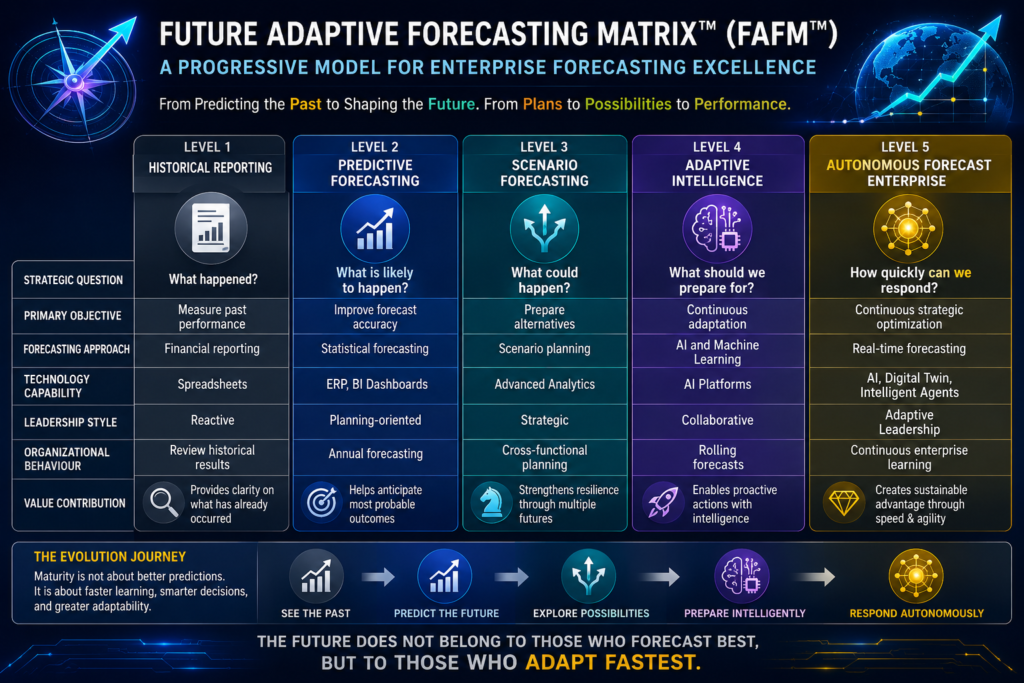
Future Adaptive Forecasting Matrix™ (FAFM™): A Progressive Model for Enterprise Forecasting Excellence
The Future Adaptive Forecasting Matrix™ (FAFM™) proposes that forecasting maturity evolves through five progressive stages, each representing a higher organizational capability rather than merely an improvement in forecasting accuracy. Traditional organizations focus primarily on historical reporting and periodic budgeting, whereas adaptive enterprises continuously monitor changing business conditions, predict emerging trends, prepare for multiple future scenarios, and dynamically adjust strategic decisions.
The framework emphasizes that forecasting excellence is determined by the speed with which an organization learns and adapts rather than by the precision of a single annual forecast. Each successive level integrates greater analytical sophistication, stronger cross-functional collaboration, broader external intelligence, and enhanced decision agility. Organizations should therefore view forecasting as an enterprise capability that continuously evolves alongside technological advancement, organizational maturity, and market complexity.
The matrix also recognizes that no organization reaches the highest maturity level solely through technology investments. Leadership commitment, governance, organizational culture, data quality, and strategic discipline remain equally important enablers of adaptive forecasting.
Table: Future Adaptive Forecasting Matrix™ (FAFM™)
| Forecasting Level | Strategic Question | Primary Objective | Forecasting Approach | Technology Capability | Leadership Style | Organizational Behaviour |
| Level 1 – Historical Reporting | What happened? | Measure past performance | Financial reporting | Spreadsheets | Reactive | Review historical results |
| Level 2 – Predictive Forecasting | What is likely to happen? | Improve forecast accuracy | Statistical forecasting | ERP, BI Dashboards | Planning-oriented | Annual forecasting |
| Level 3 – Scenario Forecasting | What could happen? | Prepare alternatives | Scenario planning | Advanced Analytics | Strategic | Cross-functional planning |
| Level 4 – Adaptive Intelligence | What should we prepare for? | Continuous adaptation | AI and Machine Learning | AI Platforms | Collaborative | Rolling forecasts |
| Level 5 – Autonomous Forecast Enterprise | How quickly can we respond? | Continuous strategic optimization | Real-time forecasting | AI, Digital Twin, Intelligent Agents | Adaptive Leadership | Continuous enterprise learning |
Organizations operating at Level 5 continuously combine external intelligence, predictive analytics, strategic foresight, and executive decision-making into an integrated forecasting ecosystem capable of responding rapidly to changing market conditions.
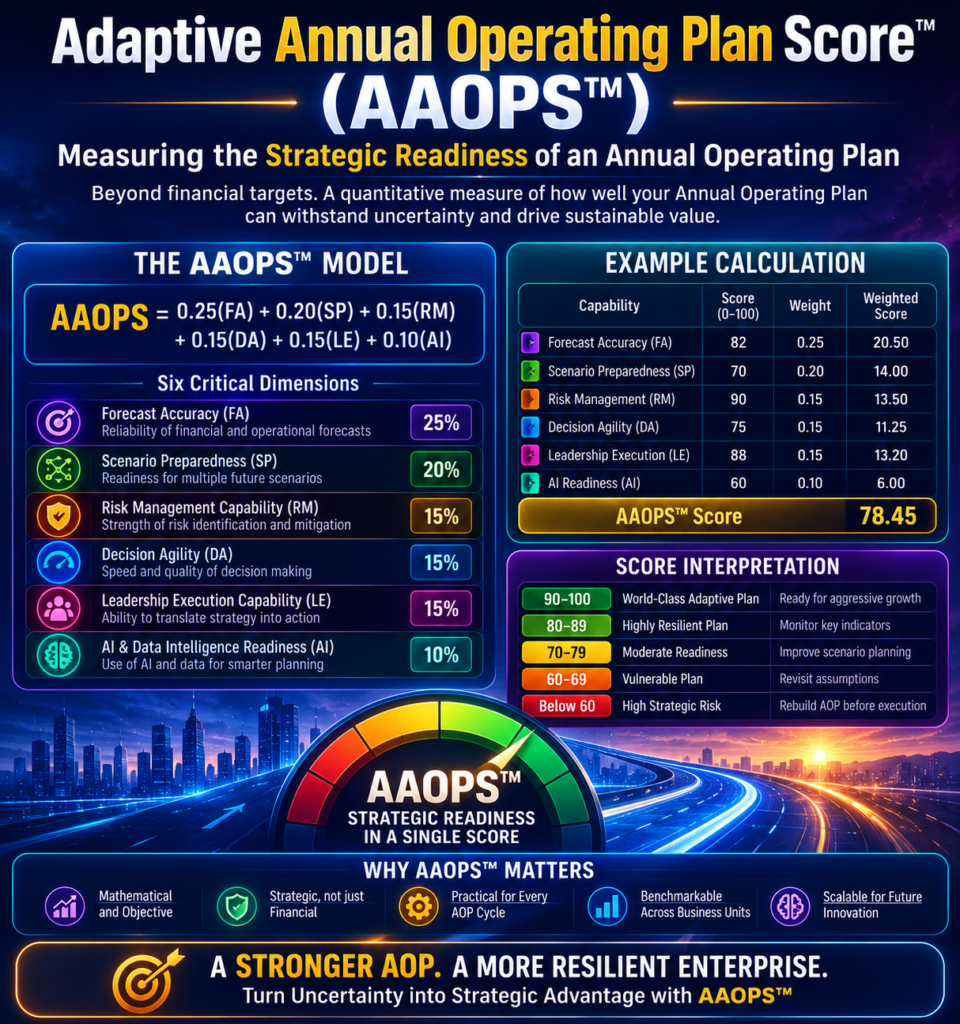
Adaptive Annual Operating Plan Score™ (AAOPS™)
Measuring the Strategic Readiness of an Annual Operating Plan
Traditional Annual Operating Plans typically evaluate only financial performance through revenue, EBITDA, operating margin, and cash flow. While these remain essential, they provide limited visibility into whether the underlying plan is sufficiently resilient to withstand uncertainty.
The Adaptive Annual Operating Plan Score™ (AAOPS™) expands the evaluation beyond financial targets by integrating forecasting accuracy, uncertainty, risk preparedness, organizational agility, and execution capability into a single quantitative score. Rather than asking whether the Annual Operating Plan will achieve its targets, the framework evaluates whether the plan is strategically robust across multiple possible future conditions.
The model combines six critical dimensions that collectively determine the quality and adaptability of an enterprise operating plan. Each dimension is assigned a weighting reflecting its contribution to long-term planning effectiveness.
Mathematical Model
Where
| Variable | Description | Score |
|---|---|---|
| FA | Forecast Accuracy | 0–100 |
| SP | Scenario Preparedness | 0–100 |
| RM | Risk Management Capability | 0–100 |
| DA | Decision Agility | 0–100 |
| LE | Leadership Execution Capability | 0–100 |
| AI | AI & Data Intelligence Readiness | 0–100 |
Example Calculation
Suppose a company evaluates itself as follows.
| Capability | Score |
|---|---|
| Forecast Accuracy | 82 |
| Scenario Preparedness | 70 |
| Risk Management | 90 |
| Decision Agility | 75 |
| Leadership Execution | 88 |
| AI Readiness | 60 |
The overall Adaptive Annual Operating Plan Score™ becomes
AAOPS
= (0.25 × 82)
- (0.20 × 70)
- (0.15 × 90)
- (0.15 × 75)
- (0.15 × 88)
- (0.10 × 60)
= 20.50
+14.00
+13.50
+11.25
+13.20
+6.00
= 78.45
Interpretation
| AAOPS™ Score | Interpretation | Strategic Recommendation |
|---|---|---|
| 90–100 | World-Class Adaptive Plan | Ready for aggressive growth and investment |
| 80–89 | Highly Resilient Plan | Monitor key strategic indicators quarterly |
| 70–79 | Moderate Readiness | Improve scenario planning and decision agility |
| 60–69 | Vulnerable Plan | Revisit assumptions and capital allocation |
| Below 60 | High Strategic Risk | Rebuild Annual Operating Plan before execution |
Board-Level Application
Boards should review the Adaptive Annual Operating Plan Score™ alongside conventional financial metrics during the Annual Operating Plan approval process. A plan projecting exceptional financial performance but achieving a low AAOPS™ indicates that the strategy may be overly dependent on optimistic assumptions or insufficiently prepared for uncertainty. Conversely, a plan with a strong AAOPS™ demonstrates greater resilience, stronger governance, and improved readiness to respond to changing business conditions.
The framework also enables year-over-year benchmarking, comparison across business units, and assessment of planning maturity during strategy reviews.
Artificial Intelligence and Machine Learning in Enterprise Forecasting
Artificial Intelligence is fundamentally changing forecasting by expanding the range of information organizations can analyze simultaneously. Traditional forecasting models typically rely upon structured internal data such as historical sales, production volumes, financial statements, and inventory records. AI systems extend forecasting capabilities by incorporating both structured and unstructured information including customer sentiment, news articles, weather conditions, social media discussions, macroeconomic indicators, satellite imagery, logistics disruptions, commodity prices, and supplier intelligence.
Machine learning algorithms continuously identify nonlinear relationships among thousands of variables that may not be apparent through conventional statistical analysis. Rather than assuming that historical relationships remain constant, these systems continuously retrain themselves as market conditions evolve.
Table 3 compares conventional forecasting with Artificial Intelligence-enabled forecasting.
| Traditional Forecasting | AI-Enabled Forecasting |
| Limited variables | Thousands of variables |
| Periodic updates | Continuous learning |
| Historical focus | Predictive and adaptive |
| Manual scenario creation | Automated scenario generation |
| Static assumptions | Dynamic assumptions |
| Human-driven pattern recognition | Algorithmic pattern discovery |
| Quarterly adjustments | Real-time recalibration |
Despite these capabilities, Artificial Intelligence should not replace executive judgment. Instead, it should augment managerial decision-making by improving analytical depth while allowing leadership teams to interpret strategic implications beyond numerical predictions.
Scenario Planning: Preparing for Multiple Futures
Perhaps no methodology has gained greater strategic importance than scenario planning. Originally pioneered by Royal Dutch Shell during the oil crises of the 1970s, scenario planning acknowledges that predicting one precise future is increasingly unrealistic. Instead, organizations develop several plausible future environments and prepare strategic responses for each.
Unlike forecasting, which estimates the most probable future, scenario planning explores multiple possible futures. This distinction fundamentally changes executive decision-making by encouraging preparedness rather than prediction.
An effective scenario planning exercise generally develops four strategic environments representing combinations of major uncertainties affecting the organization.
Table 4 presents an illustrative scenario framework.
| Scenario | Economic Growth | Technology Adoption | Competitive Intensity | Strategic Response |
| Accelerated Expansion | High | High | Moderate | Invest aggressively |
| Digital Disruption | Moderate | Very High | High | Accelerate innovation |
| Economic Slowdown | Low | Moderate | High | Protect liquidity |
| Structural Crisis | Negative | Variable | Extreme | Business continuity and resilience |
Rather than selecting a preferred scenario, leadership teams define trigger indicators that signal which future may be unfolding. This allows organizations to shift strategies rapidly as external conditions evolve instead of remaining committed to outdated assumptions established during the annual budgeting cycle.
Monte Carlo Simulation: Measuring Strategic Uncertainty
One of the greatest weaknesses of traditional Annual Operating Plans is their presentation of a single expected financial outcome. In reality, business performance exists within probability distributions rather than fixed values.
Monte Carlo Simulation addresses this limitation by repeatedly simulating thousands of possible future outcomes using varying assumptions for demand, pricing, inflation, foreign exchange rates, commodity costs, labor expenses, interest rates, customer behavior, and supply chain performance.
Instead of producing one revenue forecast, the simulation estimates a range of potential outcomes together with associated probabilities.
Table 5 illustrates a simplified example.
| Revenue Outcome | Probability |
| Above ₹10,000 Crore | 12% |
| ₹9,500–10,000 Crore | 28% |
| ₹9,000–9,500 Crore | 37% |
| ₹8,500–9,000 Crore | 18% |
| Below ₹8,500 Crore | 5% |
This probabilistic approach enables boards to evaluate downside exposure, liquidity requirements, capital allocation decisions, and contingency planning with substantially greater confidence than deterministic forecasting.
Strategic Foresight: Looking Beyond Five Years
Annual Operating Plans traditionally emphasize operational execution over the next twelve months, while five-year strategic plans frequently extrapolate existing trends. Strategic foresight challenges this assumption by examining long-term structural shifts that may fundamentally reshape industries over the coming decades.
Strategic foresight explores technological, demographic, environmental, geopolitical, regulatory, economic, and societal transformations that may create entirely new business models.
Organizations practicing strategic foresight continuously monitor weak signals rather than waiting until trends become mainstream. Examples include advancements in Artificial Intelligence, quantum computing, synthetic biology, renewable energy, autonomous mobility, space technologies, circular economy models, and demographic transitions.
Table 6 summarizes major strategic foresight domains.
| Foresight Domain | Illustrative Questions |
| Technology | Which emerging technologies may redefine our industry? |
| Customer Behaviour | How will future customer expectations evolve? |
| Regulation | Which policies could reshape competition? |
| Environment | What climate-related risks require strategic adaptation? |
| Workforce | Which future skills will determine competitiveness? |
| Capital Markets | How may investment priorities change? |
| Supply Chains | Which geopolitical shifts may disrupt sourcing? |
Organizations integrating foresight into long-term planning become substantially better prepared for discontinuous change because they actively explore future possibilities instead of merely extending historical trends.
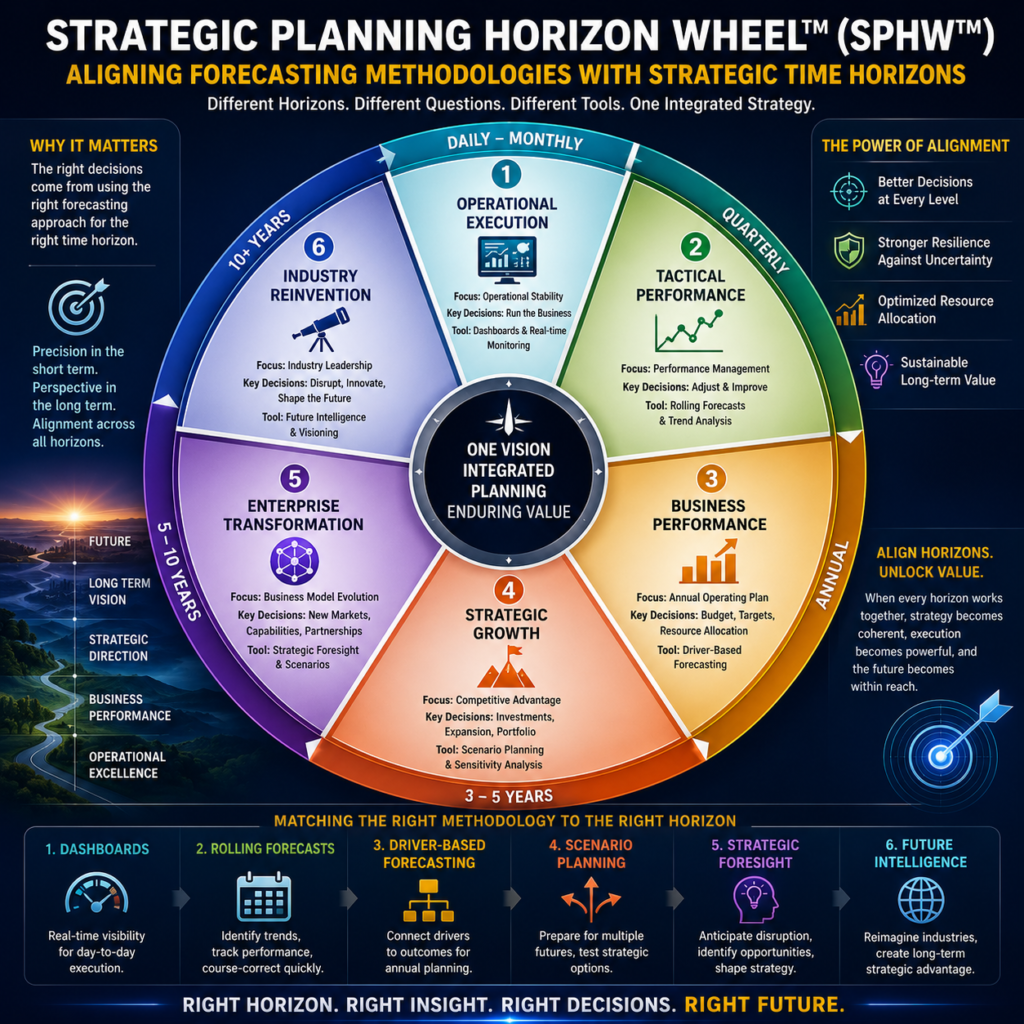
Strategic Planning Horizon Wheel™ (SPHW™): Aligning Forecasting Methodologies with Strategic Time Horizons
One of the most common planning mistakes made by organizations is applying identical forecasting methodologies across every planning horizon. The Strategic Planning Horizon Wheel™ (SPHW™) addresses this challenge by demonstrating that each planning horizon requires distinct decision frameworks, analytical tools, governance mechanisms, and leadership priorities.
Short-term planning emphasizes operational execution and performance monitoring, while long-term planning focuses increasingly on uncertainty, innovation, industry transformation, and strategic positioning. Consequently, organizations should gradually transition from descriptive analytics toward predictive, prescriptive, and exploratory methodologies as planning horizons extend.
The framework enables leadership teams to allocate appropriate forecasting resources according to the strategic significance of each decision rather than relying exclusively on annual budgeting practices.
Table: Strategic Planning Horizon Wheel™ (SPHW™)
| Planning Horizon | Executive Focus | Primary Decisions | Forecasting Methodology | Frequency of Review |
| Daily to Monthly | Operational execution | Inventory, production, pricing | Operational dashboards | Daily |
| Quarterly | Tactical performance | Sales, marketing, supply chain | Rolling forecasts | Monthly |
| Annual | Business performance | Annual Operating Plan | Driver-based forecasting | Quarterly |
| Three to Five Years | Strategic growth | Investments, expansion, portfolio | Scenario planning | Semi-annually |
| Five to Ten Years | Enterprise transformation | New business models | Strategic foresight | Annually |
| Beyond Ten Years | Industry reinvention | Long-term competitiveness | Future intelligence | Continuous monitoring |
Organizations that align forecasting methodologies with planning horizons substantially improve both decision quality and strategic agility.
Integrated Business Planning: Connecting Strategy with Operations
Forecasting becomes truly valuable only when integrated across the enterprise. Integrated Business Planning (IBP) extends traditional Sales and Operations Planning by synchronizing strategic planning, demand forecasting, supply planning, financial planning, capacity management, procurement, manufacturing, logistics, sales, and executive governance into a unified decision-making process.
IBP ensures that Annual Operating Plans remain aligned with strategic objectives while enabling rapid adjustments when market conditions change.
Table 7 illustrates the integration architecture.
| Business Function | Contribution to Forecast |
| Sales | Customer demand |
| Marketing | Campaign effectiveness |
| Supply Chain | Capacity and inventory |
| Manufacturing | Production constraints |
| Procurement | Supplier capability |
| Finance | Profitability and capital allocation |
| Human Resources | Workforce planning |
| Strategy Office | Long-term priorities |
| Executive Committee | Governance and decision-making |
This enterprise-wide integration transforms forecasting from an isolated finance activity into a strategic management capability that supports faster and more informed decisions across the organization.
Building an Enterprise Forecasting System: Governance, Operating Model, Board Dashboards and the Roadmap to Strategic Resilience
Forecasting capability is ultimately determined not by the sophistication of analytical models but by the organization’s ability to transform insights into timely strategic decisions. Many organizations invest significantly in analytics platforms, Artificial Intelligence, enterprise resource planning systems, and business intelligence tools, yet continue to experience planning failures because governance structures, decision rights, and organizational behaviors remain unchanged. Sustainable forecasting excellence therefore requires an integrated enterprise operating model that aligns people, processes, technology, data, and leadership around continuous decision-making rather than annual budgeting.
The most resilient organizations have progressively replaced the traditional annual planning cycle with a continuous planning ecosystem in which assumptions are reviewed regularly, forecasts are recalibrated dynamically, risks are reassessed continuously, and strategic priorities are refined as external conditions evolve. Forecasting becomes an ongoing organizational capability rather than a yearly financial exercise.
Enterprise Forecasting Operating Model
An effective forecasting system begins with the continuous collection of internal and external signals. These signals are transformed into business intelligence through advanced analytics and Artificial Intelligence before being evaluated by business leaders. Decisions are then translated into operational actions, whose outcomes generate new data that further improves forecasting accuracy. This creates a self-learning enterprise capable of adapting to uncertainty without waiting for the next Annual Operating Plan cycle.
Table 8 illustrates a comprehensive enterprise forecasting operating model.
| Stage | Primary Objective | Key Activities | Decision Frequency |
| Environmental Scanning | Detect external changes | Economic indicators, competitor intelligence, customer insights, regulatory monitoring | Continuous |
| Data Integration | Build enterprise data foundation | ERP, CRM, SCM, HRMS, Finance, Market Intelligence integration | Daily |
| Predictive Analytics | Generate forward-looking insights | AI models, statistical forecasting, driver-based forecasting | Weekly |
| Scenario Assessment | Evaluate future possibilities | Best case, base case, downside case, disruption scenarios | Monthly |
| Executive Review | Strategic decision-making | Leadership reviews assumptions and strategic implications | Monthly |
| Resource Allocation | Optimize investments | Budget adjustments, capital allocation, workforce deployment | Quarterly |
| Performance Monitoring | Measure execution | KPI tracking, variance analysis, leading indicator monitoring | Continuous |
| Learning & Improvement | Enhance forecasting capability | Model refinement, assumption updates, post-mortem reviews | Continuous |
This operating model transforms planning into a closed-loop learning system where every forecast contributes to improving the next forecast.
Governance Framework for Forecasting Excellence
Governance determines whether forecasting remains a finance activity or becomes a strategic capability. Organizations with mature forecasting systems establish clearly defined ownership across business functions while ensuring executive accountability for strategic assumptions rather than merely financial outcomes.
Forecast ownership should be distributed according to expertise rather than organizational hierarchy. Sales leaders own customer demand assumptions, procurement leaders own supply risks, operations leaders own production capacity, finance owns financial integration, strategy teams own long-term scenarios, while executive leadership validates enterprise-wide assumptions.
Table 9 presents an enterprise governance structure.
| Governance Layer | Primary Responsibility |
| Board of Directors | Long-term strategic direction and risk oversight |
| CEO | Enterprise alignment and strategic priorities |
| CFO | Financial planning, capital allocation and forecasting governance |
| Chief Strategy Officer | Scenario planning and long-term strategic assumptions |
| Business Unit Leaders | Market assumptions and operational execution |
| Sales & Marketing | Demand generation and customer insights |
| Supply Chain | Capacity, sourcing and logistics forecasting |
| Data Science & Analytics | AI models, predictive analytics and model validation |
| Risk Management | Enterprise risk monitoring and stress testing |
The board should avoid reviewing forecasts solely through the lens of financial performance. Instead, it should focus on the assumptions underlying forecasts, the uncertainty surrounding those assumptions, and the organization’s preparedness for alternative outcomes.
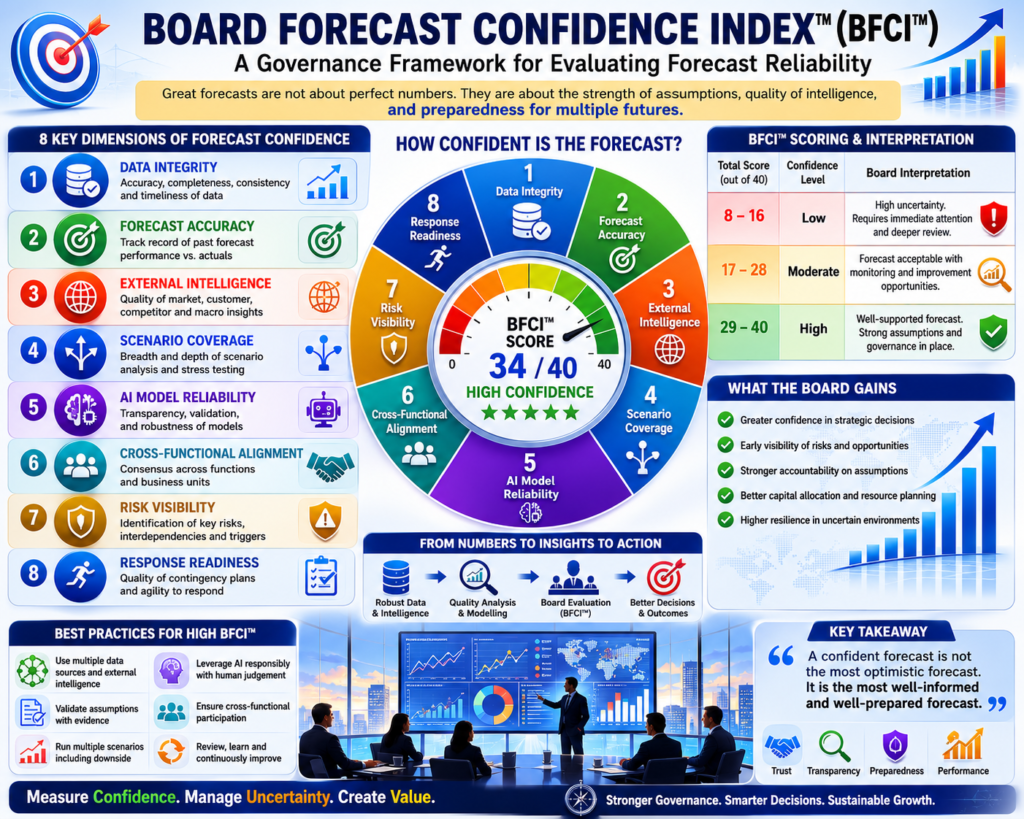
Board Forecast Confidence Index™ (BFCI™): A Governance Framework for Evaluating Forecast Reliability
Forecasts frequently present financial outcomes without adequately communicating the confidence associated with those projections. The Board Forecast Confidence Index™ (BFCI™) addresses this limitation by enabling Boards of Directors to evaluate forecast credibility through a structured governance framework.
Instead of asking whether projected revenue or profitability will be achieved, Boards should first examine the quality of assumptions supporting those forecasts. High-quality forecasts are characterized by reliable data, comprehensive scenario analysis, validated Artificial Intelligence models, strong cross-functional alignment, transparent risk identification, and well-defined contingency plans.
The BFCI™ transforms forecasting discussions from numerical debates into governance-focused strategic conversations centered on preparedness, resilience, and decision quality.
Table: Board Forecast Confidence Index™ (BFCI™)
| Evaluation Dimension | Assessment Criteria | Score (1–5) |
| Data Integrity | Accuracy, completeness, consistency | |
| Forecast Accuracy | Historical forecasting performance | |
| External Intelligence | Market, customer, competitor insights | |
| Scenario Coverage | Multiple strategic scenarios evaluated | |
| AI Model Validation | Model transparency and robustness | |
| Cross-functional Alignment | Consensus across business units | |
| Enterprise Risk Visibility | Comprehensive risk assessment | |
| Strategic Response Readiness | Availability of contingency plans |
Table: Board Forecast Confidence Rating
| Total Score | Confidence Level | Board Interpretation |
| 8–16 | Low | Significant uncertainty requiring immediate review |
| 17–28 | Moderate | Forecast acceptable with ongoing monitoring |
| 29–40 | High | Forecast supported by robust assumptions and governance |
The BFCI™ encourages Boards to evaluate not only projected financial outcomes but also the organizational capability supporting those forecasts.
The Board-Level Forecasting Dashboard
Traditional board reports emphasize historical performance through metrics such as revenue, profit, EBITDA, market share, and return on investment. While these remain important, they provide limited insight into future performance. Modern boards require dashboards that combine financial outcomes with predictive indicators, risk measures, strategic milestones, and scenario triggers.
Table 10 illustrates a future-oriented board dashboard.
| Dashboard Dimension | Illustrative Metrics |
| Financial Outlook | Revenue forecast, EBITDA forecast, Free Cash Flow forecast |
| Customer Signals | Customer acquisition rate, retention, Net Promoter Score, digital engagement |
| Market Intelligence | Competitor actions, pricing trends, market demand index |
| Operational Health | Capacity utilization, inventory turns, supplier reliability |
| Innovation | New product pipeline, R&D productivity, digital adoption |
| Risk Indicators | Geopolitical exposure, commodity volatility, cybersecurity incidents |
| ESG & Sustainability | Carbon intensity, regulatory compliance, ESG ratings |
| Strategic Execution | Milestone completion, transformation progress, capability maturity |
Such dashboards encourage boards to focus on future value creation rather than solely reviewing historical performance.
Leading Indicators for Strategic Forecasting
One of the defining characteristics of high-performing organizations is their emphasis on leading indicators rather than lagging indicators. Lagging indicators explain what has already happened, whereas leading indicators provide early warning signals that future performance may change.
Table 11 presents examples across major business functions.
| Business Outcome | Lagging Indicator | Leading Indicator |
| Revenue Growth | Monthly sales | Qualified sales pipeline, website traffic, customer enquiries |
| Profitability | EBITDA | Input cost trends, pricing power, discount levels |
| Cash Flow | Cash balance | Receivable ageing, inventory turnover, supplier payment cycle |
| Market Share | Published market share | Dealer additions, search trends, customer preference surveys |
| Manufacturing | Production output | Machine downtime, preventive maintenance compliance |
| Supply Chain | Delivery performance | Supplier risk score, logistics congestion index |
| Human Capital | Employee turnover | Engagement score, learning hours, leadership succession readiness |
| Innovation | Product revenue | Patent filings, prototype completion, customer trials |
Organizations capable of identifying changes in these leading indicators often respond several months before financial deterioration becomes visible.
Forecasting Maturity Model
Enterprise forecasting capability evolves gradually. Organizations generally progress through distinct maturity levels as technology, governance, and analytical sophistication improve.
Table 12 outlines a five-level maturity model.
| Maturity Level | Characteristics |
| Level 1 – Reactive | Spreadsheet-based planning, annual budgeting, historical analysis |
| Level 2 – Structured | Standard forecasting processes, periodic reviews, departmental planning |
| Level 3 – Integrated | Driver-based forecasting, rolling forecasts, cross-functional planning |
| Level 4 – Predictive | Artificial Intelligence, scenario planning, predictive analytics, automated insights |
| Level 5 – Adaptive Enterprise | Self-learning systems, real-time decision support, continuous strategic planning, enterprise resilience |
Organizations should assess their current maturity objectively before investing in advanced technologies. Artificial Intelligence cannot compensate for weak governance, fragmented data, or poor planning discipline.
Common Forecasting Mistakes
Even sophisticated organizations can undermine forecasting effectiveness through recurring organizational behaviors. The most common failure is treating forecasts as commitments rather than informed estimates. This discourages honest reporting and encourages managers to protect targets instead of sharing emerging risks.
Table 13 summarizes common forecasting failures and corresponding mitigation approaches.
| Common Mistake | Organizational Impact | Recommended Response |
| Excessive reliance on historical trends | Missed disruptions | Incorporate external signals and scenarios |
| Single-point forecasts | Poor risk preparedness | Use probability ranges and simulations |
| Annual planning mindset | Slow response | Adopt rolling forecasts |
| Functional silos | Inconsistent assumptions | Implement Integrated Business Planning |
| Ignoring weak signals | Strategic surprises | Strengthen environmental scanning |
| Data quality issues | Low forecast credibility | Improve governance and master data |
| Technology without process change | Limited business value | Redesign operating model before automation |
| Confirmation bias | Poor strategic decisions | Encourage independent challenge and scenario reviews |
Recognizing and addressing these behaviors is as important as selecting the appropriate forecasting methodology.
The Future of Enterprise Forecasting
The next decade will redefine enterprise forecasting. Advances in generative Artificial Intelligence, agentic AI systems, digital twins, autonomous analytics, quantum computing, and real-time enterprise data platforms will significantly expand forecasting capabilities. Organizations will increasingly move from descriptive reporting to predictive and prescriptive decision support, where intelligent systems recommend optimal actions under multiple future scenarios.
Forecasting will also become more externally connected. Real-time macroeconomic indicators, supply chain intelligence, climate data, geopolitical developments, customer sentiment, and industry signals will continuously feed enterprise planning systems, enabling organizations to respond rapidly to emerging opportunities and risks.
The competitive advantage of the future will not belong to organizations that predict perfectly, but to those that adapt fastest.
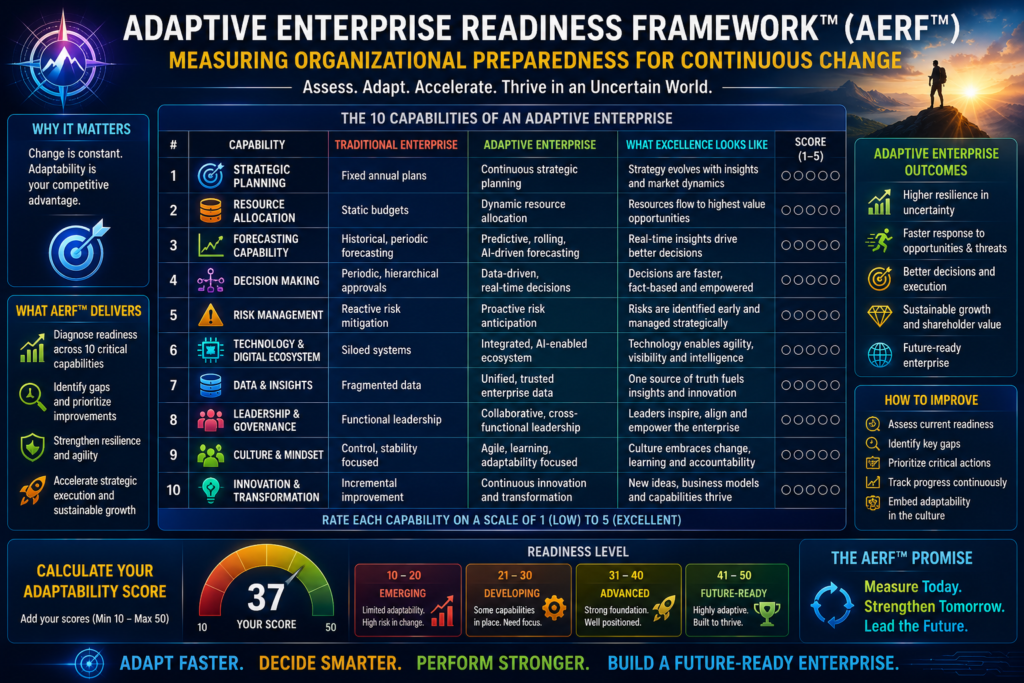
Adaptive Enterprise Readiness Framework™ (AERF™): Measuring Organizational Preparedness for Continuous Change
The Adaptive Enterprise Readiness Framework™ (AERF™) provides a comprehensive assessment model for evaluating an organization’s preparedness to operate successfully in an environment characterized by continuous uncertainty. Rather than focusing exclusively on forecasting capability, the framework examines whether enterprise-wide planning, governance, technology, culture, leadership, and decision-making processes collectively support organizational adaptability.
The framework recognizes that forecasting excellence alone cannot guarantee business resilience. Organizations must simultaneously develop agile governance structures, dynamic capital allocation, collaborative leadership, integrated digital platforms, and cultures that encourage rapid learning and informed experimentation. Each capability contributes to an enterprise’s overall ability to anticipate disruption, respond decisively, and sustain long-term value creation.
Leadership teams may periodically evaluate each capability using a standardized five-point assessment scale, enabling the organization to identify capability gaps, prioritize transformation initiatives, and benchmark progress over time. The resulting assessment supports strategic planning discussions, board reviews, enterprise risk management, and digital transformation programs.
Table: Adaptive Enterprise Readiness Framework™ (AERF™)
| Enterprise Capability | Traditional Enterprise | Adaptive Enterprise |
| Strategic Planning | Fixed annual planning | Continuous strategic planning |
| Budgeting | Static budgets | Dynamic resource allocation |
| Forecasting | Historical trend analysis | Predictive and adaptive forecasting |
| Decision-Making | Periodic executive reviews | Real-time, data-driven decisions |
| Risk Management | Reactive mitigation | Proactive risk anticipation |
| Technology | Stand-alone enterprise systems | AI-enabled integrated digital ecosystem |
| Data Management | Fragmented information | Unified enterprise data platform |
| Leadership | Functional hierarchy | Cross-functional collaborative leadership |
| Organizational Culture | Stability and control | Agility, experimentation, and learning |
| Innovation | Incremental improvements | Continuous business model innovation |
Table: Enterprise Adaptability Assessment
| Overall Score | Organizational Readiness | Strategic Interpretation |
| 10–20 | Emerging | Traditional planning capability with limited adaptability |
| 21–35 | Developing | Moderate preparedness requiring capability enhancement |
| 36–45 | Advanced | Strong adaptive planning with integrated decision-making |
| 46–50 | Future-Ready | Highly resilient enterprise capable of responding rapidly to uncertainty |
The AERF™ serves as the culminating framework of the article because it integrates the concepts of forecasting, strategic foresight, governance, Artificial Intelligence, scenario planning, and organizational resilience into a single enterprise-wide assessment model. It enables Boards and executive leadership teams to move beyond measuring forecast accuracy and instead evaluate the broader organizational capabilities required to succeed in an era of permanent uncertainty.
Conclusion
The age of certainty has given way to an era characterized by volatility, complexity, ambiguity, and continuous disruption. In this environment, the traditional Annual Operating Plan, built upon fixed assumptions and historical extrapolation, is no longer sufficient. Organizations must evolve from static planning toward adaptive planning, integrating strategic foresight, driver-based forecasting, rolling forecasts, scenario planning, probabilistic modelling, Artificial Intelligence, and enterprise-wide collaboration into a unified forecasting capability.
The purpose of forecasting is no longer to eliminate uncertainty but to improve organizational readiness. Companies that continuously monitor leading indicators, challenge assumptions, quantify uncertainty, and prepare multiple strategic responses will consistently outperform those relying on deterministic plans. Boards and executive leadership teams must therefore view forecasting not merely as a financial planning exercise but as a strategic capability that strengthens resilience, enhances agility, improves capital allocation, and creates sustainable long-term value.
The organizations that thrive over the next decade will not necessarily be those with the most accurate forecasts. They will be those that learn fastest, adapt earliest, and execute decisively as conditions change. In a world where uncertainty has become permanent, forecasting excellence is no longer a competitive advantage; it is a strategic necessity.
References
- BCG. (2024). Strategic planning in an uncertain world. https://www.bcg.com
- Deloitte. (2024). 2024 CFO Signals Survey. https://www2.deloitte.com
- McKinsey & Company. (2024). The State of Organizations 2024. https://www.mckinsey.com
- Bain & Company. (2024). Management Tools & Trends. https://www.bain.com
- PwC. (2024). Global CEO Survey. https://www.pwc.com
- EY. (2024). Global Board Risk Survey. https://www.ey.com
- KPMG. (2024). CEO Outlook. https://kpmg.com
- Gartner. (2024). Top Strategic Technology Trends. https://www.gartner.com
- Institute of Management Accountants. (2023). FP&A Best Practices. https://www.imanet.org
- FP&A Trends Group. (2024). Modern FP&A and Rolling Forecasting. https://fpa-trends.com
- Workday. (2024). Enterprise Planning and Forecasting. https://www.workday.com
- Oracle. (2024). Enterprise Performance Management Guide. https://www.oracle.com
- SAP. (2024). Integrated Business Planning Overview. https://www.sap.com
- Royal Dutch Shell. (2023). Scenario Planning Resources. https://www.shell.com
- Taleb, N. N. (2012). Antifragile: Things That Gain from Disorder. Random House.
- Schoemaker, P. J. H. (1995). Scenario Planning: A Tool for Strategic Thinking. Sloan Management Review, 36(2), 25–40.
- Porter, M. E. (1985). Competitive Advantage. Free Press.
- Kaplan, R. S., & Norton, D. P. (1996). The Balanced Scorecard. Harvard Business School Press.
- Tetlock, P. E., & Gardner, D. (2015). Superforecasting: The Art and Science of Prediction. Crown Publishing.
- Kahneman, D. (2011). Thinking, Fast and Slow. Farrar, Straus and Giroux.
Disclaimer
This article is intended solely for educational, strategic, and managerial knowledge-sharing purposes. The concepts, frameworks, methodologies, and interpretations presented are synthesized from publicly available academic literature, consulting publications, industry reports, and professional practices. They should not be construed as financial, legal, investment, accounting, or regulatory advice. Organizations should evaluate their unique business context, industry dynamics, regulatory requirements, and risk profile before implementing any forecasting or strategic planning methodology. The author assumes no responsibility for decisions or outcomes arising from the application of the ideas presented in this paper.