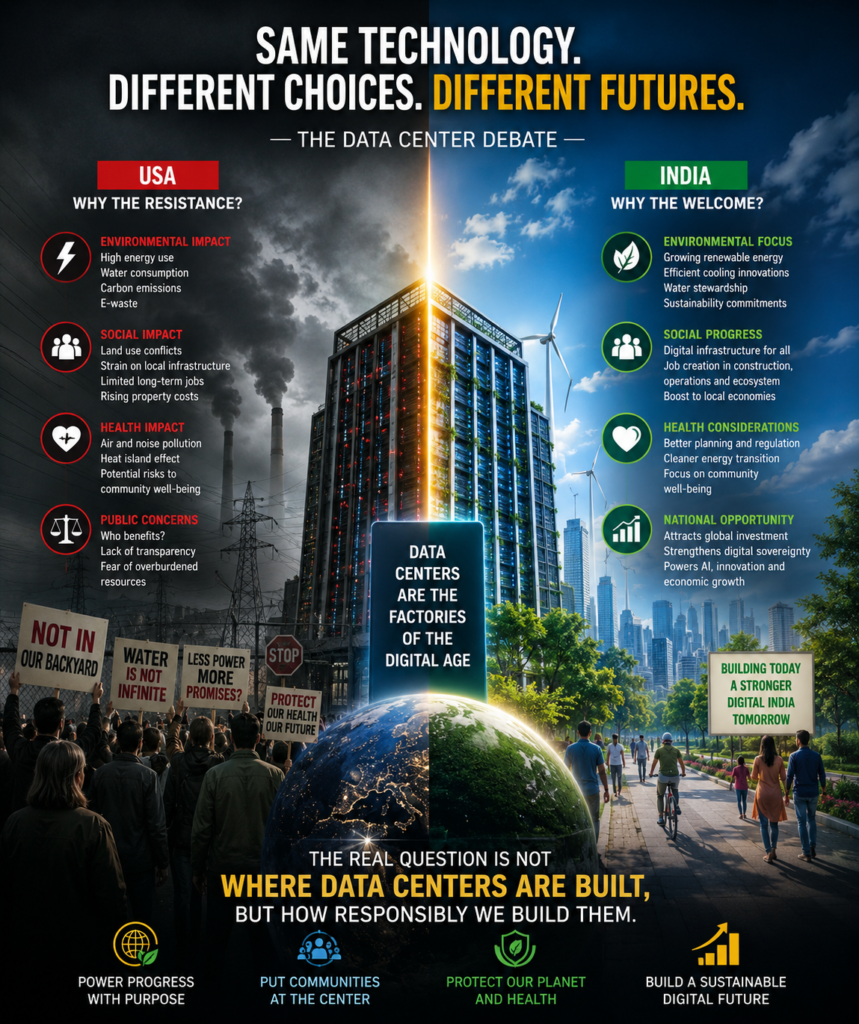
Artificial Intelligence is transforming the global economy at a pace few technologies have achieved before. Behind every AI model, cloud application, digital payment, streaming platform, e-commerce transaction, and government digital service lies a vast physical infrastructure that most people never see: the data center.
Often described as the factories of the digital age, data centers are becoming as strategically important as highways, ports, airports, power plants, and industrial zones. They store data, process information, support cloud computing, and power the algorithms that increasingly shape business, government, healthcare, education, and everyday life.
Yet a fascinating contrast is emerging across the world.
In many parts of the United States, communities are increasingly resisting the construction of new data centers. At the same time, India is actively encouraging companies such as Meta, Google, Microsoft, Amazon, Reliance, and numerous global operators to expand their data center footprint across the country.
Why is one nation questioning the expansion of digital infrastructure while another is welcoming it?
The answer lies in the complex intersection of economics, sustainability, public health, social impact, national competitiveness, and long-term development priorities.
The Global Race for Digital Infrastructure
The rise of artificial intelligence has dramatically increased demand for computing power. Every AI query requires processing resources. Every cloud application requires storage. Every digital service requires infrastructure.
As organizations generate unprecedented amounts of data, demand for hyperscale data centers continues to accelerate.
Governments increasingly view data centers as strategic assets because they:
• Attract foreign direct investment
• Support digital transformation
• Enable cloud computing ecosystems
• Create technology clusters
• Strengthen digital sovereignty
• Support AI development
• Enhance cybersecurity capabilities
• Accelerate economic growth
As a result, countries around the world are competing to attract major data center investments.
However, not everyone sees these projects as an unquestionable benefit.
Why Communities in America Are Pushing Back
Across several regions in the United States, local communities are raising concerns regarding the rapid growth of data center developments.
While few oppose technology itself, many question the long-term consequences associated with hosting large-scale facilities.
The concerns generally fall into four major categories.
| Concern Area | Key Issues Raised by Communities |
|---|---|
| Environmental | Energy consumption, water usage, carbon emissions, electronic waste |
| Social | Land use changes, community disruption, visual impact |
| Health | Air quality concerns, noise pollution, heat generation |
| Economic | Questions regarding local benefits versus infrastructure burden |
Many communities argue that the costs may increasingly outweigh the benefits if development is not carefully managed.
The Environmental Challenge
One of the most significant concerns relates to energy consumption.
Modern hyperscale data centers consume enormous amounts of electricity. Some facilities require power equivalent to that used by tens of thousands of households.
As artificial intelligence workloads increase, electricity demand continues to rise.
Data centers also require substantial cooling systems to prevent overheating of servers and networking equipment. Depending on technology and climate conditions, this cooling process may consume significant amounts of water.
Environmental concerns include:
| Environmental Factor | Potential Impact |
|---|---|
| Electricity Demand | Pressure on power grids |
| Water Consumption | Competition with local water needs |
| Carbon Emissions | Increased environmental footprint |
| Land Development | Habitat disruption |
| Electronic Waste | Disposal and recycling challenges |
For communities already facing water scarcity or grid constraints, these concerns become particularly sensitive.
The Public Health Perspective
While data centers are generally cleaner than traditional manufacturing facilities, they are not completely free from health-related concerns.
Residents often cite:
• Noise generated by cooling systems
• Backup diesel generator emissions
• Increased construction activity
• Traffic congestion during development
• Localized heat generation
While many of these impacts can be mitigated through proper planning and modern technologies, public concerns continue to influence local decision-making processes.
Increasingly, communities are asking whether sufficient safeguards exist to protect long-term public well-being.
The Social Debate
The social dimension is often overlooked.
Data centers occupy large tracts of land but generally employ fewer permanent workers compared with manufacturing plants or logistics hubs after construction is completed.
Some residents question whether local communities receive adequate benefits relative to the scale of resources consumed.
Common concerns include:
| Social Question | Community Perspective |
|---|---|
| Who benefits? | Primarily technology companies |
| Who bears the cost? | Local residents and infrastructure |
| Are jobs sufficient? | Construction jobs are temporary |
| Is transparency adequate? | Often debated |
| Are communities consulted? | Varies by project |
This has created a growing movement demanding greater accountability and community engagement before approving major projects.
Why India Is Taking a Different Approach
India’s perspective is shaped by a different stage of economic and digital development.
For India, data centers represent an opportunity rather than a burden.
The country is experiencing rapid digitalization across virtually every sector of the economy.
Digital payments, e-commerce, online education, telemedicine, cloud adoption, AI deployment, and government digital initiatives continue to expand at extraordinary rates.
To support this transformation, India requires substantial digital infrastructure.
Data centers are increasingly viewed as national assets that can support long-term economic development.
India’s Strategic Advantages
India possesses several characteristics that make it attractive for data center investment.
| Advantage | Strategic Benefit |
|---|---|
| Large Digital Population | Massive data generation |
| Growing Internet Usage | Rising demand for cloud services |
| Expanding AI Ecosystem | Increased computing requirements |
| Government Support | Investment-friendly policies |
| Skilled Workforce | Technology talent availability |
| Strategic Location | Regional data hub potential |
These factors have encouraged substantial investment commitments from domestic and international operators.
The Economic Opportunity
For India, the economic argument is compelling.
Data centers contribute through:
• Capital investment
• Construction activity
• Engineering services
• Technology employment
• Telecommunications infrastructure
• Renewable energy investments
• Cloud ecosystem development
• AI innovation platforms
• Tax revenues
Beyond direct benefits, data centers often stimulate broader digital ecosystems involving startups, software companies, cybersecurity firms, telecommunications providers, and cloud service partners.
This multiplier effect is one reason policymakers remain enthusiastic.
The Risks India Cannot Ignore
Despite the opportunities, India must avoid assuming that every data center investment automatically creates positive outcomes.
The concerns being raised in the United States provide valuable lessons.
India faces several challenges that require careful planning.
Water Stress
Many Indian cities already face significant water challenges.
If data center expansion occurs without sustainable water management strategies, pressure on local resources could intensify.
Power Demand
AI infrastructure is increasing electricity requirements worldwide.
India must ensure that growing demand does not place excessive strain on power systems or increase dependence on fossil fuels.
Urban Congestion
Concentrating large facilities in already crowded urban regions may create infrastructure bottlenecks.
Environmental Sustainability
Long-term competitiveness increasingly depends on green infrastructure rather than simply expanding capacity.
The goal should not be to build the most data centers.
The goal should be to build the most sustainable data centers.
The Future Model: Responsible Data Infrastructure
The debate should not be framed as being for or against data centers.
The real challenge is determining how they should be developed.
Future success will likely depend on balancing five priorities.
| Priority | Objective |
|---|---|
| Economic Growth | Attract investment and jobs |
| Environmental Sustainability | Reduce resource consumption |
| Public Health | Protect community well-being |
| Social Responsibility | Ensure local benefits |
| Technological Leadership | Support innovation and AI |
Countries that successfully align these priorities will gain a competitive advantage.
A New Industrial Revolution
Throughout history, nations have competed for strategic infrastructure.
The twentieth century focused on roads, railways, ports, airports, power plants, and manufacturing facilities.
The twenty-first century is increasingly focused on digital infrastructure.
Data centers have become foundational assets supporting modern economies.
However, unlike traditional infrastructure, their impacts are often less visible to the public.
The AI revolution may appear virtual, but its foundation is deeply physical.
Servers require land.
Computing requires electricity.
Cooling requires water.
Infrastructure requires communities willing to host it.
This reality explains why the debate is becoming increasingly important.
The Bigger Question
The contrast between America and India is not a story about one country being right and another being wrong.
It reflects different priorities, economic realities, development stages, and societal expectations.
America’s resistance highlights the importance of environmental stewardship, public accountability, and community engagement.
India’s enthusiasm reflects a desire to accelerate economic growth, strengthen digital capabilities, and position itself as a global technology leader.
Both perspectives offer important lessons.
The future belongs neither to unrestricted expansion nor to blanket resistance.
It belongs to responsible development.
As artificial intelligence reshapes economies and societies, data centers will become increasingly essential. The nations that succeed will not simply be those that build the most digital infrastructure. They will be those that build it in a way that balances innovation, sustainability, public health, social responsibility, and long-term economic prosperity.
The real question is no longer where data centers should be built.
The real question is how responsibly the digital future will be constructed.