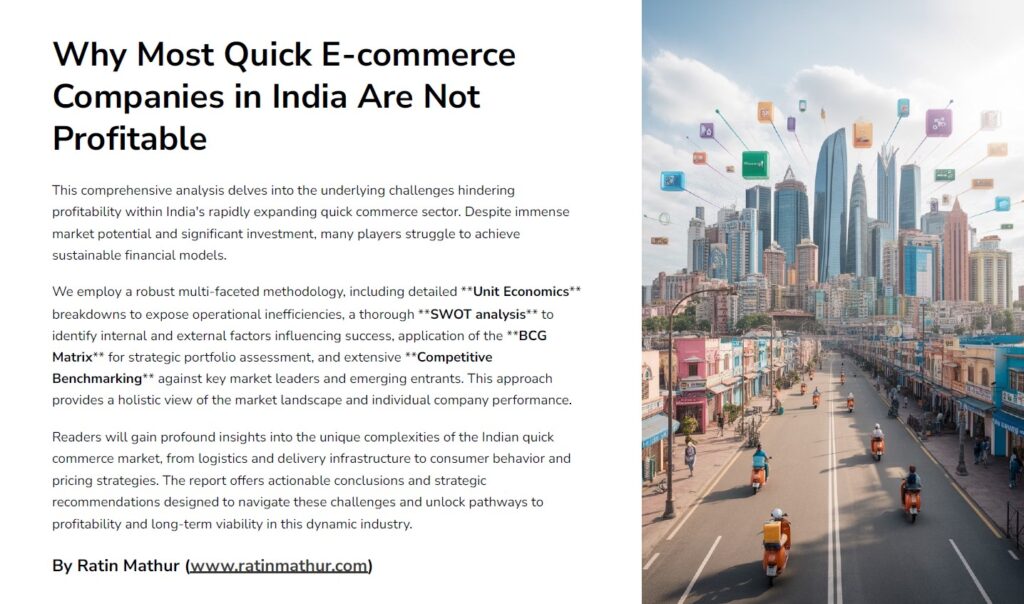
Why Most Quick E-commerce Companies in India Are Not Profitable
With Unit Economics Model, SWOT, BCG Matrix & Competitive Benchmarking
(Covering Zomato, Swiggy, Blinkit, Zepto, Nykaa, MamaEarth, DMart Ready)
1. EXECUTIVE SUMMARY
India’s quick e-commerce ecosystem—especially 10–20 minute delivery platforms—has grown exponentially, driven by urban convenience, smartphone adoption, and a young, digitally active population. However, despite soaring demand, most companies remain loss-making, primarily due to:
- Very low gross margins in grocery-led assortments
- High last-mile delivery costs
- Low order value (₹350–₹550)
- High marketing and customer acquisition costs (CAC)
- High operating costs for dark stores, riders, and warehouse staff
- Intense competition and discount wars
Among listed players:
- Zomato’s food business is profitable, but Blinkit is scaling toward breakeven.
- Nykaa is consistently profitable due to a high-margin beauty business.
- MamaEarth has intermittent profitability but struggles with high ad spend.
- Quick-commerce pure plays (Swiggy Instamart, Zepto) remain primarily loss-making.
The path to profitability lies in private label expansion, category mix improvement, order density, cost rationalization, and ad monetization.
2. INDUSTRY OVERVIEW — QUICK E-COMMERCE IN INDIA
Market Size & Growth (2024–2030)
- Market size: $5.5–6.5 billion (2024)
- CAGR: 35–45%
- Drivers:
- Urban nuclear families
- High-income millennial workforce
- Digital payments ecosystem
- Demand for instant gratification
Segment Characteristics
| Segment | Margin | Growth | Profitability |
| Grocery (Q-Commerce) | Very Low (3–12%) | Very High | Loss-making |
| Food Delivery | Medium (15–25%) | Moderate | Profit-making |
| Beauty E-commerce | High (40–65%) | High | Profitable |
| D2C Beauty | High | High | Highly dependent on CAC |
3. WHY MOST QUICK E-COMMERCE COMPANIES ARE NOT PROFITABLE
3.1 Thin Gross Margins
- Grocery generates 3–12% gross margin.
- After warehousing + delivery, margins turn negative.
3.2 High Last-Mile Delivery Cost
- Delivery cost per order = ₹35–₹70
- Represents 20–30% of AOV → structurally unprofitable unless subsidized.
3.3 Low AOV (Average Order Value)
- Typical quick commerce AOV = ₹400–₹500
- Cannot cover costs without:
- Higher AOV categories
- Basket bundling
- Delivery fees
3.4 High Operational Costs
- Dark stores, inventory holding cost, staffing
- Shrinkage & wastage in fresh categories
3.5 High Customer Acquisition Cost (CAC)
- Paid ads + influencer marketing push CAC to ₹150–₹300 per customer
3.6 High Returns (Fashion, Electronics)
- Nykaa Fashion return rates = 12–15%
- Fashion gross margins get eroded post-return processing
3.7 Discount Competition
- To acquire and retain customers, Q-commerce players offer:
- Cashbacks
- Free delivery
- Membership benefits
3.8 Late-Stage Venture Capital Pressure
- Investors earlier pushed GMV growth > profitability, leading to:
- Overspending on marketing
- Over-expansion of dark stores
- 10-minute delivery models
4. UNIT ECONOMICS – FINANCIAL MODEL
4.1 Quick Commerce Unit Economics (Zomato Blinkit, Swiggy Instamart, Zepto)
(Illustrative but realistic metro model)
| Metric | Amount (₹) | Notes |
| AOV | 480 | Metro cities |
| Gross Margin % | 14% | Higher for non-grocery |
| Gross Margin (₹) | 67.2 | 14% × AOV |
| Picking + Packing | –18 | Staff + packaging |
| Warehouse Cost Allocation | –20 | Rent + electricity |
| Delivery Cost | –52 | Major cost centre |
| Discounts/Promotions | –12 | After brand subsidies |
| Payment Gateway | –6 | 1.2% |
| Contribution Margin | –40 (negative) | Unprofitable |
| Ad Monetization Income | +9 | Sponsored listings |
| Revised Contribution | –31 | Still negative |
Breakeven AOV needed: ₹650–700 OR
Delivery cost must reduce by 30–40%.
4.2 Food Delivery Unit Economics (Zomato, Swiggy)
| Metric | ₹ | Notes |
| AOV | 420 | |
| Commission (20–22%) | 88 | Platform revenue |
| Delivery Fee | 28 | Net of promotions |
| Ads | 10 | Sponsored placements |
| Total Revenue | 126 | |
| Delivery Cost | –55 | |
| Discounts | –10 | |
| Refunds | –6 | |
| Payment Gateway | –5 | |
| Contribution Margin | +50 | PROFITABLE |
Food delivery is structurally profitable; quick commerce is not—unless scale and category mix change.
5. COMPETITIVE BENCHMARKING
5.1 Strategic Positioning Comparison
| Company | Type | Profitability | Model | Strength |
| Zomato | Food + Q-commerce | Food profitable | Aggregator + Dark Stores | High order density |
| Swiggy | Food + Instamart | Mixed | Aggregator | Strong loyalty ecosystem |
| Blinkit (Zomato) | Quick commerce | Improving | Dark stores | Category mix shift |
| Zepto | Quick commerce | Not profitable | Hyperlocal 10-min | Fastest delivery |
| Nykaa | Beauty | Profitable | Inventory-led | High private label margin |
| MamaEarth | D2C | Intermittent | Hybrid | High margins |
| DMart Ready | Grocery | Profitable | Hybrid | Pickup-first model |
5.2 Cost & Margin Comparison
| Metric | Zomato | Swiggy | Blinkit | Zepto | Nykaa | MamaEarth | DMart Ready |
| AOV | 420 | 430 | 480 | 440 | 1,200 | 700 | 550 |
| Gross Margin | 20% | 19% | 14% | 14% | 40–65% | 60–70% | 10–15% |
| Delivery Cost | Medium | Medium | High | High | Low | N/A | Lowest (pickup) |
| Returns | Low | Low | Low | Low | High (fashion) | Low | Low |
| Marketing % of Rev | 11% | 14% | 10% | 18% | 7% | 30% | <5% |
Key Insight:
Nykaa, DMart Ready, and Zomato Food achieve profitability due to high margins or low delivery costs.
Quick commerce players struggle structurally.
6. SWOT ANALYSIS FOR KEY COMPANIES
| Company | Strengths | Weaknesses | Opportunities | Threats |
| Zomato (Food Delivery + Blinkit) | • Market leader with strong brand loyalty • Profitable food delivery business with solid unit economics • High order density & efficient logistics • Growing ad revenue from restaurants and brands • Blinkit gaining scale in high-margin non-grocery | • Blinkit still contribution-negative in some clusters • Lower AOV limits margin expansion • High dependence on delivery workforce • Operational complexity (food + q-commerce + Hyperpure) | • Premium dining & subscriptions (Zomato Gold) • Blinkit expansion into electronics, gifting, home essentials • Monetization through ads & platform data • Growth in Tier II/III cities | • Swiggy competition in both food & q-commerce • Regulatory risks around commissions, delivery partner rights • Margin pressure during economic slowdown |
| Swiggy (Food Delivery + Instamart) | • Best-in-class customer experience • Strong Instamart brand in metros • Large subscription base (Swiggy One) • Diversified product mix (dineout, minis, etc.) | • Higher discounts vs Zomato historically • Slower profitability progress • Marketing cost consistently high • Lower density in some cities | • Increasing Instamart margins via private labels • Subscription monetization • Expansion in cloud kitchens and gourmet categories | • Increasing pressure from Zomato’s profitable model • Competition from Dunzo & Zepto in specific clusters • Rider availability and regulatory changes |
| Blinkit (Owned by Zomato) | • Category leader in quick commerce • Strong dark-store network density • Access to Zomato’s customer base, logistics & capital • Rapid growth in high-margin categories (electronics, gifting) | • Grocery-heavy mix limits margins • High delivery cost for 10–20 min model • Still contribution-negative in some markets • High operational cost (dark stores, staff) | • Significant ad monetization potential (CPG brands) • Private label expansion (high-margin opportunity) • Expansion into non-grocery SKUs where margins are higher | • Zepto & Instamart competition • Rising labour/operations cost • Funding constraints in q-commerce globally |
| Zepto | • Fastest delivery brand in India (<10 min) • Strong youth appeal • High-density clusters in metros • Agile execution and store rollouts | • Very high operating & delivery cost • Unproven long-term profitability • Small private label portfolio • High CAC and cash burn | • Private label ramp-up • Sponsored listings for FMCG advertisers • Tier II expansion after metro breakeven | • Blinkit’s rising dominance • Capital markets tightening for startups • Copycat competition & shrinking differentiation |
| Nykaa (Beauty + Fashion) | • India’s most trusted beauty marketplace • High-margin beauty business (40–65%) • Strong private label brands • Omnichannel presence (140+ stores) • Robust logistics & warehouse efficiency | • Fashion category has high returns & low margins • Slower app experience vs deep-pocketed rivals • Heavy dependence on celebrity-led promotions | • Tier II/III store expansion • Exclusive partnerships with international brands • Private label expansion • Cross-selling beauty + fashion | • Amazon, Myntra, Tira (Reliance) growing rapidly • Margin pressure due to increased competition • Rising logistics & returns cost |
| MamaEarth (Honasa Consumer) | • Very high-margin D2C business (60–70%) • Strong brand recognition in naturals segment • Powerful influencer-driven demand creation • Offline distribution widening rapidly | • CAC-heavy business model • Over-reliance on influencer ecosystem • Product similarity across competitors (low differentiation) • Slower repeat rates compared to traditional FMCG | • International markets (Middle East, SEA) • New product categories (men’s grooming, home care) • Offline GT/MT expansion | • Competition from HUL, Dabur, Himalaya, P&G naturals • Heavy discounting in D2C space • Volatile IPO sentiment pressures short-term profitability |
7. BCG MATRIX — QUICK E-COMMERCE LANDSCAPE (INDIA)
BCG Quadrant Classification
| Quadrant | Companies | Explanation |
| ⭐ STARS (High Growth, High Market Share) | Blinkit, Instamart, Zomato Food Delivery | High growth sectors + strong share leaders |
| 💰 CASH COWS (Low Growth, High Market Share) | Nykaa Beauty, DMart Ready | Mature segments, high share, cash-generating |
| ❓ QUESTION MARKS (High Growth, Low Market Share) | Zepto, MamaEarth, Nykaa Fashion | Fast-growing markets but small share; require strategic investment |
| 🐶 DOGS (Low Growth, Low Market Share) | BigBasket Express, Amazon Fresh Express | Limited growth and weak relative share in the rapid delivery vertical |
Key Insight:
- Blinkit and Instamart are true STARs—they lead market share in a hyper-growth category, even if profitability is still developing.
- Zepto and MamaEarth remain QUESTION MARKS, requiring focused investment to strengthen market share or risk long-term dilution.
- Nykaa Beauty and DMart Ready operate as CASH COWS, dominating mature segments with stable, profitable business models.
- Express sub-brands of BigBasket and Amazon fall into the DOG quadrant, lacking both growth momentum and relative share in rapid delivery.
8. HOW QUICK E-COMMERCE COMPANIES CAN BECOME PROFITABLE
8.1 Immediate Actions
- Relax 10-min delivery → 20–30 minutes = lower rider cost
- Introduce delivery fees based on distance/time
- Consolidate dark stores to increase order density
- Bring down marketing to <10% of revenue
- Use AI demand forecasting to reduce wastage
8.2 Medium-Term Strategy
1. Increase Gross Margin
- Expand private label to 20–30% of assortment
- Push non-grocery higher-margin categories
- Increase in-app ad revenue streams
2. Optimize Cost Structure
- Automated micro-fulfilment systems
- Cluster-based delivery planning
- Reduce SKU complexity
3. Improve AOV
- Bundling (e.g., “weekly baskets”)
- Higher minimum order value for free delivery
- Cross-sell high-margin items
4. Strengthen Loyalty & Retention
- Membership (Zomato Gold, Swiggy One)
- Personalized promotions
- Wallet functionalities
9. WHERE THEY SHOULD INVEST AND WHERE NOT
Invest More In
- Private labels
- Higher-margin categories (beauty, home, electronics acc.)
- Ad-monetization tech
- Warehouse automation
- Loyalty & subscription programs
Reduce/Stop Spending On
- Deep discounting
- 10-minute delivery promises
- Expansion into low-density Tier III/IV cities
- Influencer-obsessed marketing (for D2C)
- Large dark store footprint without density
10. WHEN TO SHIFT FROM “GROWTH” TO “PROFITABILITY”
Companies should pivot when:
- Contribution margin remains negative despite scale
- Marketing spend >12% of revenue
- AOV stagnates below ₹500
- Dark store order volume <2,000/day
- CAC/LTV ratio >1.5
- Investor priorities shift toward EBITDA margin
Ideal pivot:
When incremental GMV growth does not improve contribution margin.
11. CONCLUSIONS
- Most quick commerce companies in India are not profitable due to:
- Low-margin categories
- Expensive last-mile delivery
- High CAC and operational costs
- Discount-driven growth
- Profitability leaders (Zomato Food, Nykaa, DMart Ready) succeed through:
- High margins
- Inventory efficiencies
- Reduced delivery cost models
- Private labels
- Quick commerce will reach sustainable profitability only if companies:
- Improve category mix
- Increase private label penetration
- Reduce delivery cost
- Monetize traffic through ads
- Control CAC
- The shift from GMV → Profitability will define the next phase of Indian e-commerce.